Tag Archives: alchemy

It’s a golden world

I have a number of stories concerning gold where researchers seemed to have had an extraordinarily rich set of findings within the last month. One of these is especially interesting in light of what I published yesterday (August 11, 2025 “Turning lead into gold (for approximately a microsecond“) about an event in May 2025.

I will be providing my usual citations and links but will not be tagging all the researchers (there are far too many) other than those mentioned in the news releases.

Two from SLAC (SLAC National Accelerator Laboratory, originally named the Stanford Linear Accelerator Center in California)

While both projects took place at SLAC, there’s virtually no crossover between the team members and the findings are of an entirely different nature.

Defying the limits and surviving the entropy catastrophe

An August 11, 2025 news item on ScienceDaily announces that physics limits have been defied,

Scientists have simultaneously broken a temperature record, overturned a long-held theory and utilized a new laser spectroscopy method for dense plasmas in a groundbreaking article published on July 23 in the journal Nature.

In their research article, “Superheating gold beyond the predicted entropy catastrophe threshold,” physicists revealed they were able to heat gold to over 19,000 Kelvin (33,740 degrees Fahrenheit), over 14 times its melting point, without it losing its solid, crystalline structure.

A July 23, 2025 University of Nevada news release, which originated the news item, delves further into the topic,

“This is possibly the hottest crystalline material ever recorded,” Thomas White, lead author and Clemons-Magee Endowed Professor in Physics at the University of Nevada, Reno said.

This result overturns the long-held theoretical limit known as the entropy catastrophe. The entropy catastrophe theory states that solids cannot remain stable above approximately three times their melting temperature without spontaneously melting. The melting point of gold, 1,337 Kelvin (1,947 degrees Fahrenheit), was far more than tripled in this experiment utilizing an extremely powerful laser at Stanford University’s SLAC National Accelerator Laboratory.

“I was expecting the gold to heat quite significantly before melting, but I wasn’t expecting a fourteen-fold temperature increase,” White said.

To heat the gold, researchers at the University of Nevada, Reno, SLAC National Accelerator Laboratory, the University of Oxford, Queen’s University Belfast, the European XFEL and the University of Warwick designed an experiment to heat a thin gold foil using a laser fired for 50 quadrillionths of a second (one millionth of a billionth). The speed with which the gold was heated seems to be the reason the gold remained solid. The findings suggest that the limit of superheating solids may be far higher – or nonexistent – if heating occurs quickly enough. The new methods used in this study open the field of high energy density physics to more exploration, including in areas of planetary physics and fusion energy research.

White and his team expected that the gold would melt at its melting point, but to measure the temperature inside the gold foil, they would need a very special thermometer.

“We used the Linac Coherent Light Source, a 3-kilometer-long X-ray laser at SLAC, as essentially the world’s largest thermometer,” White said. “This allowed us to measure the temperature inside the dense plasma for the first time, something that hasn’t been possible before.”

“This development paves the way for temperature diagnostics across a broad range of high-energy-density environments,” Bob Nagler, staff scientist at SLAC and coauthor on the paper, said. “In particular, it offers the only direct method currently available for probing the temperature of warm dense states encountered during the implosion phase of inertial fusion energy experiments. As such, it is poised to make a transformative contribution to our understanding and control of fusion-relevant plasma conditions.”

Along with the experimental designers, the research article is the result of a decade of work and collaboration between Columbia University, Princeton University, the University of Padova and the University of California, Merced.

“It’s extremely exciting to have these results out in the world, and I’m really looking forward to seeing what strides we can make in the field with these new methods,” White said.

The research, funded by the National Nuclear Security Administration, will open new doors in studies of superheated materials.

“The National Nuclear Security Administrations’ Academics Program is a proud supporter of the groundbreaking innovation and continued learning that Dr. White and his team are leading for furthering future critical research areas beneficial to the Nuclear Security Enterprise,” Jahleel Hudson, director at the Techology and Partnerships Office of the NNSA said.

White and his colleagues returned to the Linac Coherent Light Source in July to measure the temperature inside hot compressed iron and are using those results to gain insights into the interiors of planets.

Several of White’s graduate students and one undergraduate student were coauthors on the study, including doctoral student Travis Griffin, undergraduate student Hunter Stramel, Daniel Haden, a former postdoctoral scholar in White’s lab, Jacob Molina, a former undergraduate student currently pursuing his doctoral degree at Princeton University and Landon Morrison, a former undergraduate student pursuing his master’s degree at the University of Oxford. Jeremy Iratcabal, research assistant professor in the Department of Physics, was also a coauthor on the paper.

“I’m incredibly grateful for the opportunity to contribute to such cutting-edge science using billion-dollar experimental platforms alongside world-class collaborators,” Griffin said. “This discovery highlights the power of this technique, and I’m excited by the possibilities it opens for the future of high-energy-density physics and fusion research. After graduation, I’ll be continuing this work as a staff scientist at the European XFEL.”

SLAC issued a July 23, 2025 news release (by Erin Woodward) of its own and UK’s University of Warwick also issued a July 23, 2025.

Here’s a link to and a citation for the paper,

Superheating gold beyond the predicted entropy catastrophe threshold by Thomas G. White, Travis D. Griffin, Daniel Haden, Hae Ja Lee, Eric Galtier, Eric Cunningham, Dimitri Khaghani, Adrien Descamps, Lennart Wollenweber, Ben Armentrout, Carson Convery, Karen Appel, Luke B. Fletcher, Sebastian Goede, J. B. Hastings, Jeremy Iratcabal, Emma E. McBride, Jacob Molina, Giulio Monaco, Landon Morrison, Hunter Stramel, Sameen Yunus, Ulf Zastrau, Siegfried H. Glenzer, Gianluca Gregori, Dirk O. Gericke & Bob Nagler. Nature volume 643, pages 950–954 (2025) DOI: https://doi.org/10.1038/s41586-025-09253-y Published: 23 July 2025 Issue Date: 24 July 2025

This paper is open access.

Gold’s secret chemistry

An August 11, 2025 news item on ScienceDaily announces how researchers at SLAC unexpectedly created gold hydride,

Scientists at SLAC unexpectedly created gold hydride, a compound of gold and hydrogen, while studying diamond formation under extreme pressure and heat. This discovery challenges gold’s reputation as a chemically unreactive metal and opens doors to studying dense hydrogen, which could help us understand planetary interiors and fusion processes. The results also suggest that extreme conditions can produce exotic, previously unknown compounds, offering exciting opportunities for future high-pressure chemistry research.

Serendipitously and for the first time, an international research team led by scientists at the U.S. Department of Energy’s SLAC National Accelerator Laboratory formed solid binary gold hydride, a compound made exclusively of gold and hydrogen atoms.

An August 4, 2025 SLAC news release by Chris Patrick, which originated the news release, provides more details, Note: Links have been removed,

The researchers were studying how long it takes hydrocarbons, compounds made of carbon and hydrogen, to form diamonds under extremely high pressure and heat. In their experiments at the European XFEL (X-ray Free-Electron Laser) in Germany, the team studied the effect of those extreme conditions in hydrocarbon samples with an embedded gold foil, which was meant to absorb the X-rays and heat the weakly absorbing hydrocarbons. To their surprise, they not only saw the formation of diamonds, but also discovered the formation of gold hydride. 

“It was unexpected because gold is typically chemically very boring and unreactive – that’s why we use it as an X-ray absorber in these experiments,” said Mungo Frost, staff scientist at SLAC who led the study. “These results suggest there’s potentially a lot of new chemistry to be discovered at extreme conditions where the effects of temperature and pressure start competing with conventional chemistry, and you can form these exotic compounds.”

The results, published in Angewandte Chemie International Edition, provide a glimpse of how the rules of chemistry change under extreme conditions like those found inside certain planets or hydrogen-fusing stars.

Studying dense hydrogen

In their experiment, the researchers first squeezed their hydrocarbon samples to pressures greater than those within Earth’s mantle using a diamond anvil cell. Then, they heated the samples to over 3,500 degrees Fahrenheit by hitting them repeatedly with X-ray pulses from the European XFEL. The team recorded and analyzed how the X-rays scattered off the samples, which allowed them to resolve the structural transformations within.

As expected, the recorded scattering patterns showed that the carbon atoms had formed a diamond structure. But the team also saw unexpected signals that were due to hydrogen atoms reacting with the gold foil to form gold hydride. 

Under the extreme conditions created in the study, the researchers found hydrogen to be in a dense, “superionic” state, where the hydrogen atoms flowed freely through the gold’s rigid atomic lattice, increasing the conductivity of the gold hydride. 

Hydrogen, which is the lightest element of the periodic table, is tricky to study with X-rays because it scatters X-rays only weakly. Here, however, the superionic hydrogen interacted with the much heavier gold atoms, and the team was able to observe hydrogen’s impact on how the gold lattice scattered X-rays. “We can use the gold lattice as a witness for what the hydrogen is doing,” Mungo said. 

The gold hydride offers a way to study dense atomic hydrogen under conditions that might also apply to other situations that are experimentally not directly accessible. For example, dense hydrogen makes up the interiors of certain planets, so studying it in the lab could teach us more about those foreign worlds. It could also provide new insights into nuclear fusion processes inside stars like our sun and help develop technology to harness fusion energy here on Earth.

Exploring new chemistry

In addition to paving the way for studies of dense hydrogen, the research also offers an avenue for exploring new chemistry. Gold, which is commonly regarded as an unreactive metal, was found to form a stable hydride at extremely high pressure and temperature. In fact, it appears to be only stable at those extreme conditions as when it cools down, the gold and hydrogen separate. The simulations also showed that more hydrogen could fit in the gold lattice at higher pressure.

The simulation framework could also be extended beyond gold hydride. “It’s important that we can experimentally produce and model these states under these extreme conditions,” said Siegfried Glenzer, High Energy Density Division director and professor for photon science at SLAC and the study’s principal investigator. “These simulation tools could be applied to model other exotic material properties in extreme conditions.” 

The team also included researchers from Rostock University, DESY, European XFEL, Helmholtz-Zentrum Dresden-Rossendorf, Frankfurt University and Bayreuth University, all in Germany; the University of Edinburgh, UK; the Carnegie Institution for Science, Stanford University and the Stanford Institute for Materials and Energy Sciences (SIMES). Parts of this work were supported by the DOE Office of Science.

Here’s a link to and a citation for the paper,

Synthesis of Gold Hydride at High Pressure and High Temperature by Mungo Frost, Kilian Abraham, Alexander F. Goncharov, R. Stewart McWilliams, Rachel J. Husband, Michal Andrzejewski, Karen Appel, Carsten Baehtz, Armin Bergermann, Danielle Brown, Elena Bykova, Anna Celeste, Eric Edmund, Nicholas J. Hartley, Konstantin Glazyrin, Heinz Graafsma, Nicolas Jaisle, Zuzana Konôpková, Torsten Laurus, Yu Lin, Bernhard Massani, Maximilian Schörner, Maximilian Schulze, Cornelius Strohm, Minxue Tang, Zena Younes, Gerd Steinle-Neumann, Ronald Redmer, Siegfried H. Glenzer. Angewandte Chemie International Edition DOI: https://doi.org/10.1002/anie.202505811 First published: 04 August 2025

This paper is behind a paywall.

Gold and a quantum revolution?

An August 11, 2025 news item on ScienceDaily announces joint research from Pennsylvania State University (Penn State) and Colorado State University,

The efficiency of quantum computers, sensors and other applications often relies on the properties of electrons, including how they are spinning. One of the most accurate systems for high performance quantum applications relies on tapping into the spin properties of electrons of atoms trapped in a gas, but these systems are difficult to scale up for use in larger quantum devices like quantum computers. Now, a team of researchers from Penn State and Colorado State has demonstrated how a gold cluster can mimic these gaseous, trapped atoms, allowing scientists to take advantage of these spin properties in a system that can be easily scaled up.

A July 22, 2025 Penn State news release (also on EurekAlert) by Gail McCormick, which originated the news item, reveals more about the work which resulted in two published papers, Note: Links have been removed,

“For the first time, we show that gold nanoclusters have the same key spin properties as the current state-of-the-art methods for quantum information systems,” said Ken Knappenberger, department head and professor of chemistry in the Penn State Eberly College of Science and leader of the research team. “Excitingly, we can also manipulate an important property called spin polarization in these clusters, which is usually fixed in a material. These clusters can be easily synthesized in relatively large quantities, making this work a promising proof-of-concept that gold clusters could be used to support a variety of quantum applications.”

Two papers describing the gold clusters and confirming their spin properties appeared in ACS Central Science, ACS Central Science and The Journal of Physical Chemistry Letters.

“An electron’s spin not only influences important chemical reactions, but also quantum applications like computation and sensing,” said Nate Smith, graduate student in chemistry in the Penn State Eberly College of Science and first author of one of the papers. “The direction an electron spins and its alignment with respect to other electrons in the system can directly impact the accuracy and longevity of quantum information systems.”

Much like the Earth spins around its axis, which is tilted with respect to the sun, an electron can spin around its axis, which can be tilted with respect to its nucleus. But unlike Earth, an electron can spin clockwise or counterclockwise. When many electrons in a material are spinning in the same direction and their tilts are aligned, the electrons are considered correlated, and the material is said to have a high degree of spin polarization. 

“Materials with electrons that are highly correlated, with a high degree of spin polarization, can maintain this correlation for a much longer time, and thus remain accurate for much longer,” Smith said.

The current state-of-the-art system for high accuracy and low error in quantum information systems involve trapped atomic ions — atoms with an electric charge — in a gaseous state. This system allows electrons to be excited to different energy levels, called Rydberg states, which have very specific spin polarizations that can last for a long period of time. It also allows for the superposition of electrons, with electrons existing in multiple states simultaneously until they are measured, which is a key property for quantum systems. 

“These trapped gaseous ions are by nature dilute, which makes them very difficult to scale up,” Knappenberger said. “The condensed phase required for a solid material, by definition, packs atoms together, losing that dilute nature. So, scaling up provides all the right electronic ingredients, but these systems become very sensitive to interference from the environment. The environment basically scrambles all the information that you encoded into the system, so the rate of error becomes very high. In this study, we found that gold clusters can mimic all the best properties of the trapped gaseous ions with the benefit of scalability.”

Scientists have heavily studied gold nanostructures for their potential use in optical technology, sensing, therapeutics and to speed up chemical reactions, but less is known about their magnetic and spin-dependent properties. In the current studies, the researchers specifically explored monolayer-protected clusters, which have a core of gold and are surrounded by other molecules called ligands. The researchers can precisely control the construction of these clusters and can synthesize relatively large amounts at one time. 

“These clusters are referred to as super atoms, because their electronic character is like that of an atom, and now we know their spin properties are also similar,” Smith said. “We identified 19 distinguishable and unique Rydberg-like spin-polarized states that mimic the super-positions that we could do in the trapped, gas-phase dilute ions. This means the clusters have the key properties needed to carry out spin-based operations.”

The researchers determined the spin polarization of the gold clusters using a similar method used with traditional atoms. While one type of gold cluster had 7% spin polarization, a cluster with different a ligand approached 40% spin polarization, which Knappenberger said is competitive with some of the leading two-dimensional quantum materials.

“This tells us that the spin properties of the electron are intimately related to the vibrations of the ligands,” Knappenberger said. “Traditionally, quantum materials have a fixed value of spin polarization that cannot be significantly changed, but our results suggest we can modify the ligand of these gold clusters to tune this property widely.”

The research team plans to explore how different structures within the ligands impact spin polarization and how they could be manipulated to fine tune spin properties.

“The quantum field is generally dominated by researchers in physics and materials science, and here we see the opportunity for chemists to use our synthesis skills to design materials with tunable results,” Knappenberger said. “This is a new frontier in quantum information science.”

In addition to Smith and Knappenberger, the research team includes Juniper Foxley, graduate student in chemistry at Penn State; Patrick Herbert, who earned a doctoral degree in chemistry at Penn State in 2019; Jane Knappenberger, researcher in the Penn State Eberly College of Science; as well as Marcus Tofanelli and Christopher Ackerson at Colorado State

Funding from the Air Force Office of Scientific Research and the U.S. National Science Foundation supported this research.

At Penn State, researchers are solving real problems that impact the health, safety and quality of life of people across the commonwealth, the nation and around the world.

For decades, federal support for research has fueled innovation that makes our country safer, our industries more competitive and our economy stronger. Recent federal funding cuts threaten this progress.

Learn more about the implications of federal funding cuts to our future at Research or Regress. [Research or Regress can found here]

Here are links to and citation for the paper,

The Influence of Passivating Ligand Identity on Au25(SR)18 Spin-Polarized Emission by Nathanael L. Smith, Patrick J. Herbert, Marcus A. Tofanelli, Jane A. Knappenberger, Christopher J. Ackerson, Kenneth L. Knappenberger Jr. The Journal of Physical Chemistry Letters 2025, 16, 20, 5168–5172 DOI: https://doi.org/10.1021/acs.jpclett.5c00723 Published May 15, 2025 Copyright © 2025 American Chemical Society

This paper is behind a paywall.

Diverse Superatomic Magnetic and Spin Properties of Au144(SC8H9)60 Clusters by Juniper Foxley, Marcus Tofanelli, Jane A. Knappenberger, Christopher J. Ackerson, Kenneth L. Knappenberger Jr ACS Central Science 2025, XXXX, XXX, XXX-XXX DOI: https://doi.org/10.1021/acscentsci.5c00139
Published May 29, 2025 © 2025 The Authors. Published by American Chemical Society. This publication is licensed under CC-BY 4.0 .

This paper is open access.

Lead into gold, the second time around

There are reasons why news releases are issued twice and/or months after a research paper was published. Whoever is scanning for news may have missed it or it was a big news day and science was not top of mind or e.g., a number of teams are publishing research in your field and are generating a lot of interest and you hope your institution will benefit from it.

This August 11, 2025 news item on ScienceDaily resuscitates a story from May 2025,

Nuclear physicists working at the Large Hadron Collider recently made headlines by achieving the centuries-old dream of alchemists (and nightmare of precious-metals investors): They transformed lead into gold.

At least for a fraction of a second. The scientists reported their results in Physical Reviews.

The accomplishment at the Large Hadron Collider, the 17-mile particle accelerator buried under the French-Swiss border, happened within a sophisticated and sensitive detector called ALICE, a scientific instrument roughly the size of a McMansion.

A July 30, 2025 University of Kansas news release (also on EurekAlert), which originated the August 11, 2025 news item, adds new details about the work, Note: A link has been removed,

It was scientists from the University of Kansas, working on the ALICE experiment, who developed the technique that tracked “ultra-peripheral” collisions between protons and ions that made gold in the LHC.

“Usually in collider experiments, we make the particles crash into each other to produce lots of debris,” said Daniel Tapia Takaki, professor of physics and leader of KU’s group at ALICE. “But in ultra-peripheral collisions, we’re interested in what happens when the particles don’t hit each other. These are near misses. The ions pass close enough to interact — but without touching. There’s no physical overlap.”

The ions racing around the LHC tunnel are heavy nuclei with many protons, each generating powerful electric fields. When accelerated, these charged ions emit photons — they shine light.

“When you accelerate an electric charge to near light speeds, it starts shining,” Tapia Takaki said. “One ion can shine light that essentially takes a picture of the other. When that light is energetic enough, it can probe deep inside the other nucleus, like a high-energy flashbulb.”

The KU researcher said during these UPC “flashes” surprising interactions can occur, including the rate event that sparked worldwide attention.

“Sometimes, the photons from both ions interact with each other — what we call photon-photon collisions,” he said. “These events are incredibly clean, with almost nothing else produced. They contrast with typical collisions where we see sprays of particles flying everywhere.”

However, the ALICE detector and the LHC were designed to collect data on head-on collisions that result in messy sprays of particles.

“These clean interactions were hard to detect with earlier setups,” Tapia Takaki said. “Our group at KU pioneered new techniques to study them. We built up this expertise years ago when it was not a popular subject.”

These methods allowed for the news-making discovery that the LHC team transmuted lead into gold momentarily via ultra-peripheral collisions where lead ions lose three protons (turning the speck of lead into a gold speck) for a fraction of a second.

Tapia Takaki’s KU co-authors on the paper are graduate student Anna Binoy; graduate student Amrit Gautam; postdoctoral researcher Tommaso Isidori; postdoctoral research assistant Anisa Khatun; and research scientist Nicola Minafra.

The KU team at the LHC ALICE experiment plans to continue studying the ultra-peripheral collisions. Tapia Takaki said that while the creation of gold fascinated the public, the potential of understanding the interactions goes deeper.

“This light is so energetic, it can knock protons out of the nucleus,” he said. “Sometimes one, sometimes two, three or even four protons. We can see these ejected protons directly with our detectors.”

Each proton removed changes the elements: One gives thallium, two gives mercury, three gives gold.

“These new nuclei are very short-lived,” he said. “They decay quickly, but not always immediately. Sometimes they travel along the beamline and hit parts of the collider — triggering safety systems.”

That’s why this research matters beyond the headlines.

“With proposals for future colliders even larger than the LHC — some up to 100 kilometers in Europe and China — you need to understand these nuclear byproducts,” Tapia Takaki said. “This ‘alchemy’ may be crucial for designing the next generation of machines.”

This work was supported by the U.S. Department of Energy Office of Science, Office of Nuclear Physics.

Here’s a new link and citation, which includes each team member’s name, for the paper,

Proton emission in ultraperipheral Pb-Pb collisions at sNN=5.02 TeV by S. Acharya, A. Agarwal, G. Aglieri Rinella, L. Aglietta, M. Agnello, N. Agrawal, Z. Ahammed, S. Ahmad, S. U. Ahn, I. Ahuja, A. Akindinov, V. Akishina, M. Al-Turany, D. Aleksandrov, B. Alessandro, H. M. Alfanda, R. Alfaro Molina, B. Ali, A. Alici, N. Alizadehvandchali, A. Alkin, J. Alme, G. Alocco, T. Alt, A. R. Altamura, I. Altsybeev, J. R. Alvarado, C. O. R. Alvarez, M. N. Anaam, C. Andrei, N. Andreou, A. Andronic, E. Andronov, V. Anguelov, F. Antinori, P. Antonioli, N. Apadula, L. Aphecetche, H. Appelshäuser, C. Arata, S. Arcelli, R. Arnaldi, J. G. M. C. A. Arneiro, I. C. Arsene, M. Arslandok, A. Augustinus, R. Averbeck, D. Averyanov, M. D. Azmi, H. Baba, A. Badalà, J. Bae, Y. Bae, Y. W. Baek, X. Bai, R. Bailhache, Y. Bailung, R. Bala, A. Baldisseri, B. Balis, Z. Banoo, V. Barbasova, F. Barile, L. Barioglio, M. Barlou, B. Barman, G. G. Barnaföldi, L. S. Barnby, E. Barreau, V. Barret, L. Barreto, C. Bartels, K. Barth, E. Bartsch, N. Bastid, S. Basu, G. Batigne, D. Battistini, B. Batyunya, D. Bauri, J. L. Bazo Alba, I. G. Bearden, C. Beattie, P. Becht, D. Behera, I. Belikov, A. D. C. Bell Hechavarria, F. Bellini, R. Bellwied, S. Belokurova, L. G. E. Beltran, Y. A. V. Beltran, G. Bencedi, A. Bensaoula, S. Beole, Y. Berdnikov, A. Berdnikova, L. Bergmann, M. G. Besoiu, L. Betev, P. P. Bhaduri, A. Bhasin, B. Bhattacharjee, L. Bianchi, J. Bielčík, J. Bielčíková, A. P. Bigot, A. Bilandzic, A. Binoy, G. Biro, S. Biswas, N. Bize, J. T. Blair, D. Blau, M. B. Blidaru, N. Bluhme, C. Blume, F. Bock, T. Bodova, J. Bok, L. Boldizsár, M. Bombara, P. M. Bond, G. Bonomi, H. Borel, A. Borissov, A. G. Borquez Carcamo, E. Botta, Y. E. M. Bouziani, D. C. Brandibur, L. Bratrud, P. Braun-Munzinger, M. Bregant, M. Broz, G. E. Bruno, V. D. Buchakchiev, M. D. Buckland, D. Budnikov, H. Buesching, S. Bufalino, P. Buhler, N. Burmasov, Z. Buthelezi, A. Bylinkin, S. A. Bysiak, J. C. Cabanillas Noris, M. F. T. Cabrera, H. Caines, A. Caliva, E. Calvo Villar, J. M. M. Camacho, P. Camerini, F. D. M. Canedo, S. L. Cantway, M. Carabas, A. A. Carballo, F. Carnesecchi, R. Caron, L. A. D. Carvalho, J. Castillo Castellanos, M. Castoldi, F. Catalano, S. Cattaruzzi, R. Cerri, I. Chakaberia, P. Chakraborty, S. Chandra, S. Chapeland, M. Chartier, S. Chattopadhay, M. Chen, T. Cheng, C. Cheshkov, D. Chiappara, V. Chibante Barroso, D. D. Chinellato, E. S. Chizzali, J. Cho, S. Cho, P. Chochula, Z. A. Chochulska, D. Choudhury, S. Choudhury, P. Christakoglou, C. H. Christensen, P. Christiansen, T. Chujo, M. Ciacco, C. Cicalo, F. Cindolo, M. R. Ciupek, G. Clai, F. Colamaria, J. S. Colburn, D. Colella, A. Colelli, M. Colocci, M. Concas, G. Conesa Balbastre, Z. Conesa del Valle, G. Contin, J. G. Contreras, M. L. Coquet, P. Cortese, M. R. Cosentino, F. Costa, S. Costanza, P. Crochet, M. M. Czarnynoga, A. Dainese, G. Dange, M. C. Danisch, A. Danu, P. Das, S. Das, A. R. Dash, S. Dash, A. De Caro, G. de Cataldo, J. de Cuveland, A. De Falco, D. De Gruttola, N. De Marco, C. De Martin, S. De Pasquale, R. Deb, R. Del Grande, L. Dello Stritto, W. Deng, K. C. Devereaux, G. G. A. de Souza, P. Dhankher, D. Di Bari, A. Di Mauro, B. Di Ruzza, B. Diab, R. A. Diaz, Y. Ding, J. Ditzel, R. Divià, Ø. Djuvsland, U. Dmitrieva, A. Dobrin, B. Dönigus, J. M. Dubinski, A. Dubla, P. Dupieux, N. Dzalaiova, T. M. Eder, R. J. Ehlers, F. Eisenhut, R. Ejima, D. Elia, B. Erazmus, F. Ercolessi, B. Espagnon, G. Eulisse, D. Evans, S. Evdokimov, L. Fabbietti, M. Faggin, J. Faivre, F. Fan, W. Fan, A. Fantoni, M. Fasel, G. Feofilov, A. Fernández Téllez, L. Ferrandi, M. B. Ferrer, A. Ferrero, C. Ferrero, A. Ferretti, V. J. G. Feuillard, V. Filova, D. Finogeev, F. M. Fionda, E. Flatland, F. Flor, A. N. Flores, S. Foertsch, I. Fokin, S. Fokin, U. Follo, E. Fragiacomo, E. Frajna, U. Fuchs, N. Funicello, C. Furget, A. Furs, T. Fusayasu, J. J. Gaardhøje, M. Gagliardi, A. M. Gago, T. Gahlaut, C. D. Galvan, S. Gami, D. R. Gangadharan, P. Ganoti, C. Garabatos, J. M. Garcia, T. García Chávez, E. Garcia-Solis, S. Garetti, C. Gargiulo, P. Gasik, H. M. Gaur, A. Gautam, M. B. Gay Ducati, M. Germain, R. A. Gernhaeuser, C. Ghosh, M. Giacalone, G. Gioachin, S. K. Giri, P. Giubellino, P. Giubilato, A. M. C. Glaenzer, P. Glässel, E. Glimos, D. J. Q. Goh, V. Gonzalez, P. Gordeev, M. Gorgon, K. Goswami, S. Gotovac, V. Grabski, L. K. Graczykowski, E. Grecka, A. Grelli, C. Grigoras, V. Grigoriev, S. Grigoryan, F. Grosa, J. F. Grosse-Oetringhaus, R. Grosso, D. Grund, N. A. Grunwald, G. G. Guardiano, R. Guernane, M. Guilbaud, K. Gulbrandsen, J. J. W. K. Gumprecht, T. Gündem, T. Gunji, W. Guo, A. Gupta, R. Gupta, R. Gupta, K. Gwizdziel, L. Gyulai, C. Hadjidakis, F. U. Haider, S. Haidlova, M. Haldar, H. Hamagaki, Y. Han, B. G. Hanley, R. Hannigan, J. Hansen, M. R. Haque, J. W. Harris, A. Harton, M. V. Hartung, H. Hassan, D. Hatzifotiadou, P. Hauer, L. B. Havener, E. Hellbär, H. Helstrup, M. Hemmer, T. Herman, S. G. Hernandez, G. Herrera Corral, S. Herrmann, K. F. Hetland, B. Heybeck, H. Hillemanns, B. Hippolyte, I. P. M. Hobus, F. W. Hoffmann, B. Hofman, M. Horst, A. Horzyk, Y. Hou, P. Hristov, P. Huhn, L. M. Huhta, T. J. Humanic, A. Hutson, D. Hutter, M. C. Hwang, R. Ilkaev, M. Inaba, G. M. Innocenti, M. Ippolitov, A. Isakov, T. Isidori, M. S. Islam, S. Iurchenko, M. Ivanov, M. Ivanov, V. Ivanov, K. E. Iversen, M. Jablonski, B. Jacak, N. Jacazio, P. M. Jacobs, S. Jadlovska, J. Jadlovsky, S. Jaelani, C. Jahnke, M. J. Jakubowska, M. A. Janik, T. Janson, S. Ji, S. Jia, T. Jiang, A. A. P. Jimenez, F. Jonas, D. M. Jones, J. M. Jowett, J. Jung, M. Jung, A. Junique, A. Jusko, J. Kaewjai, P. Kalinak, A. Kalweit, A. Karasu Uysal, D. Karatovic, N. Karatzenis, O. Karavichev, T. Karavicheva, E. Karpechev, M. J. Karwowska, U. Kebschull, M. Keil, B. Ketzer, J. Keul, S. S. Khade, A. M. Khan, S. Khan, A. Khanzadeev, Y. Kharlov, A. Khatun, A. Khuntia, Z. Khuranova, B. Kileng, B. Kim, C. Kim, D. J. Kim, D. Kim, E. J. Kim, J. Kim, J. Kim, J. Kim, M. Kim, S. Kim, T. Kim, K. Kimura, S. Kirsch, I. Kisel, S. Kiselev, A. Kisiel, J. L. Klay, J. Klein, S. Klein, C. Klein-Bösing, M. Kleiner, T. Klemenz, A. Kluge, C. Kobdaj, R. Kohara, T. Kollegger, A. Kondratyev, N. Kondratyeva, J. Konig, S. A. Konigstorfer, P. J. Konopka, G. Kornakov, M. Korwieser, S. D. Koryciak, C. Koster, A. Kotliarov, N. Kovacic, V. Kovalenko, M. Kowalski, V. Kozhuharov, G. Kozlov, I. Králik, A. Kravčáková, L. Krcal, M. Krivda, F. Krizek, K. Krizkova Gajdosova, C. Krug, M. Krüger, D. M. Krupova, E. Kryshen, V. Kučera, C. Kuhn, P. G. Kuijer, T. Kumaoka, D. Kumar, L. Kumar, N. Kumar, S. Kumar, S. Kundu, P. Kurashvili, A. B. Kurepin, A. Kuryakin, S. Kushpil, V. Kuskov, M. Kutyla, A. Kuznetsov, M. J. Kweon, Y. Kwon, S. L. La Pointe, P. La Rocca, A. Lakrathok, M. Lamanna, S. Lambert, A. R. Landou, R. Langoy, P. Larionov, E. Laudi, L. Lautner, R. A. N. Laveaga, R. Lavicka, R. Lea, H. Lee, I. Legrand, G. Legras, J. Lehrbach, A. M. Lejeune, T. M. Lelek, R. C. Lemmon, I. León Monzón, M. M. Lesch, P. Lévai, M. Li, P. Li, X. Li, B. E. Liang-Gilman, J. Lien, R. Lietava, I. Likmeta, B. Lim, H. Lim, S. H. Lim, V. Lindenstruth, C. Lippmann, D. Liskova, D. H. Liu, J. Liu, G. S. S. Liveraro, I. M. Lofnes, C. Loizides, S. Lokos, J. Lömker, X. Lopez, E. López Torres, C. Lotteau, P. Lu, Z. Lu, F. V. Lugo, J. R. Luhder, G. Luparello, Y. G. Ma, M. Mager, A. Maire, E. M. Majerz, M. V. Makariev, M. Malaev, G. Malfattore, N. M. Malik, S. K. Malik, D. Mallick, N. Mallick, G. Mandaglio, S. K. Mandal, A. Manea, V. Manko, F. Manso, G. Mantzaridis, V. Manzari, Y. Mao, R. W. Marcjan, G. V. Margagliotti, A. Margotti, A. Marín, C. Markert, C. F. B. Marquez, P. Martinengo, M. I. Martínez, G. Martínez García, M. P. P. Martins, S. Masciocchi, M. Masera, A. Masoni, L. Massacrier, O. Massen, A. Mastroserio, S. Mattiazzo, A. Matyja, F. Mazzaschi, M. Mazzilli, Y. Melikyan, M. Melo, A. Menchaca-Rocha, J. E. M. Mendez, E. Meninno, A. S. Menon, M. W. Menzel, M. Meres, L. Micheletti, D. Mihai, D. L. Mihaylov, K. Mikhaylov, N. Minafra, D. Miśkowiec, A. Modak, B. Mohanty, M. Mohisin Khan, M. A. Molander, M. M. Mondal, S. Monira, C. Mordasini, D. A. Moreira De Godoy, I. Morozov, A. Morsch, T. Mrnjavac, V. Muccifora, S. Muhuri, J. D. Mulligan, A. Mulliri, M. G. Munhoz, R. H. Munzer, H. Murakami, S. Murray, L. Musa, J. Musinsky, J. W. Myrcha, B. Naik, A. I. Nambrath, B. K. Nandi, R. Nania, E. Nappi, A. F. Nassirpour, V. Nastase, A. Nath, S. Nath, C. Nattrass, M. N. Naydenov, A. Neagu, A. Negru, E. Nekrasova, L. Nellen, R. Nepeivoda, S. Nese, N. Nicassio, B. S. Nielsen, E. G. Nielsen, S. Nikolaev, V. Nikulin, F. Noferini, S. Noh, P. Nomokonov, J. Norman, N. Novitzky, A. Nyanin, J. Nystrand, M. R. Ockleton, S. Oh, A. Ohlson, V. A. Okorokov, J. Oleniacz, A. Onnerstad, C. Oppedisano, A. Ortiz Velasquez, J. Otwinowski, M. Oya, K. Oyama, S. Padhan, D. Pagano, G. Paić, S. Paisano-Guzmán, A. Palasciano, I. Panasenko, S. Panebianco, C. Pantouvakis, H. Park, J. Park, S. Park, J. E. Parkkila, Y. Patley, R. N. Patra, B. Paul, H. Pei, T. Peitzmann, X. Peng, M. Pennisi, S. Perciballi, D. Peresunko, G. M. Perez, Y. Pestov, M. T. Petersen, V. Petrov, M. Petrovici, S. Piano, M. Pikna, P. Pillot, O. Pinazza, L. Pinsky, C. Pinto, S. Pisano, M. Płoskoń, M. Planinic, D. K. Plociennik, M. G. Poghosyan, B. Polichtchouk, S. Politano, N. Poljak, A. Pop, S. Porteboeuf-Houssais, V. Pozdniakov, I. Y. Pozos, K. K. Pradhan, S. K. Prasad, S. Prasad, R. Preghenella, F. Prino, C. A. Pruneau, I. Pshenichnov, M. Puccio, S. Pucillo, S. Qiu, L. Quaglia, A. M. K. Radhakrishnan, S. Ragoni, A. Rai, A. Rakotozafindrabe, L. Ramello, M. Rasa, S. S. Räsänen, R. Rath, M. P. Rauch, I. Ravasenga, K. F. Read, C. Reckziegel, A. R. Redelbach, K. Redlich, C. A. Reetz, H. D. Regules-Medel, A. Rehman, F. Reidt, H. A. Reme-Ness, K. Reygers, A. Riabov, V. Riabov, R. Ricci, M. Richter, A. A. Riedel, W. Riegler, A. G. Riffero, M. Rignanese, C. Ripoli, C. Ristea, M. V. Rodriguez, M. Rodríguez Cahuantzi, S. A. Rodríguez Ramírez, K. Røed, R. Rogalev, E. Rogochaya, T. S. Rogoschinski, D. Rohr, D. Röhrich, S. Rojas Torres, P. S. Rokita, G. Romanenko, F. Ronchetti, E. D. Rosas, K. Roslon, A. Rossi, A. Roy, S. Roy, N. Rubini, J. A. Rudolph, D. Ruggiano, R. Rui, P. G. Russek, R. Russo, A. Rustamov, E. Ryabinkin, Y. Ryabov, A. Rybicki, J. Ryu, W. Rzesa, B. Sabiu, S. Sadovsky, J. Saetre, S. Saha, B. Sahoo, R. Sahoo, D. Sahu, P. K. Sahu, J. Saini, K. Sajdakova, S. Sakai, M. P. Salvan, S. Sambyal, D. Samitz, I. Sanna, T. B. Saramela, D. Sarkar, P. Sarma, V. Sarritzu, V. M. Sarti, M. H. P. Sas, S. Sawan, E. Scapparone, J. Schambach, H. S. Scheid, C. Schiaua, R. Schicker, F. Schlepper, A. Schmah, C. Schmidt, M. O. Schmidt, M. Schmidt, N. V. Schmidt, A. R. Schmier, J. Schoengarth, R. Schotter, A. Schröter, J. Schukraft, K. Schweda, G. Scioli, E. Scomparin, J. E. Seger, Y. Sekiguchi, D. Sekihata, M. Selina, I. Selyuzhenkov, S. Senyukov, J. J. Seo, D. Serebryakov, L. Serkin, L. Šerkšnytė, A. Sevcenco, T. J. Shaba, A. Shabetai, R. Shahoyan, A. Shangaraev, B. Sharma, D. Sharma, H. Sharma, M. Sharma, S. Sharma, S. Sharma, U. Sharma, A. Shatat, O. Sheibani, K. Shigaki, M. Shimomura, J. Shin, S. Shirinkin, Q. Shou, Y. Sibiriak, S. Siddhanta, T. Siemiarczuk, T. F. Silva, D. Silvermyr, T. Simantathammakul, R. Simeonov, B. Singh, B. Singh, K. Singh, R. Singh, R. Singh, S. Singh, V. K. Singh, V. Singhal, T. Sinha, B. Sitar, M. Sitta, T. B. Skaali, G. Skorodumovs, N. Smirnov, R. J. M. Snellings, E. H. Solheim, C. Sonnabend, J. M. Sonneveld, F. Soramel, A. B. Soto-Hernandez, R. Spijkers, I. Sputowska, J. Staa, J. Stachel, I. Stan, P. J. Steffanic, T. Stellhorn, S. F. Stiefelmaier, D. Stocco, I. Storehaug, N. J. Strangmann, P. Stratmann, S. Strazzi, A. Sturniolo, C. P. Stylianidis, A. A. P. Suaide, C. Suire, A. Suiu, M. Sukhanov, M. Suljic, R. Sultanov, V. Sumberia, S. Sumowidagdo, L. H. Tabares, S. F. Taghavi, J. Takahashi, G. J. Tambave, S. Tang, Z. Tang, J. D. Tapia Takaki, N. Tapus, L. A. Tarasovicova, M. G. Tarzila, A. Tauro, A. Tavira García, G. Tejeda Muñoz, L. Terlizzi, C. Terrevoli, S. Thakur, M. Thogersen, D. Thomas, A. Tikhonov, N. Tiltmann, A. R. Timmins, M. Tkacik, T. Tkacik, A. Toia, R. Tokumoto, S. Tomassini, K. Tomohiro, N. Topilskaya, M. Toppi, V. V. Torres, A. G. Torres Ramos, A. Trifiró, T. Triloki, A. S. Triolo, S. Tripathy, T. Tripathy, S. Trogolo, V. Trubnikov, W. H. Trzaska, T. P. Trzcinski, C. Tsolanta, R. Tu, A. Tumkin, R. Turrisi, T. S. Tveter, K. Ullaland, B. Ulukutlu, S. Upadhyaya, A. Uras, G. L. Usai, M. Vala, N. Valle, L. V. R. van Doremalen, M. van Leeuwen, C. A. van Veen, R. J. G. van Weelden, P. Vande Vyvre, D. Varga, Z. Varga, P. Vargas Torres, M. Vasileiou, A. Vasiliev, O. Vázquez Doce, O. Vazquez Rueda, V. Vechernin, P. Veen, E. Vercellin, R. Verma, R. Vértesi, M. Verweij, L. Vickovic, Z. Vilakazi, O. Villalobos Baillie, A. Villani, A. Vinogradov, T. Virgili, M. M. O. Virta, A. Vodopyanov, B. Volkel, M. A. Völkl, S. A. Voloshin, G. Volpe, B. von Haller, I. Vorobyev, N. Vozniuk, J. Vrláková, J. Wan, C. Wang, D. Wang, Y. Wang, Y. Wang, Z. Wang, A. Wegrzynek, F. T. Weiglhofer, S. C. Wenzel, J. P. Wessels, P. K. Wiacek, J. Wiechula, J. Wikne, G. Wilk, J. Wilkinson, G. A. Willems, B. Windelband, M. Winn, J. R. Wright, W. Wu, Y. Wu, Z. Xiong, R. Xu, A. Yadav, A. K. Yadav, Y. Yamaguchi, S. Yang, S. Yano, E. R. Yeats, Z. Yin, I.-K. Yoo, J. H. Yoon, H. Yu, S. Yuan, A. Yuncu, V. Zaccolo, C. Zampolli, F. Zanone, N. Zardoshti, A. Zarochentsev, P. Závada, N. Zaviyalov, M. Zhalov, B. Zhang, C. Zhang, L. Zhang, M. Zhang, M. Zhang, S. Zhang, X. Zhang, Y. Zhang, Z. Zhang, M. Zhao, V. Zherebchevskii, Y. Zhi, D. Zhou, Y. Zhou, J. Zhu, S. Zhu, Y. Zhu, S. C. Zugravel, N. Zurlo. Physical Review C, 2025; 111 (5) DOI: 10.1103/PhysRevC.111.054906

This paper is open access. A PDF version is available here. h/t to ScienceDaily for the complete list of names

Turning lead into gold (for approximately a microsecond)

A team (ALICE or A Large Ion Collider Experiment [Wikipedia entry]) at CERN’s (European Organization for Nuclear Research) Large Hadron Collider (LHC) has achieved a dream of alchemists everywhere, it has turned lead into gold. From a May 8, 2025 CERN press release (also here on the CERN website), Note: Links have been removed,

Near-miss collisions between high-energy lead nuclei at the LHC generate intense electromagnetic fields that can knock out protons and transform lead into fleeting quantities of gold nuclei. In a paper published in Physical Review Journals, the ALICE collaboration reports measurements that quantify the transmutation of lead into gold in CERN’s Large Hadron Collider (LHC).

2025 alchemy

Illustration of an ultra-peripheral collision where the two lead (208Pb) ion beams at the LHC pass by close to each other without colliding. In the electromagnetic dissociation process, a photon interacting with a nucleus can excite oscillations of its internal structure and result in the ejection of small numbers of neutrons (two) and protons (three), leaving the gold (203Au) nucleus behind (Image: CERN).

Alchemy

Calculations of the trajectories of various beams of ions emerging to the right of the ALICE interaction point (IP). Besides the main circulating lead beam, selected gold isotopes are shown together with the most intense products of other ultraperipheral interactions. The proton and neutron fluxes intercepted by the ZDCs are also indicated. 

Transforming the base metal lead into the precious metal gold was a dream of medieval alchemists. This long-standing quest, known as chrysopoeia, may have been motivated by the observation that dull grey, relatively abundant lead is of a similar density to gold, which has long been coveted for its beautiful colour and rarity. It was only much later that it became clear that lead and gold are distinct chemical elements and that chemical methods are powerless to transmute one into the other.

With the dawn of nuclear physics in the 20th century, it was discovered that heavy elements could transform into others, either naturally, by radioactive decay, or in the laboratory, under a bombardment of neutrons or protons. Though gold has been artificially produced in this way before, the ALICE collaboration has now measured the transmutation of lead into gold by a new mechanism involving near-miss collisions between lead nuclei at the LHC.

Extremely high-energy collisions between lead nuclei at the LHC can create quark–gluon plasma, a hot and dense state of matter that is thought to have filled the universe around a millionth of a second after the Big Bang, giving rise to the matter we now know. However, in the far more frequent interactions where the nuclei just miss each other without “touching”, the intense electromagnetic fields surrounding them can induce photon–photon and photon–nucleus interactions that open further avenues of exploration.

The electromagnetic field emanating from a lead nucleus is particularly strong because the nucleus contains 82 protons, each carrying one elementary charge. Moreover, the very high speed at which lead nuclei travel in the LHC (corresponding to 99.999993% of the speed of light) causes the electromagnetic field lines to be squashed into a thin pancake, transverse to the direction of motion, producing a short-lived pulse of photons. Often, this triggers a process called electromagnetic dissociation, whereby a photon interacting with a nucleus can excite oscillations of its internal structure, resulting in the ejection of small numbers of neutrons and protons. To create gold (a nucleus containing 79 protons), three protons must be removed from a lead nucleus in the LHC beams.

“It is impressive to see that our detectors can handle head-on collisions producing thousands of particles, while also being sensitive to collisions where only a few particles are produced at a time, enabling the study of rare electromagnetic ‘nuclear transmutation’ processes,” says Marco Van Leeuwen, ALICE spokesperson.

The ALICE team used the detector’s zero degree calorimeters (ZDC) to count the number of photon–nucleus interactions that resulted in the emission of zero, one, two and three protons accompanied by at least one neutron, which are associated with the production of lead, thallium, mercury and gold, respectively. While less frequent than the creation of thallium or mercury, the results show that the LHC currently produces gold at a maximum rate of about 89,000 nuclei per second from lead–lead collisions at the ALICE collision point. Gold nuclei emerge from the collision with very high energy and hit the LHC beam pipe or collimators at various points downstream, where they immediately fragment into single protons, neutrons, and other particles. The gold exists for just a tiny fraction of a second.

The ALICE analysis shows that, during Run 2 of the LHC (2015–2018), about 86 billion gold nuclei were created at the four major experiments. In terms of mass, this corresponds to just 29 picograms (2.9 ×10⁻¹¹ g). Since the luminosity in the LHC is continually increasing thanks to regular upgrades to the machines, Run 3 has produced almost double the amount of gold that Run 2 did, but the total still amounts to trillions of times less than would be required to make a piece of jewellery. While the dream of medieval alchemists has technically come true, their hopes of riches have once again been dashed.

“Thanks to the unique capabilities of the ALICE ZDCs, the present analysis is the first to systematically detect and analyse the signature of gold production at the LHC experimentally,” says Uliana Dmitrieva of the ALICE collaboration.

“The results also test and improve theoretical models of electromagnetic dissociation which, beyond their intrinsic physics interest, are used to understand and predict beam losses that are a major limit on the performance of the LHC and future colliders,” adds John Jowett, also of the ALICE collaboration.

Richard Currie’s May 12, 2025 article for The Register (the link will take you to an excerpt on MSN) presents a practical perspective on the accomplishment,

CERN boffins turn lead into gold for about a microsecond at unimaginable cost

So alchemists had the right idea – they just lacked a 27 km particle accelerator

The dream of every medieval alchemist – turning lead into gold – has finally come true thanks to some impractical physics at CERN’s Large Hadron Collider.…

Physicists at the multibillion-euro atom smasher near Geneva managed to transmute lead into gold during high-speed ion collisions, proving that you can defy nature if you throw enough money, energy, and hardware at the problem. Sadly – if you’re an alchemist, and less so if you’re a physicist – their golden bounty lasted for about a microsecond and weighed less than a fart in a vacuum.

Ulrik Egede’s (professor of Physics, Monash University) May 12, 2025 essay for The Conversation about the accomplishment adds more information, Note: Links have been removed,

Physicists at the Large Hadron Collider turned lead into gold – by accident

Medieval alchemists dreamed of transmuting lead into gold. Today, we know that lead and gold are different elements, and no amount of chemistry can turn one into the other.

But our modern knowledge tells us the basic difference between an atom of lead and an atom of gold: the lead atom contains exactly three more protons. So can we create a gold atom by simply pulling three protons out of a lead atom?

As it turns out, we can. But it’s not easy.

While smashing lead atoms into each other at extremely high speeds in an effort to mimic the state of the universe just after the Big Bang, physicists working on the ALICE experiment at the Large Hadron Collider in Switzerland incidentally produced small amounts of gold. Extremely small amounts, in fact: a total of some 29 trillionths of a gram.

Here’s a link to and a citation for the paper,

Proton emission in ultraperipheral Pb-Pb collisions at √s NN = 5.02 TeV (journal or PDF) by S. Acharya, A. Agarwal, G. Aglieri Rinella, L. Aglietta, M. Agnello, N. Agrawal, Z. Ahammed, S. Ahmad, S. U. Ahn et al. (ALICE Collaboration). Phys. Rev. C 111, 054906 – Published 7 May, 2025 DOI: https://doi.org/10.1103/PhysRevC.111.054906

This paper is open access. There were pages of authors for this paper; this is one big collaboration. I apologize for not tagging all of the authors as I usually do.

You can find out more about the ALICE mission/collaboration here.

I do have another ‘lead into gold’ story in my March 23, 2017 posting “Making lead look like gold (so to speak).”

Deriving gold from electronic waste

Caption: The gold nugget obtained from computer motherboards in three parts. The largest of these parts is around five millimetres wide. Credit: (Photograph: ETH Zurich / Alan Kovacevic)

A March 1, 2024 ETH Zurich press release (also on EurekAlert but published February 29, 2024) by Fabio Bergamin describes research into reclaiming gold from electronic waste, Note: A link has been removed.

In brief

  • Protein fibril sponges made by ETH Zurich researchers are hugely effective at recovering gold from electronic waste.
  • From 20 old computer motherboards, the researchers retrieved a 22-​carat gold nugget weighing 450 milligrams.
  • Because the method utilises various waste and industry byproducts, it is not only sustainable but cost effective as well.

Transforming base materials into gold was one of the elusive goals of the alchemists of yore. Now Professor Raffaele Mezzenga from the Department of Health Sciences and Technology at ETH Zurich has accomplished something in that vein. He has not of course transformed another chemical element into gold, as the alchemists sought to do. But he has managed to recover gold from electronic waste using a byproduct of the cheesemaking process.

Electronic waste contains a variety of valuable metals, including copper, cobalt, and even significant amounts of gold. Recovering this gold from disused smartphones and computers is an attractive proposition in view of the rising demand for the precious metal. However, the recovery methods devised to date are energy-​intensive and often require the use of highly toxic chemicals. Now, a group led by ETH Professor Mezzenga has come up with a very efficient, cost-​effective, and above all far more sustainable method: with a sponge made from a protein matrix, the researchers have successfully extracted gold from electronic waste.

Selective gold adsorption

To manufacture the sponge, Mohammad Peydayesh, a senior scientist in Mezzenga’s Group, and his colleagues denatured whey proteins under acidic conditions and high temperatures, so that they aggregated into protein nanofibrils in a gel. The scientists then dried the gel, creating a sponge out of these protein fibrils.

To recover gold in the laboratory experiment, the team salvaged the electronic motherboards from 20 old computer motherboards and extracted the metal parts. They dissolved these parts in an acid bath so as to ionise the metals.

When they placed the protein fibre sponge in the metal ion solution, the gold ions adhered to the protein fibres. Other metal ions can also adhere to the fibres, but gold ions do so much more efficiently. The researchers demonstrated this in their paper, which they have published in the journal Advanced Materials.

As the next step, the researchers heated the sponge. This reduced the gold ions into flakes, which the scientists subsequently melted down into a gold nugget. In this way, they obtained a nugget of around 450 milligrams out of the 20 computer motherboards. The nugget was 91 percent gold (the remainder being copper), which corresponds to 22 carats.

Economically viable

The new technology is commercially viable, as Mezzenga’s calculations show: procurement costs for the source materials added to the energy costs for the entire process are 50 times lower than the value of the gold that can be recovered.

Next, the researchers want to develop the technology to ready it for the market. Although electronic waste is the most promising starting product from which they want to extract gold, there are other possible sources. These include industrial waste from microchip manufacturing or from gold-​plating processes. In addition, the scientists plan to investigate whether they can manufacture the protein fibril sponges out of other protein-​rich byproducts or waste products from the food industry.

“The fact I love the most is that we’re using a food industry byproduct to obtain gold from electronic waste,” Mezzenga says. In a very real sense, he observes, the method transforms two waste products into gold. “You can’t get much more sustainable than that!”

If you have a problem accessing either of the two previously provided links to the press release, you can try this February 29, 2024 news item on ScienceDaily.

Here’s a link to and a citation for the paper,

Gold Recovery from E-Waste by Food-Waste Amyloid Aerogels by Mohammad Peydayesh, Enrico Boschi, Felix Donat, Raffaele Mezzenga. DOI: https://doi.org/10.1002/adma.202310642 First published online: 23 January 2024

This paper is open access.

Leaning Out of Windows (LOoW): An Art and Physics Collaboration (2023 book) in Vancouver (Canada)

Be careful not to fall, is a familiar stricture when applied to ‘leaning out of windows’ supplying a frisson of danger to the ‘lean’ but in German, ‘aus dem Fenster lehnen’ or ‘lean out of the window’, is an expression for interdisciplinarity. It’s a nice touch for a book about an art/physics collaboration where it can feel ‘dangerous’ to move so far out of your comfort zone. The book is described this way in its Vancouver (Canada) Public Library catalogue entry,

Art and physics collide in this expansive exploration of how knowledge can be translated across disciplinary communities to activate new aesthetic and scientific perspectives.

Leaning Out of Windows shares findings from a six-year collaboration by a group of artists and physicists exploring the connections and differences between the language they use [emphasis mine], the means by which they develop knowledge, how that knowledge is visualized, and, ultimately, how they seek to understand the universe. Physicists from TRIUMF, Canada’s particle physics accelerator, presented key concepts in the physics of Antimatter, Emergence, and In/visible Forces to artists convened by Emily Carr University of Art + Design; the participants then generated conversations, process drawings, diagrams, field notes, and works of art. The “wondrous back-and-forth” of this process allowed both scientists and artists to, as Koenig [Ingrid Koenig] and Cutler [Randy Lee Cutler] describe, “lean out of our respective fields of inquiry and inhabit the infinite spaces of not knowing.”

From this leaning into uncertainty comes a rich array of work towards furthering the shared project of artists and scientists in shaping cultural understandings of the universe: Otoniya J. Okot Bitek reflects on the invisible forces of power; Jess H. Brewer contemplates emergence, free will, and magic; Mimi Gellman looks at the resonances between Indigenous Knowledge and physics; Jeff Derksen finds Hegelian dialectics within the matter-antimatter process; Sanem Güvenç considers the possibilities of the void; Nirmal Raj ponders the universe’s “special moment of light and visibility” we happen to inhabit; Sadira Rodrigues eschews the artificiality of the lab for a “boring berm of dirt”; and Marina Roy metaphorically turns beams of stable and radioactive gold particles into art of pigments, oils, liquid plastic, and wood. Combined with additional essays, diagrams, and artworks, these texts and artworks live in the intersection of disparate fields that nonetheless share a deep curiosity of the world and our place within it, and a dedication to building and sharing knowledges.

Self-published, “Leaning Out of Windows: An Art and Physics Collaboration” and edited by Ingrid Koenig & Randy Lee Cutler (who also wrote many of the essays) was produced through an entity known as Figure 1 (located in Vancouver). It can be purchased for $45 CAD here on the Figure 1 website or $41.71 (CAD?) on Amazon. (Weirdly, if you look at the back outside cover you’ll see a price of $45 USD.)

Kind of a book

“Leaning” functions as three kinds of books in one package. First, it is documentation for a six year project funded by the Social Sciences and Humanities Research Council of Canada (SSHRC), second, a collection of essays, and, third, a catalogue for three inter-related exhibitions. (Aside: my focus is primarily on the text for an informal book review.)

Like an art exhibition catalogue, this book is printed in a large, awkward to hold format, with shiny (coated) pages. It makes reading the essays and documentation a little challenging but perfect for a picture book/coffee table book where the images are supposed to look good.

I particularly liked the maps for the various phases of the project and the images for phase 1 showing what happens when an image is passed from one artist to the next, without explanation, asking for a new image to be produced and passed on to yet another artist and so on. There is no discussion amongst the artists about the initial impetus (the first artist in the stream of four met with physicists at a science symposium to talk about antimatter).
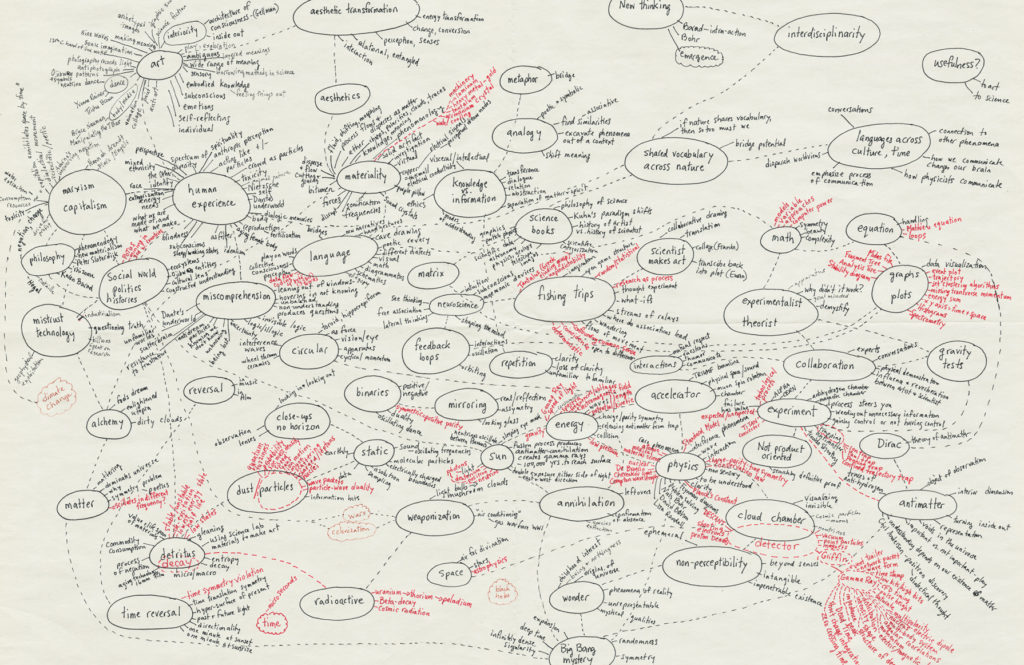
Ingrid Koenig, Antimatter Process Design (detail), 2017. This diagram shows the process design of five different streams of interactions, mapping out routes for 26 artists and 26 physicists, as well as an experimental class taught by Koenig at Emily Carr University of Art and Design. [downloaded from https://canadianart.ca/features/searching-for-the-language-of-the-universe/]

Unexpectedly, the documentation proved to be a highlight for me. BTW, you can find out more about the Leaning Out of Windows (LOoW) project (e.g. participants, phases, and art/science resources) on its website.

Koenig should be congratulated for getting as much publicity for the book as possible, given the topic and that there are no celebrities involved. CBC gave it a mention (May 8, 2023) on its Books: Leaning Out of Windows webpage. It also got a mention by Dana Gee in a May 12, 2023 ‘Books brief‘ posting on the Vancouver Sun website.

Plus, there were a couple of articles in an art magazine highlighting the art/science project while it was in progress featuring the few images I was about to access online for this project.

A January 6, 2020 article in Canadian Art Magazine by Randy Lee Cutler and Ingrid Koenig introduces the project (Note: I’ll revisit the “metaphor and analogy” mention in this article and throughout the LOoW book later in this post),

The disciplines of art and physics share certain critical perspectives: both deal with how metaphor and analogy inform creative processes. Additionally, artists and physicists address issues of the imagination, creative thinking and communication, and how meaning is made through theoretical research and process-based investigations. There are also important differences in these perspectives. Art brings an appreciation for abstract or non-representational practices. Physics research addresses complex problems relevant to understanding the study of matter and motion through space and time. Physicists also contribute knowledge about how the universe behaves. Together, the achievements of art and physics allow the possibility of a much richer understanding of the nature of reality than each field can contribute individually.

There’s a January 13, 2020 article in Canadian Art Magazine by Perrin Grauer featuring Mimi Gellman, Note: A link has been removed,

Artwork by artist and ECU Associate Professor Mimi Gellman was selected to appear on the cover of the current issue of Canadian Art magazine.

The gleaming, otherworldly image graces the magazine’s issue on antimatter —a subject which “presents a mirror world of abstract phenomena: time reversals, mutual annihilation, cosmic rays, cloud chambers, an infinite sea of sub-atomic particles that parallels our ‘real’ world of matter,” according to the issue’s editors.

Mimi describes her work as approaching some of the affinities between the biological, the perceptual, the cultural and the astronomical.

“My drawings do not explore the exterior world we perceive but rather what I call the ‘architecture of consciousness’ which permits us to perceive it,” she says.

“Recalling astronomical diagrams and reflecting the mixture of hybrid cultural worldviews in my background, they reveal deep similarities between the dimension explored by sub-atomic physics and the implicit interiority of contemporary art.”

I’m sorry I never saw any announcements for the project exhibitions, all of which seemed to have taken place at the Emily Carr University of Art + Design. There were three concepts each explored in three exhibitions, with different artists each time, titled: Antimatter, Emergence, and In/visible Forces, respectively.

A bouquet or two and a few nitpicks

Randy Lee Cutler and Ingrid Koenig have a wonderful quote from Karen Barad, physicist and philosopher, in their essay titled, “Collaborative Research between Artists and Physicists,”

Barad introduces the concept of intra-action and the fluidity of materialization through our bodily entanglements—through intra-action our bodies remain entangled with those around us. “Not only subjects but also objects are permeated through and through with their entangled kin, the other is not just in one’s skin, but in one’s bones, in one’s belly in one’s heart, in one’s nucleus, in one’s past and future.This is a true for electrons as it is for brittlestars as it is for the differentially constituted human.” As Barad asks herself, “How do I know where my physics begins and ends?” … [p. 13]

To the left of the page is a black and white photograph of entangled cables captioned, “GRIFFIN (Gamma Ray Infrastructure for Fundamental Investigations of Nuclei- TRIUMF.” It’s a nice touch and points to the difficulty of ‘illustrating’ or producing visual art in response to physics ideas such as quantum entanglement, something Einstein called, ‘spooky action at a distance’. From the Quantum entanglement Wikipedia entry, Note: Links have been removed,

Quantum entanglement is the phenomenon that occurs when a group of particles are generated, interact, or share spatial proximity in a way such that the quantum state of each particle of the group cannot be described independently of the state of the others [[emphasis mine], including when the particles are separated by a large distance [emphasis mine]. The topic of quantum entanglement is at the heart of the disparity between classical and quantum physics: entanglement is a primary feature of quantum mechanics not present in classical mechanics.[1]

Some of the essays

One essay that stood out in LOoW, was “A Boring Berm of Dirt’ (pp. 141-7) by Sadira Rodrigues. She notes that dirt and soil are not the same; one is dead (dirt) and the other is living (soil) and that the berm has an important role at TRIUMF. If you want a more specific discussion of the difference between dirt and soil, see David Beaulieu’s February 23, 2023 essay (Soil vs. Dirt: What’s the Difference?) on The Spruce website.

Rodrigues’ essay (part of the Emergence concept) situates the work physically (word play alert: physics/physically) whereas all of the other work is based on ideas.

In “Boring Berm … ,” radioactivity is mentioned, a term which is largely taboo these days due its association with poisoning, bombs, and death. The eassy goes into fascinating detail about TRIUMF’s underground facility and how the facility deals with its nuclear waste and the role that the berm plays. (On a more fanciful note, the danger in the title of the book is given another dimension in this essay focused on nuclear topics.) Regardless, the essay was definitely an eye-opener.

Aside: The institution has been rebranded from: TRIUMF (Canada’s National Laboratory for Particle and Nuclear Physics) to: TRIUMF (Canada’s national particle accelerator centre). You can find a reference to the ‘nuclear’ name in my October 2, 2018 posting although the name was already changed, probably in the early to mid-2010s. There is no mention of the ‘nuclear’ name in TRIUMF’s Wikipedia entry, accessed August 22, 2023.

Gellman and language

Mimi Gellman’s essay, “Crossing No Divide: Mapping Affinities in Art and Science” evokes unity, as can be seen in the title. She’s one of the more ‘lyrical’ writers,

There is a place in our imagination where east or west, or large or small, or any other opposites cease to be productive contradictions. As an artist and educator, I have become interested in the non-binary and resonance between Indigenous Knowledge and physics, between art and science, and between traditional ways of considering cognition and thinking with the hand. [p. 33]

This is how Gellman is described for the January 13, 2020 article in Canadian Art Magazine, which is archived on the Emily Carr University of Art + Design (ECUAD) website,

Mimi Gellman is an Anishinaabe/Ashkenazi (Ojibway-Jewish Métis) visual artist and educator with a multi-streamed practice in architectural glass and conceptual installation. She is currently an Associate Professor in the Faculty of Culture + Community at Emily Carr University of Art + Design in Vancouver, Canada, and is completing her research praxis PhD in Cultural Studies at Queen’s University on the metaphysics of Indigenous mapping.

She highlights some interesting observations about language and thinking,

The Ojibwe language, Anishinaabemowin, like many Indigenous languages is verb-based in contrast with Western languages’ noun-based constructions and these have deep implications for the development of one’s worldview. …

I suspect anyone who speaks more than one language can testify to the observation that language affects one’s worldview. More academically, it’s called linguistic relativity or the Sapir-Whorf hypothesis. I find it hard to believe that it’s considered a controversial idea but here goes from the Linguistic relativity Wikipedia entry, Note: Links have been removed,

The idea of linguistic relativity, also known as the Sapir–Whorf hypothesis /səˌpɪər ˈhwɔːrf/ sə-PEER WHORF, the Whorf hypothesis, or Whorfianism, is a principle suggesting that the structure of a language influences its speakers’ worldview or cognition, and thus individuals’ languages determine or shape their perceptions of the world.[1]

The hypothesis has long been controversial, and many different, often contradictory variations have existed throughout its history.[2] The strong hypothesis of linguistic relativity, now referred to as linguistic determinism, says that language determines thought and that linguistic categories limit and restrict cognitive categories. This was held by some of the early linguists before World War II,[3] but it is generally agreed to be false by modern linguists.[4] Nevertheless, research has produced positive empirical evidence supporting a weaker version of linguistic relativity:[4][3] that a language’s structures influence and shape a speaker’s perceptions, without strictly limiting or obstructing them.

Gettng back to Gellman, language, linguistic relativity, worldviews, and, adding physics/science, she quotes James (Sa’ke’j) Youngblood Henderson “a research fellow at the Native Law Centre of Canada, University of Saskatchewan College of Law. He was born to the Bear Clan of the Chickasaw Nation and Cheyenne Tribe in Oklahoma in 1944 and is married to Marie Battiste, a Mi’kmaw educator. In 1974, he received a juris doctorate in law from Harvard Law School,”

[at a 1993 dialogue between Western and Indigenous scientists …]

[Youngblood Henderson] We don’t have one god. You need a noun-based language to have one god. We have forces. All forces are equal and you are just the amplifier of the forces. The way you conduct your life and the dignity you give to other things gives you access to other forces. Even trees are verbs instead of nouns. The Mi’kmaq named their trees for the sound the wind makes when it blows through the trees during the autumn about an hour after the sunset, when the wind usually comes from a certain direction. So one might be like a ‘shu-shu’ something and another more like a ‘tinka-tinka’ something. Although physics in the western world has been essentially the quest for the smallest noun (which used to be a-tom, ‘that which cannot be further divided’), as they were inside the atom things weren’t acting like nouns anymore. The physicists were intrigued with the possibilities inherent in a language that didn’t depend on nouns but could move right to verbs when the circumstances were appropriate.3

This work from Gellman is a favourite of mine, and is featured in the January 13, 2020 article in Canadian Art Magazine and you’ll find it in the book,
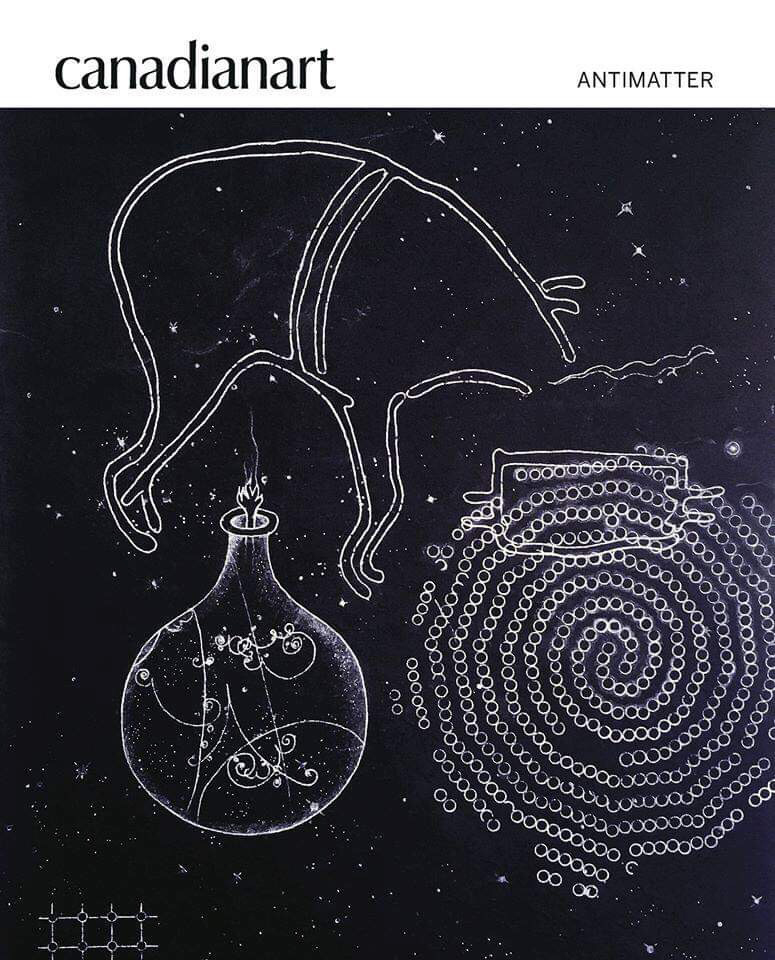
Image courtesy Mimi Gellman. Mimi Gellman, ‘Invisible Landscapes,’ 2017. Conte on Japanese Obonai paper, 63.5 x 48.3 cm. [downloaded from https://www.ecuad.ca/news/2020/canadian-art-magazine-features-cover-artwork-by-mimi-gellman]

There are more LOoW images embedded in the January 6, 2020 article on the Canadian Art Magazine website.

Derksen and his poem

Karl Marx, Friedrich Engels, Theodor W. Adorno, and Georg Wilhelm Friedrich Hegel were unexpected guest stars in Derksen’s essay, “From Two to Another: The Anti-Matter Series,” given that he is an award-winning poet. These days he has this on his profile page on the Department of English, Simon Fraser University website, “Dean and Associate Provost, Graduate and Postdoctoral Studies.”

From LOoW,

Karl Marx and Friedrich Engels are well known as materialists, having helped define a materialist view of history, of economics and of capitalism. And both Marx and Engels aimed to develop Marxism as a science rather than a model based on naturalizing capitalism and “man.” … [p. 89]

Derksen includes a diagram/poem, for which I can’t find a digitized copy, but here’s what he had to say about it,

My mode of looking at this [antimatter] is through poetic research —which itself does not aim to arrive at a synthesis but instead looks for relational moments. In this I also see a poetic language emerge from both discourses [artistic/scientific]—matter-antimatter thought and dialectical thinking. For my contribution to Leaning Out of Windows, I have tried to combine the scientific aspect of dialectical thinking with the poetic aspect of matter-antimatter thought and experimentation. To do this, I have taken the diagrammatic rendering of Carl Anderson’s experiment which resulted in his 1932 paper … as a model to relate the dialectical thinking at the heart of Marxism and matter-antimatter thought. …

Towards the end of his essay, Derksen notes that he’s working (on what I would call) a real poem. I sent an email to Derksen on August 21, 2023 asking,

  • Have you written the poem or is still in progress?
  • If you have written it, has it been published or is it being readied for publication? I would be happy to mention where.
  • If you do have it ready and would like to ‘soft launch’ the poem, could you send it to me for inclusion in the post?

No response at this time.

Flashback to Alan Storey

I think it was 2002 or 2003 when I first heard about an artist at TRIUMF, Alan Storey. The ‘residency’ was the product of a joint effort between the Canada Council for the Arts (Canada Council) and the Natural Sciences and Engineering Council of Canada (NSERC).

I spoke with Storey towards the end of his ;residency; and he was a little disappointed because nothing much had come of it. Nobody really seemed to know what to do with an artist at a nuclear facility and he didn’t really didn’t seem to know either. (Alan Storey’s work can be seen in the City of Vancouver’s collection of public art works here and on his website.)

My guess is that someone had a great idea but didn’t think past the ‘let’s give money to science institutions so they can host some artists who will magically produce wonderful things for us’ stage of thinking. While there is no longer a Canada Council/NSERC programme, it’s clear from LOoW (funded by the Social Sciences and Humanities Research Council of Canada [SSHRC]) that lessons have been learned.

Kudos to David Morissey who acted as an interface and convenor for the artists and to Nigel Smith (Director 2021 – present) and Jonathan Bagger (Director 2014 – 2020) for supporting the project from the TRIUMF side and to Ingrid Koenig and Randy Lee Cutler who organized and facilitated LOoW from the artists’ side.

Now, for the nits

“Co-thought” is mentioned a number of times. What is it? According to my searches, it has something to do with gestures. Here’s one of the few reference I could find for co-thought,

Co-thought and co-speech gestures are generated by the same action generation process by Mingyuan Chu and Sotaro Kita. Exp Psychol Learn Mem Cogn. 2016 Feb;42(2):257-70. doi: 10.1037/xlm0000168. Epub 2015 Aug 3.

Abstract

People spontaneously gesture when they speak (co-speech gestures) and when they solve problems silently (co-thought gestures) [emphasis mine]. In this study, we first explored the relationship between these 2 types of gestures and found that individuals who produced co-thought gestures more frequently also produced co-speech gestures more frequently (Experiments 1 and 2). This suggests that the 2 types of gestures are generated from the same process. We then investigated whether both types of gestures can be generated from the representational use of the action generation process that also generates purposeful actions that have a direct physical impact on the world, such as manipulating an object or locomotion (the action generation hypothesis). To this end, we examined the effect of object affordances on the production of both types of gestures (Experiments 3 and 4). We found that individuals produced co-thought and co-speech gestures more often when the stimulus objects afforded action (objects with a smooth surface) than when they did not (objects with a spiky surface). These results support the action generation hypothesis for representational gestures. However, our findings are incompatible with the hypothesis that co-speech representational gestures are solely generated from the speech production process (the speech production hypothesis).

It would have been nice if Koenig and Cutler had noted they were borrowing a word ot coining a word and explaining how it was being used in the LOoW context.

Fruit, passports, and fishing trips

The editors/writers use the words or variants, metaphor, poetry, and analogy with great abandon.

“Fruitful bridge” (top of page) and “fruitful match-ups” (bottom of page) on p. 18 seemed a bit excessive as did the “metaphorical passport” on p. 5.

I choked a bit over this on p. 19, “… these artist/scientist interactions can be seen as ‘procedural metaphors’ that enact a thought experiment … .” Procedural metaphor? It seems a bit of a stretch.

A last example and it’s a pair: “metaphorical fishing trips whereby artist and scientists received whatever they might reel in …” on p. 42 (emphases mine). Fishing trips are mentioned in a later essay too, one of the few times there’s some sort of follow through on an analogy.

Maybe someone who wasn’t involved with the project should have taken a look at the text before it was sent to the printer.

Using the words, poetry, metaphor, and analogy can be tricky and, I want to emphasize that in my opinion, those words were not often put to good use in this book.

Moving on, arts and sciences together have a longstanding history.

*ETA October 3, 2023: Ooops! I had a comment about the use of the word ‘passports’ in the book but somewhere in all my edits, I cut it out. (huff)*

Poetry and physics

One of the giants of 19th century physics, James Clerk Maxwell was also known for his poetry. and some of the most evocative (poetic) text in the LOoW book can be found in the quotes from various physicists of the 20th century. The link between physicist and poetry is explicit in a September 17, 2018 posting (12 poignant poems (and one bizarre limerick) written by physicists about physics) by Colin Hunter for the Perimeter Institute for Theoretical Physics in Waterloo, Canada.

Going back further, there’s De rerum natura, a poem in six books, by Lucretius ((c. 99 BCE– c. 55 BCE). Amongst many other philosophical concerns (e.g., the nature of mind and soul, etc.), Lucretius also discussed atomism (“… a natural philosophy proposing that the physical universe is composed of fundamental indivisible components known as atoms; from the Atomism Wikipedia entry). So, poetry and physics have a long history.

Leaving aside Derksen’s diagram/poem, there’s a dearth of poetry in the book except for a suite of seven poems from TRIUMF physicist and professor at UBC, Jess Brewer following his “Emergence, Free Will and Magic” essay,

Emergence / An extremely brief history of one universe, expressed as a series of science fiction poems by Jess H. Brewer, June 29, 2019

Inspired by Dyson Freeman’s delightful lecture series , “Time Without End: Physics and Biology in an Open Universe,” Reviews of Modern Physics (51) 1979

1. Bang
Why not?
For reasons known only to itself,
the universe begins
The quantum foam of spacetime seethes
with effortless energies,
entering and exiting this continuum
with a turbulent intensity
transcending the superficially smooth
expanding cosmos
and yet it kens the glacial passage of “time”,
because it waits.
And kens the vast reaches of “space”,
because it watches,
Its own experiences has taught it that
from each iteration of complexity,
awareness will emerge.

… [p. 149]

My thanks to Brewer for the poetry and magic and my apologies for any mistakes I’ve introduced into his piece. I was trying to be especially careful with the punctuation as that can make quite a difference to how a piece is read.

While Muriel Rukeyser is not a physicist at TRIUMF or, indeed, alive, one of her poems leads the essay “Leaning into Language or the Universe is Made of Stories,” by Randy Lee Cutler and Ingrid Koenig,

Time comes into it
Say it. Say it.
The universe is made of stories,
not of atoms..
—Muriel Ruykeyser, Speed of Darkness, 1968

Before getting into the response that physicist, David Morrissey, had to the poem, here’s a little about the poet, from the Poetry Foundation’s Muriel Ruykeyser (1913-1980) webpage,

Muriel Rukeyser was a poet, playwright, biographer, children’s book author, and political activist. Indeed, for Rukeyser, these activities and forms of expression were linked. …

One of Rukeyser’s intentions behind writing biographies of nonliterary persons was to find a meeting place between science and poetry. [emphasis mine] In an analysis of Rukeyser’s The Life of Poetry, Virginia Terris argued that Rukeyser believed that in the West, poetry and science are wrongly considered to be in opposition to one another. Thus, writes Terris, “Rukeyser [set] forth her theoretical acceptance of science … [and pointed] out the many parallels between [poetry and science]—unity within themselves, symbolic language, selectivity, the use of the imagination in formulating concepts and in execution. [emphasis mine] Both, she believe[d], ultimately contribute to one another.”

Rokeyser’s poem raised a few questions. Is her poem a story? Or, is she using symbolic language, the poem, to poke fun at stories and atoms? Is she suggesting that atoms are really stories? I found the poem evocative especially with where it was placed in the book.

Morrissey takes a prosaic approach, from the essay “Leaning into Language or the Universe is Made of Stories,”

… [in response to Rukeyser’s claim about stories] Morrissey responded stating that “scientific theories are stories—but how we evaluate stories is important—they need to be true, but they do probe, and some are more popular than others, especially theories that we can’t measure.” He surprised us further when he said that wrong stories can also be useful—they may have elements in them that turn out to be useful for future research. … [pp. 205-6]

In general and throughout this project, it seems as if they (artists and physicists) tried but, for the most part, were never quite able to articulate in poetic, metaphoric, and analogical forms. They tended to fall back onto their preferred modes of scientific notations, prosaic language, and artworks.

Both sides of the knife blade cut

Everybody does it. Poets, academics, artists, scientists, etc. we all appropriate ideas and language, sometimes without understanding them very well. Take this for example, from the Canadian Broadcasting’s (CBC) Books “Elementary Particles” August 16, 2023 webpage,

Elementary Particles by Sneha Madhavan-Reese

A poetry collection about family history and scientific exploration

Through keen, quiet observation, Sneha Madhavan-Reese’s evocative new collection takes us from the wide expanse of rural India to the minute map of Michigan we carry on the palms of our hands. These poems contemplate ancestral language, the wonder and uncertainty of scientific discovery, the resilience of a dung beetle, the fleeting existence of frost flowers on the Arctic Ocean.

The collection is full of familiar characters, from Rosa Parks to Seamus Heaney to Corporal Nathan Cirillo, anchoring it in specific moments in time and place, but has the universality that comes from exploring the complex relationship between a child and her immigrant parents, and in turn, a mother and her children. Elementary Particles examines the building blocks of a life — the personal, family, and planetary histories, transformations, and losses we all experience. (From Brick Books)

Sneha Madhavan-Reese is a writer currently based in Ottawa. In 2015 she received Arc Poetry Magazine’s Diana Brebner Prize and was shortlisted for the Montreal International Poetry Prize. Her previous poetry collection is called Observing the Moon

As you can see, there’s no substantive mention of physics in this book description—it’s just a title. Puzzling since there’s this about the author on Asian Heritage Canada’s Sneha Madhavan-Reese webpage

Sneha Madhavan-Reese’s award winning poetry has been widely published in literary magazines in North America and Australia. She earned a bachelor’s degree in mechanical engineering from MIT in 2000, and a master’s degree in mechanical engineering from the University of Michigan in 2002. Madhavan-Reese currently lives in Ottawa, Ontario. [emphases mine]

It seems the mechanical engineer did not write up her book blurb because even though the poet’s scientific specialty is not physics as such, I’d expect a better description.

In the end, it seems art and science or poetry and science (in this case, physics) sells.

Alchemy, beauty, and Marx’s surprise connection to atomism

It was unexpected to see a TRIUMF physicist reference alchemy. The physicists haven’t turned lead into gold but they have changed one element into another. If memory holds it was one metallic atom being changed into another type of metallic atom. (Having had to return the book to the library, memory has serve.)

The few references to alchemy that I’ve stumbled across elsewhere in my readings of assorted science topics are derogatory, hence the surprise. Things may be changing; Princeton University Press published a November 7, 2018 posting by author William R. Newman about Newton and alchemy. First, here’s a bit about William Newman,

William R. Newman is Distinguished Professor and Ruth N. Halls Professor in the Department of History and Philosophy of Science and Medicine at Indiana University. His many books include Atoms and Alchemy: Chymistry and the Experimental Origins of the Scientific Revolution and Promethean Ambitions: Alchemy and the Quest to Perfect Nature. He lives in Bloomington, Indiana.

Now for Newman’s comments, from the November 7, 2018 posting,

People often say that Isaac Newton was not only a great physicist, but also an alchemist. This seems astonishing, given his huge role in the development of science. Is it true, and if so, what is the evidence for it?

WN: The astonishment that Newton was an alchemist stems mostly from the derisive opinion that many moderns hold of alchemy [emphasis mine]. How could the man who discovered the law of universal gravitation, who co-invented calculus, and who was the first to realize the compound nature of white light also engage in the seeming pseudo-science of alchemy? There are many ways to answer this question, but the first thing is to consider the evidence of Newton’s alchemical undertaking. We now know that at least a million words in Newton’s hand survive in which he addresses alchemical themes. Much of this material has been edited in the last decade, and is available on the Chymistry of Isaac Newton site at www.chymistry.org. Newton wrote synopses of alchemical texts, analyzed their content in the form of reading notes and commentaries, composed florilegia or anthologies made up of snippets from his sources, kept experimental laboratory notebooks that recorded his alchemical research over a period of decades, and even put together a succession of concordances called the Index chemicus in which he compared the sayings of different authors to one another. The extent of his dedication to alchemy was almost unprecedented. Newton was not just an alchemist, he was an alchemist’s alchemist. 

… 

Beauty

The ‘beauty’ essay by Ingrid Koenig was also a surprise. Beauty seems to be anathema to contemporary artists. I wrote this in an August 23, 2016 posting (Georgina Lohan, Bharti Kher, and Pablo Picasso: the beauty and the beastliness of art [in Vancouver]), “It seems when it comes to contemporary art, beauty is transgressive.”

Koenig describes it as irrelevant for contemporary artists and yet, beauty is an important attribute to physicists. Her thoughts on beauty in visual art and in physics were a welcome addition to the book.

Marx’s connection to atomism

This will take a minute.

De rerum natura, a six-volume poem by Lucretius (mentioned under the Poetry and physics subhead of this posting), helped to establish the concept of atomism. As it turns out, Lucretius got the idea from earlier thinkers, Epicurus and Democritus.

Karl Marx’s doctoral dissertation, which focused on Lucretius, Epicurus and more, suggests an interest in science that may have led to his desire to establish economics as a science. From Cambridge University Press’s “Approaches to Lucretius; Traditions and Innovations in Reading the De Rerum Natura,” Chapter 12 – A Tribute to a Hero: Marx’s Interpretation of Epicurus in his Dissertation,

Summary

This chapter turns to Karl Marx’s treatment of Epicureanism and Lucretius [emphasis mine] in his doctoral dissertation, and argues that the questions raised by Marx may be brought to bear on our own understanding of Epicurean philosophy, particularly in respect of a tension between determinism and individual self-consciousness in a universe governed by material causation. Following the contours of Marx’s dissertation [emphasis mine], the chapter focusses on three key topics: the difference between Democritus’ and Epicurus’ methods of philosophy; the swerve of the atom; and the so-called ‘meteors’, or heavenly bodies [emphasis mine]. Marx sought to develop Hegel’s understanding of Epicurus, in particular by elevating the principle of autonomous action to a first form of self-consciousness – a consideration largely mediated by Lucretius’ theorization of the atomic swerve and his poem’s overarching framework of liberating humans from the oppression of the gods.

Fascinating, eh? The rest of this is behind a paywall. For the interested, here’s a citation and link for the book,

Approaches to Lucretius; Traditions and Innovations in Reading the De Rerum Natura
Edited by Donncha O’Rourke, University of Edinburgh

Publisher: Cambridge University Press
Online publication date: June 2020
Print publication year: 2020
Online ISBN: 9781108379854

DOI: https://doi.org/10.1017/9781108379854

32.99 (USD) Digital access

It’s a little surprising Derksen doesn’t mention the connection in his essay.

Finally

It’s an interesting book if not an easy one. (By the way, I wish they’d included an index.) You can get a preview of some of the artwork in the January 6, 2020 article on the Canadian Art Magazine website.

I can’t rid myself of the feeling that LOoW (the book) is meant to function as a ‘proof of concept’ for someone wanting to start an art/science department or programme at the Emily Carr University of Art + Design, perhaps jointly with the University of British Columbia. It is highly unusual to see this sort of material in anything other than a research journal or as a final summary to the granting agency.

Should starting an art/science programme be the intention, I hope they are successful in getting such it together and, in the meantime, thank you to the physicists and artists for their work.

We should all ‘lean out of windows’ on occasion and, if it means, falling or encountering ‘dangerous, uncomfortable ideas’ then, that’s alright too.
Making lead look like gold (so to speak)

Apparently you can make lead ‘look’ like gold if you can get it to reflect light in the same way. From a Feb. 28, 2017 news item on Nanowerk (Note: A link has been removed),

Since the Middle Ages, alchemists have sought to transmute elements, the most famous example being the long quest to turn lead into gold. Transmutation has been realized in modern times, but on a minute scale using a massive particle accelerator.

Now, theorists at Princeton University have proposed a different approach to this ancient ambition — just make one material behave like another. A computational theory published Feb. 24 [2017] in the journal Physical Review Letters (“How to Make Distinct Dynamical Systems Appear Spectrally Identical”) demonstrates that any two systems can be made to look alike, even if just for the smallest fraction of a second.

In this context, for two objects to “look” like each other, they need to reflect light in the same way. The Princeton researchers’ method involves using light to make non-permanent changes to a substance’s molecules so that they mimic the reflective properties of another substance’s molecules. This ability could have implications for optical computing, a type of computing in which electrons are replaced by photons that could greatly enhance processing power but has proven extremely difficult to engineer. It also could be applied to molecular detection and experiments in which expensive samples could be replaced by cheaper alternatives.

A Feb. 28, 2017 Princeton University news release (also on EurekAlert) by Tien Nguyen, which originated the news item, expands on the theme (Note: Links have been removed),

“It was a big shock for us that such a general statement as ‘any two objects can be made to look alike’ could be made,” said co-author Denys Bondar, an associate research scholar in the laboratory of co-author Herschel Rabitz, Princeton’s Charles Phelps Smyth ’16 *17 Professor of Chemistry.

The Princeton researchers posited that they could control the light that bounces off a molecule or any substance by controlling the light shone on it, which would allow them to alter how it looks. This type of manipulation requires a powerful light source such as an ultrafast laser and would last for only a femtosecond, or one quadrillionth of a second. Unlike normal light sources, this ultrafast laser pulse is strong enough to interact with molecules and distort their electron cloud while not actually changing their identity.

“The light emitted by a molecule depends on the shape of its electron cloud, which can be sculptured by modern lasers,” Bondar said. Using advanced computational theory, the research team developed a method called “spectral dynamic mimicry” that allowed them to calculate the laser pulse shape, which includes timing and wavelength, to produce any desired spectral output. In other words, making any two systems look alike.

Conversely, this spectral control could also be used to make two systems look as different from one another as possible. This differentiation, the researchers suggested, could prove valuable for applications of molecular detections such as identifying toxic versus safe chemicals.

Shaul Mukamel, a chemistry professor at the University of California-Irvine, said that the Princeton research is a step forward in an important and active research field called coherent control, in which light can be manipulated to control behavior at the molecular level. Mukamel, who has collaborated with the Rabitz lab but was not involved in the current work, said that the Rabitz group has had a prominent role in this field for decades, advancing technology such as quantum computing and using light to drive artificial chemical reactivity.

“It’s a very general and nice application of coherent control,” Mukamel said. “It demonstrates that you can, by shaping the optical paths, bring the molecules to do things that you want beforehand — it could potentially be very significant.”

Since the Middle Ages, alchemists have sought to transmute elements, the most famous example being the long quest to turn lead into gold. Now, theorists at Princeton University have proposed a different approach to this ancient ambition — just make one material behave like another, even if just for the smallest fraction of a second. The researchers are, left to right, Renan Cabrera, an associate research scholar in chemistry; Herschel Rabitz, Princeton’s Charles Phelps Smyth ’16 *17 Professor of Chemistry; associate research scholar in chemistry Denys Bondar; and graduate student Andre Campos. (Photo by C. Todd Reichart, Department of Chemistry)

Here’s a link to and a citation for the paper,

How to Make Distinct Dynamical Systems Appear Spectrally Identical by
Andre G. Campos, Denys I. Bondar, Renan Cabrera, and Herschel A. Rabitz.
Phys. Rev. Lett. 118, 083201 (Vol. 118, Iss. 8) DOI:https://doi.org/10.1103/PhysRevLett.118.083201 Published 24 February 2017

© 2017 American Physical Society

This paper is behind a paywall.

Pure gold nanostructures

This Nov. 4, 2016 news item on ScienceDaily features another ‘alchemy’ story although this one is truer to the source material than some of the other stories,

The idea is reminiscent of the ancient alchemists’ attempts to create gold from worthless substances: Researchers have discovered a novel way to fabricate pure gold nanostructures using an additive direct-write lithography technique. An electron beam is used to turn an auriferous organic compound into pure gold. This new technique can now be used to create nanostructures, which are needed for many applications in electronics and sensor technology. Just like with a 3D-printer on the nanoscale, almost any arbitrary shape can be created.

Caption: Nanostructure made of gold. Credit: TU Wien

Caption: Nanostructure made of gold. Credit: TU Wien

A Nov. 3, 2016 Technical University of Vienna (Technische Universität Wien) press release (also so on EurekAlert), which originated the news item, expands on the theme,

“Gold is not only a noble metal of exceptional beauty, but also a highly desired material for functional nanostructures”, says Professor Heinz Wanzenböck from TU Wien. Especially patterned gold nanostructures are key enabling structures in plasmonic devices, for biosensors with immobilized antibodies and as electrical contacts. For decades the fabrication of pure gold nanostructures on non-planar surfaces as well as of 3-dimensional gold nanostructures has been the bottleneck. Up to now, only 2-dimensional gold nanostructures on planar surfaces were achievable by resist based lithography.

The new technology, developed at TU Wien, can now solve this problem. The principle is the local decomposition of a metalorganic precursor by the focused electron beam of an electron microscope. With extremely high precision, the electron beam can decompose the organic compound at exactly the right position, leaving behind a 3D-trail of solid gold.

The final obstacle was getting the material purity right, as the electron-induced decomposition of metalorganic precursors has typically yielded metals with high carbon contaminations. This last bottleneck on the road to custom-designed, pure gold nanostructures has now been overcome as described in the work on “Highly conductive and pure gold nanostructures grown by electron beam induced deposition” published in Scientific Reports.

While conventional gold deposition usually contains about 70 atomic % carbon and only 30 atomic % gold, the new approach developed by a research group lead by Dr. Heinz Wanzenboeck at TU Wien has allowed to fabricate pure gold structures by in-situ addition of an oxidizing agent during the gold deposition. “The whole community has been working hard for the last 10 years to directly deposit pure gold nanostructures”, says Heinz Wanzenböck. At last, the group’s expertise in engineering and chemical reactions paid off and direct deposition of pure gold was successful. “It’s a bit like discovering the legendary philosopher’s stone that turns common, ignoble material into gold” joked Wanzenboeck.

This deposited pure gold structure exhibits extremely low resistivity near that of bulk gold. Generally, a FEBID gold structure has a resistivity around 1-Ohm-cm which is about 1 million times worse than the resistivity of purest bulk gold. However, this specially enhanced FEBID process produces a resistivity of 8.8 micro-Ohm-cm which is only a factor 4 away from the bulk resistivity of purest gold (2.4 micro-Ohm-cm).

The authors of the paper Dr. Mostafa Moonir Shawrav and Dipl.Ing. Philipp Taus stated, “This highly conductive and pure gold structure will open a new door for novel nanoelectronic devices. For example, it will be easier to produce pure gold structures for nanoantennas and biomolecule immobilization which will change our everyday life”. Dr. Shawrav added “it is remarkable how a regular SEM (Scanning Electron Microscope) nowadays can deposit nanostructures compared to 20 years back when it was only a characterization device”. And with pure gold direct deposition available now, he expects nanodevices to be deposited directly and utilized in many different applications for technological revolution. Concluding, this work is a giant leap forward for 3D nano-printing of gold structures which will be the core part of nanoplasmonics and bioelectronics devices.

Here’s  a link to and a citation for the paper,

Highly conductive and pure gold nanostructures grown by electron beam induced deposition by Mostafa M. Shawrav, Philipp Taus, Heinz D. Wanzenboeck, M. Schinnerl, M. Stöger-Pollach, S. Schwarz, A. Steiger-Thirsfeld, & Emmerich Bertagnolli. Scientific Reports 6, Article number: 34003 (2016)  doi:10.1038/srep34003 Published online: 26 September 2016

This paper is open access.

Making magnetic rust behave like gold and the nanoscale

Researchers at the University of Georgia (US) have found a way to combine gold nanoparticles with magnetic rust nanoparticles for a hybrid structure that behaves with the properties of both types of nanoparticles. From a Sept. 15, 2016 news item on ScienceDaily,

Researchers from the University of Georgia are giving new meaning to the phrase “turning rust into gold”—and making the use of gold in research settings and industrial applications far more affordable.

The research is akin to a type of modern-day alchemy, said Simona Hunyadi Murph, adjunct professor in the UGA Franklin College of Arts and Sciences department of physics and astronomy. Researchers combine small amounts of gold nanoparticles with magnetic rust nanoparticles to create a hybrid nanostructure that retains both the properties of gold and rust.

A Sept. 15, 2016 University of Georgia news release by Jessica Luton, which originated the news item, expands on the theme,

“Medieval alchemists tried to create gold from other metals,” she said. “That’s kind of what we did with our research. It’s not real alchemy, in the medieval sense, but it is a sort of 21st century version.”

Gold has long been a valuable resource for industry, medicine, dentistry, computers, electronics and aerospace, among others, due to unique physical and chemical properties that make it inert and resistant to oxidation. But because of its high cost and limited supply, large scale projects using gold can be prohibitive. At the nanoscale, however, using a very small amount of gold is far more affordable.

In the new study published this summer in the Journal of Physical Chemistry C, the researchers used solution chemistry to reduce gold ions into a metallic gold structure using sodium citrate. In this process, if other ingredients-rust in this case-are present in the reaction pot during the transformation process, the metallic gold structures nucleate and grow on these “ingredients,” otherwise known as supports.

“We are really excited to share our new discoveries. When researchers are looking at gold as a potential material for research, we talk about how expensive gold is. For the first time ever, we’ve been able to create a new class of cheaper, highly efficient, nontoxic, magnetically reusable hybrid nanomaterials that contain a far more abundant material-rust-than the typical noble metal gold,” said Murph, who is also a principal scientist in the National Security Directorate at the Savannah River National Laboratory in Aiken, South Carolina.

When materials are broken down in size to reach nanometer scale dimensions-1-100 nanometers, which is approximately 100,000 times smaller than the diameter of human hair-these substances can take on new properties. For example, bulk gold does not display catalytic properties; however, at the nanoscale, gold is an efficient catalyst, accelerating chemical change for many reactions including oxidation, hydrogen production or reduction of aromatic nitro compounds.

Gold nanoparticles of different sizes and shapes display different colors when impinged by light because they absorb and scatter light at specific wavelengths, known as plasmonic resonances. These plasmonic resonances are of particular interest for biological applications. If someone shines light on the gold nanoparticles, the absorbed light can be converted to heat in the surrounding media, and if bacteria or cancerous cells are in the vicinity of such gold nanoparticles, they can be destroyed by using light of appropriate wavelength. This phenomenon is known as photothermal therapy.

By replacing some of the nano-gold with magnetic nano-rust, researchers show that the hybrid gold and rust nanostructures are able to photothermally heat the surrounding media as efficiently as pure gold nanoparticles, even with a significantly smaller concentration of gold.

“In a way, we’ve done a little better than alchemy,” said George Larsen, co-investigator and postdoctoral researcher in the Group for Innovation and Advancements in Nano-Technology Sciences at the Savannah River National Laboratory, “because these new hybrid nanoparticles not only behave better than gold in some cases, but also have magnetic functionality.”

Murph and her team looked at three different shapes of hybrid nanoparticles in this research-spheres, rings and tubes.

“A differently shaped nanoparticle means that the atoms are arranged differently-into cubes, hexagons or triangles, for example,” she said. “A different atom arrangement means different packing densities, spacing between atoms, defects, surface area and surface energies. Different shapes lead to an increased atom area that is exposed to catalyze a chemical reaction. Scientifically speaking, different shape means different crystallographic facets and surface energy that could lead to higher catalytic activity and different catalytic products.

“The results of our research showed that the ring- and tube-shaped hybrid nanoparticles proved to be better catalytic materials than the sphere-shaped nanoparticles because of the way the atoms are arranged in the structure at this nanoscale. More importantly, the hybrid nanoparticles of gold and rust are better catalysts than gold nanoparticles alone, even with a significantly smaller amount of gold.

When these different shaped hybrid nanoparticles were exposed to light of specific wavelength, the spheres heated the solution up to slightly higher temperatures than the ring- or tube-shaped nanoparticles.

“This could have a variety of biological applications such as tracking, drug delivery or imaging inside the body,” Murph said. “If you feed these gold nanoparticles to bacteria and shine the light on them, you could destroy these by just using light.”

The hybrid structures could also be used for new application [sic], such as sensing, hyperthermia treatment, environmental cleaning and protection medical imaging applications including magnetic resonance imaging contrast agents, product detection and manipulation.

Here’s a link to and a citation for the paper/video,

Multifunctional Hybrid Fe2O3-Au Nanoparticles for Efficient Plasmonic Heating by Simona E. Hunyadi Murph, George K. Larsen, Robert J. Lascola. Journal of Visualized Experiments, 2016; (108) DOI: 10.3791/53598

This paper/video appears to be open access.

Digital alchemy from the University of Michigan (US)

Describing this work as ‘digital alchemy’ seems like a bit of a stretch as lead is not being turned into gold digitally or otherwise, from an Oct. 30, 2015 news item on Azonano,

Alchemy left the mainstream centuries ago, but one of its core concepts, transmuting the elements, is experiencing a revival in nanotechnology.

Researchers at the University of Michigan are charting a path toward materials with new properties by cleverly altering the nanoparticles used to build them.

An Oct. 27, 2015 University of Michigan news release, which originated the news item, provides more details from the scientists,

“Today, scientists achieve something akin to alchemy when we change materials’ building blocks by adding atoms or molecules to them, or even changing their shape. Such changes affect how the building blocks fit together, which in turn controls material’s behavior and properties,” said Sharon Glotzer, the John Werner Cahn Distinguished University Professor of Engineering and the Stuart W. Churchill Collegiate Professor of Chemical Engineering.

“We’ve developed a new theoretical tool that can be used by computers to carry out ‘alchemy’ on the fly, rapidly searching for the best building block for a given application. Digital alchemy will transform the way we design materials.”

Nanoparticles have the potential to redefine the “elements” available to materials scientists, going from the 90 stable elements to an infinite palette of tiny synthetic particles, just a few hundred times the size of the atoms themselves. The researchers propose a way to navigate the new frontier of nanoscale building blocks not by making and measuring each particle, but by exploring why particles build certain types of structures. Then, the important attributes can be identified and applied to design particles that will produce those structures.

“It seems like having an infinitude of new ‘elements’ to make materials from is a great thing. But if we don’t know the rules they use to organize themselves, and we can’t determine the rules by trial and error because we can’t make all the different elements, then we need to approach developing materials in a new way,” said Greg van Anders, a research fellow in the Glotzer group and first author of the study.

“Rapidly scanning through building blocks is not just a useful way of finding good candidates for new materials, but a necessary step to deal with the tremendous flexibility we now have in making particles.”

To demonstrate the concept, the team used a computer simulation that arranged a set of particles into a structure and then allowed the shape of the particles to change.

“We just stick the particles into a structure and say ‘find a shape that you’re happy with if you have to sit in that structure,'” van Anders said.

It had been assumed that the best shape for self-assembling into a particular structure is the one that packs into that structure most efficiently, leaving very little empty space. To test this, the team simulated the self-organization of four-sided pyramids (known as tetrahedra). They pack efficiently into a diamond structure—the structure produced by carbon atoms in a diamond—if their points are cut off. But if the diamond structure is the goal, how much of the points should be removed?

Not as much as needed for the closest packing, van Anders said. The shapes self-assembled best if the points were left a little longer, better preserving the tetrahedral character.

The team also explored what happens when ripples of attraction and repulsion run through a collection of spherical particles. This causes the particles to arrange themselves with respect to their neighbors. When these ripples are timed in a certain way, the particles form an icosahedral quasicrystal, an intricate structure that is symmetrical but doesn’t have a repeating structural unit.

“It’s one of the most complicated structures we know,” van Anders said. “If we could understand how to control the interactions so that this structure forms better, then chances are, we could also figure out how to make less complicated structures in systems that use a different set of interactions.”

This could help researchers build structures by exposing a fluid containing nanoparticles to forces such as light, electric fields and magnetic fields. These capabilities could lead to many interesting advances. One of Glotzer’s particular interests is in materials that can change color on command, creating the ultimate camouflage.

Here’s a link to and a citation for the paper,

Digital Alchemy for Materials Design: Colloids and Beyond by Greg van Anders, Daphne Klotsa, Andrew S. Karas, Paul M. Dodd, and Sharon C. Glotzer. ACS Nano, 2015, 9 (10), pp 9542–9553 DOI: 10.1021/acsnano.5b04181 Publication Date (Web): September 24, 2015

Copyright © 2015 American Chemical Society

This paper is behind a paywall.

The Veil of Nature: Museum of Liminal Science (play & installation) in Vancouver (Canada) and You Are Very Star (experience) online

Science hasn’t always been the science we think of and practice in the 21st century. For example, Isaac Newton, famed English physicist and mathematician was not the scientist we believe him to be as Stuart Clark’s Sept. 21, 2012 post for the UK’s Guardian newspaper online points out,

Often wrongly portrayed as a cold rationalist, Isaac Newton is one of history’s most compelling figures. It is true that he was capable of the most precise and logical thought it is possible for a human to achieve: his three years of obsessive work that gave birth to the Principia, containing his theory of gravity, stand as the greatest achievement in science.

Just as certainly, though, he was also consumed with what we would now view as completely unscientific pursuits: alchemy and biblical prophesy. [emphasis mine]

Tempting as it is to dismiss all of this as somehow removed from Newton’s science, his belief in spirits and what the alchemists called active principles almost certainly allowed him to conceive gravity in the mathematical form that we still use today. [emphasis mine]

Today’s science practice is the result of a long process and it includes the embarrassing (for some) such as alchemy and biblical prophecy, as well as, a 19th century scandal where an occultist, Madame Blavatsky, attempted to introduce Hindu and Buddhist teachings into Western Science.

A science installation featuring spiritualism à la Blavatsky, The Veil of Nature: Museum of Liminal Science, and an environment resembling a 19th century laboratory that immerses the participant in a multi-media, multi-sensory experience is opening on Friday, June 14, 2013. From the June 10, 2013 Simon Fraser University (Vancouver, Canada) news release,

Imagine walking into a multi-media environment that looks like a 19th century science lab on the outside but, on the inside, immerses you into a sensory world where science, spirituality, illusion and intuition fuse.

Gruben [Patricia Gruben], a screenwriter, filmmaker and associate professor, and Gotfrit [Martin Gotfrit], a music composer, sound designer and professor, will unveil The Veil of Nature: Museum of Liminal Science on Friday, June 14 at a reception. It is from 6 to 9 p.m. in Room 2205, Goldcorp Centre.

The duo’s free, public, cube-shaped, multi-sensory world will remain open until July 6. A presentation in its own right, the installation is also intended to prime the public’s creative appetite for The Secret Doctrine. The play, penned by Gruben, is about the intellectual triumphs and scandals that engulfed Helena Blavatsky, a 19th century Russian occultist.

The play runs July 2 to 6 at the Goldcorp Centre. [149 West Hastings Street, Vancouver, BC Canada]

Scholars and scientists of Blavatsky’s day alternately lauded and defamed the co-founder of the Theosophical Society in India in 1881 for injecting Hindu and Buddhist teachings into western science. Blavatsky’s ideas are laid out in her tome, The Secret Doctrine, published in 1889. Gruben’s play is named after the book.

Gotfrit composed the music and soundscape for the installation as well as the play. Toronto-based designer Marian Wihak conceived of the installation’s innovative design. …

“We wanted to explore the threshold between rational science and intuition and we could only go so far in the play because we have to keep the story moving. The installation allows visitors to experience for themselves some of the questions that Blavatsky posed.

“For example, we play with the illusionary nature of our world, the interchangeability of matter and energy and the cyclical rather than linear progression of time.”

Adds Gotfrit: “The sound and music are designed to offer another sensory mode and to extend visitors’ experience beyond the visual, tactile and olfactory,” adds Gotfrit. “I use a multi-channel immersive audio system and my generative music software to trigger visitors’ aural experience and respond to it subtly.”

You can get more information about the installation and about Madame Blavatsky at the http://www.theveilofnature.net./,

June 14 – July 6, 2013, Tuesdays through Saturdays

Open 3 – 8 pm, Appointment recommended

Room 4350, Goldcorp Centre for the Arts

149 W.Hastings, SFU Woodwards, Vancouver

I tried to make an appointment/sign up for a time but was unable (not sure if it was the system or me). You can try for yourself here. As for Gruben’s play, The Secret Doctrine, you can find out more and/or buy tickets here.

ETA June 12, 2013: Patricia Gruben very kindly noted (in response to my query) that you have to scroll over to the extreme  right to click on the SAVE button in the lower corner of the screen after filling in your name and choosing a date and time to book a viewing of the installation. (On my system the button had moved [disappeared from my perspective] and I didn’t scroll all the way to right.)

I wish them well with the installation. I last wrote about immersive experiences and installations in a March 6, 2013 posting about the Cleveland Museum of Art.

I recently posted (June 7, 2013) about an immersive, transmedia theatre production opening in Vancouver, Canada, You Are Very Star. For anyone who can’t get to Vancouver, you can get a bit of the show experience and, for those of us who will be attending the show, our experience can start at any time, from the *June 10, 2013 announcement (Note added June 12, 2013: The show opens on June 15, 2013 but there are previews in the days leading up to it),

Electric Company Theatre would like to invite you to begin your You Are Very Star experience. The show doesn’t begin when you walk through the doors at the H.R. MacMillan Space Centre in Vanier Park.
 
The show is now.
We recommend that you begin this endeavour as soon as possible, as you will have the opportunity to explore and investigate in the coming days before your scheduled performance.
As it is an online experience using innovative technology, we recommend that you take the following steps:
1. Use a computer, as you will not be able to view it on a tablet or smartphone.
2. Restart your computer (a fresh slate is good for all of us). Close other applications and browser tabs;
3. Viewing experience will be most optimal on Chrome. You may also use Firefox or Safari browsers- they should have the most recent update;
If you have any issues with the experience, please let me know by responding to this email.
Are you ready?

I’ve tried it both on Chrome and on Firefox. Both the Chrome and Firefox experiences were stunning although I experienced slightly better visuals on Chrome; I got further into the experience on Firefox (my system is held together with chewing gum and baling wire). Definitely try this out.

* Corrected June 14 to June 10.

Iron Man 3. nanotechnology, Extremis armor, and Rebecca Hall

My searches for nanotechnology news don’t usually yield much information about Hollywood casting issues but the latest on Iron Man 3 and the actress, Rebecca Hall’s possible involvement as “a sexy scientist who plays a pivotal role in the creation of nanotechnology that winds up being sold to terrorists” (May 9, 2012 posting on AceShowBiz.com website) proved to be an exception.  Variety’s Mark Grazer and Jeff Sneider covered the story in a May 8, 2012 posting,

Rebecca Hall (“The Town”) is in talks to join Marvel Studios and Disney’s “Iron Man 3,” that starts production this month.

Thesp [The thespian] would play a scientist who plays a pivotal role in the creation of a nanotechnology, known as Extremis, that winds up being sold to terrorists.

[‘The] Plot will borrow elements from Warren Ellis’ six-issue “Iron Man: Extremis,” that also heavily influenced the first “Iron Man” pic [movie], and focuses on the spread of a virus through nanotechnology.

In a search for Extremis, I found out that this story reboots the Iron Man mythology by incorporating nanotechnology and alchemy to create a new armor, the Extremis Armor, from the Extremis Armor website (I strongly suggest going to the website and reading the full text which includes a number of illustrative images if you find this sort of thing interesting),

When a bio-tech weapon of mass destruction was unleashed, Tony Stark threw himself onto the bleeding edge between science and alchemy, combining nanotechnology and his Iron Man armor.  The result, which debuted in Iron Man, Vol. IV, issue 5, was the Extremis Armor, Model XXXII, Mark I, which made him the most powerful hero in the world–but not without a price.

There were two key parts to this Extremis-enhanced suit.  The first part is the golden Undersheath, the protective interface between Stark’s nervous system and the second chief part, the External Suit Devices (ESDs), a.k.a. the red armor plating.

The Undersheath to the Iron Man suit components was super-compressed and stored in the hollows of Stark’s bones. The sheath material exited through skeletal pores and slid between all cells to self-assemble a new “skin” around him.  This skin provides a complete interface to the Iron Man suit components and can perform numerous other functions. (The process in reverse withdrew the Undersheath back into these specially modified areas of Tony Stark’s bone marrow tissue.)

The Undersheath is a nano-network that incorporates peptide-peptide logic (PPL), a molecular computational system made of superconducting plastic impregnated molecular chains.  The PPL handles, among other things: memory, critical logic paths, comparative “truth” tables, automatic response look-up tables, data storage, communication, and external sensing material interface.

The lattice assembly is a stress-compression truss with powered interstitial joints.  This can surround the PPL material and guide it through Stark’s body.  This steerable, motile lattice framework is commanded by the PPL molecule computational mentality.  The metallic component to the lattice is a controlled mimetic artifact that can take on the characteristics of most elements.  Even unusual combinations of behaviors such as extreme hardness and flexibility.

The combination of the two nano-scale materials allows for a very dense non-traditional computer that can change the fabric of its design in very powerful ways. The incorporation of the Undersheath in Stark’s entire nervous system renders reflex-level computer responses to pan-spectrum stimuli.

Anthony Stark’s Bio/Metalo-Mimetic Material concept is a radical departure from the traditional solid-state underpinnings of his prior Iron Man suit designs.  Making use of nano-scale assembly technology, “smart” molecules can be made atom by atom. The design allows for simple computers to be linked into a massive parallel computer that synthesizes human thought protocols.

The External Suit Devices (ESDs), the red armor plates, were made via mega-nano technology that has assembled atoms into large, discreet effectors.  This allows for the plates to be collapsable to very small volumes for easy storage and carried in Stark’s briefcase. The ESDs were commanded by the Undersheath and were self-powered by high-capacity Kasimer plates.  They were equipped with large arrays of nano-fans that allow flight.  Armoring-up was done by drawing the suit to Stark via a vectored repulsor field, just lightly pushing them from different angles.

The armor’s memory-metal technology renders it lightweight and flexible while not in use, but extremely durable when polarized.  The armor was strong, of course, but it could be made even stronger by rerouting repulsor input to reinforce the armor’s mass.

Stark’s skin is now a part of the suit, when engaged.  [emphasis mine] Comfort is relative because the suit rapidly responds to any discomfort, from impacts to high temperatures, from itching to scratching.  The suit’s protocols include semi-autonomy when needed.  Where Stark ends and the suit begins is flexible.  The exact nature of the artificial Extremis Virus is not known (especially because Stark recompiled the dose, then tweaked the nutrients and suspended metals, radically altering Maya Hansen’s [the character Rebecca Hall will reputedly play] formulations).  The effect it has had on Stark’s body is to allow the presence of so much alien material within his body without trauma.

Because of the bio-interface between Tony and the armor, he could utilize the suit to its fullest potential and also instantly access computers and any digital system worldwide at the speed of thought.  He was biologically integrated with his armor, one with it, imbued with unprecedented powers and abilities.  He channeled and processed data, emergency signals, and satellite reconnaissance from every law enforcement, military, and intelligence service in the world–in his head.  He could send electronic signals and make phone calls with his mind.  He could see through satellites.  Plus he had the ability to transmit whatever he saw (from his visual cortex) to other people’s display screens.  The computer’s cybernetic link enables him to operate all of the armor’s functions, as well as providing a remote link to other computers (as Stark is now part of the armor this connection is seamless).  The armor’s system was connected to the global mainframe via StarkTech servers.

I have been musing about something I’ve been calling machine/flesh as recently as my May 9, 2012 posting titled, Everything becomes part machine and this armor and concomitant storyline certainly fits in with that theme.  (For anyone curious about Warren Ellis’ six-issue story, Wikipedia provides a summary.)