Tag Archives: Alice in Wonderland

The poetry of ancient math

Mathematics and poetry are more connected than most of us realize. A July 3, 2025 article by Ev Crunden for the University of Pennsylvania’s Omnia magazine (a shorter version dated August 19, 2025 can found here) describes the intersection between mathematics, poetry, and ancient India,

Add zero and one to get one, one and one to get two, one and two to get three, two and three to get five. Most of us know this—that each successive number is the sum of the two numbers that came before it—as the Fibonacci sequence, named after a 12th-century Italian mathematician. But as early as 200 BCE, an Indian poet and mathematician named Acharya Pingala used that sequential concept to analyze poetry, and 7th-century scholar Virahanka later described it in more detail.

In fact, the use of math on the Indian subcontinent stretches back more than 3,000 years, and curiosity about this ancient and understudied history is at the center of Priya Nambrath’s research. As a fifth-year doctoral candidate in the Department of South Asia Studies, Nambrath is studying the applied practice of mathematics during medieval and premodern times in what is now Kerala, a state in southwestern India.

It’s “a deeply grounded and long-lasting mathematical tradition,” she says, one in which people drew on local religious and metaphysical themes, as well as the rhythm and structure of Sanskrit poetry. In the process, they uncovered many ideas and approaches long before Europeans did—discoveries that go largely underrecognized: “For the most part,” Nambrath says, “even students in India are not taught this aspect of cultural and intellectual history.”

Initially, Nambrath planned to dig into the topic independently. Ultimately, however, she realized she needed more academic support, “not just in the methodologies of Indian mathematics, but also in the literary and social histories of the region,” she says. …

“This research involved a lot of time spent in several different archives and dealing with different categories of archival material,” she explains. From December 2023 to September 2024, Nambrath visited manuscript libraries in India, where she identified a few mathematical texts that had not been previously studied or translated. Those texts provided insights into “a medieval system of pedagogy,” Nambrath says, one that incorporated local approaches to mathematics.

She also found that European colonial scholars struggled to completely understand Indian math. One stumbling block, she observed, was cultural prejudice and a sense of mathematical superiority. But Nambrath surmises they may also have been flummoxed by how different it was from anything they’d encountered, something she ran into herself. “My STEM [science, technology, engineering, and mathematics] background had encouraged me to think of mathematics as a kind of universal language, not susceptible to cultural and historical nuance like art, music, and literature,” she says. “But what I was seeing in Indian mathematical texts convinced me otherwise.”

Besides the close links with poetry, mathematical progress was sometimes driven by the precise requirements of ritual practice, and advancements in astronomy were often motivated by the needs of astrology. These efforts resulted in unique modes of mathematical expression, according to Nambrath.

One example is the kuṭṭākāra method, which Nambrath says translates to “the pulverizer,” or the idea of reducing or grinding something down. The method is actually an algorithm that helps to solve what we now call linear Diophantine equations. Those take the form ax + by = c, with x and y representing unknown quantities, and the other letters representing known quantities. Through the kuṭṭākāra method, coefficients in this type of equation are broken up into smaller numbers to make it easier to find a solution.

The kuṭṭākāra method has some similarities with modern computational algorithms, but it first appeared in a 5th-century text, the Āryabhaṭīyam, with many other Indian mathematicians building on it over the years. The text is a treatise written in Sanskrit verses, using what Nambrath describes as an obscure system of word-numerals—that is, consonants representing digits, vowels denoting place value.

“We think of sciences and the humanities as embodying some kind of essential disciplinary binary,” she says. “But here I was, encountering mathematical ideas and techniques encased in metrically precise and linguistically lush poetry.”

Nambrath, who is aiming to graduate next year, is now deep into writing her dissertation, along with developing a module for the Penn Museum that links artifacts in their Egyptian, Babylonian, and Greek galleries with the mathematics practiced by those cultures. Museum visitors should be able to see the result this fall [2025].

And though that activity is a side project, Nambrath says it’s bringing her research full circle. “It gives me a much more holistic view of how humans across time and geography have wrestled with mathematical problems,” she says. “These approaches can be unique, but they are always logical, and it is fascinating to see how grounded they are in culture and custom.”

I found more about mathematics and poetry in an April 12, 2023 post (it’s an excerpt from Sarah Hart’s 2023 book, “Once Upon a Prime: The Wondrous Connections Between Mathematics and Literature”) published on the Literary Hub

The connections between mathematics and poetry are profound. But they begin with something very simple: the reassuring rhythm of counting. The pattern of the numbers 1, 2, 3, 4, 5 appeals to young children as much as the rhymes we sing with them (“Once I caught a fish alive”). When we move on from nursery rhymes, we satisfy our yearning for structure in the rhyme schemes and meter of more sophisticated forms of poetry, from the rhythmic pulse of iambic pentameter to the complex structure of poetic forms like the sestina and the villanelle. The mathematics behind these and other forms of poetic constraint is deep and fascinating. I’ll share it with you in this chapter.

Much more sophisticated mathematical problems have been expressed in verse, though. As I mentioned in the introduction, it was the standard format for mathematics in the Sanskrit tradition. The twelfth-century Indian mathematician and poet Bhaskara wrote all his mathematical works in verse. Here is one of the poems in a book he dedicated to his daughter Lilavati:

Out of a swarm of bees, one fifth part settled on a blossom of
Kadamba,
and one third on a flower of Silindhri;
three times the difference of those numbers flew to the bloom
of a Kutaja.
One bee, which remained, hovered and flew about in the air,
allured at the same moment by the pleasing fragrance of
jasmine and pandanus.
Tell me, charming woman, the number of bees.

What a lovely way to write about algebra!

We don’t tend to write our mathematics in verse nowadays, more’s the pity, but the aesthetic link with poetry remains: the goal of both is beauty, a beauty that makes a virtue of economy of expression. Poets and mathematicians alike have praised each other’s specialisms. “Euclid alone has looked on Beauty bare,” wrote the American poet Edna St. Vincent Millay in a 1922 sonnet paying homage to Euclid’s geometry.

For the Irish mathematician William Rowan Hamilton, both mathematics and poetry can “lift the mind above the dull stir of Earth.” Einstein is reported to have said that mathematics is the poetry of logical thought. A mathematical proof, for example, if it’s any good, has a lot in common with a poem. In both cases, each word matters, there are no superfluous words, and the goal is to express an entire idea in a self-contained, usually fairly short, and fairly structured way.

The resonances between poetry and mathematics were expressed well by the American poet Ezra Pound in The Spirit of Romance (1910): “Poetry is a sort of inspired mathematics, which gives us equations, not for abstract figures, triangles, spheres and the like, but equations for the human emotions.” Pound made another analogy between mathematics and poetry—the way that both can be open to many layers of interpretation. I would say that mathematicians have a very similar understanding of what makes the greatest mathematics: concepts that hold within them many possible interpretations—structures that can be found in different settings and so have a universality to them.

Sarah Hart

Sarah Hart is a respected pure mathematician and a gifted expositor of mathematics. When promoted to full Professor of Mathematics at Birkbeck College (University of London) in 2013, she became the youngest STEM professor at Birkbeck and its first ever woman Mathematics Professor and one of only five women Mathematics Professors under the age of 40 in the United Kingdom. Educated at Oxford and Manchester, Dr. Hart currently holds the Gresham Professorship of Geometry, the oldest mathematics chair in the UK. The chair stretches back in an unbroken lineage to 1597. Dr. Hart is the 33rd Gresham Professor of Geometry, and the first woman ever to hold the position.

A classic story and mathematics

Years ago I was surprised to find out that “Alice in Wonderland” by Lewis Carroll held a lot of mathematical concepts. You can find more about those concepts in a December 16, 2009 article by Melanie Bayley for New Scientist, Note: A link has been removed,

What would Lewis Carroll’s Alice’s Adventures in Wonderland be without the Cheshire Cat, the trial, the Duchess’s baby or the Mad Hatter’s tea party? Look at the original story that the author told Alice Liddell and her two sisters one day during a boat trip near Oxford, though, and you’ll find that these famous characters and scenes are missing from the text.

As I embarked on my DPhil investigating Victorian literature, I wanted to know what inspired these later additions. The critical literature focused mainly on Freudian interpretations of the book as a wild descent into the dark world of the subconscious. There was no detailed analysis of the added scenes, but from the mass of literary papers, one stood out: in 1984 Helena Pycior of the University of Wisconsin-Milwaukee had linked the trial of the Knave of Hearts with a Victorian book on algebra. Given the author’s day job, it was somewhat surprising to find few other reviews of his work from a mathematical perspective. Carroll was a pseudonym: his real name was Charles Dodgson, and he was a mathematician at Christ Church College, Oxford.

The 19th century was a turbulent time for mathematics, with many new and controversial concepts, like imaginary numbers, becoming widely accepted in the mathematical community. Putting Alice’s Adventures in Wonderland in this context, it becomes clear that Dodgson, a stubbornly conservative mathematician, used some of the missing scenes to satirise these radical new ideas.

One last thing, there’s more poetry/math at JoAnne Growney’s Intersections — Poetry with Mathematics blog.

Enjoy!

It’s an ‘Alice in Wonderland’ world where a particle can be separated from its properties

In a joint research project, French, Austrians, and American researchers have achieved a state described in Lewis Carroll’s well loved story, Alice in Wonderland. (Three of the four institutions involved have issued news releases, as this is the only one to feature a quote from Alice in Wonderland describing the state, it gets mentioned first.) From a July 29, 2014 Chapman University news release on EurekAlert,

… “Well! I’ve often seen a cat without a grin,” thought Alice in Wonderland, “but a grin without a cat! It’s the most curious thing I ever saw in my life!” Alice’s surprise stems from her experience that an object and its property cannot exist independently. It seems to be impossible to find a grin without a cat. However, the strange laws of quantum mechanics (the theory which governs the microscopic world of atoms; and the most successful theory in history) tell us that it is indeed possible to separate a particle from its properties—a phenomenon which is strikingly analogous to the Cheshire Cat story. The quantum Cheshire Cat is the latest example of how strange quantum mechanics becomes when viewed through the lens of one of Aharonov’s fundamental discoveries called the “weak measurement.”

Modesty does not favour contemporary research and educational institutions and, as is common in situations where there’s significant scientific excitement with a number of collaborators, the cooperating institutions are angling to establish the importance of their institutions and/or researchers’ contributions.

Here’s more from the Chapman  University news release where it establishes its claim to the theory,

The idea of the Quantum Cheshire Cat was first discovered by Chapman’s Prof. Yakir Aharonov and first published by Aharonov’s collaborator, Prof. Jeff Tollaksen (also at Chapman University), in 2001. Aharonov’s team, including Sandu Popescu (University of Bristol and Chapman’s Institute for Quantum Studies) and Daniel Rorhlich (Ben Gurion University), continued to develop the Cheshire Cat theory in more recent publications.

A July 29, 2014 Vienna University of Technology news release on EurekAlert provides this description and its claim to inventing the technique used in the latest experimental work,

According to the law of quantum physics, particles can be in different physical states at the same time. If, for example, a beam of neutrons is divided into two beams using a silicon crystal, it can be shown that the individual neutrons do not have to decide which of the two possible paths they choose. Instead, they can travel along both paths at the same time in a quantum superposition.

“This experimental technique is called neutron interferometry”, says Professor Yuji Hasegawa from the Vienna University of Technology. “It was invented here at our institute in the 1970s, and it has turned out to be the perfect tool to investigate fundamental quantum mechanics.”

A July 29, 2014 Institut Laue-Langevin (international research institute located in Grenoble, France) news release on EurekAlert establishes its claim as the location for the experimental work,

Researchers from the Vienna University of Technology have performed the first separation of a particle from one of its properties. The study, carried out at the Institute Laue-Langevin (ILL) and published in Nature Communications, showed that in an interferometer a neutron’s magnetic moment could be measured independently of the neutron itself, thereby marking the first experimental observation of a new quantum paradox known as the ‘Cheshire Cat’. The new technique, which can be applied to any property of any quantum object, could be used to remove disturbance and improve the resolution of high precision measurements.

The fourth collaborating institution (l’Université de Cergy-Pontoise) does not seem to have issued a news release in either French or English as per my August 8, 2014 searches.

The research itself is quite fascinating and it’s worth reading all three news releases for additional nuggets information hidden amongst the repetitive bits. Here’s a description you’ll find in both the Vienna University of Technology and Chapman University news releases,

Neutrons are not electrically charged, but they carry a magnetic moment. They have a magnetic direction, the neutron spin, which can be influenced by external magnetic fields.

First, a neutron beam is split into two parts in a neutron interferometer. Then the spins of the two beams are shifted into different directions: The upper neutron beam has a spin parallel to the neutrons’ trajectory, the spin of the lower beam points into the opposite direction. After the two beams have been recombined, only those neutrons are chosen, which have a spin parallel to their direction of motion. All the others are just ignored. “This is called postselection”, says Hermann Geppert. “The beam contains neutrons of both spin directions, but we only analyse part of the neutrons.”

These neutrons, which are found to have a spin parallel to its direction of motion, must clearly have travelled along the upper path – only there, the neutrons have this spin state. This can be shown in the experiment. If the lower beam is sent through a filter which absorbs some of the neutrons, then the number of the neutrons with spin parallel to their trajectory stays the same. If the upper beam is sent through a filter, than the number of these neutrons is reduced.

Things get tricky, when the system is used to measure where the neutron spin is located: the spin can be slightly changed using a magnetic field. When the two beams are recombined appropriately, they can amplify or cancel each other. This is exactly what can be seen in the measurement, if the magnetic field is applied at the lower beam – but that is the path which the neutrons considered in the experiment are actually never supposed to take. A magnetic field applied to the upper beam, on the other hand, does not have any effect.

“By preparing the neurons in a special initial state and then postselecting another state, we can achieve a situation in which both the possible paths in the interferometer are important for the experiment, but in very different ways”, says Tobias Denkmayr. “Along one of the paths, the particles themselves couple to our measurement device, but only the other path is sensitive to magnetic spin coupling. The system behaves as if the particles were spatially separated from their properties.”

Here’s an illustration the researchers have provided,
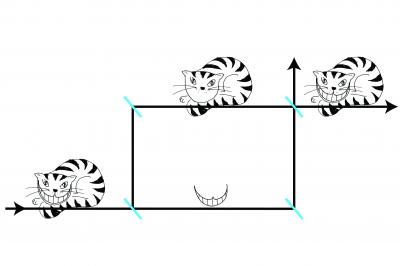
Caption: The basic idea of the Quantum Cheshire Cat: In an interferometer, an object is separated from one if its properties -- like a cat, moving on a different path than its own grin. Credit: TU Vienna / Leon Filter

Caption: The basic idea of the Quantum Cheshire Cat: In an interferometer, an object is separated from one if its properties — like a cat, moving on a different path than its own grin.
Credit: TU Vienna / Leon Filter

Here’s a link to and a citation for the paper,

Observation of a quantum Cheshire Cat in a matter-wave interferometer experiment by Tobias Denkmayr, Hermann Geppert, Stephan Sponar, Hartmut Lemmel, Alexandre Matzkin, Jeff Tollaksen, & Yuji Hasegawa. Nature Communications 5 Article number: 4492 doi:10.1038/ncomms5492 Published 29 July 2014

This is an open access paper.

Perhaps in response to concerns about the importance of theoretical physics, Chapman University’s Jeff Tollaksen offers this about possible applications  (from the Chapman University news release),

Co-Director of the Institute for Quantum Studies, Prof. Jeff Tollaksen has said: “Theoretical physics has yielded the most significant benefits for our society at the lowest costs. Discoveries in fundamental physics often lead to new industries: from electricity to smartphones to satellites. Quantum physics resulted in technological advances that drive our economy, such as the entire computer revolution, electronics, and the nuclear power industry. In addition, it impacts many other disciplines such as genetics, medicine and mathematics. Experts therefore estimate that nearly half the wealth created in the 20th century arose from quantum physics. At the Institute, we’re committed to producing the next generation of breakthroughs which will lead to the technology of the 21st century. Similarly, I’m sure this breakthrough will lead to many new applications including revised intuitions which can then serve as a guide to finding novel quantum effects.” This “Quantum Cheshire Cat” could be used for practical applications. For example, it could be used to make high precision measurements less sensitive to external perturbations. The measurements which now have been published in Nature Communications are the first experimental proof of this phenomenon.

By contrast the Europeans offer this,

With their landmark observation suitably vindicated, questions turn to the potential impact of their fundamental discovery. One application might high precision measurements of quantum systems which are often affected by disturbance.  [from the Institut Laue-Langevin news release]

Or, there’s this,

This counter intuitive effect is very interesting for high precision measurements, which are very often based on the principle of quantum interference. “When the quantum system has a property you want to measure and another property which makes the system prone to perturbations, the two can be separated using a Quantum Cheshire Cat, and possibly the perturbation can be minimized”, says Stephan Sponar. [from the Vienna University of Technology news release]

The contrast is certainly interesting.