Tag Archives: anti-adhesives

A bioinspired hydrogel patch with controllable adhesion properties for enhanced soft tissue repair

The paper’s graphical abstract presents some intriguing visuals,

Caption: Schematic representation of the A/B-sides multi-biological functional hydrogel patch. Credit: Wenle Chen from Shenzhen Second People’s Hospital, First Affiliated Hospital of Shenzhen University and Yu Wang from Wenzhou Institute, University of Chinese Academy of Sciences.

Let’s find out what those visuals were intended to convey, from an August 6, 2025 Songshan Lake Materials Laboratory (SLAB) press release on EurekAlert.org announced a bioinspired hydrogel patch,

A research team from Shenzhen University, University of Chinese Academy of Sciences and Hong Kong Polytechnic University has developed an innovative, bioinspired hydrogel patch with controllable adhesion properties to enhance soft tissue repair and prevent adhesions. Inspired by octopus suction cups and the eyeball surfaces, this patch features a dual-sided design: one side offers adjustable, revocable adhesion, while the other provides anti-adhesive functions. In vivo [animal] experiments demonstrate its effectiveness in reducing inflammation, promoting tissue healing, and allowing repositioning during surgical procedures, marking a significant advancement in biomedical materials.

Tissue repair required in scenarios such as trauma, post-operative of tumors is a common challenge for human healthcare. Soft tissue injuries and surgical wounds often face challenges such as excessive tissue adhesion, which can complicate healing and cause secondary complications. Traditional patches and sutures either lack adequate adhesion or induce unwanted tissue sticking, leading to inflammation and hindered recovery. There is an urgent need for biomaterials that can intelligently balance strong tissue integration with the ability to detach or reposition easily, matching the dynamic environment of internal tissues.

In this context, hydrogel patches, owing to their exceptional biocompatibility and potential adhesive properties, are expected to become ideal materials for soft tissue repair. These materials can gradually degrade, naturally integrate with human tissues, and easily incorporate drugs or growth factors to promote angiogenesis, thereby enhancing the speed and quality of tissue healing. In general, the common hydrogel patches can be divided into adhesive ones and anti-adhesive ones. Adhesive patches can form rapid and strong covalent bonds with moist tissue to promote tissue regeneration, whose further applications are limited by excessive tissue adhesion. While anti-adhesive patches can address the tissue adhesion problem by hydrophobic surface modification or coarse structure design, they are difficult to fit the wounds tightly for treatment. Hence, it is necessitating to design an anisotropic patch combining the merits of promoting tissue regeneration and anti-adhesive function.

The Solution: Drawing inspiration from nature, interdisciplinary research team engineered a novel hydrogel patch that mimics natural mechanisms using suction cup-like structures for physical, reversible adhesion and covalent bonds for permanent fixation. The patch’s adhesive side uses microstructures that generate negative pressure for temporary adhesion, allowing surgeons to adjust its position during surgery, once aligned, chemical reactions secure a firm, covalent attachment. The other side is made of highly hydrated, anti-adhesive materials to prevent surrounding tissue from sticking undesirably. Additionally, the patch absorbs positively charged inflammatory factors and provides sustained drug release, further aiding in inflammation reduction and tissue regeneration.

The bioinspired system features a multi-functional, dual-sided hydrogel patch composed of polyacrylic acid-NHS for the adhesive surface, and polyvinyl alcohol (PVA) combined with polyethylene glycol diacrylate (PEGDA) for the anti-adhesive barrier. Its porous network not only enables physical and chemical adhesion but also captures inflammatory cytokines, fostering a more favourable healing environment. In vivo tests in animal models confirmed the patch’s strong, controllable adhesion, its ability to prevent unwanted tissue adhesion, and its capacity to promote faster, healthier tissue repair.

The Future: This innovative hydrogel patch represents a significant step forward in the field of soft tissue repair. It combines the benefits of promoting tissue regeneration and preventing adhesion into one device. Future research will focus on optimizing the patch’s properties for specific clinical applications, such as abdominal wall defect repair and other dynamic wound management scenarios. The development of advanced manufacturing technologies like 3D bioprinting could also enable the customization of patch geometry for specific anatomical structures. Additionally, the exploration of environmentally adaptive intelligent components could lead to a more precise control of adhesion and drug release that aligns with the tissue regeneration process.

The Impact: This hydrogel patch offers a new paradigm for soft tissue repair with its “revocable” adhesion properties. It has the potential to significantly reduce clinical adhesion scores, effectively reduce inflammation, promote wound healing, and enhance collagen deposition. The successful integration of controllable adhesion and anti-adhesion functions in one patch could revolutionize the way we approach soft tissue repair and adhesion prevention in clinical settings.

Here’s a link to and a citation for the paper,

Bioinspired hydrogel patch with controllable adhesion for soft tissue repair by Wenle Chen, Wenzhao Li, Puxiang Lai, Jian Cai, Lingyu Sun, Yu Wang. Materials Futures, Volume 4, Number 3 Published Date: July 20, 2025 DOI: 10.1088/2752-5724/adec0a © 2025 The Author(s). Published by IOP Publishing Ltd on behalf of the Songshan Lake Materials Laboratory

This paper is open access.

Bacteria and an anti-biofilm coating from Ben Gurion University of the Negev (Israel)

This anti-biofilm acts as an anti-adhesive and is another approach to dealing with unwanted bacteria on medical implants and on marine equipment. From an April 25, 2016 news item about the Israeli research on ScienceDaily,

Researchers at Ben-Gurion University of the Negev (BGU) have developed an innovative anti-biofilm coating, which has significant anti-adhesive potential for a variety of medical and industrial applications.

According to the research published in Advanced Materials Interfaces, anti-adhesive patches that are developed from naturally occurring biomaterials can prevent destructive bacterial biofilm from forming on metal surfaces when they are immersed in water and other damp environments.

An April 25, 2016 American Associates Ben Gurion University of the Negev news release (also on EurekAlert), which originated the news item, describes the research further without adding much detail (Note: A link has been removed),

“Our solution addresses a pervasive need to design environmentally friendly materials to impede dangerous surface bacteria growth,” the BGU researchers from the Avram and Stella Goldstein-Goren Department of Biotechnology Engineering explain. “This holds tremendous potential for averting biofilm formed by surface-anchored bacteria and could have a tremendous impact.”

biofouling

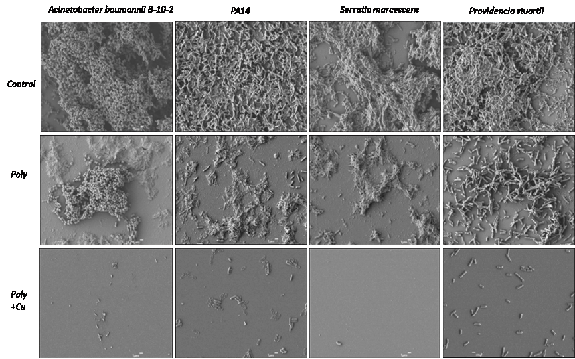
Above: SEM micrographs of A. baumannii, P. aeruginosa (PA14), S. marcescens and P.stuartii biofilm architectures. The untreated control surface shows intricate bacteria densely embedded in the matrix. Biofilms were grown statically on the different surfaces.

The anti-adhesive could be used on medical implants, devices and surgical equipment where bacteria can contribute to chronic diseases, resist antibiotic treatment and thereby compromise the body’s defense system. The prevention of aquatic biofouling on ships and bridges is one of the industrial applications.
Here’s a link to and a citation for the paper,

Novel Anti-Adhesive Biomaterial Patches: Preventing Biofilm with Metal Complex Films (MCF) Derived from a Microalgal Polysaccharide by Karina Golberg, Noa Emuna, T. P. Vinod, Dorit van Moppes, Robert S. Marks, Shoshana Malis Arad, and Ariel Kushmaro. Advanced Materials DOI: 10.1002/admi.201500486 Article first published online: 17 MAR 2016

© 2016 WILEY-VCH Verlag GmbH & Co. KGaA, Weinheim

This article is behind a paywall.

Opposite world: developing anti-adhesion surfaces

The power of the metaphor/analogy is demonstrated in a Sept. 24, 2013 news item on ScienceDaily where they’ve mentioned insects in the context of anti-adhesion—the opposite of how insects are usually referenced, i.e., how well they stick to surfaces and the search for better adhesives. Or you could put it down to lazy reading on my part as it took me a minute or so to make sense of what I was reading (from the news item),

Beetles, cockroaches, and ants will have a harder time walking up the sides of buildings or air conditioners in the future — thanks to the bio-inspired, anti-adhesive surfaces Prof. Dr. Thomas Speck, Dr. Bettina Prüm, and Dr. Holger Bohn are developing together with the Plant Biomechanics Group of the University of Freiburg. The team studied plant surfaces in order to determine what influence cell form and microstructure as well as surface chemistry exert on the adhesion behavior of insects.

The Sept. 24, 2013 University of Freiburg (Germany) press release,which originated the news item, describes the research and the new anti-adhesive surface in more detail,

The researchers conducted adhesion experiments in which Colorado potato beetles walked across differently structured plant surfaces as well as replicas made of synthetic resins. The team used a highly sensitive sensor to measure the traction forces of the beetles on various surfaces. They discovered that wavy or strongly curved cells can increase the adhesive powers of beetles, whereas microstructures composed of wax crystals or cuticular folds reduce them. The latter are tiny folds in the cuticle, a protective layer on the surface of the leaf resembling polyester. The beetles had the hardest time walking on surfaces with cuticular folds with a height and width of approximately 0.5 micrometers and a spacing of between 0.5 and 1.5 micrometers. “That is the perfect anti-adhesion surface. The insects slip off of it much easier than off glass,” says project director Thomas Speck. The cuticular folds reduce the contact area between the adhesive hairs on the beetles’ legs and the plant surface. Unlike on more coarsely structured surfaces, the beetle can’t dig its feet firmly into the cuticular folds. Thus, the microstructure of the surface has a stronger effect on the adhesion of the beetle than the cell form.

The team also took contact angle measurements to investigate the wettability of the various surfaces. The researchers used hydrophobic and hydrophilic artificial moldings of the microstructured plant surfaces in order to study the influence of the surface chemistry on surface wettability and the beetles’ walking behavior. Much like wax crystals, cuticular folds are very good at repelling water. In contrast to the wettability, which depends on both the microstructure and the surface chemistry, the walking behavior of the beetles is not influenced by the surface chemistry. This means that the beetle’s adhesive power depends solely on the physical microstructure of the surface.

Here’s a link to and a citation for the researchers’ paper,

Plant surfaces with cuticular folds and their replicas: Influence of microstructuring and surface chemistry on the attachment of a leaf beetle by Bettina Prüm, Holger Florian Bohn, Robin Seidel, Stephan Rubach, and Thomas Speck. Acta Biomaterialia Volume 9, Issue 5, May 2013, Pages 6360–6368

This paper is behind a paywall.