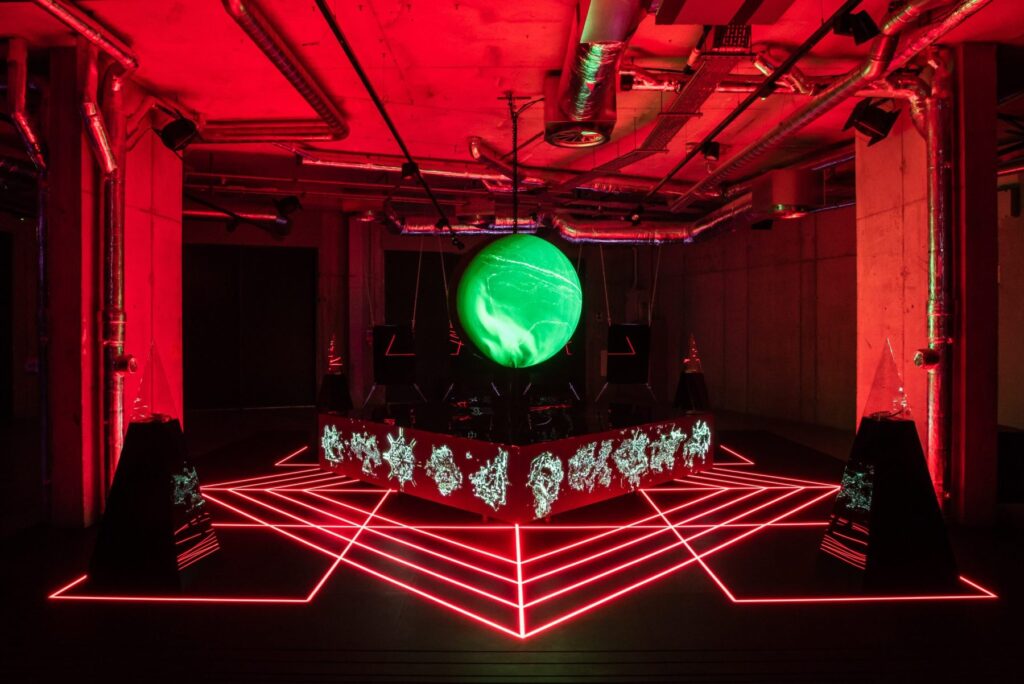
Spanning religiosity, science fiction, contemporary perspectives on artificial intelligence, and the techno-industrial complex, artist Zach Blas and writer/editor Jayne Wilkinson will be discussing CULTUS, an art installation currently being shown as part of the Belkin Gallery’s January 12 – April 14, 2024 exhibition, Aporia (Notes to a Medium),
Zach Blas, CULTUS , 2023, from the 2024 exhibition at Arebyte Gallery, London, UK. Courtesy of the artist. Photo: Max Colson
Here’s what the folks at the Belkin Art Gallery (Morris and Helen Belkin Art Gallery) had to say in their January 30, 2024 announcement (received via email),
Artist Talk with Zach Blas and Jayne Wilkinson
Thursday, February 1 at 5 pm
Please join us for a lecture by interdisciplinary artist Zach Blas, with a dialogue to follow with writer/editor Jayne Wilkinson. Blas will discuss his most recent work, CULTUS, the second in a trilogy of queer science-fiction installations addressing the beliefs, fantasies and histories that are influential to the contemporary tech industry. CULTUS (the Latin word for “worship”) considers the God-like status often afforded to artificial intelligence (AI) and examines how this religiosity is marshalled to serve beliefs about judgement and transcendence, extraction and immortality, pleasure and punishment, individual freedom and cult devotion. The conversation to follow will address some of the pressing intersecting political and ethical questions raised by both using and critiquing contemporary image technologies like AI.
This conversation will be audio-recorded; email us at belkin.gallery@ubc.ca if you are interested in listening to the recording following the event.
This talk is presented in conjunction with the Belkin’s exhibition Aporia (Notes to a Medium) and Critical Image Forum, a collaboration between the Belkin and the Department of Art History, Visual Art and Theory at UBC.
For anyone (like me) who’s never heard of either Blas or Wilkinson, there’s more on the Belkin’s event page,
Zach Blas is an artist, filmmaker and writer whose practice draws out the philosophies and imaginaries residing in computational technologies and their industries. Working across moving image, computation, installation, theory and performance, Blas has exhibited, lectured and held screenings at venues including the 12th Berlin Biennale for Contemporary Art, Whitney Museum of American Art, Tate Modern, 12th Gwangju Biennale and e-flux. His 2021 artist monograph Unknown Ideals is published by Sternberg Press. Blas is currently Assistant Professor of Visual Studies at the University of Toronto.
Jayne Wilkinson is a Toronto-based art writer and editor.
Should you be interested in attending the talk and/or the exhibition, here are some directions, from the Belkin Gallery’s Visit webpage,
Directions
The Morris and Helen Belkin Art Gallery is located at the University of British Columbia Vancouver campus, 1825 Main Mall, Vancouver BC, V6T 1Z2
TransLink offers many routes to UBC, including several express services (44, 84, R4, 99). The UBC Bus Loop is the last stop for each of these buses, and is located in the central area of campus near the AMS Nest. To get to the gallery, walk west on University Boulevard. (about 1 block) until you reach Main Mall. Turn right onto Main Mall and continue for about 3 blocks until you reach Crescent Road. We are located on your left at the corner of Main Mall and Crescent Road, near the Flagpole Plaza.
By Car
From downtown Vancouver, proceed west on West 4th Avenue, which becomes Chancellor Blvd and then merges with NW Marine Drive. Continue west on NW Marine Drive, to the Rose Garden Parkade (on your left).
From the airport, proceed to SW Marine Drive. Stay on SW Marine Drive, which eventually merges with NW Marine Drive. Continue just past the Museum of Anthropology (on your left) to the Rose Garden Parkade (on your right).
Accessibility
Entrance
The Belkin is wheelchair accessible. The main entrance is located on the east side of the building next to Main Mall. For people requiring wheelchair or easier accessibility, use the ramp from Crescent Road to access the main gallery doors. This entrance is level and accessible and has both a revolving door and a powered wheelchair-accessible door.
Washrooms
Washrooms are all-gender and include two multi-stall washrooms with wheelchair-accessible stalls and one stand-alone washroom that is wheelchair accessible.
Seating
Portable gallery stools are available for use.
Large Print Materials
Large print materials are available.
ASL Interpretation
ASL interpreters are available upon request for Belkin programs and events. To request interpretation for an event or tour, please contact us in advance.
Service Animals
Service dogs are welcome to accompany visitors.
Scent
The Belkin’s office is scent free. Occasionally, there are works or projects that are scent-focused.
Please ask our staff if you require any assistance or have any questions.
The drift in “Drift: Art and Dark Matter” (at the Belkin Art Gallery) comes from a mining term for an almost horizontal passageway or tunnel in a mine. (This makes sense when you realize SNOLAB is one of the partners for this show. For anyone unfamiliar with SNOLAB, there is more coming shortly.)
The show itself appears to be a suite of multimedia installations from four artists, which were first shown at the Agnes Etherington Art Centre at Queen’s University, Ontario.
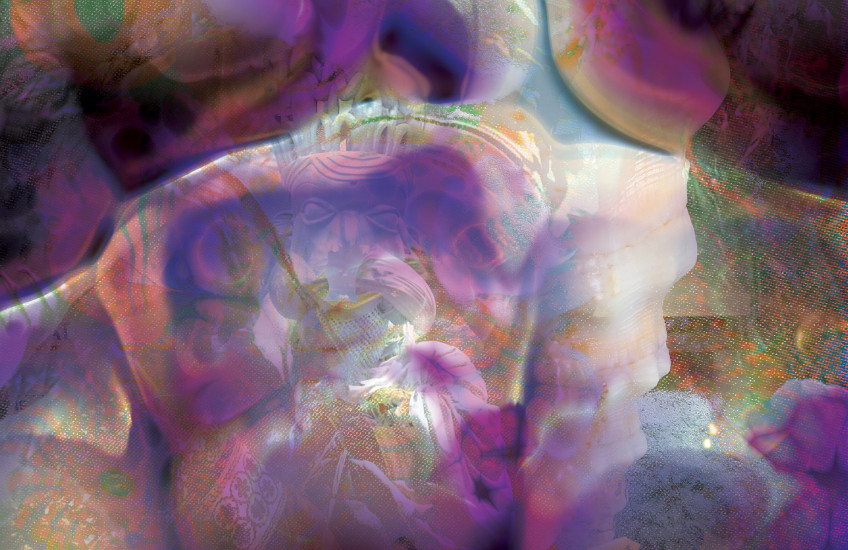
Image: Josèfa Ntjam, Organic Nebula, 2019, photomontage, mixed techniques. Collection of the artist [one of the Drift show artists]
For anyone who’s primarily interested in the show’s Belkin Gallery appearance, scroll down to the “Drift moves to the Belkin in British Columbia” subhead where you’ll find an invitation to the show’s opening and more about the BC collaboration. **As of Sept. 9, 2021, I have updated the ‘questions’ subsection (scroll down to ?) with newly arrived answers.**
Drift: the show and the art/science residencies at Queen’s University
This show, which ran from 20 February to 30 May 2021, had its start at Queen’s University (Ontario) where it featured astroparticle physics, art/science residencies, and artists Nadia Lichtig, Josèfa Ntjam, Anne Riley and Jol Thoms, (from the Drift: Art and Dark Matter exhibition webpage on the Agnes Queen’s University site; Note: The Agnes is also known as, the Agnes Etherington Art Centre), Note: A link has been removed,
Some kind of invisible matter is having a gravitational effect on everything. Without the gravity of this “dark” matter, galaxies would fly apart. Observational data in astroparticle physics indicate that it exists, but so far dark matter hasn’t been directly detected. Given the contours of such an unknown, artists Nadia Lichtig, Josèfa Ntjam, Anne Riley and Jol Thoms reflect on the “how” and “why” of physics and art as diverse and interrelating practices of knowledge. Through open exchange between disciplines, they have created works that are sensory agents between scientific ideas of dark matter and the exploration of that which has never been directly sensed.
Drift: Art and Dark Matter is a residency and exhibition project generated by Agnes Etherington Art Centre, the Arthur B. McDonald Canadian Astroparticle Physics Research Institute and SNOLAB. Four artists of national and international stature were invited to make new work while engaging with physicists, chemists and engineers contributing to the search for dark matter at SNOLAB’s facility in Sudbury, two kilometres below the surface of the Earth.
The title Drift draws from the mining term for a horizontal tunnel, in this case the hot underground passageway in the copper and nickel mine stretching between the elevator and the clean lab spaces of SNOLAB. The project thereby begins from a reflection on the forms and energies that connect physics to art, labour, landscapes, cultures and histories.
We acknowledge the support of the Canada Council for the Arts, Ontario Arts Council, an agency of the Government of Ontario, City of Kingston Arts Fund through the Kingston Arts Council and the George Taylor Richardson Memorial Fund at Queen’s University.
Partners
The Arthur B. McDonald Canadian Astroparticle Physics Research Institute is the Canadian hub for astroparticle physics research, uniting researchers, theorists, and technical experts within one organization. Located at and led by Queen’s University, the McDonald Institute is proud to have thirteen partner universities and research institutes across the country, all of which are key players in Canada’s past and future innovation in astroparticle physics.
SNOLAB is a world-class science facility located deep underground in the operational Vale Creighton nickel mine, near Sudbury, Ontario in Canada. The combination of great depth and cleanliness that SNOLAB affords allows extremely rare interactions and weak processes to be studied. The science programme at SNOLAB is currently focussed on sub-atomic physics, largely neutrino and dark matter physics. SNOLAB seeks to enable, spearhead, catalyze and promote underground science, while inspiring both the public and future professionals in the field.
SNO stands for Sudbury Neutrino Observatory according to the information in my June 6, 2019 posting about a then upcoming talk tiled, Whispering in the Dark: Updates from Underground Science. More recently, I noted that TRIUMF’s (Canada’s national particle accelerator centre) new Chief Executive Officer, Nigel Smith, was moving to Vancouver from Sudbury’s SNOLAB in my May 12, 2021 posting.
Nadia Lichtig is an artist currently living in the South of France. In her multilayered work, voice is transposed into various media including painting, print, sculpture, photography, performance, soundscape and song—each medium approached not as a field to be mastered, but as a source of possibilities to question our ability to decipher the present. Visual and aural aspects entangle in her performances.
Lichtig studied linguistics at the LMU Munich in Germany and at the Ecole des Beaux-Arts de Paris, France with Jean-Luc Vilmouth, where she graduated with honours in 2001, before assisting Mike Kelley in Los Angeles, USA the same year. She taught at the Shrishti School of Art and Technology, Bangalore, India as a visiting professor in 2006, at the Ecole des Beaux-Arts of Valence in 2007, and is professor of Fine Arts at the Ecole Supérieure des Beaux-arts of Montpellier (MOCO-ESBA), France since 2009. She has collaborated with musicians who are also visual artists, such as Bertrand Georges (Audible), Christian Bouyjou (Popopfalse), Nicolu (La Chatte), Nina Canal (Ut) and Michael Moorley (The dead C). Nadia Lichtig worked and works under several group names and pseudonyms (until 2009: EchoparK, Falseparklocation, Skrietch, Ghosttrap and Nanana).
Josèfa Ntjam was born in 1992 in Metz (FR), and currently lives and works in Paris. Ntjam is part of a generation of artists who grew up with the internet, communicating and sending images by electromagnetic wave. Working with video, text, installation, performance and photomontage, Ntjam creates a story with every piece that acts as a reflection of the world around her. Drawing connections to science fiction and the cosmos, Ntjam has said of her work, “I sat there some time ago with Sun Ra in his Spaceship experimenting with a series of alternative stories. An exoteric syncretism with which I travel as a vessel in perpetual motion.”
Ntjam studied in Amiens and Dakar (Cheikh Anta Diop University) and graduated from l’Ecole Nationale Supérieure d’Art, Bourges (FR) and Ecole Nationale Supérieure d’Art, Paris-Cergy (FR). Her works and performance have been shown at numerous venues such as the 15th Biennial of Lyon, DOC! Paris, a la Zentral (CH), Palais de Tokyo, Beton Salon, La Cite internationale des arts, la Bienanale de Dakar (SN), Let Us Rflect Festival (FR), FRAC de Caen, and CAC Bretigny.
Anne Riley is a multidisciplinary artist living as an uninvited Slavey Dene/German guest from Fort Nelson First Nation on the unceded Territories of the Musqueam, Squamish and Tsleil-waututh Nations. Her work explores different ways of being and becoming, touch, and Indigeneity. Riley received her BFA from the University of Texas at Austin in 2012. She has exhibited both in the United States and Canada. Currently she is working on a public art project commissioned by the City of Vancouver with her collaborator, T’uy’tanat Cease Wyss. Wyss and Riley’s project A Constellation of Remediation consists of Indigenous remediation gardens planted throughout the city, decolonizing and healing the dirt back to soil. The duo was longlisted for the 2021 Sobey Art Award.
Riley’s that brings the other nearly as close as oneself, included in the 2015 exhibition Every Little Bit Hurts at Western Front, foregrounded touch, impression and embodied experience. It featured a wall drawing created by the artist rubbing, dragging and moving her body across the gallery wall wearing raw-dyed denim. “I’m interested in queer touch as a radical act,” she says. “It’s not always possible because of fear. But I’m also investigating first touch between mother and child. I have the same hands as my mother and my great grandmother.”
Jol Thoms is a Canadian-born, European-based artist, author and sound designer. Both his written and moving-image work engage posthumanism, feminist science studies, general ecology and the environmental implications of pervasive technical/sensing devices. In the fields of neutrino and dark matter physics he collaborates with renowned physics institutes around the world. These “laboratory-landscapes” are the focus of his practice led PhD at the University of Westminster. In 2017 Thoms was a fellow of Schloss Solitude and resident artist at the Bosch Campus for Research and Advanced Engineering.
Thoms graduated with an Honors BA in Philosophy, Art History and Visual Studies from the University of Toronto (2009) and later studied under Prof. Simon Starling at the Städelschule in Frankfurt (2013). Between 2014 and 2016 he developed and taught an experimental creative-research program for architecture students at the University of Braunschweig with then interim director Tomás Saraceno. In 2016 Thoms won the MERU Art*Science Award for his film G24|0vßß, which was installed in the Blind Faith: Between the Cognitive and the Visceral in Contemporary Art group exhibition at Haus der Kunst, Munich.
Drift moves to the Belkin in British Columbia
An invitation (also received via email) to the show’s launch in BC is for the evening before the show officially opens,
Thursday 9 Sep 2021, 6 pm
Please join us for the opening of Drift: Art and Dark Matter with a performance-conversation between artists Denise Ferreira da Silva and Jol Thoms. This event is free and open to the public, but space is limited due to COVID-19 safety protocols. To ensure a spot, please RSVP to belkin.rsvp@ubc.ca.
Opening remarks will begin at 6 pm, followed by a conversation with Ferreira da Silva and Thoms who will touch on intersections between the films Soot Breath / Corpus Infinitum (2021) and n-Land (2021), both of which will play throughout the evening on the Belkin’s Outdoor Screen.
Soot Breath / Corpus Infinitum (2021) is a film collaboration between Arjuna Neuman and Denise Ferreira da Silva. Moving across scales geologic, historic-cultural, quantum and cosmic, the work reimagines knowledge and existence without the limits of European and Colonial constructions of the human.
n-Land (2021) is an audio-visual composition by Jol Thoms. Examining context and agency through scales at once geologic, cosmic and human, the piece probes the ecological ethics of our time through a holographic, multi-dimensional view of the SNOLAB site.
…
The official dates for Drift are Friday, September 10, 2021to December 5, 2021.
As best as I can tell from the Morris & Helen Belkin Art Gallery (the Belkin) homepage description of ‘Drift’, the show will comprise the original series of installations from the four artists featured at the Agnes. The new work from art/science residencies at the University of British Columbia (UBC), where the Belkin is located will be featured in artist talks and in a symposium to be held in November 2021.
Here’s how the newest residencies are described and a list of the various supporting agencies in an undated announcement on the Galleries West website,
…
As a complement to the Drift exhibition, the Belkin is collaborating with the Stewart Blusson Quantum Matter Institute (SBQMI) and the Department of Physics and Astronomy at UBC on Ars Scientia [emphasis mine], an interdisciplinary research project fusing the praxes of art and science that will include artist-scientist residencies and a research symposium.
We acknowledge the support of the Canada Council for the Arts, Ontario Arts Council, an agency of the Government of Ontario, City of Kingston Arts Fund through the Kingston Arts Council and the George Taylor Richardson Memorial Fund at Queen’s University. The project is curated by Sunny Kerr, Curator of Contemporary Art at Agnes Etherington Art Centre. The Belkin gratefully acknowledges [emphasis mine] the generous support of the Canada Council for the Arts, the Province of British Columbia through the BC Arts Council, UBC Grants for Catalyzing Research Clusters, and our Belkin Curator’s Forum members.
Ars Scientia
There’s a brief description of Ars Scientia in the graduate school webspace located on the UBC website. Emily Wight’s March 22, 2021 article for the Stewart Blusson Quantum Matter Institute (SBQMI) provides more detail about Ars Scientia (the first para. is the least interesting),
The Stewart Blusson Quantum Matter Institute (Blusson QMI) has partnered with the Morris & Helen Belkin Art Gallery (the Belkin) and UBC’s Department of Physics and Astronomy (UBC PHAS) in Ars Scientia, a new project that connects physicists and artists in an effort to find shared ways of communicating about science and explaining the world around us. The partnership was recently awarded two years of funding through the UBC Research Excellence Cluster program.
Though the project is in its early days, the team at Ars Scientia is already working quickly to partner scientists with artists who will conduct six-month residencies in order to explore the potential for academic art-science collaborations; much of the cluster’s early programming will be in support of DRIFT: Art and Dark Matter (DRIFT), an exhibit set to debut at the Belkin in September 2021. DRIFT is a collaborative exhibit that has linked artists and scientists in exploring ways of describing that which exists beyond the limits of our language and understanding; most recently, the exhibit connected the Agnes Etherington Art Centre at Queen’s University, the Arthur B. McDonald Canadian Astroparticle Physics Research Institute, and SNOLAB.
This partnership is a promising early step in Blusson QMI’s mission to engage meaningfully with the art community and external audiences, and an opportunity for an enriching exchange of knowledge and perspective. Students in particular will benefit from this exchange; by inviting artists into labs and research spaces, trainee scientists will gain valuable insight into how someone with different expertise might interpret their work, and how to communicate more effectively about their research. New programs are under development and will be announced soon.
Ars Scientia is co-led by Andrea Damascelli, UBC PHAS [Dept. of Physics and Astronomy] Professor and Blusson QMI Scientific Director; Jeremy Heyl, UBC PHAS Professor; and Shelly Rosenblum, Curator of Academic Programs at the Belkin, and supported by a team of staff including Program Manager James Day.
Ars Scientia: Merging Artistic Practice with Scientific Research
The long search for dark matter has put the spotlight on the limitations of human knowledge and technological capability. Confronted with the shortcomings of our established modes of detecting, diagnosing and testing, the search beckons the creation of new ways of learning and knowing. Fusing the praxes of arts and science in the emergent fields of interdisciplinary research, Ars Scientia, a tripartite partnership between UBC’s Stewart Blusson Quantum Matter Institute (SBQMI), the Department of Physics and Astronomy and the Belkin, presents an opportunity to foster new modes of knowledge exchange across the arts, sciences and their pedagogies. Funded by UBC’s Research Excellence Cluster program, Ars Scientia will conduct rich programming and research to address this line of inquiry over the next two years beginning in 2021.
The Ars Scientia research cluster has begun this interdisciplinary work by partnering scientists with artists to conduct six-month residencies that explore the potential for academic art-science collaborations. [List is not complete] Artists Justine A. Chambers, Josephine Lee, Khan Lee and Kelly Lycan have partnered with physicists Rysa Greenwood, Alannah Hallas, Daniel Korchinski, Kirk Madison, Sarah Morris and Luke Reynolds to identify areas of collaborative research in pursuit of both scientific and artistic aims. The residencies will culminate in a research symposium where collaborative findings will be shared, set to take place in November 2021 [emphases mine].
There is what seems to be a more complete list of the participants in the Belkin/Blusson residency on the same webpage as the undated announcement of the above,
Justine A. Chambers
Andrea Damascelli
James Day
Rysa Greenwood
Jeremy Heyl
Daniel Korchinski
Josephine Lee
Khan Lee
Kelly Lycan
Kirk Madison
Susana Mendez Álcala
Sarah Morris
Marcus Prasad
Luke Reynolds
Shelly Rosenblum
Emily Wight
You’ll notice two things should you go to the undated announcement. First, some of the names are clickable; these are the artists’ biographies. Second, Emily Wight who wrote the March 22, 2021 article for the Stewart Blusson Quantum Matter Institute (SBQMI) is also on the list. I also noticed that a couple of the names belong to people who are staff members, James Day (Ars Scientia Program Manager) and Marcus Prasad (from his personal website: Academic Programs Assistant at the Belkin Assistant Project Coordinator for Ars Scientia).
?
On Thursday, Sept. 2, 2021, I emailed some followup questions for the folks at the Belkin. Sadly, I failed to take into account that long weekend, which gave them very little time to respond before I planned to post this. Should I receive any replies, I will update this posting.
*ETA September 9, 2021: Marcus Prasad, Academic Programs Assistant at the Belkin Assistant Project Coordinator for Ars Scientia, very kindly sent answers to the questions:
Here are the questions:
Would you have any details about the talks, projects, and/or symposium?
*One of Ars Scientia’s main projects is a residency program between UBC physicists and 4 artists who have been paired up or grouped together to think through an arts-science collaboration. As practicing professionals in their respective fields, they have been asked to think about points of intersection and difference in their disciplines, as well as to formulate new ways of knowing and learning from each other. The intent of this residency program is to provide time and space for these collaborations to unfold in whatever way the participants desire. We plan to have a symposium/gathering event at the end of November where findings from these collaborations can be presented in a large discussion. While this research cluster is topically related to the Drift exhibition at the Belkin, it is somewhat of a separate entity. Programming in the research cluster complements the Belkin’s exhibition, but will continue over the next couple of years after Drift has left the gallery. [emphases mine]
Will there be an online version of the BC work? (e.g., the Agnes had and still has an online version of the show.)
*I am unsure what kind of online presence the Belkin will have for the works in the exhibition specifically, but documentation of related events and programming is often made available on their website.
I noticed that Emily Wight who wrote the March 22, 2021 article about the show for the ‘Stewart Blusson’ is also listed as one of the participants. The only (more or less) relevant online reference I could find for Ms. Wight was at Carleton University for a student art show. Is this the same person? Is she an artist and/or writer who’s participating in the residency?
*Emily Wight is part of the steering committee for Ars Scientia, along with myself, James Day, and Susana Mendez Álcala. Shelly Rosenblum, Andrea Damascelli, and Jeremy Heyl are the cluster co-leads, and the rest of the listed names are either artists or physicists participating in the residency.
**Note: Susana Mendez Álcala is the Large Grants and Awards Officer at the SBQMI.
Will there be some talks that focus on astrophysics? e.g., Might someone from TRIUMF such as the new CEO, Nigel Smith who came here from the SNOLAB give a talk? [See my May 12, 2021 posting about TRIUMF’s new Chief Executive Office {CEO}]
Following on that thought, will there be any joint events with other organizations as there were with The Beautiful Brain show? [See my September 11, 2017 posting titled: “Art in the details: A look at the role of art in science—a Sept. 19, 2017 Café Scientifique event in Vancouver, Canada” for more about that exhibit and its associated events ?
*To my knowledge, we have not planned for a talk with TRIUMF as of yet. The QMI is working on programming with the H.R. MacMillan space centre for Dark Matter Days, however, and we do plan to expand our reach to other organizations in the second year of our cluster.
**Prasad also had this to say: “… we are in the midst of getting an Ars Scientia website up, so there’ll be more concrete information on there to come.”
**Thank you to Marcus Prasad for the answers and for clearing up a few matters that I had not thought to ask about.**
One comment: I have had difficulties accessing the Belkin Gallery website, e.g., most of Wednesday, Sept. 1, 2021 and on the morning of Friday, September 3, 2021. Hopefully, they’re experiencing just a few glitches and nothing more serious.