Tag Archives: Daniel Wigdor

Toronto’s ArtSci Salon is hosting a couple more October 2025 events

I have two art/science events and one art/science conference/festival (IRL [in real life or in person] and Zoom) taking place in Toronto, Ontario.

October 16, 2025

There is a closing event for the “I don’t do Math” series mentioned in my September 8, 2025 posting,

ABOUT
“I don’t do math” is a photographic series referencing dyscalculia, a learning difference affecting a person’s ability to understand and manipulate number-based information.

This initiative seeks to raise awareness about the challenges posed by dyscalculia with educators, fellow mathematicians, and parents, and to normalize its existence, leading to early detection and augmented support. In addition, it seeks to reflect on and question broader issues and assumptions about the role and significance of Mathematics and Math education in today’s changing socio-cultural and economic contexts. 

The exhibition will contain pedagogical information and activities for visitors and students. The artist will also address the extensive research that led to the exhibition. The exhibition will feature two panel discussions following the opening and to conclude the exhibition.

I have some information from an October 12, 2025 ArtSci Salon announcement (received via email) about the “I don’t do math” closing event,

in us for 

Closing Exhibition Panel Discussion
Thursday, October 16 2025
10:00 am -12:00 pm room 309
The Fields Institute for Research in Mathematical Sciences (or online)

Artist Ann Piché will be in conversation with
Andrew Fiss, Jacqueline Wernimont, Amenda Chow, Ellen Abrams, Michael Barany and JP Ascher

RSVP here

October 21, 2025

The second event mentioned in the October 12, 2025 ArtSci Salon announcement, Note 1: A link has been removed, Note 2: This event is part of a larger series,

Marco Donnarumma 
Monsters of Grace: bodies, sounds, and machines

Tuesday, October 21, 2025
3:30-4:30 PM
Sensorium Research Loft 
4th floor
Goldfarb Centre for Fine Arts
York University

About the talk
What is sound to those who do not hear it? How does one listen to something that cannot be heard? What kind of sensory gaps are created by aiding technologies such as prostheses and artificial intelligence (AI)? As a matter of fact, the majority of non-deaf people hear only partially due to age and personal experience. Still, sound is most often considered through the normalizing viewpoint of the non-deaf. If I become your body, what does sound become for me? Join us to welcome Marco Donnarumma  ahead of his new installation/performance at Paul Cadario Conference Room (Oct 22, 8-10 PM University College [University of Toronto] – 15 King’s College Circle). His talk will focus on this latest work in the context of a largest body of work titled “I Am Your Body,” an ongoing project investigating how normative power is enforced through the technological mediation of the senses.

About the artist:
Marco Donnarumma is an artist, inventor and theorist. His oeuvre confronts normative body politics with uncompromising counter-narratives, where bodies are in tension between control and agency, presence and absence, grace and monstrosity. He is best known for using sound, AI, biosensors, and robotics to turn the body into a site of resistance and transformation. He has presented his work in thirty-seven countries across Asia, Europe, North and South America and is the recipient of numerous accolades, most notably the German Federal Ministry of Research and Education’s Artist of the Science Year 2018, and the Prix Ars Electronica’s Award of Distinction in Sound Art 2017. Donnarumma received a ZER01NE Creator grant in 2024 and was named a pioneer of performing arts with advanced technologies by the major national newspaper Der Standard, Austria. His writings are published in Frontiers in Computer Science, Computer Music Journal and Performance Research, among others, and his newest book chapter, co-authored with Elizabeth Jochum, will appear in Robot Theaters by Routledge. Together with Margherita Pevere he runs the performance group Fronte Vacuo.


I wonder if Donnarumma’s “Monsters of Grace: bodies, sounds, and machines’ received any inspiration from “Monsters of Grace” (Wikipedia entry) or if it’s just happenstance, Note: Links have been removed,

Monsters of Grace is a multimedia chamber opera in 13 short acts directed by Robert Wilson, with music by Philip Glass and libretto from the works of 13th-century Sufi mystic Jalaluddin Rumi. The title is said to be a reference to Wilson’s corruption of a line from Hamlet: “Angels and ministers of grace defend us!” (1.4.39).

So, the October 21, 2025 event is a talk at York University taking place before the “Who’s afraid of AI? Arts, Sciences, and the Futures of Intelligence” (more below).

“Who’s afraid of AI? Arts, Sciences, and the Futures of Intelligence,” a conference and arts festival at the University of Toronto

The conference (October 23 – 24, 2025) is concurrent with the arts festival (October 19 – 25, 2025) at the University of Toronto. Here’s more from the event homepage on the https://bmolab.artsci.utoronto.ca/ website, Note: BMO stands for Bank of Montreal, Note: No mention of Edward Albee and “Who’s afraid of Virginia Woolf?,”

2025 marks an inflection point in our technological landscape, driven by seismic shifts in AI innovation.

Who’s Afraid of AI? Arts, Science, and the Futures of Intelligence is a week-long inquiry into the implications and future directions of AI for our creative and collective imaginings, and the many possible futures of intelligence. The complexity of these immediate future calls for interdisciplinary dialogue, bringing together artists, AI researchers, and humanities scholars.

In this volatile domain, the question of who envisions our futures is vital. Artists explore with complexity and humanity, while the humanities reveal the histories of intelligence and the often-overlooked ways knowledge and decision-making have been shaped. By placing these voices in dialogue with AI researchers and technologists, Who’s Afraid of AI? examines the social dimensions of technology, questions tech solutionism from a social-impact perspective, and challenges profit-driven AI with innovation guided by public values.

The two-day conference at the University of Toronto’s University College anchors the week and features panels and debates with leading figures in these disciplines, including a keynote by 2025 Nobel Laureate in Physics Geoffrey Hinton, the “Godfather of AI” and 2025 Neil Graham Lecturer in Science, Fei-Fei Li, an AI pioneer.

Throughout the week, the conversation continues across the city with:

  • AI-themed and AI powered art shows and exhibitions
  • Film screenings
  • Innovative theatre
  • Experimental music

Who’s Afraid of AI? demonstrates that Toronto has not only shaped the history of AI but continues to prepare its future.Step into this changing landscape and be part of this transformative dialogue — register today!

Organizing Committee:

Pia Kleber, Professor-Emerita, Comparative Literature, and Drama, U of T
Dirk Bernhardt-Walther, Department of Psychology, Program Director, Cognitive Science, U of T
David Rokeby, Director, BMO Lab, Centre for Drama, Theatre and Performance Studies, U of T
Rayyan Dabbous, PhD candidate, Centre for Comparative Literature, U of T

This looks like a pretty interesting programme (if you’re mainly focused on AI and the creative arts), from the event homepage on the https://bmolab.artsci.utoronto.ca/ website, Note 1: All times are ET, Note 2: I have not included speakers’ photos,

The conference will explore core questions about AI such as its capabilities, possibilities and challenges, bringing their unique research, creative practice, scholarship and experience to the discussion. Speakers will also engage in an interdisciplinary conversation on topics including AI’s implications for theories of mind and embodiment, its influence on creation, innovation, and discovery, its recognition of diverse perspectives, and its transformation of artistic, cultural, political and everyday practices.

Thursday, October 23, 2025

Mind the World

9 AM | Clark Reading Room, University College – 15 King’s College Circle

What are the merits and limits of artificial intelligence within the larger debate on embodiment? This session brings together an artist who has given AI a physical dimension, a neuroscientist who reckons with the biological neural networks inspiring AI, and a humanist knowledgeable of the longer history in which the human has tried to decouple itself from its bodily needs and wants.

Suzanne Kite
Director, The Wihanble S’a Center for Indigenous AI

James DiCarlo
Director, MIT Quest for Intelligence

N. Katherine Hayles
James B. Duke Distinguished Professor Emerita of Literature

Staging AI

11 AM | Clark Reading Room, University College – 15 King’s College Circle

How is AI changing the arts? To answer this question, we bring together theatre directors and artists who have made AI the main driving plot of their stories and those who opted to keep technology secondary in their productions.

Kay Voges
Artistic Director, Schauspiel Köln

Roland Schimmelpfennig
Playwright and Director, Berlin

Hito Steyerl
Artist, Filmmaker and Writer, Berlin

Recognizing ‘Noise’

2 PM | Clark Reading Room, University College – 15 King’s College Circle

How can we design a more inclusive AI? This session brings together an artist who has worked with AI and has been sensitive to groups who may be excluded by its practice, an inclusive design scholar who has grappled with AI’s potential for personalized accessibility, and a humanist who understands the longer history on pattern and recognition from which emerged AI.

Marco Donnarumma
Artist, Inventor, Theorist, Berlin

Jutta Treviranus
Director, OCADU [Ontario College of Art & Design University],
Inclusive Design Research Centre

Eryk Salvaggio
Media Artist and Tech Policy Press Fellow, Rochester

Art, Design, and Application are the Solution to AI’s Charlie Chaplain Problem

4 PM | Hart House Theatre – 7 Hart House Circle

Daniel Wigdor
CoFounder and Chief Executive Officer, AXL

Keynote and Neil Graham Lecture in Science

4:15 PM | Hart House Theatre – 7 Hart House Circle

Fei-Fei Li
Sequoia Professor in Computer Science, Stanford Institute for Human-Centered AI

Geoffrey Hinton
2024 Nobel Laureate in Physics, Professor Emeritus in Computer Science

Friday, October 24, 2025

Life with AI

9 AM | Clark Reading Room, University College – 15 King’s College Circle

How do machine minds relate to human minds? What can we learn from one about the other? In this session we interrogate the impact of AI on our understanding of human knowledge and tool-making, from the perspective of philosophy, computer science, as well as the arts.

Jeanette Winterson
Author, Fellow of the Royal Society of Literature, Great Britain

Leif Weatherby
Professor of German and Director of Digital Theory Lab at
New York University

Jennifer Nagel
Professor, Philosophy, University of Toronto Mississauga

Discovery & In/Sight

11 AM | Clark Reading Room, University College – 15 King’s College Circle

This session explores creative practice through the lens of innovation and cultural/scientific advancement. An artist who creates with critical inspiration from AI joins forces with an innovation scholar who investigates the effects of AI on our decision making, as well as a philosopher of science who understands scientific discovery and inference as well as their limits.

Vladan Joler
Visual Artist and Professor of
New Media, University of Novi Sad [Serbia]

Alán Aspuru-Guzik
Professor of Chemistry and Computer Science, University of Toronto

Brian Baigrie
Professor, Institute for the History and Philosophy of Science & Technology, University of Toronto

Social history & Possible Futures

2 PM | Clark Reading Room, University College – 15 King’s College Circle

How does AI ownership and its private uses coexist within a framework of public good? It brings together an artist who has created AI tools to be used by others, an AI ethics researcher who has turned algorithmic bias into collective insight, and a philosopher who understands the connection between AI and the longer history of automation and work from which AI emerged.

Memo Akten
Artist working with Code, Data and AI, UC San Diego

Beth Coleman
Professor, Institute of Communication, Culture, Information and Technology, University of Toronto

Matteo Pasquinelli
Professor, Philosophy and Cultural Heritage Università Ca’ Foscari Venezia [Italy]

A Theory of Latent Spaces | Conclusion: Where do we go from here?

4 PM | Clark Reading Room, University College – 15 King’s College Circle

Antonio Somaini, curator of the remarkable ‘World through AI’ exhibition at the Museé du Jeu de Paume in Paris, will discuss the way in which ‘latent spaces’, a core characteristic of current AI models as “meta-archives” that shape profoundly our relation with the past.

Following this, we will engage in a larger discussion amongst the various conference speakers and attendees on how we can, as artists, humanities scholars, scientists and the general public, collectively imagine and cultivate a future where AI serves the public good and enhances our individual and collective lives.”

Antonio Somaini
Curator and Professor, Sorbonne Nouvelle [Université Sorbonne Nouvelle]

You can register here for this free conference, although, there’s now a waitlist for in person attendance. Do not despair, there’s access by Zoom,

In case you can’t make it in person, join us by Zoom:

Link: https://utoronto.zoom.us/j/82603012955

Webinar ID: 826 0301 2955

Passcode: 512183

I have not forgotten the festival, from the event homepage on the https://bmolab.artsci.utoronto.ca/ website,

Events Also Happening

October 22 | 2 PM | Student Forum and AI Commentary Contest Award | Paul Cadario Conference Room, University College – 15 King’s College Circle

October 22 | 8 – 10 PM | Marco Donnarumma, world première of a new performance installation | Paul Cadario Conference Room, University College – 15 King’s College Circle

October 23 | 2 PM | Jeanette Winterson: Arts & AI Talk | Paul Cadario Conference Room, University College – 15 King’s College Circle

October 24 | 7 PM | The Kiss by Roland Schimmelpfennig | The BMO Lab, University College – 15 King’s College Circle (Note: we are scheduling more performances. Check back for more info soon!)

October 25 | 8 PM | AI Cabaret featuring Jason Sherman, Rick Miller, Cole Lewis, BMO Lab projects and more| Crow’s Theatre, Nada Ristich Studio-Gallery – 345 Carlaw Avenue..

Get tickets for the AI Cabaret

(Use promo code AICAB for 100% discount)

Enjoy!

An algorithm for modern quilting

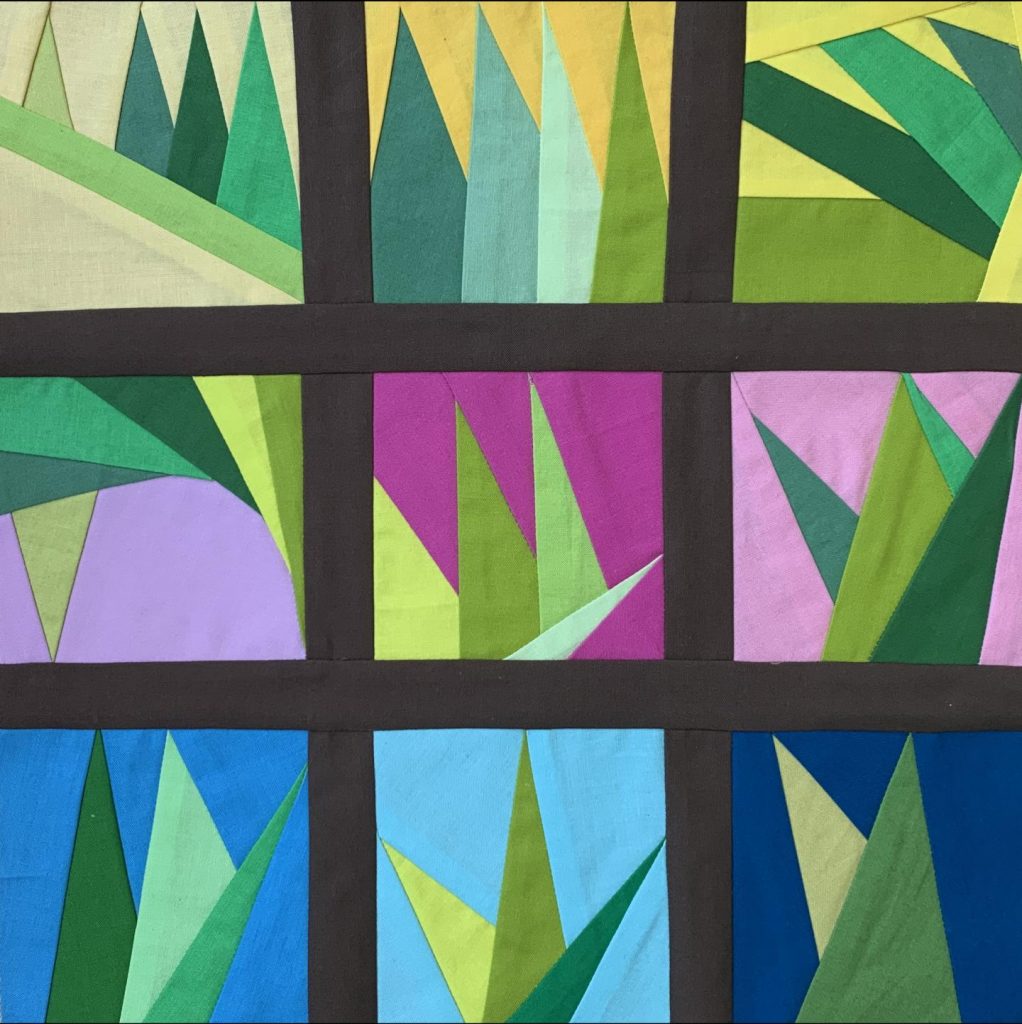
Caption: Each of the blocks in this quilt were designed using an algorithm-based tool developed by Stanford researchers. Credit: Mackenzie Leake

I love the colours. This research into quilting and artificial intelligence (AI) was presented at SIGGRAPH 2021 in August. (SIGGRAPH is, also known as, ACM SIGGRAPH or ‘Association for Computing Machinery’s Special Interest Group on Computer Graphics and Interactive Techniques’.)

A June 3, 2021 news item on ScienceDaily announced the presentation,

Stanford University computer science graduate student Mackenzie Leake has been quilting since age 10, but she never imagined the craft would be the focus of her doctoral dissertation. Included in that work is new prototype software that can facilitate pattern-making for a form of quilting called foundation paper piecing, which involves using a backing made of foundation paper to lay out and sew a quilted design.

Developing a foundation paper piece quilt pattern — which looks similar to a paint-by-numbers outline — is often non-intuitive. There are few formal guidelines for patterning and those that do exist are insufficient to assure a successful result.

“Quilting has this rich tradition and people make these very personal, cherished heirlooms but paper piece quilting often requires that people work from patterns that other people designed,” said Leake, who is a member of the lab of Maneesh Agrawala, the Forest Baskett Professor of Computer Science and director of the Brown Institute for Media Innovation at Stanford. “So, we wanted to produce a digital tool that lets people design the patterns that they want to design without having to think through all of the geometry, ordering and constraints.”

A paper describing this work is published and will be presented at the computer graphics conference SIGGRAPH 2021 in August.

A June 2, 2021 Stanford University news release (also on EurekAlert), which originated the news item, provides more detail,

Respecting the craft

In describing the allure of paper piece quilts, Leake cites the modern aesthetic and high level of control and precision. The seams of the quilt are sewn through the paper pattern and, as the seaming process proceeds, the individual pieces of fabric are flipped over to form the final design. All of this “sew and flip” action means the pattern must be produced in a careful order.

Poorly executed patterns can lead to loose pieces, holes, misplaced seams and designs that are simply impossible to complete. When quilters create their own paper piecing designs, figuring out the order of the seams can take considerable time – and still lead to unsatisfactory results.

“The biggest challenge that we’re tackling is letting people focus on the creative part and offload the mental energy of figuring out whether they can use this technique or not,” said Leake, who is lead author of the SIGGRAPH paper. “It’s important to me that we’re really aware and respectful of the way that people like to create and that we aren’t over-automating that process.”

This isn’t Leake’s first foray into computer-aided quilting. She previously designed a tool for improvisational quilting, which she presented [PatchProv: Supporting Improvistiional Design Practices for Modern Quilting by Mackenzie Leake, Frances Lai, Tovi Grossman, Daniel Wigdor, and Ben Lafreniere] at the human-computer interaction conference CHI in May [2021]. [Note: Links to the May 2021 conference and paper added by me.]

Quilting theory

Developing the algorithm at the heart of this latest quilting software required a substantial theoretical foundation. With few existing guidelines to go on, the researchers had to first gain a more formal understanding of what makes a quilt paper piece-able, and then represent that mathematically.

They eventually found what they needed in a particular graph structure, called a hypergraph. While so-called “simple” graphs can only connect data points by lines, a hypergraph can accommodate overlapping relationships between many data points. (A Venn diagram is a type of hypergraph.) The researchers found that a pattern will be paper piece-able if it can be depicted by a hypergraph whose edges can be removed one at a time in a specific order – which would correspond to how the seams are sewn in the pattern.

The prototype software allows users to sketch out a design and the underlying hypergraph-based algorithm determines what paper foundation patterns could make it possible – if any. Many designs result in multiple pattern options and users can adjust their sketch until they get a pattern they like. The researchers hope to make a version of their software publicly available this summer.

“I didn’t expect to be writing my computer science dissertation on quilting when I started,” said Leake. “But I found this really rich space of problems involving design and computation and traditional crafts, so there have been lots of different pieces we’ve been able to pull off and examine in that space.”

###

Researchers from University of California, Berkeley and Cornell University are co-authors of this paper. Agrawala is also an affiliate of the Institute for Human-Centered Artificial Intelligence (HAI).

An abstract for the paper “A Mathematical Foundation for Foundation Paper Pieceable Quilts” by Mackenzie Leake, Gilbert Bernstein, Abe Davis and Maneesh Agrawala can be found here along with links to a PDF of the full paper and video on YouTube.

Afterthought: I noticed that all of the co-authors for the May 2021 paper are from the University of Toronto and most of them including Mackenzie Leake are associated with that university’s Chatham Labs.