Tag Archives: Doyoon Kim

Nanofabrication, silk microneedles, and agriculture

In demonstrations, the team showed their new technique could be used to give plants iron to treat a disease known as chlorosis, and to add B12 to tomato plants to make them more nutritious for humans. Credit: Courtesy of Benedetto Marelli

What a gorgeous tomato plant! Here’s more about the work that went into this plant and others in an April 29, 2025 news item on ScienceDaily,

When farmers apply pesticides to their crops, 30 to 50 percent of the chemicals end up in the air or soil instead of on the plants. Now, a team of researchers from MIT [Massachusetts Institute of Technology] and Singapore has developed a much more precise way to deliver substances to plants: tiny needles made of silk.

In a study published today in Nature Nanotechnology, the researchers developed a way to produce large amounts of these hollow silk microneedles. They used them to inject agrochemicals and nutrients into plants, and to monitor their health.

An April 29, 2025 Massachusetts Institute of Technology (MIT) news release (also on EurekAlert) by Zach Winn, which originated the news item, delves further into the research, Note: Links have been removed,

“There’s a big need to make agriculture more efficient,” says Benedetto Marelli, the study’s senior author and an associate professor of civil and environmental engineering at MIT. “Agrochemicals are important for supporting our food system, but they’re also expensive and bring environmental side effects, so there’s a big need to deliver them precisely.”

Yunteng Cao PhD ’22, currently a postdoc [at?] Yale University, and Doyoon Kim, a former postdoc in the Marelli lab, led the study, which included a collaboration with the Disruptive and Sustainable Technologies for Agricultural Precision (DiSTAP) interdisciplinary research group at the Singapore-MIT Alliance for Research and Technology (SMART). 

In demonstrations, the team used the technique to give plants iron to treat a disease known as chlorosis, and to add vitamin B12 to tomato plants to make them more nutritious. The researchers also showed the microneedles could be used to monitor the quality of fluids flowing into plants and to detect when the surrounding soil contained heavy metals.

Overall, the researchers believe the microneedles could serve as a new kind of plant interface for real-time health monitoring and biofortification.

“These microneedles could be a tool for plant scientists so they can understand more about plant health and how they grow,” Marelli says. “But they can also be used to add value to crops, making them more resilient and possibly even increasing yields.”

The inner workings of plants

Accessing the inner tissues of living plants requires scientists to get through the plants’ waxy skin without causing too much stress. In previous work, the researchers used silk-based microneedles to deliver agrochemicals to plants in lab environments and to detect pH changes in living plants. But these initial efforts involved small payloads, limiting their applications in commercial agriculture.

“Microneedles were originally developed for the delivery of vaccines or other drugs in humans,” Marelli explains. “Now we’ve adapted it so that the technology can work with plants, but initially we could not deliver sufficient doses of agrochemicals and nutrients to mitigate stressors or enhance crop nutritional values.”

Hollow structures could increase the amount of chemicals microneedles can deliver, but Marelli says creating those structures at scale has historically required clean rooms and expensive facilities like the ones found inside the MIT.nano building.

For this study, Cao and Kim created a new way to manufacture hollow silk microneedles by combining silk fibroin protein with a salty solution inside tiny, cone-shaped molds. As water evaporated from the solution, the silk solidified into the mold while the salt forms crystalline structures inside the molds. When the salt was removed, it left behind in each needle a hollow structure or tiny pores, depending on the salt concentration and the separation of the organic and inorganic phases.

“It’s a pretty simple fabrication process. It can be done outside of a clean room — you could do it in your kitchen if you wanted,” Kim says. “It doesn’t require any expensive machinery.”

The researchers then tested their microneedles’ ability to deliver iron to iron-deficient tomato plants, which can cause a disease known as chlorosis. Chlorosis can decrease yields, but treating it by spraying crops is inefficient and can have environmental side effects. The researchers showed that their hollow microneedles could be used for the sustained delivery of iron without harming the plants.

The researchers also showed their microneedles could be used to fortify crops while they grow. Historically, crop fortification efforts have focused on minerals like zinc or iron, with vitamins only added after the food is harvested.

In each case, the researchers applied the microneedles to the stalks of plants by hand, but Marelli envisions equipping autonomous vehicles and other equipment already used in farms to automate and scale the process.

As part of the study, the researchers used microneedles to deliver vitamin B12, which is primarily found naturally in animal products, into the stalks of growing tomatoes, showing that vitamin B12 moved into the tomato fruits before harvest. The researchers propose their method could be used to fortify more plants with the vitamin.

Co-author Daisuke Urano, a plant scientist with DiSTAP, explains that “through a comprehensive assessment, we showed minimal adverse effects from microneedle injections in plants, with no observed short- or long-term negative impacts.”

“This new delivery mechanism opens up a lot of potential applications, so we wanted to do something nobody had done before,” Marelli explains.

Finally, the researchers explored the use of their microneedles to monitor the health of plants by studying tomatoes growing in hydroponic solutions contaminated with cadmium, a toxic metal commonly found in farms close to industrial and mining sites. They showed their microneedles absorbed the toxin within 15 minutes of being injected into the tomato stalks, offering a path to rapid detection.

Current advanced techniques for monitoring plant health, such as colorimetric and hyperspectral lead analyses, can only detect problems after plants growth is already being stunted. Other methods, such as sap sampling, can be too time-consuming.

Microneedles, in contrast, could be used to more easily collect sap for ongoing chemical analysis. For instance, the researchers showed they could monitor cadmium levels in tomatoes over the course of 18 hours.

A new platform for farming

The researchers believe the microneedles could be used to complement existing agricultural practices like spraying. The researchers also note the technology has applications beyond agriculture, such as in biomedical engineering.

“This new polymeric microneedle fabrication technique may also benefit research in microneedle-mediated transdermal and intradermal drug delivery and health monitoring,” Cao says.

For now, though, Marelli believes the microneedles offer a path to more precise, sustainable agriculture practices.

“We want to maximize the growth of plants without negatively affecting the health of the farm or the biodiversity of surrounding ecosystems,” Marelli says. “There shouldn’t be a trade-off between the agriculture industry and the environment. They should work together.”

This work was supported, in part, by the U.S. Office of Naval Research, the U.S. National Science Foundation, SMART, the National Research Foundation of Singapore, and the Singapore Prime Minister’s Office.

Here’s a link to and a citation for the paper,

Nanofabrication of silk microneedles for high-throughput micronutrient delivery and continuous sap monitoring in plants by Yunteng Cao, Doyoon Kim, Sally Shuxian Koh, Zheng Li, Federica Rigoldi, Julia Eva Fortmueller, Kasey Goh, Yilin Zhang, Eugene J. Lim, Hui Sun, Elise Uyehara, Raju Cheerlavancha, Yangyang Han, Rajeev J. Ram, Daisuke Urano & Benedetto Marelli. Nature Nanotechnology (2025) DOI: https://doi.org/10.1038/s41565-025-01923-2 Published: 29 April 2025

This paper is behind a paywall.

Food sensor made from of silk microneedles looks like velco

These sensors really do look like velcro,
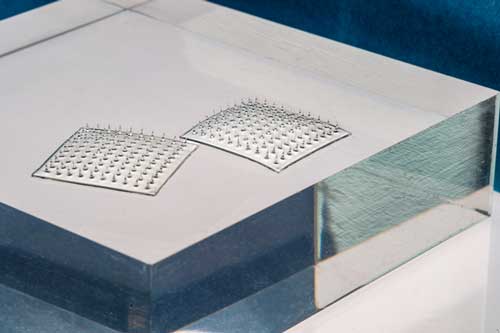
The Velcro-like food sensor, made from an array of silk microneedles, can pierce through plastic packaging to sample food for signs of spoilage and bacterial contamination. Image: Felice Frankel

A September 9, 2020 news item on Nanowerk announces some research from the Massachusetts Institute (MIT),

MIT engineers have designed a Velcro-like food sensor, made from an array of silk microneedles, that pierces through plastic packaging to sample food for signs of spoilage and bacterial contamination.

The sensor’s microneedles are molded from a solution of edible proteins found in silk cocoons, and are designed to draw fluid into the back of the sensor, which is printed with two types of specialized ink. One of these “bioinks” changes color when in contact with fluid of a certain pH range, indicating that the food has spoiled; the other turns color when it senses contaminating bacteria such as pathogenic E. coli.

A Sept. 9, 2020 MIT news release (also on EurekAlert), which originated the news item, delves further into the research,

The researchers attached the sensor to a fillet of raw fish that they had injected with a solution contaminated with E. coli. After less than a day, they found that the part of the sensor that was printed with bacteria-sensing bioink turned from blue to red — a clear sign that the fish was contaminated. After a few more hours, the pH-sensitive bioink also changed color, signaling that the fish had also spoiled.

The results, published today in the journal Advanced Functional Materials, are a first step toward developing a new colorimetric sensor that can detect signs of food spoilage and contamination.

Such smart food sensors might help head off outbreaks such as the recent salmonella contamination in onions and peaches. They could also prevent consumers from throwing out food that may be past a printed expiration date, but is in fact still consumable.

“There is a lot of food that’s wasted due to lack of proper labeling, and we’re throwing food away without even knowing if it’s spoiled or not,” says Benedetto Marelli, the Paul M. Cook Career Development Assistant Professor in MIT’s Department of Civil and Environmental Engineering. “People also waste a lot of food after outbreaks, because they’re not sure if the food is actually contaminated or not. A technology like this would give confidence to the end user to not waste food.”

Marelli’s co-authors on the paper are Doyoon Kim, Yunteng Cao, Dhanushkodi Mariappan, Michael S. Bono Jr., and A. John Hart.

Silk and printing

The new food sensor is the product of a collaboration between Marelli, whose lab harnesses the properties of silk to develop new technologies, and Hart, whose group develops new manufacturing processes.

Hart recently developed a high-resolution floxography technique, realizing microscopic patterns that can enable low-cost printed electronics and sensors. Meanwhile, Marelli had developed a silk-based microneedle stamp that penetrates and delivers nutrients to plants. In conversation, the researchers wondered whether their technologies could be paired to produce a printed food sensor that monitors food safety.

“Assessing the health of food by just measuring its surface is often not good enough. At some point, Benedetto mentioned his group’s microneedle work with plants, and we realized that we could combine our expertise to make a more effective sensor,” Hart recalls.

The team looked to create a sensor that could pierce through the surface of many types of food. The design they came up with consisted of an array of microneedles made from silk.

“Silk is completely edible, nontoxic, and can be used as a food ingredient, and it’s mechanically robust enough to penetrate through a large spectrum of tissue types, like meat, peaches, and lettuce,” Marelli says.

A deeper detection

To make the new sensor, Kim first made a solution of silk fibroin, a protein extracted from moth cocoons, and poured the solution into a silicone microneedle mold. After drying, he peeled away the resulting array of microneedles, each measuring about 1.6 millimeters long and 600 microns wide — about one-third the diameter of a spaghetti strand.

The team then developed solutions for two kinds of bioink — color-changing printable polymers that can be mixed with other sensing ingredients. In this case, the researchers mixed into one bioink an antibody that is sensitive to a molecule in E. coli. When the antibody comes in contact with that molecule, it changes shape and physically pushes on the surrounding polymer, which in turn changes the way the bioink absorbs light. In this way, the bioink can change color when it senses contaminating bacteria.

The researchers made a bioink containing antibodies sensitive to E. coli, and a second bioink sensitive to pH levels that are associated with spoilage. They printed the bacteria-sensing bioink on the surface of the microneedle array, in the pattern of the letter “E,” next to which they printed the pH-sensitive bioink, as a “C.” Both letters initially appeared blue in color.

Kim then embedded pores within each microneedle to increase the array’s ability to draw up fluid via capillary action. To test the new sensor, he bought several fillets of raw fish from a local grocery store and injected each fillet with a fluid containing either E. coli, Salmonella, or the fluid without any contaminants. He stuck a sensor into each fillet. Then, he waited.

After about 16 hours, the team observed that the “E” turned from blue to red, only in the fillet contaminated with E. coli, indicating that the sensor accurately detected the bacterial antigens. After several more hours, both the “C” and “E” in all samples turned red, indicating that every fillet had spoiled.

The researchers also found their new sensor indicates contamination and spoilage faster than existing sensors that only detect pathogens on the surface of foods.

“There are many cavities and holes in food where pathogens are embedded, and surface sensors cannot detect these,” Kim says. “So we have to plug in a bit deeper to improve the reliability of the detection. Using this piercing technique, we also don’t have to open a package to inspect food quality.”

The team is looking for ways to speed up the microneedles’ absorption of fluid, as well as the bioinks’ sensing of contaminants. Once the design is optimized, they envision the sensor could be used at various stages along the supply chain, from operators in processing plants, who can use the sensors to monitor products before they are shipped out, to consumers who may choose to apply the sensors on certain foods to make sure they are safe to eat.

Here’s a link to and a citation for the paper,

A Microneedle Technology for Sampling and Sensing Bacteria in the Food Supply Chain by Doyoon Kim, Yunteng Cao, Dhanushkodi Mariappan, Michael S. Bono Jr., A. John Hart, Benedetto Marelli. DOI: https://doi.org/10.1002/adfm.202005370 First published: 09 September 2020

This paper is behind a paywall.