Tag Archives: eczema

Gene-editing tools like CRISPR unlock promising new topical treatments for the first time for skin diseases

Exciting? Yes. However, as far as I can tell, hey are a long way from human clinical trials. Onto the good news, from a January 27, 2026 University of British Columbia (UBC) news release (can be found here at the Life Science Institute, here at the Faculty of Medicine, and here at the university’s press office), Note: Links have been removed,

Gene-editing tools like CRISPR (clustered regularly interspaced short palindromic repeats) have unlocked new treatments for previously uncurable diseases. Now, researchers at the University of British Columbia are extending those possibilities to the skin for the first time.

The UBC team, together with researchers from the Berlin Institute of Health at Charité in Germany, has developed the first gene therapy capable of correcting faulty genes when applied directly to human skin. Outlined today [January 27, 2926] in a paper published in Cell Stem Cell, the breakthrough could lead to new treatments for a wide range of genetic skin conditions, from rare inherited diseases to more common disorders like eczema.

“With this work, we show that it is possible to correct disease-causing mutations in human skin using a topical treatment that is safe, scalable and easy-to-use,” said Dr. Sarah Hedtrich, an associate professor at UBC’s school of biomedical engineering and senior author of the study. “Importantly, the approach corrects the root cause of disease, and our data suggests that a one-time treatment might even be enough to provide a lasting and durable cure.”

Broad therapeutic potential 

In the study, the researchers show the gene therapy can correct the most common genetic mutation behind autosomal recessive congenital ichthyosis (ARCI), a rare and life-threatening inherited skin disorder that appears at birth.

Affecting approximately one in 100,000 people, ARCI causes lifelong complications including extremely dry and scaly skin, chronic inflammation and a high risk of infections. There is currently no cure or effective treatment, and patients must manage their symptoms for life.

“For many patients, this condition is not only physically painful, but also deeply stigmatizing and isolating,” said Dr. Hedtrich.

By testing the treatment in models made from living human skin, the team showed it can restore up to 30 per cent of normal skin function—a level that previous research suggests could be clinically meaningful for returning skin function to normal.

While ARCI affects relatively few people, the researchers say the treatment strategy could be adapted to many other genetic skin diseases, including epidermolysis bullosa—a severe skin blistering condition often called ‘butterfly skin’—and potentially more common conditions such as eczema or psoriasis.

“The approach we developed is a platform technology,” said Dr. Hedtrich. “It can be readily adapted to treat almost any skin disease.”

A new way to deliver CRISPR gene editing 

Despite major advances in gene editing, applying the technology to skin diseases has remained a long-standing challenge. The skin’s primary role is to protect the body from the outside world, making it difficult to deliver large biological therapies, such as gene editors, past its protective barrier.

To overcome this, the team developed a novel delivery method that uses lipid nanoparticle technology, or LNPs. These microscopic “bubbles of fat,” pioneered by UBC professor Dr. Pieter Cullis [emphasis mine] and brought to global prominence through mRNA vaccines, are able to carry gene-editing technology into cells.

Using a clinically approved laser, the researchers first create microscopic, pain-free openings in the outer layers of the skin. This allows the lipid nanoparticles to pass through the skin barrier and reach skin stem cells beneath the surface. Once inside, the gene editor corrects the underlying DNA mutation, enabling the skin to begin functioning more normally.

“This is a highly targeted, localized approach,” said Dr. Hedtrich. “The treatment stays in the skin and we saw no evidence of off-target effects, which is a critical safety milestone.”

The study was conducted in close collaboration with Vancouver-based biotech company NanoVation Therapeutics [emphasis mine], a UBC spin-off focused on developing LNP-based genetic medicines. The researchers now hope to bring the treatment into clinical testing and have already been working with regulatory authorities to define the necessary safety and efficacy studies. [emphasis mine]

“Our goal now is to take this from the lab into first-in-human clinical trials,” said Dr. Hedtrich. “We hope this work will ultimately lead to a safe, effective treatment that can transform the lives of patients who currently have no real therapeutic options.”

Here’s a link to and a citation for the paper,

Lipid nanoparticle-based non-viral in situ gene editing of congenital ichthyosis-causing mutations in human skin models by Dilem Ceren Apaydin, Gaurav Sadhnani, Tiffany Carlaw, Jan Renziehausen, Elena Lizunova, Viviane Filor, Anna Hiller, Sophia Brumhard, Vincent Halim, Ulrike Brüning, Johannes Bischof, Rafaela Horbach Marodin, Daniel Z. Kurek, Manuel Rhiel, Sandra Ammann, Tatjana I. Cornu, Toni Cathomen, Leif Erik Sander, Benedikt Obermayer, Fabian Coscia, Jennifer Kirwan, Ulrich Koller, Achim D. Gruber, Wolfgang Bäumer, and Sarah Hedtrich. Cell Stem Cell Available online 27 January 2026 In Press, Corrected Proof DOI: https://doi.org/10.1016/j.stem.2026.01.001

This paper is behind a paywall.

NanoVation Therapeutics, the UBC spin-off mentioned in the news release, was co-founded by Pieter Cullis according to the company’s Our Team webpage.

Novel probiotic for eczema from US National Institute of Allergy and Infectious Diseases (NIAID)

This treatment relieves symptoms; it doesn’t cure. As for whether or not it’s currently available to the public, it’s a little complicated.

I am not endorsing or recommending the treatment. That said, it does look promising.

Now, here’s the latest news about the treatment.

Novel probiotic for eczema

A June 26, 2024 (US National Institutes of Health) NIH/National Institute of Allergy and Infectious Diseases news release (also on EurekAlert) announces the availability of a new treatment for rrelief of eczema,

WHAT:
NIAID research has led to the availability of a new over-the-counter topical eczema probiotic. The probiotic is based on the discovery by scientists at the National Institute of Allergy and Infectious Diseases (NIAID), part of the National Institutes of Health, that bacteria present on healthy skin called Roseomonas mucosa can safely relieve eczema symptoms in adults and children. R. mucosa-based topical interventions could simplify or complement current eczema management, when used in consultation with an individual’s healthcare provider. A milestone for eczema sufferers, the availability of an R. mucosa-based probiotic is the result of seven years of scientific discovery and research in NIAID’s Laboratory of Clinical Immunology and Microbiology (LCIM).

Eczema—also known as atopic dermatitis—is a chronic inflammatory skin condition that affects approximately 20% of children and 10% of adults worldwide. The condition is characterized by dry, itchy skin that can compromise the skin’s barrier, which functions to retain moisture and keep out allergens. This can make people with eczema more vulnerable to bacterial, viral and fungal skin infections. R. mucosa is a commensal bacterium, meaning it occurs naturally as part of a typical skin microbiome. Individuals with eczema experience imbalances in the microbiome and are deficient in certain skin lipids (oils). NIAID researchers demonstrated that R. mucosa can help restore those lipids.

Scientists led by Ian Myles, M.D., M.P.H., chief of the LCIM Epithelial Research Unit, found specific strains of R. mucosa reduced eczema-related skin inflammation and enhanced the skin’s natural barrier function in both adults and children. To arrive at this finding, Dr. Myles and colleagues spearheaded a spectrum of translational research on R. mucosa. They isolated and cultured R. mucosa in the laboratory, conducted preclinical (laboratory/animal) and clinical (human) studies, and made the bacteria available for commercial, non-therapeutic development [emphasis mine]. The R. mucosa-based probiotic released this week is formulated by Skinesa and called Defensin. [emphasis mine]

In Phase 1/2 open-label and Phase 2 blinded, placebo-controlled clinical studies, most people experienced greater than 75% improvement in eczema severity following application of R. mucosa. Improvement was seen on all treated skin sites, including the inner elbows, inner knees, hands, trunk and neck. The researchers also observed improvement in skin barrier function. Additionally, most participants needed fewer corticosteroids to manage their eczema, experienced less itching, and reported a better quality of life following R. mucosa therapy. These benefits persisted after treatment ended: therapeutic R. mucosa strains remained on the skin for up to eight months in study participants who were observed for that duration.

To expand the potential use of R. mucosa, NIAID will conduct an additional clinical trial to generate further evidence on its efficacy in reducing eczema symptoms [emphasis mine]. Those data could form the basis of an application to the Food and Drug Administration to enable the product to be regulated as a nonprescription drug and made accessible to a broader population of people with eczema. Study results are expected in 2024 [?] [emphasis mine].

WHO: 
Ian Myles, M.D., M.P.H, chief of the Epithelial Research Unit in NIAID’s Laboratory of Clinical Immunology and Microbiology, …

Not mentioned for some reason, is that there are no side effects of the treatment. There also appears to be an error in the news release/business announcement regarding the date for the next study results. There is currently a clinical trial which is due to begin August 20, 2024 and to be completed in 2026. There are no other trials listed on the ClinicalTrials.govwebsite after the trial results reported in 2020.

Non-therapeutic product? Nonprescription drug?

There is now a non-therapeutic product based on the R. mucosa-based probiotic that was tested by Ian Myles and his team. In short, it’s being sold as a skin product for people with itchy, dry skin and with no mention of eczema or any other skin condition. Sold as Defensin™ by Skinesa, they have this to say about their product,

Improves the look and feel of your skin in 90 days or less.

A skin health breakthrough from over 7 years of research, Defensin™ was created by a team of doctors to promote healthy skin.

*Probiotic strain Roseomonas mucosa RSM 2015 clinically shown to improve skin health.(1),(2)

*9 out of 10 patients achieved clearer, healthier skin in the clinical trial.(1)

*Innovated and studied by doctors at the NIH.(1),(2)

SPECIAL NOTICE: NIH RESEARCH SHOWS THIS PRODUCT IS NOT COMPATIBLE WITH:

Aveeno Eczema Therapy
Eucerin Eczema Relief
Aquafor Healing Ointment
Curel Hydrotherapy

(1) Myles, Ian A et al. Sci Transl Med 2020 Sep 9;12(560):eaaz8631. doi: 10.1126/scitranslmed.aaz8631.
(2) Myles, Ian A, et al. JCI Insight. 2018 May 3;3(9):e120608. doi: 10.1172/jci.insight.120608.

FAQs (frequently asked questions) by Skinesa

Keep scrolling down the Defensin™ by Skinesa webpage and you will find these questions and answers amongst others,

What makes Defensin different from other products?

Probiotics are live microorganisms that provide health benefits when administered in adequate amounts. By definition, probiotics must have a scientifically demonstrated health effect.

In the case of Defensin™ Topical Skin Probiotic, our probiotic ingredient can be matched to two randomized controlled clinical trials that show safety and efficacy in promoting clear, healthy skin. Our probiotic is a one-of-a-kind probiotic strain that is not available generically.

Note: 99% of the “probiotic” topical skincare products are not probiotics at all, rather they are lysates, or probiotic byproducts which are not living.

Are there any side effects of using Defensin?

There are no known side effects based on the 2 successful clinical trials.

Getting picky

At this point, the treatment has no side effects but there have been adverse events. Like a lot of people, I assumed these two terms were synonymous. Wrong. The difference is largely but no exclusively one of degree. Here’s how the Association of Health Care Journalists explains it, from their Adverse event vs. side effect webpage,

Adverse events and side effects are often conflated in news stories, blogs, social media, everyday discussion and even in conversations with medical professionals. However, when writing about research studies, there is a key difference that journalists must understand to avoid inadvertently misleading readers. An adverse event refers to any event that affects a person’s health that occurs after they have received a treatment, whether that treatment is a medication, a surgery, a therapy or another intervention. The adverse event may or may not be caused by the intervention [emphasis mine].

A side effect is an adverse effect that has been determined as a direct result [emphasis mine] of the intervention. In other words, the person who took a certain medication experiences an adverse event, such as a dry mouth or an increased blood pressure, that the medication definitely caused. Side effects are determined by comparing adverse events [emphasis mine] in randomized controlled trials where one group receives the intervention and one group does not. If the proportion of a certain adverse event is much higher in the group receiving the drug or intervention than in the control group, then the drug or intervention is the cause of that adverse event, which then becomes a side effect.

For example [emphasis mine], say 100 people receive the flu vaccine. Then 90 of them have sore arms, 10 have fevers, two have muscle cramps, two of them get into car accidents later that day, and one of them has a heart attack [emphasis mine] that night. All of those events are adverse effects [emphasis mine]— including the car accidents and heart attack — even though there is no biological way the flu vaccine could have caused the car accidents and there is no evidence that flu vaccines increase the risk of a heart attack. The sore arms, fevers and muscle cramps, however, very well could have been side effects [emphasis mine]. It’s not a guarantee that all the fevers were caused by the flu vaccine, but fever is a known possible side effect of the vaccine. The muscle cramps depend on where they occurred. If the cramps are in the arms where the person got the shot, it probably is a side effect. If it’s a Charley horse cramp in the leg, it’s an adverse event that’s probably unrelated to the flu vaccine. If it’s general achiness for a day that feels similar to what the flu feels like, then it likely was caused by the vaccine since that’s a known side effect. This is why reading the list of adverse events in a vaccine package insert tells the reader nothing about actual possible side effects of the vaccine.

Thank you to the Association of Health Care Journalists (AHCJ)! One last flower, if you have time, check out Mary Chris Jaklevic’s August 13, 2024 article, “How a class reporting project exposed ethical problems with a pioneering brain study” on the AHCJ website. The study, by the way, was being conducted at the Mount Sinai Medical Center in New York. As Mount Sinai notes on its About Us webpage,

Encompassing the Icahn School of Medicine at Mount Sinai and eight hospital campuses in the New York metropolitan area, as well as a large, regional ambulatory footprint, Mount Sinai is internationally acclaimed for its excellence in research, patient care, and education [emphasis mine] across a range of specialties.

Thankfully, no one appears to have suffered harm from the research but the ethical issues are troubling.

Getting back to the eczema treatment and adverse events vs. side effects

The 2020 study cited on the Skinesa’s Defensin webpage notes this in the study’s abstract,

Dysbiosis of the skin microbiota is increasingly implicated as a contributor to the pathogenesis of atopic dermatitis (AD). We previously reported first-in-human safety and clinical activity results from topical application of the commensal skin bacterium Roseomonas mucosa for the treatment of AD in 10 adults and 5 children older than 9 years of age. Here, we examined the potential mechanism of action of R. mucosa treatment and its impact on children with AD less than 7 years of age, the most common age group for children with AD. In 15 children with AD, R. mucosa treatment was associated with amelioration of disease severity, improvement in epithelial barrier function, reduced Staphylococcus aureus burden on the skin, and a reduction in topical steroid requirements without severe adverse events [emphasis mine]. Our observed response rates to R. mucosa treatment were greater than those seen in historical placebo control groups in prior AD studies. Skin improvements and colonization by R. mucosa persisted for up to 8 months after cessation of treatment. Analyses of cellular scratch assays and the MC903 mouse model of AD suggested that production of sphingolipids by R. mucosa, cholinergic signaling, and flagellin expression may have contributed to therapeutic impact through induction of a TNFR2-mediated epithelial-to-mesenchymal transition. These results suggest that a randomized, placebo-controlled trial of R. mucosa treatment in individuals with AD is warranted and implicate commensals in the maintenance of the skin epithelial barrier.

Fro anyone who wants to see the 2020 study, here’s a link to and a citation for it,

Therapeutic responses to Roseomonas mucosa in atopic dermatitis may involve lipid-mediated TNF-related epithelial repair by Ian A. Myles, Carlo R. Castillo, Kent D. Barbian, Kishore Kanakabandi, Kimmo Virtaneva, Emily Fitzmeyer, Monica Paneru, Francisco Otaizo-Carrasquero, Timothy G. Myers, Tovah E. Markowitz, Ian N. Moore, Xue Liu, Marc Ferrer, Yosuke Sakamachi, Stavros Garantziotis, Muthulekha Swamydas, Michail S. Lionakis, Erik D. Anderson, Noah J. Earland, Sundar Ganesan, Ashleigh A. Sun, Jenna R.E. Bergerson, Robert A. Silverman, Maureen Petersen, Craig A. Martens, and Sandip K. Datta . Science Translational Medicine 9 Sep 2020 Vol 12, Issue 560 DOI: 10.1126/scitranslmed.aaz8631

This paper appears to be open access.

Moving on to ‘nonprescription drug’

If I understand the news release/business announcement correctly, this latest clinical trial is designed with FDA (US Food and Drug Administration) approval in mind. This will allow marketing of the treatment or product as an nonprescription drug for eczema. Right now, Defensin is being sold as a ‘topical skin probiotic’.

Here’s more about the latest trial, from the Cardamom and Topical Roseomonas in Atopic Dermatitis webpage on clinicaltrials.gov,

Study Overview

Brief Summary

Background:

Atopic dermatitis (AD), also called eczema, is a chronic skin condition. AD can make skin dry and itchy, and sometimes it can lead to serious health problems, such as asthma, food allergies, eye infections, and sleep problems. No cure exists for AD. Researchers know that people with AD have different kinds of harmless bacteria on their skin than do people without AD. They want to see if adding a harmless bacteria (Roseomonas mucosa) to the skin can help people with AD.

Objective:

To test a skin treatment that contains R. mucosa and ground cardamom seeds in people with AD.

Eligibility:

People aged 2 years and older with AD.

Design:

All study visits will be remote. Participants will have 5 visits over about 7 months.

Participants will be screened. Researchers will review their AD and medical history.

Participants will receive a study product in the mail. The product comes as a powder in single-use packets. Participants will be shown how to mix the powder with water in a single-use spray vial. They will spray the solution onto their skin 2 to 3 times per week for 14 weeks.

Half of participants will receive the study powder. Half will receive a placebo; the placebo looks just like the study powder but contains no bacteria. They will not know which one they have.

During 3 study visits, participants will take a skin swab. They will receive supplies in the mail to rub a cotton swab on their skin and mail it back to the researchers.

Participants may opt to have pictures taken of their AD.

Participants will fill out 4 online questionnaires.Show less

Detailed Description

Study Description:

This is a double-blind, randomized, phase 2b clinical trial for a topical formulation of a live biotherapeutic containing Roseomonas mucosa combined with ground cardamom seeds in a sucrose solution for patients with atopic dermatitis (AD). Participants will reconstitute the dried product in water and apply topically 2 or 3 times per week for 14 weeks. After 14 weeks, all interventions will cease, and participants will be followed for an additional 14 weeks to assess how long treatment effects last. During the course of study, we will assess disease severity (eg, itch, rash, and quality of life [QOL]) using a variety of AD assessments, ease of compliance with treatment, and changes in the microbiome profile of the skin. We hypothesize that topical treatment with Roseomonas mucosa, combined with ground cardamom seeds, will provide significantly more alleviation in AD symptoms than placebo, and that these effects will last beyond active treatment (due to the ability of the bacteria to colonize the patients’ skin).

Primary Objective:

To determine if R mucosa combined with ground cardamom seeds can improve symptoms of AD in patients aged 2 and older, 14 weeks after treatment discontinuation.

Primary Endpoint:

Proportion of participants achieving a 90% improvement in Eczema Area and Severity Index (EASI90; a measure of eczema rash) from baseline(week 0) to study completion (week 28).

Official Title

A Phase 2b, Double-Blind, Randomized, Placebo-Controlled Trial of Cardamom and Topical Roseomonas in Atopic Dermatitis

Eligibility criteria [emphasis mine]

Ages Eligible for Study 2 Years to 100 Years (Child,  Adult,  Older Adult )

I’ve read eligibility criteria for lots and lots of studies and this is the first time I’ve seen this range of ages. Usually children, youth and older adults (over 55) are excluded.

To sum up, you can buy a product from Skinesa (it’s not cheap), which doesn’t make any promises about eczema. There’s also a clinical trial where final results won’t be published until at least 2026.

Again,this post is neither an endorsement nor a recommendation. If you are interested in the currently available product, I’d suggest consulting with your doctor.

Tightening the skin (and protecting it and removing wrinkles, temporarily)

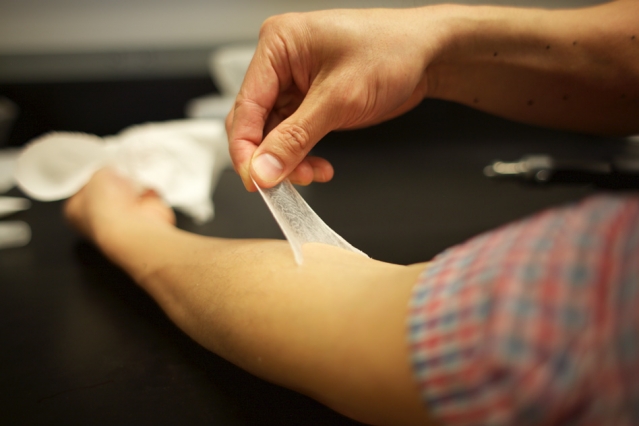
“It’s an invisible layer that can provide a barrier, provide cosmetic improvement, and potentially deliver a drug locally to the area that’s being treated. Those three things together could really make it ideal for use in humans,” Daniel Anderson says. Photo: Melanie Gonick/MIT

“It’s an invisible layer that can provide a barrier, provide cosmetic improvement, and potentially deliver a drug locally to the area that’s being treated. Those three things together could really make it ideal for use in humans,” Daniel Anderson says. Photo: Melanie Gonick/MIT

It almost looks like he’s peeling off his own skin and I imagine that’s the secret to this polymer’s success. A May 9, 2016 news item on phys.org describes the work being done at the Massachusetts Institute of Technology (MIT) and elsewhere with collaborators,

Scientists at MIT, Massachusetts General Hospital, Living Proof, and Olivo Labs have developed a new material that can temporarily protect and tighten skin, and smooth wrinkles. With further development, it could also be used to deliver drugs to help treat skin conditions such as eczema and other types of dermatitis.

A May 9, 2016 MIT news release (also on EurekAlert), which originated the news item, provides more detail,

The material, a silicone-based polymer that could be applied on the skin as a thin, imperceptible coating, mimics the mechanical and elastic properties of healthy, youthful skin. In tests with human subjects, the researchers found that the material was able to reshape “eye bags” under the lower eyelids and also enhance skin hydration. This type of “second skin” could also be adapted to provide long-lasting ultraviolet protection, the researchers say.

“It’s an invisible layer that can provide a barrier, provide cosmetic improvement, and potentially deliver a drug locally to the area that’s being treated. Those three things together could really make it ideal for use in humans,” says Daniel Anderson, an associate professor in MIT’s Department of Chemical Engineering and a member of MIT’s Koch Institute for Integrative Cancer Research and Institute for Medical Engineering and Science (IMES).

Anderson is one of the authors of a paper describing the polymer in the May 9 online issue of Nature Materials. Robert Langer, the David H. Koch Institute Professor at MIT and a member of the Koch Institute, is the paper’s senior author, and the paper’s lead author is Betty Yu SM ’98, ScD ’02, former vice president at Living Proof. Langer and Anderson are co-founders of Living Proof and Olivo Labs, and Yu earned her master’s and doctorate at MIT.

Mimicking skin

As skin ages, it becomes less firm and less elastic — problems that can be exacerbated by sun exposure. This impairs skin’s ability to protect against extreme temperatures, toxins, microorganisms, radiation, and injury. About 10 years ago, the research team set out to develop a protective coating that could restore the properties of healthy skin, for both medical and cosmetic applications.

“We started thinking about how we might be able to control the properties of skin by coating it with polymers that would impart beneficial effects,” Anderson says. “We also wanted it to be invisible and comfortable.”

The researchers created a library of more than 100 possible polymers, all of which contained a chemical structure known as siloxane — a chain of alternating atoms of silicon and oxygen. These polymers can be assembled into a network arrangement known as a cross-linked polymer layer (XPL). The researchers then tested the materials in search of one that would best mimic the appearance, strength, and elasticity of healthy skin.

“It has to have the right optical properties, otherwise it won’t look good, and it has to have the right mechanical properties, otherwise it won’t have the right strength and it won’t perform correctly,” Langer says.

The best-performing material has elastic properties very similar to those of skin. In laboratory tests, it easily returned to its original state after being stretched more than 250 percent (natural skin can be elongated about 180 percent). In laboratory tests, the novel XPL’s elasticity was much better than that of two other types of wound dressings now used on skin — silicone gel sheets and polyurethane films.

“Creating a material that behaves like skin is very difficult,” says Barbara Gilchrest, a dermatologist at MGH and an author of the paper. “Many people have tried to do this, and the materials that have been available up until this have not had the properties of being flexible, comfortable, nonirritating, and able to conform to the movement of the skin and return to its original shape.”

The XPL is currently delivered in a two-step process. First, polysiloxane components are applied to the skin, followed by a platinum catalyst that induces the polymer to form a strong cross-linked film that remains on the skin for up to 24 hours. This catalyst has to be added after the polymer is applied because after this step the material becomes too stiff to spread. Both layers are applied as creams or ointments, and once spread onto the skin, XPL becomes essentially invisible.

High performance

The researchers performed several studies in humans to test the material’s safety and effectiveness. In one study, the XPL was applied to the under-eye area where “eye bags” often form as skin ages. These eye bags are caused by protrusion of the fat pad underlying the skin of the lower lid. When the material was applied, it applied a steady compressive force that tightened the skin, an effect that lasted for about 24 hours.

In another study, the XPL was applied to forearm skin to test its elasticity. When the XPL-treated skin was distended with a suction cup, it returned to its original position faster than untreated skin.

The researchers also tested the material’s ability to prevent water loss from dry skin. Two hours after application, skin treated with the novel XPL suffered much less water loss than skin treated with a high-end commercial moisturizer. Skin coated with petrolatum was as effective as XPL in tests done two hours after treatment, but after 24 hours, skin treated with XPL had retained much more water. None of the study participants reported any irritation from wearing XPL.

“I think it has great potential for both cosmetic and noncosmetic applications, especially if you could incorporate antimicrobial agents or medications,” says Thahn Nga Tran, a dermatologist and instructor at Harvard Medical School, who was not involved in the research.

Living Proof has spun out the XPL technology to Olivo Laboratories, LLC, a new startup formed to focus on the further development of the XPL technology. Initially, Olivo’s team will focus on medical applications of the technology for treating skin conditions such as dermatitis.


This video supplied by MIT shows how to apply the polymer and offers a description and demonstration of its properties once applied,

Here’s a link to and a citation for the paper,

An elastic second skin by Betty Yu, Soo-Young Kang, Ariya Akthakul, Nithin Ramadurai, Morgan Pilkenton, Alpesh Patel, Amir Nashat, Daniel G. Anderson, Fernanda H. Sakamoto, Barbara A. Gilchrest, R. Rox Anderson & Robert Langer. Nature Materials (2016) doi:10.1038/nmat4635 Published online 09 May 2016

This paper is behind a paywall.

One final comment, I wonder who’s lining up to invest in this product.