Tag Archives: Edmond Lam

Turning marine waste into medical applications

This 2025 Research Story on the Natural Sciences and Engineering Research Council of Canada website describes work from McGill University to turn marine waste into a bioadhesive, Note: A link has been removed,

An interdisciplinary team of researchers at McGill University has developed an ultra-strong, environmentally friendly medical glue, or bioadhesive, made from marine waste. The discovery has promising applications for wound care, surgeries, drug delivery, wearable devices and medical implants.

“A glue that can close wounds or make something strongly adhere to the skin is critical for many medical interventions,” says Audrey Moores, a chemistry professor at McGill.

A July 31, 2025 McGill University news release, which originated the research story, has more detail to offer, Note: Links have been removed,

“Many existing bioadhesive products are based on toxic compounds, while overall, there is a need to explore new materials that demonstrate both high adhesion and strong fatigue resistance, or the ability to hold even if pulled apart repeatedly,” Moores said.  
 
Moore [sic] and main co-author Jianyu Li, Associate Professor, Department of Mechanical Engineering and Canada Research Chair in Tissue Repair and Regeneration reported their findings in “Nanowhisker glues for fatigue-resistant bioadhesion and interfacial functionalization,” published in Nature Communications.  

Naturally sourced nanowhiskers give the glue its strength 

The new bioadhesive is composed of chitosan, a chemically modified form of chitin, the natural building block found in the exoskeletons of shellfish and certain fungi. 

The researchers modified the chitosan to have a nanowhisker shape – a feature that proved to be essential to the bioadhesive’s effectiveness – using a mechanochemical process pioneered by co-authors Moores and Edmond Lam in previous studies.   

 “We chemically manipulate this material to turn it into nanochitosan, which has a range of different properties we can finetune. Using this nanomaterial, we can make nanoglue,” Moores said. 

Ultrasound turns whiskers into interlocking structures 

To apply the nanoglue, researchers use a unique ultrasound technology developed by the Li group to penetrate the skin.  When exposed to sound waves, the nanowhiskers not only adhere firmly to skin but also interlock into a rigid, resilient scaffolding that drastically enhances the glue’s strength and durability. 

“Imagine you have a Band-Aid on your hand. It’s difficult to get it to stay, because your hand moves a lot,” Moores explained.  

“To get it to stick, you need the skin to be permeable to the glue. We used microneedles or ultrasound for that. 

 “We were surprised to see that ultrasound was critical to making a strong glue. While our initial strategy was to get the nanoglue to stick to the skin, we also discovered ultrasounds helped build a complex, interconnected network of our nanostructures. These nanowhisker glues are simply better than the current glues out there.”  

They say the nanostructure has promising applications beyond health care, in many engineering contexts. 

Allergy-safe, and potentially vegan 

The bioadhesive is also fully biocompatible, even for people with seafood allergies. 

“People who are allergic to shellfish are not allergic to chitin, but the proteins. We can remove these in the manufacturing process and avoid allergic reactions.  
 
“We could also theoretically make a vegan version from fungi,” Moores added. 

This research was funded by the Natural Sciences and Engineering Research Council of Canada, the National Research Council Ocean program, the Canada Foundation for Innovation and the National Institutes of Health of the United States, the Canada Research Chairs Program, the Fonds de Recherche du Québec Nature et Technologies (FRQNT) – Centre for Green Chemistry and Catalysis and McGill University.

For those who like to listen to their science news, the Canadian Broadcasting Corporation (CBC) has an 8 mins. 8 secs. radio segment where researcher Audrey Moores is interviewed by Angelica Montgomery. on Quebec AM.

Here’s a link to and a citation for the paper,

Nanowhisker glues for fatigue-resistant bioadhesion and interfacial functionalization by Shuaibing Jiang, Tony Jin, Tianqin Ning, Zhen Yang, Zhenwei Ma, Ran Huo, Yixun Cheng, Davis Kurdyla, Edmond Lam, Rong Long, Audrey Moores & Jianyu Li. Nature Communications volume 16, Article number: 6826 (2025) DOI: https://doi.org/10.1038/s41467-025-62019-y Published: 24 July 2025

This paper is open access.

Making longer lasting bandages with sound and bubbles

This research into longer lasting bandages described in an August 12, 2022 news item on phys.org comes from McGill University (Montréal, Canada)

Researchers have discovered that they can control the stickiness of adhesive bandages using ultrasound waves and bubbles. This breakthrough could lead to new advances in medical adhesives, especially in cases where adhesives are difficult to apply such as on wet skin.

“Bandages, glues, and stickers are common bioadhesives that are used at home or in clinics. However, they don’t usually adhere well on wet skin. It’s also challenging to control where they are applied and the strength and duration of the formed adhesion,” says McGill University Professor Jianyu Li, who led the research team of engineers, physicists, chemists, and clinicians.

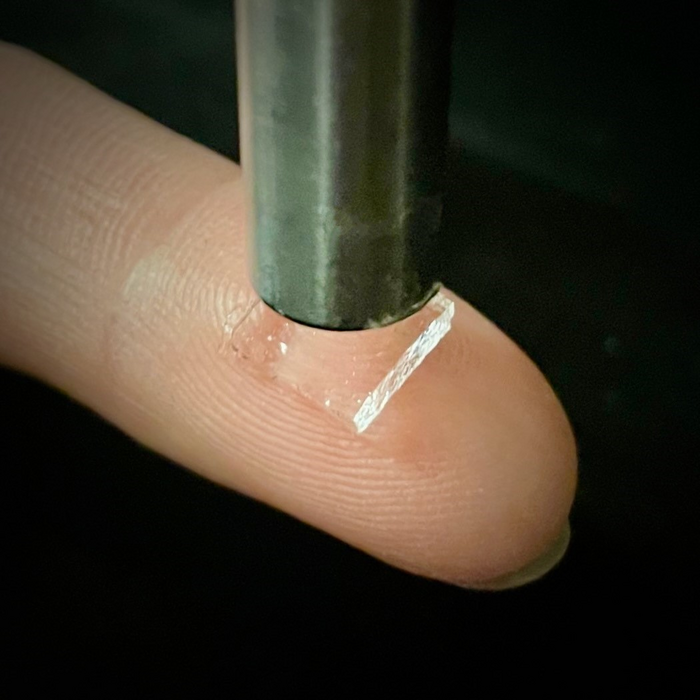
Caption: Adhesive hydrogel applied on skin under ultrasound probe. Credit: Ran Huo and Jianyu Li

An August 12, 2022 McGill University news release (also on EurekAlert), which originated the news item, delves further into the work,

“We were surprised to find that by simply playing around with ultrasonic intensity, we can control very precisely the stickiness of adhesive bandages on many tissues,” says lead author Zhenwei Ma, a former student of Professor Li and now a Killam Postdoctoral Fellow at the University of British Columbia.

Ultrasound induced bubbles control stickiness

In collaboration with physicists Professor Outi Supponen and Claire Bourquard from the Institute of Fluid Dynamics at ETH Zurich, the team experimented with ultrasound induced microbubbles to make adhesives stickier. “The ultrasound induces many microbubbles, which transiently push the adhesives into the skin for stronger bioadhesion,” says Professor Supponen. “We can even use theoretical modeling to estimate exactly where the adhesion will happen.”

Their study, published in the journal Science, shows that the adhesives are compatible with living tissue in rats. The adhesives can also potentially be used to deliver drugs through the skin. “This paradigm-shifting technology will have great implications in many branches of medicine,” says University of British Columbia Professor Zu-hua Gao. “We’re very excited to translate this technology for applications in clinics for tissue repair, cancer therapy, and precision medicine.”

“By merging mechanics, materials and biomedical engineering, we envision the broad impact of our bioadhesive technology in wearable devices, wound management, and regenerative medicine,” says Professor Li, who is also a Canada Research Chair in Biomaterials and Musculoskeletal Health.

Here’s a link to and a citation for the paper,

Controlled tough bioadhesion mediated by ultrasound by Zhenwei Ma, Claire Bourquard, Qiman Gao, Shuaibing Jiang, Tristan De Iure-Grimmel, Ran Huo, Xuan Li, Zixin He, Zhen Yang, Galen Yang, Yixiang Wang, Edmond Lam, Zu-hua Gao, Outi Supponen and Jianyu Li. Science 11 Aug 2022 Vol 377, Issue 6607 pp. 751-755 DOI: 10.1126/science.abn8699

This paper is behind a paywall.

I haven’t seen this before but it seems that one of the journal’s editors decided to add a standalone paragraph to hype some of the other papers about adhesives in the issue,

A sound way to make it stick

Tissue adhesives play a role in temporary or permanent tissue repair, wound management, and the attachment of wearable electronics. However, it can be challenging to tailor the adhesive strength to ensure reversibility when desired and to maintain permeability. Ma et al. designed hydrogels made of polyacrylamide or poly(N-isopropylacrylamide) combined with alginate that are primed using a solution containing nanoparticles of chitosan, gelatin, or cellulose nanocrystals (see the Perspective by Es Sayed and Kamperman). The application of ultrasound causes cavitation that pushes the primer molecules into the tissue. The mechanical interlocking of the anchors eventually results in strong adhesion between hydrogel and tissue without the need for chemical bonding. Tests on porcine or rat skin showed enhanced adhesion energy and interfacial fatigue resistance with on-demand detachment. —MSL

I like the wordplay and am guessing that MSL is:

Marc S. Lavine
Senior Editor
Education: BASc, University of Toronto; PhD, University of Cambridge
Areas of responsibility: Reviews; materials science, biomaterials, engineering