Tag Archives: electrochemical sensors

It’s all about the cellulose and the graphite: using fallen leaves as the basis for medical and laboratory sensors

Caption: Sensor printed on leaf by CO2 laser. Credit: Bruno Janegitz

A May 9, 2024 news item on phys.org announces work which makes use of fallen leaves, Note: A link has been removed,

Fabrication of sensors by 3D printing combines speed, freedom of design, and the possibility of using waste as a substrate. Various results have been obtained in a circular economy mode, whereby residues usually thrown away are instead used as low-cost resources.

A highly creative solution involving the printing of electrochemical sensors on fallen tree leaves has now been presented by a team of researchers in Brazil led by Bruno Janegitz, a professor at the Federal University of São Carlos (UFSCar) and head of its Laboratory for Sensors, Nanomedicines, and Nanostructured Materials (LSNANO), and Thiago Paixão, a professor at the University of São Paulo (USP) and head of its Electronic Tongues and Chemical Sensors Lab (L2ESQ).

A May 8, 2024 Fundação de Amparo à Pesquisa do Estado de São Paulo (FAPESP) press release (also on EurekAlert but published May 9, 2024) by José Tadeu Arantes, Note: Links have been removed,

The initiative was supported by FAPESP and highlighted in an article published in the journal ACS Sustainable Chemistry & Engineering.

“We used a CO2 [carbon dioxide] laser to print the design of interest on a leaf by means of pyrolysis and carbonization. We thereby obtained an electrochemical sensor for use in determining levels of dopamine and paracetamol. It’s very easy to operate. A drop of the solution containing one of these compounds is placed on the sensor, and the potentiostat to which it’s coupled displays the concentration,” Janegitz said.

Simply put, the laser beam burns the leaf in a pyrolytic process that converts its cellulose into graphite [emphasis mine], and the graphite body is printed on the leaf in a shape suited to functioning as a sensor. During the fabrication process, the parameters of the CO2 laser, including laser power, pyrolysis scan rate and scan gap, are systematically adjusted to achieve optimal outcomes.

“The sensors were characterized by morphological and physicochemical methods, permitting exhaustive exploration of the novel carbonized surface generated on the leaves,” Janegitz said.

“Furthermore, the applicability of the sensors was confirmed by tests involving the detection of dopamine and paracetamol in biological and pharmaceutical samples. For dopamine, the system proved efficient in a linear range of 10–1,200 micromoles per liter, with a detection limit of 1.1 micromole per liter. For paracetamol, the system worked well in a linear range of 5-100 micromoles per liter, with a detection limit of 0.76.”

In the tests involving dopamine and paracetamol, conducted as proof of concept, the electrochemical sensors derived from fallen tree leaves attained a satisfactory analytical performance and noteworthy reproducibility, highlighting their potential as an alternative to conventional substrates.

Substituting fallen tree leaves for conventional materials yields significant gains in terms of cost-cutting and above all environmental sustainability. “The leaves would have been incinerated, or at best composted. Instead, they were used as a substrate for high value-added devices in a major advancement for the fabrication of next-generation electrochemical sensors,” Janegitz said. 

There’s also this, “The Agency FAPESP licenses news via Creative Commons (CC-BY-NC-ND) so that they can be republished free of charge and in a simple way by other digital or printed vehicles.”

Here’s a link to and a citation for the paper,

Green Fabrication and Analytical Application of Disposable Carbon Electrodes Made from Fallen Tree Leaves Using a CO2Laser by Rodrigo Vieira Blasques, Jéssica Rocha Camargo, William Barros Veloso, Gabriel Negrão Meloni, Fernando Amaral Fernandes, Beatriz Fernandes Germinare, Luiz Ricardo Guterres e Silva, Abner de Siervo, Thiago Regis Longo Cesar Paixão, and Bruno Campos Janegitz. ACS Sustainable Chem. Eng. 2024, 12, 8, 3061–3072 DOI: https://doi.org/10.1021/acssuschemeng.3c06526 Publication Date: February 13, 2024 Copyright © 2024 American Chemical Society

This paper is behind a paywall.

A Tootsie Roll® sensor

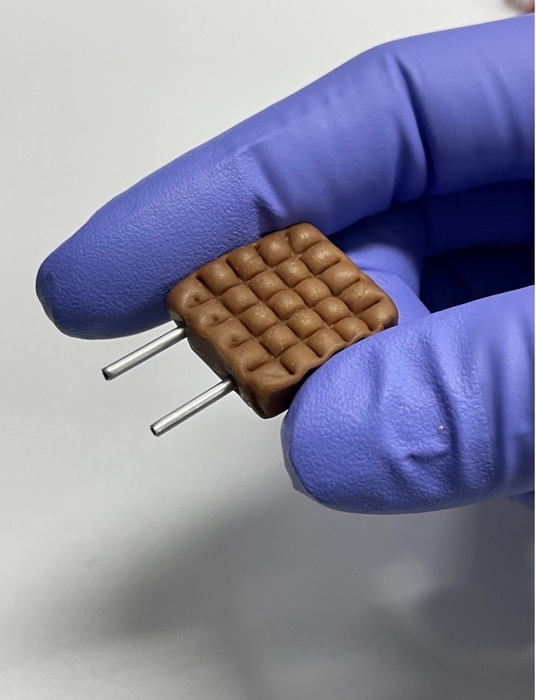
Caption: An electrode made with a molded Tootsie Roll® and aluminum tubes can help monitor ovulation status and kidney health. Credit: Adapted from ACS Applied Materials & Interfaces 2021, DOI: 10.1021/acsami.1c11306

That really is a flattened Tootsie Roll® as a September 26, 2021 American Chemical Society (ACS) news release (on EurekAlert) notes,

Single-use diagnostic tests often aren’t practical for health professionals or patients in resource-limited areas, where cost and waste disposal are big concerns. So, researchers reporting in ACS Applied Materials & Interfaces have turned to a surprising material, Tootsie Roll® candy, to develop an inexpensive and low-waste device. The candy was used as an electrode, the part of the sensor that detects salt and electrolyte levels in saliva, to monitor ovulation status or kidney health. 

Disposable test strips have advanced the speed and accuracy of at-home health monitoring. For example, ovulation predictor kits measure luteinizing hormone levels, and there are test strips that measure creatinine levels for patients with chronic kidney disease. However, their costs add up quickly and, between the packaging and the strips themselves, there’s a lot of waste that needs to be disposed of. Previous researchers have indicated that simple measurements of a person’s salivary salt and electrolyte content could be appropriate for managing some conditions. So, Beelee Chua and Donghyun Lee wanted to repurpose unconventional and widely available materials, including electrically conductive soft candies, into an easily accessible, low-waste sensor that could simply be licked by patients to analyze their saliva. 

To make the prototype sensor, the researchers first flattened a Tootsie Roll® and pressed crevices into its surface in a crosshatched pattern to hold the saliva sample. Then, they inserted two thin, reusable aluminum tubes, which acted as electrical contacts, connecting the candy electrode into a circuit with a current source and an output voltage detector. In preliminary tests, the device could measure salt levels that were physiologically relevant for health monitoring in a salt-water solution and artificial saliva. For example, when covered in diluted artificial saliva, the sensor could reliably measure a change in voltage low enough to detect the 10-30% drop in salts that occurs when a person ovulates. While the maximum salt content in the artificial saliva samples was similar to that of a healthy adult, the researchers used calculations to estimate that conductivities three times higher, which signal a problem with the kidneys, would be within the measurable range of the device. Although testing with real human samples is still needed, the researchers say that using soft candy as electrodes opens up the possibility for low-waste, inexpensive electrochemical sensors and circuits in the future.

The authors acknowledge funding from the National Research Foundation of Korea.

Here’s a link to and a citation for the paper,

Soft Candy as an Electronic Material Suitable for Salivary Conductivity-Based Medical Diagnostics in Resource-Scarce Clinical Settings by Donghyun Lee and Beelee Chua. ACS Appl. Mater. Interfaces 2021, 13, 37, 43984–43992 DOI: https://doi.org/10.1021/acsami.1c11306 Publication Date:September 10, 2021 Copyright © 2021 American Chemical Society

This paper is behind a paywall.