Tag Archives: gold nanoclusters

It’s a golden world

I have a number of stories concerning gold where researchers seemed to have had an extraordinarily rich set of findings within the last month. One of these is especially interesting in light of what I published yesterday (August 11, 2025 “Turning lead into gold (for approximately a microsecond“) about an event in May 2025.

I will be providing my usual citations and links but will not be tagging all the researchers (there are far too many) other than those mentioned in the news releases.

Two from SLAC (SLAC National Accelerator Laboratory, originally named the Stanford Linear Accelerator Center in California)

While both projects took place at SLAC, there’s virtually no crossover between the team members and the findings are of an entirely different nature.

Defying the limits and surviving the entropy catastrophe

An August 11, 2025 news item on ScienceDaily announces that physics limits have been defied,

Scientists have simultaneously broken a temperature record, overturned a long-held theory and utilized a new laser spectroscopy method for dense plasmas in a groundbreaking article published on July 23 in the journal Nature.

In their research article, “Superheating gold beyond the predicted entropy catastrophe threshold,” physicists revealed they were able to heat gold to over 19,000 Kelvin (33,740 degrees Fahrenheit), over 14 times its melting point, without it losing its solid, crystalline structure.

A July 23, 2025 University of Nevada news release, which originated the news item, delves further into the topic,

“This is possibly the hottest crystalline material ever recorded,” Thomas White, lead author and Clemons-Magee Endowed Professor in Physics at the University of Nevada, Reno said.

This result overturns the long-held theoretical limit known as the entropy catastrophe. The entropy catastrophe theory states that solids cannot remain stable above approximately three times their melting temperature without spontaneously melting. The melting point of gold, 1,337 Kelvin (1,947 degrees Fahrenheit), was far more than tripled in this experiment utilizing an extremely powerful laser at Stanford University’s SLAC National Accelerator Laboratory.

“I was expecting the gold to heat quite significantly before melting, but I wasn’t expecting a fourteen-fold temperature increase,” White said.

To heat the gold, researchers at the University of Nevada, Reno, SLAC National Accelerator Laboratory, the University of Oxford, Queen’s University Belfast, the European XFEL and the University of Warwick designed an experiment to heat a thin gold foil using a laser fired for 50 quadrillionths of a second (one millionth of a billionth). The speed with which the gold was heated seems to be the reason the gold remained solid. The findings suggest that the limit of superheating solids may be far higher – or nonexistent – if heating occurs quickly enough. The new methods used in this study open the field of high energy density physics to more exploration, including in areas of planetary physics and fusion energy research.

White and his team expected that the gold would melt at its melting point, but to measure the temperature inside the gold foil, they would need a very special thermometer.

“We used the Linac Coherent Light Source, a 3-kilometer-long X-ray laser at SLAC, as essentially the world’s largest thermometer,” White said. “This allowed us to measure the temperature inside the dense plasma for the first time, something that hasn’t been possible before.”

“This development paves the way for temperature diagnostics across a broad range of high-energy-density environments,” Bob Nagler, staff scientist at SLAC and coauthor on the paper, said. “In particular, it offers the only direct method currently available for probing the temperature of warm dense states encountered during the implosion phase of inertial fusion energy experiments. As such, it is poised to make a transformative contribution to our understanding and control of fusion-relevant plasma conditions.”

Along with the experimental designers, the research article is the result of a decade of work and collaboration between Columbia University, Princeton University, the University of Padova and the University of California, Merced.

“It’s extremely exciting to have these results out in the world, and I’m really looking forward to seeing what strides we can make in the field with these new methods,” White said.

The research, funded by the National Nuclear Security Administration, will open new doors in studies of superheated materials.

“The National Nuclear Security Administrations’ Academics Program is a proud supporter of the groundbreaking innovation and continued learning that Dr. White and his team are leading for furthering future critical research areas beneficial to the Nuclear Security Enterprise,” Jahleel Hudson, director at the Techology and Partnerships Office of the NNSA said.

White and his colleagues returned to the Linac Coherent Light Source in July to measure the temperature inside hot compressed iron and are using those results to gain insights into the interiors of planets.

Several of White’s graduate students and one undergraduate student were coauthors on the study, including doctoral student Travis Griffin, undergraduate student Hunter Stramel, Daniel Haden, a former postdoctoral scholar in White’s lab, Jacob Molina, a former undergraduate student currently pursuing his doctoral degree at Princeton University and Landon Morrison, a former undergraduate student pursuing his master’s degree at the University of Oxford. Jeremy Iratcabal, research assistant professor in the Department of Physics, was also a coauthor on the paper.

“I’m incredibly grateful for the opportunity to contribute to such cutting-edge science using billion-dollar experimental platforms alongside world-class collaborators,” Griffin said. “This discovery highlights the power of this technique, and I’m excited by the possibilities it opens for the future of high-energy-density physics and fusion research. After graduation, I’ll be continuing this work as a staff scientist at the European XFEL.”

SLAC issued a July 23, 2025 news release (by Erin Woodward) of its own and UK’s University of Warwick also issued a July 23, 2025.

Here’s a link to and a citation for the paper,

Superheating gold beyond the predicted entropy catastrophe threshold by Thomas G. White, Travis D. Griffin, Daniel Haden, Hae Ja Lee, Eric Galtier, Eric Cunningham, Dimitri Khaghani, Adrien Descamps, Lennart Wollenweber, Ben Armentrout, Carson Convery, Karen Appel, Luke B. Fletcher, Sebastian Goede, J. B. Hastings, Jeremy Iratcabal, Emma E. McBride, Jacob Molina, Giulio Monaco, Landon Morrison, Hunter Stramel, Sameen Yunus, Ulf Zastrau, Siegfried H. Glenzer, Gianluca Gregori, Dirk O. Gericke & Bob Nagler. Nature volume 643, pages 950–954 (2025) DOI: https://doi.org/10.1038/s41586-025-09253-y Published: 23 July 2025 Issue Date: 24 July 2025

This paper is open access.

Gold’s secret chemistry

An August 11, 2025 news item on ScienceDaily announces how researchers at SLAC unexpectedly created gold hydride,

Scientists at SLAC unexpectedly created gold hydride, a compound of gold and hydrogen, while studying diamond formation under extreme pressure and heat. This discovery challenges gold’s reputation as a chemically unreactive metal and opens doors to studying dense hydrogen, which could help us understand planetary interiors and fusion processes. The results also suggest that extreme conditions can produce exotic, previously unknown compounds, offering exciting opportunities for future high-pressure chemistry research.

Serendipitously and for the first time, an international research team led by scientists at the U.S. Department of Energy’s SLAC National Accelerator Laboratory formed solid binary gold hydride, a compound made exclusively of gold and hydrogen atoms.

An August 4, 2025 SLAC news release by Chris Patrick, which originated the news release, provides more details, Note: Links have been removed,

The researchers were studying how long it takes hydrocarbons, compounds made of carbon and hydrogen, to form diamonds under extremely high pressure and heat. In their experiments at the European XFEL (X-ray Free-Electron Laser) in Germany, the team studied the effect of those extreme conditions in hydrocarbon samples with an embedded gold foil, which was meant to absorb the X-rays and heat the weakly absorbing hydrocarbons. To their surprise, they not only saw the formation of diamonds, but also discovered the formation of gold hydride. 

“It was unexpected because gold is typically chemically very boring and unreactive – that’s why we use it as an X-ray absorber in these experiments,” said Mungo Frost, staff scientist at SLAC who led the study. “These results suggest there’s potentially a lot of new chemistry to be discovered at extreme conditions where the effects of temperature and pressure start competing with conventional chemistry, and you can form these exotic compounds.”

The results, published in Angewandte Chemie International Edition, provide a glimpse of how the rules of chemistry change under extreme conditions like those found inside certain planets or hydrogen-fusing stars.

Studying dense hydrogen

In their experiment, the researchers first squeezed their hydrocarbon samples to pressures greater than those within Earth’s mantle using a diamond anvil cell. Then, they heated the samples to over 3,500 degrees Fahrenheit by hitting them repeatedly with X-ray pulses from the European XFEL. The team recorded and analyzed how the X-rays scattered off the samples, which allowed them to resolve the structural transformations within.

As expected, the recorded scattering patterns showed that the carbon atoms had formed a diamond structure. But the team also saw unexpected signals that were due to hydrogen atoms reacting with the gold foil to form gold hydride. 

Under the extreme conditions created in the study, the researchers found hydrogen to be in a dense, “superionic” state, where the hydrogen atoms flowed freely through the gold’s rigid atomic lattice, increasing the conductivity of the gold hydride. 

Hydrogen, which is the lightest element of the periodic table, is tricky to study with X-rays because it scatters X-rays only weakly. Here, however, the superionic hydrogen interacted with the much heavier gold atoms, and the team was able to observe hydrogen’s impact on how the gold lattice scattered X-rays. “We can use the gold lattice as a witness for what the hydrogen is doing,” Mungo said. 

The gold hydride offers a way to study dense atomic hydrogen under conditions that might also apply to other situations that are experimentally not directly accessible. For example, dense hydrogen makes up the interiors of certain planets, so studying it in the lab could teach us more about those foreign worlds. It could also provide new insights into nuclear fusion processes inside stars like our sun and help develop technology to harness fusion energy here on Earth.

Exploring new chemistry

In addition to paving the way for studies of dense hydrogen, the research also offers an avenue for exploring new chemistry. Gold, which is commonly regarded as an unreactive metal, was found to form a stable hydride at extremely high pressure and temperature. In fact, it appears to be only stable at those extreme conditions as when it cools down, the gold and hydrogen separate. The simulations also showed that more hydrogen could fit in the gold lattice at higher pressure.

The simulation framework could also be extended beyond gold hydride. “It’s important that we can experimentally produce and model these states under these extreme conditions,” said Siegfried Glenzer, High Energy Density Division director and professor for photon science at SLAC and the study’s principal investigator. “These simulation tools could be applied to model other exotic material properties in extreme conditions.” 

The team also included researchers from Rostock University, DESY, European XFEL, Helmholtz-Zentrum Dresden-Rossendorf, Frankfurt University and Bayreuth University, all in Germany; the University of Edinburgh, UK; the Carnegie Institution for Science, Stanford University and the Stanford Institute for Materials and Energy Sciences (SIMES). Parts of this work were supported by the DOE Office of Science.

Here’s a link to and a citation for the paper,

Synthesis of Gold Hydride at High Pressure and High Temperature by Mungo Frost, Kilian Abraham, Alexander F. Goncharov, R. Stewart McWilliams, Rachel J. Husband, Michal Andrzejewski, Karen Appel, Carsten Baehtz, Armin Bergermann, Danielle Brown, Elena Bykova, Anna Celeste, Eric Edmund, Nicholas J. Hartley, Konstantin Glazyrin, Heinz Graafsma, Nicolas Jaisle, Zuzana Konôpková, Torsten Laurus, Yu Lin, Bernhard Massani, Maximilian Schörner, Maximilian Schulze, Cornelius Strohm, Minxue Tang, Zena Younes, Gerd Steinle-Neumann, Ronald Redmer, Siegfried H. Glenzer. Angewandte Chemie International Edition DOI: https://doi.org/10.1002/anie.202505811 First published: 04 August 2025

This paper is behind a paywall.

Gold and a quantum revolution?

An August 11, 2025 news item on ScienceDaily announces joint research from Pennsylvania State University (Penn State) and Colorado State University,

The efficiency of quantum computers, sensors and other applications often relies on the properties of electrons, including how they are spinning. One of the most accurate systems for high performance quantum applications relies on tapping into the spin properties of electrons of atoms trapped in a gas, but these systems are difficult to scale up for use in larger quantum devices like quantum computers. Now, a team of researchers from Penn State and Colorado State has demonstrated how a gold cluster can mimic these gaseous, trapped atoms, allowing scientists to take advantage of these spin properties in a system that can be easily scaled up.

A July 22, 2025 Penn State news release (also on EurekAlert) by Gail McCormick, which originated the news item, reveals more about the work which resulted in two published papers, Note: Links have been removed,

“For the first time, we show that gold nanoclusters have the same key spin properties as the current state-of-the-art methods for quantum information systems,” said Ken Knappenberger, department head and professor of chemistry in the Penn State Eberly College of Science and leader of the research team. “Excitingly, we can also manipulate an important property called spin polarization in these clusters, which is usually fixed in a material. These clusters can be easily synthesized in relatively large quantities, making this work a promising proof-of-concept that gold clusters could be used to support a variety of quantum applications.”

Two papers describing the gold clusters and confirming their spin properties appeared in ACS Central Science, ACS Central Science and The Journal of Physical Chemistry Letters.

“An electron’s spin not only influences important chemical reactions, but also quantum applications like computation and sensing,” said Nate Smith, graduate student in chemistry in the Penn State Eberly College of Science and first author of one of the papers. “The direction an electron spins and its alignment with respect to other electrons in the system can directly impact the accuracy and longevity of quantum information systems.”

Much like the Earth spins around its axis, which is tilted with respect to the sun, an electron can spin around its axis, which can be tilted with respect to its nucleus. But unlike Earth, an electron can spin clockwise or counterclockwise. When many electrons in a material are spinning in the same direction and their tilts are aligned, the electrons are considered correlated, and the material is said to have a high degree of spin polarization. 

“Materials with electrons that are highly correlated, with a high degree of spin polarization, can maintain this correlation for a much longer time, and thus remain accurate for much longer,” Smith said.

The current state-of-the-art system for high accuracy and low error in quantum information systems involve trapped atomic ions — atoms with an electric charge — in a gaseous state. This system allows electrons to be excited to different energy levels, called Rydberg states, which have very specific spin polarizations that can last for a long period of time. It also allows for the superposition of electrons, with electrons existing in multiple states simultaneously until they are measured, which is a key property for quantum systems. 

“These trapped gaseous ions are by nature dilute, which makes them very difficult to scale up,” Knappenberger said. “The condensed phase required for a solid material, by definition, packs atoms together, losing that dilute nature. So, scaling up provides all the right electronic ingredients, but these systems become very sensitive to interference from the environment. The environment basically scrambles all the information that you encoded into the system, so the rate of error becomes very high. In this study, we found that gold clusters can mimic all the best properties of the trapped gaseous ions with the benefit of scalability.”

Scientists have heavily studied gold nanostructures for their potential use in optical technology, sensing, therapeutics and to speed up chemical reactions, but less is known about their magnetic and spin-dependent properties. In the current studies, the researchers specifically explored monolayer-protected clusters, which have a core of gold and are surrounded by other molecules called ligands. The researchers can precisely control the construction of these clusters and can synthesize relatively large amounts at one time. 

“These clusters are referred to as super atoms, because their electronic character is like that of an atom, and now we know their spin properties are also similar,” Smith said. “We identified 19 distinguishable and unique Rydberg-like spin-polarized states that mimic the super-positions that we could do in the trapped, gas-phase dilute ions. This means the clusters have the key properties needed to carry out spin-based operations.”

The researchers determined the spin polarization of the gold clusters using a similar method used with traditional atoms. While one type of gold cluster had 7% spin polarization, a cluster with different a ligand approached 40% spin polarization, which Knappenberger said is competitive with some of the leading two-dimensional quantum materials.

“This tells us that the spin properties of the electron are intimately related to the vibrations of the ligands,” Knappenberger said. “Traditionally, quantum materials have a fixed value of spin polarization that cannot be significantly changed, but our results suggest we can modify the ligand of these gold clusters to tune this property widely.”

The research team plans to explore how different structures within the ligands impact spin polarization and how they could be manipulated to fine tune spin properties.

“The quantum field is generally dominated by researchers in physics and materials science, and here we see the opportunity for chemists to use our synthesis skills to design materials with tunable results,” Knappenberger said. “This is a new frontier in quantum information science.”

In addition to Smith and Knappenberger, the research team includes Juniper Foxley, graduate student in chemistry at Penn State; Patrick Herbert, who earned a doctoral degree in chemistry at Penn State in 2019; Jane Knappenberger, researcher in the Penn State Eberly College of Science; as well as Marcus Tofanelli and Christopher Ackerson at Colorado State

Funding from the Air Force Office of Scientific Research and the U.S. National Science Foundation supported this research.

At Penn State, researchers are solving real problems that impact the health, safety and quality of life of people across the commonwealth, the nation and around the world.

For decades, federal support for research has fueled innovation that makes our country safer, our industries more competitive and our economy stronger. Recent federal funding cuts threaten this progress.

Learn more about the implications of federal funding cuts to our future at Research or Regress. [Research or Regress can found here]

Here are links to and citation for the paper,

The Influence of Passivating Ligand Identity on Au25(SR)18 Spin-Polarized Emission by Nathanael L. Smith, Patrick J. Herbert, Marcus A. Tofanelli, Jane A. Knappenberger, Christopher J. Ackerson, Kenneth L. Knappenberger Jr. The Journal of Physical Chemistry Letters 2025, 16, 20, 5168–5172 DOI: https://doi.org/10.1021/acs.jpclett.5c00723 Published May 15, 2025 Copyright © 2025 American Chemical Society

This paper is behind a paywall.

Diverse Superatomic Magnetic and Spin Properties of Au144(SC8H9)60 Clusters by Juniper Foxley, Marcus Tofanelli, Jane A. Knappenberger, Christopher J. Ackerson, Kenneth L. Knappenberger Jr ACS Central Science 2025, XXXX, XXX, XXX-XXX DOI: https://doi.org/10.1021/acscentsci.5c00139
Published May 29, 2025 © 2025 The Authors. Published by American Chemical Society. This publication is licensed under CC-BY 4.0 .

This paper is open access.

Lead into gold, the second time around

There are reasons why news releases are issued twice and/or months after a research paper was published. Whoever is scanning for news may have missed it or it was a big news day and science was not top of mind or e.g., a number of teams are publishing research in your field and are generating a lot of interest and you hope your institution will benefit from it.

This August 11, 2025 news item on ScienceDaily resuscitates a story from May 2025,

Nuclear physicists working at the Large Hadron Collider recently made headlines by achieving the centuries-old dream of alchemists (and nightmare of precious-metals investors): They transformed lead into gold.

At least for a fraction of a second. The scientists reported their results in Physical Reviews.

The accomplishment at the Large Hadron Collider, the 17-mile particle accelerator buried under the French-Swiss border, happened within a sophisticated and sensitive detector called ALICE, a scientific instrument roughly the size of a McMansion.

A July 30, 2025 University of Kansas news release (also on EurekAlert), which originated the August 11, 2025 news item, adds new details about the work, Note: A link has been removed,

It was scientists from the University of Kansas, working on the ALICE experiment, who developed the technique that tracked “ultra-peripheral” collisions between protons and ions that made gold in the LHC.

“Usually in collider experiments, we make the particles crash into each other to produce lots of debris,” said Daniel Tapia Takaki, professor of physics and leader of KU’s group at ALICE. “But in ultra-peripheral collisions, we’re interested in what happens when the particles don’t hit each other. These are near misses. The ions pass close enough to interact — but without touching. There’s no physical overlap.”

The ions racing around the LHC tunnel are heavy nuclei with many protons, each generating powerful electric fields. When accelerated, these charged ions emit photons — they shine light.

“When you accelerate an electric charge to near light speeds, it starts shining,” Tapia Takaki said. “One ion can shine light that essentially takes a picture of the other. When that light is energetic enough, it can probe deep inside the other nucleus, like a high-energy flashbulb.”

The KU researcher said during these UPC “flashes” surprising interactions can occur, including the rate event that sparked worldwide attention.

“Sometimes, the photons from both ions interact with each other — what we call photon-photon collisions,” he said. “These events are incredibly clean, with almost nothing else produced. They contrast with typical collisions where we see sprays of particles flying everywhere.”

However, the ALICE detector and the LHC were designed to collect data on head-on collisions that result in messy sprays of particles.

“These clean interactions were hard to detect with earlier setups,” Tapia Takaki said. “Our group at KU pioneered new techniques to study them. We built up this expertise years ago when it was not a popular subject.”

These methods allowed for the news-making discovery that the LHC team transmuted lead into gold momentarily via ultra-peripheral collisions where lead ions lose three protons (turning the speck of lead into a gold speck) for a fraction of a second.

Tapia Takaki’s KU co-authors on the paper are graduate student Anna Binoy; graduate student Amrit Gautam; postdoctoral researcher Tommaso Isidori; postdoctoral research assistant Anisa Khatun; and research scientist Nicola Minafra.

The KU team at the LHC ALICE experiment plans to continue studying the ultra-peripheral collisions. Tapia Takaki said that while the creation of gold fascinated the public, the potential of understanding the interactions goes deeper.

“This light is so energetic, it can knock protons out of the nucleus,” he said. “Sometimes one, sometimes two, three or even four protons. We can see these ejected protons directly with our detectors.”

Each proton removed changes the elements: One gives thallium, two gives mercury, three gives gold.

“These new nuclei are very short-lived,” he said. “They decay quickly, but not always immediately. Sometimes they travel along the beamline and hit parts of the collider — triggering safety systems.”

That’s why this research matters beyond the headlines.

“With proposals for future colliders even larger than the LHC — some up to 100 kilometers in Europe and China — you need to understand these nuclear byproducts,” Tapia Takaki said. “This ‘alchemy’ may be crucial for designing the next generation of machines.”

This work was supported by the U.S. Department of Energy Office of Science, Office of Nuclear Physics.

Here’s a new link and citation, which includes each team member’s name, for the paper,

Proton emission in ultraperipheral Pb-Pb collisions at sNN=5.02 TeV by S. Acharya, A. Agarwal, G. Aglieri Rinella, L. Aglietta, M. Agnello, N. Agrawal, Z. Ahammed, S. Ahmad, S. U. Ahn, I. Ahuja, A. Akindinov, V. Akishina, M. Al-Turany, D. Aleksandrov, B. Alessandro, H. M. Alfanda, R. Alfaro Molina, B. Ali, A. Alici, N. Alizadehvandchali, A. Alkin, J. Alme, G. Alocco, T. Alt, A. R. Altamura, I. Altsybeev, J. R. Alvarado, C. O. R. Alvarez, M. N. Anaam, C. Andrei, N. Andreou, A. Andronic, E. Andronov, V. Anguelov, F. Antinori, P. Antonioli, N. Apadula, L. Aphecetche, H. Appelshäuser, C. Arata, S. Arcelli, R. Arnaldi, J. G. M. C. A. Arneiro, I. C. Arsene, M. Arslandok, A. Augustinus, R. Averbeck, D. Averyanov, M. D. Azmi, H. Baba, A. Badalà, J. Bae, Y. Bae, Y. W. Baek, X. Bai, R. Bailhache, Y. Bailung, R. Bala, A. Baldisseri, B. Balis, Z. Banoo, V. Barbasova, F. Barile, L. Barioglio, M. Barlou, B. Barman, G. G. Barnaföldi, L. S. Barnby, E. Barreau, V. Barret, L. Barreto, C. Bartels, K. Barth, E. Bartsch, N. Bastid, S. Basu, G. Batigne, D. Battistini, B. Batyunya, D. Bauri, J. L. Bazo Alba, I. G. Bearden, C. Beattie, P. Becht, D. Behera, I. Belikov, A. D. C. Bell Hechavarria, F. Bellini, R. Bellwied, S. Belokurova, L. G. E. Beltran, Y. A. V. Beltran, G. Bencedi, A. Bensaoula, S. Beole, Y. Berdnikov, A. Berdnikova, L. Bergmann, M. G. Besoiu, L. Betev, P. P. Bhaduri, A. Bhasin, B. Bhattacharjee, L. Bianchi, J. Bielčík, J. Bielčíková, A. P. Bigot, A. Bilandzic, A. Binoy, G. Biro, S. Biswas, N. Bize, J. T. Blair, D. Blau, M. B. Blidaru, N. Bluhme, C. Blume, F. Bock, T. Bodova, J. Bok, L. Boldizsár, M. Bombara, P. M. Bond, G. Bonomi, H. Borel, A. Borissov, A. G. Borquez Carcamo, E. Botta, Y. E. M. Bouziani, D. C. Brandibur, L. Bratrud, P. Braun-Munzinger, M. Bregant, M. Broz, G. E. Bruno, V. D. Buchakchiev, M. D. Buckland, D. Budnikov, H. Buesching, S. Bufalino, P. Buhler, N. Burmasov, Z. Buthelezi, A. Bylinkin, S. A. Bysiak, J. C. Cabanillas Noris, M. F. T. Cabrera, H. Caines, A. Caliva, E. Calvo Villar, J. M. M. Camacho, P. Camerini, F. D. M. Canedo, S. L. Cantway, M. Carabas, A. A. Carballo, F. Carnesecchi, R. Caron, L. A. D. Carvalho, J. Castillo Castellanos, M. Castoldi, F. Catalano, S. Cattaruzzi, R. Cerri, I. Chakaberia, P. Chakraborty, S. Chandra, S. Chapeland, M. Chartier, S. Chattopadhay, M. Chen, T. Cheng, C. Cheshkov, D. Chiappara, V. Chibante Barroso, D. D. Chinellato, E. S. Chizzali, J. Cho, S. Cho, P. Chochula, Z. A. Chochulska, D. Choudhury, S. Choudhury, P. Christakoglou, C. H. Christensen, P. Christiansen, T. Chujo, M. Ciacco, C. Cicalo, F. Cindolo, M. R. Ciupek, G. Clai, F. Colamaria, J. S. Colburn, D. Colella, A. Colelli, M. Colocci, M. Concas, G. Conesa Balbastre, Z. Conesa del Valle, G. Contin, J. G. Contreras, M. L. Coquet, P. Cortese, M. R. Cosentino, F. Costa, S. Costanza, P. Crochet, M. M. Czarnynoga, A. Dainese, G. Dange, M. C. Danisch, A. Danu, P. Das, S. Das, A. R. Dash, S. Dash, A. De Caro, G. de Cataldo, J. de Cuveland, A. De Falco, D. De Gruttola, N. De Marco, C. De Martin, S. De Pasquale, R. Deb, R. Del Grande, L. Dello Stritto, W. Deng, K. C. Devereaux, G. G. A. de Souza, P. Dhankher, D. Di Bari, A. Di Mauro, B. Di Ruzza, B. Diab, R. A. Diaz, Y. Ding, J. Ditzel, R. Divià, Ø. Djuvsland, U. Dmitrieva, A. Dobrin, B. Dönigus, J. M. Dubinski, A. Dubla, P. Dupieux, N. Dzalaiova, T. M. Eder, R. J. Ehlers, F. Eisenhut, R. Ejima, D. Elia, B. Erazmus, F. Ercolessi, B. Espagnon, G. Eulisse, D. Evans, S. Evdokimov, L. Fabbietti, M. Faggin, J. Faivre, F. Fan, W. Fan, A. Fantoni, M. Fasel, G. Feofilov, A. Fernández Téllez, L. Ferrandi, M. B. Ferrer, A. Ferrero, C. Ferrero, A. Ferretti, V. J. G. Feuillard, V. Filova, D. Finogeev, F. M. Fionda, E. Flatland, F. Flor, A. N. Flores, S. Foertsch, I. Fokin, S. Fokin, U. Follo, E. Fragiacomo, E. Frajna, U. Fuchs, N. Funicello, C. Furget, A. Furs, T. Fusayasu, J. J. Gaardhøje, M. Gagliardi, A. M. Gago, T. Gahlaut, C. D. Galvan, S. Gami, D. R. Gangadharan, P. Ganoti, C. Garabatos, J. M. Garcia, T. García Chávez, E. Garcia-Solis, S. Garetti, C. Gargiulo, P. Gasik, H. M. Gaur, A. Gautam, M. B. Gay Ducati, M. Germain, R. A. Gernhaeuser, C. Ghosh, M. Giacalone, G. Gioachin, S. K. Giri, P. Giubellino, P. Giubilato, A. M. C. Glaenzer, P. Glässel, E. Glimos, D. J. Q. Goh, V. Gonzalez, P. Gordeev, M. Gorgon, K. Goswami, S. Gotovac, V. Grabski, L. K. Graczykowski, E. Grecka, A. Grelli, C. Grigoras, V. Grigoriev, S. Grigoryan, F. Grosa, J. F. Grosse-Oetringhaus, R. Grosso, D. Grund, N. A. Grunwald, G. G. Guardiano, R. Guernane, M. Guilbaud, K. Gulbrandsen, J. J. W. K. Gumprecht, T. Gündem, T. Gunji, W. Guo, A. Gupta, R. Gupta, R. Gupta, K. Gwizdziel, L. Gyulai, C. Hadjidakis, F. U. Haider, S. Haidlova, M. Haldar, H. Hamagaki, Y. Han, B. G. Hanley, R. Hannigan, J. Hansen, M. R. Haque, J. W. Harris, A. Harton, M. V. Hartung, H. Hassan, D. Hatzifotiadou, P. Hauer, L. B. Havener, E. Hellbär, H. Helstrup, M. Hemmer, T. Herman, S. G. Hernandez, G. Herrera Corral, S. Herrmann, K. F. Hetland, B. Heybeck, H. Hillemanns, B. Hippolyte, I. P. M. Hobus, F. W. Hoffmann, B. Hofman, M. Horst, A. Horzyk, Y. Hou, P. Hristov, P. Huhn, L. M. Huhta, T. J. Humanic, A. Hutson, D. Hutter, M. C. Hwang, R. Ilkaev, M. Inaba, G. M. Innocenti, M. Ippolitov, A. Isakov, T. Isidori, M. S. Islam, S. Iurchenko, M. Ivanov, M. Ivanov, V. Ivanov, K. E. Iversen, M. Jablonski, B. Jacak, N. Jacazio, P. M. Jacobs, S. Jadlovska, J. Jadlovsky, S. Jaelani, C. Jahnke, M. J. Jakubowska, M. A. Janik, T. Janson, S. Ji, S. Jia, T. Jiang, A. A. P. Jimenez, F. Jonas, D. M. Jones, J. M. Jowett, J. Jung, M. Jung, A. Junique, A. Jusko, J. Kaewjai, P. Kalinak, A. Kalweit, A. Karasu Uysal, D. Karatovic, N. Karatzenis, O. Karavichev, T. Karavicheva, E. Karpechev, M. J. Karwowska, U. Kebschull, M. Keil, B. Ketzer, J. Keul, S. S. Khade, A. M. Khan, S. Khan, A. Khanzadeev, Y. Kharlov, A. Khatun, A. Khuntia, Z. Khuranova, B. Kileng, B. Kim, C. Kim, D. J. Kim, D. Kim, E. J. Kim, J. Kim, J. Kim, J. Kim, M. Kim, S. Kim, T. Kim, K. Kimura, S. Kirsch, I. Kisel, S. Kiselev, A. Kisiel, J. L. Klay, J. Klein, S. Klein, C. Klein-Bösing, M. Kleiner, T. Klemenz, A. Kluge, C. Kobdaj, R. Kohara, T. Kollegger, A. Kondratyev, N. Kondratyeva, J. Konig, S. A. Konigstorfer, P. J. Konopka, G. Kornakov, M. Korwieser, S. D. Koryciak, C. Koster, A. Kotliarov, N. Kovacic, V. Kovalenko, M. Kowalski, V. Kozhuharov, G. Kozlov, I. Králik, A. Kravčáková, L. Krcal, M. Krivda, F. Krizek, K. Krizkova Gajdosova, C. Krug, M. Krüger, D. M. Krupova, E. Kryshen, V. Kučera, C. Kuhn, P. G. Kuijer, T. Kumaoka, D. Kumar, L. Kumar, N. Kumar, S. Kumar, S. Kundu, P. Kurashvili, A. B. Kurepin, A. Kuryakin, S. Kushpil, V. Kuskov, M. Kutyla, A. Kuznetsov, M. J. Kweon, Y. Kwon, S. L. La Pointe, P. La Rocca, A. Lakrathok, M. Lamanna, S. Lambert, A. R. Landou, R. Langoy, P. Larionov, E. Laudi, L. Lautner, R. A. N. Laveaga, R. Lavicka, R. Lea, H. Lee, I. Legrand, G. Legras, J. Lehrbach, A. M. Lejeune, T. M. Lelek, R. C. Lemmon, I. León Monzón, M. M. Lesch, P. Lévai, M. Li, P. Li, X. Li, B. E. Liang-Gilman, J. Lien, R. Lietava, I. Likmeta, B. Lim, H. Lim, S. H. Lim, V. Lindenstruth, C. Lippmann, D. Liskova, D. H. Liu, J. Liu, G. S. S. Liveraro, I. M. Lofnes, C. Loizides, S. Lokos, J. Lömker, X. Lopez, E. López Torres, C. Lotteau, P. Lu, Z. Lu, F. V. Lugo, J. R. Luhder, G. Luparello, Y. G. Ma, M. Mager, A. Maire, E. M. Majerz, M. V. Makariev, M. Malaev, G. Malfattore, N. M. Malik, S. K. Malik, D. Mallick, N. Mallick, G. Mandaglio, S. K. Mandal, A. Manea, V. Manko, F. Manso, G. Mantzaridis, V. Manzari, Y. Mao, R. W. Marcjan, G. V. Margagliotti, A. Margotti, A. Marín, C. Markert, C. F. B. Marquez, P. Martinengo, M. I. Martínez, G. Martínez García, M. P. P. Martins, S. Masciocchi, M. Masera, A. Masoni, L. Massacrier, O. Massen, A. Mastroserio, S. Mattiazzo, A. Matyja, F. Mazzaschi, M. Mazzilli, Y. Melikyan, M. Melo, A. Menchaca-Rocha, J. E. M. Mendez, E. Meninno, A. S. Menon, M. W. Menzel, M. Meres, L. Micheletti, D. Mihai, D. L. Mihaylov, K. Mikhaylov, N. Minafra, D. Miśkowiec, A. Modak, B. Mohanty, M. Mohisin Khan, M. A. Molander, M. M. Mondal, S. Monira, C. Mordasini, D. A. Moreira De Godoy, I. Morozov, A. Morsch, T. Mrnjavac, V. Muccifora, S. Muhuri, J. D. Mulligan, A. Mulliri, M. G. Munhoz, R. H. Munzer, H. Murakami, S. Murray, L. Musa, J. Musinsky, J. W. Myrcha, B. Naik, A. I. Nambrath, B. K. Nandi, R. Nania, E. Nappi, A. F. Nassirpour, V. Nastase, A. Nath, S. Nath, C. Nattrass, M. N. Naydenov, A. Neagu, A. Negru, E. Nekrasova, L. Nellen, R. Nepeivoda, S. Nese, N. Nicassio, B. S. Nielsen, E. G. Nielsen, S. Nikolaev, V. Nikulin, F. Noferini, S. Noh, P. Nomokonov, J. Norman, N. Novitzky, A. Nyanin, J. Nystrand, M. R. Ockleton, S. Oh, A. Ohlson, V. A. Okorokov, J. Oleniacz, A. Onnerstad, C. Oppedisano, A. Ortiz Velasquez, J. Otwinowski, M. Oya, K. Oyama, S. Padhan, D. Pagano, G. Paić, S. Paisano-Guzmán, A. Palasciano, I. Panasenko, S. Panebianco, C. Pantouvakis, H. Park, J. Park, S. Park, J. E. Parkkila, Y. Patley, R. N. Patra, B. Paul, H. Pei, T. Peitzmann, X. Peng, M. Pennisi, S. Perciballi, D. Peresunko, G. M. Perez, Y. Pestov, M. T. Petersen, V. Petrov, M. Petrovici, S. Piano, M. Pikna, P. Pillot, O. Pinazza, L. Pinsky, C. Pinto, S. Pisano, M. Płoskoń, M. Planinic, D. K. Plociennik, M. G. Poghosyan, B. Polichtchouk, S. Politano, N. Poljak, A. Pop, S. Porteboeuf-Houssais, V. Pozdniakov, I. Y. Pozos, K. K. Pradhan, S. K. Prasad, S. Prasad, R. Preghenella, F. Prino, C. A. Pruneau, I. Pshenichnov, M. Puccio, S. Pucillo, S. Qiu, L. Quaglia, A. M. K. Radhakrishnan, S. Ragoni, A. Rai, A. Rakotozafindrabe, L. Ramello, M. Rasa, S. S. Räsänen, R. Rath, M. P. Rauch, I. Ravasenga, K. F. Read, C. Reckziegel, A. R. Redelbach, K. Redlich, C. A. Reetz, H. D. Regules-Medel, A. Rehman, F. Reidt, H. A. Reme-Ness, K. Reygers, A. Riabov, V. Riabov, R. Ricci, M. Richter, A. A. Riedel, W. Riegler, A. G. Riffero, M. Rignanese, C. Ripoli, C. Ristea, M. V. Rodriguez, M. Rodríguez Cahuantzi, S. A. Rodríguez Ramírez, K. Røed, R. Rogalev, E. Rogochaya, T. S. Rogoschinski, D. Rohr, D. Röhrich, S. Rojas Torres, P. S. Rokita, G. Romanenko, F. Ronchetti, E. D. Rosas, K. Roslon, A. Rossi, A. Roy, S. Roy, N. Rubini, J. A. Rudolph, D. Ruggiano, R. Rui, P. G. Russek, R. Russo, A. Rustamov, E. Ryabinkin, Y. Ryabov, A. Rybicki, J. Ryu, W. Rzesa, B. Sabiu, S. Sadovsky, J. Saetre, S. Saha, B. Sahoo, R. Sahoo, D. Sahu, P. K. Sahu, J. Saini, K. Sajdakova, S. Sakai, M. P. Salvan, S. Sambyal, D. Samitz, I. Sanna, T. B. Saramela, D. Sarkar, P. Sarma, V. Sarritzu, V. M. Sarti, M. H. P. Sas, S. Sawan, E. Scapparone, J. Schambach, H. S. Scheid, C. Schiaua, R. Schicker, F. Schlepper, A. Schmah, C. Schmidt, M. O. Schmidt, M. Schmidt, N. V. Schmidt, A. R. Schmier, J. Schoengarth, R. Schotter, A. Schröter, J. Schukraft, K. Schweda, G. Scioli, E. Scomparin, J. E. Seger, Y. Sekiguchi, D. Sekihata, M. Selina, I. Selyuzhenkov, S. Senyukov, J. J. Seo, D. Serebryakov, L. Serkin, L. Šerkšnytė, A. Sevcenco, T. J. Shaba, A. Shabetai, R. Shahoyan, A. Shangaraev, B. Sharma, D. Sharma, H. Sharma, M. Sharma, S. Sharma, S. Sharma, U. Sharma, A. Shatat, O. Sheibani, K. Shigaki, M. Shimomura, J. Shin, S. Shirinkin, Q. Shou, Y. Sibiriak, S. Siddhanta, T. Siemiarczuk, T. F. Silva, D. Silvermyr, T. Simantathammakul, R. Simeonov, B. Singh, B. Singh, K. Singh, R. Singh, R. Singh, S. Singh, V. K. Singh, V. Singhal, T. Sinha, B. Sitar, M. Sitta, T. B. Skaali, G. Skorodumovs, N. Smirnov, R. J. M. Snellings, E. H. Solheim, C. Sonnabend, J. M. Sonneveld, F. Soramel, A. B. Soto-Hernandez, R. Spijkers, I. Sputowska, J. Staa, J. Stachel, I. Stan, P. J. Steffanic, T. Stellhorn, S. F. Stiefelmaier, D. Stocco, I. Storehaug, N. J. Strangmann, P. Stratmann, S. Strazzi, A. Sturniolo, C. P. Stylianidis, A. A. P. Suaide, C. Suire, A. Suiu, M. Sukhanov, M. Suljic, R. Sultanov, V. Sumberia, S. Sumowidagdo, L. H. Tabares, S. F. Taghavi, J. Takahashi, G. J. Tambave, S. Tang, Z. Tang, J. D. Tapia Takaki, N. Tapus, L. A. Tarasovicova, M. G. Tarzila, A. Tauro, A. Tavira García, G. Tejeda Muñoz, L. Terlizzi, C. Terrevoli, S. Thakur, M. Thogersen, D. Thomas, A. Tikhonov, N. Tiltmann, A. R. Timmins, M. Tkacik, T. Tkacik, A. Toia, R. Tokumoto, S. Tomassini, K. Tomohiro, N. Topilskaya, M. Toppi, V. V. Torres, A. G. Torres Ramos, A. Trifiró, T. Triloki, A. S. Triolo, S. Tripathy, T. Tripathy, S. Trogolo, V. Trubnikov, W. H. Trzaska, T. P. Trzcinski, C. Tsolanta, R. Tu, A. Tumkin, R. Turrisi, T. S. Tveter, K. Ullaland, B. Ulukutlu, S. Upadhyaya, A. Uras, G. L. Usai, M. Vala, N. Valle, L. V. R. van Doremalen, M. van Leeuwen, C. A. van Veen, R. J. G. van Weelden, P. Vande Vyvre, D. Varga, Z. Varga, P. Vargas Torres, M. Vasileiou, A. Vasiliev, O. Vázquez Doce, O. Vazquez Rueda, V. Vechernin, P. Veen, E. Vercellin, R. Verma, R. Vértesi, M. Verweij, L. Vickovic, Z. Vilakazi, O. Villalobos Baillie, A. Villani, A. Vinogradov, T. Virgili, M. M. O. Virta, A. Vodopyanov, B. Volkel, M. A. Völkl, S. A. Voloshin, G. Volpe, B. von Haller, I. Vorobyev, N. Vozniuk, J. Vrláková, J. Wan, C. Wang, D. Wang, Y. Wang, Y. Wang, Z. Wang, A. Wegrzynek, F. T. Weiglhofer, S. C. Wenzel, J. P. Wessels, P. K. Wiacek, J. Wiechula, J. Wikne, G. Wilk, J. Wilkinson, G. A. Willems, B. Windelband, M. Winn, J. R. Wright, W. Wu, Y. Wu, Z. Xiong, R. Xu, A. Yadav, A. K. Yadav, Y. Yamaguchi, S. Yang, S. Yano, E. R. Yeats, Z. Yin, I.-K. Yoo, J. H. Yoon, H. Yu, S. Yuan, A. Yuncu, V. Zaccolo, C. Zampolli, F. Zanone, N. Zardoshti, A. Zarochentsev, P. Závada, N. Zaviyalov, M. Zhalov, B. Zhang, C. Zhang, L. Zhang, M. Zhang, M. Zhang, S. Zhang, X. Zhang, Y. Zhang, Z. Zhang, M. Zhao, V. Zherebchevskii, Y. Zhi, D. Zhou, Y. Zhou, J. Zhu, S. Zhu, Y. Zhu, S. C. Zugravel, N. Zurlo. Physical Review C, 2025; 111 (5) DOI: 10.1103/PhysRevC.111.054906

This paper is open access. A PDF version is available here. h/t to ScienceDaily for the complete list of names

Are nano electronics as good as gold?

“As good as gold” was a behavioural goal when I was a child. It turns out, the same can be said of gold in electronic devices according to the headline for a March 26, 2020 news item on Nanowerk (Note: Links have been removed),

As electronics shrink to nanoscale, will they still be good as gold?

Deep inside computer chips, tiny wires made of gold and other conductive metals carry the electricity used to process data.

But as these interconnected circuits shrink to nanoscale, engineers worry that pressure, such as that caused by thermal expansion when current flows through these wires, might cause gold to behave more like a liquid than a solid, making nanoelectronics unreliable. That, in turn, could force chip designers to hunt for new materials to make these critical wires.

But according to a new paper in Physical Review Letters (“Nucleation of Dislocations in 3.9 nm Nanocrystals at High Pressure”), chip designers can rest easy. “Gold still behaves like a solid at these small scales,” says Stanford mechanical engineer Wendy Gu, who led a team that figured out how to pressurize gold particles just 4 nanometers in length — the smallest particles ever measured — to assess whether current flows might cause the metal’s atomic structure to collapse.

I have seen the issue about gold as a metal or liquid before but I can’t find it here (search engines, sigh). However, I found this somewhat related story from almost five years ago. In my April 14, 2015 posting (Gold atoms: sometimes they’re a metal and sometimes they’re a molecule), there was news that the number of gold atoms present means the difference between being a metal and being a molecule .This could have implications as circuit elements (which include some gold in their fabrication) shrink down past a certain point.

A March 24, 2020 Stanford University news release (also on Eurekalert but published on March 25, 2020) by Andrew Myers, which originated the news item, provides details about research designed to investigate a similar question, i.e, can we used gold as we shrink the scale?*,

To conduct the experiment, Gu’s team first had to devise a way put tiny gold particles under extreme pressure, while simultaneously measuring how much that pressure damaged gold’s atomic structure.

To solve the first problem, they turned to the field of high-pressure physics to borrow a device known as a diamond anvil cell. As the name implies, both hammer and anvil are diamonds that are used to compress the gold. As Gu explained, a nanoparticle of gold is built like a skyscraper with atoms forming a crystalline lattice of neat rows and columns. She knew that pressure from the anvil would dislodge some atoms from the crystal and create tiny defects in the gold.

The next challenge was to detect these defects in nanoscale gold. The scientists shined X-rays through the diamond onto the gold. Defects in the crystal caused the X-rays to reflect at different angles than they would on uncompressed gold. By measuring variations in the angles at which the X-rays bounced off the particles before and after pressure was applied, the team was able to tell whether the particles retained the deformations or reverted to their original state when pressure was lifted.

In practical terms, her findings mean that chipmakers can know with certainty that they’ll be able to design stable nanodevices using gold — a material they have known and trusted for decades — for years to come.

“For the foreseeable future, gold’s luster will not fade,” Gu says.

*The 2015 research measured the gold nanoclusters by the number of atoms within the cluster with the changes occurring at some where between 102 atoms and 144 atoms. This 2020 work measures the amount of gold by nanometers as in 3.9 nm gold nanocrystals . So, how many gold atoms in a nanometer? Cathy Murphy provides the answer and the way to calculate it for yourself in a July 26, 2016 posting on the Sustainable Nano blog ( a blog by the Center for Sustainable Nanotechnology),

Two years ago, I wrote a blog post called Two Ways to Make Nanoparticles, describing the difference between top-down and bottom-up methods for making nanoparticles. In the post I commented, “we can estimate, knowing how gold atoms pack into crystals, that there are about 2000 gold atoms in one 4 nm diameter gold nanoparticle.” Recently, a Sustainable Nano reader wrote in to ask about how this calculation is done. It’s a great question!

So, a 3.9 nm gold nanocrystal contains approximately 2000 gold atoms. (If you have time, do read Murphy’s description of how to determine the number of gold atoms in a gold nanoparticle.) So, this research does not answer the question posed by the 2015 research.

It may take years before researchers can devise tests for gold nanoclusters consisting of 102 atoms as opposed to nanoparticles consisting of 2000 atoms. In the meantime, here’s a link to and a citation for the latest on how gold reacts as we shrink the size of our electronics,

Nucleation of Dislocations in 3.9 nm Nanocrystals at High Pressure by Abhinav Parakh, Sangryun Lee, K. Anika Harkins, Mehrdad T. Kiani, David Doan, Martin Kunz, Andrew Doran, Lindsey A. Hanson, Seunghwa Ryu, and X. Wendy Gu. Phys. Rev. Lett. 124, 106104 DOI:https://doi.org/10.1103/PhysRevLett.124.106104 Published 13 March 2020 © 2020 American Physical Society

This paper is behind a paywall.
Novel self-assembly at 102 atoms

A Jan. 13, 2017 news item on ScienceDaily announces a discovery about self-assembly of 102-atom gold nanoclusters,

Self-assembly of matter is one of the fundamental principles of nature, directing the growth of larger ordered and functional systems from smaller building blocks. Self-assembly can be observed in all length scales from molecules to galaxies. Now, researchers at the Nanoscience Centre of the University of Jyväskylä and the HYBER Centre of Excellence of Aalto University in Finland report a novel discovery of self-assembling two- and three-dimensional materials that are formed by tiny gold nanoclusters of just a couple of nanometres in size, each having 102 gold atoms and a surface layer of 44 thiol molecules. The study, conducted with funding from the Academy of Finland and the European Research Council, has been published in Angewandte Chemie.

A Jan. 13, 2017 Academy of Finland press release, which originated the news item, provides more technical information about the work,

The atomic structure of the 102-atom gold nanocluster was first resolved by the group of Roger D Kornberg at Stanford University in 2007 (2). Since then, several further studies of its properties have been conducted in the Jyväskylä Nanoscience Centre, where it has also been used for electron microscopy imaging of virus structures (3). The thiol surface of the nanocluster has a large number of acidic groups that can form directed hydrogen bonds to neighbouring nanoclusters and initiate directed self-assembly.

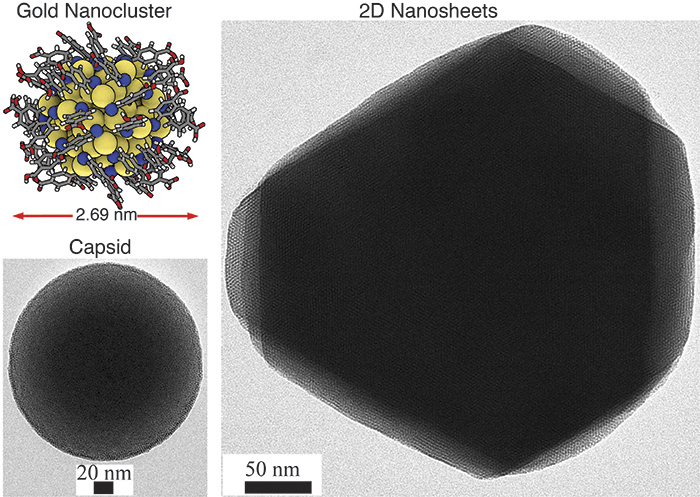
The self-assembly of gold nanoclusters took place in a water-methanol mixture and produced two distinctly different superstructures that were imaged in a high-resolution electron microscope at Aalto University. In one of the structures, two-dimensional hexagonally ordered layers of gold nanoclusters were stacked together, each layer being just one nanocluster thick. Modifying the synthesis conditions, also three-dimensional spherical, hollow capsid structures were observed, where the thickness of the capsid wall corresponds again to just one nanocluster size (see figure).

While the details of the formation mechanisms of these superstructures warrant further systemic investigations, the initial observations open several new views into synthetically made self-assembling nanomaterials.

“Today, we know of several tens of different types of atomistically precise gold nanoclusters, and I believe they can exhibit a wide variety of self-assembling growth patterns that could produce a range of new meta-materials,” said Academy Professor Hannu Häkkinen, who coordinated the research at the Nanoscience Centre. “In biology, typical examples of self-assembling functional systems are viruses and vesicles. Biological self-assembled structures can also be de-assembled by gentle changes in the surrounding biochemical conditions. It’ll be of great interest to see whether these gold-based materials can be de-assembled and then re-assembled to different structures by changing something in the chemistry of the surrounding solvent.”

“The free-standing two-dimensional nanosheets will bring opportunities towards new-generation functional materials, and the hollow capsids will pave the way for highly lightweight colloidal framework materials,” Postdoctoral Researcher Nonappa (Aalto University) said.

Professor Olli Ikkala of Aalto University said: “In a broader framework, it has remained as a grand challenge to master the self-assemblies through all length scales to tune the functional properties of materials in a rational way. So far, it has been commonly considered sufficient to achieve sufficiently narrow size distributions of the constituent nanoscale structural units to achieve well-defined structures. The present findings suggest a paradigm change to pursue strictly defined nanoscale units for self-assemblies.”

References:

(1)    Nonappa, T. Lahtinen, J.S. Haataja, T.-R. Tero, H. Häkkinen and O. Ikkala, “Template-Free Supracolloidal Self-Assembly of Atomically Precise Gold Nanoclusters: From 2D Colloidal Crystals to Spherical Capsids”, Angewandte Chemie International Edition, published online 23 November 2016, DOI: 10.1002/anie.201609036

(2)    P. Jadzinsky et al., “Structure of a thiol-monolayer protected gold nanoparticle at 1.1Å resolution”, Science 318, 430 (2007)

(3)    V. Marjomäki et al., “Site-specific targeting of enterovirus capsid by functionalized monodispersed gold nanoclusters”, PNAS 111, 1277 (2014)

Here’s the figure mentioned in the news release,

Figure: 2D hexagonal sheet-like and 3D capsid structures based on atomically precise gold nanoclusters as guided by hydrogen bonding between the ligands. The inset in the top left corner shows the atomic structure of one gold nanocluster.

Here’s a link to and a citation for the paper,

Template-Free Supracolloidal Self-Assembly of Atomically Precise Gold Nanoclusters: From 2D Colloidal Crystals to Spherical Capsids by Dr. Nonappa, Dr. Tanja Lahtinen, M. Sc. Johannes. S. Haataja, Dr. Tiia-Riikka Tero, Prof. Hannu Häkkinen, and Prof. Olli Ikkala. Angewandte Chemie International Edition Volume 55, Issue 52, pages 16035–16038, December 23, 2016 Version of Record online: 23 NOV 2016 DOI: 10.1002/anie.201609036

© 2016 Wiley-VCH Verlag GmbH & Co. KGaA, Weinheim

This paper is behind a paywall.

Fishnet of gold atoms improves solar cell performance

Apparently they’re calling the University of Western Ontario by a new name, Western University. Given the university’s location in what is generally acknowledged as central Canada or, sometimes, as eastern Canada, this seems like a geographically confusing approach not only in Canada but elsewhere too. After all, more than one country boasts a ‘west’.

A Sept. 26, 2014 news item on Nanowerk highlights new work on improving solar cell performance (Note: A link has been removed),

Scientists at Western University [Ontario, Canada] have discovered that a small molecule created with just 144 atoms of gold can increase solar cell performance by more than 10 per cent. These findings, published recently by the high-impact journal Nanoscale (“Tessellated gold nanostructures from Au144(SCH2CH2Ph)60 molecular precursors and their use in organic solar cell enhancement”), represent a game-changing innovation that holds the potential to take solar power mainstream and dramatically decrease the world’s dependence on traditional, resource-based sources of energy, says Giovanni Fanchini from Western’s Faculty of Science.

For those of us who remember ‘times tables’, the number 144 can have a special meaning as it is the last number (’12’ times ’12’ equals ‘144’) one was obliged to memorize. At least, that was true at my school in Vancouver, Canada but perhaps not elsewhere, eh?

Getting back to the ‘fishnet’, a Sept. 25, 2014 Western University news release, which originated the news item, expands the business possibilities for this work,

Fanchini, the Canada Research Chair in Carbon-based Nanomaterials and Nano-optoelectronics, says the new technology could easily be fast-tracked and integrated into prototypes of solar panels in one to two years and solar-powered phones in as little as five years.

“Every time you recharge your cell phone, you have to plug it in,” says Fanchini, an assistant professor in Western’s Department of Physics and Astronomy. “What if you could charge mobile devices like phones, tablets or laptops on the go? Not only would it be convenient, but the potential energy savings would be significant.”

The Western researchers have already started working with manufacturers of solar components to integrate their findings into existing solar cell technology and are excited about the potential.

“The Canadian business industry already has tremendous know-how in solar manufacturing,” says Fanchini. “Our invention is modular, an add-on to the existing production process, so we anticipate a working prototype very quickly.”

The news release then gives a few technical details,

Making nanoplasmonic enhancements, Fanchini and his team use “gold nanoclusters” as building blocks to create a flexible network of antennae on more traditional solar panels to attract an increase of light. While nanotechnology is the science of creating functional systems at the molecular level, nanoplasmonics investigates the interaction of light with and within these systems.

“Picture an extremely delicate fishnet of gold,” explains Fanchini explains, noting that the antennae are so miniscule they are unseen even with a conventional optical microscope. “The fishnet catches the light emitted by the sun and draws it into the active region of the solar cell.”

According to Fanchini, the spectrum of light reflected by gold is centered on the yellow colour and matches the light spectrum of the sun making it superior for such antennae as it greatly amplifies the amount of sunlight going directly into the device.

“Gold is very robust, resilient to oxidization and not easily damaged, making it the perfect material for long-term use,” says Fanchini. “And gold can also be recycled.”

It has been known for some time that larger gold nanoparticles enhance solar cell performance, but the Western team is getting results with “a ridiculously small amount” – approximately 10,000 times less than previous studies, which is 10,000 times less expensive too.

I hope to hear about a working prototype soon. Meanwhile, here’s a link to and a citation for the paper,

Tessellated gold nanostructures from Au144(SCH2CH2Ph)60 molecular precursors and their use in organic solar cell enhancement by Reg Bauld, Mahdi Hesari, Mark S. Workentin, and Giovanni Fanchini. Nanoscale, 2014,6, 7570-7575 DOI: 10.1039/C4NR01821D
First published online 06 May 2014

This paper is behind a paywall.

One final comment, it seems like a long lead time between publication of the paper and publicity. I wonder if the paper failed to get notice in May 2014, assuming there was a campaign at the time, or if this is considered a more optimal time period for getting noticed.