Tag Archives: infrared light

Nanotechnology-enabled contact lenses that give infrared vision to humans

A May 22, 2025 news item on Nanowerk announced a nanotechnology-enabled contact lens that made international news, Note: A link has been removed,

Neuroscientists and materials scientists have created contact lenses that enable infrared vision in both humans and mice by converting infrared light into visible light. Unlike infrared night vision goggles, the contact lenses, described in the Cell Press journal Cell (“Near-infrared spatiotemporal color vision in humans enabled by upconversion contact lenses”), do not require a power source—and they enable the wearer to perceive multiple infrared wavelengths. Because they’re transparent, users can see both infrared and visible light simultaneously, though infrared vision was enhanced when participants had their eyes closed.

“Our research opens up the potential for non-invasive wearable devices to give people super-vision,” says senior author Tian Xue, a neuroscientist at the University of Science and Technology of China. “There are many potential applications right away for this material. For example, flickering infrared light could be used to transmit information in security, rescue, encryption or anti-counterfeiting settings.”

A May 22, 2025 Cell Press news release on EurekAlert, which originated the news item, goes on to describe how researchers were able to introduce new capabilities for contact lenses,

The contact lens technology uses nanoparticles that absorb infrared light and convert it into wavelengths that are visible to mammalian eyes (e.g., electromagnetic radiation in the 400-700 nm range). The nanoparticles specifically enable detection of “near-infrared light,” which is infrared light in the 800-1600 nm range, just beyond what humans can already see. The team previously showed that these nanoparticles enable infrared vision in mice when injected into the retina, but they wanted to design a less invasive option.  

To create the contact lenses, the team combined the nanoparticles with flexible, non-toxic polymers that are used in standard soft contact lenses. After showing that the contact lenses were non-toxic, they tested their function in both humans and mice. 

They found that contact lens-wearing mice displayed behaviors suggesting that they could see infrared wavelengths. For example, when the mice were given the choice of a dark box and an infrared-illuminated box, contact-wearing mice chose the dark box whereas contact-less mice showed no preference. The mice also showed physiological signals of infrared vision: the pupils of contact-wearing mice constricted in the presence of infrared light, and brain imaging revealed that infrared light caused their visual processing centers to light up.  

In humans, the infrared contact lenses enabled participants to accurately detect flashing morse code-like signals and to perceive the direction of incoming infrared light. “It’s totally clear cut: without the contact lenses, the subject cannot see anything, but when they put them on, they can clearly see the flickering of the infrared light,” said Xue. “We also found that when the subject closes their eyes, they’re even better able to receive this flickering information, because near-infrared light penetrates the eyelid more effectively than visible light, so there is less interference from visible light.”  

An additional tweak to the contact lenses allows users to differentiate between different spectra of infrared light by engineering the nanoparticles to color-code different infrared wavelengths. For example, infrared wavelengths of 980 nm were converted to blue light, wavelengths of 808 nm were converted to green light, and wavelengths of 1,532 nm were converted to red light. In addition to enabling wearers to perceive more detail within the infrared spectrum, these color-coding nanoparticles could be modified to help color blind people see wavelengths that they would otherwise be unable to detect. 

“By converting red visible light into something like green visible light, this technology could make the invisible visible for color blind people,” says Xue. 

Because the contact lenses have limited ability to capture fine details (due to their close proximity to the retina, which causes the converted light particles to scatter), the team also developed a wearable glass system using the same nanoparticle technology, which enabled participants to perceive higher-resolution infrared information.   

Currently, the contact lenses are only able to detect infrared radiation projected from an LED light source, but the researchers are working to increase the nanoparticles’ sensitivity so that they can detect lower levels of infrared light.  

“In the future, by working together with materials scientists and optical experts, we hope to make a contact lens with more precise spatial resolution and higher sensitivity,” says Xue.  

Jennifer Ouellette’s May 22, 2025 article for Ars Technica emphasizes the military aspect of this work,

Tired of using bulky night vision goggles for your clandestine nocturnal activities? An interdisciplinary team of Chinese neuroscientists and materials scientists has developed near-infrared contact lenses that enabled both mice and humans to see in the dark, even with their eyes closed, according to a new paper published in the journal Cell.

Humans and other mammals can only perceive a limited range of the electromagnetic spectrum (light), usually in the 400–700 nm range. There are creatures that can see in infrared (snakes, mosquitoes, bullfrogs) or ultraviolet (bees, birds), and goldfish can perceive both. But humans must augment themselves with technology in order to expand our range of vision.

Night vision goggles and similar devices have been around since the 1930s, including infrared-visible converters, but these require external energy sources, and the converters have a multilayer structure that makes them opaque and hence challenging to integrate with a human eye. The authors previously were able to confer near-infrared vision to mice by injecting nanoparticles that bind to photoreceptors into their eyes—basically creating a near-infrared nanoantenna—but realized that most people would be averse to the prospect of sticking needles in their eyes. So they looked for a better alternative. Contact lenses seemed the obvious choice.

Ouellette’s May 22, 2025 article is a good read.

Caption: Study participant putting contacts in Credit: Yuqian Ma, Yunuo Chen, Hang Zhao

Here’s a link to and a citation for the paper,

Near-infrared spatiotemporal color vision in humans enabled by upconversion contact lenses by Yuqian Ma (马玉乾), Yunuo Chen (陈雨诺), Sheng Wang, Zi-Han Chen, Yuanwei Zhang, Ling Huang, Xinxin Zhang, Fei Yin, Yunxuan Wang, Mingzhu Yang, Zhanjun Li, Kai Huang, Xin Fang, Zishuo Li, Minghong Wang, Wenhui Liu, Jia-Nan Li, Longfei Li, Hang Zhao, Min Wei, Yiming Shi, Rong Liu, Mei Zhang, Jutao Chen, Jiawei Shen, Jianjun Meng, Yupeng Yang, Fan Zhang, Xinglong Gong, Gang Han, Tian Xue (薛天). Cell Volume 188, Issue 13, 26 June 2025, Pages 3375-3388.e18 DOI: https://doi.org/10.1016/j.cell.2025.04.019 Available online 22 May 2025, Version of Record 26 June 2025

This paper is behind a paywall.

Art/science and a paintable diagnostic test for cancer

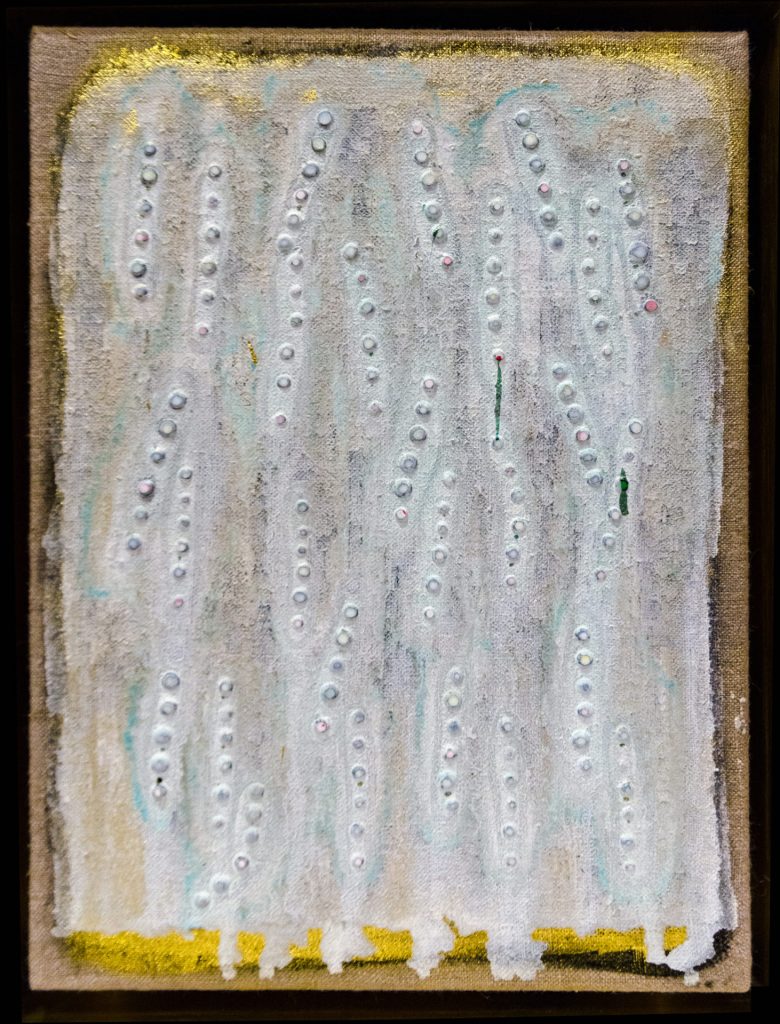
One of Joseph Cohen’s painting incorporating carbon nanotubes photographed in normal light. Photo courtesy of Joseph Cohen. [downloaded from https://news.artnet.com/art-world/carbon-nanotube-cancer-paint-1638340?utm_content=from_&utm_source=Sailthru&utm_medium=email&utm_campaign=Global%20September%202%20PM&utm_term=artnet%20News%20Daily%20Newsletter%20USE%20%2830%20Day%20Engaged%20Only%29]

The artist credited with the work seen in the above, Joseph Cohen, has done something remarkable with carbon nanotubes (CNTs). Something even more remarkable than the painting as Sarah Cascone recounts in her August 30, 2019 article for artnet.com (Note: A link has been removed),

Not every artist can say that his or her work is helping in the fight against cancer. But over the past several years, Joseph Cohen has done just that, working to develop a new, high-tech paint that can be used not only on canvas, but also to detect cancers and medical conditions such as hypertension and diabetes.

Sloan Kettering Institute scientist Daniel Heller first suggested that Cohen come work at his lab after seeing the artist’s work, which is often made with pigments that incorporate diamond dust and gold, at the DeBuck Gallery in New York.

“We initially thought that in working with an artist, we would make art to shed a little light on our science for the public,” Heller told the Memorial Sloan Kettering blog. “But the collaboration actually taught us something that could help us shine a light on cancer.”

For Cohen, the project was initially intended to develop a new way of art-making. In Heller’s lab, he worked with carbon nanotubes, which Heller was already employing in cancer research, for their optical properties. “They fluoresce in the infrared spectrum,” Cohen says. “That gives artists the opportunity to create paintings in a new spectrum, with a whole new palette of colors.”

Because human eyesight is limited, we can’t actually see infrared fluorescence. But using a special short-wave infrared camera, Cohen is able to document otherwise invisible effects, revealing the carbon nanotube paint’s hidden colors.

“What you’re perceiving as a static painting is actually in motion,” Cohen says. “I’m creating paintings that exist outside of the visible experience.”

Art Supplies—and a Diagnostic Tool

That same imaging technique can be used by doctors looking for microalbuminuria, a condition that causes the kidneys to leak trace amounts of albumin into urine, which is an early sign of of several cancers, diabetes, and high blood pressure.

Cohen helped co-author a paper published this month in Nature Communications about using the nanosensor paint in litmus paper tests with patient urine samples. The study found that the paint, when viewed through infrared light, was able to reveal the presence of albumin based on changes in the paint’s fluorescence after being exposed to the urine sample.

“It’s easy to detect albumen with a dipstick if there’s a lot of levels in the urine, but that would be like looking at stage four cancer,” Cohen says. “This is early detection.”

What’s more, a nanosensor paint can be easily used around the world, even in poor areas that don’t have access to the best diagnostic technologies. Doctors may even be able to view the urine samples using an infrared imaging attachments on their smartphones.

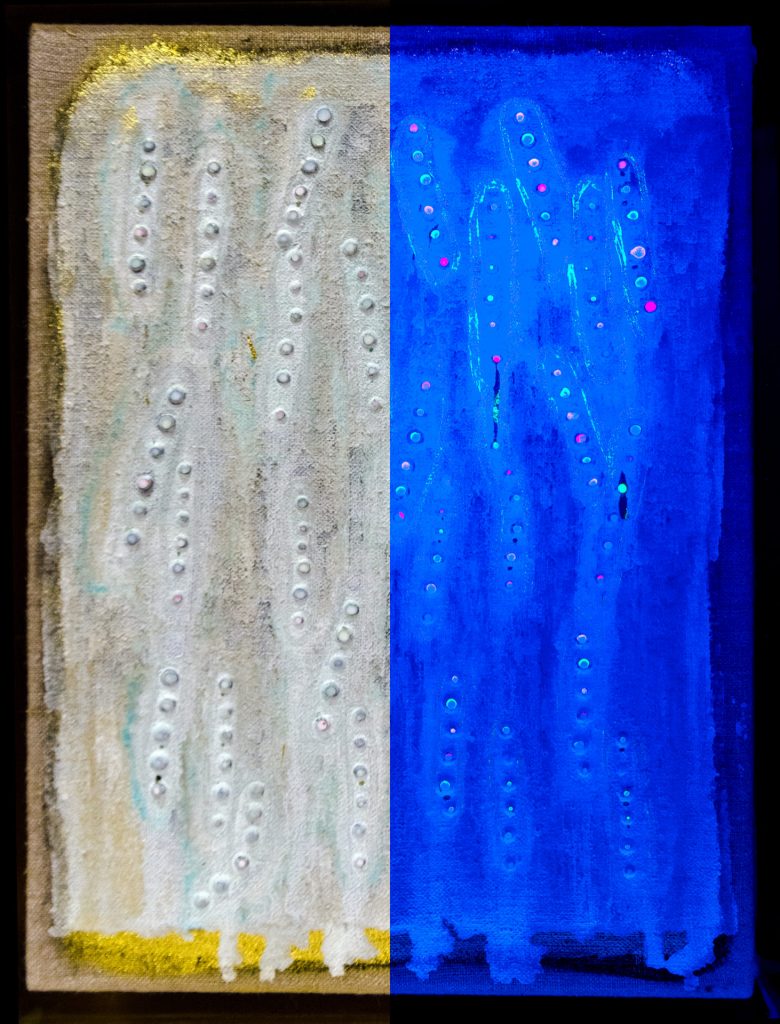
One of Joseph Cohen’s painting incorporating carbon nanotubes shown in both the visible light (left) and in UV fluorescence (right). Photo courtesy of Joseph Cohen. [downloaded from https://news.artnet.com/art-world/carbon-nanotube-cancer-paint-1638340?utm_content=from_&utm_source=Sailthru&utm_medium=email&utm_campaign=Global%20September%202%20PM&utm_term=artnet%20News%20Daily%20Newsletter%20USE%20%2830%20Day%20Engaged%20Only%29]

Amazing, eh? If you have the time, do read Cascone’s article in its entirety and should your curiosity be insatiable, there’s also an August 22, 2019 posting by Jim Stallard on the Memorial Sloan Kettering Cancer Center blog,

Here’s a link to and a citation for the paper,

Synthetic molecular recognition nanosensor paint for microalbuminuria by Januka Budhathoki-Uprety, Janki Shah, Joshua A. Korsen, Alysandria E. Wayne, Thomas V. Galassi, Joseph R. Cohen, Jackson D. Harvey, Prakrit V. Jena, Lakshmi V. Ramanathan, Edgar A. Jaimes & Daniel A. Heller. Nature Communicationsvolume 10, Article number: 3605 (2019) DOI: https://doi.org/10.1038/s41467-019-11583-1 Published: 09 August 2019

This paper is open access.

Joseph Cohen has graced this blog before in a May 3, 2019 posting titled, Where do I stand? a graphene artwork. It seems Cohen is very invested in using nanoscale carbon particles for his art.