Tag Archives: International Day of Light

The importance of photonics (science of light) in African science

A May 14, 2025 essay (h/t to phys.org) written by Andrew Forbes, professor, University of the Witwatersrand, and Patience Mthunzi-Kufa, distinguished professor, University of South Africa, for The Conversation describes the history, current work, and hopes for photonics on the African continent, Note: Some links have been removed,

Light is all around us, essential for one of our primary senses (sight) as well as life on Earth itself. It underpins many technologies that affect our daily lives, including energy harvesting with solar cells, light-emitting-diode (LED) displays and telecommunications through fibre optic networks.

The smartphone is a great example of the power of light. Inside the box, its electronic functionality works because of quantum mechanics [Note; Link removed]. The front screen is an entirely photonic device: liquid crystals controlling light. The back too: white light-emitting diodes for a flash, and lenses to capture images.

We use the word photonics, and sometimes optics, to capture the harnessing of light for new applications and technologies. Their importance in modern life is celebrated every year on 16 May with the International Day of Light.

Scientists on the African continent, despite the resource constraints they work under, have made notable contributions to photonics research. Some of these have been captured in a recent special issue of the journal Applied Optics [Note: Link removed]. Along with colleagues in this field from Morocco and Senegal, we introduced this collection of papers [Note: Link removed], which aims to celebrate excellence and show the impact of studies that address continental issues.

Africa’s history in formal optics stems back thousands of years, [emphasis mine] with references to lens design already recorded in ancient Egyptian writings.

In more recent times, Africa has contributed to two Nobel prizes based on optics. Ahmed Zewail (Egyptian born) watched the ultrafast processes in chemistry with lasers (1999, Nobel Prize for Chemistry) and Serge Harouche (Moroccan born) studied the behaviour of individual particles of light, photons (2012, Nobel Prize for Physics).

The papers in the special journal issue touch on a diversity of continent-relevant topics.

One is on using optics to communicate across free-space (air) even in bad weather conditions. This light-based solution was tested using weather data from two African cities, Alexandria in Egypt and Setif in Algeria.

Another paper is about tiny quantum sources of quantum entanglement for sensing. The authors used diamond, a gem found in South Africa and more commonly associated with jewellery. Diamond has many flaws, one of which can produce single photons as an output when excited. The single photon output was split into two paths, as if the particle went both left and right at the same time. This is the quirky notion of entanglement, in this case, created with diamonds. If an object is placed in any one path, the entanglement can detect it. Strangely, sometimes the photons take the left-path but the object is in the right-path, yet still it can be detected.

One contributor proposes a cost-effective method to detect and classify harmful bacteria in water.

New approaches in spectroscopy (studying colour) [Note: Link removed] for detecting cell health; biosensors to monitor salt and glucose levels in blood; and optical tools for food security all play their part in optical applications on the continent.

Another area of African optics research that has important applications is the use of optical fibres for sensing the quality of soil and its structural integrity. Optical fibres are usually associated with communication, but a modern trend is to use the existing optical fibre already laid to sense for small changes in the environment, for instance, as early warning systems for earthquakes. The research shows that conventional fibre can also be used to tell if soil is degrading, either from lack of moisture or some physical shift in structure (weakness or movement). It is an immediately useful tool for agriculture, building on many decades of research.

The last century was based on electronics and controlling electrons. This century will be dominated by photonics, controlling photons.

Professor Zouheir Sekkat of University Mohamed V, Rabat, and director of the Pole of Optics and Photonics within MAScIR of University Mohamed VI Polytechnic Benguerir, Morocco, contributed to this article.

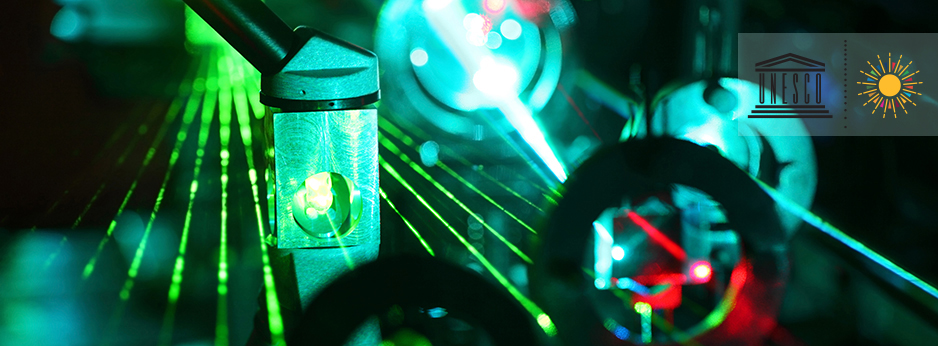
Light-based technologies have wide practical applications. Wikimedia Commons, CC BY [downloaded from https://theconversation.com/light-is-the-science-of-the-future-the-africans-using-it-to-solve-local-challenges-256031]

Here’s the special issue with two links:

Virtual Feature Issue

Joint feature issue in Applied Optics and Optics Continuum: Optical Science and Photonics in Africa (OSPA)

Zouheir Sekkat, Optics & Photonics Center, MAScIR-UM6P, Ben Guerir, and University Mohamed 5, Morocco (Lead Editor)
Andrew Forbes, University Witwatersrand, South Africa
Patience Mthunzi-Kufa, CSIR, South Africa
Balla Diop Ngom, University Cheikh Anta Diop, Senegal

OR

20 March 2025, Volume 64, Issue 9, pp. 2102-2323; Feat. pp: OSPA1–3; C1–C163  

Enjoy!

May 16, 2018: UNESCO’s (United Nations Educational, Scientific and Cultural Organization) First International Day of Light

Courtesy: UNESCO

From a May 11, 2018 United Nations Educational, Scientific and Cultural Organization (UNESCO) press release (received via email),

UNESCO will welcome leading scientists on 16 May 2018 for the 1st edition of the International Day of Light (02:30-08:00 pm) to celebrate the role light plays in our daily lives. Researchers and intellectuals will examine how light-based technologies can contribute to meet pressing challenges in diverse areas, such as medicine, education, agriculture and energy.

            UNESCO Director-General Audrey Azoulay will open this event, which will count with the participation of renowned scientists, including:

  • Kip Thorne, 2017 Nobel Prize in Physics, California Institute of Technology (United States of America).
  • Claude Cohen-Tannoudji, 1997 Nobel Prize in Physics, Collège de France.
  • Khaled Toukan, Director of the Synchrotron-light for Experimental Science and Applications in the Middle East (SESAME) based in Allan, Jordan.

The programme of keynotes and roundtables will address many key issues including science policy, our perception of the universe, and international cooperation, through contributions from experts and scientists from around the world.

The programme also includes cultural events, an illumination of UNESCO Headquarters, a photonics science show and an exhibit on the advances of light-based technologies and art.

            The debates that flourished in 2015, in the framework of the International Year of Light, highlighted the importance of light sciences and light-based technologies in achieving the United Nations Sustainable Development Goals. Several thousand events were held in 147 countries during the Year placed under the auspices of UNESCO.  

The proclamation of 16 May as the International Day of Light was supported by UNESCO’s Executive Board following a proposal by Ghana, Mexico, New Zealand and the Russian Federation, and approved by the UNESCO General Conference in November 2017.

More information:

I have taken a look at the programme which is pretty interesting. Unfortunately, I can’t excerpt parts of it for inclusion here as very odd things happen when I attempt to ‘copy and paste’. On the plus side. there’s a bit more information about this ‘new day’ on its event page,

Light plays a central role in our lives. On the most fundamental level, through photosynthesis, light is at the origin of life itself. The study of light has led to promising alternative energy sources, lifesaving medical advances in diagnostics technology and treatments, light-speed internet and many other discoveries that have revolutionized society and shaped our understanding of the universe. These technologies were developed through centuries of fundamental research on the properties of light – starting with Ibn Al-Haytham’s seminal work, Kitab al-Manazir (Book of Optics), published in 1015 and including Einstein’s work at the beginning of the 20th century, which changed the way we think about time and light.

The International Day of Light celebrates the role light plays in science, culture and art, education, and sustainable development, and in fields as diverse as medicine, communications, and energy. The will allow many different sectors of society worldwide to participate in activities that demonstrates how science, technology, art and culture can help achieve the goals of UNESCO – building the foundation for peaceful societies.

The International Day of Light is celebrated on 16 May each year, the anniversary of the first successful operation of the laser in 1960 by physicist and engineer, Theodore Maiman. This day is a call to strengthen scientific cooperation and harness its potential to foster peace and sustainable development.

Happy International Day of Light on Wednesday, May 16, 2018!