Tag Archives: Jörn Köhler

Merry 2024 Christmas (2 of 2) What sounds like something from Star Trek? Answer: 7 new frog species discovered in Madagascar

‘Captain Sisko’ is a new favourite frog image and the audio file is a revelation (scroll down and the scroll down further). Later on, this is an amusing cartoon version of a Star Trek captain.

As for the story proper, scientists who have a passion for Star Trek have made a discovery in Madagascar, from an October 15, 2024 news item on ScienceDaily,

An international team of researchers have discovered seven new species of tree frogs that make otherworldly calls in the rainforests of Madagascar. Their strange, high-pitched whistling calls sound more like sound effects from the sci-fi series Star Trek. As a result, the researchers have named the new species after seven of the series’ most iconic captains.

This is a gorgeous frog,

Frog Boophis to be named after Captain Sisko from Star Trek. Photo: Mark D. Scherz

An October 15, 2024 University of Copenhagen press release (also on EurekAlert), which originated the news item,

If you think all frogs croak, you’d be wrong. Seven newly discovered species from the tree frog genus Boophis, found across the rainforests of Madagascar, emit special bird-like whistling sounds in their communication with other frogs.

These whistling sounds reminded the research team, led by Professor Miguel Vences of the Technische Universität Braunschweig, Germany, of Star Trek, where similar whistle-like sound effects are frequently used.

“That’s why we named the frogs after Kirk, Picard, Sisko, Janeway, Archer, Burnham, and Pike—seven of the most iconic captains from the sci-fi series,” says Professor Vences.

“Not only do these frogs sound like sound-effects from Star Trek, but it seems also fitting that to find them, you often have to do quite a bit of trekking! A few species are found in places accessible to tourists, but to find several of these species, we had to undertake major expeditions to remote forest fragments and mountain peaks. There’s a real sense of scientific discovery and exploration here, which we think is in the spirit of Star Trek,” explains Assistant Professor Mark D. Scherz from the Natural History Museum of Denmark at the University of Copenhagen, who was senior author on the study.

To Drown Out the Sound of Water

The otherworldly calls of these frogs are known as “advertisement calls”—a type of self-promotion that, according to the researchers, may convey information about the male frog’s suitability as a mate to females. This particular group live along fast-flowing streams in the most mountainous regions of Madagascar—a loud background that may explain why the frogs call at such high pitches.

For fans of Star Trek, some of the frog calls might remind them of sounds from the so-called ‘boatswain whistle’ and a device called the ‘tricorder.’ To others, they might sound like a bird or an insect.

“If the frogs just croaked like our familiar European frogs, they might not be audible over the sound of rushing water from the rivers they live near. Their high-pitched trills and whistles stand out against all that noise,” explains Dr Jörn Köhler, Senior Curator of Vertebrate Zoology at the Hessisches Landesmuseum Darmstadt, Germany, who played a key role in analyzing the calls of the frogs.

“The appearance of the frogs has led to them being confused with similar species until now, but each species makes a distinctive series of these high-pitched whistles, that has allowed us to tell them apart from each other, and from other frogs,” he says.

The calls also lined up with the genetic analysis the team performed.

Vulnerable to Climate Change

Madagascar is renowned for its immense biodiversity, and research in its rainforests continues to uncover hidden species, making it a true paradise for frogs. Madagascar, an island roughly the size of France, is home to about 9% of all the world’s frog species.

“We’ve only scratched the surface of what Madagascar’s rainforests have to offer. Every time we go into the forest, we find new species, and just in terms of frogs, there are still several hundred species we haven’t yet described,” says Professor Andolalao Rakotoarison of the Université d’Itasy in Madagascar. Just in the last ten years, she and the rest of this team have described around 100 new species from the island.

The researchers behind the discovery hope that this new knowledge will strengthen conservation efforts in Madagascar’s rainforests. The species often live in close geographic proximity but at different altitudes and in different microhabitats. This division makes them particularly vulnerable to changes in climate or the environment.

Thus, the research team urges greater awareness around the conservation of Madagascar’s biodiversity to ensure that these unique species and their habitats are preserved for the future. But they also hope to continue exploring, to seek out new species in forests where no scientist has gone before.

Researchers have made an audio file of the ‘Star Trek’ captain calls available, from the October 15, 2024 University of Copenhagen press release on EurekAlert, If I didn’t know, I would have guessed these were frogs,

Here’s a link to and a citation for the paper

Communicator whistles: A Trek through the taxonomy of the Boophis marojezensis complex reveals seven new, morphologically cryptic treefrogs from Madagascar (Amphibia: Anura: Mantellidae) by Miguel Vences, Jörn Köhler, Carl R. Hutter, Michaela Preick, Alice Petzold, Andolalao Rakotoarison, Fanomezana M. Ratsoavina, Frank Glaw, Mark D. Scherz. Vertebrate Zoology 74: 643-681 DOI: https://doi.org/10.3897/vz.74.e121110 Published October 14, 2024

This article appears to be open access.

There is an amusing illustration of one of the ‘Star Trek’ frog. Unfortunately, there isn’t a caption or credit for the illustration but it is from the University of Copenhagen,

New gecko species in Madagascar with skin specially adapted to tearing

After all these years of writing about geckos and their adhesive properties (they can hang off a wall or ceiling by a single toe), I’ve developed a mild interest in them. From a Feb. 7, 2017 posting by Dirk Steinke for the One species a day blog,

The new species was found in northern Madagascar and its name was build [sic] from the two Greek stems mégas, meaning ‘very large’ and lepís, meaning ‘scale’, and refers to the large size of the scales of this species in comparison to other geckos.
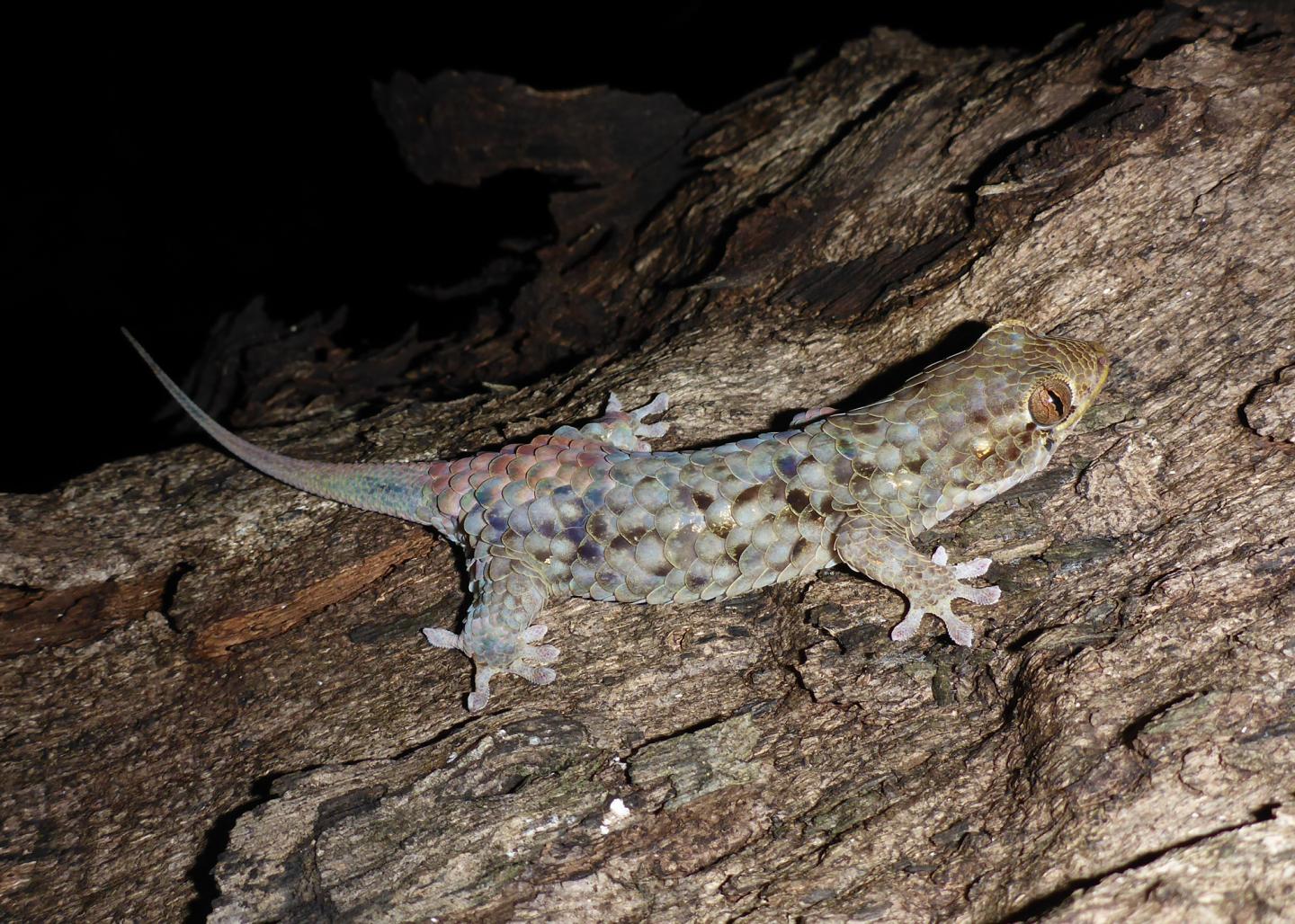
Caption: The new fish-scale gecko, Geckolepis megalepis, has the largest body scales of all geckos. This nocturnal lizard was discovered in the ‘tsingy’ karst formations in northern Madagascar Credit: F. Glaw

There’s more about the new species and the research in a Feb. 7, 2017 PeerJ news release on EurekAlert,

Many lizards can drop their tails when grabbed, but one group of geckos has gone to particularly extreme lengths to escape predation. Fish-scale geckos in the genus Geckolepis have large scales that tear away with ease, leaving them free to escape whilst the predator is left with a mouth full of scales. Scientists have now described a new species (Geckolepis megalepis) that is the master of this art, possessing the largest scales of any gecko.

The skin of fish-scale geckos is specially adapted to tearing. The large scales are attached only by a relatively narrow region that tears with ease, and beneath them they have a pre-formed splitting zone within the skin itself. Together, these features make them especially good at escaping from predators. Although several other geckos are able to lose their skin like this if they are grasped really firmly, Geckolepis are apparently able to do it actively, and at the slightest touch. And while others might take a long time to regenerate their scales, fish-scale geckos can grow them back, scar-free, in a matter of weeks.

This remarkable (if somewhat gruesome) ability has made these geckos a serious challenge to the scientists who want to study them. Early researchers described how it was necessary to catch them with bundles of cotton wool, to avoid them losing almost all of their skin. Today, little has changed, and researchers try to catch them without touching them if possible, by luring them into plastic bags. But once they are caught, the challenges are not over; identifying and describing them is even harder.

“A study a few years ago showed that our understanding of the diversity of fish-scale geckos was totally inadequate,” says Mark D. Scherz, lead author of the new study and PhD student at the Ludwig Maximilian University of Munich and Zoologische Staatssammlung München, “it showed us that there were actually about thirteen highly distinct genetic lineages in this genus, and not just the three or four species we thought existed. One of the divergent lineages they identified was immediately obvious as a new species, because it had such massive scales. But to name it, we had to find additional reliable characteristics that distinguish it from the other species.” A challenging task indeed: one of the main ways reptile species can be told apart is by their scale patterns, but these geckos lose their scales with such ease that the patterns are often lost by the time they reach adulthood. “You have to think a bit outside the box with Geckolepis. They’re a nightmare to identify. So we turned to micro-CT to get at their skeletons and search there for identifying features.” Micro-CT (micro-computed tomography) is essentially a 3D x-ray of an object. This method is allowing morphologists like Scherz to examine the skeletons of animals without having to dissect them, opening up new approaches to quickly study the internal morphology of animals.

By looking at the skeletons of the geckos, the team was able to identify some features of the skull that distinguish their new species from all others. But they also found some surprises; a species named 150 years ago, Geckolepis maculata, was confirmed to be different from the genetic lineage that it had been thought to be. “This is just typical of Geckolepis. You think you have them sorted out, but then you get a result that turns your hypothesis on its head. We still have no idea what Geckolepis maculata really is–we are just getting more and more certain what it’s not.”

The new species, Geckolepis megalepis, which was described by researchers from the US, Germany, and Columbia [sic] in a paper published today in the open access journal PeerJ, is most remarkable because of its huge scales, which are by far the largest of any gecko. The researchers hypothesize that the larger scales tear more easily than smaller scales, because of their greater surface area relative to the attachment area, and larger friction surface. “What’s really remarkable though is that these scales–which are really dense and may even be bony, and must be quite energetically costly to produce–and the skin beneath them tear away with such ease, and can be regenerated quickly and without a scar,” says Scherz. The mechanism for regeneration, which is not well understood, could potentially have applications in human medicine, where regeneration research is already being informed by studies on salamander limbs and lizard tails.

Here’s a link to and a citation for the paper,

Off the scale: a new species of fish-scale gecko (Squamata: Gekkonidae: Geckolepis) with exceptionally large scales by Mark D. Scherz​, Juan D. Daza, Jörn Köhler, Miguel Vences, Frank Glaw. PeerJ 5:e2955 https://doi.org/10.7717/peerj.2955

This paper is open access.

For anyone unfamiliar with ‘gecko research’, scientists are fascinated by their abilities and have been researching them (in a field known as biomimicry or bioinspired engineering or biomimetics) for years with the hope of mimicking those abilities for new applications. You can check out a March 19, 2015 posting or this July 10, 2014 posting for examples or you can search ‘gecko’ on this blog for more examples.