Tag Archives: Kyushu University

Growing plant roots and fungal hyphae in silica nanoparticles for 3D microvascular networks

This is fascinating,

A November 19, 2024 news item on phys.org describes the problem the researchers in Japan were solving,

Microfluidic technology has become increasingly important in many scientific fields, such as regenerative medicine, microelectronics, and environmental science. However, conventional microfabrication techniques face limitations in scale and in the construction of complex networks. These hurdles are compounded when it comes to building more intricate 3D microfluidic networks.

A November 19, 2024 Kyushu University press release (also on EurekAlert), which originated the news item, describes how the researchers propose to solve the problem building 3D microfluidic networks, Note: Links have been removed,

Now, researchers from Kyushu University have developed a new and convenient technique for building such complex 3D microfluidic networks. Their tool? Plants and fungi. The team developed a ‘soil’ medium using nanoparticles of glass (silica) and a cellulose based binding agent, then allowed plants and fungi to grow roots into it. After the plants were removed, the glass was left with a complex 3D microfluidic network of micrometer-sized hollow holes where the roots once were.

The new method can also be utilized for observing and preserving 3D biological structures that are typically difficult to study in soil, opening new opportunities for research in plant and fungal biology. Their findings were published in the journal Scientific Reports.

“The primary motivation for this research was to overcome the limitations of conventional microfabrication techniques in creating complex 3D microfluidic structures. The focus of our lab is biomimetics, where we try to solve engineering problems by looking to nature and artificially replicating such structures,” explains Professor Fujio Tsumori of Kyushu University’s Faculty of Engineering, who led the study. “And what better example of microfluidics in nature than plant roots and fungal hyphae? So, we set out to develop a method that could harness the natural growth patterns of these organisms and create optimized microfluidic networks.”

The researchers began by developing a ‘soil’ like mix for plants to grow in, but instead of dirt, they combined growth medium with glass nanoparticles smaller than 1 μm in diameter with hydroxypropyl methyl cellulose as a binding agent. They then seeded this ‘soil’ mixture and waited for the plants to take root. After confirming successful plant growth, the ‘soil’ was baked leaving only the glass with root cavities.

“The process is called sintering, which aggregates fine particles together into a more solid state. It is similar to powder metallurgy in the manufacturing of ceramics,” continues Tsumori. “In this case it is the plant that does the molding.”

Their method was able to replicate the intricate biological structures of a plant’s main roots which can be up to 150 μm in diameter, and all the way down to it root hairs which can be about 8 μm in diameter. Tests with other organisms showed that the method can even replicate the root structure of fungi, called hyphae.

“Hyphae are even thinner and can be as small as 1-2 μm in diameter. That’s thinner than a single strand of spider silk,” says Tsumori.

The team hopes that their new bio-inspired microfluidic fabrication technique could be used in various fields of science and engineering, potentially leading to more efficient microreactors, advanced heat exchangers, and innovative tissue engineering scaffolds.

“In the biological sciences, this technique provides a unique tool for studying the intricate 3D structures of plant roots and fungal networks, which can advance our understanding of soil ecosystems,” concludes Tsumori. “By bridging biological systems and engineering, our research has the potential to pave the way for new technologies and scientific discoveries.”

About Kyushu University 
Founded in 1911, Kyushu University is one of Japan’s leading research-oriented institutes of higher education, consistently ranking as one of the top ten Japanese universities in the Times Higher Education World University Rankings and the QS World Rankings. The university is one of the seven national universities in Japan, located in Fukuoka, on the island of Kyushu—the most southwestern of Japan’s four main islands with a population and land size slightly larger than Belgium. Kyushu U’s multiple campuses—home to around 19,000 students and 8000 faculty and staff—are located around Fukuoka City, a coastal metropolis that is frequently ranked among the world’s most livable cities and historically known as Japan’s gateway to Asia. Through its VISION 2030, Kyushu U will “drive social change with integrative knowledge.” By fusing the spectrum of knowledge, from the humanities and arts to engineering and medical sciences, Kyushu U will strengthen its research in the key areas of decarbonization, medicine and health, and environment and food, to tackle society’s most pressing issues.

Here’s a link to and a citation for the paper,

Replicating biological 3D root and hyphal networks in transparent glass chips by Tetsuro Koga, Shota Nakashima & Fujio Tsumori. Scientific Reports volume 14, Article number: 21128 (2024) DOI: https://doi.org/10.1038/s41598-024-72333-y Published: 10 September 2024

This paper is open access.

Sixth Japan SciCom (science communication) Forum (JSF 2024) comes to Fukuoka on October 22-23, 2024

Hopefully this gives you enough time to attend the 2024 science communication forum in Japan, if you haven’t already planned to,

Caption: Join us at Kyushu University, Fukuoka this October for Japan SciCom Forum 2024. You can scan the QR code to register. Credit: Kyushu University

I have more information here in an August 9, 2024 Japan SciCom Forum press release on EurekAlert,

On October 22 and 23 [2024], the sixth Japan SciCom Forum Conference (JSF 2024) will be held at Kyushu University’s Ito Campus. Fukuoka will become the third city, following Tokyo and Okinawa, to welcome specialists in science communication from Japan and around the world.

JSF 2024 will bring together a diverse group of science communicators, writers, researchers, and journalists, along with experts from overseas. The conference is open to anyone involved in sharing research findings internationally, as well as those interested in science communication, public outreach, and engagement.

This year’s JSF will explore a wide range of topics, including crisis management, video production, and the use of AI in science communication. There will also be a focus on advancing inclusion and co-creation through varied communication channels. 

“We are delighted to host JSF 2024 at Kyushu University and warmly welcome researchers and communicators from diverse backgrounds,” said Satoko Kanzaki, Executive Vice President of Communications and Public Relations at Kyushu University. “Science communication is essential not only for researchers but also for fostering a two-way dialogue between researchers and the public, encouraging society as a whole to engage with scientific topics. As we look to the future, it is important to explore the impact of science and technology on society, considering not only their benefits but also their ethical, legal, and social implications. We hope this two-day conference will serve as a platform to deepen discussions on science communication and contribute to its continued advancement.”

Japan SciCom Forum is a platform for individuals involved in science communication and outreach from Japan, with a global focus. During the two-day conference this year, the keynotes will address the challenges of science communication, while workshops will offer practical insights and skills for outreach. Additionally, there will be opportunities throughout the program for participants to engage in discussions and networking. 

“The Japan SciCom Forum is more than just a conference; it’s a platform for collaboration and innovation in science communication. This year’s event in Fukuoka will highlight the dynamic ways we can engage with diverse audiences and bring science to the forefront of public discourse,” said Thilina Heenatigala from the Earth-Life Science Institute (ELSI) and member of the JSF organizing team. 

Ayumi Koso, from the National Institute of Genetics (NIG) and a JSF organizing team member added, “It’s a pleasure to bring the Japan Scicom Forum conference to another region in Japan. This year’s two-day conference offers plenty of time to socialize, and I look forward to seeing both new and familiar faces in Fukuoka!”

Registration is 1,000 yen and the event will be in English. Participants from outside Japan are welcome. For program and registration information please see here: JSF 2024

Here’s the agenda, from the JSF 2024 event page,

Programme Schedule:

DAY 1 (TUES, OCT 22)

13:00-20:00 (find your local start time)

13:00 – 13:10: Welcome from Kyushu University President Ishibashi [Tatsuro Ishibashi] (10 min)

13:10 – 13:20: Housekeeping

13:20 – 13:50: Keynote: Kiki Bowman, Head of Communications, United Nations University (30 mins)

13:50 – 14:05: Keynote Q&A (15 mins)

(Group photo will be taken before the coffee break)

14:05 –  14:30: Coffee break (25 mins)

14:30 – 16:00: Workshops (4 in parallel, 25 people in each) (90 mins)

Workshop 1: Tomoko Otake, Senior Writer, The Japan Times. Think like a journalist: understanding and engaging with the media.

Workshop 2: Akira Ohkubo, Science Communicator, Miraikan – The National Museum of Emerging Science and Innovation. Why inclusion matters at your workplace and activities.

Workshop 3: Andrew Robertson, Associate Professor, Faculty of Engineering, Kyushu University. Getting Started with Videos – From Equipment to Editing.

Workshop 4: Kaoru Natori, Director of Communications, Médecins Sans Frontières Japan. Better Safe Than Sorry – Equipping Your Institution for Crisis Day.

16:00 – 17:00: Social hour

Coffee break/Speed networking/Deep dive discussions/Campus tour (60 mins)

17:00 – 18:00: Panel Discussion on AI and Science Communication (60 mins)

18:30 – 20:30: Networking dinner (120 mins)

DAY 2 (WEDS, OCT 23)
10:00-19:30 (find your local start time)

10:00 – 10:15: Welcome from Brian Lin (EurekAlert!) and housekeeping (15 mins)

10:15 – 10:45: Keynote: Tetsukazu Yahara, Director, Fukuoka City Science Museum (30 mins)

10:45 – 11:00: Keynote Q&A (15 mins)

11:00 – 12:00: Contributor talks (3 talks, 20min each, 15min talk+5 min Q&A) (60 mins)

12:00 – 13:30: Lunch break (90 mins)

13:30 – 14:30: Contributor talks (3 talks, 20min each, 15min talk+5 min Q&A) (60 mins)

14:30 – 15:30: Social hour

Coffee break/Open mic/Campus tour (60 mins)

15:30 – 16:30: Panel discussion and Q&A (60 mins)

16:30 – 16:45: Concluding remarks

16:45 Adjourn (Hall closes 17:00)

SPECIAL EVENT: THURSDAY, OCT 24, 10:00 – 11:30
There will be a EurekAlert! Japan Users meeting at Hakata station (JR Hakata City). Participation is free.

Registration

Register to attend the conference.

Submit your application to present a paper at the JSF annual meeting.

The deadline for making an application to present a paper at the 2024 forum is Friday, September 13, 2024.

Growing electronics on trees

An April 26, 2022 news item on phys.org caught my eye with its mention of nanocellulose, trees, and electronics,

Electronics can grow on trees thanks to nanocellulose paper semiconductors

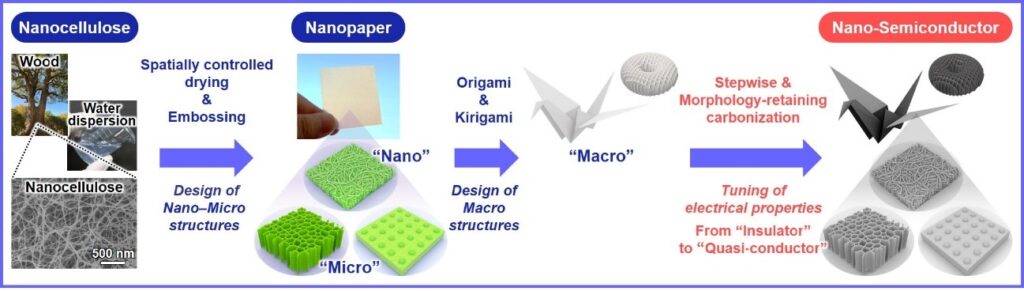
Semiconducting nanomaterials with 3D network structures have high surface areas and a lot of pores that make them excellent for applications involving adsorbing, separating, and sensing. However, simultaneously controlling the electrical properties and creating useful micro- and macro-scale structures, while achieving excellent functionality and end-use versatility, remains challenging. Now, Osaka University researchers, in collaboration with The University of Tokyo, Kyushu University, and Okayama University, have developed a nanocellulose paper semiconductor that provides both nano−micro−macro trans-scale designability of the 3D structures and wide tunability of the electrical properties. Their findings are published in ACS Nano.

Cellulose is a natural and easy to source material derived from wood. Cellulose nanofibers (nanocellulose) can be made into sheets of flexible nanocellulose paper (nanopaper) with dimensions like those of standard A4. Nanopaper does not conduct an electric current; however, heating can introduce conducting properties. Unfortunately, this exposure to heat can also disrupt the nanostructure.

The researchers have therefore devised a treatment process that allows them to heat the nanopaper without damaging the structures of the paper from the nanoscale up to the macroscale.

Caption: Schematic diagram of the preparation of the wood nanocellulose-derived nano-semiconductor with customizable electrical properties and 3D structures Credit: 2022 Koga et al. Nanocellulose paper semiconductor with a 3D network structure and its nano−micro−macro trans-scale design. ACS Nano

An April 28, 2022 Osaka University news release (also on EurekAlert), which originated the news item, provides more detail about the work

“An important property for the nanopaper semiconductor is tunability because this allows devices to be designed for specific applications,” explains study author Hirotaka Koga. “We applied an iodine treatment that was very effective for protecting the nanostructure of the nanopaper. Combining this with spatially controlled drying meant that the pyrolysis treatment did not substantially alter the designed structures and the selected temperature could be used to control the electrical properties.”

The researchers used origami (paper folding) and kirigami (paper cutting) techniques to provide playful examples of the flexibility of the nanopaper at the macrolevel. A bird and box were folded, shapes including an apple and snowflake were punched out, and more intricate structures were produced by laser cutting. This demonstrated the level of detail possible, as well as the lack of damage caused by the heat treatment.

Examples of successful applications showed nanopaper semiconductor sensors incorporated into wearable devices to detect exhaled moisture breaking through facemasks and moisture on the skin. The nanopaper semiconductor was also used as an electrode in a glucose biofuel cell and the energy generated lit a small bulb.

“The structure maintenance and tunability that we have been able to show is very encouraging for the translation of nanomaterials into practical devices,” says Associate Professor Koga. “We believe that our approach will underpin the next steps in sustainable electronics made entirely from plant materials.”

About Osaka University

Osaka University was founded in 1931 as one of the seven imperial universities of Japan and is now one of Japan’s leading comprehensive universities with a broad disciplinary spectrum. This strength is coupled with a singular drive for innovation that extends throughout the scientific process, from fundamental research to the creation of applied technology with positive economic impacts. Its commitment to innovation has been recognized in Japan and around the world, being named Japan’s most innovative university in 2015 (Reuters 2015 Top 100) and one of the most innovative institutions in the world in 2017 (Innovative Universities and the Nature Index Innovation 2017). Now, Osaka University is leveraging its role as a Designated National University Corporation selected by the Ministry of Education, Culture, Sports, Science and Technology to contribute to innovation for human welfare, sustainable development of society, and social transformation.

Here’s a link to and a citation for the paper,

Nanocellulose Paper Semiconductor with a 3D Network Structure and Its Nano–Micro–Macro Trans-Scale Design by Hirotaka Koga, Kazuki Nagashima, Koichi Suematsu, Tsunaki Takahashi, Luting Zhu, Daiki Fukushima, Yintong Huang, Ryo Nakagawa, Jiangyang Liu, Kojiro Uetani, Masaya Nogi, Takeshi Yanagida, and Yuta Nishina. ACS Nano 2022, XXXX, XXX, XXX-XXX DOI: https://doi.org/10.1021/acsnano.1c10728 Publication Date:April 26, 2022 © 2022 The Authors. Published by American Chemical Society

The paper appears to be open access.