Tag Archives: Lainey Gossip

Dancer with a motor neuron(e) disease (MND) guides her digital avatar through a stage performance

[downloaded from https://lbbonline.com/news/NTT-Inc-Pushes-Boundaries-of-Human-Potential-with-Waves-of-Will]

An April 10, 2026 article by Mark Lobel and Liv McMahon for the British Broadcasting Corporation (BBC) highlights a remarkable dance performance,

A ballerina with Amyotrophic Lateral Sclerosis (ALS) says she was able to dance again after her brainwaves were used to power an avatar live on-stage in Amsterdam.

Breanna Olson, a mother of three, found out two and a half years ago she had ALS, the most common form of motor neurone disease (MND) and which, with no known cure, weakens muscles and over time affects speech, swallowing and breathing.

However, using sensors to measure the electrical activity transmitted from her brain, her motor signals could be converted into an digital avatar.

Breanna lives in Tacoma, Washington state, in the US and has trained in ballet, contemporary, and jazz dance since childhood.

MND affects nerves in the brain and spinal cord, controlling muscle movement. As these weaken and stiffen over time it can affect walking, talking, eating and breathing.

The performance, held at the OBA Theatre in Amsterdam in December [2025], was described at the time as the “first of its kind”.

It saw Breanna use an electroencephalogram (or EEG) headset, developed by Japanese tech firm Dentsu Lab in collaboration with data company NTT, to capture her brain activity and specific motor signals associated with imagining certain dance movements.

A brainwave interface translating these signals into computer instructions then allowed her to convey which of these movements she wanted her mixed-reality avatar to dance in real-time.

Breanna told the BBC she got to know the “unique” but “quite challenging” technology during the project.

“You have to isolate your muscles and the noise around you… and really focus inward,” she said.

But despite its challenges, Breanna said the experience had helped re-establish a sense of expression and connection eroded by her condition.

“This is a new way of expression,” she said. “To be able to move in a new way and a different way is just freeing.”

The project, called Waves of Will, is part of a wider initiative which aims to explore how innovation and technology can help restore personal expression, identity and participation for those living with motor-degenerative diseases such as ALS.

“There are many brainwave technologies and research all over the world, but most of them are very expensive and not accessible to everyone,” Dentsu Lab chief creative officer Naoki Tanaka told the BBC.

“This is exactly why we started Waves of Will – to make a new brainwave interface.”

The BBC’s April 10, 2026 article includes an embedded video and more images. For the curious, here’s more about the company and research that made the performance possible.

NTT, Dentsu Lab Tokyo, ALS, and Waves of Will

NTT was originally known as Nippon Telegraph and Telephone Corporation. These days its a “leading global technology company providing services to consumers and business as a mobile operator, infrastructure, networks, applications, and consulting provider” according to a June 14th, 2023 NTT press release (PDF). Here’s more from the press release,

Initiatives to Enrich Communication for ALS Symbionts

To create a world where people with ALS can freely move, express themselves and
interact with others

NTT Corporation (NTT), in cooperation with WITH ALS and Dentsu Lab
Tokyo, through research and development, aims to realize a world where people living with
amyotrophic lateral sclerosis (ALS)[1] can be freed from physical limitations caused by ALS
progression, and communicate with others freely.

  1. Background and Purpose
    “Communication is the most important thing.” These are the words of people living with ALS. As
    ALS progresses, cognition remains normal, and muscle strength throughout the body gradually
    loses function. It is said that by putting on a respirator, you can live your life to the full term, but on
    the other hand, by tracheostomy surgery to put on a respirator, you lose your voice. The choices
    made to keep living can also lead to loss of speech.

    Because of the loss of the means of communication through spoken language and physical
    expression, many people fear disconnection from society and lose hope of living. Globally, more
    than 90% of ALS patients refuse to wear a ventilator.

    NTT is promoting Project Humanity, which aims to solve problems by focusing on people, not only
    those with diseases and disabilities, but also those who support them. This initiative, as part of
    Project Humanity, aims to change the current situation surrounding ALS for people living with ALS
    through the implementation of our communication technology.
  2. Past Initiatives
    Advances in speech synthesis technology have made it possible to record the voice of a person
    and realize synthetic speech with a voice that is unique to the person. However, as ALS symptoms develops, people often have difficulty speaking when they decide to record their voice. In addition, current speech synthesis technology requires the voices to be recorded in a proper recording environment, and it is a significant burden to obtain voice recordings. For this reason, there is currently a huge barrier for people living with ALS to use their own synthetic voice.

    A year ago, we succeeded in reproducing a person’s voice using speech synthesis technology from the audio of a few minutes of recorded video. This technology enables communication in multiple languages with the voice of the individual. Last year, we partnered with WITH ALS and Dentsu Lab Tokyo to use this technology on the Cannes Lions stage. A Japanese ALS symbiont who cannot speak has experienced dialogue and musical performance in English with his own tone of voice. And this year, we succeeded in creating synthetic voices of multiple ALS symbionts from even fewer recordings and recordings of a few seconds. Even if you are not able to speak now, you can still create a synthetic voice if you have the audio recording of your voice before you lost your voice. The synthesized audio created with this technology will be used in a live music performance at the ALS Awareness Music Festival “MOVE FES.” hosted by WITH ALS on June 18 [2023], in conjunction with World ALS Day on June 21 [2023].
  3. Future Initiatives
    In the future, we plan to expand nonverbal expressions so that people living with ALS can
    communicate more freely. First, we will further develop the motor-skill-transfer technology based
    on NTT’s biometric information and work on the following.

    Free manipulation of avatars by ALS symbionts in metaverse space

    Reproduce ALS symbiont’s motion in real space

    In the operation of the avatar (Figure 1), the body is equipped with a myoelectric sensor that
    acquires biological information, and the biological information obtained by the minute muscular
    activity of the body is converted into operational input, thereby realizing to operate the avatar freely.

    Dentsu Lab Tokyo is responsible for creating rich expressions. In the reproduction exercise (Figure 2), the muscles are controlled by presenting electrical muscle stimulation to the body to achieve the reproduction of intended motion.

    Regarding avatar representation, we will use body motion generation technology to realize the nonverbal representation of the ALS symbiont as well as the speech of synthetic speech. Body motion generation technology automatically generates the corresponding motion of a person’s speech by using a motion generation model constructed from the characteristics of speech and motion data collected at that time.

About WITH ALS
Founded in 2016 by Masatane Muto, who is facing amyotrophic lateral sclerosis (ALS), also known as Lou Gehrig’s disease. The mission of WITH ALS General Incorporated Association is to raise awareness of the disease and promote advocacy in search of new treatments and support systems.

It also develops action plans and provides information to build hope and enhance the quality of life
of those with the disease and their families. https://withals.com/

About Dentsu Lab Tokyo
Dentsu Lab Tokyo is a creative R&D organization that combines research, planning, and
development. Under the philosophy of “PLAYFUL SOLUTION” and “Be Irregular”, we use digital
technology and ideas to develop expressions that move people’s minds and solve social issues
that the world demands today. https://dentsulab.tokyo/

In 2024 Dentsu Lab had two projects voted as finalists for the South by Southwest (SXWS)’s innovation awards. (You can read more about the projects here.)

Getting back to Waves of Will, a December 17, 2025 news item on the Little Black Book provides a little more information about the performance and the company’s hopes and dreams, Note: A link has been removed,

Dentsu Lab, in collaboration with long-term client partner NTT, Inc., has unveiled ‘Waves of Will’, a live dance performance that demonstrates how meaningful application of technology and advanced R&D can translate into emotional storytelling and an intimately human experience.

In this unique performance, professional dancer Breanna Olson, who lives with ALS (Amyotrophic Lateral Sclerosis), performs through a mixed reality avatar using a brainwave interface that allows her to express her will. Using an EEG-based system, Breanna’s brain activity is captured and analysed to detect specific learned motor signals that allows her to select from predefined movement options. Rather than responding to passive stimuli, the interface enables Breanna to actively convey her will.

Breanna used this system in pre-production to help shape the artistic direction of the piece, and during the performance itself, to select the movements that the virtual dancer would execute.

The performance unfolds in three acts: in the first act, Olson performs through her will, using the brainwave interface to trigger predefined movements of the avatar.

In the second act, she is joined by her brother Casey Herd, a former principal dancer and Breanna’s dance partner since childhood. And finally, in the third act, other dancers will join the duo, creating a graceful and emotionally resonant performance together.

‘Waves of Will’ is the latest chapter in Project Humanity and All Players Welcome, the long-term collaboration between Dentsu Lab and NTT, Inc. exploring the use of technology to create a more inclusive world. In the previous chapter, Japanese EYE VDJ “MASA” Muto, who lives with ALS, transformed bio-signals into live music and “dance.” This project garnered international recognition at Cannes Lions, SXSW and the Japan Media Arts Festival, redefining the relationship between creativity and technology. Now, with ‘Waves of Will’, the partnership reaches its most ambitious expression yet, demonstrating how Dentsu Lab partners with clients like NTT to translate technological capability into cultural and societal impact.

“This is what Innovating to Impact looks like in action,” said Naoki Tanaka, chief creative officer, Dentsu Lab. “Together with NTT, we’ve transformed cutting-edge R&D into an experience that moves people. It’s proof that when creativity and technology meet, innovation drives both cultural relevance and measurable client impact. For us, it’s not about ideas that stay in the lab, but about helping brands bring meaningful, world-first experiences to life.”

“Our partnership with Dentsu Lab has shown what’s possible when innovation meets purpose,” said Mariko Nakamura, senior research engineer at NTT, Inc. “Through Project Humanity and All Players Welcome, most recently with ‘Waves of Will’, we don’t just demonstrate our technology; we are changing how people see NTT and showing the impact we can make among global communities and cultures.”

Founded in Tokyo over a decade ago as one of the first creative R&D labs of its kind, Dentsu Lab has evolved into a global innovation network exploring how technology, design, and human insight can create lasting impact. Today, the Lab operates across London, Amsterdam, Warsaw, Mumbai and Bengaluru. Its work applies the rigour of research and development to creativity, rapidly prototyping and testing ideas that bridge culture and commerce. Open by design, Dentsu Lab collaborates with clients, creatives, technologists, artists, and academic partners to translate complex innovation into emotionally resonant experiences. The collaboration with NTT on ‘Waves of Will’ exemplifies this mission: proving that creativity and technology, when united, can move both people, industries, and society forward.

There are more images and videos embedded in the December 17, 2025 news item.

You can watch the Waves of Will dance performance on Vimeo or on YouTube.

To dance, to make music

The Breanna Olson and dancing avatar story along with my April 2, 2026 posting “Brain-computer interfaces (BCIs) and music composition” about a quadriplegic musician can serve as a launching pad tor some thinking about the future. First, comments by actor Timothée Chalamet provide more fodder for thought.

From a March 13, 2026 article by Gwyneth Egan for the Canadian Broadcasting Corporation’s (CBC) news online website,

..

While talking to actor Matthew McConaughey about keeping movie theatres alive at a recent CNN and Variety town hall event, Chalamet said he doesn’t “want to be working in ballet or opera,” which he said “no one cares about” anymore.

Although he earned laughs from the live audience at the time, and added that he gives “all respect to the ballet and opera people out there,” his comments have since gone viral — and they’ve been met with swift backlash. 

Critics of Chalamet — who’s Oscar-nominated for best actor this year for his leading role in Marty Supreme — have proven one thing to be true: people do care about the centuries-old art forms that endure in theatres and performance halls around the world. 

On the one hand, O’Donnell [Hannah O’Donnell, a Prince Edward Island-based opera singer] said she doesn’t want to bring more attention to Chalamet’s comments — but on the other, it’s been “awesome to laugh in the face of your haters.” 

Chalamet’s name has been used as a discount code by ballet and opera companies, including the Seattle opera, which offered a 14 per cent discount — a nod to the “14 cents in viewership” Chalamet predicted his comments would cause him to lose. 

Egan’s March 13, 2026 article includes an embedded video and images.

Chalamet’s comments continue to provoke discussion most recently with actor Charlize Theron, from an April 20, 2026 posting “Timmy in Miami” by Lainey on Lainey Gossip

In a wide-ranging interview with The New York Times published this weekend, Charlize reflects on her experience as a dancer earlier in her career and says that, “Dance is probably one of the hardest things I ever did. Dancers are superheroes. What they put their bodies through in complete silence.” At which point Timmy’s name comes up – and her response:

“Oh, boy, I hope I run into him one day. That was a very reckless comment on an art form, two art forms, that we need to lift up constantly because, yes, they do have a hard time. But in 10 years, A.I. is going to be able to do Timothée’s job, but it will not be able to replace a person on a stage dancing live [emphasis mine]. And we shouldn’t [expletive] on other art forms. Dance taught me discipline. It taught structure. It taught hard work. It taught me to be tough. It’s borderline abusive. There were several times that I had blood infections from blisters that just never healed. And you don’t get a day off. I’m literally talking about bleeding through your shoes. And that’s something that you have to practice every single day, the mind-set of just, you don’t give up, there’s no other option, you keep going.”

The dancer’s avatar, the musician’s brain wave music (alternative rock), an actor’s careless comments about ballet and opera, and another actor’s assertion that AI will never replace a live dancer on stage; all of It’s enough to make you wonder what dance and music will be like in the future.

A spray-on dress with nanoparticles as the base?

Even a month after the fact, this is still fascinating. The magic is in watching the paint/textile get sprayed onto model, Bella Hadid’s body, and watching the liquid transform into a textile. (Note: Ms. Hadid has a minimal amount of clothing at the start),

Fashion designer/scientist, Manel Torres developed the technology, Fabrican, about 20 years ago according to an October 14, 2022 article by Gooseed for complex.com,

Coperni, the Parisian ready-to-wear brand founded by Sébastien Meyer and Arnaud Vaillant, has always focused on tailored minimalism since it launched in 2013. Yet it also strives to take an innovative approach to design that connects its collections with the current fashion moment and pay homage to the past.  

The finale of their Spring/Summer 2023 presentation for Paris Fashion Week, where model Bella Hadid walked onto stage half-naked to get sprayed with a white substance, gave the brand a viral moment. At first glance, most of us thought it was a performance. But after a few minutes, the white shell that appeared on Bella’s body looked like a dress solidified into a texture that almost resembled latex. It wasn’t a body painting, but an actual dress. Charlotte Raymond, Coperni’s Head of Design, even helped style the dress by cutting a slit into the garment and altering the straps to make it an off the shoulder silhouette. The rest is history. Videos of the dress blew up on social media and are now anchored in the digital ether.

The truth is that this magic behind the dress is not new. It has been around for almost two decades.

The innovative technology behind Hadid’s Coperni dress was created by Manel Torres, a Spanish fashion designer turned scientist. Torres has been nicknamed “The Chemist Tailor” because of Fabrican, a liquid tissue made up of polymers, additives, and fiber that turns into a solid nonwoven material when it comes into contact with air. That’s why Fabrican can come out of a spray can to instantly create something like Bella’s Coperni dress. It can also be used to create protective covering for furniture or car interiors. Torres founded his business in 2003 and has been researching the possibility of creating clothes, chairs, and medical patches with just one spray for over 20 years and counting.

His journey started first at the La Escuela de Artes y Técnicas de la Moda in Barcelona, where Torres studied arts with a specialty in fashion design. He then enrolled at the Royal College of Art in London where he graduated with an MA in womenswear. He went on to graduate with a PhD from the Royal College of Art in 2001 by publishing a thesis centered on spray-on fabrics from an aerosol can. It was a collaborative thesis between his school’s fashion department and the chemical engineering department at the Imperial College of London. Torres then started creating his own collections with the first versions of Fabrican fabric. Before Coperni, he presented Fabrican at several runway shows like Science in Style in 2010 and during Moscow Fashion Week in 2011.

Despite Torres’ fashion background, he mostly works with clients within the automobile, medical, and sportswear industry. “I’m a fashion guy so my wish is that this industry starts to invest more in technology and not rely so much on branding,” says Torres when sharing his views on the fashion industry a couple days after the Coperni moment.

Torres’ drive to push Fabrican into the fashion business has also garnered the interest of other industries outside of apparel. He says it has made him realize that there are possibilities for new production models in all aspects of design. “This is completely a new idea so it requires a completely new approach. That in an industry like fashion, and in any industry in general, is going to take some time,” says Torres. He is patient and persistent about achieving his number one goal, which is to make Fabrican available for everybody.

Additionally, since Fabrican is plant-based and composed of natural fibers, it can be used as an alternative to animal-derived leathers. The fabric can also be washed and reused and sprayed on to again to extend the garment. Torres hopes to grow Fabrican to an industrial scale with the help of a robotic arm spray system that could quickly create complex forms in a very precise way and operate 24 hours a day, which could significantly reduce human labor and product costs associated with garment production. The durability of the fabric is also something that Torres assures to be “very similar to the clothes we use daily but needs to be improved.” He reveals that he’s currently working with the German government to apply Fabrican technology to produce uniforms.

…  

For the curious, there are more images and videos embedded, as well as, the links I’ve have eliminated from the excerpts, in Gooseed’s October 14, 2022 article.

Eglė Radžiūtė’s October 3 (?), 2022 article for boredpanda.com fills out the fashion commentary with a bit more detail about the science, Note: Links have been removed,

In about 9 minutes, Bella’s body was engulfed in a light layer of fabric. Once the fabric had a second to settle, Coperni’s Head of Design Charlotte Raymond came up to wipe off the excess and shape the dress into its final form. Lowering the shoulder straps, cutting the bottom to mid-calf length, and adding a slit on Bella’s left leg, Charlotte completed something that was out of this world.

The segment was not previously rehearsed with Bella due to her Paris Fashion Week schedule, adding to the magic, as well as showing off the professionalism of the dress’s engineers, the designers, and Bella herself. The night before the show, a model stood in for Bella, but she couldn’t control her shivering on the chilly runway as the cold material hit her skin.

“I was so nervous,” Bella said backstage, as it would have been her first experience being sprayed. But she didn’t let it show. She was steely and delicate, occasionally raising her arms above her head with an elegant flair, or offering a little smile at the people working on her. “I kind of just became the character, whoever she is.”

Wasn’t it cold up there? “Honey, cold is an understatement,” Bella said, as reported by the NYTimes. “I really blacked out.” Yet as soon as she left the runway, she felt like the performance had been a “pinnacle moment” in her career.

Let’s dive into the science behind the dress. Partnering with Doctor Manel Torres, Founder and Managing Director of Fabrican Ltd, they utilized a spray-on fabric that, once sprayed, dries to create a wearable, non-woven textile. It can be made using different types of fibers: from natural to synthetic, including wool, cotton, nylon, cellulose, and carbon nanofibers. [emphasis mine]

Based in London [UK], at the London Bioscience Innovation Center, Doctor Torres has been working on this multifaceted piece of technology since 2003. A liquid suspension—a finely distributed solid in a liquid, which is not dissolved—is applied via spray gun or aerosol to a surface, creating a fabric. The cross-linking of fibers, which adhere to one another, creates an instant non-woven fabric.

The future-forward invention may be used for more than just creating intricate fashion; they believe it can revolutionize multiple industries. As stated on BBC’s The Imagineers, the fabric is sterile and thus can be made into bandages. It can be made to set hard and, thus, could be used as a cast for broken bones. But perhaps most crucially, the fabric absorbs oil, and so it could be used to clean up after oil tanker disasters.

Whilst in pictures the dress looked to be made of a kind of silk or cotton, those who got close enough to touch it discovered that it felt soft but elastic, bumpy like a sponge. According to Arnaud, the dress was taken off like any other tight, slightly stretchy one: a process of peeling off and shimmying out. It can be hung and washed, or put back into the bottle of its original solution to regenerate.

Coperni is an ultra-modern Parisian ready-to-wear and accessories brand designed by Sébastien Meyer and Arnaud Vaillant. Established in 2013, the pair have been on a mission to find the intersection between fashion and technology, “marrying exhaustive origami-like technique with a neat, ‘sportif’ silhouette.”

You can better see the dress’s texture in this image,
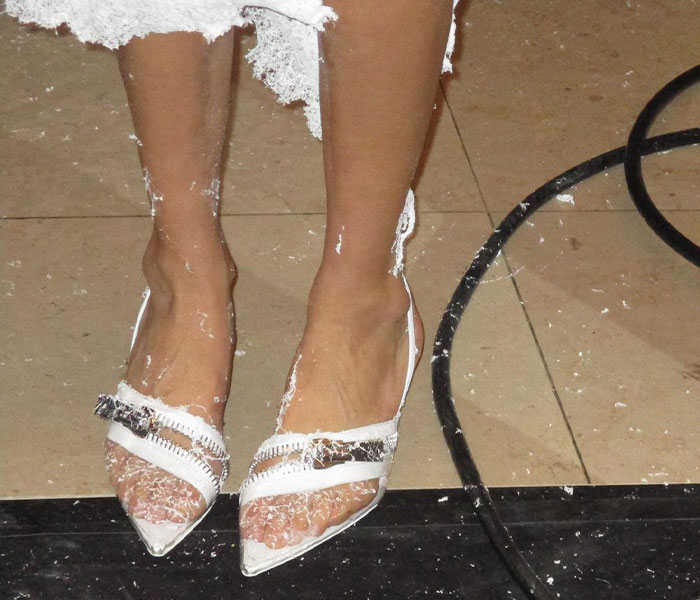
Image credits: bellahadid [downloaded from https://www.boredpanda.com/bella-hadid-coperni-spray-on-dress/?utm_source=duckduckgo&utm_medium=referral&utm_campaign=organic]

Health concerns

Do read the comments at the end of Eglė Radžiūtė’s October 3 (?), 2022 article. Most are admiring but there is a cautionary note from a construction painter noting that no one wore any “respiratory protective devices.” An ‘industrial hygienist’ seconded the the painter’s concern “that stuff is in their lungs,” as would anyone concerned with lung health.

The science of a spray-on textile

You can glean some information from his patent filings (where you’ll find mention of nanosilica but not of the carbon nanofibers mentioned in Radžiūtė’s article), Non-woven fabric Patent number: 8124549; Non-woven fabric Patent number: 8088315; Non-Woven Fabric Publication number: 20100286583; Non-Woven Fabric Publication number: 20090036014; and Non-woven fabric Publication number: 20050222320 on justia.com. The full list of Torres’ patents is here.

I’m guessing there’s more than one kind of engineered nanomaterial to be found in Torres’ mixtures but he’s pretty careful about spilling too much information. Charlotte Hu in her October 4, 2022 article for Popular Science helps to decode further the information in the patents (Note: Links have been removed),

This instantaneously materialized dress is not a magic trick, but a testament to innovations in material science more than two decades in the making. The man behind the creation is Manel Torres, who in 2003 created the substance used on Hadid, Fabrican (presumably a portmanteau of the phrase “fabric in a can”). His inspiration? Silly string and spiderwebs. His idea was to elevate the coarse cords of the silly string into a finer fabric that could be dispersed through a mist. Torres explained in a 2013 Ted Talk that when this spray-on fabric comes in contact with air, it turns into a solid material that’s stretchy and feels like suede. 

What exactly is in Fabrican? According to the patents granted to the company, the liquid fabric is made up of a suspension of liquid polymers (large molecules bonded together), additives, binders like natural latex, cross-linked natural and synthetic fibers, and a fast-evaporating solvent like acetone. The fibers can be polyester, polypropylene, cotton, linen, or wool. 

Torres added that they can easily form the material around 3D molds or patterns and tweak the textures, so they can get something that’s fleece-like, paper-like, lace-like, or rubber-like. He imagined that people could go into a booth, customize their dress, and instantly have it 3D printed onto their bodies. The spray could even be used for spot repairs on existing clothing.  

… Fabrican states on its website that it uses “fibres recycled from discarded clothes and other fabrics. The technology can also utilise biodegradable fibres and binders in place of fossil-based polymers to reduce the carbon footprint of material and manufacturing.” Additionally, the company said that “at the end of their useful life, sprayed fabrics can be re-dissolved and sprayed anew.”  

For the curious, here’s the Fabrican Ltd. website, the Coperni website, and a Wikipedia entry for Silly String.

I have another story about producing something in midair in a May 17, 2016 posting titled: Printing in midair. That was about 3D printing metallic devices in midair.

H/t to the Celebrity Social Media October 3, 2022 posting (keep scrolling down about 75% of the way down) on Laineygossip.com and to Rosemary Hurst because her comments about the dress led me to Charlotte Hu’s article. *ETA: November 4, 2022 at 1550 PT: Rosemary compared to a process for handmaking paper.*

Transcript of nanocellulose fibre podcast interview with Alcides Leão, Ph.D., from São Paulo State University

The American Chemical Society (ACS) has a podcast and transcript of an interview with Alcides Leão, Ph.D., from São Paulo State University College of Agricultural Sciences, São Paulo, Brazil. (I last mentiioned Leão in my March 28, 2011 posting where I profiled his and his colleagues’ work on using nanocellulose fibres in automotive plastics as a greener alternative to the plastics currently used.) You might prefer to listen to the podcast (made available through the ACS’s Global Challenges/Chemistry Solutions project)  or you can read the transcript,

Global Challenges/Chemistry Solutions
Promoting Public Health: “Green” cars made from pineapples and bananas

Combating disease . . .  promoting public health … providing clean water and safe food . . . developing new sources of energy . . . confronting climate change. Hello, from the American Chemical Society — the ACS. Our more than 163,000 members make up the world’s largest scientific society. This is “Global Challenges/Chemistry Solutions: New Solutions 2011.” Global Challenges 2011 updates the ACS’ award-winning podcast series. In 2011, we are focusing on the four themes of the International Year of Chemistry: Health, energy, environment and materials. Today’s solution addressed the desirability of developing more “green” cars.

With manufacturers building hybrids that have excellent gas mileage, the next step appears to be new vehicles that are created through the fruits of workers’ labors, literally –– cars made, in part, out of bananas or pineapples. Their study, explaining how they can create stronger, lighter, and more sustainable materials for cars and other products, was presented this spring at the ACS 241st National Meeting & Exposition in Anaheim.Here’s study lead author Alcides Leão, Ph.D., with São Paulo State University College of Agricultural Sciences São Paulo, Brazil.

“The properties of these plastics are incredible. They are light, but very strong — 30 per cent lighter and 3-to-4 times stronger than the materials used today. We believe that a lot of car parts, including dashboards, bumpers, side panels, will be made of nano-sized fruit fibers in the future. For one thing, they will help reduce the weight of cars and that will improve fuel economy. They also will help us make more sturdy vehicles.”

Besides cutting down on weight and improving gas mileage, nano-cellulose reinforced plastics have mechanical advantages over conventional automotive plastics. These new plastics can reduce damage from heat and spilled gasoline [emphasis mine], for example.

“These new polymers can replace certain plastics used today or can be used to reinforce materials and this is a real advantage because the fruit plastics are biodegradable. Any source of cellulose-related material could be used. In fact, sludge from pulp and paper cellulose plants could be used. This sludge pulp accounts for a huge amount of waste in Brazil and other countries. How could you use fruit to build sturdier cars, some people have asked? The fact is that the nano-cellulose fibers that go into the plastics are almost as stiff as Kevlar, the renowned super-strong material used in armor and bulletproof vests. Unlike Kevlar and other traditional plastics, which are made from petroleum or natural gas, nano-cellulose fibers are completely renewable. We now have a partnership with a Malaysian company to use these fibers to develop a bullet-proof vest.”

The process, though expensive, has a major advantage which offsets the cost, and the approach looks promising for manufacturing other products in the future. Increasing production certainly will reduce the cost.“To prepare the nano-fibers, we inserted the leaves and stems of pineapples or other plants into a device similar to a pressure cooker. We then added certain chemicals to the plants and heated the mixture over several cycles, producing a fine material that resembles talcum powder. The process is costly, but it takes just one pound of nano-cellulose to produce 100 pounds of super-strong, lightweight plastic. So far, we’re focusing on replacing automotive plastics. But in the future, we may be able to replace steel and aluminum automotive parts using these plant-based nanocellulose materials. In addition, the new plastic could be used to build airplanes.”

Smart Chemists/Innovative Thinking

Smart chemists. Innovative thinking. That’s the key to solving global challenges of the 21st Century. Please check out more of our full-length podcasts on wide-ranging issues facing chemistry and science, such as promoting public health, developing new fuels and confronting climate change, at www.acs.org/GlobalChallenges.Today’s podcast was written by Michael Bernstein. I’m Adam Dylewski at the American Chemical Society in Washington.

I applaud the interest in providing solutions to our global challenges but let’s not forget that some of these challenges were created as a consequence of a failure to anticipate negative outcomes from  previous chemical solutions to challenges.

On a personal note, I’m intrigued to see that these new plastics could reduce damage from heat and spilled gasoline in light of last night’s events in Vancouver where after losing the Stanley Cup, some Canuck fans overturned and burned a few vehicles as well as smashing window storefronts and looting stores. Here’s a bit of a commentary from Elaine Lui (Lainey’s Gossip) on last night’s events and what’s happening today (Note: her language is a bit saltier than mine so I’ve compromised by replacing vowels with asterisks),

There’s nothing like running to your car to make sure it’s not vandalised. The crowd was already pretty angry when we went past. And we were early. We darted across the street to avoid a fight, were fortunate to find the car unharmed, and got out of there quickly, safely home to our dogs. Others, as you’ve probably seen, were not so lucky.

It sucks that the Canucks lost the Stanley Cup. But it sucks even more that this is the image you have of Vancouver today. They keep saying that a small group of d*ckh**ds deliberately destroyed the city and that their efforts should not represent who and what we are. But what about all those people just standing there, not leaving, so that they could photo bomb a fight, and post that sh*t on Facebook?

While you shake your head at the idiocy that went down last night, I wonder if you could take a moment to consider that there is profound heartbreak today for the people who love Vancouver to see, to know, that these *ssh*l*s, who are not true fans, have p*ss*d on the face of our awesome town.

The people of our awesome town are already trying to restore it. Thousands of Vancouver residents have already volunteered to assist with clean up efforts. Click here for more information and follow @vancouverclean for updates on how and where you can help.

Lui is a gossip columnist who generally concentrates on movie, television, and fashion industry gossip with an occasional foray into film and literary criticism.

ETA: I should credit Cameron Chai’s June 16, 2011 news item at Azonano for providing me with the information about the ACS podcast.