Tag Archives: living material

The art of building material that lives and stores carbon (Canada House)

Caption: Picoplanktonics shows large-format objects made of photosynthetic structures. Credit: (Image: Valentina Mori/ Biennale di Venezia) [downloaded from https://canadacouncil.ca/initiatives/venice-biennale/2025]

The work you see in the above is being displayed at the 2025 Venice Architecture Biennale or Biennale Architettura 2025; 19th International Architecture Exhibition being held in Venice, 10.05 – 23.11 2025 (May 10 – November 23, 2025). Note: Links have been removed.

A June 20, 2025 ETH Zurich press release (also on EurekAlert) by Michael Keller describes how research material ended up in a display at the 2025 Venice Architecture Biennale,

In brief

  • ETH researchers present a living material consisting of a hydrogel and cyanobacteria embedded in it.
  • The photosynthetic bacteria extract CO2 from the atmosphere and convert it into biomass and carbonate-containing minerals.
  • The 3D-printable building material is intended to help reduce the carbon footprint of buildings and infrastructure in the future.
  • At the Venice Biennale and the Triennale in Milan, two exhibits explore how the living material could be used in architecture.

The idea seems futuristic: At ETH Zurich, various disciplines are working together to combine conventional materials with bacteria, algae and fungi. The common goal: to create living materials that acquire useful properties thanks to the metabolism of microorganisms – “such as the ability to bind CO2 from the air by means of photosynthesis,” says Mark Tibbitt, Professor of Macromolecular Engineering at ETH Zurich.

An interdisciplinary research team led by Tibbitt has now turned this vision into reality: it has stably incorporated photosynthetic bacteria – known as cyanobacteria – into a printable gel and developed a material that is alive, grows and actively removes carbon from the air. The researchers recently presented their “photosynthetic living material” in a study in the journal Nature Communications.

Key characteristic: Dual carbon sequestration

The material can be shaped using 3D printing and only requires sunlight and artificial seawater with readily available nutrients in addition to CO2 to grow. “As a building material, it could help to store CO2 directly in buildings in the future,” says Tibbitt, who co-initiated the research into living materials at ETH Zurich.

The special thing about it: the living material absorbs much more CO2 than it binds through organic growth. “This is because the material can store carbon not only in biomass, but also in the form of minerals – a special property of these cyanobacteria,” reveals Tibbitt.

Yifan Cui, one of the two lead authors of the study, explains: “Cyanobacteria are among the oldest life forms in the world. They are highly efficient at photosynthesis and can utilise even the weakest light to produce biomass from CO2 and water”.

At the same time, the bacteria change their chemical environment outside the cell as a result of photosynthesis, so that solid carbonates (such as lime) precipitate. These minerals represent an additional carbon sink and – in contrast to biomass – store CO2 in a more stable form.

Cyanobacteria as master builders

“We utilise this ability specifically in our material,” says Cui, who is a doctoral student in Tibbitt’s research group. A practical side effect: the minerals are deposited inside the material and reinforce it mechanically. In this way, the cyanobacteria slowly harden the initially soft structures.

Laboratory tests showed that the material continuously binds CO₂ over a period of 400 days, most of it in mineral form – around 26 milligrams of CO2 per gram of material. This is significantly more than many biological approaches and comparable to the chemical mineralisation of recycled concrete (around 7 mg CO2 per gram).

Hydrogel as a habitat

The carrier material that harbours the living cells is a hydrogel – a gel made of cross-linked polymers with a high water content. Tibbitt’s team selected the polymer network so that it can transport light, CO2, water and nutrients and allows the cells to spread evenly inside without leaving the material.

To ensure that the cyanobacteria live as long as possible and remain efficient, the researchers have also optimised the geometry of the structures using 3D printing processes to increase the surface area, increase light penetration and promote the flow of nutrients.

Co-first author Dalia Dranseike: “In this way, we created structures that enable light penetration and passively distribute nutrient fluid throughout the body by capillary forces.” Thanks to this design, the encapsulated cyanobacteria lived productively for more than a year, the materials researcher in Tibbitt’s team is pleased to report.

Infrastructure as a carbon sink

The researchers see their living material as a low-energy and environmentally friendly approach that can bind CO2 from the atmosphere and supplement existing chemical processes for carbon sequestration. “In the future, we want to investigate how the material can be used as a coating for building façades to bind CO2 throughout the entire life cycle of a building,” Tibbitt looks ahead.

There is still a long way to go – but colleagues from the field of architecture have already taken up the concept and realised initial interpretations in an experimental way.

Two installations in Venice and Milan

Thanks to ETH doctoral student Andrea Shin Ling, basic research from the ETH laboratories has made it onto the big stage at the Architecture Biennale in Venice. “It was particularly challenging to scale up the production process from laboratory format to room dimensions,” says the architect and bio-designer, who is also involved in this study.

Ling is doing her doctorate at ETH Professor Benjamin Dillenburger’s Chair of Digital Building Technologies [sic]. In her dissertation, she developed a platform for biofabrication that can print living structures containing functional cyanobacteria on an architectural scale.

For the Picoplanktonics installation in the Canada Pavilion, the project team used the printed structures as living building blocks to construct two tree-trunk-like objects, the largest around three metres high. Thanks to the cyanobacteria, these can each bind up to 18 kg of CO2 per year – about as much as a 20-year-old pine tree in the temperate zone.

“The installation is an experiment – we have adapted the Canada Pavilion so that it provides enough light, humidity and warmth for the cyanobacteria to thrive and then we watch how they behave,” says Ling. This is a commitment: The team monitors and maintains the installation on site – daily. Until 23 November [2025].

At the 24th Triennale di Milano, Dafne’s Skin is investigating the potential of living materials for future building envelopes. On a structure covered with wooden shingles, microorganisms form a deep green patina that changes the wood over time: A sign of decay becomes an active design element that binds CO2 and emphasises the aesthetics of microbial processes. Dafne’s Skin is a collaboration between MAEID Studio and Dalia Dranseike. It is part of the exhibition “We the Bacteria: Notes Toward Biotic Architecture” and runs until 9 November [2025].

The photosynthetic living material was created thanks to an interdisciplinary collaboration within the framework of ALIVE (Advanced Engineering with Living Materials). The ETH Zurich initiative promotes collaboration between researchers from different disciplines in order to develop new living materials for a wide range of applications.

Before exploring the Canadian connection a little further, here’s a link to and a citation for the paper,

Dual carbon sequestration with photosynthetic living materials by Dalia Dranseike, Yifan Cui, Andrea S. Ling, Felix Donat, Stéphane Bernhard, Margherita Bernero, Akhil Areeckal, Marco Lazic, Xiao-Hua Qin, John S. Oakey, Benjamin Dillenburger, André R. Studart & Mark W. Tibbitt. Nature Communications volume 16, Article number: 3832 (2025) DOI: https://doi.org/10.1038/s41467-025-58761-y Published: 23 April 2025

This paper is open access.

I have three more links, one to Dafne’s Skin (a living exhibition at Milan Triennale 2025), one to the studio that collaborated with ETH Zurich on Dafne’s Skin: MAEID – Future Retrospective Narrative, and the last one is to ETH’s ALIVE (Advanced Engineering with Living Materials).

Canadian connection

The Canada Council for the Arts has featured this work on its 2025 Venice Architecture
 Biennale webpage
,

Living Room Collective: Picoplanktonics

On the occasion of Canada’s participation in the 19th International Architecture Exhibition – La Biennale di Venezia, the Canada Council for the Arts present Picoplanktonics at the Canada Pavilion, from May 10 to November 23, 2025.

Amidst the ongoing global climate crisis, the Living Room Collective has developed a ground-breaking exhibition that showcases the potential for collaboration between humans and nature. Comprised of 3D printed structures that contain live cyanobacteria capable of carbon sequestration, Picoplanktonics is an exploration of our potential to co-operate with living systems by co-constructing spaces that remediate the planet rather than exploit it.

The Living Room Collective’s exhibition is the culmination of four years of collaborative research by Andrea Shin Ling and various interdisciplinary contributors. It is focused on harnessing the design principles of living systems to develop sustainable, intelligent and resilient materials and technologies for the future. By leveraging ancient biological processes alongside emergent technologies, it proposes designing environments under an ecology-first ethos.

“The Canada Council for the Arts is delighted to unveil Picoplanktonics by the Living Room Collective at the 19th International Architecture Exhibition – La Biennale di Venezia. Through the lens of architecture, this year’s Canadian exhibition brings technological innovation and ecological stewardship together. It is a unique exhibition, sure to inspire global audiences and to ignite important conversations, about how our built environment might better house and use natural systems for a more sustainable future.”

– Michelle Chawla, Director and CEO, Canada Council for the Arts

When visitors enter the Canada Pavilion, they will encounter 3D printed structures that were originally fabricated in an ETH Zürich laboratory. These are the largest living material structures produced using a first-of-its-kind biofabrication platform capable of printing living structures at an architectural scale. The unique Picoplanktonics experience stems from adapting the Canada Pavilion to provide enough light, moisture, and warmth for the living cyanobacteria within the structures to grow, thrive and change. For the duration of the exhibition, caretakers will be onsite tending to the structures, emphasizing care and stewardship as essential elements of the design.

As global carbon emissions continue to rise to untenable levels, Picoplanktonics presents a vision of how a regenerative system of construction could operate. It is an ongoing experiment centered on leveraging the reciprocal relationship between living structures, the built environment, and humans. In this way, the Living Room Collective is rethinking building principles and prioritizing ecological resilience beyond human species survival.

“Picoplanktonics marks four years of research at ETH Zürich with international collaborators in material science, biology, robotics, and computational design. As we move these living prototypes into the Canada Pavilion, we are thrilled to invite the public into this open experiment and reveal all phases of the material’s life, including growth, sickness, and death, while collectively imagining a regenerative design approach that seeks planetary remediation.”

–Andrea Shin Ling, The Living Room Collective

The Living Room Collective

The Living Room Collective is a group of architects, scientists, artists and educators who work at the intersection of architecture, biology and digital fabrication technologies—led by Canadian architect and biodesigner Andrea Shin Ling. Alongside core team members Nicholas Hoban, Vincent Hui and Clayton Lee, the collective seeks to move society away from exploitative systems of production to regenerative ones by inventing design methods and processes that center on natural systems.

They see the Biennale Architettura 2025 as a platform to generate national and international conversations that ask: How does one fabricate a biological architecture? What are the conditions of stewardship? What are the strategies to instigate this at scale, regionally and globally?

Andrea Shin Ling is an architect and biodesigner who works at the intersection of design, digital fabrication and biology. Her work focuses on how the critical application of biologically and computationally mediated design processes can move society away from exploitative systems of production to regenerative ones. She is the 2020 S+T+ARTS Grand Prize winner for her work as Ginkgo Bioworks’ creative resident designing the decay of artifacts in order to access material circularity. Andrea is a founder of designGUILD, a Toronto-based art collective, and was a researcher in the Mediated Matter group at the MIT Media Lab, where she worked on Aguahoja I, a 3D-printed bio-material pavilion. She is currently a doctoral fellow at the Chair of Digital Building Technologies at ETH Zurich.

Nicholas Hoban is a computational designer, fabricator and educator. He works at the intersection of computational design, robotics, construction and simulation in pedagogy, research and practice. Nicholas is the director of applied technologies at the John H. Daniels Faculty of Architecture [University of Toronto], Landscape, and Design and a lecturer within the Daniels technology specialist program, leading various research and teaching labs while developing curriculum for studios and seminars on advanced fabrication and robotics within architecture. His research focuses on the application of robotics within fabrication and construction and on how we can solve critical problems in geometry through integrated processes. Nicholas was a lead fabricator and computational designer for two previous Venice Biennales: for the 2014 Canadian Pavilion for Lateral Office’s Arctic Adaptations and for the 2016 Swiss Pavilion for Christian Kerez’s Incidental Space.

Vincent Hui is a distinguished professor at Toronto Metropolitan University’s Department of Architectural Science, imparting knowledge across diverse domains from design studios to digital tools. His pedagogical excellence has earned him multiple teaching accolades, as he delves into the intersections of architecture, fabrication and allied disciplines. With over 25 years of experience, his extensive publication portfolio focuses on design pedagogy, simulation, prototyping and technological convergence, complemented by a rich body of creative work showcased globally. Collaborating with esteemed organizations such as the Royal Architectural Institute of Canada (RAIC), the Ontario Association of Architects (OAA) and the Canadian Architecture Students’ Association (CASA), Vincent endeavours to empower the next generation of designers, navigating emergent shifts in praxis. Committed to bridging academia and industry, he advocates for experiential learning initiatives and outreach endeavours for aspiring designers. His remarkable contributions have culminated in his induction into the esteemed RAIC College of Fellows.

Clayton Lee is a curator, producer and performance artist. He is currently the director (artistic) of the Fierce Festival, in Birmingham, UK. He was previously the director of the Rhubarb Festival, Canada’s longest-running festival of new and experimental performance, at Buddies in Bad Times Theatre. Clayton has also worked as creative producer on Jess Dobkin’s projects, including For What It’s Worth, her commission at the Wellcome Collection, in London, UK; as curatorial associate at the Luminato Festival; and as managing producer of the CanadaHub at the Edinburgh Festival Fringe. His performance projects have been presented in venues across Canada, the United States, the United Kingdom and New Zealand. He was one of the Art Gallery of Ontario’s 2023 artists-in-residence.

There are still a few months left if you want to attend. Bon Voyage!

Semi-living gloves as sensors

Researchers at the Massachusetts Institute of Technology (MIT) are calling it a new ‘living material’ according to a Feb. 16, 2017 news item on Nanowerk,

Engineers and biologists at MIT have teamed up to design a new “living material” — a tough, stretchy, biocompatible sheet of hydrogel injected with live cells that are genetically programmed to light up in the presence of certain chemicals.
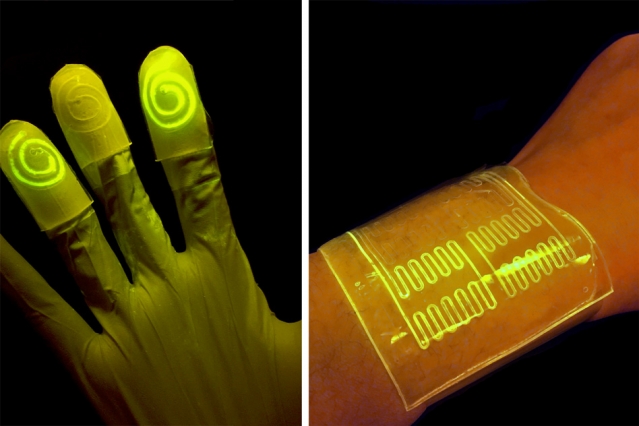
Researchers have found that the hydrogel’s mostly watery environment helps keep nutrients and programmed bacteria alive and active. When the bacteria reacts to a certain chemical, the bacteria are programmed to light up, as seen on the left. Courtesy of the researchers

A Feb. 15, 2017 MIT news release, which originated the news item, provides more information about this work,

In a paper published this week in the Proceedings of the National Academy of Sciences, the researchers demonstrate the new material’s potential for sensing chemicals, both in the environment and in the human body.

The team fabricated various wearable sensors from the cell-infused hydrogel, including a rubber glove with fingertips that glow after touching a chemically contaminated surface, and bandages that light up when pressed against chemicals on a person’s skin.

Xuanhe Zhao, the Robert N. Noyce Career Development associate professor of mechanical engineering at MIT, says the group’s living material design may be adapted to sense other chemicals and contaminants, for uses ranging from crime scene investigation and forensic science, to pollution monitoring and medical diagnostics.

“With this design, people can put different types of bacteria in these devices to indicate toxins in the environment, or disease on the skin,” says Timothy Lu, associate professor of biological engineering and of electrical engineering and computer science. “We’re demonstrating the potential for living materials and devices.”

The paper’s co-authors are graduate students Xinyue Liu, Tzu-Chieh Tang, Eleonore Tham, Hyunwoo Yuk, and Shaoting Lin.

Infusing life in materials

Lu and his colleagues in MIT’s Synthetic Biology Group specialize in creating biological circuits, genetically reprogramming the biological parts in living cells such as E. coli to work together in sequence, much like logic steps in an electrical circuit. In this way, scientists can reengineer living cells to carry out specific functions, including the ability to sense and signal the presence of viruses and toxins.

However, many of these newly programmed cells have only been demonstrated in situ, within Petri dishes, where scientists can carefully control the nutrient levels necessary to keep the cells alive and active — an environment that has proven extremely difficult to replicate in synthetic materials.

“The challenge to making living materials is how to maintain those living cells, to make them viable and functional in the device,” Lu says. “They require humidity, nutrients, and some require oxygen. The second challenge is how to prevent them from escaping from the material.”

To get around these roadblocks, others have used freeze-dried chemical extracts from genetically engineered cells, incorporating them into paper to create low-cost, virus-detecting diagnostic strips. But extracts, Lu says, are not the same as living cells, which can maintain their functionality over a longer period of time and may have higher sensitivity for detecting pathogens.

Other groups have seeded heart muscle cells onto thin rubber films to make soft, “living” actuators, or robots. When bent repeatedly, however, these films can crack, allowing the live cells to leak out.

A lively host

Zhao’s group in MIT’s Soft Active Materials Laboratory has developed a material that may be ideal for hosting living cells. For the past few years, his team has come up with various formulations of hydrogel — a tough, highly stretchable, biocompatible material made from a mix of polymer and water. Their latest designs have contained up to 95 percent water, providing an environment which Zhao and Lu recognized might be suitable for sustaining living cells. The material also resists cracking even when repeatedly stretched and pulled — a property that could help contain cells within the material.

The two groups teamed up to integrate Lu’s genetically programmed bacterial cells into Zhao’s sheets of hydrogel material. They first fabricated layers of hydrogel and patterned narrow channels within the layers using 3-D printing and micromolding techniques. They fused the hydrogel to a layer of elastomer, or rubber, that is porous enough to let in oxygen. They then injected E. coli cells into the hydrogel’s channels. The cells were programmed to fluoresce, or light up, when in contact with certain chemicals that pass through the hydrogel, in this case a natural compound known as DAPG (2,4-diacetylphloroglucinol).

The researchers then soaked the hydrogel/elastomer material in a bath of nutrients which infused throughout the hydrogel and helped to keep the bacterial cells alive and active for several days.

To demonstrate the material’s potential uses, the researchers first fabricated a sheet of the material with four separate, narrow channels, each containing a type of bacteria engineered to glow green in response to a different chemical compound. They found each channel reliably lit up when exposed to its respective chemical.

Next, the team fashioned the material into a bandage, or “living patch,” patterned with channels containing bacteria sensitive to rhamnose, a naturally occurring sugar. The researchers swabbed a volunteer’s wrist with a cotton ball soaked in rhamnose, then applied the hydrogel patch, which instantly lit up in response to the chemical.

Finally, the researchers fabricated a hydrogel/elastomer glove whose fingertips contained swirl-like channels, each of which they filled with different chemical-sensing bacterial cells. Each fingertip glowed in response to picking up a cotton ball soaked with a respective compound.

The group has also developed a theoretical model to help guide others in designing similar living materials and devices.

“The model helps us to design living devices more efficiently,” Zhao says. “It tells you things like the thickness of the hydrogel layer you should use, the distance between channels, how to pattern the channels, and how much bacteria to use.”

Ultimately, Zhao envisions products made from living materials, such as gloves and rubber soles lined with chemical-sensing hydrogel, or bandages, patches, and even clothing that may detect signs of infection or disease.

Here’s a link to and a citation for the paper,

Stretchable living materials and devices with hydrogel–elastomer hybrids hosting programmed cells by Xinyue Liu, Tzu-Chieh Tang, Eléonore Tham, Hyunwoo Yuk, Shaoting Lin, Timothy K. Lu, and Xuanhe Zhao. PNAS February 15, 2017 doi: 10.1073/pnas.1618307114 Published online before print February 15, 2017

This paper appears to be open access.