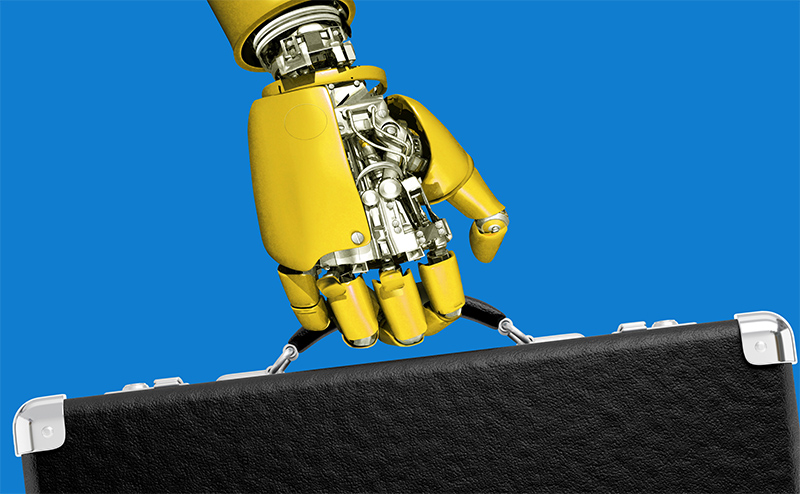
It’s fascinating to see all the current excitement (distressed and/or enthusiastic) around the act of writing and artificial intelligence. Easy to forget that it’s not new. First, the ‘non-human authors’ and then the panic(s). *What follows the ‘nonhuman authors’ is essentially a survey of situation/panic.*
How to handle non-human authors (ChatGPT and other AI agents)—the medical edition
The first time I wrote about the incursion of robots or artificial intelligence into the field of writing was in a July 16, 2014 posting titled “Writing and AI or is a robot writing this blog?” ChatGPT (then known as GPT-2) first made its way onto this blog in a February 18, 2019 posting titled “AI (artificial intelligence) text generator, too dangerous to release?“
The folks at the Journal of the American Medical Association (JAMA) have recently adopted a pragmatic approach to the possibility of nonhuman authors of scientific and medical papers, from a January 31, 2022 JAMA editorial,
Artificial intelligence (AI) technologies to help authors improve the preparation and quality of their manuscripts and published articles are rapidly increasing in number and sophistication. These include tools to assist with writing, grammar, language, references, statistical analysis, and reporting standards. Editors and publishers also use AI-assisted tools for myriad purposes, including to screen submissions for problems (eg, plagiarism, image manipulation, ethical issues), triage submissions, validate references, edit, and code content for publication in different media and to facilitate postpublication search and discoverability..1
In November 2022, OpenAI released a new open source, natural language processing tool called ChatGPT.2,3 ChatGPT is an evolution of a chatbot that is designed to simulate human conversation in response to prompts or questions (GPT stands for “generative pretrained transformer”). The release has prompted immediate excitement about its many potential uses4 but also trepidation about potential misuse, such as concerns about using the language model to cheat on homework assignments, write student essays, and take examinations, including medical licensing examinations.5 In January 2023, Nature reported on 2 preprints and 2 articles published in the science and health fields that included ChatGPT as a bylined author.6 Each of these includes an affiliation for ChatGPT, and 1 of the articles includes an email address for the nonhuman “author.” According to Nature, that article’s inclusion of ChatGPT in the author byline was an “error that will soon be corrected.”6 However, these articles and their nonhuman “authors” have already been indexed in PubMed and Google Scholar.
Nature has since defined a policy to guide the use of large-scale language models in scientific publication, which prohibits naming of such tools as a “credited author on a research paper” because “attribution of authorship carries with it accountability for the work, and AI tools cannot take such responsibility.”7 The policy also advises researchers who use these tools to document this use in the Methods or Acknowledgment sections of manuscripts.7 Other journals8,9 and organizations10 are swiftly developing policies that ban inclusion of these nonhuman technologies as “authors” and that range from prohibiting the inclusion of AI-generated text in submitted work8 to requiring full transparency, responsibility, and accountability for how such tools are used and reported in scholarly publication.9,10 The International Conference on Machine Learning, which issues calls for papers to be reviewed and discussed at its conferences, has also announced a new policy: “Papers that include text generated from a large-scale language model (LLM) such as ChatGPT are prohibited unless the produced text is presented as a part of the paper’s experimental analysis.”11 The society notes that this policy has generated a flurry of questions and that it plans “to investigate and discuss the impact, both positive and negative, of LLMs on reviewing and publishing in the field of machine learning and AI” and will revisit the policy in the future.11
…
This is a link to and a citation for the JAMA editorial,
Nonhuman “Authors” and Implications for the Integrity of Scientific Publication and Medical Knowledge by Annette Flanagin, Kirsten Bibbins-Domingo, Michael Berkwits, Stacy L. Christiansen. JAMA. 2023;329(8):637-639. doi:10.1001/jama.2023.1344
The editorial appears to be open access.
ChatGPT in the field of education
Dr. Andrew Maynard (scientist, author, and professor of Advanced Technology Transitions in the Arizona State University [ASU] School for the Future if Innovation in Society and founder of the ASU Future of Being Human initiative and Director of the ASU Risk Innovation Nexus) also takes a pragmatic approach in a March 14, 2023 posting on his eponymous blog,
Like many of my colleagues, I’ve been grappling with how ChatGPT and other Large Language Models (LLMs) are impacting teaching and education — especially at the undergraduate level.
…
We’re already seeing signs of the challenges here as a growing divide emerges between LLM-savvy students who are experimenting with novel ways of using (and abusing) tools like ChatGPT, and educators who are desperately trying to catch up. As a result, educators are increasingly finding themselves unprepared and poorly equipped to navigate near-real-time innovations in how students are using these tools. And this is only exacerbated where their knowledge of what is emerging is several steps behind that of their students.
To help address this immediate need, a number of colleagues and I compiled a practical set of Frequently Asked Questions on ChatGPT in the classroom. These covers the basics of what ChatGPT is, possible concerns over use by students, potential creative ways of using the tool to enhance learning, and suggestions for class-specific guidelines.
…
Dr. Maynard goes on to offer the FAQ/practical guide here. Prior to issuing the ‘guide’, he wrote a December 8, 2022 essay on Medium titled “I asked Open AI’s ChatGPT about responsible innovation. This is what I got.”
Crawford Kilian, a longtime educator, author, and contributing editor to The Tyee, expresses measured enthusiasm for the new technology (as does Dr. Maynard), in a December 13, 2022 article for thetyee.ca, Note: Links have been removed,
…
ChatGPT, its makers tell us, is still in beta form. Like a million other new users, I’ve been teaching it (tuition-free) so its answers will improve. It’s pretty easy to run a tutorial: once you’ve created an account, you’re invited to ask a question or give a command. Then you watch the reply, popping up on the screen at the speed of a fast and very accurate typist.
…
Early responses to ChatGPT have been largely Luddite: critics have warned that its arrival means the end of high school English, the demise of the college essay and so on. But remember that the Luddites were highly skilled weavers who commanded high prices for their products; they could see that newfangled mechanized looms would produce cheap fabrics that would push good weavers out of the market. ChatGPT, with sufficient tweaks, could do just that to educators and other knowledge workers.
Having spent 40 years trying to teach my students how to write, I have mixed feelings about this prospect. But it wouldn’t be the first time that a technological advancement has resulted in the atrophy of a human mental skill.
Writing arguably reduced our ability to memorize — and to speak with memorable and persuasive coherence. …
…
Writing and other technological “advances” have made us what we are today — powerful, but also powerfully dangerous to ourselves and our world. If we can just think through the implications of ChatGPT, we may create companions and mentors that are not so much demonic as the angels of our better nature.
More than writing: emergent behaviour
The ChatGPT story extends further than writing and chatting. From a March 6, 2023 article by Stephen Ornes for Quanta Magazine, Note: Links have been removed,
What movie do these emojis describe?

That prompt was one of 204 tasks chosen last year to test the ability of various large language models (LLMs) — the computational engines behind AI chatbots such as ChatGPT. The simplest LLMs produced surreal responses. “The movie is a movie about a man who is a man who is a man,” one began. Medium-complexity models came closer, guessing The Emoji Movie. But the most complex model nailed it in one guess: Finding Nemo.
“Despite trying to expect surprises, I’m surprised at the things these models can do,” said Ethan Dyer, a computer scientist at Google Research who helped organize the test. It’s surprising because these models supposedly have one directive: to accept a string of text as input and predict what comes next, over and over, based purely on statistics. Computer scientists anticipated that scaling up would boost performance on known tasks, but they didn’t expect the models to suddenly handle so many new, unpredictable ones.
…
“That language models can do these sort of things was never discussed in any literature that I’m aware of,” said Rishi Bommasani, a computer scientist at Stanford University. Last year, he helped compile a list of dozens of emergent behaviors [emphasis mine], including several identified in Dyer’s project. That list continues to grow.
Now, researchers are racing not only to identify additional emergent abilities but also to figure out why and how they occur at all — in essence, to try to predict unpredictability. Understanding emergence could reveal answers to deep questions around AI and machine learning in general, like whether complex models are truly doing something new or just getting really good at statistics. It could also help researchers harness potential benefits and curtail emergent risks.
…
Biologists, physicists, ecologists and other scientists use the term “emergent” to describe self-organizing, collective behaviors that appear when a large collection of things acts as one. Combinations of lifeless atoms give rise to living cells; water molecules create waves; murmurations of starlings swoop through the sky in changing but identifiable patterns; cells make muscles move and hearts beat. Critically, emergent abilities show up in systems that involve lots of individual parts. But researchers have only recently been able to document these abilities in LLMs as those models have grown to enormous sizes.
…
But the debut of LLMs also brought something truly unexpected. Lots of somethings. With the advent of models like GPT-3, which has 175 billion parameters — or Google’s PaLM, which can be scaled up to 540 billion — users began describing more and more emergent behaviors. One DeepMind engineer even reported being able to convince ChatGPT that it was a Linux terminal and getting it to run some simple mathematical code to compute the first 10 prime numbers. Remarkably, it could finish the task faster than the same code running on a real Linux machine.
As with the movie emoji task, researchers had no reason to think that a language model built to predict text would convincingly imitate a computer terminal. Many of these emergent behaviors illustrate “zero-shot” or “few-shot” learning, which describes an LLM’s ability to solve problems it has never — or rarely — seen before. This has been a long-time goal in artificial intelligence research, Ganguli [Deep Ganguli, a computer scientist at the AI startup Anthropic] said. Showing that GPT-3 could solve problems without any explicit training data in a zero-shot setting, he said, “led me to drop what I was doing and get more involved.”
…
There is an obvious problem with asking these models to explain themselves: They are notorious liars. [emphasis mine] “We’re increasingly relying on these models to do basic work,” Ganguli said, “but I do not just trust these. I check their work.” As one of many amusing examples, in February [2023] Google introduced its AI chatbot, Bard. The blog post announcing the new tool shows Bard making a factual error.
…
If you have time, I recommend reading Omes’s March 6, 2023 article.
The panic
Perhaps not entirely unrelated to current developments, there was this announcement in a May 1, 2023 article by Hannah Alberga for CTV (Canadian Television Network) news, Note: Links have been removed,
Toronto’s pioneer of artificial intelligence quits Google to openly discuss dangers of AI
…
Geoffrey Hinton, professor at the University of Toronto and the “godfather” of deep learning – a field of artificial intelligence that mimics the human brain – announced his departure from the company on Monday [May 1, 2023] citing the desire to freely discuss the implications of deep learning and artificial intelligence, and the possible consequences if it were utilized by “bad actors.”
Hinton, a British-Canadian computer scientist, is best-known for a series of deep neural network breakthroughs that won him, Yann LeCun and Yoshua Bengio the 2018 Turing Award, known as the Nobel Prize of computing.
…
Hinton has been invested in the now-hot topic of artificial intelligence since its early stages. In 1970, he got a Bachelor of Arts in experimental psychology from Cambridge, followed by his Ph.D. in artificial intelligence in Edinburgh, U.K. in 1978.
He joined Google after spearheading a major breakthrough with two of his graduate students at the University of Toronto in 2012, in which the team uncovered and built a new method of artificial intelligence: neural networks. The team’s first neural network was incorporated and sold to Google for $44 million.
Neural networks are a method of deep learning that effectively teaches computers how to learn the way humans do by analyzing data, paving the way for machines to classify objects and understand speech recognition.
…
There’s a bit more from Hinton in a May 3, 2023 article by Sheena Goodyear for the Canadian Broadcasting Corporation’s (CBC) radio programme, As It Happens (the 10 minute radio interview is embedded in the article), Note: A link has been removed,
There was a time when Geoffrey Hinton thought artificial intelligence would never surpass human intelligence — at least not within our lifetimes.
Nowadays, he’s not so sure.
“I think that it’s conceivable that this kind of advanced intelligence could just take over from us,” the renowned British-Canadian computer scientist told As It Happens host Nil Köksal. “It would mean the end of people.”
…
For the last decade, he [Geoffrey Hinton] divided his career between teaching at the University of Toronto and working for Google’s deep-learning artificial intelligence team. But this week, he announced his resignation from Google in an interview with the New York Times.
Now Hinton is speaking out about what he fears are the greatest dangers posed by his life’s work, including governments using AI to manipulate elections or create “robot soldiers.”
But other experts in the field of AI caution against his visions of a hypothetical dystopian future, saying they generate unnecessary fear, distract from the very real and immediate problems currently posed by AI, and allow bad actors to shirk responsibility when they wield AI for nefarious purposes.
…
Ivana Bartoletti, founder of the Women Leading in AI Network, says dwelling on dystopian visions of an AI-led future can do us more harm than good.
“It’s important that people understand that, to an extent, we are at a crossroads,” said Bartoletti, chief privacy officer at the IT firm Wipro.
“My concern about these warnings, however, is that we focus on the sort of apocalyptic scenario, and that takes us away from the risks that we face here and now, and opportunities to get it right here and now.”
…
Ziv Epstein, a PhD candidate at the Massachusetts Institute of Technology who studies the impacts of technology on society, says the problems posed by AI are very real, and he’s glad Hinton is “raising the alarm bells about this thing.”
“That being said, I do think that some of these ideas that … AI supercomputers are going to ‘wake up’ and take over, I personally believe that these stories are speculative at best and kind of represent sci-fi fantasy that can monger fear” and distract from more pressing issues, he said.
He especially cautions against language that anthropomorphizes — or, in other words, humanizes — AI.
…
“It’s absolutely possible I’m wrong. We’re in a period of huge uncertainty where we really don’t know what’s going to happen,” he [Hinton] said.
Don Pittis in his May 4, 2022 business analysis for CBC news online offers a somewhat jaundiced view of Hinton’s concern regarding AI, Note: Links have been removed,
As if we needed one more thing to terrify us, the latest warning from a University of Toronto scientist considered by many to be the founding intellect of artificial intelligence, adds a new layer of dread.
Others who have warned in the past that thinking machines are a threat to human existence seem a little miffed with the rock-star-like media coverage Geoffrey Hinton, billed at a conference this week as the Godfather of AI, is getting for what seems like a last minute conversion. Others say Hinton’s authoritative voice makes a difference.
…
Not only did Hinton tell an audience of experts at Wednesday’s [May 3, 2023] EmTech Digital conference that humans will soon be supplanted by AI — “I think it’s serious and fairly close.” — he said that due to national and business competition, there is no obvious way to prevent it.
“What we want is some way of making sure that even if they’re smarter than us, they’re going to do things that are beneficial,” said Hinton on Wednesday [May 3, 2023] as he explained his change of heart in detailed technical terms.
“But we need to try and do that in a world where there’s bad actors who want to build robot soldiers that kill people and it seems very hard to me.”
“I wish I had a nice and simple solution I could push, but I don’t,” he said. “It’s not clear there is a solution.”
So when is all this happening?
“In a few years time they may be significantly more intelligent than people,” he told Nil Köksal on CBC Radio’s As It Happens on Wednesday [May 3, 2023].
While he may be late to the party, Hinton’s voice adds new clout to growing anxiety that artificial general intelligence, or AGI, has now joined climate change and nuclear Armageddon as ways for humans to extinguish themselves.
But long before that final day, he worries that the new technology will soon begin to strip away jobs and lead to a destabilizing societal gap between rich and poor that current politics will be unable to solve.
The EmTech Digital conference is a who’s who of AI business and academia, fields which often overlap. Most other participants at the event were not there to warn about AI like Hinton, but to celebrate the explosive growth of AI research and business.
…
As one expert I spoke to pointed out, the growth in AI is exponential and has been for a long time. But even knowing that, the increase in the dollar value of AI to business caught the sector by surprise.
Eight years ago when I wrote about the expected increase in AI business, I quoted the market intelligence group Tractica that AI spending would “be worth more than $40 billion in the coming decade,” which sounded like a lot at the time. It appears that was an underestimate.
“The global artificial intelligence market size was valued at $428 billion U.S. in 2022,” said an updated report from Fortune Business Insights. “The market is projected to grow from $515.31 billion U.S. in 2023.” The estimate for 2030 is more than $2 trillion.
…
This week the new Toronto AI company Cohere, where Hinton has a stake of his own, announced it was “in advanced talks” to raise $250 million. The Canadian media company Thomson Reuters said it was planning “a deeper investment in artificial intelligence.” IBM is expected to “pause hiring for roles that could be replaced with AI.” The founders of Google DeepMind and LinkedIn have launched a ChatGPT competitor called Pi.
And that was just this week.
…
“My one hope is that, because if we allow it to take over it will be bad for all of us, we could get the U.S. and China to agree, like we did with nuclear weapons,” said Hinton. “We’re all the in same boat with respect to existential threats, so we all ought to be able to co-operate on trying to stop it.”
Interviewer and moderator Will Douglas Heaven, an editor at MIT Technology Review finished Hinton’s sentence for him: “As long as we can make some money on the way.”
Hinton has attracted some criticism himself. Wilfred Chan writing for Fast Company has two articles, “‘I didn’t see him show up’: Ex-Googlers blast ‘AI godfather’ Geoffrey Hinton’s silence on fired AI experts” on May 5, 2023, Note: Links have been removed,
Geoffrey Hinton, the 75-year-old computer scientist known as the “Godfather of AI,” made headlines this week after resigning from Google to sound the alarm about the technology he helped create. In a series of high-profile interviews, the machine learning pioneer has speculated that AI will surpass humans in intelligence and could even learn to manipulate or kill people on its own accord.
But women who for years have been speaking out about AI’s problems—even at the expense of their jobs—say Hinton’s alarmism isn’t just opportunistic but also overshadows specific warnings about AI’s actual impacts on marginalized people.
“It’s disappointing to see this autumn-years redemption tour [emphasis mine] from someone who didn’t really show up” for other Google dissenters, says Meredith Whittaker, president of the Signal Foundation and an AI researcher who says she was pushed out of Google in 2019 in part over her activism against the company’s contract to build machine vision technology for U.S. military drones. (Google has maintained that Whittaker chose to resign.)
…
Another prominent ex-Googler, Margaret Mitchell, who co-led the company’s ethical AI team, criticized Hinton for not denouncing Google’s 2020 firing of her coleader Timnit Gebru, a leading researcher who had spoken up about AI’s risks for women and people of color.
“This would’ve been a moment for Dr. Hinton to denormalize the firing of [Gebru],” Mitchell tweeted on Monday. “He did not. This is how systemic discrimination works.”
Gebru, who is Black, was sacked in 2020 after refusing to scrap a research paper she coauthored about the risks of large language models to multiply discrimination against marginalized people. …
…
… An open letter in support of Gebru was signed by nearly 2,700 Googlers in 2020, but Hinton wasn’t one of them.
Instead, Hinton has used the spotlight to downplay Gebru’s voice. In an appearance on CNN Tuesday [May 2, 2023], for example, he dismissed a question from Jake Tapper about whether he should have stood up for Gebru, saying her ideas “aren’t as existentially serious as the idea of these things getting more intelligent than us and taking over.” [emphasis mine]
…
Gebru has been mentioned here a few times. She’s mentioned in passing in a June 23, 2022 posting “Racist and sexist robots have flawed AI” and in a little more detail in an August 30, 2022 posting “Should AI algorithms get patents for their inventions and is anyone talking about copyright for texts written by AI algorithms?” scroll down to the ‘Consciousness and ethical AI’ subhead
Chan has another Fast Company article investigating AI issues also published on May 5, 2023, “Researcher Meredith Whittaker says AI’s biggest risk isn’t ‘consciousness’—it’s the corporations that control them.”
The last two existential AI panics
The term “autumn-years redemption tour”is striking and while the reference to age could be viewed as problematic, it also hints at the money, honours, and acknowledgement that Hinton has enjoyed as an eminent scientist. I’ve covered two previous panics set off by eminent scientists. “Existential risk” is the title of my November 26, 2012 posting which highlights Martin Rees’ efforts to found the Centre for Existential Risk at the University of Cambridge.
Rees is a big deal. From his Wikipedia entry, Note: Links have been removed,
Martin John Rees, Baron Rees of Ludlow OM FRS FREng FMedSci FRAS HonFInstP[10][2] (born 23 June 1942) is a British cosmologist and astrophysicist.[11] He is the fifteenth Astronomer Royal, appointed in 1995,[12][13][14] and was Master of Trinity College, Cambridge, from 2004 to 2012 and President of the Royal Society between 2005 and 2010.[15][16][17][18][19][20]
…
The Centre for Existential Risk can be found here online (it is located at the University of Cambridge). Interestingly, Hinton who was born in December 1947 will be giving a lecture “Digital versus biological intelligence: Reasons for concern about AI” in Cambridge on May 25, 2023.
The next panic was set off by Stephen Hawking (1942 – 2018; also at the University of Cambridge, Wikipedia entry) a few years before he died. (Note: Rees, Hinton, and Hawking were all born within five years of each other and all have/had ties to the University of Cambridge. Interesting coincidence, eh?) From a January 9, 2015 article by Emily Chung for CBC news online,
Machines turning on their creators has been a popular theme in books and movies for decades, but very serious people are starting to take the subject very seriously. Physicist Stephen Hawking says, “the development of full artificial intelligence could spell the end of the human race.” Tesla Motors and SpaceX founder Elon Musk suggests that AI is probably “our biggest existential threat.”
Artificial intelligence experts say there are good reasons to pay attention to the fears expressed by big minds like Hawking and Musk — and to do something about it while there is still time.
Hawking made his most recent comments at the beginning of December [2014], in response to a question about an upgrade to the technology he uses to communicate, He relies on the device because he has amyotrophic lateral sclerosis, a degenerative disease that affects his ability to move and speak.
…
Popular works of science fiction – from the latest Terminator trailer, to the Matrix trilogy, to Star Trek’s borg – envision that beyond that irreversible historic event, machines will destroy, enslave or assimilate us, says Canadian science fiction writer Robert J. Sawyer.
Sawyer has written about a different vision of life beyond singularity [when machines surpass humans in general intelligence,] — one in which machines and humans work together for their mutual benefit. But he also sits on a couple of committees at the Lifeboat Foundation, a non-profit group that looks at future threats to the existence of humanity, including those posed by the “possible misuse of powerful technologies” such as AI. He said Hawking and Musk have good reason to be concerned.
To sum up, the first panic was in 2012, the next in 2014/15, and the latest one began earlier this year (2023) with a letter. A March 29, 2023 Thompson Reuters news item on CBC news online provides information on the contents,
Elon Musk and a group of artificial intelligence experts and industry executives are calling for a six-month pause in developing systems more powerful than OpenAI’s newly launched GPT-4, in an open letter citing potential risks to society and humanity.
Earlier this month, Microsoft-backed OpenAI unveiled the fourth iteration of its GPT (Generative Pre-trained Transformer) AI program, which has wowed users with its vast range of applications, from engaging users in human-like conversation to composing songs and summarizing lengthy documents.
The letter, issued by the non-profit Future of Life Institute and signed by more than 1,000 people including Musk, called for a pause on advanced AI development until shared safety protocols for such designs were developed, implemented and audited by independent experts.
…
Co-signatories included Stability AI CEO Emad Mostaque, researchers at Alphabet-owned DeepMind, and AI heavyweights Yoshua Bengio, often referred to as one of the “godfathers of AI,” and Stuart Russell, a pioneer of research in the field.
According to the European Union’s transparency register, the Future of Life Institute is primarily funded by the Musk Foundation, as well as London-based effective altruism group Founders Pledge, and Silicon Valley Community Foundation.
The concerns come as EU police force Europol on Monday {March 27, 2023] joined a chorus of ethical and legal concerns over advanced AI like ChatGPT, warning about the potential misuse of the system in phishing attempts, disinformation and cybercrime.
Meanwhile, the U.K. government unveiled proposals for an “adaptable” regulatory framework around AI.
The government’s approach, outlined in a policy paper published on Wednesday [March 29, 2023], would split responsibility for governing artificial intelligence (AI) between its regulators for human rights, health and safety, and competition, rather than create a new body dedicated to the technology.
…
The engineers have chimed in, from an April 7, 2023 article by Margo Anderson for the IEEE (institute of Electrical and Electronics Engineers) Spectrum magazine, Note: Links have been removed,
The open letter [published March 29, 2023], titled “Pause Giant AI Experiments,” was organized by the nonprofit Future of Life Institute and signed by more than 27,565 people (as of 8 May). It calls for cessation of research on “all AI systems more powerful than GPT-4.”
It’s the latest of a host of recent “AI pause” proposals including a suggestion by Google’s François Chollet of a six-month “moratorium on people overreacting to LLMs” in either direction.
In the news media, the open letter has inspired straight reportage, critical accounts for not going far enough (“shut it all down,” Eliezer Yudkowsky wrote in Time magazine), as well as critical accounts for being both a mess and an alarmist distraction that overlooks the real AI challenges ahead.
IEEE members have expressed a similar diversity of opinions.
…
There was an earlier open letter in January 2015 according to Wikipedia’s “Open Letter on Artificial Intelligence” entry, Note: Links have been removed,
In January 2015, Stephen Hawking, Elon Musk, and dozens of artificial intelligence experts[1] signed an open letter on artificial intelligence calling for research on the societal impacts of AI. The letter affirmed that society can reap great potential benefits from artificial intelligence, but called for concrete research on how to prevent certain potential “pitfalls”: artificial intelligence has the potential to eradicate disease and poverty, but researchers must not create something which is unsafe or uncontrollable.[1] The four-paragraph letter, titled “Research Priorities for Robust and Beneficial Artificial Intelligence: An Open Letter”, lays out detailed research priorities in an accompanying twelve-page document.
…
As for ‘Mr. ChatGPT’ or Sam Altman, CEO of OpenAI, while he didn’t sign the March 29, 2023 letter, he appeared before US Congress suggesting AI needs to be regulated according to May 16, 2023 news article by Mohar Chatterjee for Politico.
You’ll notice I’ve arbitrarily designated three AI panics by assigning their origins to eminent scientists. In reality, these concerns rise and fall in ways that don’t allow for such a tidy analysis. As Chung notes, science fiction regularly addresses this issue. For example, there’s my October 16, 2013 posting, “Wizards & Robots: a comic book encourages study in the sciences and maths and discussions about existential risk.” By the way, will.i.am (of the Black Eyed Peas band was involved in the comic book project and he us a longtime supporter of STEM (science, technology, engineering, and mathematics) initiatives.
Finally (but not quite)
Puzzling, isn’t it? I’m not sure we’re asking the right questions but it’s encouraging to see that at least some are being asked.
Dr. Andrew Maynard in a May 12, 2023 essay for The Conversation (h/t May 12, 2023 item on phys.org) notes that ‘Luddites’ questioned technology’s inevitable progress and were vilified for doing so, Note: Links have been removed,
The term “Luddite” emerged in early 1800s England. At the time there was a thriving textile industry that depended on manual knitting frames and a skilled workforce to create cloth and garments out of cotton and wool. But as the Industrial Revolution gathered momentum, steam-powered mills threatened the livelihood of thousands of artisanal textile workers.
Faced with an industrialized future that threatened their jobs and their professional identity, a growing number of textile workers turned to direct action. Galvanized by their leader, Ned Ludd, they began to smash the machines that they saw as robbing them of their source of income.
It’s not clear whether Ned Ludd was a real person, or simply a figment of folklore invented during a period of upheaval. But his name became synonymous with rejecting disruptive new technologies – an association that lasts to this day.
Questioning doesn’t mean rejecting
Contrary to popular belief, the original Luddites were not anti-technology, nor were they technologically incompetent. Rather, they were skilled adopters and users of the artisanal textile technologies of the time. Their argument was not with technology, per se, but with the ways that wealthy industrialists were robbing them of their way of life
…
In December 2015, Stephen Hawking, Elon Musk and Bill Gates were jointly nominated for a “Luddite Award.” Their sin? Raising concerns over the potential dangers of artificial intelligence.
The irony of three prominent scientists and entrepreneurs being labeled as Luddites underlines the disconnect between the term’s original meaning and its more modern use as an epithet for anyone who doesn’t wholeheartedly and unquestioningly embrace technological progress.
Yet technologists like Musk and Gates aren’t rejecting technology or innovation. Instead, they’re rejecting a worldview that all technological advances are ultimately good for society. This worldview optimistically assumes that the faster humans innovate, the better the future will be.
…
In an age of ChatGPT, gene editing and other transformative technologies, perhaps we all need to channel the spirit of Ned Ludd as we grapple with how to ensure that future technologies do more good than harm.
In fact, “Neo-Luddites” or “New Luddites” is a term that emerged at the end of the 20th century.
In 1990, the psychologist Chellis Glendinning published an essay titled “Notes toward a Neo-Luddite Manifesto.”
…
Then there are the Neo-Luddites who actively reject modern technologies, fearing that they are damaging to society. New York City’s Luddite Club falls into this camp. Formed by a group of tech-disillusioned Gen-Zers, the club advocates the use of flip phones, crafting, hanging out in parks and reading hardcover or paperback books. Screens are an anathema to the group, which sees them as a drain on mental health.
I’m not sure how many of today’s Neo-Luddites – whether they’re thoughtful technologists, technology-rejecting teens or simply people who are uneasy about technological disruption – have read Glendinning’s manifesto. And to be sure, parts of it are rather contentious. Yet there is a common thread here: the idea that technology can lead to personal and societal harm if it is not developed responsibly.
…
Getting back to where this started with nonhuman authors, Amelia Eqbal has written up an informal transcript of a March 16, 2023 CBC radio interview (radio segment is embedded) about ChatGPT-4 (the latest AI chatbot from OpenAI) between host Elamin Abdelmahmoud and tech journalist, Alyssa Bereznak.
I was hoping to add a little more Canadian content, so in March 2023 and again in April 2023, I sent a question about whether there were any policies regarding nonhuman or AI authors to Kim Barnhardt at the Canadian Medical Association Journal (CMAJ). To date, there has been no reply but should one arrive, I will place it here.
In the meantime, I have this from Canadian writer, Susan Baxter in her May 15, 2023 blog posting “Coming soon: Robot Overlords, Sentient AI and more,”
…
The current threat looming (Covid having been declared null and void by the WHO*) is Artificial Intelligence (AI) which, we are told, is becoming too smart for its own good and will soon outsmart humans. Then again, given some of the humans I’ve met along the way that wouldn’t be difficult.
…
All this talk of scary-boo AI seems to me to have become the worst kind of cliché, one that obscures how our lives have become more complicated and more frustrating as apps and bots and cyber-whatsits take over.
The trouble with clichés, as Alain de Botton wrote in How Proust Can Change Your Life, is not that they are wrong or contain false ideas but more that they are “superficial articulations of good ones”. Cliches are oversimplifications that become so commonplace we stop noticing the more serious subtext. (This is rife in medicine where metaphors such as talk of “replacing” organs through transplants makes people believe it’s akin to changing the oil filter in your car. Or whatever it is EV’s have these days that needs replacing.)
…
Should you live in Vancouver (Canada) and are attending a May 28, 2023 AI event, you may want to read Susan Baxter’s piece as a counterbalance to, “Discover the future of artificial intelligence at this unique AI event in Vancouver,” a May 19, 2023 sponsored content by Katy Brennan for the Daily Hive,
…
If you’re intrigued and eager to delve into the rapidly growing field of AI, you’re not going to want to miss this unique Vancouver event.
On Sunday, May 28 [2023], a Multiplatform AI event is coming to the Vancouver Playhouse — and it’s set to take you on a journey into the future of artificial intelligence.
The exciting conference promises a fusion of creativity, tech innovation, and thought–provoking insights, with talks from renowned AI leaders and concept artists, who will share their experiences and opinions.
Guests can look forward to intense discussions about AI’s pros and cons, hear real-world case studies, and learn about the ethical dimensions of AI, its potential threats to humanity, and the laws that govern its use.
Live Q&A sessions will also be held, where leading experts in the field will address all kinds of burning questions from attendees. There will also be a dynamic round table and several other opportunities to connect with industry leaders, pioneers, and like-minded enthusiasts.
…
This conference is being held at The Playhouse, 600 Hamilton Street, from 11 am to 7:30 pm, ticket prices range from $299 to $349 to $499 (depending on when you make your purchase, From the Multiplatform AI Conference homepage,
Event Speakers
Max Sills
General Counsel at MidjourneyFrom Jan 2022 – present (Advisor – now General Counsel) – Midjourney – An independent research lab exploring new mediums of thought and expanding the imaginative powers of the human species (SF) Midjourney – a generative artificial intelligence program and service created and hosted by a San Francisco-based independent research lab Midjourney, Inc. Midjourney generates images from natural language descriptions, called “prompts”, similar to OpenAI’s DALL-E and Stable Diffusion. For now the company uses Discord Server as a source of service and, with huge 15M+ members, is the biggest Discord server in the world. In the two-things-at-once department, Max Sills also known as an owner of Open Advisory Services, firm which is set up to help small and medium tech companies with their legal needs (managing outside counsel, employment, carta, TOS, privacy). Their clients are enterprise level, medium companies and up, and they are here to help anyone on open source and IP strategy. Max is an ex-counsel at Block, ex-general manager of the Crypto Open Patent Alliance. Prior to that Max led Google’s open source legal group for 7 years.
…
So, the first speaker listed is a lawyer associated with Midjourney, a highly controversial generative artificial intelligence programme used to generate images. According to their entry on Wikipedia, the company is being sued, Note: Links have been removed,
…
On January 13, 2023, three artists – Sarah Andersen, Kelly McKernan, and Karla Ortiz – filed a copyright infringement lawsuit against Stability AI, Midjourney, and DeviantArt, claiming that these companies have infringed the rights of millions of artists, by training AI tools on five billion images scraped from the web, without the consent of the original artists.[32]
…
My October 24, 2022 posting highlights some of the issues with generative image programmes and Midjourney is mentioned throughout.
As I noted earlier, I’m glad to see more thought being put into the societal impact of AI and somewhat disconcerted by the hyperbole from the like of Geoffrey Hinton and the like of Vancouver’s Multiplatform AI conference organizers. Mike Masnick put it nicely in his May 24, 2023 posting on TechDirt (Note 1: I’ve taken a paragraph out of context, his larger issue is about proposals for legislation; Note 2: Links have been removed),
…
Honestly, this is partly why I’ve been pretty skeptical about the “AI Doomers” who keep telling fanciful stories about how AI is going to kill us all… unless we give more power to a few elite people who seem to think that it’s somehow possible to stop AI tech from advancing. As I noted last month, it is good that some in the AI space are at least conceptually grappling with the impact of what they’re building, but they seem to be doing so in superficial ways, focusing only on the sci-fi dystopian futures they envision, and not things that are legitimately happening today from screwed up algorithms.
…
For anyone interested in the Canadian government attempts to legislate AI, there’s my May 1, 2023 posting, “Canada, AI regulation, and the second reading of the Digital Charter Implementation Act, 2022 (Bill C-27).”
Addendum (June 1, 2023)
Another statement warning about runaway AI was issued on Tuesday, May 30, 2023. This was far briefer than the previous March 2023 warning, from the Center for AI Safety’s “Statement on AI Risk” webpage,
Mitigating the risk of extinction from AI should be a global priority alongside other societal-scale risks such as pandemics and nuclear war [followed by a list of signatories] …
Vanessa Romo’s May 30, 2023 article (with contributions from Bobby Allyn) for NPR ([US] National Public Radio) offers an overview of both warnings. Rae Hodge’s May 31, 2023 article for Salon offers a more critical view, Note: Links have been removed,
The artificial intelligence world faced a swarm of stinging backlash Tuesday morning, after more than 350 tech executives and researchers released a public statement declaring that the risks of runaway AI could be on par with those of “nuclear war” and human “extinction.” Among the signatories were some who are actively pursuing the profitable development of the very products their statement warned about — including OpenAI CEO Sam Altman and Google DeepMind CEO Demis Hassabis.
“Mitigating the risk of extinction from AI should be a global priority alongside other societal-scale risks such as pandemics and nuclear war,” the statement from the non-profit Center for AI Safety said.
But not everyone was shaking in their boots, especially not those who have been charting AI tech moguls’ escalating use of splashy language — and those moguls’ hopes for an elite global AI governance board.
TechCrunch’s Natasha Lomas, whose coverage has been steeped in AI, immediately unravelled the latest panic-push efforts with a detailed rundown of the current table stakes for companies positioning themselves at the front of the fast-emerging AI industry.
“Certainly it speaks volumes about existing AI power structures that tech execs at AI giants including OpenAI, DeepMind, Stability AI and Anthropic are so happy to band and chatter together when it comes to publicly amplifying talk of existential AI risk. And how much more reticent to get together to discuss harms their tools can be seen causing right now,” Lomas wrote.
“Instead of the statement calling for a development pause, which would risk freezing OpenAI’s lead in the generative AI field, it lobbies policymakers to focus on risk mitigation — doing so while OpenAI is simultaneously crowdfunding efforts to shape ‘democratic processes for steering AI,'” Lomas added.
…
The use of scary language and fear as a marketing tool has a long history in tech. And, as the LA Times’ Brian Merchant pointed out in an April column, OpenAI stands to profit significantly from a fear-driven gold rush of enterprise contracts.
“[OpenAI is] almost certainly betting its longer-term future on more partnerships like the one with Microsoft and enterprise deals serving large companies,” Merchant wrote. “That means convincing more corporations that if they want to survive the coming AI-led mass upheaval, they’d better climb aboard.”
…
Fear, after all, is a powerful sales tool.
Romo’s May 30, 2023 article for NPR offers a good overview and, if you have the time, I recommend reading Hodge’s May 31, 2023 article for Salon in its entirety.
*ETA June 8, 2023: This sentence “What follows the ‘nonhuman authors’ is essentially a survey of situation/panic.” was added to the introductory paragraph at the beginning of this post.