Tag Archives: Nadav Noor

Walking again? Israeli team gears up to implant bioengineered spinal cord tissue into paralyzed patient

The Israeli team working on this regenerative medicine project has already (in 2022) been successful with mice. Diana Bletter’s August 21, 2025 Times of Israel article, excerpts of which can be found later in this posting, added some details that I appreciated. That said, the press release is quite accessible and informative.

An August 19, 2025 Tel Aviv University (TAU) press release (also on EurekAlert but edited and published on August 20, 2025) describes the upcoming human trial, Note: Links have been removed,

What if we could restore the ability to walk to people paralyzed by injury or illness? This vision is now moving closer to reality. Three years ago, Tel Aviv University researchers succeeded in engineering a human spinal cord in the lab for the first time. Since then, progress has been rapid, with animal trials showing unprecedented success. Now, for the first time, the technology is set to be tested in human patients.

Prof. Tal Dvir, of TAU’s Sagol Center for Regenerative Biotechnology, head of the Nanotechnology Center, and Chief Scientist of the biotech company Matricelf, explains: “The spinal cord is made up of nerve cells that transmit electrical signals from the brain to every part of the body. When the spinal cord is torn due to trauma — from a car accident, a fall, or a battlefield injury — this chain is broken. Think of it like an electrical cable that’s been cut: if the two parts don’t touch, the electrical signal can’t pass. The cable won’t carry electricity, and in the same way, the person can’t transmit the signal beyond the site of the injury.”

This is one of the few injuries in the human body with no natural ability to regenerate. “Neurons are cells that do not divide and do not renew themselves. They are not like skin cells, which can repair themselves after injury. They are more similar to heart cells: once damage occurs, the body cannot restore them,” notes Prof. Dvir.

 Engineering a Personalized Implant

To overcome this challenge, the TAU researchers developed a fully personalized process. Blood cells are taken from the patient and reprogrammed through genetic engineering to behave like embryonic stem cells, capable of becoming any type of cell in the body.

Meanwhile, fat tissue from the same patient is used to extract substances such as collagen and sugars. These are used to produce a unique hydrogel. “The beauty of this gel is that it’s also personalized, just like the cells. We take the cells that we’ve reprogrammed into embryonic-like stem cells, place them inside the gel, and mimic the embryonic development of the spinal cord,” says Prof. Dvir.

The result is a complete three-dimensional implant. “At the end of the process, we don’t just turn the cells into motor neurons — because cells alone won’t help us — but into three-dimensional tissue: neuronal networks of the spinal cord. After about a month, we obtain a 3D implant with many neurons that transmit electrical signals. These 3D tissues are then implanted into the damaged area.”

Visualization of the next stage of the research – human spinal cord implants for treating paralysis (Photo: Sagol Center for Regenerative Biotechnology)

From Animals to Human Patients

The researchers first tested the implant in lab animals. “We showed that we can treat animals with chronic injuries. Not animals that were injured just recently, but those we allowed enough time to pass — like a person more than a year after an injury. More than 80% of the animals regained full walking ability,” Prof. Dvir explains.

Encouraged by these results, the team submitted the findings to Israel’s Ministry of Health. “About six months ago we received preliminary approval to begin compassionate-use trials with eight patients. We decided, of course, that the first patient would be Israeli. This is undoubtedly a matter of national pride. The technology was developed here in Israel, at Tel Aviv University and at Matricelf, and from the very beginning it was clear to us that the first-ever surgery would be performed in Israel, with an Israeli patient.” he says.

Looking Ahead

The first implant in a human patient is expected within about a year. For the initial trials, the team will focus on patients whose paralysis is relatively recent — within about a year of injury. “Once we prove that the treatment works — everything is open, and we’ll be able to treat any injury,” says Prof. Dvir.

Behind the initiative are key figures from both academia and industry. Prof. Dvir founded Matricelf in 2019 together with Dr. Alon Sinai, based on the revolutionary organ engineering technology developed at TAU under a licensing agreement through Ramot, the University’s technology transfer company. The company’s CEO is Gil Hakim, while the scientific development is led by Dr. Tamar Harel-Adar and her team.

“They managed to get us to the stage of regulatory approvals so quickly — and that’s amazing,” says Prof. Dvir.

Gil Hakim, CEO of Matricelf , concludes: “This milestone marks the shift from pioneering research to patient treatment. For the first time, we are translating years of successful preclinical work into a procedure for people living with paralysis. Our approach, using each patient’s own cells to engineer a new spinal cord, eliminates key safety risks and positions Matricelf at the forefront of regenerative medicine. If successful, this therapy has the potential to define a new standard of care in spinal cord repair, addressing a multi-billion-dollar market with no effective solutions today. This first procedure is more than a scientific breakthrough, it is a value-inflection point for Matricelf and a step toward transforming an area of medicine long considered untreatable. We are proud that Israel is leading this global effort and are fully committed to bringing this innovation to patients worldwide.”

Diana Bletter’s August 21, 2025 article for The Times of Israel (h/t August 21, 2025 Google alert) covers much of the same ground as the press release but there are some new details, Note: Links have been removed,

Prof. Tal Dvir, head of the Sagol Center for Regenerative Biotechnology and the Nanotechnology Center at Tel Aviv University, said his research team is now able to engineer a spinal cord that functions exactly like a natural one by implanting 3D-engineered tissue into the damaged area.

Fusion then occurs between the new tissue and the healthy areas above and below the injury that will end the paralysis.

The upcoming spinal cord implant surgery marks the next stage in a process that began about three years ago, when Dvir’s lab at Tel Aviv University succeeded in engineering a personalized 3D spinal cord in the laboratory.

The groundbreaking findings, published in the prestigious journal Advanced Science, demonstrated for the first time ever that mice suffering from chronic paralysis that were treated with these engineered implants started to walk — and even scamper — again.


The success rate with the engineered spinal cord was 80 percent for mice with chronic paralysis. Among those with recent or short-term paralysis, 100% of the mice walked.

Patients remain paralyzed because neurons do not renew

Around the world, there are over 15 million people who have suffered spinal cord injuries. Professionals can help stabilize the injury but not much else.

Dvir said that as a result, the damage only worsens. Over time, the damaged area becomes scar tissue.

“The patient remains paralyzed below the site of injury,” he said. “If the injury is in the neck, all four limbs may be paralyzed. If in the lower back, the legs will not move, and so on.”

Spinal cord injuries are one of the very few injuries in the human body that are not impacted by natural regenerative ability, Dvir explained.

“The neurons do not divide and do not renew themselves,” he said. “These cells are not like skin cells, which can heal after injury, but are more like heart cells: Once damaged, the body cannot repair them.”

“The spinal cord is composed of nerve cells that transmit electrical signals from the brain to all parts of the body,” Dvir said. “The decision is made in the brain, the electrical signal passes through the spinal cord, and from there, neurons activate the muscles throughout the body.”

When the spinal cord is severed due to trauma, such as a car accident, a fall, or a combat injury, this chain is broken.

“Think of an electrical cable that has been cut,” Dvir said. “When the two ends no longer touch, the electrical signal cannot pass. The cable will not transmit electricity, and the person cannot transmit the signal beyond the injury.”

Dvir’s team aims to fix that.

Implanting an engineered human spinal cord

Dvir said that the researchers start the process with a small biopsy from the belly.

They then take these blood cells and perform a process known as reprogramming — genetic engineering that transforms the cells into embryonic stem cell-like cells, capable of developing into any cell type in the body.

In the next step, the scientists take fatty tissue from the patient, extract key components such as collagens and sugars, and build a customized hydrogel. The embryonic stem cell-like cells are placed in this gel, and the embryonic development of a spinal cord is mimicked.

This spinal cord will then be transplanted into the human body, restoring the body’s abilities.

I have a link to Dvir’s company, Matricelf and a link to and a citation to the Dvir team’s 2022 study,

Regenerating the Injured Spinal Cord at the Chronic Phase by Engineered iPSCs-Derived 3D Neuronal Networks by Lior Wertheim, Reuven Edri, Yona Goldshmit, Tomer Kagan, Nadav Noor, Angela Ruban, Assaf Shapira, Irit Gat-Viks, Yaniv Assaf, Tal Dvir. Advanced Science Volume9, Issue 11 April 14, 2022 2105694 DOI: https://doi.org/10.1002/advs.202105694 First published online: 07 February 2022

This paper is open access.

One more note, there is other work devoted to enable paralyzed people to walk again such as the Walk Again Project (Wikipedia entry), Note: Links have been removed,

Walk Again Project is an international, non-profit consortium led by Miguel Nicolelis, created in 2009 in a partnership between Duke University and the IINN/ELS [International Institute for Neurosciences of Natal – Edmond and Lily Safra or Instituto Internacional de Neurociências Edmond e Lily Safra; (INN-ELS)], where researchers come together to find neuro-rehabilitation treatments for spinal cord injuries,[1][2][3] which pioneered the development and use of the brain–machine interface, including its non-invasive version,[4] with an EEG.[5]

My May 15, 2019 posting “Walking again with exoskeletons and brain-controlled, non-invasive muscle stimulation enabling people to walk” features more information about the Walk Again Project (scroll down to the ‘Brazil and Walk Again” subhead and a Canadian project (Note: The CBC has removed access to a video that I’d embedded in the posting.)

I wish all the best for everyone involved in the upcoming human trial.

First 3D heart printed using patient’s biological materials

This is very exciting news and it’s likely be at least 10 years before this technology could be made available to the public.
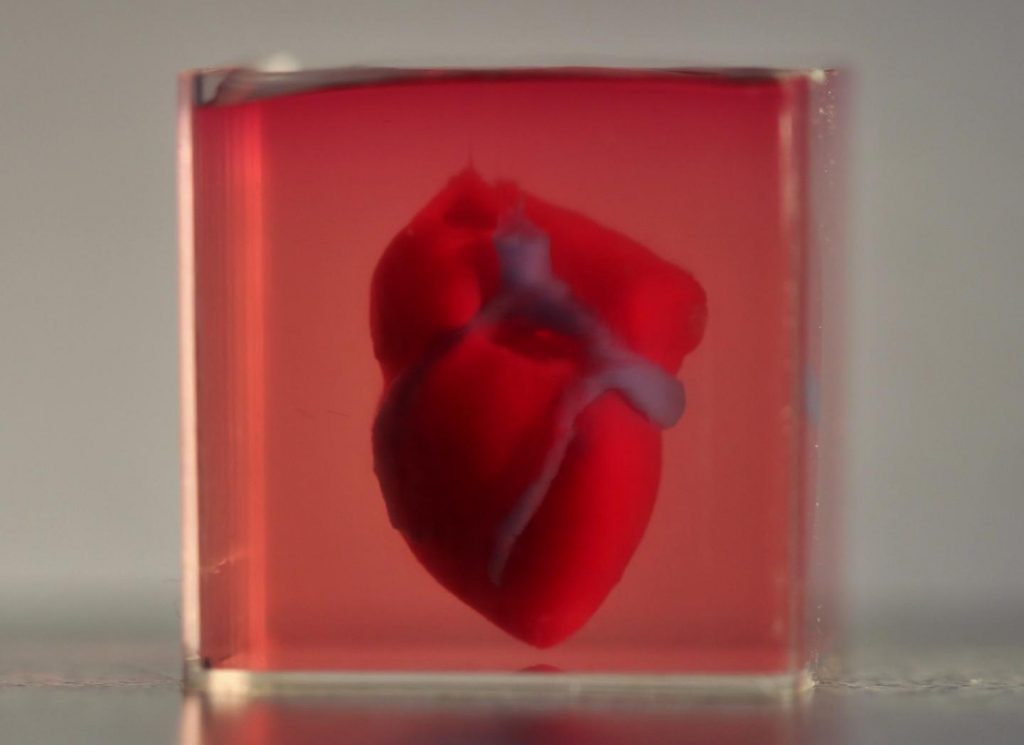
Caption: A 3D-printed, small-scaled human heart engineered from the patient’s own materials and cells. Credit: Advanced Science. © 2019 The Authors.

An April 15, 2019 news item on ScienceDaily makes a remarkable announcement,

In a major medical breakthrough, Tel Aviv University researchers have “printed” the world’s first 3D vascularised engineered heart using a patient’s own cells and biological materials. Their findings were published on April 15 [2019] in a study in Advanced Science.

Until now, scientists in regenerative medicine — a field positioned at the crossroads of biology and technology — have been successful in printing only simple tissues without blood vessels.

“This is the first time anyone anywhere has successfully engineered and printed an entire heart replete with cells, blood vessels, ventricles and chambers,” says Prof. Tal Dvir of TAU’s School of Molecular Cell Biology and Biotechnology, Department of Materials Science and Engineering, Center for Nanoscience and Nanotechnology and Sagol Center for Regenerative Biotechnology, who led the research for the study.

An April 15, 2019 Amricna Friends of Tel Aviv University (TAU) news release (also on EurekAlert), which originated the news item, provides more detail,

Heart disease is the leading cause of death among both men and women in the United States. Heart transplantation is currently the only treatment available to patients with end-stage heart failure. Given the dire shortage of heart donors, the need to develop new approaches to regenerate the diseased heart is urgent.

“This heart is made from human cells and patient-specific biological materials. In our process these materials serve as the bioinks, substances made of sugars and proteins that can be used for 3D printing of complex tissue models,” Prof. Dvir says. “People have managed to 3D-print the structure of a heart in the past, but not with cells or with blood vessels. Our results demonstrate the potential of our approach for engineering personalized tissue and organ replacement in the future.

Research for the study was conducted jointly by Prof. Dvir, Dr. Assaf Shapira of TAU’s Faculty of Life Sciences and Nadav Moor, a doctoral student in Prof. Dvir’s lab.

“At this stage, our 3D heart is small, the size of a rabbit’s heart, [emphasis mine] ” explains Prof. Dvir. “But larger human hearts require the same technology.”

For the research, a biopsy of fatty tissue was taken from patients. The cellular and a-cellular materials of the tissue were then separated. While the cells were reprogrammed to become pluripotent stem cells, the extracellular matrix (ECM), a three-dimensional network of extracellular macromolecules such as collagen and glycoproteins, were processed into a personalized hydrogel that served as the printing “ink.”

After being mixed with the hydrogel, the cells were efficiently differentiated to cardiac or endothelial cells to create patient-specific, immune-compatible cardiac patches with blood vessels and, subsequently, an entire heart.

According to Prof. Dvir, the use of “native” patient-specific materials is crucial to successfully engineering tissues and organs.

“The biocompatibility of engineered materials is crucial to eliminating the risk of implant rejection, which jeopardizes the success of such treatments,” Prof. Dvir says. “Ideally, the biomaterial should possess the same biochemical, mechanical and topographical properties of the patient’s own tissues. Here, we can report a simple approach to 3D-printed thick, vascularized and perfusable cardiac tissues that completely match the immunological, cellular, biochemical and anatomical properties of the patient.”

The researchers are now planning on culturing the printed hearts in the lab and “teaching them to behave” like hearts, Prof. Dvir says. They then plan to transplant the 3D-printed heart in animal models.

“We need to develop the printed heart further,” he concludes. “The cells need to form a pumping ability; they can currently contract, but we need them to work together. Our hope is that we will succeed and prove our method’s efficacy and usefulness.

“Maybe, in ten years, there will be organ printers in the finest hospitals around the world, and these procedures will be conducted routinely.”

Growing the heart to human size and getting the cells to work together so the heart will pump makes it seem like the 10 years Dvir imagines as the future date when there will be organ printers in hospitals routinely printing up hearts seems a bit optimistic. Regardless, I hope he’s right. Bravo to these Israeli researchers!

Here’s a link to and a citation for the paper,

3D Printing of Personalized Thick and Perfusable Cardiac Patches and Hearts by Nadav Noor, Assaf Shapira, Reuven Edri, Idan Gal, Lior Wertheim, Tal Dvir. Advanced Science DOI: https://doi.org/10.1002/advs.201900344 First published: 15 April 2019

This paper is open access.