Tag Archives: Nazmul Karim

‘SWEET’ (smart, wearable, and eco-friendly electronic textiles)

I always appreciate a good acronym and this one is pretty good. (From my perspective, a good acronym is memorable and doesn’t involve tortured terminology such as CRISPR-Cas9, which stands for clustered regularly interspaced short palindromic repeats-CRISPR-associated protein 9).

On to ‘SWEET’ and a January 2, 2025 news item on ScienceDaily announcing a new UK study on wearable e-textiles,

A research team led by the University of Southampton and UWE Bristol [University of the West of England Bristol] has shown wearable electronic textiles (e-textiles) can be both sustainable and biodegradable.

A new study, which also involved the universities of Exeter, Cambridge, Leeds and Bath, describes and tests a new sustainable approach for fully inkjet-printed, eco-friendly e-textiles named ‘Smart, Wearable, and Eco-friendly Electronic Textiles’, or ‘SWEET’.

A January 2, 2025 University of Southampton press release (also on EurekAlert), which originated the news item, describes e-textiles and how this latest work represents a step forward in making them environmentally friendly,

E-textiles are those with embedded electrical components, such as sensors, batteries or lights. They might be used in fashion, for performance sportwear, or for medical purposes as garments that monitor people’s vital signs.

Such textiles need to be durable, safe to wear and comfortable, but also, in an industry which is increasingly concerned with clothing waste, they need to be kind to the environment when no longer required.

Professor Nazmul Karim at the University of Southampton’s Winchester School of Art, who led the study, explains: “Integrating electrical components into conventional textiles complicates the recycling of the material because it often contains metals, such as silver, that don’t easily biodegrade. Our potential ecofriendly approach for selecting sustainable materials and manufacturing overcomes this, enabling the fabric to decompose when it is disposed of.”

The team’s design has three layers, a sensing layer, a layer to interface with the sensors and a base fabric. It uses a textile called Tencel for the base, which is made from renewable wood and is biodegradable. The active electronics in the design are made from graphene, along with a polymer called PEDOT: PSS. These conductive materials are precision inkjet-printed onto the fabric.

The researchers tested samples of the material for continuous monitoring of human physiology using five volunteers. Swatches of the fabric, connected to monitoring equipment, were attached to gloves worn by the participants. Results confirmed the material can effectively and reliably measure both heart rate and temperature at the industry standard level.

Dr Shaila Afroj, an Associate Professor of Sustainable Materials from the University of Exeter and a co-author of the study, highlighted the importance of this performance: “Achieving reliable, industry-standard monitoring with eco-friendly materials is a significant milestone. It demonstrates that sustainability doesn’t have to come at the cost of functionality, especially in critical applications like healthcare.”

The project team then buried the e-textiles in soil to measure its biodegradable properties. After four months, the fabric had lost 48 percent of its weight and 98 percent of its strength, suggesting relatively rapid and also effective decomposition. Furthermore, a life cycle assessment revealed the graphene-based electrodes had up to 40 times less impact on the environment than standard electrodes.

Marzia Dulal from UWE Bristol, a Commonwealth PhD Scholar and the first author of the study, highlighted the environmental impact: “Our life cycle analysis shows that graphene-based e-textiles have a fraction of the environmental footprint compared to traditional electronics. This makes them a more responsible choice for industries looking to reduce their ecological impact.”

The ink-jet printing process is also a more sustainable approach for e-textile fabrications, depositing exact numbers of functional materials on textiles as needed, with almost no material waste and less use of water and energy than conventional screen printing.

Professor Karim concludes: “ Amid rising pollution from landfill sites, our study helps to address a lack of research in the area of biodegradation of e-textiles. These materials will become increasingly more important in our lives, particularly in the area of healthcare, so it’s really important we consider how to make them more eco-friendly, both in their manufacturing and disposal.”

The researchers hope they can now move forward with designing wearable garments made from SWEET for potential use in the healthcare sector, particularly in the area of early detection and prevention of heart-related diseases that 640 million people (source: BHF [British Heart Foundation]) suffer from worldwide.

Here’s a link to and a citation for the paper,

Sustainable, Wearable, and Eco-Friendly Electronic Textiles by Marzia Dulal, Harsh Rajesh Mansukhlal Modha, Jingqi Liu, Md Rashedul Islam, Chris Carr, Tawfique Hasan, Robin Michael Statham Thorn, Shaila Afroj, Nazmul Karim. Energy & Enviornmental Materials DOI: https://doi.org/10.1002/eem2.12854 First published: 18 December 2024

This paper is open access.

Regulating body temperature, graphene-style

I find some illustrations a little difficult to decipher,
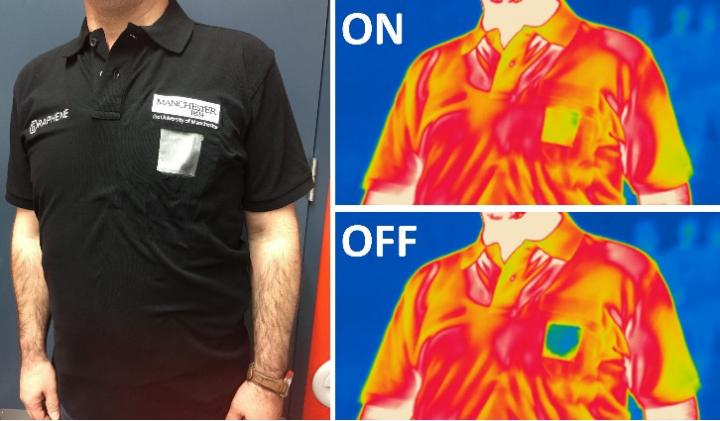
Caption: Graphene thermal smart materials. Credit: The University of Manchester

I believe the red in the ‘on/off’ images, signifies heat from the surrounding environment and is not an indicator for body heat and the yellow square in the ‘on’ image indicates the shirt is working and repelling that heat.

Moving on, a June 18, 2020 news item on Nanowerk describes this latest work on a smart textile that can help regulate body temperature when it’s hot,

New research on the two-dimensional (2D) material graphene has allowed researchers to create smart adaptive clothing which can lower the body temperature of the wearer in hot climates.

A team of scientists from The University of Manchester’s National Graphene Institute have created a prototype garment to demonstrate dynamic thermal radiation control within a piece of clothing by utilising the remarkable thermal properties and flexibility of graphene. The development also opens the door to new applications such as, interactive infrared displays and covert infrared communication on textiles.

A June 18, 2020 University of Manchester press release (also on EurekAlert), which originated the news item, provides more detail,

The human body radiates energy in the form of electromagnetic waves in the infrared spectrum (known as blackbody radiation). In a hot climate it is desirable to make use the full extent of the infrared radiation to lower the body temperature that can be achieved by using infrared-transparent textiles. As for the opposite case, infrared-blocking covers are ideal to minimise the energy loss from the body. Emergency blankets are a common example used to deal with treating extreme cases of body temperature fluctuation.

The collaborative team of scientists demonstrated the dynamic transition between two opposite states by electrically tuning the infrared emissivity (the ability to radiate energy) of the graphene layers integrated onto textiles.

One-atom thick graphene was first isolated and explored in 2004 at The University of Manchester. Its potential uses are vast and research has already led to leaps forward in commercial products including; batteries, mobile phones, sporting goods and automotive.

The new research published today in journal Nano Letters, demonstrates that the smart optical textile technology can change its thermal visibility. The technology uses graphene layers to control of thermal radiation from textile surfaces.

Professor Coskun Kocabas, who led the research, said: “Ability to control the thermal radiation is a key necessity for several critical applications such as temperature management of the body in excessive temperature climates. Thermal blankets are a common example used for this purpose. However, maintaining these functionalities as the surroundings heats up or cools down has been an outstanding challenge.”

Prof Kocabas added: “The successful demonstration of the modulation of optical properties on different forms of textile can leverage the ubiquitous use of fibrous architectures and enable new technologies operating in the infrared and other regions of the electromagnetic spectrum for applications including textile displays, communication, adaptive space suits, and fashion”.

This study built on the same group’s previous research using graphene to create thermal camouflage which would fool infrared cameras. The new research can also be integrated into existing mass-manufacture textile materials such as cotton. To demonstrate, the team developed a prototype product within a t-shirt allowing the wearer to project coded messages invisible to the naked eye but readable by infrared cameras.

“We believe that our results are timely showing the possibility of turning the exceptional optical properties of graphene into novel enabling technologies. The demonstrated capabilities cannot be achieved with conventional materials.”

“The next step for this area of research is to address the need for dynamic thermal management of earth-orbiting satellites. Satellites in orbit experience excesses of temperature, when they face the sun, and they freeze in the earth’s shadow. Our technology could enable dynamic thermal management of satellites by controlling the thermal radiation and regulate the satellite temperature on demand.” said Kocabas.

Professor Sir Kostya Novoselov was also involved in the research: “This is a beautiful effect, intrinsically routed in the unique band structure of graphene. It is really exciting to see that such effects give rise to the high-tech applications.” he said.

Advanced materials is one of The University of Manchester’s research beacons – examples of pioneering discoveries, interdisciplinary collaboration and cross-sector partnerships that are tackling some of the biggest questions facing the planet. #ResearchBeacons

Here’s a link to and a citation for the paper,

Graphene-Enabled Adaptive Infrared Textiles by M. Said Ergoktas, Gokhan Bakan, Pietro Steiner, Cian Bartlam, Yury Malevich, Elif Ozden-Yenigun, Guanliang He, Nazmul Karim, Pietro Cataldi, Mark A. Bissett, Ian A. Kinloch, Kostya S. Novoselov, and Coskun Kocabas. Nano Lett. 2020, XXXX, XXX, XXX-XXX DOI: https://doi.org/10.1021/acs.nanolett.0c01694 Publication Date:June 18, 2020 Copyright © 2020 American Chemical Society

This paper is behind a paywall.