Tag Archives: New York University (NYU)

Toronto’s ArtSci Salon is hosting a couple more October 2025 events

I have two art/science events and one art/science conference/festival (IRL [in real life or in person] and Zoom) taking place in Toronto, Ontario.

October 16, 2025

There is a closing event for the “I don’t do Math” series mentioned in my September 8, 2025 posting,

ABOUT
“I don’t do math” is a photographic series referencing dyscalculia, a learning difference affecting a person’s ability to understand and manipulate number-based information.

This initiative seeks to raise awareness about the challenges posed by dyscalculia with educators, fellow mathematicians, and parents, and to normalize its existence, leading to early detection and augmented support. In addition, it seeks to reflect on and question broader issues and assumptions about the role and significance of Mathematics and Math education in today’s changing socio-cultural and economic contexts. 

The exhibition will contain pedagogical information and activities for visitors and students. The artist will also address the extensive research that led to the exhibition. The exhibition will feature two panel discussions following the opening and to conclude the exhibition.

I have some information from an October 12, 2025 ArtSci Salon announcement (received via email) about the “I don’t do math” closing event,

in us for 

Closing Exhibition Panel Discussion
Thursday, October 16 2025
10:00 am -12:00 pm room 309
The Fields Institute for Research in Mathematical Sciences (or online)

Artist Ann Piché will be in conversation with
Andrew Fiss, Jacqueline Wernimont, Amenda Chow, Ellen Abrams, Michael Barany and JP Ascher

RSVP here

October 21, 2025

The second event mentioned in the October 12, 2025 ArtSci Salon announcement, Note 1: A link has been removed, Note 2: This event is part of a larger series,

Marco Donnarumma 
Monsters of Grace: bodies, sounds, and machines

Tuesday, October 21, 2025
3:30-4:30 PM
Sensorium Research Loft 
4th floor
Goldfarb Centre for Fine Arts
York University

About the talk
What is sound to those who do not hear it? How does one listen to something that cannot be heard? What kind of sensory gaps are created by aiding technologies such as prostheses and artificial intelligence (AI)? As a matter of fact, the majority of non-deaf people hear only partially due to age and personal experience. Still, sound is most often considered through the normalizing viewpoint of the non-deaf. If I become your body, what does sound become for me? Join us to welcome Marco Donnarumma  ahead of his new installation/performance at Paul Cadario Conference Room (Oct 22, 8-10 PM University College [University of Toronto] – 15 King’s College Circle). His talk will focus on this latest work in the context of a largest body of work titled “I Am Your Body,” an ongoing project investigating how normative power is enforced through the technological mediation of the senses.

About the artist:
Marco Donnarumma is an artist, inventor and theorist. His oeuvre confronts normative body politics with uncompromising counter-narratives, where bodies are in tension between control and agency, presence and absence, grace and monstrosity. He is best known for using sound, AI, biosensors, and robotics to turn the body into a site of resistance and transformation. He has presented his work in thirty-seven countries across Asia, Europe, North and South America and is the recipient of numerous accolades, most notably the German Federal Ministry of Research and Education’s Artist of the Science Year 2018, and the Prix Ars Electronica’s Award of Distinction in Sound Art 2017. Donnarumma received a ZER01NE Creator grant in 2024 and was named a pioneer of performing arts with advanced technologies by the major national newspaper Der Standard, Austria. His writings are published in Frontiers in Computer Science, Computer Music Journal and Performance Research, among others, and his newest book chapter, co-authored with Elizabeth Jochum, will appear in Robot Theaters by Routledge. Together with Margherita Pevere he runs the performance group Fronte Vacuo.


I wonder if Donnarumma’s “Monsters of Grace: bodies, sounds, and machines’ received any inspiration from “Monsters of Grace” (Wikipedia entry) or if it’s just happenstance, Note: Links have been removed,

Monsters of Grace is a multimedia chamber opera in 13 short acts directed by Robert Wilson, with music by Philip Glass and libretto from the works of 13th-century Sufi mystic Jalaluddin Rumi. The title is said to be a reference to Wilson’s corruption of a line from Hamlet: “Angels and ministers of grace defend us!” (1.4.39).

So, the October 21, 2025 event is a talk at York University taking place before the “Who’s afraid of AI? Arts, Sciences, and the Futures of Intelligence” (more below).

“Who’s afraid of AI? Arts, Sciences, and the Futures of Intelligence,” a conference and arts festival at the University of Toronto

The conference (October 23 – 24, 2025) is concurrent with the arts festival (October 19 – 25, 2025) at the University of Toronto. Here’s more from the event homepage on the https://bmolab.artsci.utoronto.ca/ website, Note: BMO stands for Bank of Montreal, Note: No mention of Edward Albee and “Who’s afraid of Virginia Woolf?,”

2025 marks an inflection point in our technological landscape, driven by seismic shifts in AI innovation.

Who’s Afraid of AI? Arts, Science, and the Futures of Intelligence is a week-long inquiry into the implications and future directions of AI for our creative and collective imaginings, and the many possible futures of intelligence. The complexity of these immediate future calls for interdisciplinary dialogue, bringing together artists, AI researchers, and humanities scholars.

In this volatile domain, the question of who envisions our futures is vital. Artists explore with complexity and humanity, while the humanities reveal the histories of intelligence and the often-overlooked ways knowledge and decision-making have been shaped. By placing these voices in dialogue with AI researchers and technologists, Who’s Afraid of AI? examines the social dimensions of technology, questions tech solutionism from a social-impact perspective, and challenges profit-driven AI with innovation guided by public values.

The two-day conference at the University of Toronto’s University College anchors the week and features panels and debates with leading figures in these disciplines, including a keynote by 2025 Nobel Laureate in Physics Geoffrey Hinton, the “Godfather of AI” and 2025 Neil Graham Lecturer in Science, Fei-Fei Li, an AI pioneer.

Throughout the week, the conversation continues across the city with:

  • AI-themed and AI powered art shows and exhibitions
  • Film screenings
  • Innovative theatre
  • Experimental music

Who’s Afraid of AI? demonstrates that Toronto has not only shaped the history of AI but continues to prepare its future.Step into this changing landscape and be part of this transformative dialogue — register today!

Organizing Committee:

Pia Kleber, Professor-Emerita, Comparative Literature, and Drama, U of T
Dirk Bernhardt-Walther, Department of Psychology, Program Director, Cognitive Science, U of T
David Rokeby, Director, BMO Lab, Centre for Drama, Theatre and Performance Studies, U of T
Rayyan Dabbous, PhD candidate, Centre for Comparative Literature, U of T

This looks like a pretty interesting programme (if you’re mainly focused on AI and the creative arts), from the event homepage on the https://bmolab.artsci.utoronto.ca/ website, Note 1: All times are ET, Note 2: I have not included speakers’ photos,

The conference will explore core questions about AI such as its capabilities, possibilities and challenges, bringing their unique research, creative practice, scholarship and experience to the discussion. Speakers will also engage in an interdisciplinary conversation on topics including AI’s implications for theories of mind and embodiment, its influence on creation, innovation, and discovery, its recognition of diverse perspectives, and its transformation of artistic, cultural, political and everyday practices.

Thursday, October 23, 2025

Mind the World

9 AM | Clark Reading Room, University College – 15 King’s College Circle

What are the merits and limits of artificial intelligence within the larger debate on embodiment? This session brings together an artist who has given AI a physical dimension, a neuroscientist who reckons with the biological neural networks inspiring AI, and a humanist knowledgeable of the longer history in which the human has tried to decouple itself from its bodily needs and wants.

Suzanne Kite
Director, The Wihanble S’a Center for Indigenous AI

James DiCarlo
Director, MIT Quest for Intelligence

N. Katherine Hayles
James B. Duke Distinguished Professor Emerita of Literature

Staging AI

11 AM | Clark Reading Room, University College – 15 King’s College Circle

How is AI changing the arts? To answer this question, we bring together theatre directors and artists who have made AI the main driving plot of their stories and those who opted to keep technology secondary in their productions.

Kay Voges
Artistic Director, Schauspiel Köln

Roland Schimmelpfennig
Playwright and Director, Berlin

Hito Steyerl
Artist, Filmmaker and Writer, Berlin

Recognizing ‘Noise’

2 PM | Clark Reading Room, University College – 15 King’s College Circle

How can we design a more inclusive AI? This session brings together an artist who has worked with AI and has been sensitive to groups who may be excluded by its practice, an inclusive design scholar who has grappled with AI’s potential for personalized accessibility, and a humanist who understands the longer history on pattern and recognition from which emerged AI.

Marco Donnarumma
Artist, Inventor, Theorist, Berlin

Jutta Treviranus
Director, OCADU [Ontario College of Art & Design University],
Inclusive Design Research Centre

Eryk Salvaggio
Media Artist and Tech Policy Press Fellow, Rochester

Art, Design, and Application are the Solution to AI’s Charlie Chaplain Problem

4 PM | Hart House Theatre – 7 Hart House Circle

Daniel Wigdor
CoFounder and Chief Executive Officer, AXL

Keynote and Neil Graham Lecture in Science

4:15 PM | Hart House Theatre – 7 Hart House Circle

Fei-Fei Li
Sequoia Professor in Computer Science, Stanford Institute for Human-Centered AI

Geoffrey Hinton
2024 Nobel Laureate in Physics, Professor Emeritus in Computer Science

Friday, October 24, 2025

Life with AI

9 AM | Clark Reading Room, University College – 15 King’s College Circle

How do machine minds relate to human minds? What can we learn from one about the other? In this session we interrogate the impact of AI on our understanding of human knowledge and tool-making, from the perspective of philosophy, computer science, as well as the arts.

Jeanette Winterson
Author, Fellow of the Royal Society of Literature, Great Britain

Leif Weatherby
Professor of German and Director of Digital Theory Lab at
New York University

Jennifer Nagel
Professor, Philosophy, University of Toronto Mississauga

Discovery & In/Sight

11 AM | Clark Reading Room, University College – 15 King’s College Circle

This session explores creative practice through the lens of innovation and cultural/scientific advancement. An artist who creates with critical inspiration from AI joins forces with an innovation scholar who investigates the effects of AI on our decision making, as well as a philosopher of science who understands scientific discovery and inference as well as their limits.

Vladan Joler
Visual Artist and Professor of
New Media, University of Novi Sad [Serbia]

Alán Aspuru-Guzik
Professor of Chemistry and Computer Science, University of Toronto

Brian Baigrie
Professor, Institute for the History and Philosophy of Science & Technology, University of Toronto

Social history & Possible Futures

2 PM | Clark Reading Room, University College – 15 King’s College Circle

How does AI ownership and its private uses coexist within a framework of public good? It brings together an artist who has created AI tools to be used by others, an AI ethics researcher who has turned algorithmic bias into collective insight, and a philosopher who understands the connection between AI and the longer history of automation and work from which AI emerged.

Memo Akten
Artist working with Code, Data and AI, UC San Diego

Beth Coleman
Professor, Institute of Communication, Culture, Information and Technology, University of Toronto

Matteo Pasquinelli
Professor, Philosophy and Cultural Heritage Università Ca’ Foscari Venezia [Italy]

A Theory of Latent Spaces | Conclusion: Where do we go from here?

4 PM | Clark Reading Room, University College – 15 King’s College Circle

Antonio Somaini, curator of the remarkable ‘World through AI’ exhibition at the Museé du Jeu de Paume in Paris, will discuss the way in which ‘latent spaces’, a core characteristic of current AI models as “meta-archives” that shape profoundly our relation with the past.

Following this, we will engage in a larger discussion amongst the various conference speakers and attendees on how we can, as artists, humanities scholars, scientists and the general public, collectively imagine and cultivate a future where AI serves the public good and enhances our individual and collective lives.”

Antonio Somaini
Curator and Professor, Sorbonne Nouvelle [Université Sorbonne Nouvelle]

You can register here for this free conference, although, there’s now a waitlist for in person attendance. Do not despair, there’s access by Zoom,

In case you can’t make it in person, join us by Zoom:

Link: https://utoronto.zoom.us/j/82603012955

Webinar ID: 826 0301 2955

Passcode: 512183

I have not forgotten the festival, from the event homepage on the https://bmolab.artsci.utoronto.ca/ website,

Events Also Happening

October 22 | 2 PM | Student Forum and AI Commentary Contest Award | Paul Cadario Conference Room, University College – 15 King’s College Circle

October 22 | 8 – 10 PM | Marco Donnarumma, world première of a new performance installation | Paul Cadario Conference Room, University College – 15 King’s College Circle

October 23 | 2 PM | Jeanette Winterson: Arts & AI Talk | Paul Cadario Conference Room, University College – 15 King’s College Circle

October 24 | 7 PM | The Kiss by Roland Schimmelpfennig | The BMO Lab, University College – 15 King’s College Circle (Note: we are scheduling more performances. Check back for more info soon!)

October 25 | 8 PM | AI Cabaret featuring Jason Sherman, Rick Miller, Cole Lewis, BMO Lab projects and more| Crow’s Theatre, Nada Ristich Studio-Gallery – 345 Carlaw Avenue..

Get tickets for the AI Cabaret

(Use promo code AICAB for 100% discount)

Enjoy!

Web Summit in Vancouver, Canada from May 27 – 30, 2025 (it was formerly the Collision Conference in Toronto)

Here’s more about the Web Summit in Vancouver, Canada from May 27 – 30, 2025,

“The world’s premier tech conference” – Politico

In May 2025, thousands of international entrepreneurs, investors, media outlets, and leaders will gather at the Vancouver Convention Centre for our newest event: Web Summit Vancouver.

What is Web Summit Vancouver?

The Guardian called us “Glastonbury for geeks”, the Atlantic [magazine] “where the future goes to be born”, and Inc. “the best technology conference on the planet”.

This year, we’re excited to welcome the world’s tech community to the first Web Summit in North America. Vancouver [emphasis mine] is ready.

The tech world will gather in Vancouver

Web Summit Vancouver will take over from Collision in Toronto [emphasis mine], continuing our mission to connect the global technology ecosystem. Vancouver is one of the world’s most beautiful cities, with a flourishing tech community that connects the Americas, Asia and the Canadian West Coast.

So they’ve rebranded ‘Collision’ in Toronto as the ‘Web Summit’ for the move to Vancouver?

A May 22, 2025 news item on DailyHive.com provides information that looks like it was regurgitated from the organizer’s news release,

Over 100 of the world’s top leaders in tech will be attending the highly anticipated Web Summit Vancouver next week, and it’s not too late to get your ticket.

Web Summit Vancouver will take place from May 27 to 30 [2025] and is known as the “Olympics of Tech.”

Some notable speakers include:

  • Jay Graber – CEO, BlueSky
  • Brad Smith – Vice Chair and President, Microsoft
  • Max Lytvyn – Co-founder, Grammarly
  • Gary Marcus – Professor, scientist, bestselling author, entrepreneur, and AI contrarian, NYU
  • May Habib, Co-founder and CEO, Write [s.b. Writer]
  • Raquel Urtasun – Founder and CEO, Waab [s.b. Waabi]
  • Qasar Younis – Co-founder and CEO, Applied Intuition
  • Laura A. Clayton – President, Corporates, Thomson Reuters
  • Nicole Parlapino – Chief Marketing Officer, Tubi
  • Neil Patel – Founder, Neil Patel Digital
  • JaVale McGee – 3x NBA Champion, Olympic Gold Medallist, Grammy Nominated Producer
  • Peter Montopoli -Chief Tournament Officer, Canada FIFA World Cup 2026 [emphasis mine]

The event is organized by Web Summit, which also holds large-scale technology conferences worldwide in cities like Lisbon [emphasis mine], Rio de Janeiro, and Doha. Vancouver’s event will be the first Web Summit in North America.

It’s not just global names that will be attending, as over 300 B.C. companies [emphasis mine] will be showcased, highlighting how important the tech sector is to the province’s economic and innovative growth.

The cheapest ticket (from the https://vancouver.websummit.com/tickets/attendees/ webpage) is $835.00 CAD including tax. You will be allowed to wander around for four days. Not included are: Speaker lounge access, Fast-tracked registration, Evening receptions, Meeting spaces, Delicious catered food and drinks, or Access to all exhibition floor lounges. In short, more money = more access.

$$$ and other matters

The promise is that there will be some sort of economic benefit to the local economy. The promise is made over and over again in the June 2024 coverage of the announcement that the Web Summit was coming to Vancouver.

This June 12, 2024 article by Kenneth Chan for the Daily Hive provides what seems to be an insider’s view of the announcement,

It is now confirmed that the massive annual Collision Conference, one of the world’s largest tech conferences, will be leaving Toronto for its new home of Vancouver in 2025.

It is deemed to be North America’s fastest-growing tech conference, with over 40,000 attendees from more than 130 countries. The conference assembles high-profile individuals from around the world, bringing together thousands of international thought leaders in tech, unicorn founders, investors, startups, and media.

“Vancouver is ready to welcome the world. We’re a young, energetic city full of opportunity,” said Vancouver Mayor Ken Sim in a statement today.

“Nowhere is that more obvious than in our thriving tech scene, where we’re advancing leading edge technology like virtual reality and augmented reality. Vancouver is attracting highly skilled people from around the world drawn here by our lifestyle, incredible natural surroundings, and the chance to be part of something exciting.”

This follows a concerted effort by levels of government and the business and tourism community to woo event organizer Web Summit to keep the event in Canada, and choose Vancouver as the conference’s new permanent home.

The effort was led by local tourism authority Destination Vancouver, in partnership with the federal government’s Pacific Economic Development Canada (PacifiCan), the Government of British Columbia’s Ministry of Jobs, Economic Development and Innovation, the City of Vancouver, and local tech industry leaders, including the Frontier Collective.

Web Summit is also behind other major tech conferences such as Web Summit Lisbon [emphasis mine], Web Summit Rio de Janeiro, Web Summit Doha, Rise Hong Kong, and MoneyConf Dublin.

The decision to move Collision Conference to Vancouver also comes as a big nod to the city’s tech industry, which has seen wildly exponential growth over the past decade to become one of BC’s largest economic sectors in terms of the number of jobs the industry supports, with many of these jobs being high paying.

“We can’t wait to gather the tech world in Vancouver and take over the city next year. Last month I flew to Vancouver to check out the city and meet Mayor Ken Sim and Destination Vancouver. I was so blown away by its beauty and tech scene. It’s the perfect place to bring the tech world,” said Paddy Cosgrave, CEO of Web Summit.

“Similar to Lisbon [emphasis mine], Vancouver and British Columbia might seem like the underdogs at first, but the energy and drive to build on an already very fast-growing technology ecosystem blew me away.”

Destination Vancouver estimates Web Summit Vancouver will produce substantial local economic spinoffs, with nearly $57 million in direct spending and over $93 million in overall economic impact for British Columbia in its first year [*emphasis mine*].

Throughout its life in Toronto, starting with the inaugural Toronto conference in 2019 and the event’s post-pandemic return in 2022 and 2023, the event had a cumulative three-year local economic impact of $189 million [emphases mine].

“We knew Vancouver was the right place for Web Summit,” said Royce Chwin, president and CEO of Destination Vancouver. “A transformational event of this calibre will continue to build our reputation as an exceptional host city and sharpen Vancouver’s global destination competitiveness.”

Alcoholics Anonymous (AA) [emphasis mine] will host its 2025 International Convention from July 3 to 6 [2025] at the Vancouver Convention Centre and BC Place Stadium. This will be AA’s first International Convention in a decade, as the 2020 convention in Detroit was cancelled due to the pandemic. The convention is held once every five years in a new destination, and about 50,000 attendees from around the world are expected for the first convention in a decade in Vancouver.

I will get to Lisbon later. First, I’d like to know how they derived the numbers for the economic benefits they’re claiming for Toronto and how they’ve used that information to make estimates for Vancouver and British Columbia. I’d also like to know who benefits? As for the Alcoholics Anonymous gathering, it seems like an odd addition (other than it’s another large gathering) to Chan’s article, which was titled “Collision Conference moving to Vancouver from Toronto in 2025.”

Then, there’s the June 12, 2024 Destination Vancouver news release, which adds little information but does provide Mayor Ken Sim’s full quote,

“Vancouver is ready to welcome the world,” said Mayor Ken Sim. “We’re a young, energetic city full of opportunity. Nowhere is that more obvious than in our thriving tech scene, where we’re advancing leading edge technology like virtual reality and augmented reality. Vancouver is attracting highly skilled people from around the world drawn here by our lifestyle, incredible natural surroundings, and the chance to be part of something exciting.”

I’m not sure what the mayor knows about Vancouver technology scene given that he’s an accountant by trade and is an entrepreneur who founded Nurse Next Door (a home nursing business) and Rosemary Rock Salt (a bagel business). As far as I’m aware there’s not a single person with a science/technology degree/background on city council.

Waiting almost a week to make its own announcement Web Summit issued a June 18, 2024 news release with a few interesting additional details,

In the last two years, Web Summit has introduced three brand new events, including Web Summit Rio in South America, which has gathered more than 60,000 attendees in its first two years, and Web Summit Qatar in the Middle East, which drew 15,000 attendees in its first year.

Web Summit’s flagship event in Lisbon is set to bring more than 70,000 attendees from 150-plus countries to Lisbon this November. In total, participation at Web Summit events has increased by 51 percent since 2022, and by the end of the year, our 2024 events will have drawn more than 160,000 attendees.

Web Summit aims to bolster this growth further as it takes over Vancouver in May 2025. With more than 11,000 tech companies, technology has become the fastest-growing sector in the province [emphases mine]. The tech sector is growing at twice the rate of the overall economy, and Vancouver ranks first in high tech job growth in North America. Home to six unicorns, including Dapper Labs, Blockstream, Trulioo, LayerZero Labs, Visier, the city also hosts major tech companies Salesforce, Apple and Amazon.

“We are now in four continents and have every intention to bring something to Africa very soon, as we continue our ambition to connect the tech world and build meaningful and lasting communities around the world,” he [Paddy Cosgrave, founder and CEO of Web Summit] added.

Destination Vancouver anticipates that Web Summit Vancouver will generate CA$172 million in direct spending and CA$279 million in overall economic impact for British Columbia over three years. Web Summit’s direct economic impact can be worth €200 million annually in cities such as Lisbon, where it hosts its flagship event.

Web Summit has played a critical role in bolstering the tech landscape in its host cities and countries. Since Web Summit’s arrival in Lisbon, the Portuguese startup economy has grown significantly, influencing many young startups to relocate to Lisbon and major companies such as Mercedes, Revolut, and Google to open offices there.

Over 300 BC tech companies being showcased when there are over 11,000 in the province? It must have been an interesting (money, personal contacts) selection process.

How much are we paying for this economic windfall?

A June 19, 2024 article by Josh Scott for BetaKit.com gives readers a sense of some of what went into luring Collision/Web Summit to Vancouver, Note: Links have been removed,

BetaKit has been tracking Vancouver as a possible Collision destination for over a year since reporting on the myriad issues casting doubt on the conference’s long-term viability in Toronto. Last week, following prodding from BetaKit, Web Summit confirmed that Vancouver reached a three-year deal to host a rebranded event dubbed Web Summit Vancouver, funded by up to $14.8 million CAD combined from the federal, provincial, and municipal governments. The first Web Summit Vancouver will be held at the Vancouver Convention Centre from May 27 to 30, 2025.

“Knowing that we have this incredible tech scene that doesn’t seem to be really known in some corners of the world, this was a perfect opportunity to marry what we do in terms of building the visitor economy and Web Summit, which is truly an experience,” Destination Vancouver president and CEO Royce Chwin said during a June 14 event hosted by KPMG celebrating the successful bid.

The celebration carried into Collision’s opening night on June 17 at the Frontier Collective “Vancouver Takeover” event, which featured Web Summit head of Asia Pacific Casey Lau [emphasis mine], Vancouver Mayor Ken Sim, tech leaders from across the country, including the people behind the winning bid. “Vancouver is literally taking Collision from Toronto to the West Coast,” said Ali Clarke, the event’s MC.

“The cool thing about Collision is most people outside of tech—in fact, almost everyone outside of tech—don’t have a fucking clue as to what’s going on, but they will because we have three years to wave the flag,” Sim said on stage [emphasis mine]. That flag, he said, represents that Vancouver is “open for business,” understands tech, and has a strong and growing innovation ecosystem.

Speaking on stage alongside Sim at the Vancouver Takeover, Lau said, “It’s just a fantastic city and I think that it’s a great backdrop for a conference, and what is going on in Vancouver is great for people to see.”

“We’re just really happy that we’re able to keep [the event] in Canada because it was leaving the country,” Sim told BetaKit in an interview following his remarks, pointing out that Vancouver beat other possible host cities, including international candidates like Mexico City. Sim previously told BetaKit that the priority was keeping the conference in Canada, a sentiment that Chwin echoed in his own comments to BetaKit.

In an interview with BetaKit, Lau singled out Vancouver’s growing tech ecosystem, beautiful natural landscape, proximity to the San Francisco Bay Area, and Sim’s support for the tech sector as some of the factors that brought the tech conference west.

Last summer [2023], investigative reporting from BetaKit revealing the extent of municipal support for the original Collsion Toronto bid, as well as the ask to renew for another three years at a much higher price, kickstarted a national debate on government support of international ventures versus home-grown alternatives. This time, the supporting governments have been proactive in disclosing how much has been committed to bringing the conference to Vancouver, as well as its value proposition relative to local events like INNOVATEwest.

The City of Vancouver is providing Web Summit Vancouver with up to $1.6 million over three years, including a $250,000 first-year cash grant via Destination Vancouver, waiving permits worth up to $355,000 annually to host events in city-owned outdoor areas, and up to $75,000 in-kind annually to offset safety and running costs incurred for providing those venues.

Through PacifiCan, the Government of Canada is providing Web Summit Vancouver with up to $6.6 million over three years. The Government of BC has also pledged $6.6 million over three years to the event.

These federal, provincial, and municipal commitments total up to $14.8 million over three years, less per year than the $6.5 million BetaKit previously reported Collision was receiving annually in Toronto and a far cry from the north of $40 million over three years that BetaKit previously reported that Collision had once sought to stay in Toronto.

Web Summit Vancouver 2025 is expected to be much smaller than Collision 2024. While the parties involved are not yet willing to share attendance expectations, the event will need to contend with the same issues that undermined Vancouver’s original push for Collision—namely, the city’s lack of hotel space.

Nearly six months after resigning following his controversial statements about the Israel-Hamas war on social media, Web Summit co-founder Paddy Cosgrave returned as CEO this April. Asked how Cosgrave’s behaviour and association factored into the process, Chwin indicated that the economic and socioeconomic impact of an event like Web Summit Vancouver “outweighed” the controversy associated with Cosgrave.

For his part, during a press conference today at Collision, Sim said, “I do want to thank Paddy, you, Casey, [and] your entire Web Summit team for giving us the opportunity to host Web Summit and to show the world why Vancouver is the best city on the planet.”

Asked what tangible impact he expects Web Summit Vancouver to have, Sim told BetaKit that the numbers are evolving but noted he anticipates “hundreds of millions of dollars” of investment into the local economy and more tech organizations to set up shop in the city, among other benefits.

Casey Lau (emphasized in the article) shows up again in another article further on. As for how much this Web Summit will cost Vancouver, there’s more coming in the next section.

I recommend Scott’s June 19, 2024 article; it provides an insightful read.

A local critique

A June 14, 2024 article by Dan Fumano for the Vancouver Sun newspaper offers more detail about just what taxpayers will be spending and how this web summit was secured,

The two former schoolmates [emphasis mine] embraced tightly and slapped each other’s backs.

“We did it. We did it,” said Casey Lau [emphasis mine], head of Asia Pacific for Web Summit, one of the world’s top tech-conference organizers. As Lau hugged Ken Sim [emphasis mine], with whom he attended Vancouver’s Churchill Secondary School decades ago, he told the now-mayor: “I’m super-proud of the city.”

Lau and Sim were among a crowd of excited government officials and business people at an event Friday in KPMG’s downtown Vancouver office tower, toasting the week’s news: Web Summit is coming to Vancouver for three years starting in 2025, slated to bring tens of thousands of delegates and hundreds of millions in economic impact for the city.

Getting the event to the West Coast required a lot of behind-the-scenes work among different levels of government and private-sector actors — and at least $14 million of public funds.

This was interesting, from Fumano’s June 14, 2024 article,

The event, formerly known as Collision Conference and sometimes described as “the Olympics of tech,” was held in Las Vegas in past years, and then New Orleans, and most recently in Toronto from 2019 until this year’s [2024] edition, which later this month marks its final time in Canada’s most-populous city before moving west next year.

“The Toronto deal was ending,” explained Lau, who is now based in Hong Kong [emphasis mine]. “I said: ‘I know this guy in Vancouver,’” meaning Sim, “and then that’s how it started.”

It didn’t happen overnight. Sim said he has had his eye on bringing this event to his hometown since soon after being sworn into office in late 2022.

Sim, an entrepreneur before getting into politics, is a major booster of Vancouver’s tech scene. He seems to love big business conferences and international events [Note: Remember Peter Montopoli, a Web Summit Vancouver 2025 speaker from the Canada FIFA World Cup 2026 organization, which will hold some of its World Cup soccer matches in Vancouver? See this November 19, 2022 article “Who’s going to Qatar for the FIFA World Cup?” by Bob Mackin for more about Sim, attendance at meetings, and the world cup], especially those that shine a spotlight on Vancouver and boost the city’s international profile. When the news broke earlier this week about Web Summit Vancouver 2025, Sim was in London for a tech event there. [emphases mine]

Regarding the London Tech event, from the https://www.showsbee.com/fairs/40328-London-Tech-Week-2024.html,

London Tech Week 2024 Shape the Future Uniting global tech to drive sustainable innovation Dates: Monday, June 10, 2024 – Wednesday, June 12, 2024

London Tech Week is a global celebration of tech, uniting the most innovative thinkers and talent of tomorrow in a week-long festival. Showcasing how tech is transforming business and society, London Tech Week drives thought provoking conversations around innovation, diversity and transformation, providing a platform for the tech ecosystem to come together to drive change.

And there’s this from the 2025 London Tech Week homepage,

London Tech Week is where the UK’s biggest businesses, most creative innovators and smartest investors converge with global tech leaders. For over 10 years it has been a meeting place where strategies are set, policies are announced and business gets done.

Why did the mayor of Vancouver (accountant and founder of a home nursing business and bagel business) need to attend the 2024 London Tech Week and how did it or will it benefit the city and provincial economy?

According to a December 15, 2024 article by Dan Fumano for the Vancouver Sun newspaper, Mayor Ken Sim had a very high rate of absenteeism from city council meetings (2022 – 2024),

Since being elected in October 2022, Sim has been [sic] missed 36 per cent of council votes — not attending in person or online. [emphasis mine]

That is more than double the rate of his predecessors, Kennedy Stewart and Gregor Robertson. Stewart, mayor from 2018 to 2022, was absent for 16 per cent of votes. Robertson, mayor from 2008 to 2018, missed 14 per cent between 2016 and 2018, the only part of his time in office for which figures were available.

Where is the value for people in Vancouver? *ETA May 25, 2025: When Mayor Sim went to Quatar for a World Cup game? From Mackin’s “Who’s going to Qatar for the FIFA World Cup?,”

Just two weeks after being sworn-in [emphasis mine], [first time ever elected to public office] Vancouver Mayor Ken Sim is jetting off to Qatar to enjoy the FIFA World Cup. … Neither Toronto Mayor John Tory nor Seattle Mayor Bruce Harrell are traveling to Qatar, according to their respective press secretaries.” [Both Toronto and Seattle will be hosting 2026 World Cup games.]*

Getting back to Fumano’s June 14, 2024 article, which offers greater detail about the deal (money) required to lure Web Summit to Vancouver, Note: A link has been removed,

Long before this week’s headlines, government officials, private-sector players and lobbyists were working toward this result.

B.C.’s lobbyist registry shows that last year, Destination Vancouver enlisted the services of Thoughtbridge Management Consultants, led by Bill Tam, to help Vancouver’s work putting together a competitive bid to attract what was then known as Collision Conference.

The province contributed $200,000 to support Destination Vancouver’s bid development efforts, said a spokesperson for B.C.’s Ministry of Jobs, Economic Development and Innovation.

Later, the B.C. government put up $6.6 million to secure Web Summit for three years — $3 million in cash for the organizers and $3.6 million for “in-kind contributions,” the details of which are still to be determined, the ministry spokesperson said.

The federal government also kicked in $6.6 million to support the hosting of Web Summit Vancouver, said a spokesperson for Pacific Economic Development Canada.

Brenda Bailey, B.C.’s minister of jobs, economic development and innovation, says this public investment will provide a great return for B.C.

“It’s very appropriate for people to ask that question. This is money that belongs to the public [true!], and we have to spend it very carefully,” Bailey said. “You can imagine the level of analysis that goes into making a decision like this [and yet you don’t share any details about it], to support such a thing as a splashy conference. But it’s not the splash that attracts me, it’s the investment community and opportunities that will come out of this.”

… in April [2024], council conditionally approved a cash grant of $250,000 to the event organizers, along with up to $1.32 million in “value-in-kind offset grants” over three years, including waiving fees for operational and public safety costs, street banners and permits for Web Summit to host events on outdoor city-owned public spaces. [emphases mine]

While Web Summit has grown over the years, the firm and its CEO, Paddy Cosgrave, have also drawn controversy and criticism. Not everyone in Torontos’ tech industry was sad to see Collision leave town. [emphasis mine] In a commentary last year in The Globe and Mail, Philippe Telio, founder of Canadian tech conference Startupfest, argued that public money would be better directed to homegrown Canadian organizations. Collision was receiving about $6.5 million a year in public funds, Telio wrote, and was asking for even more money to stay in Toronto, a request the government should reject.

Vancouver’s bid was also supported by Frontier Collective, a not-for-profit working to boost Vancouver’s high-tech sector. Frontier Collective co-founder and CEO Dan Burgar said Web Summitt will be “a game-changer” for the city.

The Lisbon connection?

The mention of Lisbon in the various articles caught my eye due to a local scandal regarding Metro Vancouver and employee travel, from a November 18, 2024 article by Catherine Urquhart for Global TV news online,

In recent days Metro Vancouver staff posted a video and photos from a trip to the Web Summit in Lisbon, Portugal [emphasis mine].

Metro Vancouver staffer Sue Mah boasted about Stella the robotic dog, killer yoga moves, and a reception they attended.

The trip comes just a few months after a Global News freedom of information request uncovered how Metro Vancouver spent more than $64,000 taxpayer dollars on fancy food and alcohol at a conference in Toronto.

Travel spending continues even as Metro Vancouver residents face huge tax increases connected to the North Shore Wastewater Treatment Plant, estimated to be about $3 billion over budget.

The staff member who travelled to Lisbon is with Invest Vancouver, promoted as Metro Vancouver’s regional economic development service.

The agency was launched about five years ago, even though Metro Vancouver lists its core mandate as providing regional utility services related to drinking water, liquid waste, and solid waste [emphasis mine].

“Based on what I can see, and based on what I have read, this looks like a lot of scope creep and looks like a lot of duplication,” Fontaine [New Westminster, a Metro Vancouver municipality member, councillor Daniel Fontaine] said.

It’ s not clear what value Metro Vancouver would received from this junket, from Urquhart’s November 18, 2024 article, “Global News emailed Metro Vancouver communications staff with a number of questions. They have not provided any answers.”

A few thoughts

Something like the Web Summit in Vancouver is not an inherently bad idea. I’ve been to trade shows and international meetings and they can be very exciting … for the attendees. I spent my money on lodgings, food and, maybe, some sightseeing and souvenirs. It’s not clear to me what the economic benefit would have been for the average person living in the city.

Of course, an individual attendee is not going to light up the local economy. The hope is that businesses will be enticed into opening up offices in the locale, that entrepreneurial types will find investors and found startups, and that those who have startups will attract more investment and grow.

It’s disconcerting to see elected officials and civil servants who may or may not have any relevant expertise jumping on the hype bandwagon. Yes, the latest technology can be very exciting but you’re using money from taxpayers and that should require some thought and care.

Mayor Sim’s trip to the 2024 London Tech Week might have been good idea but it’s hard to tell when no information is offered. As for the Web Summit, we’ll be hosting a smaller event than the previous Collision in Toronto and we’re paying more for the privilege.

As for Metro Vancouver’s investment agency staff taking a trip to Web Summit Lisbon on the taxpayers’ dime? At best, it seems odd.

In the end, I hope I’m wrong and that this turns out to be a bonanza for the local economy stretching beyond the hotel and restaurant and other tourist industries.

*May 8, 2026 ‘miine’ corrected to ‘mine’ in this passage “$57 million in direct spending and over $93 million in overall economic impact for British Columbia in its first year [emphasis mine].”

Need to improve oversight on chimeric human-animal research

It seems chimeras are of more interest these days. In all likelihood that has something to do with the fellow who received a transplant of a pig’s heart in January 2022 (he died in March 2022).

For those who aren’t familiar with the term, a chimera is an entity with two different DNA (deoxyribonucleic acid) identities. In short, if you get a DNA sample from the heart, it’s different from a DNA sample obtained from a cheek swab. This contrasts with a hybrid such as a mule (donkey/horse) whose DNA samples show a consisted identity throughout its body.

A December 12, 2022 The Hastings Center news release (also on EurekAlert) announces a special report,

A new report on the ethics of crossing species boundaries by inserting human cells into nonhuman animals – research surrounded by debate – makes recommendations clarifying the ethical issues and calling for improved oversight of this work.

The report, “Creating Chimeric Animals — Seeking Clarity On Ethics and Oversight,” was developed by an interdisciplinary team, with funding from the National Institutes of Health. Principal investigators are Josephine Johnston and Karen Maschke, research scholars at The Hastings Center, and Insoo Hyun, director of the Center for Life Sciences and Public Learning at the Museum of Life Sciences in Boston, formerly of Case Western Reserve University.

Advances in human stem cell science and gene editing enable scientists to insert human cells more extensively and precisely into nonhuman animals, creating “chimeric” animals, embryos, and other organisms that contain a mix of human and nonhuman cells.

Many people hope that this research will yield enormous benefits, including better models of human disease, inexpensive sources of human eggs and embryos for research, and sources of tissues and organs suitable for transplantation into humans. 

But there are ethical concerns about this type of research, which raise questions such as whether the moral status of nonhuman animals is altered by the insertion of human stem cells, whether these studies should be subject to additional prohibitions or oversight, and whether this kind of research should be done at all.

The report found that:

Animal welfare is a primary ethical issue and should be a focus of ethical and policy analysis as well as the governance and oversight of chimeric research.

Chimeric studies raise the possibility of unique or novel harms resulting from the insertion and development of human stem cells in nonhuman animals, particularly when those cells develop in the brain or central nervous system.

Oversight and governance of chimeric research are siloed, and public communication is minimal. Public communication should be improved, communication between the different committees involved in oversight at each institution should be enhanced, and a national mechanism created for those involved in oversight of these studies. 

Scientists, journalists, bioethicists, and others writing about chimeric research should use precise and accessible language that clarifies rather than obscures the ethical issues at stake. The terms “chimera,” which in Greek mythology refers to a fire-breathing monster, and “humanization” are examples of ethically laden, or overly broad language to be avoided.

The Research Team

The Hastings Center

• Josephine Johnston
• Karen J. Maschke
• Carolyn P. Neuhaus
• Margaret M. Matthews
• Isabel Bolo

Case Western Reserve University
• Insoo Hyun (now at Museum of Science, Boston)
• Patricia Marshall
• Kaitlynn P. Craig

The Work Group

• Kara Drolet, Oregon Health & Science University
• Henry T. Greely, Stanford University
• Lori R. Hill, MD Anderson Cancer Center
• Amy Hinterberger, King’s College London
• Elisa A. Hurley, Public Responsibility in Medicine and Research
• Robert Kesterson, University of Alabama at Birmingham
• Jonathan Kimmelman, McGill University
• Nancy M. P. King, Wake Forest University School of Medicine
• Geoffrey Lomax, California Institute for Regenerative Medicine
• Melissa J. Lopes, Harvard University Embryonic Stem Cell Research Oversight Committee
• P. Pearl O’Rourke, Harvard Medical School
• Brendan Parent, NYU Grossman School of Medicine
• Steven Peckman, University of California, Los Angeles
• Monika Piotrowska, State University of New York at Albany
• May Schwarz, The Salk Institute for Biological Studies
• Jeff Sebo, New York University
• Chris Stodgell, University of Rochester
• Robert Streiffer, University of Wisconsin-Madison
• Lorenz Studer, Memorial Sloan Kettering Cancer Center
• Amy Wilkerson, The Rockefeller University

Here’s a link to and a citation for the report,

Creating Chimeric Animals: Seeking Clarity on Ethics and Oversight edited by Karen J. Maschke, Margaret M. Matthews, Kaitlynn P. Craig, Carolyn P. Neuhaus, Insoo Hyun, Josephine Johnston, The Hastings Center Report Volume 52, Issue S2 (Special Report), November‐December 2022 First Published: 09 December 2022

This report is open access.

Coming soon: Responsible AI at the 35th Canadian Conference on Artificial Intelligence (AI) from 30 May to 3 June, 2022

35 years? How have I not stumbled on this conference before? Anyway, I’m glad to have the news (even if I’m late to the party), from the 35th Canadian Conference on Artificial Intelligence homepage,

The 35th Canadian Conference on Artificial Intelligence will take place virtually in Toronto, Ontario, from 30 May to 3 June, 2022. All presentations and posters will be online, with in-person social events to be scheduled in Toronto for those who are able to attend in-person. Viewing rooms and isolated presentation facilities will be available for all visitors to the University of Toronto during the event.

The event is collocated with the Computer and Robot Vision conferences. These events (AI·CRV 2022) will bring together hundreds of leaders in research, industry, and government, as well as Canada’s most accomplished students. They showcase Canada’s ingenuity, innovation and leadership in intelligent systems and advanced information and communications technology. A single registration lets you attend any session in the two conferences, which are scheduled in parallel tracks.

The conference proceedings are published on PubPub, an open-source, privacy-respecting, and open access online platform. They are submitted to be indexed and abstracted in leading indexing services such as DBLP, ACM, Google Scholar.

You can view last year’s [2021] proceedings here: https://caiac.pubpub.org/ai2021.

The 2021 proceedings appear to be open access.

I can’t tell if ‘Responsible AI’ has been included as a specific topic in previous conferences but 2022 is definitely hosting a couple of sessions based on that theme, from the Responsible AI activities webpage,

Keynote speaker: Julia Stoyanovich

New York University

“Building Data Equity Systems”

Equity as a social concept — treating people differently depending on their endowments and needs to provide equality of outcome rather than equality of treatment — lends a unifying vision for ongoing work to operationalize ethical considerations across technology, law, and society.  In my talk I will present a vision for designing, developing, deploying, and overseeing data-intensive systems that consider equity as an essential objective.  I will discuss ongoing technical work, and will place this work into the broader context of policy, education, and public outreach.

Biography: Julia Stoyanovich is an Institute Associate Professor of Computer Science & Engineering at the Tandon School of Engineering, Associate Professor of Data Science at the Center for Data Science, and Director of the Center for Responsible AI at New York University (NYU).  Her research focuses on responsible data management and analysis: on operationalizing fairness, diversity, transparency, and data protection in all stages of the data science lifecycle.  She established the “Data, Responsibly” consortium and served on the New York City Automated Decision Systems Task Force, by appointment from Mayor de Blasio.  Julia developed and has been teaching courses on Responsible Data Science at NYU, and is a co-creator of an award-winning comic book series on this topic.  In addition to data ethics, Julia works on the management and analysis of preference and voting data, and on querying large evolving graphs. She holds M.S. and Ph.D. degrees in Computer Science from Columbia University, and a B.S. in Computer Science and in Mathematics & Statistics from the University of Massachusetts at Amherst.  She is a recipient of an NSF CAREER award and a Senior Member of the ACM.

Panel on ethical implications of AI

Panelists

Luke Stark, Faculty of Information and Media Studies, Western University

Luke Stark is an Assistant Professor in the Faculty of Information and Media Studies at Western University in London, ON. His work interrogating the historical, social, and ethical impacts of computing and AI technologies has appeared in journals including The Information Society, Social Studies of Science, and New Media & Society, and in popular venues like Slate, The Globe and Mail, and The Boston Globe. Luke was previously a Postdoctoral Researcher in AI ethics at Microsoft Research, and a Postdoctoral Fellow in Sociology at Dartmouth College; he holds a PhD from the Department of Media, Culture, and Communication at New York University, and a BA and MA from the University of Toronto.

Nidhi Hegde, Associate Professor in Computer Science and Amii [Alberta Machine Intelligence Institute] Fellow at the University of Alberta

Nidhi is a Fellow and Canada CIFAR [Canadian Institute for Advanced Research] AI Chair at Amii and an Associate Professor in the Department of Computing Science at the University of Alberta. Before joining UAlberta, she spent many years in industry research labs. Most recently, she was a Research team lead at Borealis AI (a research institute at Royal Bank of Canada), where her team worked on privacy-preserving methods for machine learning models and other applied problems for RBC. Prior to that, she spent many years in research labs in Europe working on a variety of interesting and impactful problems. She was a researcher at Bell Labs, Nokia, in France from January 2015 to March 2018, where she led a new team focussed on Maths and Algorithms for Machine Learning in Networks and Systems, in the Maths and Algorithms group of Bell Labs. She also spent a few years at the Technicolor Paris Research Lab working on social network analysis, smart grids, privacy, and recommendations. Nidhi is an associate editor of the IEEE/ACM Transactions on Networking, and an editor of the Elsevier Performance Evaluation Journal.

Karina Vold, Assistant Professor, Institute for the History and Philosophy of Science and Technology, University of Toronto

Dr. Karina Vold is an Assistant Professor at the Institute for the History and Philosophy of Science and Technology at the University of Toronto. She is also a Faculty Affiliate at the U of T Schwartz Reisman Institute for Technology and Society, a Faculty Associate at the U of T Centre for Ethics, and an Associate Fellow at the University of Cambridge’s Leverhulme Centre for the Future of Intelligence. Vold specialises in Philosophy of Cognitive Science and Philosophy of Artificial Intelligence, and her recent research has focused on human autonomy, cognitive enhancement, extended cognition, and the risks and ethics of AI.

Elissa Strome, Executive Director, Pan-Canadian Artificial Intelligence Strategy at CIFAR

Elissa is Executive Director, Pan-Canadian Artificial Intelligence Strategy at CIFAR, working with research leaders across the country to implement Canada’s national research strategy in AI.  Elissa completed her PhD in Neuroscience from the University of British Columbia in 2006. Following a post-doc at Lund University, in Sweden, she decided to pursue a career in research strategy, policy and leadership. In 2008, she joined the University of Toronto’s Office of the Vice-President, Research and Innovation and was Director of Strategic Initiatives from 2011 to 2015. In that role, she led a small team dedicated to advancing the University’s strategic research priorities, including international institutional research partnerships, the institutional strategy for prestigious national and international research awards, and the establishment of the SOSCIP [Southern Ontario Smart Computing Innovation Platform] research consortium in 2012. From 2015 to 2017, Elissa was Executive Director of SOSCIP, leading the 17-member industry-academic consortium through a major period of growth and expansion, and establishing SOSCIP as Ontario’s leading platform for collaborative research and development in data science and advanced computing.

Tutorial on AI and the Law

Prof. Maura R. Grossman, University of Waterloo, and

Hon. Paul W. Grimm, United States District Court for the District of Maryland

AI applications are becoming more and more ubiquitous in almost every field of endeavor, and the same is true as to the legal industry. This panel, consisting of an experienced lawyer and computer scientist, and a U.S. federal trial court judge, will discuss how AI is currently being used in the legal profession, what adoption has been like since the introduction of AI to law in about 2009, what legal and ethical issues AI applications have raised in the legal system, and how a sitting trial court judge approaches AI evidence, in particular, the determination of whether to admit that AI evidence or not, when they are a non-expert.

How is AI being used in the legal industry today?

What has the legal industry’s reaction been to legal AI applications?

What are some of the biggest legal and ethical issues implicated by legal and other AI applications?

How does a sitting trial court judge evaluate AI evidence when making a determination of whether to admit that AI evidence or not?

What considerations go into the trial judge’s decision?

What happens if the judge is not an expert in AI?  Do they recuse?

You may recognize the name, Julia Stoyanovich, as she was mentioned here in my March 23, 2022 posting titled, The “We are AI” series gives citizens a primer on AI, a series of peer-to-peer workshops aimed at introducing the basics of AI to the public. There’s also a comic book series associated with it and all of the materials are available for free. It’s all there in the posting.

Getting back to the Responsible AI activities webpage,, there’s one more activity and this seems a little less focused on experts,

Virtual Meet and Greet on Responsible AI across Canada

Given the many activities that are fortunately happening around the responsible and ethical aspects of AI here in Canada, we are organizing an event in conjunction with Canadian AI 2022 this year to become familiar with what everyone is doing and what activities they are engaged in.

It would be wonderful to have a unified community here in Canada around responsible AI so we can support each other and find ways to more effectively collaborate and synergize. We are aiming for a casual, discussion-oriented event rather than talks or formal presentations.

The meet and greet will be hosted by Ebrahim Bagheri, Eleni Stroulia and Graham Taylor. If you are interested in participating, please email Ebrahim Bagheri (bagheri@ryerson.ca).

Thank you to the co-chairs for getting the word out about the Responsible AI topic at the conference,

Responsible AI Co-chairs

Ebrahim Bagheri
Professor
Electrical, Computer, and Biomedical Engineering, Ryerson University
Website

Eleni Stroulia
Professor, Department of Computing Science
Acting Vice Dean, Faculty of Science
Director, AI4Society Signature Area
University of Alberta
Website

The organization which hosts these conference has an almost palindromic abbreviation, CAIAC for Canadian Artificial Intelligence Association (CAIA) or Association Intelligence Artificiel Canadien (AIAC). Yes, you do have to read it in English and French and the C at either end gets knocked depending on which language you’re using, which is why it’s almost.

The CAIAC is almost 50 years old (under various previous names) and has its website here.

*April 22, 2022 at 1400 hours PT removed ‘the’ from this section of the headline: “… from 30 May to 3 June, 2022.” and removed period from the end.
Hot nano-chisel for creating artificial bones?

If ‘chisel’ made you think of sculpting, you are correct. The researchers are alluding to the process of sculpting in their research.

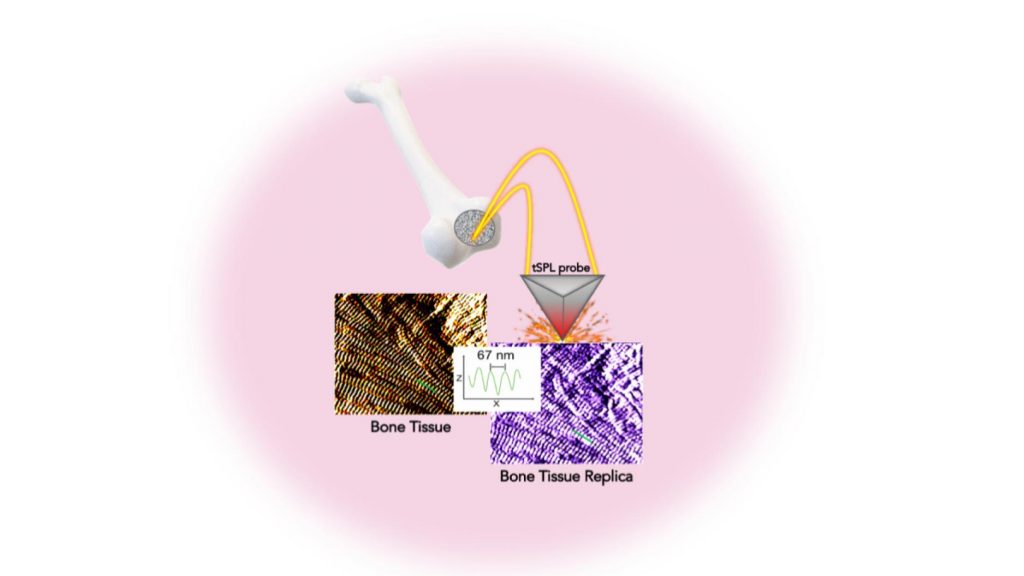
Researchers were able to replicate — with sub-15 nm resolution — bone tissue structure in a biocompatible material using thermal scanning probe lithography. This method opens up unprecedented possibilities for pioneering new stem cell studies and biomedical applications. Courtesy: New York University Tandon School of Engineering

From a February 9, 2021 news item on phys.org (Note: Links have been removed),

A holy grail for orthopedic research is a method for not only creating artificial bone tissue that precisely matches the real thing, but does so in such microscopic detail that it includes tiny structures potentially important for stem cell differentiation, which is key to bone regeneration.

Researchers at the NYU [New York University] Tandon School of Engineering and New York Stem Cell Foundation Research Institute (NYSF) have taken a major step by creating the exact replica of a bone using a system that pairs biothermal imaging with a heated “nano-chisel.” In a study, “Cost and Time Effective Lithography of Reusable Millimeter Size Bone Tissue Replicas with Sub-15 nm Feature Size on a Biocompatible Polymer,” which appears in the journal Advanced Functional Materials, the investigators detail a system allowing them to sculpt, in a biocompatible material, the exact structure of the bone tissue, with features smaller than the size of a single protein—a billion times smaller than a meter. This platform, called, bio-thermal scanning probe lithography (bio-tSPL), takes a “photograph” of the bone tissue, and then uses the photograph to produce a bona-fide replica of it.

The team, led by Elisa Riedo, professor of chemical and biomolecular engineering at NYU Tandon, and Giuseppe Maria de Peppo, a Ralph Lauren Senior Principal Investigator at the NYSF, demonstrated that it is possible to scale up bio-tSPL to produce bone replicas on a size meaningful for biomedical studies and applications, at an affordable cost. These bone replicas support the growth of bone cells derived from a patient’s own stem cells, creating the possibility of pioneering new stem cell applications with broad research and therapeutic potential. This technology could revolutionize drug discovery and result in the development of better orthopedic implants and devices.

A February 8, 2021 NYU Tandon School of Engineering news release (also on EurekAlert but published February 9, 2021), which originated the news item, explains the work in further detail,

In the human body, cells live in specific environments that control their behavior and support tissue regeneration via provision of morphological and chemical signals at the molecular scale. In particular, bone stem cells are embedded in a matrix of fibers — aggregates of collagen molecules, bone proteins, and minerals. The bone hierarchical structure consists of an assembly of micro- and nano- structures, whose complexity has hindered their replication by standard fabrication methods so far.

“tSPL is a powerful nanofabrication method that my lab pioneered a few years ago, and it is at present implemented by using a commercially available instrument, the NanoFrazor,” said Riedo. “However, until today, limitations in terms of throughput and biocompatibility of the materials have prevented its use in biological research. We are very excited to have broken these barriers and to have led tSPL into the realm of biomedical applications.”

Its time- and cost-effectiveness, as well as the cell compatibility and reusability of the bone replicas, make bio-tSPL an affordable platform for the production of surfaces that perfectly reproduce any biological tissue with unprecedented precision.

“I am excited about the precision achieved using bio-tSPL. Bone-mimetic surfaces, such as the one reproduced in this study, create unique possibilities for understanding cell biology and modeling bone diseases, and for developing more advanced drug screening platforms,” said de Peppo. “As a tissue engineer, I am especially excited that this new platform could also help us create more effective orthopedic implants to treat skeletal and maxillofacial defects resulting from injury or disease.”

Here’s a link to and a citation for the paper,

Cost and Time Effective Lithography of Reusable Millimeter Size Bone Tissue Replicas With Sub‐15 nm Feature Size on A Biocompatible Polymer by Xiangyu Liu, Alessandra Zanut, Martina Sladkova‐Faure, Liyuan Xie, Marcus Weck, Xiaorui Zheng, Elisa Riedo, Giuseppe Maria de Peppo. Advanced Functional Materials DOI: https://doi.org/10.1002/adfm.202008662 First published: 05 February 2021

This paper is behind a paywall.

Techno Art: mathematicians help conserve digital art

For anyone who’s not familiar with the problem, digital art is disappearing or very difficult and/or expensive to access after the technology on which or with which it was created becomes obsolete. Fear not! Mathematicians are coming to the rescue in a joint programme between New York University (NYU) and the Solomon R. Guggenheim Museum.

From a February 16, 2019 news item on ScienceDaily,

Just as conservators have developed methods to protect traditional artworks, computer scientists have now created means to safeguard computer- or time-based art by following the same preservation principles.

Software- and computer-based works of art are fragile — not unlike their canvas counterparts — as their underlying technologies such as operating systems and programming languages change rapidly, placing these works at risk.

These include Shu Lea Cheang’s Brandon (1998-99), Mark Napier’s net.flag (2002), and John F. Simon Jr.’s Unfolding Object (2002),  three online works recently conserved at the Solomon R. Guggenheim Museum, through a collaboration with New York University’s Courant Institute of Mathematical Sciences.

Fortunately, just as conservators have developed methods to protect traditional artworks, computer scientists, in collaboration with time-based media conservators, have created means to safeguard computer- or time-based art by following the same preservation principles.

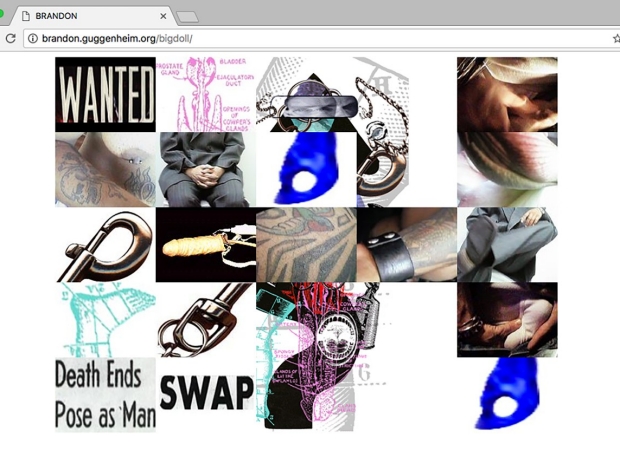
Brandon’s interface “bigdoll” after the 2016–2017 restoration. (C) Solomon R. Guggenheim Museum

A February 15, 2019 NYU news release, which originated the news item, delves further into the world of digital art preservation and conservation,

“The principles of art conservation for traditional works of art can be applied to decision-making in conservation of software- and computer-based works of art with respect to programming language selection, programming techniques, documentation, and other aspects of software remediation during restoration,” explains Deena Engel, a professor of computer science at New York University’s Courant Institute of Mathematical Sciences.

Since 2014, she has been working with the Guggenheim Museum’s Conservation Department to analyze, document, and preserve computer-based artworks from the museum’s permanent collection. In 2016, the Guggenheim took more formal steps to ensure the stature of these works by establishing Conserving Computer-Based Art (CCBA), a research and treatment initiative aimed at preserving software and computer-based artworks held by the museum.

“As part of conserving contemporary art, conservators are faced with new challenges as artists use current technology as media for their artworks,” says Engel. “If you think of a word processing document that you wrote 10 years ago, can you still open it and read or print it? Software-based art can be very complex. Museums are tasked with conserving and exhibiting works of art in perpetuity. It is important that museums and collectors learn to care for these vulnerable and important works in contemporary art so that future generations can enjoy them.”

Under this initiative, a team led by Engel and Joanna Phillips, former senior conservator of time-based media at the Guggenheim Museum, and including conservation fellow Jonathan Farbowitz and Lena Stringari, deputy director and chief conservator at the Guggenheim Museum, explore and implement both technical and theoretical approaches to the treatment and restoration of software-based art.

In doing so, they not only strive to maintain the functionality and appeal of the original works, but also follow the ethical principles that guide conservation of traditional artwork, such as sculptures and paintings. Specifically, Engel and Phillips adhere to the American Institute for Conservation of Historic and Artistic Works’ Code of Ethics, Guidelines for Practice, and Commentaries, applying these standards to artistic creations that rely on software as a medium.

“For example, if we migrate a work of software-based art from an obsolete programming environment to a current one, our selection and programming decisions in the new programming language and environment are informed in part by evaluating the artistic goals of the medium first used,” explains Engel. “We strive to maintain respect for the artist’s coding style and approach in our restoration.”

So far, Phillips and Engel have completed two restorations of on-line artworks at the museum: Cheang’s Brandon (restored in 2016-2017) and Simon’s Unfolding Object (restored in 2018).

Commissioned by the Guggenheim in 1998, Brandon was the first of three web artworks acquired by the museum. Many features of the work had begun to fail within the fast-evolving technological landscape of the Internet: specific pages were no longer accessible, text and image animations no longer displayed properly, and internal and external links were broken. Through changes implemented by CCBA, Brandon fully resumes its programmed, functional, and aesthetic behaviors. The newly restored artwork can again be accessed at http://brandon.guggenheim.org.

Unfolding Object enables visitors from across the globe to create their own individual artwork online by unfolding the pages of a virtual “object”—a two-dimensional rectangular form—click by click, creating a new, multifaceted shape. Users may also see traces left by others who have previously unfolded the same facets, represented by lines or hash marks. The colors of the object and the background change depending on the time of day, so that two simultaneous users in different time zones are looking at different colors. But because the Java technology used to develop this early Internet artwork is now obsolete, the work was no longer supported by contemporary web browsers and is not easily accessible online.

The CCBA team, in dialogue with the artist, analyzed and documented the artwork’s original source code and aesthetic and functional behaviors before identifying a treatment strategy. The team determined that a migration from the obsolete Java applet code to the contemporary programming language JavaScript was necessary. In place of a complete rewriting of the code, a treatment that art conservators would deem invasive, the CCBA team developed a new migration strategy more in line with contemporary conservation ethics, “code resituation,” which preserves as much of the original source code as possible

About the CCBA

A longtime pioneer in the field of contemporary art conservation, and one of the few institutions in the United States with dedicated staff and lab facilities for the conservation of time-based media art, the Guggenheim established the Conserving Computer-Based Art initiative in 2016. The first program dedicated to this subject at the museum, this multiyear project was created to research and develop better practices for the acquisition, preservation, maintenance, and display of computer-based art. By addressing the challenges of preserving digital artworks, including hardware failure, rapid obsolescence of operating systems, and artists’ custom software, CCBA is tasked with the conservation of 22 computer-based artworks in the Guggenheim collection to ensure long-term storage and access to the public. The CCBA initiative is an opportunity for the Guggenheim to facilitate cross-institutional collaboration towards best-practice development, and CCBA integrates the museum’s ongoing work with the faculty and students of the Department of Computer Science at NYU’s Courant Institute for Mathematical Sciences.

Conserving Computer-Based Art is supported by the Carl & Marilynn Thoma Art Foundation, the New York State Council on the Arts with the support of Governor Andrew Cuomo and the New York State Legislature, Christie’s, and Josh Elkes.

About the Solomon R. Guggenheim Foundation

The Solomon R. Guggenheim Foundation was established in 1937 and is dedicated to promoting the understanding and appreciation of modern and contemporary art through exhibitions, education programs, research initiatives, and publications. The Guggenheim international constellation of museums includes the Solomon R. Guggenheim Museum, New York; the Peggy Guggenheim Collection, Venice; the Guggenheim Museum Bilbao; and the future Guggenheim Abu Dhabi. In 2019, the Frank Lloyd Wright-designed Solomon R. Guggenheim Museum celebrates 60 years as an architectural icon and “temple of spirit” where radical art and architecture meet. To learn more about the museum and the Guggenheim’s activities around the world, visit guggenheim.org.

About the Courant Institute of Mathematical Sciences

New York University’s Courant Institute of Mathematical Sciences is a leading center for research and education in mathematics and computer science. The Institute has contributed to domestic and international science and engineering by promoting an integrated view of mathematics and computation. Faculty and students are engaged in a broad range of research activities, which include many areas of mathematics and computer science as well as the application of these disciplines to problems in the biological, physical, and economic sciences. The Courant Institute has played a central role in the development of applied mathematics, analysis, and computer science, and its faculty has received numerous national and international awards in recognition of their extraordinary research accomplishments. For more information, visit http://www.cims.nyu.edu/.

Have fun exploring these relatively newly available art works.

Congratulate China on the world’s first quantum communication network

China has some exciting news about the world’s first quantum network; it’s due to open in late August 2017 so you may want to have your congratulations in order for later this month.

An Aug. 4, 2017 news item on phys.org makes the announcement,

As malicious hackers find ever more sophisticated ways to launch attacks, China is about to launch the Jinan Project, the world’s first unhackable computer network, and a major milestone in the development of quantum technology.

Named after the eastern Chinese city where the technology was developed, the network is planned to be fully operational by the end of August 2017. Jinan is the hub of the Beijing-Shanghai quantum network due to its strategic location between the two principal Chinese metropolises.

“We plan to use the network for national defence, finance and other fields, and hope to spread it out as a pilot that if successful can be used across China and the whole world,” commented Zhou Fei, assistant director of the Jinan Institute of Quantum Technology, who was speaking to Britain’s Financial Times.

An Aug. 3, 2017 CORDIS (Community Research and Development Research Information Service [for the European Commission]) press release, which originated the news item, provides more detail about the technology,

By launching the network, China will become the first country worldwide to implement quantum technology for a real life, commercial end. It also highlights that China is a key global player in the rush to develop technologies based on quantum principles, with the EU and the United States also vying for world leadership in the field.

The network, known as a Quantum Key Distribution (QKD) network, is more secure than widely used electronic communication equivalents. Unlike a conventional telephone or internet cable, which can be tapped without the sender or recipient being aware, a QKD network alerts both users to any tampering with the system as soon as it occurs. This is because tampering immediately alters the information being relayed, with the disturbance being instantly recognisable. Once fully implemented, it will make it almost impossible for other governments to listen in on Chinese communications.

In the Jinan network, some 200 users from China’s military, government, finance and electricity sectors will be able to send messages safe in the knowledge that only they are reading them. It will be the world’s longest land-based quantum communications network, stretching over 2 000 km.

Also speaking to the ‘Financial Times’, quantum physicist Tim Byrnes, based at New York University’s (NYU) Shanghai campus commented: ‘China has achieved staggering things with quantum research… It’s amazing how quickly China has gotten on with quantum research projects that would be too expensive to do elsewhere… quantum communication has been taken up by the commercial sector much more in China compared to other countries, which means it is likely to pull ahead of Europe and US in the field of quantum communication.’

However, Europe is also determined to also be at the forefront of the ‘quantum revolution’ which promises to be one of the major defining technological phenomena of the twenty-first century. The EU has invested EUR 550 million into quantum technologies and has provided policy support to researchers through the 2016 Quantum Manifesto.

Moreover, with China’s latest achievement (and a previous one already notched up from July 2017 when its quantum satellite – the world’s first – sent a message to Earth on a quantum communication channel), it looks like the race to be crowned the world’s foremost quantum power is well and truly underway…

Prior to this latest announcement, Chinese scientists had published work about quantum satellite communications, a development that makes their imminent terrestrial quantum network possible. Gabriel Popkin wrote about the quantum satellite in a June 15, 2017 article Science magazine,

Quantum entanglement—physics at its strangest—has moved out of this world and into space. In a study that shows China’s growing mastery of both the quantum world and space science, a team of physicists reports that it sent eerily intertwined quantum particles from a satellite to ground stations separated by 1200 kilometers, smashing the previous world record. The result is a stepping stone to ultrasecure communication networks and, eventually, a space-based quantum internet.

“It’s a huge, major achievement,” says Thomas Jennewein, a physicist at the University of Waterloo in Canada. “They started with this bold idea and managed to do it.”

Entanglement involves putting objects in the peculiar limbo of quantum superposition, in which an object’s quantum properties occupy multiple states at once: like Schrödinger’s cat, dead and alive at the same time. Then those quantum states are shared among multiple objects. Physicists have entangled particles such as electrons and photons, as well as larger objects such as superconducting electric circuits.

Theoretically, even if entangled objects are separated, their precarious quantum states should remain linked until one of them is measured or disturbed. That measurement instantly determines the state of the other object, no matter how far away. The idea is so counterintuitive that Albert Einstein mocked it as “spooky action at a distance.”

Starting in the 1970s, however, physicists began testing the effect over increasing distances. In 2015, the most sophisticated of these tests, which involved measuring entangled electrons 1.3 kilometers apart, showed once again that spooky action is real.

Beyond the fundamental result, such experiments also point to the possibility of hack-proof communications. Long strings of entangled photons, shared between distant locations, can be “quantum keys” that secure communications. Anyone trying to eavesdrop on a quantum-encrypted message would disrupt the shared key, alerting everyone to a compromised channel.

But entangled photons degrade rapidly as they pass through the air or optical fibers. So far, the farthest anyone has sent a quantum key is a few hundred kilometers. “Quantum repeaters” that rebroadcast quantum information could extend a network’s reach, but they aren’t yet mature. Many physicists have dreamed instead of using satellites to send quantum information through the near-vacuum of space. “Once you have satellites distributing your quantum signals throughout the globe, you’ve done it,” says Verónica Fernández Mármol, a physicist at the Spanish National Research Council in Madrid. …

Popkin goes on to detail the process for making the discovery in easily accessible (for the most part) writing and in a video and a graphic.

Russell Brandom writing for The Verge in a June 15, 2017 article about the Chinese quantum satellite adds detail about previous work and teams in other countries also working on the challenge (Note: Links have been removed),

Quantum networking has already shown promise in terrestrial fiber networks, where specialized routing equipment can perform the same trick over conventional fiber-optic cable. The first such network was a DARPA-funded connection established in 2003 between Harvard, Boston University, and a private lab. In the years since, a number of companies have tried to build more ambitious connections. The Swiss company ID Quantique has mapped out a quantum network that would connect many of North America’s largest data centers; in China, a separate team is working on a 2,000-kilometer quantum link between Beijing and Shanghai, which would rely on fiber to span an even greater distance than the satellite link. Still, the nature of fiber places strict limits on how far a single photon can travel.

According to ID Quantique, a reliable satellite link could connect the existing fiber networks into a single globe-spanning quantum network. “This proves the feasibility of quantum communications from space,” ID Quantique CEO Gregoire Ribordy tells The Verge. “The vision is that you have regional quantum key distribution networks over fiber, which can connect to each other through the satellite link.”

China isn’t the only country working on bringing quantum networks to space. A collaboration between the UK’s University of Strathclyde and the National University of Singapore is hoping to produce the same entanglement in cheap, readymade satellites called Cubesats. A Canadian team is also developing a method of producing entangled photons on the ground before sending them into space.

I wonder if there’s going to be an invitational event for scientists around the world to celebrate the launch.

New ABCs of research: seminars and a book

David Bruggeman has featured a new book and mentioned its attendant seminars in an April 19, 2016 post on his Pasco Phronesis blog (Note: A link has been removed),

Ben Shneiderman, Professor of Computer Science at the University of Maryland at College Park, recently published The New ABCs of Research: Achieving Breakthrough Collaborations.  It’s meant to be a guide for students and researchers about the various efforts to better integrate different kinds of research and design to improve research outputs and outcomes. …

David has an embedded a video of Schneiderman discussing the principles espoused in his book. There are some upcoming seminars including one on Thursday, April 21, 2016 (today) at New York University (NYU) at 12:30 pm at 44 West 4th St, Kaufman Management Center, Room 3-50. From the description on the NYU event page,

Solving the immense problems of the 21st century will require ambitious research teams that are skilled at producing practical solutions and foundational theories simultaneously – that is the ABC Principle: Applied & Basic Combined.  Then these research teams can deliver high-impact outcomes by applying the SED Principle: Blend Science, Engineering and Design Thinking, which encourages use of the methods from all three disciplines.  These guiding principles (ABC & SED) are meant to replace Vannevar Bush’s flawed linear model from 1945 that has misled researchers for 70+ years.  These new guiding principles will enable students, researchers, business leaders, and government policy makers to accelerate discovery and innovation.

Oxford University Press:  http://ukcatalogue.oup.com/product/9780198758839.do

Book website:  http://www.cs.umd.edu/hcil/newabcs

There is another seminar on Wednesday, April 27, 2016 at 3:00 pm in the Pepco Room, #1105 Kim Engineering Building at the University of Maryland which is handy for anyone in the Washington, DC area.