Tag Archives: reduced graphene oxide (rGO)

Engineering graphene to block and detect malaria

Michael Berger wrote an August 17, 2025 Nanowerk spotlight article on proposed research into the use of graphene as a protection against malaria carrying mosquitoes, Note: Links have been removed,

Malaria continues to resist elimination efforts, even as vaccines and treatments become easier to access. Despite substantial progress, the disease remains a serious global threat. According to the World Health Organization, in 2023 there were an estimated 597,000 malaria-related deaths and 263 million cases worldwide. Preventive measures such as insecticide-treated bed nets and indoor spraying remain key strategies, and diagnostic testing and treatments are essential for managing infections.

Yet each tool faces limits. Mosquitoes are developing resistance to insecticides. Parasites are evolving resistance to treatments. Diagnostics often require lab settings or fail to detect infections early or at low levels. Malaria must be managed at many points—from the mosquito bite to parasite growth to detection—but the current tools are not equally effective at every stage.

Materials science is now stepping into this space with a new class of engineered substances: two-dimensional (2D) materials, particularly graphene and its variants. Graphene is a single sheet of carbon atoms arranged in a hexagonal pattern, known for its exceptional strength, electrical conductivity, and chemical reactivity. These properties make it promising for applications that require both sensitivity and selectivity, such as detecting tiny amounts of biomolecules or blocking microscopic particles.

Figure 1: Graphene in the fight against malaria. I) Material based on a diversity of graphene (e.g., 0D, 1D, 2D, 3D, monolayer, multilayer, and nanosheet) with chemical properties of strong strength, high mobility, high transparency, good heat conductivity, biocompatibility, and chemical stability; II) advanced devices (e.g., nanofabrication of graphene quantum dots, surface plasmon resonance biosensing chip) demonstrating antimalarial characteristics can be used for III) malaria treatment (i.e., enhanced predation efficiency of natural enemies, prevented P. falciparum bites by acting as physical barrier, interference P. falciparum sense the human body, the superior loading capacity of graphene oxide nanosheets (GOns) for essential biomolecules required for the growth and development of malaria parasites resulted in the depletion of vital nutrients, diagnosis malaria by rapid detection of DNA, RBC, lactate dehydrogenase (LDH), and nanodrug delivery system with high toxicity against malaria mosquitoes) at IV) different stages of malaria development from injection of sporozoites by an infected mosquito to multiplication of merozoites in RBCs. This review contributes to a better understanding of the opportunities and challenges associated with graphene-based materials in the fight against malaria, offering valuable guidance for future research and development in this important area. [downloaded from https://advanced.onlinelibrary.wiley.com/doi/10.1002/anbr.202300130]

Berger’s August 17, 2025 article delves into further detail, Note: A link has been removed,

A comprehensive review published in Advanced NanoBiomed Research (“The Comprehensive Roadmap Toward Malaria Elimination Using Graphene and its Promising 2D Analogs”) outlines how graphene and similar materials could be systematically applied across multiple stages of malaria control.

The authors present a structured roadmap covering synthesis methods, biological interactions, safety issues, and potential for use in both diagnosis and prevention. Their approach is not to suggest a single cure-all, but to identify specific material properties that could address long-standing weaknesses in current malaria tools.

The paper begins by describing how graphene and its common derivatives — including graphene oxide (GO), reduced graphene oxide (rGO), and graphene quantum dots (GQDs) — can be manufactured using physical, chemical, or biological methods. Physical methods include mechanical exfoliation and chemical vapor deposition, which yield high-purity graphene sheets. Chemical methods, such as Hummers’ method, oxidize graphite to produce GO, a more water-dispersible form that is easier to work with in biological environments. Biological or “green” methods use plant extracts or microbes as reducing agents to avoid toxic solvents, and these are seen as more scalable and biocompatible for medical applications. Each method has trade-offs in cost, quality, and environmental impact.

Once produced, graphene-based materials can interact with malaria parasites, mosquitoes, or infected blood cells in ways that potentially disrupt the disease process. The authors identify three primary intervention points: prevention, parasite inhibition, and diagnosis.

In terms of prevention, graphene’s impermeability makes it an effective barrier material. When applied as a coating on fabrics or films, it can block mosquito bites by physically resisting the insect’s proboscis and masking human scent cues such as carbon dioxide and lactic acid. Laboratory studies have demonstrated that multilayer GO coatings on the skin prevent mosquitoes from locating and piercing the surface, reducing bite risk without using chemicals. These barrier films are flexible and can be integrated into clothing or wearable devices. Because the films are stable and resistant to wear, they offer longer-lasting protection than chemical repellents.

The review also discusses using GQDs as larvicides, since these nanoscale particles can penetrate mosquito larvae and disrupt their development. Their small size allows them to pass through biological membranes and interfere with cell function, though the exact mechanism remains under study.

The second application area is inhibition of parasite development. After a person is bitten, the malaria parasite enters the bloodstream and invades red blood cells. GO nanosheets have shown the ability to bind to the parasite’s outer membrane or to essential nutrients in the blood, physically blocking the parasite’s access to the cell. In vitro experiments suggest that GO can capture or neutralize the parasite before it completes its life cycle.
Some graphene derivatives can interfere with protein transport or nutrient absorption, making the environment inside the host less favorable to the parasite. These materials could potentially be delivered through injectable suspensions or oral carriers, though this application remains in early experimental phases.

One of the most promising areas for using graphene in malaria control is early diagnosis. Accurate detection is critical for timely treatment and for preventing the spread of infection, especially in areas with limited medical infrastructure. Traditional diagnostic tools, such as rapid tests and blood smears, often miss low-level infections or require trained personnel and laboratory settings. Graphene offers a way to build more sensitive, portable, and reliable detection devices.

Graphene’s usefulness in sensing comes from its structure. Because it is only one atom thick, any molecule that lands on its surface can quickly alter its electrical or optical properties. This makes it especially good at detecting very small amounts of biological material — such as the proteins, DNA, or altered red blood cells that signal a malaria infection.

If you are interested in the possibilities that graphene offers, Berger’s August 17, 2025 article is well worth reading in its entirety.

Here’s a link to and a citation for the paper,

The Comprehensive Roadmap Toward Malaria Elimination Using Graphene and its Promising 2D Analogs by Fangzhou He, George Junior, Rajashree Konar, Yuanding Huang, Ke Zhang, Lijing Ke, Meng Niu, Boon Tong Goh, Amine El Moutaouakil, Gilbert Daniel Nessim, Mohamed Belmoubarik, Weng Kung Peng. Advanced NanoBiomed Research Volume 5, Issue 8 August 2025 2300130 DOI: https://doi.org/10.1002/anbr.202300130 First published online: 15 March 2024

This paper is open access.

Graphene-based material for high-performance supercapacitors

Researchers from Russia and France have developed a new material, based on graphene, that would allow supercapacitors to store more energy according to a January 15, 2021 news item on Nanowerk,

Scientists of Tomsk Polytechnic University jointly with colleagues from the University of Lille (Lille, France) synthetized a new material based on reduced graphene oxide (rGO) for supercapacitors, energy storage devices. The rGO modification method with the use of organic molecules, derivatives of hypervalent iodine, allowed obtaining a material that stores 1.7 times more electrical energy.

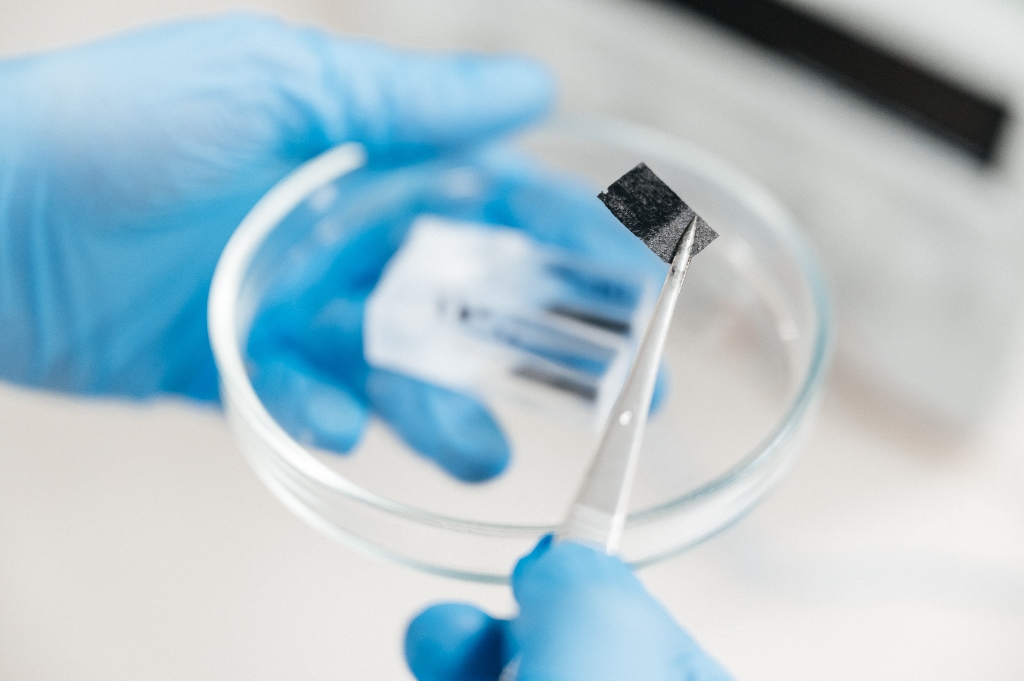
Photo: modified rGO supercapacitor electrodes. Courtesy: Tomsk University

A January 15, 2020 Tomsk Polytechnic University press release (also on EurekAlert), which originated the news item, provides more details,

A supercapacitor is an electrochemical device for storage and release of electric charge. Unlike batteries, they store and release energy several times faster and do not contain lithium.

A supercapacitor is an element with two electrodes separated by an organic or inorganic electrolyte. The electrodes are coated with an electric charge accumulating material. The modern trend in science is to use various materials based on graphene, one of the thinnest and most durable materials known to man. The researchers of TPU and the University of Lille used reduced graphene oxide (rGO), a cheap and available material.

“Despite their potential, supercapacitors are not wide-spread yet. For further development of the technology, it is required to enhance the efficiency of supercapacitors. One of the key challenges here is to increase the energy capacity.

It can be achieved by expanding the surface area of an energy storage material, rGO in this particular case. We found a simple and quite fast method. We used exceptionally organic molecules under mild conditions and did not use expensive and toxic metals,” Pavel Postnikov, Associate Professor of TPU Research School of Chemistry and Applied Biomedical Science and the research supervisor says.

Reduced graphene oxide in a powder form is deposited on electrodes. As a result, the electrode becomes coated with hundreds of nanoscale layers of the substance. The layers tend to agglomerate, in other words, to sinter. To expand the surface area of a material, the interlayer spacing should be increased.

“For this purpose, we modified rGO with organic molecules, which resulted in the interlayer spacing increase. Insignificant differences in interlayer spacing allowed increasing energy capacity of the material by 1.7 times. That is, 1 g of the new material can store 1.7 times more energy in comparison with a pristine reduced graphene oxide,” Elizaveta Sviridova, Junior Research Fellow of TPU Research School of Chemistry and Applied Biomedical Sciences and one of the authors of the article explains.

The reaction proceeded through the formation of active arynes from iodonium salts. They kindle scientists` interest due to their property to form a single layer of new organic groups on material surfaces. The TPU researchers have been developing the chemistry of iodonium salts for many years.

“The modification reaction proceeds under mild conditions by simply mixing the solution of iodonium salt with reduced graphene oxide. If we compare it with other methods of reduced graphene oxide functionalization, we have achieved the highest indicators of material energy capacity increase,” Elizaveta Sviridova says.

Here’s a link to and a citation for the paper,

Aryne cycloaddition reaction as a facile and mild modification method for design of electrode materials for high-performance symmetric supercapacitor by Elizaveta Sviridova, Min Li, Alexandre Barras, Ahmed Addad, Mekhman S.Yusubov, Viktor V. Zhdankin, Akira Yoshimura, Sabine Szunerits, Pavel S. Postnikov, Rabah Boukherroub. Electrochimica Acta Volume 369, 10 February 2021, 137667 DOI: https://doi.org/10.1016/j.electacta.2020.137667

This paper is behind a paywall.