I’m sorry to be late. Thankfully this show extends into July 2023, so, there’s still plenty of time to get to Chicago’s The Block Museum of Art (at Northwestern University) art/science exhibition. I found this on the museum’s exhibition page for “The Heart’s Knowledge: Science and Empathy in the Art of Dario Robleto” show,
What do we owe to the memories of one another’s hearts?
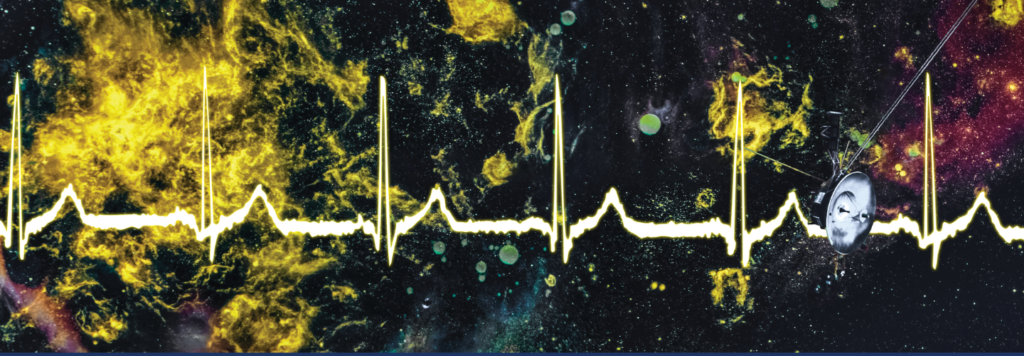
For American artist Dario Robleto (b. 1972), artists and scientists share a common aspiration: to increase the sensitivity of their observations. Throughout the history of scientific invention, instruments like the cardiograph and the telescope have extended the reach of perception from the tiniest stirrings of the human body to the farthest reaches of space. In his prints, sculptures, and video and sound installations, Robleto contemplates the emotional significance of these technologies, bringing us closer to the latent traces of life buried in the scientific record.
The Heart’s Knowledge concentrates on the most recent decade of Robleto’s creative practice, a period of deepening engagement with histories of medicine, biomedical engineering, sound recording, and space exploration. The exhibition organizes the artist’s conceptually ambitious, elegantly wrought artworks as a series of multisensory encounters between art and science. Each work seeks to attune viewers to the material traces of life at scales ranging from the intimate to the universal, returning always to the question: Does empathy extend beyond the boundaries of time and space?
…
Here’s more from a January 27, 2023 Northwestern University news release (received via email),
Exhibition searches for meaning at the limits of science and perception
“The Heart’s Knowledge: Science and Empathy in the Art of Dario Robleto” is on view Jan. 27 to July 9 [2023] at The Block Museum of Art
- Works are informed by dialogue with Northwestern Engineering researchers during five-year residency
- Exhibition a tribute to NASA Golden Record creator, ‘whose heart has left the solar system’
- Opening conversation with the artist will take place at 2 p.m. on [Saturday] Feb. 4 [2023]
American artist Dario Robleto (b. 1972) believes artists and scientists share a common aspiration: to increase the sensitivity of their observations.
From understanding the human body’s pulses and brainwaves to viewing the faintest glimmers of light from the edge of the observable universe, groundbreaking science pushes the limits of perception. Similarly, the perceptive work of artists can extend the boundaries of empathy and understanding.
Since 2018, Robleto served as an artist-at-large at the McCormick School of Engineering. This unique partnership between The Block Museum and McCormick gave the artist an open “hall pass” to learn from, collaborate with and question scientists, engineers and experts from across the University.
Robleto’s five-year residency concludes with the exhibition “The Heart’s Knowledge: Science and Empathy in the Art of Dario Robleto.” Co-presented by The Block Museum and McCormick, the exhibition is on view from Jan. 27 to July 9 [2023] at The Block Museum, 40 Arts Circle Drive on Northwestern’s Evanston campus. [emphasis mine]
A free opening conversation with the artist will take place at 2 p.m. on Saturday, Feb. 4 [2023], in Norris University Center’s McCormick Auditorium, 1999 Campus Drive in Evanston.
About the Exhibition: “The Heart’s Knowledge”
Throughout the history of scientific invention, instruments like the cardiograph and the telescope have extended the reach of perception from the tiniest stirrings of the human body to the farthest reaches of space.
Robleto’s prints, sculptures and video and sound installations contemplate the emotional significance of these technologies, bringing viewers closer to the latent traces of life buried in the scientific record.
“The Heart’s Knowledge” represents a decade of Robleto’s creative practice, from 2012 to 2022, a period marked by a deepening engagement with science, including astronomy, synthetic biology and exobiology, and a widening embrace of new materials and creative forms, from 3D-printed objects to film.
Robleto dedicates the exhibition to Ann Druyan, the creative director of NASA’s Golden Record for the Voyager 1 and 2 projects. The record includes Druyan’s brainwaves and heartbeats, recorded as she reflected on her secret love for famed astronomer and future husband Carl Sagan. The act of sneaking “love on board the Voyager” inspired Robleto to compose a love letter to the only human whose “heart has left the solar system.”
Robleto sees Druyan’s act to include her emotions on the record as the central inspiration of his work. “I consider it the greatest work of subversive, avant-garde art not yet given its due,” Robleto said. “The Golden Record and Ann’s radical act brought us all together to think about what it means to be human — to one another and to unknown beings on other worlds.”
The exhibition organizes the artist’s conceptually ambitious, elegantly wrought artworks as a series of multisensory encounters between art and science. Each asks viewers to seek out the material traces of life in scales ranging from the intimate to the universal, and to question: Does empathy extend beyond the boundaries of time and space?
“Whether he’s addressing the most minute phenomena of the body or the horizons of the known universe, Robleto binds the rigor of scientific inquiry with artistic expression,” said exhibition curator Michael Metzger, The Block’s Pick-Laudati Curator of Media Arts.
“Straining at the bounds of observation, Robleto discovers unity at the limits; the common endeavor of art and science to achieve a form of knowledge that language alone cannot speak,” Metzger said.
The exhibition includes three sections:
“Heartbeats“
Rooted in the artist’s longstanding fascination with the clinical and cultural history of the human heart, “Heartbeats” draws inspiration from 19th-century pioneers of cardiography, whose instruments graphically measured heart activity for the first time, leaving behind poignant records of human subjectivity. In “The First Time, the Heart (A Portrait of Life 1854-1913)” (2017), Robleto transforms early measurements of heartbeats into photolithographs executed on paper hand-sooted with candle flames. For the installation “The Pulse Armed with a Pen (An Unknown History of the Human Heartbeat)” (2014), Robleto collaborated with sound historian Patrick Feaster to digitally resurrect these heartbeats in audio form, giving visitors access to intimate pulses of life recorded before the invention of sound playback.“Wavelengths“
Robleto has recently embraced digital video to create works that narrate transformational episodes in the recording and study of wave phenomena. “Wavelengths” comprises two hour-long immersive video installations. “The Boundary of Life is Quietly Crossed” (2019) is inspired by NASA’s Voyager Golden Record, a gold-plated phonographic disc launched into space onboard the Voyager I and II space probes in 1977. In “The Aorta of an Archivist” (2020-2021), Robleto investigates three breakthroughs in the history of recording: the first recording of a choral performance made with an Edison wax cylinder, the first heartbeat captured while listening to music and the first effort to transcribe the brain wave activity of a dreaming subject.“Horizons“
In the final section, “Horizons,” Robleto evokes the spirit of the Hubble telescope and the search for extraterrestrial life, gazing out at the boundaries of the observable universe. Inspired by his time as an artist-in-residence at the SETI Institute (Search for Extraterrestrial Intelligence) and as artistic consultant to the Breakthrough Initiatives, his intricate sculptures, such as “Small Crafts on Sisyphean Seas” (2018), give shape to the speculative search for intelligent life in the universe. Other works like “The Computer of Jupiter” (2019) are framed as “gifts for extraterrestrials” offering an alternative view of the best way to begin a dialogue with alien intelligences.The Artist-at-Large Program at Northwestern
Lisa Corrin, the Ellen Philips Katz Executive Director of The Block Museum of Art, and Julio M. Ottino, dean of McCormick School of Engineering, envisioned the possibilities of this unconventional partnership between scientist and artist when they launched the artist-at-large initiative together. The work is part of an ongoing Art + Engineering initiative and a part of the whole-brain engineering philosophy at Northwestern Engineering.
“Here, a university’s school of engineering and its art museum come together in the shared belief that transformative innovation can happen at the intersections of usually distinct academic disciplines and modes of creativity and inquiry,” Corrin said. “We had faith that something meaningful would emerge organically if we merely provided structures in which informal interactions might take place.”
“We wanted to model for young engineers the value of embracing uncertainty as part of the journey that leads to innovation and opens pathways within the imagination — as artists do,” Ottino said. “We are grateful to Dario Robleto for accepting our invitation to come to Northwestern and to enter the unknown with us. He has taught us that our shared future resides in our capacity for compassion and for empathy, the ethos at the heart of his work that holds the most promise for those at the forefront of science in the interest of humankind.”
More information about Robleto’s residency can be found in the article “Dario is our Socrates” on the Block Museum website and by viewing the Northwestern Engineering video “Artist-at-Large Program: Dario Robleto.”
Exhibition Events
“The Heart’s Knowledge” will include six months of events and dialogues that will illuminate the intersections in Robleto’s practice. All events are free and open to the public. For current program information, visit The Block Museum website.
Program highlights for February and March include:
Science, Art and the Search for Meaning: Opening Conversation with Dario Robleto
Saturday, Feb. 4 [2023], 2 p.m.
Norris University Center, McCormick Auditorium
1999 Campus DriveThe Block Museum hosts a discussion that reaches across boundaries to examine the shared pursuit that binds artists and scientists. The conversation features artist Dario Robleto; Jennifer Roberts, professor of the humanities at Harvard University; Lucianne Walkowicz, astronomer and co-founder of the JustSpace Alliance; and Michael Metzger, Pick-Laudati Curator of Media Arts and curator of “The Heart’s Knowledge.”
“X: The Man with the X-Ray Eyes” (1963)
Friday, Feb. 10 [2023], 7 p.m.
Block Cinema
40 Arts Circle DriveA Science on Screen program with Catherine Belling, associate professor of medical education at Northwestern University Feinberg School of Medicine.
“First Man” (2018)
Saturday Feb. 18 [2023], 1 p.m.
Block Cinema
40 Arts Circle DriveA Science on Screen program featuring history researcher Jordan Bimm of the University of Chicago, who will discuss the military origins of “space medicine.”
Exhibition Conversation: Interstellar Aesthetics and Acts of Translation in Art and Science
Wednesday, Feb. 22 [2023], 6 p.m.
Block MuseumJoining artist Dario Robleto in conversation are Elizabeth Kessler, exhibition publication contributor and a lecturer in American Studies at Stanford University, and Shane Larson, research professor of physics and astronomy and associate director of CIERA (Center for Interdisciplinary Exploration and Research in Astrophysics) at Northwestern.
Gallery Talk: Stillness, Wonder and Gifts for Extraterrestrials
Thursday, Feb. 23 [2023], 12:30 p.m.
Block MuseumElizabeth Kessler of Stanford University will discuss Robleto’s “gifts for extraterrestrials” series.
Online Conversation: Ann Druyan, The Golden Record and the Memory of Our Hearts
Wednesday, March 8 [2023], 6 p.m. [ET]
Block CinemaAnn Druyan, creative director for NASA’s Voyager Interstellar Messaging Project and writer and producer of the PBS television series “Cosmos,” joins Robleto and art historian Jennifer Roberts for a conversation about the Golden Record and the heart’s memory.
Exhibition Publication
In conjunction with the exhibition, The Block Museum of Art and the McCormick School of Engineering are proud to announce the publication of “The Heart’s Knowledge: Science and Empathy in the Art of Dario Robleto,” (Artbook, D.A.P., 2023).
The publication is edited by Michael Metzger with contributions by Metzger, Robert M. Brain, Daniel K. L. Chua, Patrick Feaster, Stefan Helmreich, Elizabeth A. Kessler ,Julius B. Lucks, Elizabeth Kathleen Mitchell, Alexander Rehding, Jennifer L. Roberts, Claire Isabel Webb and Dario Robleto.
About Dario Robleto
Dario Robleto was born in San Antonio, Texas, in 1972 and received his BFA from the University of Texas at San Antonio in 1997. He lives and works in Houston, Texas. The artist has had numerous solo exhibitions since 1997, most recently at the Spencer Museum of Art, Lawrence, Kansas (2021); the Radcliffe Institute for Advanced Study at Harvard University (2019); the McNay Museum, San Antonio, Texas (2018); Menil Collection, Houston, Texas (2014); the Baltimore Museum of Art (2014); the New Orleans Museum of Art (2012); and the Museum of Contemporary Art, Denver (2011).
He is currently working on his first book, “Life Signs: The Tender Science of the Pulsewave,” co-authored with art historian Jennifer Roberts, the Elizabeth Cary Agassiz Professor of the Humanities at Harvard (University of Chicago Press).
Exhibition Credits
“The Heart’s Knowledge: Science and Empathy in the Art of Dario Robleto” exhibition is made possible through a partnership with the Robert R. McCormick School of Engineering and Applied Science at Northwestern University. Major support also was provided by the National Endowment for the Arts. Additional support is contributed by the Dorothy J. Speidel Fund; the Bernstein Family Contemporary Art Fund; the Barry and Mary Ann MacLean Fund for Art and Engineering; the Illinois Arts Council Agency; and the Alumnae of Northwestern University. The exhibition publication is made possible in part by the Sandra L. Riggs Publications Fund.
Should you be in the Chicago area and interested in the exhibit, you can find all the information for your visit here.