Tag Archives: stone

Nanomaterial restoration of colossal statues on Mount Nemrut (Türkiye)

[downloaded from https://whc.unesco.org/en/list/448]

Before getting to the nanomaterial restoration, here’s a little information about the project, Nemrut Dağ, from its UNESCO (United Nations Educational, Scientific and Cultural Organization) World Heritage List webpage,

Nemrut Dağ

The mausoleum of Antiochus I (69–34 B.C.), who reigned over Commagene, a kingdom founded north of Syria and the Euphrates after the breakup of Alexander’s empire, is one of the most ambitious constructions of the Hellenistic period. The syncretism of its pantheon, and the lineage of its kings, which can be traced back through two sets of legends, Greek and Persian [emphasis mine], is evidence of the dual origin of this kingdom’s culture.

Description is available under license CC-BY-SA IGO 3.0

Outstanding Universal Value

Brief synthesis

Crowning one of the highest peaks of the Eastern Taurus mountain range in south-east Turkey, Nemrut Dağ is the Hierotheseion (temple-tomb and house of the gods) built by the late Hellenistic King Antiochos I of Commagene (69-34 B.C.) as a monument to himself.

With a diameter of 145 m, the 50 m high funerary mound of stone chips is surrounded on three sides by terraces to the east, west and north directions. Two separate antique processional routes radiate from the east and west terraces. Five giant seated limestone statues, identified by their inscriptions as deities, face outwards from the tumulus on the upper level of the east and west terraces. These are flanked by a pair of guardian animal statues – a lion and eagle – at each end. The heads of the statues have fallen off to the lower level, which accommodates two rows of sandstone stelae, mounted on pedestals with an altar in front of each stele. One row carries relief sculptures of Antiochos’ paternal Persian ancestors, the other of his maternal Macedonian ancestors. Inscriptions on the backs of the stelae record the genealogical links. A square altar platform is located at the east side of the east terrace. On the west terrace there is an additional row of stelae representing the particular significance of Nemrut, the handshake scenes (dexiosis) showing Antiochos shaking hands with a deity and the stele with a lion horoscope, believed to be indicating the construction date of the cult area. The north terrace is long, narrow and rectangular in shape, and hosts a series of sandstone pedestals. The stelae lying near the pedestals on the north terrace have no reliefs or inscriptions.

The Hierotheseion of Antiochos I is one of the most ambitious constructions of the Hellenistic period. Its complex design and colossal scale combined to create a project unequalled in the ancient world. A highly developed technology was used to build the colossal statues and orthostats (stelae), the equal of which has not been found anywhere else for this period. The syncretism of its pantheon and the lineage of its kings, which can be traced back through two sets of legends, Greek and Persian, is evidence of the dual origin of this kingdom’s culture.

Criterion (i): The tomb of Antiochos I of Commagene is a unique artistic achievement. The landscaping of the natural site of Nemrut Dağ is one of the most colossal undertakings of the Hellenistic period (some of the stone blocks used weigh up to nine tons).

Criterion (iii): The tomb or the Hierotheseion of Nemrut Dağ bears unique testimony to the civilization of the kingdom of Commagene. Antiochos I is represented in this monument as a descendant of Darius by his father Mithridates, and a descendant of Alexander by his mother Laodice. This semi-legendary ancestry translates in genealogical terms the ambition of a dynasty that sought to remain independent of the powers of both the East and the West.

Criterion (iv): More so than the tombs at Karakus and Eski Kahta, the tumulus at Nemrut Dağ illustrates, through the liberal syncretism of a very original pantheon, a significant, historical period. The assimilation of Zeus with Oromasdes (the Iranian god Ahuramazda), and Heracles with Artagnes (the Iranian god Verathragna) finds its artistic equivalent in an intimate mixture of Greek, Persian and Anatolian aesthetics in the statuary and the bas-reliefs.

Integrity

Nemrut Dağ is largely intact and truthfully and credibly expresses it Outstanding Universal Value. The important cult areas of Commagene still exist, the structures are the original ones and their original interrelations can still be observed and perceived.  Although the property boundary contains the tumulus and the east, west and north terraces, it does not include the full extent of the ceremonial routes. The greatest threat to the integrity of the property is the material damage caused by environmental conditions such as serious seasonal and daily temperature variations, freezing and thawing cycles, wind, snow accumulation, and sun exposure.  The height of the tumulus is now reduced from its estimated original 60 m due to weathering, previous uncontrolled research investigations and climbing by visitors. Furthermore, the Nemrut property is located within a first degree earthquake zone and is very close to the East Anatolian Fault, which is seismically active. Therefore, the tumulus, statues and stelae are vulnerable to earthquakes.

Authenticity

Nemrut Dağ retains its authenticity in terms of form, materials and design as one of the unique artistic achievements of the Hellenistic period with its fascinating beauty of monumental sculptures in a spectacular setting. It has survived  in a moderately well-preserved state. The original ceremonial routes to the Hierotheseion are known and still used for access today.

I highlighted ‘syncretism’ and ‘Greek and Persian legends’ in the previous excerpt as I found a different description which includes another influence while confirming the debt to Greek and Persian legends in this September 12, 2021 article for Arthipo,

Nemrut Mountain Statues, Kingdom of Commagene and Mount of Gods

Nemrut Mountain Statues is an archeological site that is among the archaeological hits of Asia Minor, and at the same time still keeps many secrets. Until now, it has not been possible to pinpoint what the artificial embankment at the top of the mountain hides. The colossal statues on Mount Nemrut are an excellent example of religious syncretism and Antiochus’ attempt to introduce a new state cult combining Greek, Persian and Armenian influences [emphasis mine].

Mount Nemrut Sculptures History and Art

Crowning one of the highest peaks of the Eastern Taurus mountain range in southeast Turkey, Mount Nemrut is the Hierotheseion (temple-tomb and home of the gods), built by the late Hellenistic King Antiochos I of Commagene (69-34 BC). The mausoleum of Antiochus I (69-34 BC), who ruled on Commagene, a kingdom established in the north of Syria and the Euphrates after the collapse of Alexander’s empire, is one of the most ambitious structures of the Hellenistic period. The syncretism of its pantheon and the lineage of its kings, which can be traced through two series of legends, Greek and Persian [emphasis mine], is evidence of the dual origin of the culture of this kingdom.

Material Used

The monuments on Nemrut Mountain Statues were built using two main types of rock materials; the first was a gray-green rock called tufite, consisting of a pyroclastic material containing a significant mixture of sedimentary material. These include steles with pictures of ancestors on the two main terraces, several small sculptures and minor architectural elements. The other material was the much more durable white and yellow limestone rock, which was also the main building material and from which huge statues and altars were carved.

Preservation and nanotechnology in Türkiye

The Nemrut Dağ preservation project is described in two different articles. There is significant overlap but also new detail in each one. This July 19, 2025 article by David Ramirez for The Anatoolian provides good detail,

The monumental statues atop Mount Nemrut, a UNESCO World Heritage Site, are undergoing advanced conservation efforts using nano lime technology. Initiated in 2022, the restoration work has yielded promising results, leading to the expansion of the project in 2025.

Located at an altitude of 2,206 meters, Mount Nemrut hosts colossal stone sculptures that have endured centuries of harsh environmental conditions. To address the micro-cracks forming on their surfaces and internal structures, experts began applying nano-dispersed calcium hydroxide solutions. Following successful trials, the project now focuses on the iconic Eagle Head and King Antiochus I statues on the western terrace.

A Blend of Technology and Preservation

In the initial phase, layers of dirt and grime are meticulously removed from the statue surfaces. Then, the nano lime solution is carefully injected into the cracks using syringes. This not only strengthens the stone from within but also prevents water infiltration caused by rain and atmospheric conditions.

The method is designed to maintain the natural appearance of the stones, allowing visitors to experience the statues in their original form. The restoration phase is expected to take approximately one month, focusing on sustainable conservation without compromising historical authenticity.

Expanded Restoration in 2025

Ayşe Ebru Çorbacı, Director of the , stated that a test application on the Heracles statue in 2022 had shown effective results:

“After observing the success of the pilot project, we planned a comprehensive restoration for 2025. Our goal is to strengthen the structural integrity while preserving the aesthetic features of the statues. The cracks won’t be completely filled, allowing the original forms to remain visible.”

An August 22, 2025 article for Türkiye Today adds more information,

Authorities in Türkiye have begun a large-scale preservation project for the colossal statues on Mount Nemrut using nanotechnology.

The effort aims to protect the two-thousand-year-old stone heads from further erosion caused by wind, snow, and sun.

Nanotechnology methods strengthen Nemrut statues against erosion

The Ministry of Culture and Tourism announced that the first stage of the project was completed between July 7 and 27 [2025].

A team of one expert from Adiyaman Museum and six restorers worked on the eastern and western terraces of the mountain. They focused on the heads of King Antiochos and the eagle, two sandstone reliefs, and the head of Apollo.

“With the first consolidation works, the heads of Antiochos, the eagle, and the statue of Apollo have regained their integrity. Thanks to the interventions made with nanotechnology on the east and west terraces, the texture of the stones was strengthened and cracks were closed.” [Culture and Tourism Minister Mehmet Nuri Ersoy]

Restoration team uses new tech to protect Nemrut’s monuments

The team used different nanomaterials depending on the stone.

Limestone monuments were cleaned mechanically and biologically, then reinforced with a nano-particle calcium hydroxide solution. Cracks were filled with a hydraulic lime-based mortar. Sandstone works were treated with nano-dispersed ethyl silicate to block water from seeping into the stone.

One of the most symbolic results was on the Apollo statue. Its headpiece, which had been reattached and separated several times in the past, was permanently fixed during this round of work.

Minister Ersoy emphasized that this was the first time such methods were permanently applied at Nemrut. “Nano lime and nano silicate techniques have breathed new life into Nemrut’s stones for the first time,” he said.

Five year conservation roadmap aims to secure Nemrut’s future

The project is planned to continue over five years. Test studies began in 2022 and monitoring continued through 2023 and 2024 before this summer’s application phase. …

There’s more about stone here in a November 10, 2023 posting “Preserving stone and repairing historic Church of the Scalzi in Venice (Italy) with nanotechnology.” The nanotechnology solution mentioned in the Italian story is in fact a nanosilica solution similar to the one being used at Nemrut Dağ. There are the other stone stories mentioned in the 2023 piece,

My other stone postings:

Water wears away stone at Rice University (Texas, US) and at the University of Bremen (Germany)

I am fascinated by research that focuses on boundaries as does this work from Rice University (Texas, US) and the University of Bremen (Germany) but first a general description of the research from a Dec. 6, 2013 news item on Nanowerk (Note: A link has been removed),

Scientists from Rice University and the University of Bremen’s Center for Marine Environmental Sciences (MARUM) in Germany have combined cutting-edge experimental techniques and computer simulations to find a new way of predicting how water dissolves crystalline structures like those found in natural stone and cement.

In a new study featured on the cover of the Nov. 28 issue of the Journal of Physical Chemistry C (“Kinetic Monte Carlo Simulations of Silicate Dissolution: Model Complexity and Parametrization”), the team found their method was more efficient at predicting the dissolution rates of crystalline structures in water than previous methods. The research could have wide-ranging impacts in diverse areas, including water quality and planning, environmental sustainability, corrosion resistance and cement construction.

The Dec. 5, 2013 Rice University news release, which originated the news item, explains the reasons for the research and delves into the subject of boundaries,

“We need to gain a better understanding of dissolution mechanisms to better predict the fate of certain materials, both in nature and in man-made systems,” said lead investigator Andreas Lüttge, a professor of mineralogy at MARUM and professor emeritus and research professor in Earth science at Rice. His team specializes in studying the thin boundary layer that forms between minerals and fluids.

Boundary layers are ubiquitous in nature; they occur when raindrops fall on stone, water seeps through soil and the ocean meets the sea floor. Scientists and engineers have long been interested in accurately explaining how crystalline materials, including many minerals and stones, interact with and are dissolved by water. Calculations about the rate of these dissolution processes are critical in many fields of science and engineering.

In the new study, Lüttge and lead author Inna Kurganskaya, a research associate in Earth science at Rice, studied dissolution processes using quartz, one of the most common minerals found in nature. Quartz, or silicon dioxide, is a type of silicate, the most abundant group of minerals in Earth’s crust.

At the boundary layer where quartz and water meet, multiple chemical reactions occur. Some of these happen simultaneously and others take place in succession. In the new study, the researchers sought to create a computerized model that could accurately simulate the complex chemistry at the boundary layer.

“The new model simulates the dissolution kinetics at the boundary layer with greater precision than earlier stochastic models operating at the same scale,” Kurganskaya said. “Existing simulations rely on rate constants assigned to a wide range of possible reactions, and as a result, the total material flux from the surface have an inherent variance range — a plus or minus factor that is always there.”

The team used new equipment to achieve increased imaging precision (from the news release),

One reason the team’s simulations more accurately represent real processes is that its models incorporate actual measurements from cutting-edge instruments and from high-tech materials, including glass ceramics and nanomaterials. With a special imaging technique called “vertical scanning interferometry,” which the group at MARUM and Rice helped to develop, the team scanned the crystal surfaces of both minerals and manufactured materials to generate topographic maps with a resolution of a just a few nanometers, or billionths of a meter.

“We found that dissolution rates that were predicted using rate constants were sometimes off by as much as two orders of magnitude,” Lüttge said.

The new method for more precisely predicting dissolution processes could revolutionize the way engineers and scientists make many calculations related to a myriad of things, including the stability of building materials, the longevity of materials used for radioactive waste storage and more, he said.

“Further work is needed to prove the broad utility of the method,” he said. “In the next phase of research, we plan to test our simulations on larger systems and over longer periods.”

One often sees funding information at the end of these types of news releases, which I don’t usually include here but I found this one a bit surprising (this is the first time I’ve seen research supported by a university that has no researchers involved in the work),

The research was supported by the Global Climate and Energy Project at Stanford University

The researchers offered this image to illustrate their work,
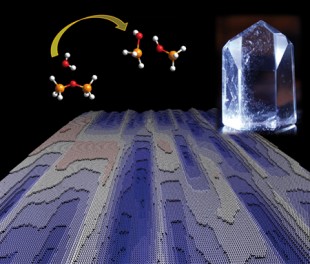
The dissolution process of a crystalline structure in water is shown: two bonded SiO4 -- molecules dissolve (top left), a quartz crystal (top right) and the computer-simulated surface of a dissolving crystalline structure (below). CREDIT: MARUM & Rice University

The dissolution process of a crystalline structure in water is shown: two bonded SiO4 — molecules dissolve (top left), a quartz crystal (top right) and the computer-simulated surface of a dissolving crystalline structure (below). CREDIT: MARUM & Rice University

For those who just can’t get enough information, here’s a link to and a citation for the paper,

Kinetic Monte Carlo Simulations of Silicate Dissolution: Model Complexity and Parametrization by Inna Kurganskaya and Andreas Luttge. J. Phys. Chem. C, 2013, 117 (47), pp 24894–24906 DOI: 10.1021/jp408845m Publication Date (Web): October 10, 2013
Copyright © 2013 American Chemical Society

This paper is behind a paywall.