Tag Archives: University of Padova

It’s a golden world

I have a number of stories concerning gold where researchers seemed to have had an extraordinarily rich set of findings within the last month. One of these is especially interesting in light of what I published yesterday (August 11, 2025 “Turning lead into gold (for approximately a microsecond“) about an event in May 2025.

I will be providing my usual citations and links but will not be tagging all the researchers (there are far too many) other than those mentioned in the news releases.

Two from SLAC (SLAC National Accelerator Laboratory, originally named the Stanford Linear Accelerator Center in California)

While both projects took place at SLAC, there’s virtually no crossover between the team members and the findings are of an entirely different nature.

Defying the limits and surviving the entropy catastrophe

An August 11, 2025 news item on ScienceDaily announces that physics limits have been defied,

Scientists have simultaneously broken a temperature record, overturned a long-held theory and utilized a new laser spectroscopy method for dense plasmas in a groundbreaking article published on July 23 in the journal Nature.

In their research article, “Superheating gold beyond the predicted entropy catastrophe threshold,” physicists revealed they were able to heat gold to over 19,000 Kelvin (33,740 degrees Fahrenheit), over 14 times its melting point, without it losing its solid, crystalline structure.

A July 23, 2025 University of Nevada news release, which originated the news item, delves further into the topic,

“This is possibly the hottest crystalline material ever recorded,” Thomas White, lead author and Clemons-Magee Endowed Professor in Physics at the University of Nevada, Reno said.

This result overturns the long-held theoretical limit known as the entropy catastrophe. The entropy catastrophe theory states that solids cannot remain stable above approximately three times their melting temperature without spontaneously melting. The melting point of gold, 1,337 Kelvin (1,947 degrees Fahrenheit), was far more than tripled in this experiment utilizing an extremely powerful laser at Stanford University’s SLAC National Accelerator Laboratory.

“I was expecting the gold to heat quite significantly before melting, but I wasn’t expecting a fourteen-fold temperature increase,” White said.

To heat the gold, researchers at the University of Nevada, Reno, SLAC National Accelerator Laboratory, the University of Oxford, Queen’s University Belfast, the European XFEL and the University of Warwick designed an experiment to heat a thin gold foil using a laser fired for 50 quadrillionths of a second (one millionth of a billionth). The speed with which the gold was heated seems to be the reason the gold remained solid. The findings suggest that the limit of superheating solids may be far higher – or nonexistent – if heating occurs quickly enough. The new methods used in this study open the field of high energy density physics to more exploration, including in areas of planetary physics and fusion energy research.

White and his team expected that the gold would melt at its melting point, but to measure the temperature inside the gold foil, they would need a very special thermometer.

“We used the Linac Coherent Light Source, a 3-kilometer-long X-ray laser at SLAC, as essentially the world’s largest thermometer,” White said. “This allowed us to measure the temperature inside the dense plasma for the first time, something that hasn’t been possible before.”

“This development paves the way for temperature diagnostics across a broad range of high-energy-density environments,” Bob Nagler, staff scientist at SLAC and coauthor on the paper, said. “In particular, it offers the only direct method currently available for probing the temperature of warm dense states encountered during the implosion phase of inertial fusion energy experiments. As such, it is poised to make a transformative contribution to our understanding and control of fusion-relevant plasma conditions.”

Along with the experimental designers, the research article is the result of a decade of work and collaboration between Columbia University, Princeton University, the University of Padova and the University of California, Merced.

“It’s extremely exciting to have these results out in the world, and I’m really looking forward to seeing what strides we can make in the field with these new methods,” White said.

The research, funded by the National Nuclear Security Administration, will open new doors in studies of superheated materials.

“The National Nuclear Security Administrations’ Academics Program is a proud supporter of the groundbreaking innovation and continued learning that Dr. White and his team are leading for furthering future critical research areas beneficial to the Nuclear Security Enterprise,” Jahleel Hudson, director at the Techology and Partnerships Office of the NNSA said.

White and his colleagues returned to the Linac Coherent Light Source in July to measure the temperature inside hot compressed iron and are using those results to gain insights into the interiors of planets.

Several of White’s graduate students and one undergraduate student were coauthors on the study, including doctoral student Travis Griffin, undergraduate student Hunter Stramel, Daniel Haden, a former postdoctoral scholar in White’s lab, Jacob Molina, a former undergraduate student currently pursuing his doctoral degree at Princeton University and Landon Morrison, a former undergraduate student pursuing his master’s degree at the University of Oxford. Jeremy Iratcabal, research assistant professor in the Department of Physics, was also a coauthor on the paper.

“I’m incredibly grateful for the opportunity to contribute to such cutting-edge science using billion-dollar experimental platforms alongside world-class collaborators,” Griffin said. “This discovery highlights the power of this technique, and I’m excited by the possibilities it opens for the future of high-energy-density physics and fusion research. After graduation, I’ll be continuing this work as a staff scientist at the European XFEL.”

SLAC issued a July 23, 2025 news release (by Erin Woodward) of its own and UK’s University of Warwick also issued a July 23, 2025.

Here’s a link to and a citation for the paper,

Superheating gold beyond the predicted entropy catastrophe threshold by Thomas G. White, Travis D. Griffin, Daniel Haden, Hae Ja Lee, Eric Galtier, Eric Cunningham, Dimitri Khaghani, Adrien Descamps, Lennart Wollenweber, Ben Armentrout, Carson Convery, Karen Appel, Luke B. Fletcher, Sebastian Goede, J. B. Hastings, Jeremy Iratcabal, Emma E. McBride, Jacob Molina, Giulio Monaco, Landon Morrison, Hunter Stramel, Sameen Yunus, Ulf Zastrau, Siegfried H. Glenzer, Gianluca Gregori, Dirk O. Gericke & Bob Nagler. Nature volume 643, pages 950–954 (2025) DOI: https://doi.org/10.1038/s41586-025-09253-y Published: 23 July 2025 Issue Date: 24 July 2025

This paper is open access.

Gold’s secret chemistry

An August 11, 2025 news item on ScienceDaily announces how researchers at SLAC unexpectedly created gold hydride,

Scientists at SLAC unexpectedly created gold hydride, a compound of gold and hydrogen, while studying diamond formation under extreme pressure and heat. This discovery challenges gold’s reputation as a chemically unreactive metal and opens doors to studying dense hydrogen, which could help us understand planetary interiors and fusion processes. The results also suggest that extreme conditions can produce exotic, previously unknown compounds, offering exciting opportunities for future high-pressure chemistry research.

Serendipitously and for the first time, an international research team led by scientists at the U.S. Department of Energy’s SLAC National Accelerator Laboratory formed solid binary gold hydride, a compound made exclusively of gold and hydrogen atoms.

An August 4, 2025 SLAC news release by Chris Patrick, which originated the news release, provides more details, Note: Links have been removed,

The researchers were studying how long it takes hydrocarbons, compounds made of carbon and hydrogen, to form diamonds under extremely high pressure and heat. In their experiments at the European XFEL (X-ray Free-Electron Laser) in Germany, the team studied the effect of those extreme conditions in hydrocarbon samples with an embedded gold foil, which was meant to absorb the X-rays and heat the weakly absorbing hydrocarbons. To their surprise, they not only saw the formation of diamonds, but also discovered the formation of gold hydride. 

“It was unexpected because gold is typically chemically very boring and unreactive – that’s why we use it as an X-ray absorber in these experiments,” said Mungo Frost, staff scientist at SLAC who led the study. “These results suggest there’s potentially a lot of new chemistry to be discovered at extreme conditions where the effects of temperature and pressure start competing with conventional chemistry, and you can form these exotic compounds.”

The results, published in Angewandte Chemie International Edition, provide a glimpse of how the rules of chemistry change under extreme conditions like those found inside certain planets or hydrogen-fusing stars.

Studying dense hydrogen

In their experiment, the researchers first squeezed their hydrocarbon samples to pressures greater than those within Earth’s mantle using a diamond anvil cell. Then, they heated the samples to over 3,500 degrees Fahrenheit by hitting them repeatedly with X-ray pulses from the European XFEL. The team recorded and analyzed how the X-rays scattered off the samples, which allowed them to resolve the structural transformations within.

As expected, the recorded scattering patterns showed that the carbon atoms had formed a diamond structure. But the team also saw unexpected signals that were due to hydrogen atoms reacting with the gold foil to form gold hydride. 

Under the extreme conditions created in the study, the researchers found hydrogen to be in a dense, “superionic” state, where the hydrogen atoms flowed freely through the gold’s rigid atomic lattice, increasing the conductivity of the gold hydride. 

Hydrogen, which is the lightest element of the periodic table, is tricky to study with X-rays because it scatters X-rays only weakly. Here, however, the superionic hydrogen interacted with the much heavier gold atoms, and the team was able to observe hydrogen’s impact on how the gold lattice scattered X-rays. “We can use the gold lattice as a witness for what the hydrogen is doing,” Mungo said. 

The gold hydride offers a way to study dense atomic hydrogen under conditions that might also apply to other situations that are experimentally not directly accessible. For example, dense hydrogen makes up the interiors of certain planets, so studying it in the lab could teach us more about those foreign worlds. It could also provide new insights into nuclear fusion processes inside stars like our sun and help develop technology to harness fusion energy here on Earth.

Exploring new chemistry

In addition to paving the way for studies of dense hydrogen, the research also offers an avenue for exploring new chemistry. Gold, which is commonly regarded as an unreactive metal, was found to form a stable hydride at extremely high pressure and temperature. In fact, it appears to be only stable at those extreme conditions as when it cools down, the gold and hydrogen separate. The simulations also showed that more hydrogen could fit in the gold lattice at higher pressure.

The simulation framework could also be extended beyond gold hydride. “It’s important that we can experimentally produce and model these states under these extreme conditions,” said Siegfried Glenzer, High Energy Density Division director and professor for photon science at SLAC and the study’s principal investigator. “These simulation tools could be applied to model other exotic material properties in extreme conditions.” 

The team also included researchers from Rostock University, DESY, European XFEL, Helmholtz-Zentrum Dresden-Rossendorf, Frankfurt University and Bayreuth University, all in Germany; the University of Edinburgh, UK; the Carnegie Institution for Science, Stanford University and the Stanford Institute for Materials and Energy Sciences (SIMES). Parts of this work were supported by the DOE Office of Science.

Here’s a link to and a citation for the paper,

Synthesis of Gold Hydride at High Pressure and High Temperature by Mungo Frost, Kilian Abraham, Alexander F. Goncharov, R. Stewart McWilliams, Rachel J. Husband, Michal Andrzejewski, Karen Appel, Carsten Baehtz, Armin Bergermann, Danielle Brown, Elena Bykova, Anna Celeste, Eric Edmund, Nicholas J. Hartley, Konstantin Glazyrin, Heinz Graafsma, Nicolas Jaisle, Zuzana Konôpková, Torsten Laurus, Yu Lin, Bernhard Massani, Maximilian Schörner, Maximilian Schulze, Cornelius Strohm, Minxue Tang, Zena Younes, Gerd Steinle-Neumann, Ronald Redmer, Siegfried H. Glenzer. Angewandte Chemie International Edition DOI: https://doi.org/10.1002/anie.202505811 First published: 04 August 2025

This paper is behind a paywall.

Gold and a quantum revolution?

An August 11, 2025 news item on ScienceDaily announces joint research from Pennsylvania State University (Penn State) and Colorado State University,

The efficiency of quantum computers, sensors and other applications often relies on the properties of electrons, including how they are spinning. One of the most accurate systems for high performance quantum applications relies on tapping into the spin properties of electrons of atoms trapped in a gas, but these systems are difficult to scale up for use in larger quantum devices like quantum computers. Now, a team of researchers from Penn State and Colorado State has demonstrated how a gold cluster can mimic these gaseous, trapped atoms, allowing scientists to take advantage of these spin properties in a system that can be easily scaled up.

A July 22, 2025 Penn State news release (also on EurekAlert) by Gail McCormick, which originated the news item, reveals more about the work which resulted in two published papers, Note: Links have been removed,

“For the first time, we show that gold nanoclusters have the same key spin properties as the current state-of-the-art methods for quantum information systems,” said Ken Knappenberger, department head and professor of chemistry in the Penn State Eberly College of Science and leader of the research team. “Excitingly, we can also manipulate an important property called spin polarization in these clusters, which is usually fixed in a material. These clusters can be easily synthesized in relatively large quantities, making this work a promising proof-of-concept that gold clusters could be used to support a variety of quantum applications.”

Two papers describing the gold clusters and confirming their spin properties appeared in ACS Central Science, ACS Central Science and The Journal of Physical Chemistry Letters.

“An electron’s spin not only influences important chemical reactions, but also quantum applications like computation and sensing,” said Nate Smith, graduate student in chemistry in the Penn State Eberly College of Science and first author of one of the papers. “The direction an electron spins and its alignment with respect to other electrons in the system can directly impact the accuracy and longevity of quantum information systems.”

Much like the Earth spins around its axis, which is tilted with respect to the sun, an electron can spin around its axis, which can be tilted with respect to its nucleus. But unlike Earth, an electron can spin clockwise or counterclockwise. When many electrons in a material are spinning in the same direction and their tilts are aligned, the electrons are considered correlated, and the material is said to have a high degree of spin polarization. 

“Materials with electrons that are highly correlated, with a high degree of spin polarization, can maintain this correlation for a much longer time, and thus remain accurate for much longer,” Smith said.

The current state-of-the-art system for high accuracy and low error in quantum information systems involve trapped atomic ions — atoms with an electric charge — in a gaseous state. This system allows electrons to be excited to different energy levels, called Rydberg states, which have very specific spin polarizations that can last for a long period of time. It also allows for the superposition of electrons, with electrons existing in multiple states simultaneously until they are measured, which is a key property for quantum systems. 

“These trapped gaseous ions are by nature dilute, which makes them very difficult to scale up,” Knappenberger said. “The condensed phase required for a solid material, by definition, packs atoms together, losing that dilute nature. So, scaling up provides all the right electronic ingredients, but these systems become very sensitive to interference from the environment. The environment basically scrambles all the information that you encoded into the system, so the rate of error becomes very high. In this study, we found that gold clusters can mimic all the best properties of the trapped gaseous ions with the benefit of scalability.”

Scientists have heavily studied gold nanostructures for their potential use in optical technology, sensing, therapeutics and to speed up chemical reactions, but less is known about their magnetic and spin-dependent properties. In the current studies, the researchers specifically explored monolayer-protected clusters, which have a core of gold and are surrounded by other molecules called ligands. The researchers can precisely control the construction of these clusters and can synthesize relatively large amounts at one time. 

“These clusters are referred to as super atoms, because their electronic character is like that of an atom, and now we know their spin properties are also similar,” Smith said. “We identified 19 distinguishable and unique Rydberg-like spin-polarized states that mimic the super-positions that we could do in the trapped, gas-phase dilute ions. This means the clusters have the key properties needed to carry out spin-based operations.”

The researchers determined the spin polarization of the gold clusters using a similar method used with traditional atoms. While one type of gold cluster had 7% spin polarization, a cluster with different a ligand approached 40% spin polarization, which Knappenberger said is competitive with some of the leading two-dimensional quantum materials.

“This tells us that the spin properties of the electron are intimately related to the vibrations of the ligands,” Knappenberger said. “Traditionally, quantum materials have a fixed value of spin polarization that cannot be significantly changed, but our results suggest we can modify the ligand of these gold clusters to tune this property widely.”

The research team plans to explore how different structures within the ligands impact spin polarization and how they could be manipulated to fine tune spin properties.

“The quantum field is generally dominated by researchers in physics and materials science, and here we see the opportunity for chemists to use our synthesis skills to design materials with tunable results,” Knappenberger said. “This is a new frontier in quantum information science.”

In addition to Smith and Knappenberger, the research team includes Juniper Foxley, graduate student in chemistry at Penn State; Patrick Herbert, who earned a doctoral degree in chemistry at Penn State in 2019; Jane Knappenberger, researcher in the Penn State Eberly College of Science; as well as Marcus Tofanelli and Christopher Ackerson at Colorado State

Funding from the Air Force Office of Scientific Research and the U.S. National Science Foundation supported this research.

At Penn State, researchers are solving real problems that impact the health, safety and quality of life of people across the commonwealth, the nation and around the world.

For decades, federal support for research has fueled innovation that makes our country safer, our industries more competitive and our economy stronger. Recent federal funding cuts threaten this progress.

Learn more about the implications of federal funding cuts to our future at Research or Regress. [Research or Regress can found here]

Here are links to and citation for the paper,

The Influence of Passivating Ligand Identity on Au25(SR)18 Spin-Polarized Emission by Nathanael L. Smith, Patrick J. Herbert, Marcus A. Tofanelli, Jane A. Knappenberger, Christopher J. Ackerson, Kenneth L. Knappenberger Jr. The Journal of Physical Chemistry Letters 2025, 16, 20, 5168–5172 DOI: https://doi.org/10.1021/acs.jpclett.5c00723 Published May 15, 2025 Copyright © 2025 American Chemical Society

This paper is behind a paywall.

Diverse Superatomic Magnetic and Spin Properties of Au144(SC8H9)60 Clusters by Juniper Foxley, Marcus Tofanelli, Jane A. Knappenberger, Christopher J. Ackerson, Kenneth L. Knappenberger Jr ACS Central Science 2025, XXXX, XXX, XXX-XXX DOI: https://doi.org/10.1021/acscentsci.5c00139
Published May 29, 2025 © 2025 The Authors. Published by American Chemical Society. This publication is licensed under CC-BY 4.0 .

This paper is open access.

Lead into gold, the second time around

There are reasons why news releases are issued twice and/or months after a research paper was published. Whoever is scanning for news may have missed it or it was a big news day and science was not top of mind or e.g., a number of teams are publishing research in your field and are generating a lot of interest and you hope your institution will benefit from it.

This August 11, 2025 news item on ScienceDaily resuscitates a story from May 2025,

Nuclear physicists working at the Large Hadron Collider recently made headlines by achieving the centuries-old dream of alchemists (and nightmare of precious-metals investors): They transformed lead into gold.

At least for a fraction of a second. The scientists reported their results in Physical Reviews.

The accomplishment at the Large Hadron Collider, the 17-mile particle accelerator buried under the French-Swiss border, happened within a sophisticated and sensitive detector called ALICE, a scientific instrument roughly the size of a McMansion.

A July 30, 2025 University of Kansas news release (also on EurekAlert), which originated the August 11, 2025 news item, adds new details about the work, Note: A link has been removed,

It was scientists from the University of Kansas, working on the ALICE experiment, who developed the technique that tracked “ultra-peripheral” collisions between protons and ions that made gold in the LHC.

“Usually in collider experiments, we make the particles crash into each other to produce lots of debris,” said Daniel Tapia Takaki, professor of physics and leader of KU’s group at ALICE. “But in ultra-peripheral collisions, we’re interested in what happens when the particles don’t hit each other. These are near misses. The ions pass close enough to interact — but without touching. There’s no physical overlap.”

The ions racing around the LHC tunnel are heavy nuclei with many protons, each generating powerful electric fields. When accelerated, these charged ions emit photons — they shine light.

“When you accelerate an electric charge to near light speeds, it starts shining,” Tapia Takaki said. “One ion can shine light that essentially takes a picture of the other. When that light is energetic enough, it can probe deep inside the other nucleus, like a high-energy flashbulb.”

The KU researcher said during these UPC “flashes” surprising interactions can occur, including the rate event that sparked worldwide attention.

“Sometimes, the photons from both ions interact with each other — what we call photon-photon collisions,” he said. “These events are incredibly clean, with almost nothing else produced. They contrast with typical collisions where we see sprays of particles flying everywhere.”

However, the ALICE detector and the LHC were designed to collect data on head-on collisions that result in messy sprays of particles.

“These clean interactions were hard to detect with earlier setups,” Tapia Takaki said. “Our group at KU pioneered new techniques to study them. We built up this expertise years ago when it was not a popular subject.”

These methods allowed for the news-making discovery that the LHC team transmuted lead into gold momentarily via ultra-peripheral collisions where lead ions lose three protons (turning the speck of lead into a gold speck) for a fraction of a second.

Tapia Takaki’s KU co-authors on the paper are graduate student Anna Binoy; graduate student Amrit Gautam; postdoctoral researcher Tommaso Isidori; postdoctoral research assistant Anisa Khatun; and research scientist Nicola Minafra.

The KU team at the LHC ALICE experiment plans to continue studying the ultra-peripheral collisions. Tapia Takaki said that while the creation of gold fascinated the public, the potential of understanding the interactions goes deeper.

“This light is so energetic, it can knock protons out of the nucleus,” he said. “Sometimes one, sometimes two, three or even four protons. We can see these ejected protons directly with our detectors.”

Each proton removed changes the elements: One gives thallium, two gives mercury, three gives gold.

“These new nuclei are very short-lived,” he said. “They decay quickly, but not always immediately. Sometimes they travel along the beamline and hit parts of the collider — triggering safety systems.”

That’s why this research matters beyond the headlines.

“With proposals for future colliders even larger than the LHC — some up to 100 kilometers in Europe and China — you need to understand these nuclear byproducts,” Tapia Takaki said. “This ‘alchemy’ may be crucial for designing the next generation of machines.”

This work was supported by the U.S. Department of Energy Office of Science, Office of Nuclear Physics.

Here’s a new link and citation, which includes each team member’s name, for the paper,

Proton emission in ultraperipheral Pb-Pb collisions at sNN=5.02 TeV by S. Acharya, A. Agarwal, G. Aglieri Rinella, L. Aglietta, M. Agnello, N. Agrawal, Z. Ahammed, S. Ahmad, S. U. Ahn, I. Ahuja, A. Akindinov, V. Akishina, M. Al-Turany, D. Aleksandrov, B. Alessandro, H. M. Alfanda, R. Alfaro Molina, B. Ali, A. Alici, N. Alizadehvandchali, A. Alkin, J. Alme, G. Alocco, T. Alt, A. R. Altamura, I. Altsybeev, J. R. Alvarado, C. O. R. Alvarez, M. N. Anaam, C. Andrei, N. Andreou, A. Andronic, E. Andronov, V. Anguelov, F. Antinori, P. Antonioli, N. Apadula, L. Aphecetche, H. Appelshäuser, C. Arata, S. Arcelli, R. Arnaldi, J. G. M. C. A. Arneiro, I. C. Arsene, M. Arslandok, A. Augustinus, R. Averbeck, D. Averyanov, M. D. Azmi, H. Baba, A. Badalà, J. Bae, Y. Bae, Y. W. Baek, X. Bai, R. Bailhache, Y. Bailung, R. Bala, A. Baldisseri, B. Balis, Z. Banoo, V. Barbasova, F. Barile, L. Barioglio, M. Barlou, B. Barman, G. G. Barnaföldi, L. S. Barnby, E. Barreau, V. Barret, L. Barreto, C. Bartels, K. Barth, E. Bartsch, N. Bastid, S. Basu, G. Batigne, D. Battistini, B. Batyunya, D. Bauri, J. L. Bazo Alba, I. G. Bearden, C. Beattie, P. Becht, D. Behera, I. Belikov, A. D. C. Bell Hechavarria, F. Bellini, R. Bellwied, S. Belokurova, L. G. E. Beltran, Y. A. V. Beltran, G. Bencedi, A. Bensaoula, S. Beole, Y. Berdnikov, A. Berdnikova, L. Bergmann, M. G. Besoiu, L. Betev, P. P. Bhaduri, A. Bhasin, B. Bhattacharjee, L. Bianchi, J. Bielčík, J. Bielčíková, A. P. Bigot, A. Bilandzic, A. Binoy, G. Biro, S. Biswas, N. Bize, J. T. Blair, D. Blau, M. B. Blidaru, N. Bluhme, C. Blume, F. Bock, T. Bodova, J. Bok, L. Boldizsár, M. Bombara, P. M. Bond, G. Bonomi, H. Borel, A. Borissov, A. G. Borquez Carcamo, E. Botta, Y. E. M. Bouziani, D. C. Brandibur, L. Bratrud, P. Braun-Munzinger, M. Bregant, M. Broz, G. E. Bruno, V. D. Buchakchiev, M. D. Buckland, D. Budnikov, H. Buesching, S. Bufalino, P. Buhler, N. Burmasov, Z. Buthelezi, A. Bylinkin, S. A. Bysiak, J. C. Cabanillas Noris, M. F. T. Cabrera, H. Caines, A. Caliva, E. Calvo Villar, J. M. M. Camacho, P. Camerini, F. D. M. Canedo, S. L. Cantway, M. Carabas, A. A. Carballo, F. Carnesecchi, R. Caron, L. A. D. Carvalho, J. Castillo Castellanos, M. Castoldi, F. Catalano, S. Cattaruzzi, R. Cerri, I. Chakaberia, P. Chakraborty, S. Chandra, S. Chapeland, M. Chartier, S. Chattopadhay, M. Chen, T. Cheng, C. Cheshkov, D. Chiappara, V. Chibante Barroso, D. D. Chinellato, E. S. Chizzali, J. Cho, S. Cho, P. Chochula, Z. A. Chochulska, D. Choudhury, S. Choudhury, P. Christakoglou, C. H. Christensen, P. Christiansen, T. Chujo, M. Ciacco, C. Cicalo, F. Cindolo, M. R. Ciupek, G. Clai, F. Colamaria, J. S. Colburn, D. Colella, A. Colelli, M. Colocci, M. Concas, G. Conesa Balbastre, Z. Conesa del Valle, G. Contin, J. G. Contreras, M. L. Coquet, P. Cortese, M. R. Cosentino, F. Costa, S. Costanza, P. Crochet, M. M. Czarnynoga, A. Dainese, G. Dange, M. C. Danisch, A. Danu, P. Das, S. Das, A. R. Dash, S. Dash, A. De Caro, G. de Cataldo, J. de Cuveland, A. De Falco, D. De Gruttola, N. De Marco, C. De Martin, S. De Pasquale, R. Deb, R. Del Grande, L. Dello Stritto, W. Deng, K. C. Devereaux, G. G. A. de Souza, P. Dhankher, D. Di Bari, A. Di Mauro, B. Di Ruzza, B. Diab, R. A. Diaz, Y. Ding, J. Ditzel, R. Divià, Ø. Djuvsland, U. Dmitrieva, A. Dobrin, B. Dönigus, J. M. Dubinski, A. Dubla, P. Dupieux, N. Dzalaiova, T. M. Eder, R. J. Ehlers, F. Eisenhut, R. Ejima, D. Elia, B. Erazmus, F. Ercolessi, B. Espagnon, G. Eulisse, D. Evans, S. Evdokimov, L. Fabbietti, M. Faggin, J. Faivre, F. Fan, W. Fan, A. Fantoni, M. Fasel, G. Feofilov, A. Fernández Téllez, L. Ferrandi, M. B. Ferrer, A. Ferrero, C. Ferrero, A. Ferretti, V. J. G. Feuillard, V. Filova, D. Finogeev, F. M. Fionda, E. Flatland, F. Flor, A. N. Flores, S. Foertsch, I. Fokin, S. Fokin, U. Follo, E. Fragiacomo, E. Frajna, U. Fuchs, N. Funicello, C. Furget, A. Furs, T. Fusayasu, J. J. Gaardhøje, M. Gagliardi, A. M. Gago, T. Gahlaut, C. D. Galvan, S. Gami, D. R. Gangadharan, P. Ganoti, C. Garabatos, J. M. Garcia, T. García Chávez, E. Garcia-Solis, S. Garetti, C. Gargiulo, P. Gasik, H. M. Gaur, A. Gautam, M. B. Gay Ducati, M. Germain, R. A. Gernhaeuser, C. Ghosh, M. Giacalone, G. Gioachin, S. K. Giri, P. Giubellino, P. Giubilato, A. M. C. Glaenzer, P. Glässel, E. Glimos, D. J. Q. Goh, V. Gonzalez, P. Gordeev, M. Gorgon, K. Goswami, S. Gotovac, V. Grabski, L. K. Graczykowski, E. Grecka, A. Grelli, C. Grigoras, V. Grigoriev, S. Grigoryan, F. Grosa, J. F. Grosse-Oetringhaus, R. Grosso, D. Grund, N. A. Grunwald, G. G. Guardiano, R. Guernane, M. Guilbaud, K. Gulbrandsen, J. J. W. K. Gumprecht, T. Gündem, T. Gunji, W. Guo, A. Gupta, R. Gupta, R. Gupta, K. Gwizdziel, L. Gyulai, C. Hadjidakis, F. U. Haider, S. Haidlova, M. Haldar, H. Hamagaki, Y. Han, B. G. Hanley, R. Hannigan, J. Hansen, M. R. Haque, J. W. Harris, A. Harton, M. V. Hartung, H. Hassan, D. Hatzifotiadou, P. Hauer, L. B. Havener, E. Hellbär, H. Helstrup, M. Hemmer, T. Herman, S. G. Hernandez, G. Herrera Corral, S. Herrmann, K. F. Hetland, B. Heybeck, H. Hillemanns, B. Hippolyte, I. P. M. Hobus, F. W. Hoffmann, B. Hofman, M. Horst, A. Horzyk, Y. Hou, P. Hristov, P. Huhn, L. M. Huhta, T. J. Humanic, A. Hutson, D. Hutter, M. C. Hwang, R. Ilkaev, M. Inaba, G. M. Innocenti, M. Ippolitov, A. Isakov, T. Isidori, M. S. Islam, S. Iurchenko, M. Ivanov, M. Ivanov, V. Ivanov, K. E. Iversen, M. Jablonski, B. Jacak, N. Jacazio, P. M. Jacobs, S. Jadlovska, J. Jadlovsky, S. Jaelani, C. Jahnke, M. J. Jakubowska, M. A. Janik, T. Janson, S. Ji, S. Jia, T. Jiang, A. A. P. Jimenez, F. Jonas, D. M. Jones, J. M. Jowett, J. Jung, M. Jung, A. Junique, A. Jusko, J. Kaewjai, P. Kalinak, A. Kalweit, A. Karasu Uysal, D. Karatovic, N. Karatzenis, O. Karavichev, T. Karavicheva, E. Karpechev, M. J. Karwowska, U. Kebschull, M. Keil, B. Ketzer, J. Keul, S. S. Khade, A. M. Khan, S. Khan, A. Khanzadeev, Y. Kharlov, A. Khatun, A. Khuntia, Z. Khuranova, B. Kileng, B. Kim, C. Kim, D. J. Kim, D. Kim, E. J. Kim, J. Kim, J. Kim, J. Kim, M. Kim, S. Kim, T. Kim, K. Kimura, S. Kirsch, I. Kisel, S. Kiselev, A. Kisiel, J. L. Klay, J. Klein, S. Klein, C. Klein-Bösing, M. Kleiner, T. Klemenz, A. Kluge, C. Kobdaj, R. Kohara, T. Kollegger, A. Kondratyev, N. Kondratyeva, J. Konig, S. A. Konigstorfer, P. J. Konopka, G. Kornakov, M. Korwieser, S. D. Koryciak, C. Koster, A. Kotliarov, N. Kovacic, V. Kovalenko, M. Kowalski, V. Kozhuharov, G. Kozlov, I. Králik, A. Kravčáková, L. Krcal, M. Krivda, F. Krizek, K. Krizkova Gajdosova, C. Krug, M. Krüger, D. M. Krupova, E. Kryshen, V. Kučera, C. Kuhn, P. G. Kuijer, T. Kumaoka, D. Kumar, L. Kumar, N. Kumar, S. Kumar, S. Kundu, P. Kurashvili, A. B. Kurepin, A. Kuryakin, S. Kushpil, V. Kuskov, M. Kutyla, A. Kuznetsov, M. J. Kweon, Y. Kwon, S. L. La Pointe, P. La Rocca, A. Lakrathok, M. Lamanna, S. Lambert, A. R. Landou, R. Langoy, P. Larionov, E. Laudi, L. Lautner, R. A. N. Laveaga, R. Lavicka, R. Lea, H. Lee, I. Legrand, G. Legras, J. Lehrbach, A. M. Lejeune, T. M. Lelek, R. C. Lemmon, I. León Monzón, M. M. Lesch, P. Lévai, M. Li, P. Li, X. Li, B. E. Liang-Gilman, J. Lien, R. Lietava, I. Likmeta, B. Lim, H. Lim, S. H. Lim, V. Lindenstruth, C. Lippmann, D. Liskova, D. H. Liu, J. Liu, G. S. S. Liveraro, I. M. Lofnes, C. Loizides, S. Lokos, J. Lömker, X. Lopez, E. López Torres, C. Lotteau, P. Lu, Z. Lu, F. V. Lugo, J. R. Luhder, G. Luparello, Y. G. Ma, M. Mager, A. Maire, E. M. Majerz, M. V. Makariev, M. Malaev, G. Malfattore, N. M. Malik, S. K. Malik, D. Mallick, N. Mallick, G. Mandaglio, S. K. Mandal, A. Manea, V. Manko, F. Manso, G. Mantzaridis, V. Manzari, Y. Mao, R. W. Marcjan, G. V. Margagliotti, A. Margotti, A. Marín, C. Markert, C. F. B. Marquez, P. Martinengo, M. I. Martínez, G. Martínez García, M. P. P. Martins, S. Masciocchi, M. Masera, A. Masoni, L. Massacrier, O. Massen, A. Mastroserio, S. Mattiazzo, A. Matyja, F. Mazzaschi, M. Mazzilli, Y. Melikyan, M. Melo, A. Menchaca-Rocha, J. E. M. Mendez, E. Meninno, A. S. Menon, M. W. Menzel, M. Meres, L. Micheletti, D. Mihai, D. L. Mihaylov, K. Mikhaylov, N. Minafra, D. Miśkowiec, A. Modak, B. Mohanty, M. Mohisin Khan, M. A. Molander, M. M. Mondal, S. Monira, C. Mordasini, D. A. Moreira De Godoy, I. Morozov, A. Morsch, T. Mrnjavac, V. Muccifora, S. Muhuri, J. D. Mulligan, A. Mulliri, M. G. Munhoz, R. H. Munzer, H. Murakami, S. Murray, L. Musa, J. Musinsky, J. W. Myrcha, B. Naik, A. I. Nambrath, B. K. Nandi, R. Nania, E. Nappi, A. F. Nassirpour, V. Nastase, A. Nath, S. Nath, C. Nattrass, M. N. Naydenov, A. Neagu, A. Negru, E. Nekrasova, L. Nellen, R. Nepeivoda, S. Nese, N. Nicassio, B. S. Nielsen, E. G. Nielsen, S. Nikolaev, V. Nikulin, F. Noferini, S. Noh, P. Nomokonov, J. Norman, N. Novitzky, A. Nyanin, J. Nystrand, M. R. Ockleton, S. Oh, A. Ohlson, V. A. Okorokov, J. Oleniacz, A. Onnerstad, C. Oppedisano, A. Ortiz Velasquez, J. Otwinowski, M. Oya, K. Oyama, S. Padhan, D. Pagano, G. Paić, S. Paisano-Guzmán, A. Palasciano, I. Panasenko, S. Panebianco, C. Pantouvakis, H. Park, J. Park, S. Park, J. E. Parkkila, Y. Patley, R. N. Patra, B. Paul, H. Pei, T. Peitzmann, X. Peng, M. Pennisi, S. Perciballi, D. Peresunko, G. M. Perez, Y. Pestov, M. T. Petersen, V. Petrov, M. Petrovici, S. Piano, M. Pikna, P. Pillot, O. Pinazza, L. Pinsky, C. Pinto, S. Pisano, M. Płoskoń, M. Planinic, D. K. Plociennik, M. G. Poghosyan, B. Polichtchouk, S. Politano, N. Poljak, A. Pop, S. Porteboeuf-Houssais, V. Pozdniakov, I. Y. Pozos, K. K. Pradhan, S. K. Prasad, S. Prasad, R. Preghenella, F. Prino, C. A. Pruneau, I. Pshenichnov, M. Puccio, S. Pucillo, S. Qiu, L. Quaglia, A. M. K. Radhakrishnan, S. Ragoni, A. Rai, A. Rakotozafindrabe, L. Ramello, M. Rasa, S. S. Räsänen, R. Rath, M. P. Rauch, I. Ravasenga, K. F. Read, C. Reckziegel, A. R. Redelbach, K. Redlich, C. A. Reetz, H. D. Regules-Medel, A. Rehman, F. Reidt, H. A. Reme-Ness, K. Reygers, A. Riabov, V. Riabov, R. Ricci, M. Richter, A. A. Riedel, W. Riegler, A. G. Riffero, M. Rignanese, C. Ripoli, C. Ristea, M. V. Rodriguez, M. Rodríguez Cahuantzi, S. A. Rodríguez Ramírez, K. Røed, R. Rogalev, E. Rogochaya, T. S. Rogoschinski, D. Rohr, D. Röhrich, S. Rojas Torres, P. S. Rokita, G. Romanenko, F. Ronchetti, E. D. Rosas, K. Roslon, A. Rossi, A. Roy, S. Roy, N. Rubini, J. A. Rudolph, D. Ruggiano, R. Rui, P. G. Russek, R. Russo, A. Rustamov, E. Ryabinkin, Y. Ryabov, A. Rybicki, J. Ryu, W. Rzesa, B. Sabiu, S. Sadovsky, J. Saetre, S. Saha, B. Sahoo, R. Sahoo, D. Sahu, P. K. Sahu, J. Saini, K. Sajdakova, S. Sakai, M. P. Salvan, S. Sambyal, D. Samitz, I. Sanna, T. B. Saramela, D. Sarkar, P. Sarma, V. Sarritzu, V. M. Sarti, M. H. P. Sas, S. Sawan, E. Scapparone, J. Schambach, H. S. Scheid, C. Schiaua, R. Schicker, F. Schlepper, A. Schmah, C. Schmidt, M. O. Schmidt, M. Schmidt, N. V. Schmidt, A. R. Schmier, J. Schoengarth, R. Schotter, A. Schröter, J. Schukraft, K. Schweda, G. Scioli, E. Scomparin, J. E. Seger, Y. Sekiguchi, D. Sekihata, M. Selina, I. Selyuzhenkov, S. Senyukov, J. J. Seo, D. Serebryakov, L. Serkin, L. Šerkšnytė, A. Sevcenco, T. J. Shaba, A. Shabetai, R. Shahoyan, A. Shangaraev, B. Sharma, D. Sharma, H. Sharma, M. Sharma, S. Sharma, S. Sharma, U. Sharma, A. Shatat, O. Sheibani, K. Shigaki, M. Shimomura, J. Shin, S. Shirinkin, Q. Shou, Y. Sibiriak, S. Siddhanta, T. Siemiarczuk, T. F. Silva, D. Silvermyr, T. Simantathammakul, R. Simeonov, B. Singh, B. Singh, K. Singh, R. Singh, R. Singh, S. Singh, V. K. Singh, V. Singhal, T. Sinha, B. Sitar, M. Sitta, T. B. Skaali, G. Skorodumovs, N. Smirnov, R. J. M. Snellings, E. H. Solheim, C. Sonnabend, J. M. Sonneveld, F. Soramel, A. B. Soto-Hernandez, R. Spijkers, I. Sputowska, J. Staa, J. Stachel, I. Stan, P. J. Steffanic, T. Stellhorn, S. F. Stiefelmaier, D. Stocco, I. Storehaug, N. J. Strangmann, P. Stratmann, S. Strazzi, A. Sturniolo, C. P. Stylianidis, A. A. P. Suaide, C. Suire, A. Suiu, M. Sukhanov, M. Suljic, R. Sultanov, V. Sumberia, S. Sumowidagdo, L. H. Tabares, S. F. Taghavi, J. Takahashi, G. J. Tambave, S. Tang, Z. Tang, J. D. Tapia Takaki, N. Tapus, L. A. Tarasovicova, M. G. Tarzila, A. Tauro, A. Tavira García, G. Tejeda Muñoz, L. Terlizzi, C. Terrevoli, S. Thakur, M. Thogersen, D. Thomas, A. Tikhonov, N. Tiltmann, A. R. Timmins, M. Tkacik, T. Tkacik, A. Toia, R. Tokumoto, S. Tomassini, K. Tomohiro, N. Topilskaya, M. Toppi, V. V. Torres, A. G. Torres Ramos, A. Trifiró, T. Triloki, A. S. Triolo, S. Tripathy, T. Tripathy, S. Trogolo, V. Trubnikov, W. H. Trzaska, T. P. Trzcinski, C. Tsolanta, R. Tu, A. Tumkin, R. Turrisi, T. S. Tveter, K. Ullaland, B. Ulukutlu, S. Upadhyaya, A. Uras, G. L. Usai, M. Vala, N. Valle, L. V. R. van Doremalen, M. van Leeuwen, C. A. van Veen, R. J. G. van Weelden, P. Vande Vyvre, D. Varga, Z. Varga, P. Vargas Torres, M. Vasileiou, A. Vasiliev, O. Vázquez Doce, O. Vazquez Rueda, V. Vechernin, P. Veen, E. Vercellin, R. Verma, R. Vértesi, M. Verweij, L. Vickovic, Z. Vilakazi, O. Villalobos Baillie, A. Villani, A. Vinogradov, T. Virgili, M. M. O. Virta, A. Vodopyanov, B. Volkel, M. A. Völkl, S. A. Voloshin, G. Volpe, B. von Haller, I. Vorobyev, N. Vozniuk, J. Vrláková, J. Wan, C. Wang, D. Wang, Y. Wang, Y. Wang, Z. Wang, A. Wegrzynek, F. T. Weiglhofer, S. C. Wenzel, J. P. Wessels, P. K. Wiacek, J. Wiechula, J. Wikne, G. Wilk, J. Wilkinson, G. A. Willems, B. Windelband, M. Winn, J. R. Wright, W. Wu, Y. Wu, Z. Xiong, R. Xu, A. Yadav, A. K. Yadav, Y. Yamaguchi, S. Yang, S. Yano, E. R. Yeats, Z. Yin, I.-K. Yoo, J. H. Yoon, H. Yu, S. Yuan, A. Yuncu, V. Zaccolo, C. Zampolli, F. Zanone, N. Zardoshti, A. Zarochentsev, P. Závada, N. Zaviyalov, M. Zhalov, B. Zhang, C. Zhang, L. Zhang, M. Zhang, M. Zhang, S. Zhang, X. Zhang, Y. Zhang, Z. Zhang, M. Zhao, V. Zherebchevskii, Y. Zhi, D. Zhou, Y. Zhou, J. Zhu, S. Zhu, Y. Zhu, S. C. Zugravel, N. Zurlo. Physical Review C, 2025; 111 (5) DOI: 10.1103/PhysRevC.111.054906

This paper is open access. A PDF version is available here. h/t to ScienceDaily for the complete list of names

7th annual Vancouver Nanomedicine Day, Sept. 17, 2020

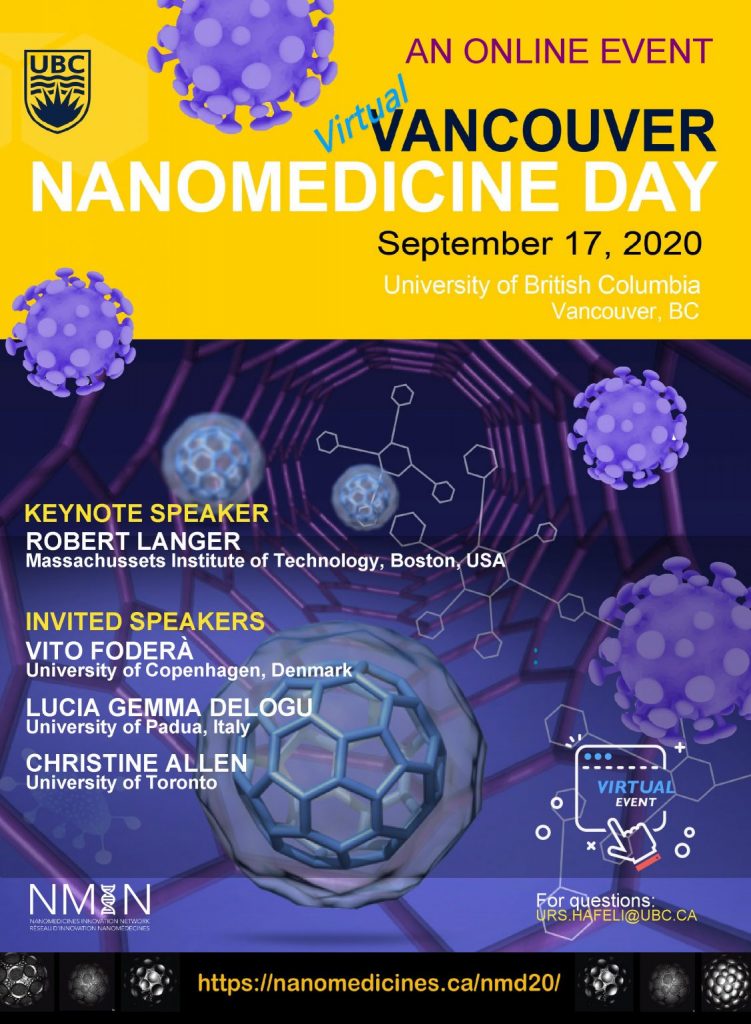
Like so many events these days (COVID-19 days), this event put on by Canada’s NanoMedicines Innovation Network (NMIN) will be held virtually. Here’s more from the ‘Virtual’ Vancouver Nanomedicine Day 2020 event page on the NMIN website,

This world-class symposium, the sixth event of its kind, will bring together a record number (1000+) of renowned Canadian and international experts from across the nanomedicines field to:

  • highlight the discoveries and innovations in nanomedicines that are contributing to global progress in acute, chronic and orphan disease treatment and management;
  • present up-to-date diagnostic and therapeutic  nanomedicine approaches to addressing the challenges of COVID-19; and
  • facilitate discussion among nanomedicine researchers and innovators and UBC and NMIN clinician-scientists, basic researchers, trainees, and research partners.

Since 2014, Vancouver Nanomedicine Day has advanced nanomedicine research, knowledge mobilization and commercialization in Canada by sharing high-impact findings and facilitating interaction—among researchers, postdoctoral fellows, graduate students, and life science and startup biotechnology companies—to catalyze research collaboration.

Here are a few highlights from the ‘Virtual’ Vancouver Nanomedicine Day 2020 event page,

  • An introduction to nanomedicines by Dr. Emmanuel Ho (University of Waterloo)
  • A keynote address by an iconic nanomedicine innovator: Dr. Robert Langer (MIT, Department of Chemical Engineering)
  • Invited talks by internationally renowned experts, including Dr. Vito Foderà (The University of Copenhagen, Denmark); Dr. Lucia Gemma Delogu (University of Padova, Italy); and Dr. Christine Allen (University of Toronto)
  • A virtual poster competition, with cash prizes for the top posters
  • A debate on whether “nanomedicines are still the next big thing” between Marcel Bally (proponent) and Kishor Wasan (opponent)

You can get the Program in PDF.

Registration is free. But you must Register.

Here’s the event poster,
[downloaded from https://www.nanomedicines.ca/nmd-2020/]

I have a few observations, First, Robert Langer is a big deal. Here are a few highlights from his Wikipedia entry (Note: Links have been removed),

Robert Samuel Langer, Jr. FREng[2] (born August 29, 1948) is an American chemical engineer, scientist, entrepreneur, inventor and one of the twelve Institute Professors at the Massachusetts Institute of Technology.[3]

Langer holds over 1,350 granted or pending patents.[3][29] He is one of the world’s most highly cited researchers, having authored nearly 1,500 scientific papers, and has participated in the founding of multiple technology companies.[30][31]

Langer is the youngest person in history (at 43) to be elected to all three American science academies: the National Academy of Sciences, the National Academy of Engineering and the Institute of Medicine. He was also elected as a charter member of National Academy of Inventors.[32] He was elected as an International Fellow[2] of the Royal Academy of Engineering[2] in 2010.

It’s all about commercializing the research—or is it?

(This second observation is a little more complicated and requires a little context.) The NMIN is one of Canada’s Networks of Centres of Excellence (who thought that name up? …sigh), from the NMIN About page,

NMIN is funded by the Government of Canada through the Networks of Centres of Excellence (NCE) Program.

The NCEs seem to be firmly fixed on finding pathways to commercialization (from the NCE About page) Note: All is not as it seems,

Canada’s global economic competitiveness [emphasis mine] depends on making new discoveries and transforming them into products, services [emphasis mine] and processes that improve the lives of Canadians. To meet this challenge, the Networks of Centres of Excellence (NCE) offers a suite of programs that mobilize Canada’s best research, development and entrepreneurial [emphasis mine] expertise and focus it on specific issues and strategic areas.

NCE programs meet Canada’s needs to focus a critical mass of research resources on social and economic challenges, commercialize [emphasis mine] and apply more of its homegrown research breakthroughs, increase private-sector R&D, [emphasis mine] and train highly qualified people. As economic [emphasis mine] and social needs change, programs have evolved to address new challenges.

Interestingly, the NCE is being phased out,

As per the December 2018 NCE Program news, funding for the Networks of Centres of Excellence (NCE) Program will be gradually transferred to the New Frontiers in Research Fund (NFRF).

The new agency, NFRF, appears to have a completely different mandate, from the NFRF page on the Canada Research Coordinating Committee webspace,

The Canada Research Coordinating Committee designed the New Frontiers in Research Fund (NFRF) following a comprehensive national consultation, which involved Canadian researchers, research administrators, stakeholders and the public. NFRF is administered by the Tri-agency Institutional Programs Secretariat, which is housed within the Social Sciences and Humanities Research Council (SSHRC), on behalf of Canada’s three research granting agencies: the Canadian Institutes of Health Research, the Natural Sciences and Engineering Research Council and SSHRC.

The fund will invest $275 million over the next 5 years beginning in fiscal 2018-19, and $65 million ongoing, to fund international, interdisciplinary, fast-breaking and high-risk research.

NFRF is composed of three streams to support groundbreaking research.

  • Exploration generates opportunities for Canada to build strength in high-risk, high-reward and interdisciplinary research;
  • Transformation provides large-scale support for Canada to build strength and leadership in interdisciplinary and transformative research; and
  • International enhances opportunities for Canadian researchers to participate in research with international partners.

As you can see there’s no reference to commercialization or economic challenges.

Personally

Here at last is the second observation, I find it hard to believe that the government of Canada has given up on the idea of commercializing research and increasing the country’s economic competitiveness through research. Certainly, Langer’s virtual appearance at Vancouver Nanomedicine Day 2020, suggests that at least some corners of the Canadian research establishment are remaining staunchly entrepreneurial.

After all, the only Canadian government ministry with science in its name is this one: Innovation, Science and Economic Development Canada (ISED), as of Sept. 11, 2020.. (The other ‘science’ ministries are Natural Resources Canada, Environment and Climate Change Canada, Fisheries and Oceans Canada, Health Canada, and Agriculture and Agri-Food Canada.) ISED is not exactly subtle. Intriguingly the latest review on the state of science and technology in Canada was released on April 10, 2018 (from the April 10, 2018 Council of Canadian Academies CCA] news release),

Canada remains strong in research output and impact, capacity for R&D and innovation at risk: New expert panel report

While Canada is a highly innovative country, with a robust research base and thriving communities of technology start-ups, significant barriers—such as a lack of managerial skills, the experience needed to scale-up companies, and foreign acquisition of high-tech firms—often prevent the translation of innovation into wealth creation.[emphasis mine] The result is a deficit of technology companies growing to scale in Canada, and a loss of associated economic and social benefits.This risks establishing a vicious cycle, where successful companies seek growth opportunities elsewhere due to a lack of critical skills and experience in Canada guiding companies through periods of rapid expansion.

According to the CCA’s [2018 report] Summary webpage, it was Innovation, Science and Economic Development Canada which requested the report. (I wrote up a two-part commentary under one of my favourite titles: “The Hedy Lamarr of international research: Canada’s Third assessment of The State of Science and Technology and Industrial Research and Development in Canada.” Part 1 and Part 2)

I will be fascinated to watch the NFRF and science commercialization situations as they develop.

In the meantime, you can sign up for free to attend the ‘Virtual’ Vancouver Nanomedicine Day 2020.
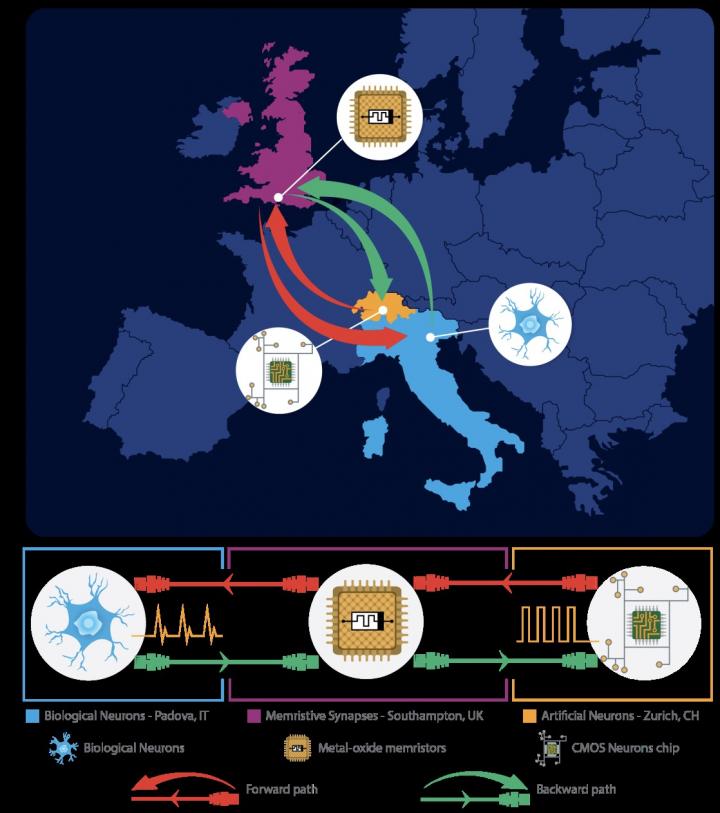
Connecting biological and artificial neurons (in UK, Switzerland, & Italy) over the web

Caption: The virtual lab connecting Southampton, Zurich and Padova. Credit: University of Southampton

A February 26, 2020 University of Southampton press release (also on EurekAlert) describes this work,

Research on novel nanoelectronics devices led by the University of Southampton enabled brain neurons and artificial neurons to communicate with each other. This study has for the first time shown how three key emerging technologies can work together: brain-computer interfaces, artificial neural networks and advanced memory technologies (also known as memristors). The discovery opens the door to further significant developments in neural and artificial intelligence research.

Brain functions are made possible by circuits of spiking neurons, connected together by microscopic, but highly complex links called ‘synapses’. In this new study, published in the scientific journal Nature Scientific Reports, the scientists created a hybrid neural network where biological and artificial neurons in different parts of the world were able to communicate with each other over the internet through a hub of artificial synapses made using cutting-edge nanotechnology. This is the first time the three components have come together in a unified network.

During the study, researchers based at the University of Padova in Italy cultivated rat neurons in their laboratory, whilst partners from the University of Zurich and ETH Zurich created artificial neurons on Silicon microchips. The virtual laboratory was brought together via an elaborate setup controlling nanoelectronic synapses developed at the University of Southampton. These synaptic devices are known as memristors.

The Southampton based researchers captured spiking events being sent over the internet from the biological neurons in Italy and then distributed them to the memristive synapses. Responses were then sent onward to the artificial neurons in Zurich also in the form of spiking activity. The process simultaneously works in reverse too; from Zurich to Padova. Thus, artificial and biological neurons were able to communicate bidirectionally and in real time.

Themis Prodromakis, Professor of Nanotechnology and Director of the Centre for Electronics Frontiers at the University of Southampton said “One of the biggest challenges in conducting research of this kind and at this level has been integrating such distinct cutting edge technologies and specialist expertise that are not typically found under one roof. By creating a virtual lab we have been able to achieve this.”

The researchers now anticipate that their approach will ignite interest from a range of scientific disciplines and accelerate the pace of innovation and scientific advancement in the field of neural interfaces research. In particular, the ability to seamlessly connect disparate technologies across the globe is a step towards the democratisation of these technologies, removing a significant barrier to collaboration.

Professor Prodromakis added “We are very excited with this new development. On one side it sets the basis for a novel scenario that was never encountered during natural evolution, where biological and artificial neurons are linked together and communicate across global networks; laying the foundations for the Internet of Neuro-electronics. On the other hand, it brings new prospects to neuroprosthetic technologies, paving the way towards research into replacing dysfunctional parts of the brain with AI [artificial intelligence] chips.”

I’m fascinated by this work and after taking a look at the paper, I have to say, the paper is surprisingly accessible. In other words, I think I get the general picture. For example (from the Introduction to the paper; citation and link follow further down),

… To emulate plasticity, the memristor MR1 is operated as a two-terminal device through a control system that receives pre- and post-synaptic depolarisations from one silicon neuron (ANpre) and one biological neuron (BN), respectively. …

If I understand this properly, they’ve integrated a biological neuron and an artificial neuron in a single system across three countries.

For those who care to venture forth, here’s a link and a citation for the paper,

Memristive synapses connect brain and silicon spiking neurons by Alexantrou Serb, Andrea Corna, Richard George, Ali Khiat, Federico Rocchi, Marco Reato, Marta Maschietto, Christian Mayr, Giacomo Indiveri, Stefano Vassanelli & Themistoklis Prodromakis. Scientific Reports volume 10, Article number: 2590 (2020) DOI: https://doi.org/10.1038/s41598-020-58831-9 Published 25 February 2020

The paper is open access.