I’m featuring two upcoming events in London (UK).
Nanotechnology 101: The biggest thing you’ve never seen
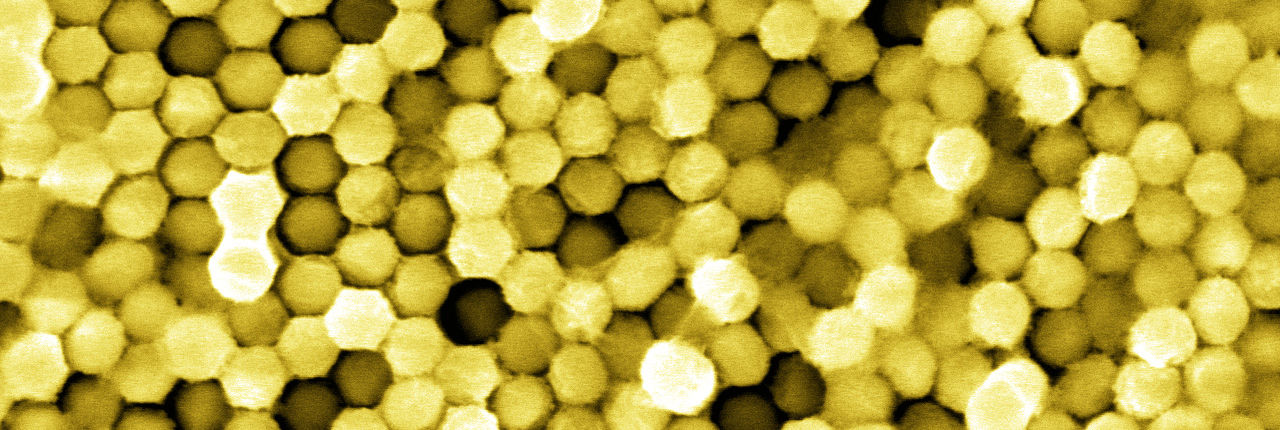
Gold Nanowire Array
Credit: lacomj via Flickr: www.flickr.com/photos/40137058@N07/3790862760 [downloaded from http://www.rigb.org/whats-on/events-2015/october/public-nanotechnology-101-the-biggest-thing-you]
How could nanotechnology be used to create smart and extremely resilient materials? Or to boil water three times faster? Join former NASA Nanotechnology Project Manager Michael Meador to learn about the fundamentals of nanotechnology—what it is and why it’s unique—and how this emerging, disruptive technology will change the world. From invisibility cloaks to lightweight fuel-efficient vehicles and a cure for cancer, nanotechnology might just be the biggest thing you can’t see.
About the speaker
Michael Meador is currently Director of the U.S. National Nanotechnology Coordination Office, on secondment from NASA where he had been managing the Nanotechnology Project in the Game Changing Technology Program, working to mature nanotechnologies with high potential for impact on NASA missions. One part of his current job is to communicate nanotechnology research to policy-makers and the public.
Here’s some logistical information from the event page,
7.00pm to 8.30pm, Tuesday 20 October
The TheatreStandard £12
Concession £8
Associate £6
Free to Members, Faraday Members and Fellows
For anyone who may not know offhand where the Royal Institution and its theatre is located,
The Royal Institution of Great Britain
21 Albemarle Street
London
W1S 4BS+44 (0) 20 7409 2992
(9.00am – 6.00pm Mon – Fri)
Here’s a description of the Royal Institution from its Wikipedia entry (Note: Links have been removed),
The Royal Institution of Great Britain (often abbreviated as the Royal Institution or RI) is an organisation devoted to scientific education and research, based in London.
The Royal Institution was founded in 1799 by the leading British scientists of the age, including Henry Cavendish and its first president, George Finch, the 9th Earl of Winchilsea,[1] for
diffusing the knowledge, and facilitating the general introduction, of useful mechanical inventions and improvements; and for teaching, by courses of philosophical lectures and experiments, the application of science to the common purposes of life.
— [2]Much of its initial funding and the initial proposal for its founding were given by the Society for Bettering the Conditions and Improving the Comforts of the Poor, under the guidance of philanthropist Sir Thomas Bernard and American-born British scientist Sir Benjamin Thompson, Count Rumford. Since its founding it has been based at 21 Albemarle Street in Mayfair. Its Royal Charter was granted in 1800. The Institution announced in January 2013 that it was considering sale of its Mayfair headquarters to meet its mounting debts.[3]
#RE_IMAGINE
While this isn’t a nanotechnology event, it does touch on topics discussed here many times: wearable technology, futuristic fashion, and the integration of technology into the body. The Digital Anthropology Lab (of the London College of Fashion, which is part of the University of the Arts London) is being officially launched with a special event on Oct. 16, 2015. Before describing the event, here’s more about the Digital Anthropology Lab from its homepage,
Crafting fashion experience digitally
The Digital Anthropology Lab, launching in Autumn 2015, London College of Fashion, University of the Arts London is a research studio bringing industry and academia together to develop a new way of making smarter with technology.
…
The Digital Anthropology Lab, London College of Fashion, experiments with artefacts, communities, consumption and making in the digital space, using 3D printing, body scanning, code and electronics. We focus on an experimental approach to digital anthropology, allowing us to practically examine future ways in which digital collides with the human experience. We connect commercial partners to leading research academics and graduate students, exploring seed ideas for fashion tech.
…
Now
WEARABLES
We radically re-imagine this emerging fashion- tech space, exploring both the beautification of technology for wearables and critically explore the ‘why.’Near
IoT BIG DATA
Join us to experiment with, ‘The Internet of Fashion Things.’ Where the Internet of Things, invisible big data technologies, virtual fit and meta-data collide.Future
DESIGN FICTIONS
With the luxury of the imagination, we aim to re- wire our digital ambitions and think again about designing future digital fashion experiences for generation 2050.
Here’s information I received from the Sept. 30, 2015 announcement I received via email,
The Digital Anthropology Lab at London College of Fashion, UAL invites you to #RE_IMAGINE: A forum exploring the now, near and future of fashion technology.
#RE_IMAGINE, the Digital Anthropology Lab’s launch event, will present a fantastically diverse range of digital speakers and ask them to respond to the question – ‘Where are our digital selves heading?’
Join us to hear from pioneers, risk takers, entrepreneurs, designers and inventors including Ian Livingston CBE, Luke Robert Mason from New Bionics, Katie Baron from Stylus, J. Meejin Yoon from MIT among others. Also come to see what happened when we made fashion collide with the Internet of Things, they are wearable but not as you know it…
#RE_IMAGINE aims to be an informative, networked and enlightening brainstorm of a day. To book your place please follow this link.
To coincide with the exhibition Digital Disturbances, Fashion Space Gallery presents a late night opening event. Alongside a curator tour will be a series of interactive demonstrations and displays which bring together practitioners working across design, science and technology to investigate possible human and material futures. We’d encourage you to stay and enjoy this networking opportunity.
Friday 16th October 2015
9.30am – 5pm – Forum event
5pm – 8.30pm – Digital Disturbances networking event
London College of Fashion
20 John Princes Street
London
W1G 0BJ
Ticket prices are £75.00 for a standard ticket and £35.00 for concession tickets (more details here).
For more #RE_IMAGINE specifics, there’s the event’s Agenda page. As for Digital Disturbances, here’s more from the Fashion Space Gallery’s Exhibition homepage,
Digital Disturbances
…
11th September – 12th December 2015
Digital Disturbances examines the influence of digital concepts and tools on fashion. It provides a lens onto the often strange effects that emerge from interactions across material and virtual platforms – information both lost and gained in the process of translation. It presents the work of seven designers and creative teams whose work documents these interactions and effects, both in the design and representation of fashion. They can be traced across the surfaces of garments, through the realisation of new silhouettes, in the remixing of images and bodies in photography and film, and into the nuances of identity projected into social and commercial spaces.
Designers include: ANREALAGE, Bart Hess, POSTmatter, Simone C. Niquille and Alexander Porter, Flora Miranda, Texturall and Tigran Avetisyan.
Digital Disturbances is curated by Leanne Wierzba.
Two events—two peeks into the future.