Tag Archives: US National Oceanic and Atmostpheric Administration (NOAA)

A nanoscale look inside a blacktip shark’s skeleton reveals ‘sharkitecture’

It’s usually sharkskin that excites scientific attention. (It has nanoscale structures that endow it with special properties See: “Characterization of shark skin properties and biomimetic replication” published July 15, 2024). This May 20, 2025 news item on ScienceDaily shifts attention to the skeleton,

Sharks have been evolving for more than 450 million years, developing skeletons not from bone, but from a tough, mineralized form of cartilage. These creatures are more than just fast swimmers — they’re built for efficiency. Their spines act like natural springs, storing and releasing energy with each tailbeat, allowing them to move through the water with smooth, powerful grace.

Now, scientists are peering inside shark skeletons at the nanoscale, revealing a microscopic “sharkitecture” that helps these ancient apex predators withstand extreme physical demands of constant motion.

A May 20, 2025 Florida Atlantic University (FAU) news release (also on EurekAlert) by Gisele Galoustian, which originated the news item, delves further into the topic, Note: Links have been removed,

Using synchrotron X-ray nanotomography with detailed 3D imaging and in-situ mechanical testing, researchers from the Charles E. Schmidt College of Science and the College of Engineering and Computer Science at Florida Atlantic University, in collaboration with the German Electron Synchrotron (DESY) in Germany, and NOAA [US National Oceanic and Atmospheric Administration] Fisheries, have mapped the internal structure of blacktip sharks (Carcharhinus limbatus) in unprecedented detail.

Results of the study, published in ACS ]American Chemical Society] Nano, reveal two distinct regions within the blacktip shark’s mineralized cartilage: the corpus calcareum and the intermediale. Though both are composed of densely packed collagen and bioapatite, their internal structures differ significantly. In both regions, mineralized plates are arranged in porous structures, reinforced by thick struts that help the skeleton withstand strain from multiple directions – a critical adaptation for sharks, whose constant swimming places repeated stress on the spine.

At the nanoscale, researchers observed tiny needle-like bioapatite crystals – a mineral also found in human bones – aligned with strands of collagen. This intricate structure gives the cartilage surprising strength while still allowing flexibility.

Even more intriguing, the team discovered helical fiber structures primarily based on collagen – suggesting a sophisticated, layered design optimized to prevent cracks from spreading. Under strain, fiber and mineral networks work together to absorb and distribute force, contributing to the shark’s resilience and flexibility.

“Nature builds remarkably strong materials by combining minerals with biological polymers, such as collagen – a process known as biomineralization. This strategy allows creatures like shrimp, crustaceans and even humans to develop tough, resilient skeletons,” said Vivian Merk, Ph.D., senior author and an assistant professor in the FAU Department of Chemistry and Biochemistry, the FAU Department of Ocean and Mechanical Engineering, and the FAU Department of Biomedical Engineering. “Sharks are a striking example. Their mineral-reinforced spines work like springs, flexing and storing energy as they swim. By learning how they build such tough yet adaptable skeletons, we hope to inspire the design of next-generation materials.” 

In experiments applying mechanical stress on microscopic samples of shark vertebrae, the researchers observed tiny deformations – less than a micrometer – after a single cycle of applied pressure. Interestingly, fractures only occurred after a second round of loading and were contained within a single mineralized plane, hinting at the material’s built-in resistance to catastrophic failure.

“After hundreds of millions of years of evolution, we can now finally see how shark cartilage works at the nanoscale – and learn from them,” said Marianne Porter, Ph.D., co-author and an associate professor in the FAU Department of Biological Sciences. “We’re discovering how tiny mineral structures and collagen fibers come together to create a material that’s both strong and flexible, perfectly adapted for a shark’s powerful swimming. These insights could help us design better materials by following nature’s blueprint.”

Found in warm, shallow coastal waters worldwide, blacktip sharks are sleek, fast-swimming predators known for their incredible agility and speed, reaching up to 20 miles per hour. One of the most striking behaviors they display is leaping and spinning out of the water, often during feeding – an acrobatic move that adds to their mystique.

This research not only enhances the biomechanical understanding of shark skeletons but also offers valuable insights for engineers and materials scientists. 

“This research highlights the power of interdisciplinary collaboration,” said Stella Batalama, Ph.D., dean of the College of Engineering and Computer Science. “By bringing together engineers, biologists and materials scientists, we’ve uncovered how nature builds strong yet flexible materials. The layered, fiber-reinforced structure of shark cartilage offers a compelling model for high-performance, resilient design, which holds promise for developing advanced materials from medical implants to impact-resistant gear.”

Study co-authors are Dawn Raja Somu, Ph.D.; and Steven A. Soini, Ph.D., two recent Ph.D. graduates from the Charles E. Schmidt College of Science; Ani Briggs, a former undergraduate student in the FAU College of Engineering and Computer Science; Kritika Singh, Ph.D.; and Imke Greving, Ph.D., scientists at outstations of the DESY PETRA III X-ray light source operated by Helmholtz-Zentrum Hereon; and Michelle Passerotti, Ph.D., a research fish biologist at NOAA Fisheries.

This research was supported by a National Science Foundation (NSF) grant awarded to Merk; an NSF CAREER Award, awarded to Porter; and seed funding from the FAU College of Engineering and Computer Science and FAU Sensing Institute (I-SENSE). The acquisition of a transmission electron microscope was supported by a United States Department of Defense instrumentation/equipment grant awarded to Merk.

Caption: An X-ray nanotomography reconstruction of the intermedial cartilage of a blacktip shark. The colors indicate the thickness of the struts, with red representing thicker areas and blue indicating thinner ones. Credit: Florida Atlantic University

Here’s a link to and a citation for the paper,

A Nanoscale View of the Structure and Deformation Mechanism of Mineralized Shark Vertebral Cartilage by Dawn Raja Somu, Steven A. Soini, Ani Briggs, Kritika Singh, Imke Greving, Marianne Porter, Michelle Passerotti, and Vivian Merk. ACS Nano 2025, 19, 14, 14410–14421 DOI: https://doi.org/10.1021/acsnano.5c02004 Published April 7, 2025 Copyright © 2025 American Chemical Society

This paper is behind a paywall.

Frankenturtles released

This really is a ‘Frankenstein’ story complete with turtle cadavers. From a June 14, 2016 news item on ScienceDaily,

It was a dark and stormy night in the laboratory, and jagged bolts of lightning lit the sky as Dr. Kaplan and his assistant Bianca stitched the pieces of the lifeless creature back together.

Actually, it was a sunny day on the shores of Chesapeake Bay, but recent sea turtle research by Assistant Professor David Kaplan of the Virginia Institute of Marine Science and graduate student Bianca Santos easily brings to mind the classic tale of Dr. Frankenstein and his makeshift monster.

Santos, a master’s student in William & Mary’s School of Marine Science at VIMS, is working with Kaplan to reduce sea turtle mortality by trying to pinpoint where the hundreds of dead loggerhead sea turtles that wash up on Chesapeake Bay beaches each summer may have succumbed. With that knowledge, researchers could hone in on likely causes of sea-turtle death, while wildlife authorities could map out safe zones for these imperiled marine reptiles. One of Kaplan’s research specialties is the spatial management of marine ecosystems.
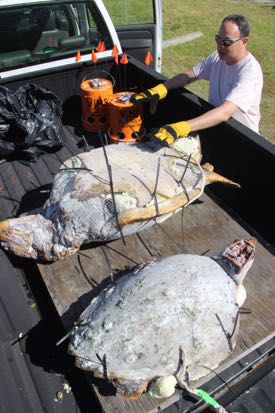
 

David Kaplan examines the Frankenturtles before their deployment. Also visible are the bucket drifters that more closely follow Bay currents. Courtesy: VIMS

David Kaplan examines the Frankenturtles before their deployment. Also visible are the bucket drifters that more closely follow Bay currents. Courtesy: VIMS

A June 14, 2016 Virginia Institute of Marine Science news release by David Malmquist, which originated the news item, expands on the theme,

The pair’s approach to the problem is ingenious if somewhat morbid: obtain dead sea turtles (from the Virginia Aquarium’s Stranding Response Program), replace the turtles’ inner organs with buoyant Styrofoam, “sew” their shells back together with zip ties, and then attach GPS units to track the path of the “Frankenturtles” as winds and currents disperse them from a mid-Bay release site.

“It might seem sort of gross, but it’s a good way to reuse a dead turtle that would otherwise be buried,” says Kaplan. “And hopefully, the deployment of our two Frankenturtles will ultimately help lower the number of turtle deaths in the future.”

Santos explains that the team is actually releasing three different types of drifters: the two Frankenturtles, two wooden-Styrofoam turtle models, and a pair of bucket drifters. By observing how the wind differentially affects the highly buoyant, sail-like wooden models; the partly emergent Frankenturtles; and the mostly submerged buckets, the researchers hope to better understand how a wind-driven carcass might deviate from the more predictable current patterns traced by the Bay’s surface waters. Sea turtles initially sink after dying, but quickly float back to the surface buoyed by gases from decomposing tissues.

“Our plan is to deploy the drifters on several different occasions—under a variety of wind and wave conditions—and in locations where mortality events could occur during the spring peak in strandings,” says Santos. “We’ll then use the separation rate between our bucket drifters, which closely track water movement, and our turtle carcasses to determine the amount of wind forcing to apply to simulated carcasses in our computer model.”

They initiated their field trials on June 13th [2016], deploying the drifters in open Bay waters about halfway between the mouth of the York River and Cape Charles on Virginia’s bayside Eastern Shore. One Frankenturtle comprises the remains of a 15-20 year old loggerhead killed by a boat strike. The other is a younger turtle whose mode of death remains a mystery despite a necropsy. Deploying these creatures wasn’t an easy job: in addition to the unforgettable and growing aroma of thawing turtle, the creatures are both heavy and unwieldy. The larger Frankenturtle weighs in at 150 pounds, the smaller at 70 pounds.

Modeling turtle movement

Once data from the Frankenturtle trials have allowed the researchers to properly configure their “turtle carcass drift model,” they’ll feed the model with historical records of stranding locations provided by the Virginia Aquarium’s Stranding Response Team. The team is the Commonwealth’s official entity for responding to reports of dead and injured sea turtles and other marine life in Bay and nearby coastal waters.

“If our model can accurately simulate how winds and currents act on a dead sea turtle, we should be able to backtrack from a stranding site to the place where the turtle likely died,” says Santos. “By knowing the ‘where,’” she adds, “we can better look at the ‘why.’”

The researchers plan to track the Frankenturtles and other drifters released on June 13th for 3-4 days before retrieving the GPS units for future use. Earlier experiments by Santos show that’s about how long dead turtles remain intact before they are dismembered and consumed by waves, birds, crabs, and fish. The public can view the motion of the drifters in real-time via the VIMS website at www.vims.edu/frankenturtle.

Sea turtle mortality

Mortality of loggerhead turtles in Chesapeake Bay is of continuing concern. “Strandings peaked in the early 2000s at around 200-400 per year,” says Kaplan. “Modifications to the pound-net fishery likely reduced the number to the current 100-300 per year, and it is these we’re trying to understand.” He adds that scientists don’t really don’t have a good idea what percentage of dead turtles these strandings represent. “The actual number could be much higher,” Kaplan says.

Evidence that strandings may represent only a small percentage of actual deaths comes from Santos’ decay experiments as well as the low odds of finding every dead turtle. “Bianca’s decay study shows that turtles remain intact for only 3-5 days after death, decreasing the likelihood that they might last long enough to wash up on a beach,” says Kaplan. “And of those that do wash ashore, many probably strand in remote or marshy areas where they are unlikely to be observed and reported by a beachgoer.”

Potential sources of mortality in the Bay include accidental capture in fishing gear, strikes by boat propellers, entanglement in plastic trash, and sudden drops in temperature.

Although loggerheads are the most common sea turtles in the Chesapeake, with 5,000-10,000 entering Bay waters each summer to feed, they are listed as “threatened” in U.S. waters under the Endangered Species Act due to the perils they face across their range, including loss of nesting habitat, disorientation of hatchlings by beachfront lighting, nest predation, and incidental capture in dredges and coastal fisheries. Measures to protect against these threats are enforced by NOAA Fisheries and the U.S. Fish and Wildlife Service.