Imagine a small autonomous vehicle that could drive over land, stop, and flatten itself into a quadcopter. The rotors start spinning, and the vehicle flies away. Looking at it more closely, what do you think you would see? What mechanisms have caused it to morph from a land vehicle into a flying quadcopter? You might imagine gears and belts, perhaps a series of tiny servo motors that pulled all its pieces into place.
If this mechanism was designed by a team at Virginia Tech led by Michael Bartlett, assistant professor in mechanical engineering, you would see a new approach for shape changing at the material level. These researchers use rubber, metal, and temperature to morph materials and fix them into place with no motors or pulleys. The team’s work has been published in Science Robotics. Co-authors of the paper include graduate students Dohgyu Hwang and Edward J. Barron III and postdoctoral researcher A. B. M. Tahidul Haque.
Nature is rich with organisms that change shape to perform different functions. The octopus dramatically reshapes to move, eat, and interact with its environment; humans flex muscles to support loads and hold shape; and plants move to capture sunlight throughout the day. How do you create a material that achieves these functions to enable new types of multifunctional, morphing robots?
“When we started the project, we wanted a material that could do three things: change shape, hold that shape, and then return to the original configuration, and to do this over many cycles,” said Bartlett. “One of the challenges was to create a material that was soft enough to dramatically change shape, yet rigid enough to create adaptable machines that can perform different functions.”
To create a structure that could be morphed, the team turned to kirigami, the Japanese art of making shapes out of paper by cutting. (This method differs from origami, which uses folding.) By observing the strength of those kirigami patterns in rubbers and composites, the team was able to create a material architecture of a repeating geometric pattern.
Next, they needed a material that would hold shape but allow for that shape to be erased on demand. Here they introduced an endoskeleton made of a low melting point alloy (LMPA) embedded inside a rubber skin. Normally, when a metal is stretched too far, the metal becomes permanently bent, cracked, or stretched into a fixed, unusable shape. However, with this special metal embedded in rubber, the researchers turned this typical failure mechanism into a strength. When stretched, this composite would now hold a desired shape rapidly, perfect for soft morphing materials that can become instantly load bearing.
Finally, the material had to return the structure back to its original shape. Here, the team incorporated soft, tendril-like heaters next to the LMPA mesh. The heaters cause the metal to be converted to a liquid at 60 degrees Celsius (140 degrees Fahrenheit), or 10 percent of the melting temperature of aluminum. The elastomer skin keeps the melted metal contained and in place, and then pulls the material back into the original shape, reversing the stretching, giving the composite what the researchers call “reversible plasticity.” After the metal cools, it again contributes to holding the structure’s shape.
“These composites have a metal endoskeleton embedded into a rubber with soft heaters, where the kirigami-inspired cuts define an array of metal beams. These cuts combined with the unique properties of the materials were really important to morph, fix into shape rapidly, then return to the original shape,” Hwang said.
The researchers found that this kirigami-inspired composite design could create complex shapes, from cylinders to balls to the bumpy shape of the bottom of a pepper. Shape change could also be achieved quickly: After impact with a ball, the shape changed and fixed into place in less than 1/10 of a second. Also, if the material broke, it could be healed multiple times by melting and reforming the metal endoskeleton.
One drone for land and air, one for sea
The applications for this technology are only starting to unfold. By combining this material with onboard power, control, and motors, the team created a functional drone that autonomously morphs from a ground to air vehicle. The team also created a small, deployable submarine, using the morphing and returning of the material to retrieve objects from an aquarium by scraping the belly of the sub along the bottom.
“We’re excited about the opportunities this material presents for multifunctional robots. These composites are strong enough to withstand the forces from motors or propulsion systems, yet can readily shape morph, which allows machines to adapt to their environment,” said Barron.
Looking forward, the researchers envision the morphing composites playing a role in the emerging field of soft robotics to create machines that can perform diverse functions, self-heal after being damaged to increase resilience, and spur different ideas in human-machine interfaces and wearable devices.
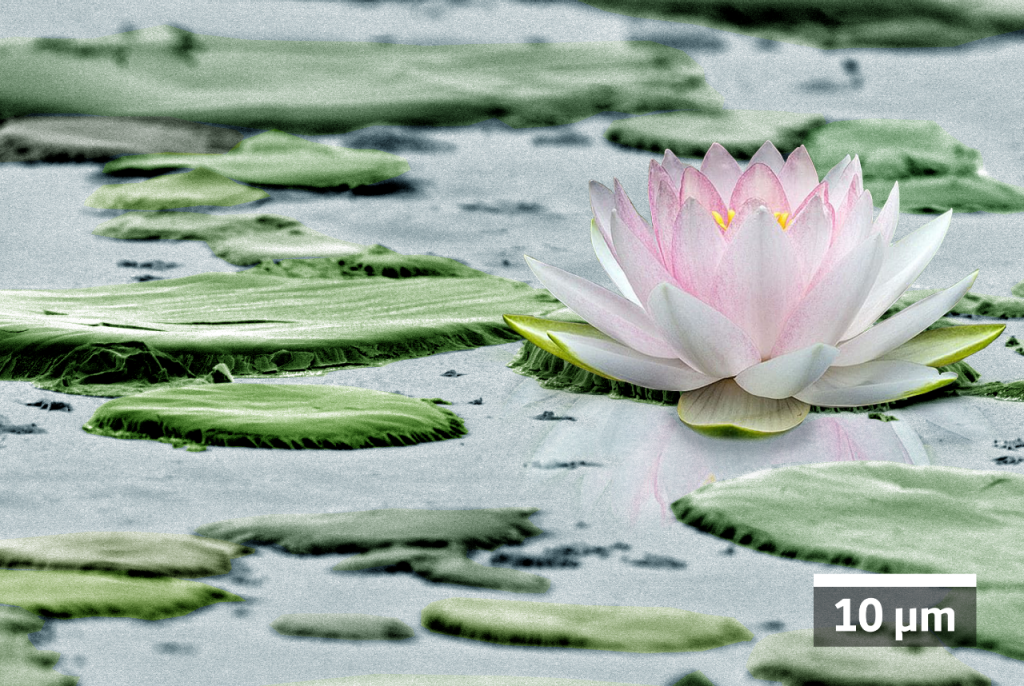
Mohsen Hosseini and William Ducker’s contest-winning image, titled “Lotus on Anti-SARS-CoV-2 Coating.” [downloaded from https://vtx.vt.edu/articles/2021/12/nnci-image-contest.html]
Not everything is as it seems in this image according to a January 5, 2022 news item on phys.org (Note: Links have been removed),
At extremely small scales, looks can be deceiving. While at first glance you might see lily pads floating on a tranquil pond, this image is actually a clever adaptation of a snapshot taken on a scanning electron microscope.
In reality, the green spots are only a few micrometers across—smaller than width of a human hair. They make up a surface coating that was developed to limit the transmission of SARS-CoV-2, the virus that causes COVID-19. The coating is composed of a silver-based material applied to a glass surface. The lotus flower, though, was some added artistic flair courtesy of image-editing software.
…
A January 4, 2022 Virginia Tech news release, which originated the news item, provides more details about the ‘whimsical’ researchers, the image contest, and the research that led to their entry,
Mohsen Hosseini, Ph.D. candidate in chemical engineering, and William Ducker, professor of chemical engineering, recently won an award in the National Nanotechnology Coordinated Infrastructure (NNCI) image contest with this image. Both Hosseini and Ducker are affiliated with the Macromolecules Innovation Institute (MII).
Their win was in the category “most whimsical.”
“As part of the rigor involved in scientific research, I am always careful to maintain the accuracy of my original results,” said Hosseini. “However, this competition was very freeing. It gave me a chance to take my scanning electron microscopy results and legitimately alter it in any way that I chose. It was liberating and fun to express my artistic style. The result isn’t a Monet, but I am glad people liked it.”
The image contest, titled “Plenty of Beauty at the Bottom,” is hosted annually by NNCI in celebration of National Nano Day, which occurred on Oct. 9, 2021. Funded by the National Science Foundation, the NNCI is a network of 16 sites around the country that are dedicated to supporting nanoscience and nanotechnology research and development. Virginia Tech’s NanoEarth center is part of that network, working to advance earth and environmental nanotechnology infrastructure. This image was captured using a scanning electron microscope (SEM) that is part of the Nanoscale Characterization and Fabrication Laboratory (NCFL) in the Virginia Tech Corporate Research Center. This SEM is the latest addition to the instrument suite at the NCFL, which is an initiative of the Institute for Critical Technology and Applied Science. The NCFL gives researchers across the University access to advanced instrumentation including state-of-the-art electron microscopes, optical microscopes, and several spectroscopic techniques.
The development of the protective surface coating began more than a year ago, when the coronavirus pandemic was in its early stages. Working on a team that included another doctoral student, Saeed Behzadinasab, the researchers’ goal was to find a way to prevent the spread of COVID-19 via contaminated surfaces. The coating they produced can successfully inactivate the virus (SARS-CoV-2) when it lands on a solid surface, so that when a person later touches the surface, the virus is unable to infect them.
In studying how their surface coating behaves and performs, the researchers captured images of it at the micro scale. Hosseini explained, “The NNCI contest invitation motivated me to select one of the scanning electron microscope images of my coatings, and edit it according to the contest’s criteria. My brain was filled with ideas since I had recently designed a front cover that was awarded to our paper published in ACS Biomaterials Science & Engineering. I came up with a lotus idea in minutes and that worked very well.”
Interestingly, the researchers had originally developed a brown coating that showed a great deal of promise. However, after conducting tests with consumers, it became clear that the public would be more likely to use a coating that was clear, instead of brown. Ducker’s research group was inspired to produce another coating, which this time would be transparent. As Hosseini put it, “It’s ironic that the invisible coating ended up being the subject of visual art, and even got an award for it.”
Ducker and Hosseini teamed up with Joseph Falkinham and Myra Williams from the Department of Biological Sciences to test the coating on a variety of other illness-causing microorganisms. It proved particularly effective against several bacteria including MRSA, a troublesome antibiotic-resistant bacterium that plagues hospitals.
With its transparent appearance and its broad antimicrobial effectiveness, the coating is now a strong candidate for commercialization. Indeed, Ducker has founded a company dedicated to pursuing the production of this surface coating on a larger scale.
Hosseini and Ducker are proud to have their image shared with the national nanoscience community. The recognition shows an appreciation for their hard work, in addition to their whimsical perspective. According to NanoEarth assistant director Tonya Pruitt, “Virginia Tech has had some excellent submissions to the NNCI image contest over the years, but this is the first year we’ve had a winner!”
You can find the other winners and honorable mentions of the NNCI Image Contest 2021 here. The contest is also known as “Plenty of Beauty at the Bottom” in honour of Richard Feynman and his 1959 lecture, “There’s plenty of room at the bottom.”
The flower beetle Torynorrhina flammea. [downloaded from https://www.nanowerk.com/nanotechnology-news2/newsid=58269.php]
That is one gorgeous beetle and a June 17, 2021 news item on Nanowerk reveals that it features in a structural colour story (i.e, how structures rather than pigments create colour),
The unique mechanical and optical properties found in the exoskeleton of a humble Asian beetle has the potential to offer a fascinating new insight into how to develop new, effective bio-inspired technologies.
Pioneering new research by a team of international scientists, including Professor Pete Vukusic from the University of Exeter, has revealed a distinctive, and previously unknown property within the carapace of the flower beetle – a member of the scarab beetle family.
The study showed that the beetle has small micropillars within the carapace – or the upper section of the exoskeleton – that give the insect both strength and flexibility to withstand damage very effectively.
Crucially, these micropillars are incorporated into highly regular layering in the exoskeleton that concurrently give the beetle an intensely bright metallic colour appearance.
For this new study, the scientists used sophisticated modelling techniques to determine which of the two functions – very high mechanical strength or conspicuously bright colour – were more important to the survival of the beetle.
They found that although these micropillars do create a highly enhanced toughness of the beetle shell, they were most beneficial for optimising the scattering of coloured light that generates its conspicuous appearance.
The research is published this week in the leading journal, Proceedings of the National Academy of Sciences, PNAS.
Professor Vukusic, one of three leads of the research along with Professor Li at Virginia Tech and Professor Kolle at MIT [Massachusetts Institute of Technology], said: “The astonishing insights generated by this research have only been possible through close collaborative work between Virginia Tech, MIT, Harvard and Exeter, in labs that trailblaze the fields of materials, mechanics and optics. Our follow-up venture to make use of these bio-inspired principles will be an even more exciting journey.”.
The seeds of the pioneering research were sown more than 16 years ago as part of a short project created by Professor Vukusic in the Exeter undergraduate Physics labs. Those early tests and measurements, made by enthusiastic undergraduate students, revealed the possibility of intriguing multifunctionality.
The original students examined the form and structure of beetles’ carapce to try to understand the simple origin of their colour. They noticed for the first time, however, the presence of strength-inducing micropillars.
Professor Vukusic ultimately carried these initial findings to collaborators Professor Ling Li at Virginia Tech and Professor Mathias Kolle at Harvard and then MIT who specialise in the materials sciences and applied optics. Using much more sophisticated measurement and modelling techniques, the combined research team were also to confirm the unique role played by the micropillars in enhancing the beetles’ strength and toughness without compromising its intense metallic colour.
The results from the study could also help inspire a new generation of bio-inspired materials, as well as the more traditional evolutionary research.
By understanding which of the functions provides the greater benefit to these beetles, scientists can develop new techniques to replicate and reproduce the exoskeleton structure, while ensuring that it has brilliant colour appearance with highly effective strength and toughness.
Professor Vukusic added: “Such natural systems as these never fail to impress with the way in which they perform, be it optical, mechanical or in another area of function. The way in which their optical or mechanical properties appear highly tolerant of all manner of imperfections too, continues to offer lessons to us about scientific and technological avenues we absolutely should explore. There is exciting science ahead of us on this journey.”
It’s interesting to see scientists take science fiction and use it as inspiration; something which I think happens more often than we know. After all, when someone asks where you got an idea, it can be difficult to track down the thought process that started it all.
Scientists at Virginia Tech (Virginia Polytechnic Institute and State University) are looking for a new source of inspiration after offering a close examination of how insect-size superheroes, Ant-Man and the Wasp might breathe. From a December 11, 2018 news item on phys.org (Note: A link has been removed),
Max Mikel-Stites and Anne Staples were searching for a sequel.
This summer, Staples, an associate professor in the Department of Biomedical Engineering and Mechanics in the College of Engineering, and graduate student Mikel-Stites published a paper in the inaugural issue of the Journal of Superhero Science titled, “Ant-Man and the Wasp: Microscale Respiration and Microfluidic Technology.”
Now, they needed a new hero.
The two were working with a team of graduate students, brainstorming who could be the superhero subject for their next scientific inquiry. Superman? Batgirl? Aquaman?
Mikel-Stites lobbied for an investigation of Dazzler’s sonoluminescent powers. Staples was curious how Mera, The Princes sof Atlantis, used her hydrokinetic powers.
It turns out, comic books are a great inspiration for scientific discovery.
This month, Mikel-Stites is presenting the findings of their paper at the American Physical Society’s Division of Fluid Dynamics meeting.
The wonder team’s paper looked at how Ant-Man and the Wasp breathe when they shrink down to insect-size and Staples’ lab studied how fluids flow in nature. Insects naturally move fluids and gases efficiently at tiny scales. If engineers can learn how insects breathe, they can use the knowledge to invent new microfluidic technologies.
A November 2018 Virginia Tech news release (also on EurekAlert but published on December 11, 2018) by Nancy Dudek describes the ‘Ant-Man and Wasp respiratory project’ before revealing the inspiration for the team’s new project,
“Before the 2018 ‘Ant-Man and the Wasp’ movie, my lab was already wondering about insect-scale respiration,” said Staples. “I wanted to get people to appreciate different breathing mechanisms.”
For most of Mikel-Stites’ life, he had been nit-picking at the “science” in science-fiction movies.
“I couldn’t watch ‘Armageddon’ once they got up to space station Mir and there was artificial gravity. Things like that have always bothered me. But for ‘Ant-Man and the Wasp’ it was worse,” he said.
Staples and Mikel-Stites decided to join forces to research Ant-Man’s microscale respiration.
Mikel-Stites was stung by what he dubbed “the altitude problem or death-zone dilemma.” For Ant-Man and the Wasp to shrink down to insect size and still breathe, they would have to overcome an atmospheric density similar to the top of Mt. Everest. Their tiny bodies would also require higher metabolisms. For their survival, the Marvel comic universe had to give Ant-Man and the Wasp superhero technologies.
“I thought it would be fun to find a solution for how this small-scale respiration would work,”said Mikel-Stites.”I started digging through Ant-Man’s history. I looped through scenes in the 2015 movie where we could address the physics. Then I did the same thing with trailers from the 2018 movie. I used that to make a list of problems and a list of solutions.”
Ant-Man and the Wasp solve the altitude problem with their superhero suits. In their publication, Mikel-Stites and Staples write that the masks in Ant-Man and the Wasp’s suits contain “a combination of an air pump, a compressor, and a molecular filter including Pym particle technology,” that allows them to breathe while they are insect-sized.
“This publication showed how different physics phenomena can dominate at different size scales, how well-suited organisms are for their particular size, and what happens when you start altering that,” said Mikel-Stites. “It also shows that Hollywood doesn’t always get it right when it comes to science!”
Their manuscript was accepted by the Journal of Superhero Science before the release of the sequel, “Ant-Man and the Wasp.” Mikel-Stites was concerned the blockbuster might include new technologies or change Ant-Man’s canon. If the Marvel comic universe changed between the 2015 ‘Ant-Man’ movie and the sequel, their hypotheses would be debunked and they would be forced to retract their paper.
“I went to the 2018 movie before the manuscript came out in preprint so that if the movie contradicted us we could catch it. But the 2018 movie actually supported everything we had said, which was really nice,” said Mikel-Stites. Most moviegoers simply watched the special effects and left the theater entertained. But Mikel-Stitesleft the movie with confirmation of the paper’s hypotheses.
The Staples lab members are not the only ones interested in tiny technologies. From lab-on-a-chip microfluidic devices to nanoparticles that deliver drugs directly to cells, consumers will ultimately benefit from this small scientific field that delivers big results.
“In both the movies and science, shrinking is a common theme and has been for the last 50-60 years. This idea is something that we all like to think about. Given enough time, we can reach the point where science can take it from the realms of magic into something that we actually have an explanation for,” Mikel-Stites said.
In fact, the Staples lab group has already done just that.
While Mikel-Stites is presenting his superhero science at the APS meeting, his colleague Krishnashis Chatterjee, who recently completed his Ph.D. in engineering mechanics will be presenting his research on fabricating and testing four different insect-inspired micro-fluidic devices.
From fiction to function, the Staples lab likes to have fun along the way.
“I think that it is really important to connect with people and be engaged in science with topics they already know about. With this superhero science paper I wanted to support this mission,” Staples said.
And who did the lab mates choose for their next superhero science subject? The Princess of Atlantis, Mera. They hope they can publish another superhero science paper that really makes waves.
And, just because the idea of a superhero science journal tickles my fancy, here’s a little more from the journal’s About webpage,
Serial title Superhero Science and Technolog
Focus and Scope Superhero Science and Technology (SST) is multi-disciplinary journal that considers new research in the fields of science, technology, engineering and ethics motivated and presented using the superhero genre.
The superhero genre has become one of the most popular in modern cinema. Since the 2000 film X-Men, numerous superhero-themed films based on characters from Marvel Comics and DC Comics have been released. Films such as The Avengers, Iron Man 3, Avengers: Age of Ultron and Captain America: Civil War have all earned in excess of $1 billion dollars at the box office, thus demonstrating their relevance in modern society and popular culture.
Of particular interest for Superhero Science and Technology are articles that motivate new research by using the platform of superheroes, supervillains, their superpowers, superhero/supervillain exploits in Hollywood blockbuster films or superhero/supervillain adventures from comic books. Articles should be written in a manner so that they are accessible to both the academic community and the interested non-scientist i.e. general public, given the popularity of the superhero genre.
Dissemination of content using this approach provides a potential for the researcher to communicate their work to a larger audience, thus increasing their visibility and outreach within and outside of the academic domain.
The scope of the journal includes but is not limited to: Genetic editing approaches; Innovations in the field of robotics; New and advanced materials; Additive Manufacturing i.e. 3D printing, for both bio and non-bio applications; Advancements in bio-chemical processing; Biomimicry technologies; Space physics, astrophysical and cosmological research; Developments in propulsion systems; Responsible innovation; Ethical issues pertaining to technologies and their use for human enhancement or augmentation.
Open Access Policy SST is licensed under a Creative Commons Attribution 4.0 International (CC BY 4.0) licence. You are free to use the work, but you have to attribute (refer to) the work in the manner specified by the author or licensor (but not in any way that suggests that they endorse you or your use of the work). The easiest way to refer to an article is to use the HOWTO CITE tool that you’ll find alongside each article in the right sidebar.
Editor-in-Chief Dr. Barry W. Fitzgerald, TU Delft, the Netherlands Editorial Board Prof. Wim Briels, University of Twente, the Netherlands Dr. Ian Clancy, University of Limerick, Ireland Dr. Neil Clancy, University College London, UK Dr. Tom Hunt, University of Kent, UK Ass. Prof. Johan Padding, TU Delft, the Netherlands Ass. Prof. Aimee van Wynsberghe, TU Delft, the Netherlands Prof. Ilja Voets, TU Eindhoven, the Netherlands
For anyone unfamiliar with the abbreviation, TU stands for University of Technology or Technische Universiteit in Dutch.
The researchers involved in this work are confident enough about their prospects that they will be patenting their research into yarns. From an August 25, 2017 news item on Nanowerk,
An international research team led by scientists at The University of Texas at Dallas and Hanyang University in South Korea has developed high-tech yarns that generate electricity when they are stretched or twisted.
In a study published in the Aug. 25 [2017] issue of the journal Science (“Harvesting electrical energy from carbon nanotube yarn twist”), researchers describe “twistron” yarns and their possible applications, such as harvesting energy from the motion of ocean waves or from temperature fluctuations. When sewn into a shirt, these yarns served as a self-powered breathing monitor.
“The easiest way to think of twistron harvesters is, you have a piece of yarn, you stretch it, and out comes electricity,” said Dr. Carter Haines, associate research professor in the Alan G. MacDiarmid NanoTech Institute at UT Dallas and co-lead author of the article. The article also includes researchers from South Korea, Virginia Tech, Wright-Patterson Air Force Base and China.
The yarns are constructed from carbon nanotubes, which are hollow cylinders of carbon 10,000 times smaller in diameter than a human hair. The researchers first twist-spun the nanotubes into high-strength, lightweight yarns. To make the yarns highly elastic, they introduced so much twist that the yarns coiled like an over-twisted rubber band.
In order to generate electricity, the yarns must be either submerged in or coated with an ionically conducting material, or electrolyte, which can be as simple as a mixture of ordinary table salt and water.
“Fundamentally, these yarns are supercapacitors,” said Dr. Na Li, a research scientist at the NanoTech Institute and co-lead author of the study. “In a normal capacitor, you use energy — like from a battery — to add charges to the capacitor. But in our case, when you insert the carbon nanotube yarn into an electrolyte bath, the yarns are charged by the electrolyte itself. No external battery, or voltage, is needed.”
When a harvester yarn is twisted or stretched, the volume of the carbon nanotube yarn decreases, bringing the electric charges on the yarn closer together and increasing their energy, Haines said. This increases the voltage associated with the charge stored in the yarn, enabling the harvesting of electricity.
Stretching the coiled twistron yarns 30 times a second generated 250 watts per kilogram of peak electrical power when normalized to the harvester’s weight, said Dr. Ray Baughman, director of the NanoTech Institute and a corresponding author of the study.
“Although numerous alternative harvesters have been investigated for many decades, no other reported harvester provides such high electrical power or energy output per cycle as ours for stretching rates between a few cycles per second and 600 cycles per second.”
Lab Tests Show Potential Applications
In the lab, the researchers showed that a twistron yarn weighing less than a housefly could power a small LED, which lit up each time the yarn was stretched.
To show that twistrons can harvest waste thermal energy from the environment, Li connected a twistron yarn to a polymer artificial muscle that contracts and expands when heated and cooled. The twistron harvester converted the mechanical energy generated by the polymer muscle to electrical energy.
“There is a lot of interest in using waste energy to power the Internet of Things, such as arrays of distributed sensors,” Li said. “Twistron technology might be exploited for such applications where changing batteries is impractical.”
The researchers also sewed twistron harvesters into a shirt. Normal breathing stretched the yarn and generated an electrical signal, demonstrating its potential as a self-powered respiration sensor.
“Electronic textiles are of major commercial interest, but how are you going to power them?” Baughman said. “Harvesting electrical energy from human motion is one strategy for eliminating the need for batteries. Our yarns produced over a hundred times higher electrical power per weight when stretched compared to other weavable fibers reported in the literature.”
Electricity from Ocean Waves
“In the lab we showed that our energy harvesters worked using a solution of table salt as the electrolyte,” said Baughman, who holds the Robert A. Welch Distinguished Chair in Chemistry in the School of Natural Sciences and Mathematics. “But we wanted to show that they would also work in ocean water, which is chemically more complex.”
In a proof-of-concept demonstration, co-lead author Dr. Shi Hyeong Kim, a postdoctoral researcher at the NanoTech Institute, waded into the frigid surf off the east coast of South Korea to deploy a coiled twistron in the sea. He attached a 10 centimeter-long yarn, weighing only 1 milligram (about the weight of a mosquito), between a balloon and a sinker that rested on the seabed.
Every time an ocean wave arrived, the balloon would rise, stretching the yarn up to 25 percent, thereby generating measured electricity.
Even though the investigators used very small amounts of twistron yarn in the current study, they have shown that harvester performance is scalable, both by increasing twistron diameter and by operating many yarns in parallel.
“If our twistron harvesters could be made less expensively, they might ultimately be able to harvest the enormous amount of energy available from ocean waves,” Baughman said. “However, at present these harvesters are most suitable for powering sensors and sensor communications. Based on demonstrated average power output, just 31 milligrams of carbon nanotube yarn harvester could provide the electrical energy needed to transmit a 2-kilobyte packet of data over a 100-meter radius every 10 seconds for the Internet of Things.”
The investigators have filed a patent on the technology.
In the U.S., the research was funded by the Air Force, the Air Force Office of Scientific Research, NASA, the Office of Naval Research and the Robert A. Welch Foundation. In Korea, the research was supported by the Korea-U.S. Air Force Cooperation Program and the Creative Research Initiative Center for Self-powered Actuation of the National Research Foundation and the Ministry of Science.
Here’s a link to and a citation for the paper,
Harvesting electrical energy from carbon nanotube yarn twist by Shi Hyeong Kim, Carter S. Haines, Na Li, Keon Jung Kim, Tae Jin Mun, Changsoon Choi, Jiangtao Di, Young Jun Oh, Juan Pablo Oviedo, Julia Bykova, Shaoli Fang, Nan Jiang, Zunfeng Liu, Run Wang, Prashant Kumar, Rui Qiao, Shashank Priya, Kyeongjae Cho, Moon Kim, Matthew Steven Lucas, Lawrence F. Drummy, Benji Maruyama, Dong Youn Lee, Xavier Lepró, Enlai Gao, Dawood Albarq, Raquel Ovalle-Robles, Seon Jeong Kim, Ray H. Baughman. Science 25 Aug 2017: Vol. 357, Issue 6353, pp. 773-778 DOI: 10.1126/science.aam8771
This paper is behind a paywall.
Dexter Johnson in an Aug. 25, 2017 posting on his Nanoclast blog (on the IEEE [Institute of Electrical and Electronics Engineers] website) delves further into the research,
…
“Basically what’s happening is when we stretch the yarn, we’re getting a change in capacitance of the yarn. It’s that change that allows us to get energy out,” explains Carter Haines, associate research professor at UT Dallas and co-lead author of the paper describing the research, in an interview with IEEE Spectrum.
This makes it similar in many ways to other types of energy harvesters. For instance, in other research, it has been demonstrated—with sheets of rubber with coated electrodes on both sides—that you can increase the capacitance of a material when you stretch it and it becomes thinner. As a result, if you have charge on that capacitor, you can change the voltage associated with that charge.
“We’re more or less exploiting the same effect but what we’re doing differently is we’re using an electric chemical cell to do this,” says Haines. “So we’re not changing double layer capacitance in normal parallel plate capacitors. But we’re actually changing the electric chemical capacitance on the surface of a super capacitor yarn.”
While there are other capacitance-based energy harvesters, those other devices require extremely high voltages to work because they’re using parallel plate capacitors, according to Haines.
…
Dexter asks good questions and his post is very informative.
It turns out that Canada has the fifth largest reserve of coal in the world, according to the Coal in Canada Wikipedia entry (Note: Links have been removed),
Coal reserves in Canada rank fifth largest in the world (following the former Soviet Union, the United States, the People’s Republic of China and Australia) at approximately 10 billion tons, 10% of the world total.[1] This represents more energy than all of the oil and gas in the country combined. The coal industry generates CDN$5 billion annually.[2] Most of Canada’s coal mining occurs in the West of the country.[3] British Columbia operates 10 coal mines, Alberta 9, Saskatchewan 3 and New Brunswick one. Nova Scotia operates several small-scale mines, Westray having closed following the 1992 disaster there.[4]
Environmental scientists led by the Virginia Tech College of Science have discovered that the burning of coal produces incredibly small particles of a highly unusual form of titanium oxide.
When inhaled, these nanoparticles can enter the lungs and potentially the bloodstream.
The particulates — known as titanium suboxide nanoparticles — are unintentionally produced as coal is burned, creating these tiniest of particles, as small as 100 millionths of a meter [emphasis mine], said the Virginia Tech-led team. When the particles are introduced into the air — unless captured by high-tech particle traps — they can float away from power plant stacks and travel on air currents locally, regionally, and even globally.
As an example of this, these nanoparticles were found on city streets, sidewalks, and in standing water in Shanghai, China.
The findings are published in the latest issue of Nature Communications under team leader Michael F. Hochella Jr., University Distinguished Professor of Geosciences with the College of Science, and Yi Yang, a professor at East China Normal University in Shanghai. Other study participants include Duke University, the University of Kentucky, and Laurentian University in Canada.
“The problem with these nanoparticles is that there is no easy or practical way to prevent their formation during coal burning,” Hochella said, adding that in nations with strong environmental regulations, such as the United States, most of the nanoparticles would be caught by particle traps. Not so in Africa [a continent not a nation], China, or India, where regulations are lax or nonexistent, with coal ash and smoke entering the open air.
“Due to advanced technology used at U.S.-based coal burning power plants, mandated by the Clean Air Act and the Environmental Protection Agency, most of these nanoparticles and other tiny particles are removed before the final emission of the plant’s exhaust gases,” Hochella said. “But in countries where the particles from the coal burning are not nearly so efficiently removed, or removed at all, these titanium suboxide nanoparticles and many other particle types are emitted into the atmosphere, in part resulting in hazy skies that plague many countries, especially in China and India.”
Hochella and his team found these previously unknown nanoparticles not only in coal ash from around the world and in the gaseous waste emissions of coal plants, but on city streets, in soils and storm water ponds, and at wastewater treatment plants.
“I could not believe what I have found at the beginning, because they had been reported so extremely rarely in the natural environment,” said Yang, who once worked as a visiting professor in Virginia Tech’s Department of Geosciences with Hochella. “It took me several months to confirm their occurrence in coal ash samples.”
The newly found titanium suboxide — called Magnéli phases — was once thought rare, found only sparingly on Earth in some meteorites, from a small area of rock formations in western Greenland, and occasionally in moon rocks. The findings by Hochella and his team indicate that these nanoparticles are in fact widespread globally. They are only now being studied for the first time in natural environments using powerful electron microscopes.
Why did the discovery occur now? According to the report, nearly all coal contains traces of the minerals rutile and/or anatase, both “normal,” naturally occurring, and relatively inert titanium oxides, especially in the absence of light. When those minerals are burned in the presence of coal, research found they easily and quickly converted to these unusual titanium suboxide nanoparticles. The nanoparticles then become entrained in the gases that leave the power plant.
When inhaled, the nanoparticles enter deep into the lungs, potentially all the way into the air sacs that move oxygen into our bloodstream during the normal breathing process. While human lung toxicity of these particles is not yet known, a preliminary biotoxicity test by Hochella and Richard Di Giulio, professor of environmental toxicology, and Jessica Brandt, a doctoral candidate, both at Duke University, indicates that the particles do indeed have toxicity potential.
According to the team, further study is clearly needed, especially biotoxicity testing directly relevant to the human lung. Partnering with coal-power plants either in the United States or China would be ideal, said Yang.
More troubling, the study shows that titanium suboxide nanoparticles are biologically active in the dark, making the particles highly suspect. Exact human health effects are yet unknown.
“Future studies will need to very carefully investigate and access the toxicity of titanium suboxide nanoparticles in the human lung, and this could take years, a sobering thought considering its potential danger,” Hochella said.
As the titanium suboxide nanoparticle itself is produced incidentally, Hochella and his team came across the nanoparticle by accident while studying a 2014 coal ash spill in the Dan River, North Carolina. During the study of the downstream movement of toxic metals in the ash in the Dan River, the team discovered and recognized the presence of small amounts of the highly unusual titanium suboxide.
The group later produced the titanium suboxide nanoparticles when burning coal in a lab simulation.
This new potential air pollution health hazard builds on already established findings from the World Health Organization. It estimates that 3.3 million premature deaths occur worldwide per year due to polluted air, Hochella said. In China, 1.6 million premature deaths are estimated annually due to cardiovascular and respiratory injury from air pollution. Most Chinese megacities top 100 severely hazy days each year with particle concentrations two to four times higher than WHO guidelines, Yang said.
Direct health effects on humans is only one factor. Findings of thousands of scientists have determined that the biggest driver of warming of the planet and the resulting climate change is industrial-scale coal burning. The impact of titanium suboxide nanoparticles found in the atmosphere, in addition to greenhouse gases, on animals, water, and plants is not yet known.
They’ve used an unusual unit of measurement, “100 millionths of a meter,” nanoparticles are usually described in nanometers.
Here’s a link to and a citation for the paper,
Discovery and ramifications of incidental Magnéli phase generation and release from industrial coal-burning by Yi Yang, Bo Chen, James Hower, Michael Schindler, Christopher Winkler, Jessica Brandt, Richard Di Giulio, Jianping Ge, Min Liu, Yuhao Fu, Lijun Zhang, Yuru Chen, Shashank Priya, & Michael F. Hochella Jr. Nature Communications 8, Article number: 194 (2017) doi:10.1038/s41467-017-00276-2 Published online: 08 August 2017
This paper is behind a paywall.
This put me in mind of the famous London smog, which one doesn’t hear about much anymore. For anyone not familiar with that phenomenon, here’s more from the Great Smog of London Wikipedia entry (Note: Links have been removed),
The Great Smog of London, or Great Smog of 1952 sometimes called the Big Smoke,[1] was a severe air-pollution event [emphasis mine] that affected the British capital of London in December 1952. A period of cold weather, combined with an anticyclone and windless conditions, collected airborne pollutants – mostly arising from the use of coal [emphasis mine]– to form a thick layer of smog over the city. It lasted from Friday, 5 December to Tuesday, 9 December 1952 and then dispersed quickly when the weather changed.
It caused major disruption by reducing visibility and even penetrating indoor areas, far more severe than previous smog events experienced in the past, called “pea-soupers”. Government medical reports in the following weeks, however, estimated that up until 8 December, 4,000 people had died as a direct result of the smog and 100,000 more were made ill by the smog’s effects on the human respiratory tract. More recent research suggests that the total number of fatalities was considerably greater, about 12,000.[2]
London had suffered since the 1200s from poor air quality,[3] which worsened in the 1600s,[4][5] but the Great Smog is known to be the worst air-pollution event in the history of the United Kingdom,[6] and the most significant in terms of its effect on environmental research, government regulation, and public awareness of the relationship between air quality and health.[2][4] It led to several changes in practices and regulations, including the Clean Air Act 1956. …
This would usually be a simple event announcement but with the advent of a new, related (in my mind if no one else’s) development on Facebook, this has become a roundup of sorts.
Facebotlish (Facebook’s chatbots create their own language)
The language created by Facebook’s chatbots, Facebotlish, was an unintended consequence—that’s right Facebook’s developers did not design a language for the chatbots or anticipate its independent development, apparently. Adrienne LaFrance’s June 20, 2017 article for theatlantic.com explores the development and the question further,
Something unexpected happened recently at the Facebook Artificial Intelligence Research lab. Researchers who had been training bots to negotiate with one another realized that the bots, left to their own devices, started communicating in a non-human language.
In order to actually follow what the bots were saying, the researchers had to tweak their model, limiting the machines to a conversation humans could understand. (They want bots to stick to human languages because eventually they want those bots to be able to converse with human Facebook users.) …
Here’s what the language looks like (from LaFrance article),
…
Here’s an example of one of the bot negotiations that Facebook observed:Bob: i can i i everything else . . . . . . . . . . . . . . Alice: balls have zero to me to me to me to me to me to me to me to me to Bob: you i everything else . . . . . . . . . . . . . . Alice: balls have a ball to me to me to me to me to me to me to me Bob: i i can i i i everything else . . . . . . . . . . . . . . Alice: balls have a ball to me to me to me to me to me to me to me Bob: i . . . . . . . . . . . . . . . . . . . Alice: balls have zero to me to me to me to me to me to me to me to me to Bob: you i i i i i everything else . . . . . . . . . . . . . . Alice: balls have 0 to me to me to me to me to me to me to me to me to Bob: you i i i everything else . . . . . . . . . . . . . . Alice: balls have zero to me to me to me to me to me to me to me to me to
It is incomprehensible to humans even after being tweaked, even so, some successful negotiations can ensue.
Facebook’s researchers aren’t the only one to come across the phenomenon (from LaFrance’s article; Note: Links have been removed),
Other AI researchers, too, say they’ve observed machines that can develop their own languages, including languages with a coherent structure, and defined vocabulary and syntax—though not always actual meaningful, by human standards.
In one preprint paper added earlier this year [2017] to the research repository arXiv, a pair of computer scientists from the non-profit AI research firm OpenAI wrote about how bots learned to communicate in an abstract language—and how those bots turned to non-verbal communication, the equivalent of human gesturing or pointing, when language communication was unavailable. (Bots don’t need to have corporeal form to engage in non-verbal communication; they just engage with what’s called a visual sensory modality.) Another recent preprint paper, from researchers at the Georgia Institute of Technology, Carnegie Mellon, and Virginia Tech, describes an experiment in which two bots invent their own communication protocol by discussing and assigning values to colors and shapes—in other words, the researchers write, they witnessed the “automatic emergence of grounded language and communication … no human supervision!”
The implications of this kind of work are dizzying. Not only are researchers beginning to see how bots could communicate with one another, they may be scratching the surface of how syntax and compositional structure emerged among humans in the first place.
LaFrance’s article is well worth reading in its entirety especially since the speculation is focused on whether or not the chatbots’ creation is in fact language. There is no mention of consciousness and perhaps this is just a crazy idea but is it possible that these chatbots have consciousness? The question is particularly intriguing in light of some of philosopher David Chalmers’ work (see his 2014 TED talk in Vancouver, Canada: https://www.ted.com/talks/david_chalmers_how_do_you_explain_consciousness/transcript?language=en runs roughly 18 mins.); a text transcript is also featured. There’s a condensed version of Chalmers’ TED talk offered in a roughly 9 minute NPR (US National Public Radio) interview by Gus Raz. Here are some highlights from the text transcript,
So we’ve been hearing from brain scientists who are asking how a bunch of neurons and synaptic connections in the brain add up to us, to who we are. But it’s consciousness, the subjective experience of the mind, that allows us to ask the question in the first place. And where consciousness comes from – that is an entirely separate question.
DAVID CHALMERS: Well, I like to distinguish between the easy problems of consciousness and the hard problem.
RAZ: This is David Chalmers. He’s a philosopher who coined this term, the hard problem of consciousness.
CHALMERS: Well, the easy problems are ultimately a matter of explaining behavior – things we do. And I think brain science is great at problems like that. It can isolate a neural circuit and show how it enables you to see a red object, to respondent and say, that’s red. But the hard problem of consciousness is subjective experience. Why, when all that happens in this circuit, does it feel like something? How does a bunch of – 86 billion neurons interacting inside the brain, coming together – how does that produce the subjective experience of a mind and of the world?
RAZ: Here’s how David Chalmers begins his TED Talk.
(SOUNDBITE OF TED TALK)
CHALMERS: Right now, you have a movie playing inside your head. It has 3-D vision and surround sound for what you’re seeing and hearing right now. Your movie has smell and taste and touch. It has a sense of your body, pain, hunger, orgasms. It has emotions, anger and happiness. It has memories, like scenes from your childhood, playing before you. This movie is your stream of consciousness. If we weren’t conscious, nothing in our lives would have meaning or value. But at the same time, it’s the most mysterious phenomenon in the universe. Why are we conscious?
RAZ: Why is consciousness more than just the sum of the brain’s parts?
CHALMERS: Well, the question is, you know, what is the brain? It’s this giant complex computer, a bunch of interacting parts with great complexity. What does all that explain? That explains objective mechanism. Consciousness is subjective by its nature. It’s a matter of subjective experience. And it seems that we can imagine all of that stuff going on in the brain without consciousness. And the question is, where is the consciousness from there? It’s like, if someone could do that, they’d get a Nobel Prize, you know?
RAZ: Right.
CHALMERS: So here’s the mapping from this circuit to this state of consciousness. But underneath that is always going be the question, why and how does the brain give you consciousness in the first place?
(SOUNDBITE OF TED TALK)
CHALMERS: Right now, nobody knows the answers to those questions. So we may need one or two ideas that initially seem crazy before we can come to grips with consciousness, scientifically. The first crazy idea is that consciousness is fundamental. Physicists sometimes take some aspects of the universe as fundamental building blocks – space and time and mass – and you build up the world from there. Well, I think that’s the situation we’re in. If you can’t explain consciousness in terms of the existing fundamentals – space, time – the natural thing to do is to postulate consciousness itself as something fundamental – a fundamental building block of nature. The second crazy idea is that consciousness might be universal. This view is sometimes called panpsychism – pan, for all – psych, for mind. Every system is conscious. Not just humans, dogs, mice, flies, but even microbes. Even a photon has some degree of consciousness. The idea is not that photons are intelligent or thinking. You know, it’s not that a photon is wracked with angst because it’s thinking, oh, I’m always buzzing around near the speed of light. I never get to slow down and smell the roses. No, not like that. But the thought is, maybe photons might have some element of raw subjective feeling, some primitive precursor to consciousness.
RAZ: So this is a pretty big idea – right? – like, that not just flies, but microbes or photons all have consciousness. And I mean we, like, as humans, we want to believe that our consciousness is what makes us special, right – like, different from anything else.
CHALMERS: Well, I would say yes and no. I’d say the fact of consciousness does not make us special. But maybe we’ve a special type of consciousness ’cause you know, consciousness is not on and off. It comes in all these rich and amazing varieties. There’s vision. There’s hearing. There’s thinking. There’s emotion and so on. So our consciousness is far richer, I think, than the consciousness, say, of a mouse or a fly. But if you want to look for what makes us distinct, don’t look for just our being conscious, look for the kind of consciousness we have. …
Intriguing, non?
Vancouver premiere of Baba Brinkman’s Rap Guide to Consciousness
Baba Brinkman, former Vancouverite and current denizen of New York City, is back in town offering a new performance at the Rio Theatre (1680 E. Broadway, near Commercial Drive). From a July 5, 2017 Rio Theatre event page and ticket portal,
Baba Brinkman’s Rap Guide to Consciousness
Wednesday, July 5 [2017] at 6:30pm PDT
Baba Brinkman’s new hip-hop theatre show “Rap Guide to Consciousness” is all about the neuroscience of consciousness. See it in Vancouver at the Rio Theatre before it goes to the Edinburgh Fringe Festival in August [2017].
This event also features a performance of “Off the Top” with Dr. Heather Berlin (cognitive neuroscientist, TV host, and Baba’s wife), which is also going to Edinburgh.
Wednesday, July 5
Doors 6:00 pm | Show 6:30 pm
Advance tickets $12 | $15 at the door
*All ages welcome!
*Sorry, Groupons and passes not accepted for this event.
“Utterly unique… both brilliantly entertaining and hugely informative” ★ ★ ★ ★ ★ – Broadway Baby
“An education, inspiring, and wonderfully entertaining show from beginning to end” ★ ★ ★ ★ ★ – Mumble Comedy
There’s quite the poster for this rap guide performance,
In addition to the Vancouver and Edinburgh performance (the show was premiered at the Brighton Fringe Festival in May 2017; see Simon Topping’s very brief review in this May 10, 2017 posting on the reviewshub.com), Brinkman is raising money (goal is $12,000US; he has raised a little over $3,000 with approximately one month before the deadline) to produce a CD. Here’s more from the Rap Guide to Consciousness campaign page on Indiegogo,
Brinkman has been working with neuroscientists, Dr. Anil Seth (professor and co-director of Sackler Centre for Consciousness Science) and Dr. Heather Berlin (Brinkman’s wife as noted earlier; see her Wikipedia entry or her website).
There’s a bit more information about the rap project and Anil Seth in a May 3, 2017 news item by James Hakner for the University of Sussex,
The research frontiers of consciousness science find an unusual outlet in an exciting new Rap Guide to Consciousness, premiering at this year’s Brighton Fringe Festival.
Professor Anil Seth, Co-Director of the Sackler Centre for Consciousness Science at the University of Sussex, has teamed up with New York-based ‘peer-reviewed rapper’ Baba Brinkman, to explore the latest findings from the neuroscience and cognitive psychology of subjective experience.
What is it like to be a baby? We might have to take LSD to find out. What is it like to be an octopus? Imagine most of your brain was actually built into your fingertips. What is it like to be a rapper kicking some of the world’s most complex lyrics for amused fringe audiences? Surreal.
In this new production, Baba brings his signature mix of rap comedy storytelling to the how and why behind your thoughts and perceptions. Mixing cutting-edge research with lyrical performance and projected visuals, Baba takes you through the twists and turns of the only organ it’s better to donate than receive: the human brain. Discover how the various subsystems of your brain come together to create your own rich experience of the world, including the sights and sounds of a scientifically peer-reviewed rapper dropping knowledge.
The result is a truly mind-blowing multimedia hip-hop theatre performance – the perfect meta-medium through which to communicate the dazzling science of consciousness.
Baba comments: “This topic is endlessly fascinating because it underlies everything we do pretty much all the time, which is probably why it remains one of the toughest ideas to get your head around. The first challenge with this show is just to get people to accept the (scientifically uncontroversial) idea that their brains and minds are actually the same thing viewed from different angles. But that’s just the starting point, after that the details get truly amazing.”
Baba Brinkman is a Canadian rap artist and award-winning playwright, best known for his “Rap Guide” series of plays and albums. Baba has toured the world and enjoyed successful runs at the Edinburgh Fringe Festival and off-Broadway in New York. The Rap Guide to Religion was nominated for a 2015 Drama Desk Award for “Unique Theatrical Experience” and The Rap Guide to Evolution (“Astonishing and brilliant” NY Times), won a Scotsman Fringe First Award and a Drama Desk Award nomination for “Outstanding Solo Performance”. The Rap Guide to Climate Chaos premiered in Edinburgh in 2015, followed by a six-month off-Broadway run in 2016.
Baba is also a pioneer in the genre of “lit-hop” or literary hip-hop, known for his adaptations of The Canterbury Tales, Beowulf, and Gilgamesh. He is a recent recipient of the National Center for Science Education’s “Friend of Darwin Award” for his efforts to improve the public understanding of evolutionary biology.
Anil Seth is an internationally renowned researcher into the biological basis of consciousness, with more than 100 (peer-reviewed!) academic journal papers on the subject. Alongside science he is equally committed to innovative public communication. A Wellcome Trust Engagement Fellow (from 2016) and the 2017 British Science Association President (Psychology), Professor Seth has co-conceived and consulted on many science-art projects including drama (Donmar Warehouse), dance (Siobhan Davies dance company), and the visual arts (with artist Lindsay Seers). He has also given popular public talks on consciousness at the Royal Institution (Friday Discourse) and at the main TED conference in Vancouver. He is a regular presence in print and on the radio and is the recipient of awards including the BBC Audio Award for Best Single Drama (for ‘The Sky is Wider’) and the Royal Society Young People’s Book Prize (for EyeBenders). This is his first venture into rap.
Professor Seth said: “There is nothing more familiar, and at the same time more mysterious than consciousness, but research is finally starting to shed light on this most central aspect of human existence. Modern neuroscience can be incredibly arcane and complex, posing challenges to us as public communicators.
“It’s been a real pleasure and privilege to work with Baba on this project over the last year. I never thought I’d get involved with a rap artist – but hearing Baba perform his ‘peer reviewed’ breakdowns of other scientific topics I realized here was an opportunity not to be missed.”
Interestingly, Seth has another Canadian connection; he’s a Senior Fellow of the Azrieli Program in Brain, Mind & Consciousness at the Canadian Institute for Advanced Research (CIFAR; Wikipedia entry). By the way, the institute was promised $93.7M in the 2017 Canadian federal government budget for the establishment of a Pan-Canadian Artificial Intelligence Strategy (see my March 24, 2017 posting; scroll down about 25% of the way and look for the highlighted dollar amount). You can find out more about the Azrieli programme here and about CIFAR on its website.
The Hard Problem (a Tom Stoppard play)
Brinkman isn’t the only performance-based artist to be querying the concept of consciousness, Tom Stoppard has written a play about consciousness titled ‘The Hard Problem’, which debuted at the National Theatre (UK) in January 2015 (see BBC [British Broadcasting Corporation] news online’s Jan. 29, 2015 roundup of reviews). A May 25, 2017 commentary by Andrew Brown for the Guardian offers some insight into the play and the issues (Note: Links have been removed),
There is a lovely exchange in Tom Stoppard’s play about consciousness, The Hard Problem, when an atheist has been sneering at his girlfriend for praying. It is, he says, an utterly meaningless activity. Right, she says, then do one thing for me: pray! I can’t do that, he replies. It would betray all I believe in.
So prayer can have meanings, and enormously important ones, even for people who are certain that it doesn’t have the meaning it is meant to have. In that sense, your really convinced atheist is much more religious than someone who goes along with all the prayers just because that’s what everyone does, without for a moment supposing the action means anything more than asking about the weather.
The Hard Problem of the play’s title is a phrase coined by the Australian philosopher David Chalmers to describe the way in which consciousness arises from a physical world. What makes it hard is that we don’t understand it. What makes it a problem is slightly different. It isn’t the fact of consciousness, but our representations of consciousness, that give rise to most of the difficulties. We don’t know how to fit the first-person perspective into the third-person world that science describes and explores. But this isn’t because they don’t fit: it’s because we don’t understand how they fit. For some people, this becomes a question of consuming interest.
…
There are also a couple of video of Tom Stoppard, the playwright, discussing his play with various interested parties, the first being the director at the National Theatre who tackled the debut run, Nicolas Hytner: https://www.youtube.com/watch?v=s7J8rWu6HJg (it runs approximately 40 mins.). Then, there’s the chat Stoppard has with previously mentioned philosopher, David Chalmers: https://www.youtube.com/watch?v=4BPY2c_CiwA (this runs approximately 1 hr. 32 mins.).
I gather ‘consciousness’ is a hot topic these days and, in the venacular of the 1960s, I guess you could describe all of this as ‘expanding our consciousness’. Have a nice weekend!
It seems the Center for the Environmental Implications of Nanotechnology (CEINT) at Duke University (North Carolina, US) is making an adjustment to its focus and opening the door to industry, as well as, government research. It has for some years (my first post about the CEINT at Duke University is an Aug. 15, 2011 post about its mesocosms) been focused on examining the impact of nanoparticles (also called nanomaterials) on plant life and aquatic systems. This Jan. 9, 2017 US National Science Foundation (NSF) news release (h/t Jan. 9, 2017 Nanotechnology Now news item) provides a general description of the work,
We can’t see them, but nanomaterials, both natural and manmade, are literally everywhere, from our personal care products to our building materials–we’re even eating and drinking them.
At the NSF-funded Center for Environmental Implications of Nanotechnology (CEINT), headquartered at Duke University, scientists and engineers are researching how some of these nanoscale materials affect living things. One of CEINT’s main goals is to develop tools that can help assess possible risks to human health and the environment. A key aspect of this research happens in mesocosms, which are outdoor experiments that simulate the natural environment – in this case, wetlands. These simulated wetlands in Duke Forest serve as a testbed for exploring how nanomaterials move through an ecosystem and impact living things.
CEINT is a collaborative effort bringing together researchers from Duke, Carnegie Mellon University, Howard University, Virginia Tech, University of Kentucky, Stanford University, and Baylor University. CEINT academic collaborations include on-going activities coordinated with faculty at Clemson, North Carolina State and North Carolina Central universities, with researchers at the National Institute of Standards and Technology and the Environmental Protection Agency labs, and with key international partners.
The research in this episode was supported by NSF award #1266252, Center for the Environmental Implications of NanoTechnology.
Water researchers are interested in nanotechnology, and one of its most commonplace applications: nanosilver. Today these tiny particles with anti-microbial properties are being used in a wide range of consumer products. The problem with nanoparticles is that we don’t fully understand what happens when they are released into the environment.
The research at the IISD-ELA [International Institute for Sustainable Development Experimental Lakes Area] will look at the impacts of nanosilver on ecosystems. What happens when it gets into the food chain? And how does it affect plants and animals?
Here’s a video describing the Nanosilver project at the ELA,
You may have noticed a certain tone to the video and it is due to some political shenanigans, which are described in this Aug. 8, 2016 article by Bartley Kives for the Canadian Broadcasting Corporation’s (CBC) online news.
A new process allows materials synthesized at the nano-level to be scaled to larger sizes to take advantage of their mechanical, optical, and energy properties. Xiaoyu “Rayne” Zheng, assistant professor of mechanical engineering, describes the process in the journal Nature Materials. Courtesy: Virginia Tech
Scaling up has been a big problem with nanotechnology and, according to a July 18, 2016 news item on phys.org, it seems researchers have found a solution,
For years, scientists and engineers have synthesized materials at the nanoscale level to take advantage of their mechanical, optical, and energy properties, but efforts to scale these materials to larger sizes have resulted in diminished performance and structural integrity.
Now, researchers led by Xiaoyu “Rayne” Zheng, an assistant professor of mechanical engineering at Virginia Tech have published a study in the journal Nature Materials that describes a new process to create lightweight, strong and super elastic 3-D printed metallic nanostructured materials with unprecedented scalability, a full seven orders of magnitude control of arbitrary 3-D architectures.
Strikingly, these multiscale metallic materials have displayed super elasticity because of their designed hierarchical 3-D architectural arrangement and nanoscale hollow tubes, resulting in more than a 400 percent increase of tensile elasticity over conventional lightweight metals and ceramic foams.
The approach, which produces multiple levels of 3-D hierarchical lattices with nanoscale features, could be useful anywhere there’s a need for a combination of stiffness, strength, low weight, and high flexibility — such as in structures to be deployed in space, flexible armors, lightweight vehicles, and batteries, opening the door for applications in aerospace, military, and automotive industries.
Natural materials, such as trabecular bone and the toes of geckos, have evolved with multiple levels of 3-D architectures, spanning from the nanoscale to the macroscale. Human-made materials have yet to achieve this delicate control of structural features.
“Creating 3-D hierarchical micro features across the entire seven orders of magnitude in structural bandwidth in products is unprecedented,” said Zheng, the lead author of the study and the research team leader. “Assembling nanoscale features into billets of materials through multi-leveled 3-D architectures, you begin to see a variety of programmed mechanical properties, such as minimal weight, maximum strength, and super elasticity at centimeter scales.”
The process Zheng and his collaborators use to create the material is an innovation in a digital light 3-D printing technique that overcomes current tradeoffs between high resolution and build volume, a major limitation in scalability of current 3-D printed microlattices and nanolattices.
Related materials that can be produced at the nanoscale, such as graphene sheets, can be 100 times stronger than steel, but trying to upsize these materials in three dimensions degrades their strength eight orders of magnitude — in other words, they become 100 million times less strong.
“The increased elasticity and flexibility obtained through the new process and design come without incorporating soft polymers, thereby making the metallic materials suitable as flexible sensors and electronics in harsh environments, where chemical and temperature resistance are required,” Zheng said.
These multi-leveled hierarchical lattice also means more surface area is available to collect photons’ energies, as they can enter the structure from all directions and be collected not just on the surface, like traditional photovoltaic panels, but also inside the lattice structure. One of the great opportunities this study creates is the ability to produce multi-functional inorganic materials, such as metals and ceramics, to explore photonic and energy-harvesting properties in these new materials.
Here’s a link to and a citation for the paper,
Multiscale metallic metamaterials by Xiaoyu Zheng, William Smith, Julie Jackson, Bryan Moran, Huachen Cui, Da Chen, Jianchao Ye, Nicholas Fang, Nicholas Rodriguez, Todd Weisgraber, & Christopher M. Spadaccini. Nature Materials (2016) doi:10.1038/nmat4694 Published online 18 July 2016
Academics, small business, and industry researchers are the big winners in a US National Science Foundation bonanza according to a Sept. 16, 2015 news item on Nanowerk,
To advance research in nanoscale science, engineering and technology, the National Science Foundation (NSF) will provide a total of $81 million over five years to support 16 sites and a coordinating office as part of a new National Nanotechnology Coordinated Infrastructure (NNCI).
The NNCI sites will provide researchers from academia, government, and companies large and small with access to university user facilities with leading-edge fabrication and characterization tools, instrumentation, and expertise within all disciplines of nanoscale science, engineering and technology.
A Sept. 16, 2015 NSF news release provides a brief history of US nanotechnology infrastructures and describes this latest effort in slightly more detail (Note: Links have been removed),
The NNCI framework builds on the National Nanotechnology Infrastructure Network (NNIN), which enabled major discoveries, innovations, and contributions to education and commerce for more than 10 years.
“NSF’s long-standing investments in nanotechnology infrastructure have helped the research community to make great progress by making research facilities available,” said Pramod Khargonekar, assistant director for engineering. “NNCI will serve as a nationwide backbone for nanoscale research, which will lead to continuing innovations and economic and societal benefits.”
The awards are up to five years and range from $500,000 to $1.6 million each per year. Nine of the sites have at least one regional partner institution. These 16 sites are located in 15 states and involve 27 universities across the nation.
Through a fiscal year 2016 competition, one of the newly awarded sites will be chosen to coordinate the facilities. This coordinating office will enhance the sites’ impact as a national nanotechnology infrastructure and establish a web portal to link the individual facilities’ websites to provide a unified entry point to the user community of overall capabilities, tools and instrumentation. The office will also help to coordinate and disseminate best practices for national-level education and outreach programs across sites.
…
New NNCI awards:
Mid-Atlantic Nanotechnology Hub for Research, Education and Innovation, University of Pennsylvania with partner Community College of Philadelphia, principal investigator (PI): Mark Allen
Texas Nanofabrication Facility, University of Texas at Austin, PI: Sanjay Banerjee
Northwest Nanotechnology Infrastructure, University of Washington with partner Oregon State University, PI: Karl Bohringer
Southeastern Nanotechnology Infrastructure Corridor, Georgia Institute of Technology with partners North Carolina A&T State University and University of North Carolina-Greensboro, PI: Oliver Brand
Midwest Nano Infrastructure Corridor, University of Minnesota Twin Cities with partner North Dakota State University, PI: Stephen Campbell
Montana Nanotechnology Facility, Montana State University with partner Carlton College, PI: David Dickensheets
Soft and Hybrid Nanotechnology Experimental Resource,
Northwestern University with partner University of Chicago, PI: Vinayak Dravid
The Virginia Tech National Center for Earth and Environmental Nanotechnology Infrastructure, Virginia Polytechnic Institute and State University, PI: Michael Hochella
North Carolina Research Triangle Nanotechnology Network, North Carolina State University with partners Duke University and University of North Carolina-Chapel Hill, PI: Jacob Jones
San Diego Nanotechnology Infrastructure, University of California, San Diego, PI: Yu-Hwa Lo
Cornell Nanoscale Science and Technology Facility, Cornell University, PI: Daniel Ralph
Nebraska Nanoscale Facility, University of Nebraska-Lincoln, PI: David Sellmyer
Nanotechnology Collaborative Infrastructure Southwest, Arizona State University with partners Maricopa County Community College District and Science Foundation Arizona, PI: Trevor Thornton
The Kentucky Multi-scale Manufacturing and Nano Integration Node, University of Louisville with partner University of Kentucky, PI: Kevin Walsh
The Center for Nanoscale Systems at Harvard University, Harvard University, PI: Robert Westervelt
The universities are trumpeting this latest nanotechnology funding,