Tag Archives: wool

Turning billions of tons of waste materials (feathers, wool and hair) into eco-friendly materials

A September 17, 2025 news item from ScienceDaily announced research from Harvard University focused on more sustainable ways to recycle protein by breaking down keratin,

Key Takeaways

  • SEAS [School of Engineering and Applied Sciences] researchers have discovered the chemical mechanism by which certain salt compounds break down protein waste, like wool and feathers.
  • The discovery enables a gentler and more sustainable protein recycling process.

The textile and meat-processing industries produce billions of tons of waste annually in the form of feathers, wool and hair, all of which are rich in keratin – the strong, fibrous protein found in hair, skin and nails.

Turning all that animal waste into useful products – from wound dressings to eco-friendly textiles to health extracts – would be a boon for the environment and for new, sustainable industries. But upcycling proteins is challenging: Breaking down, or de-naturing, proteins into their component parts typically requires corrosive chemicals in large, polluting facilities, keeping any cost-effective protocol out of reach.

Researchers in the Harvard John A. Paulson School of Engineering and Applied Sciences (SEAS) have uncovered key fundamental chemistry of how proteins like keratin de-nature in the presence of certain salt compounds – an insight that could take protein recycling to the next level.

Caption: An artist’s depiction of hair, made out of keratin, denaturing when ions are present. Credit: Michael Rosnach

A September 3, 2025 Harvard John A. Paulson School of Engineering and Applied Sciences (SEAS) news release, also on EurekAlert but published September 4, 2025, by Anne J. Manning, which originated the news item, provides more detail,

A team led by Kit Parker, the Tarr Family Professor of Bioengineering and Applied Physics at SEAS, combined experiments and molecular simulations to better illuminate the chemical mechanisms by which salts cause proteins to unfold. They’ve shown that a solution of concentrated, a salt compound known to break apart keratin, interacts with the protein molecules in a completely unexpected way – not by binding to the proteins directly, as was conventional wisdom, but by changing the structure of the surrounding water molecules to create a setting more favorable for spontaneous protein unfolding.

This insight allowed the researchers to design a gentler, more sustainable keratin extraction process, separating the protein out of solution easily and without the need for harsh chemicals. The process can also be reversed with the same salt mixture, enabling recovery and reuse of lithium bromide denaturants.

The research is published in Nature Communicationsand is also featured in a Behind the Paper blog post.

Inspired by keratin biomaterials

First author Yichong Wang, a graduate student in chemistry who works in Parker’s group, said the research builds on the lab’s longstanding interest in developing keratin biomaterials with shape memory for biomedical applications. They had previously observed that keratin extracted from lithium bromide solvents can form thick, shapeable gels that readily separate from the surrounding solution and solidify almost immediately when placed back in water. While useful, they found the behavior odd, and they wanted to understand it better.

“We thought there might be a gap between current mechanistic understanding of how de-naturation works, and what we were seeing,” Wang said. “That’s when we got very interested in the mechanism itself to see if we could optimize our extraction procedures by explaining this phenomenon better.”

Molecular dynamics reveals shifts in surrounding water

To dig deeper, the team turned to the lab of Professor Eugene Shakhnovich in the Department of Chemistry and Chemical Biology, whose expertise is in protein biophysics. Molecular dynamics simulations led by co-author Junlang Liu allowed them to see that the lithium bromides were not working on the proteins at all, but rather, on the water around them.

It turns out lithium bromide ions cause water molecules to shift into two different populations – normal water, and water molecules that become trapped by the salt ions. As the normal water volume decreases, the proteins start to unfold due to the thermodynamic shift in the environment, rather than being directly ripped apart like in other de-naturation methods. “Making the water less like water, allows the protein to unfold itself,” Wang said. They had similar results by testing simpler proteins like fibronectin, pointing to a universal mechanism.

Better understanding and designing protein extraction methods that are less energy-intensive and less polluting than conventional ones opens potential avenues for protein-upcycling industries. In the Parker lab, using keratin as a substrate for tissue engineering is a major research thrust; having a reliable, sustainable method to extract and re-use such products would bolster their efforts.

What’s more, the process could lay a path for a whole new biomaterials industry, turning a massive waste stream like hair or chicken feathers into low-cost recycled materials, possibly as an alternative for traditional plastics, for example.

The research had many sources of federal support, including the National Institutes of Health (R35GM139571 and R01EY030444) and the National Science Foundation through the Harvard University Materials Research Science and Engineering Center (DMR-2011764). Other funding came from the Health@InnoHK program of the Innovation and Technology Commission, part of the Hong Kong SAR Government; and the Medical and Health Informatics Laboratories at NTT Research, Inc.

Here’s a link to and a citation for the paper,

Entropy-driven denaturation enables sustainable protein regeneration through rapid gel-solid transition by Yichong Wang, Junlang Liu, Michael M. Peters, Ryoma Ishii, Dianzhuo Wang, Sourav Chowdhury, Kevin Kit Parker & Eugene I. Shakhnovich. Nature Communications volume 16, Article number: 6907 (2025) DOI: https://doi.org/10.1038/s41467-025-61959-9 Published online: 26 July 2025 Version of record: 26 July 2025

This paper is open access.

There’s also an August 1, 2025 posting by Yichong Wang and Kit Parker (two of the paper’s authors) on SpringerNature’s Behind the Paper blog,

From Hofmeister’s Curiosity to an Interesting Mechanism

In 1888, Franz Hofmeister published a curious observation: salts affect protein solubility in water in systematic ways. This led to the famous “Hofmeister Series,” a ranking of ions based on their ability to precipitate or solubilize proteins. Over the next century, many studies expanded on these observations of salt-induced effects on protein folding, but a unifying theory explaining how ions influence protein structure remained elusive.

Our recent study originated from a practical challenge rather than a theoretical hypothesis. In our lab’s ongoing work to study the shape memory effect of regenerated keratin — a structural protein abundant in wool, hair, and feathers — we observed some puzzling behaviors. When keratin is extracted using concentrated lithium bromide (LiBr), it does not form a fully solubilized protein solution. Instead, we observed that the proteins spontaneously aggregate into a thick, cohesive gel that can be readily separated from the surrounding solution. More unexpectedly, this protein gel solidifies almost immediately upon rehydration, without the need for dialysis or removal of the denaturants. These phenomenon contrasted sharply with the behavior observed when using organic denaturants such as urea or guanidine hydrochloride.

 Illustration by Michael Rosnach (Disease Biophysics Group, Harvard University)

None of these phenomenon matched existing explanations for how LiBr supposedly works. If LiBr denatures proteins by directly binding to them, why would the keratin spontaneously separate out of solution? Why would it renature so quickly just by being placed back in water? …

Enjoy the August 1, 2025 posting!

Drip dry housing

This piece on new construction materials does have a nanotechnology aspect although it’s not made clear exactly how nanotechnology plays a role.

From a Dec. 28, 2016 news item on phys.org (Note: A link has been removed),

The construction industry is preparing to use textiles from the clothing and footwear industries. Gore-Tex-like membranes, which are usually found in weather-proof jackets and trekking shoes, are now being studied to build breathable, water-resistant walls. Tyvek is one such synthetic textile being used as a “raincoat” for homes.

You can find out more about Tyvek here.on the Dupont website.

A Dec. 21, 2016 press release by Chiara Cecchi for Youris ((European Research Media Center), which originated the news item, proceeds with more about textile-type construction materials,

Camping tents, which have been used for ages to protect against wind, ultra-violet rays and rain, have also inspired the modern construction industry, or “buildtech sector”. This new field of research focuses on the different fibres (animal-based such as wool or silk, plant-based such as linen and cotton and synthetic such as polyester and rayon) in order to develop technical or high-performance materials, thus improving the quality of construction, especially for buildings, dams, bridges, tunnels and roads. This is due to the fibres’ mechanical properties, such as lightness, strength, and also resistance to many factors like creep, deterioration by chemicals and pollutants in the air or rain.

“Textiles play an important role in the modernisation of infrastructure and in sustainable buildings”, explains Andrea Bassi, professor at the Department of Civil and Environmental Engineering (DICA), Politecnico of Milan, “Nylon and fiberglass are mixed with traditional fibres to control thermal and acoustic insulation in walls, façades and roofs. Technological innovation in materials, which includes nanotechnologies [emphasis mine] combined with traditional textiles used in clothes, enables buildings and other constructions to be designed using textiles containing steel polyvinyl chloride (PVC) or ethylene tetrafluoroethylene (ETFE). This gives the materials new antibacterial, antifungal and antimycotic properties in addition to being antistatic, sound-absorbing and water-resistant”.

Rooflys is another example. In this case, coated black woven textiles are placed under the roof to protect roof insulation from mould. These building textiles have also been tested for fire resistance, nail sealability, water and vapour impermeability, wind and UV resistance.

Photo: Production line at the co-operative enterprise CAVAC Biomatériaux, France. Natural fibres processed into a continuous mat (biofib) – Martin Ansell, BRE CICM, University of Bath, UK

In Spain three researchers from the Technical University of Madrid (UPM) have developed a new panel made with textile waste. They claim that it can significantly enhance both the thermal and acoustic conditions of buildings, while reducing greenhouse gas emissions and the energy impact associated with the development of construction materials.

Besides textiles, innovative natural fibre composite materials are a parallel field of the research on insulators that can preserve indoor air quality. These bio-based materials, such as straw and hemp, can reduce the incidence of mould growth because they breathe. The breathability of materials refers to their ability to absorb and desorb moisture naturally”, says expert Finlay White from Modcell, who contributed to the construction of what they claim are the world’s first commercially available straw houses, “For example, highly insulated buildings with poor ventilation can build-up high levels of moisture in the air. If the moisture meets a cool surface it will condensate and producing mould, unless it is managed. Bio-based materials have the means to absorb moisture so that the risk of condensation is reduced, preventing the potential for mould growth”.

The Bristol-based green technology firm [Modcell] is collaborating with the European Isobio project, which is testing bio-based insulators which perform 20% better than conventional materials. “This would lead to a 5% total energy reduction over the lifecycle of a building”, explains Martin Ansell, from BRE Centre for Innovative Construction Materials (BRE CICM), University of Bath, UK, another partner of the project.

“Costs would also be reduced. We are evaluating the thermal and hygroscopic properties of a range of plant-derived by-products including hemp, jute, rape and straw fibres plus corn cob residues. Advanced sol-gel coatings are being deposited on these fibres to optimise these properties in order to produce highly insulating and breathable construction materials”, Ansell concludes.
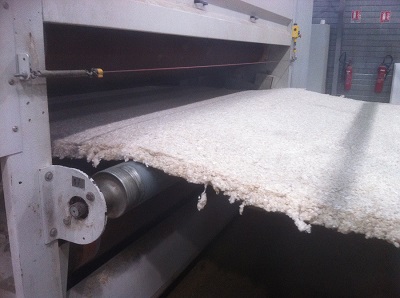
You can find Modcell here.

Here’s another image, which I believe is a closeup of the processed fibre shown in the above,
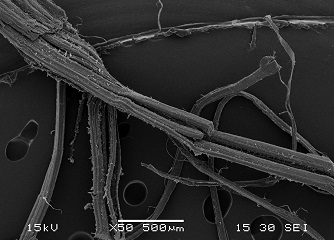
Production line at the co-operative enterprise CAVAC Biomatériaux, France. Natural fibres processed into a continuous mat (biofib) – Martin Ansell, BRE CICM, University of Bath, UK [Note: This caption appears to be a copy of the caption for the previous image]