Tag Archives: Xiaomeng Liu

Tissue-like bioelectronic mesh system capable of growing with cardiac tissues

Graphene, heralded for its biocompatibility, features in a March 22, 2024 news item on ScienceDaily about research about biosensing and a mesh system that can grow,

A team of engineers has recently built a tissue-like bioelectronic mesh system integrated with an array of atom-thin graphene sensors that can simultaneously measure both the electrical signal and the physical movement of cells in lab-grown human cardiac tissue. This tissue-like mesh can grow along with the cardiac cells, allowing researchers to observe how the heart’s mechanical and electrical functions change during the developmental process. The new device is a boon for those studying cardiac disease as well as those studying the potentially toxic side-effects of many common drug therapies.

Caption: A bioelectronic mesh, studded with graphene sensors (red), can measure the electrical signal and movement of cardiac tissue (purple and green) at the same time. Credit: Gao et al., 10.1038/s41467-024-46636-7

A March 21, 2024 University of Massachusetts at Amherst news release (also on EurekAlert), which originated the news item, delves further into the topics of heart disease and biosensor implants, Note: Links have been removed,

Cardiac disease is the leading cause of human morbidity and mortality across the world. The heart is also very sensitive to therapeutic drugs, and the pharmaceutical industry spends millions of dollars in testing to make sure that its products are safe. However, ways to effectively monitor living cardiac tissue are extremely limited.

In part, this is because it is very risky to implant sensors in a living heart, but also because the heart is a complex kind of muscle with more than one thing that needs monitoring. “Cardiac tissue is very special,” says Jun Yao, associate professor of electrical and computer engineering in UMass Amherst’s College of Engineering and the paper’s senior author. “It has a mechanical activity—the contractions and relaxations that pump blood through our body—coupled to an electrical signal that controls that activity.”

But today’s sensors can typically only measure one characteristic at a time, and a two-sensor device that could measure both charge and movement would be so bulky as to impede the cardiac tissue’s function. Until now, there was no single sensor capable of measuring the heart’s dual properties without interfering with its functioning.

The new device is built of two critical components, explains lead author Hongyan Gao, who is pursuing his Ph.D. in electrical engineering at UMass Amherst. The first is a three-dimensional cardiac microtissue (CMT), grown in a lab from human stem cells under the guidance of co-author Yubing Sun, associate professor of mechanical and industrial engineering at UMass Amherst. CMT has become the preferred model for in vitro testing because it is the closest analog yet to a full-size, living human heart. However, because CMT is grown in a test tube, it has to mature, a process that takes time and can be easily disrupted by a clumsy sensor.

The second critical component involves graphene—a pure-carbon substance only one atom thick. Graphene has a few surprising quirks to its nature that make it perfect for a cardiac sensor. Graphene is electrically conductive, and so it can sense the electrical charges shooting through cardiac tissue. It is also piezoresistive, which means that as it is stretched—say, by the beating of a heart—its electrical resistance increases. And because graphene is impossibly thin, it can register even the tiniest flutter of muscle contraction or relaxation and can do so without impeding the heart’s function, all through the maturation process. Co-author Jing Kong, professor of electrical engineering at MIT, and her group supplied this critical graphene material.

“Although there have already been many applications for graphene, it is wonderful to see that it can be used in this critical need, which takes advantage of graphene’s different characteristics,” says Kong.

Gao, Yao and their colleagues then embedded a series of graphene sensors in a soft, stretchable porous mesh scaffold they developed that has close structural and mechanical properties to human tissue and which can be applied non-invasively to cardiac tissue.

“No one has ever done this before,” says Gao. “Graphene can survive in a biological environment without degrading for a very long time and not lose its conductivity, so we can monitor the CMT across its entire maturation process.”

“This is crucial for a number of reasons,” adds Yao. “Our sensor can give real-time feedback to scientists and drug researchers, and it can do so in a cost-effective way. We take pride in using the insights of electrical engineering to help build tools that can be useful to a wide range of researchers.”

In the future, Gao says, he hopes to be able to adapt his sensor to grander scales, even to in vivo monitoring, which would provide the best-possible data to help solve cardiac disease.

This research was supported by the Army Research Office, the National Institutes of Health, the U.S. National Science Foundation, the Semiconductor Research Corporation, and the Link Foundation, as well as the Institute for Applied Life Sciences at UMass Amherst.

Here’s a link to and a citation for the paper,

Graphene-integrated mesh electronics with converged multifunctionality for tracking multimodal excitation-contraction dynamics in cardiac microtissues by Hongyan Gao, Zhien Wang, Feiyu Yang, Xiaoyu Wang, Siqi Wang, Quan Zhang, Xiaomeng Liu, Yubing Sun, Jing Kong & Jun Yao. Nature Communications volume 15, Article number: 2321 (2024) DOI: https://doi.org/10.1038/s41467-024-46636-7 Published: 14 March 2024

This paper is open access.

Neuromorphic computing with voltage usage comparable to human brains

Part of neuromorphic computing’s appeal is the promise of using less energy because, as it turns out, the human brain uses small amounts of energy very efficiently. A team of researchers at the University of Massachusetts at Amherst have developed function in the same range of voltages as the human brain. From an April 20, 2020 news item on ScienceDaily,

Only 10 years ago, scientists working on what they hoped would open a new frontier of neuromorphic computing could only dream of a device using miniature tools called memristors that would function/operate like real brain synapses.

But now a team at the University of Massachusetts Amherst has discovered, while on their way to better understanding protein nanowires, how to use these biological, electricity conducting filaments to make a neuromorphic memristor, or “memory transistor,” device. It runs extremely efficiently on very low power, as brains do, to carry signals between neurons. Details are in Nature Communications.

An April 20, 2020 University of Massachusetts at Amherst news release (also on EurekAlert), which originated the news items, dives into detail about how these researchers were able to achieve bio-voltages,

As first author Tianda Fu, a Ph.D. candidate in electrical and computer engineering, explains, one of the biggest hurdles to neuromorphic computing, and one that made it seem unreachable, is that most conventional computers operate at over 1 volt, while the brain sends signals called action potentials between neurons at around 80 millivolts – many times lower. Today, a decade after early experiments, memristor voltage has been achieved in the range similar to conventional computer, but getting below that seemed improbable, he adds.

Fu reports that using protein nanowires developed at UMass Amherst from the bacterium Geobacter by microbiologist and co-author Derek Lovely, he has now conducted experiments where memristors have reached neurological voltages. Those tests were carried out in the lab of electrical and computer engineering researcher and co-author Jun Yao.

Yao says, “This is the first time that a device can function at the same voltage level as the brain. People probably didn’t even dare to hope that we could create a device that is as power-efficient as the biological counterparts in a brain, but now we have realistic evidence of ultra-low power computing capabilities. It’s a concept breakthrough and we think it’s going to cause a lot of exploration in electronics that work in the biological voltage regime.”

Lovely points out that Geobacter’s electrically conductive protein nanowires offer many advantages over expensive silicon nanowires, which require toxic chemicals and high-energy processes to produce. Protein nanowires also are more stable in water or bodily fluids, an important feature for biomedical applications. For this work, the researchers shear nanowires off the bacteria so only the conductive protein is used, he adds.

Fu says that he and Yao had set out to put the purified nanowires through their paces, to see what they are capable of at different voltages, for example. They experimented with a pulsing on-off pattern of positive-negative charge sent through a tiny metal thread in a memristor, which creates an electrical switch.

They used a metal thread because protein nanowires facilitate metal reduction, changing metal ion reactivity and electron transfer properties. Lovely says this microbial ability is not surprising, because wild bacterial nanowires breathe and chemically reduce metals to get their energy the way we breathe oxygen.

As the on-off pulses create changes in the metal filaments, new branching and connections are created in the tiny device, which is 100 times smaller than the diameter of a human hair, Yao explains. It creates an effect similar to learning – new connections – in a real brain. He adds, “You can modulate the conductivity, or the plasticity of the nanowire-memristor synapse so it can emulate biological components for brain-inspired computing. Compared to a conventional computer, this device has a learning capability that is not software-based.”

Fu recalls, “In the first experiments we did, the nanowire performance was not satisfying, but it was enough for us to keep going.” Over two years, he saw improvement until one fateful day when his and Yao’s eyes were riveted by voltage measurements appearing on a computer screen.

“I remember the day we saw this great performance. We watched the computer as current voltage sweep was being measured. It kept doing down and down and we said to each other, ‘Wow, it’s working.’ It was very surprising and very encouraging.”

Fu, Yao, Lovely and colleagues plan to follow up this discovery with more research on mechanisms, and to “fully explore the chemistry, biology and electronics” of protein nanowires in memristors, Fu says, plus possible applications, which might include a device to monitor heart rate, for example. Yao adds, “This offers hope in the feasibility that one day this device can talk to actual neurons in biological systems.”

That last comment has me wondering about why you would want to have your device talk to actual neurons. For neuroprosthetics perhaps?

Here’s a link to and a citation for the paper,

Bioinspired bio-voltage memristors by Tianda Fu, Xiaomeng Liu, Hongyan Gao, Joy E. Ward, Xiaorong Liu, Bing Yin, Zhongrui Wang, Ye Zhuo, David J. F. Walker, J. Joshua Yang, Jianhan Chen, Derek R. Lovley & Jun Yao. Nature Communications volume 11, Article number: 1861 (2020) DOI: https://doi.org/10.1038/s41467-020-15759-y Published: 20 April 2020

This paper is open access.

There is an illustration of the work
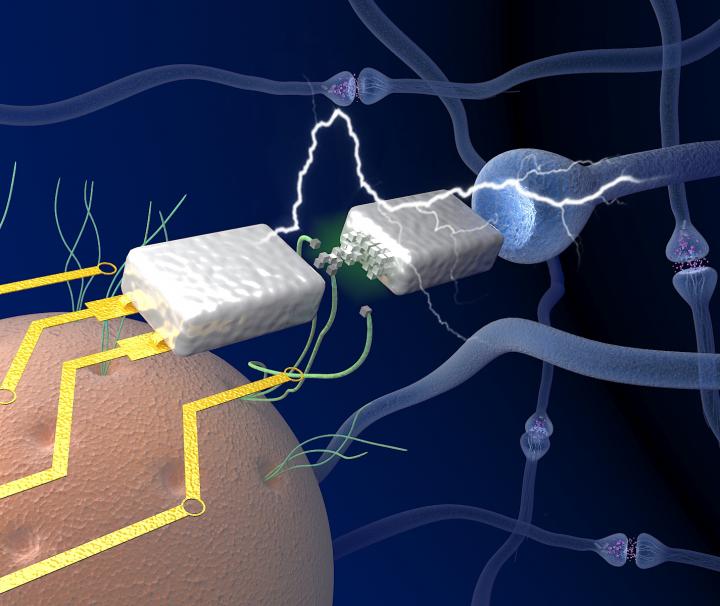
Caption: A graphic depiction of protein nanowires (green) harvested from microbe Geobacter (orange) facilitate the electronic memristor device (silver) to function with biological voltages, emulating the neuronal components (blue junctions) in a brain. Credit: UMass Amherst/Yao lab

Graphene like water

This is graphene research from Harvard University and Raytheon according to a Feb. 11, 2016 news item on phys.org (Note: Links have been removed),

It’s one atom thick [i.e., two-dimensional], stronger than steel, harder than diamond and one of the most conductive materials on earth.

But, several challenges must be overcome before graphene products are brought to market. Scientists are still trying to understand the basic physics of this unique material. Also, it’s very challenging to make and even harder to make without impurities.

In a new paper published in Science, researchers at the [sic] Harvard and Raytheon BBN Technology have advanced our understanding of graphene’s basic properties, observing for the first time electrons in a metal behaving like a fluid.

A Feb. 11, 2016 Harvard University press release by Leah Burrows (also on EurekAlert), which originated the news item, provides more detail,

In order to make this observation, the team improved methods to create ultra-clean graphene and developed a new way measure its thermal conductivity. This research could lead to novel thermoelectric devices as well as provide a model system to explore exotic phenomena like black holes and high-energy plasmas.

An electron super highway

In ordinary, three-dimensional metals, electrons hardly interact with each other. But graphene’s two-dimensional, honeycomb structure acts like an electron superhighway in which all the particles have to travel in the same lane. The electrons in graphene act like massless relativistic objects, some with positive charge and some with negative charge. They move at incredible speed — 1/300 of the speed of light — and have been predicted to collide with each other ten trillion times a second at room temperature.  These intense interactions between charge particles have never been observed in an ordinary metal before.

The team created an ultra-clean sample by sandwiching the one-atom thick graphene sheet between tens of layers of an electrically insulating perfect transparent crystal with a similar atomic structure of graphene.

“If you have a material that’s one atom thick, it’s going to be really affected by its environment,” said Jesse Crossno, a graduate student in the Kim Lab [Philip Kim, professor of physics and applied physics] and first author of the paper.  “If the graphene is on top of something that’s rough and disordered, it’s going to interfere with how the electrons move. It’s really important to create graphene with no interference from its environment.”

The technique was developed by Kim and his collaborators at Columbia University before he moved to Harvard in 2014 and now have been perfected in his lab at SEAS [Harvard School of Engineering and Applied Sciences].

Next, the team set up a kind of thermal soup of positively charged and negatively charged particles on the surface of the graphene, and observed how those particles flowed as thermal and electric currents.

What they observed flew in the face of everything they knew about metals.

A black hole on a chip

Most of our world — how water flows or how a curve ball curves —  is described by classical physics. Very small things, like electrons, are described by quantum mechanics while very large and very fast things, like galaxies, are described by relativistic physics, pioneered by Albert Einstein.

Combining these laws of physics is notoriously difficult but there are extreme examples where they overlap. High-energy systems like supernovas and black holes can be described by linking classical theories of hydrodynamics with Einstein’s theories of relativity.

But it’s difficult to run an experiment on a black hole. Enter graphene.

When the strongly interacting particles in graphene were driven by an electric field, they behaved not like individual particles but like a fluid that could be described by hydrodynamics.

“Instead of watching how a single particle was affected by an electric or thermal force, we could see the conserved energy as it flowed across many particles, like a wave through water,” said Crossno.

“Physics we discovered by studying black holes and string theory, we’re seeing in graphene,” said Andrew Lucas, co-author and graduate student with Subir Sachdev, the Herchel Smith Professor of Physics at Harvard. “This is the first model system of relativistic hydrodynamics in a metal.”

Moving forward, a small chip of graphene could be used to model the fluid-like behavior of other high-energy systems.

Industrial implications

So we now know that strongly interacting electrons in graphene behave like a liquid — how does that advance the industrial applications of graphene?

First, in order to observe the hydrodynamic system, the team needed to develop a precise way to measure how well electrons in the system carry heat.  It’s very difficult to do, said co-PI Kin Chung Fong, scientist with Raytheon BBN Technology.

Materials conduct heat in two ways: through vibrations in the atomic structure or lattice; and carried by the electrons themselves.

“We needed to find a clever way to ignore the heat transfer from the lattice and focus only on how much heat is carried by the electrons,” Fong said.

To do so, the team turned to noise. At finite temperature, the electrons move about randomly:  the higher the temperature, the noisier the electrons. By measuring the temperature of the electrons to three decimal points, the team was able to precisely measure the thermal conductivity of the electrons.

“This work provides a new way to control the rate of heat transduction in graphene’s electron system, and as such will be key for energy and sensing-related applications,” said Leonid Levitov, professor of physics at MIT [Massachusetts Institute of Technology].

“Converting thermal energy into electric currents and vice versa is notoriously hard with ordinary materials,” said Lucas. “But in principle, with a clean sample of graphene there may be no limit to how good a device you could make.”

Here’s a link to and a citation for the paper,

Observation of the Dirac fluid and the breakdown of the Wiedemann-Franz law in graphene by Jesse Crossno, Jing K. Shi, Ke Wang, Xiaomeng Liu, Achim Harzheim, Andrew Lucas, Subir Sachdev, Philip Kim, Takashi Taniguchi, Kenji Watanabe, Thomas A. Ohki, Kin Chung Fong.Science  11 Feb 2016: pp. DOI: 10.1126/science.aad0343

This paper is behind a paywall.

Here’s an image illustrating the research,

Caption: In a new paper published in Science, researchers at the Harvard and Raytheon BBN Technology have advanced our understanding of graphene's basic properties, observing for the first time electrons in a metal behaving like a fluid. Credit: Peter Allen/Harvard SEAS

Caption: In a new paper published in Science, researchers at the Harvard and Raytheon BBN Technology have advanced our understanding of graphene’s basic properties, observing for the first time electrons in a metal behaving like a fluid. Credit: Peter Allen/Harvard SEAS