Tag Archives: Yonggang Wang

Proof-of-concept for implantable batteries that run on body’s own oxygen

Bioenergy harvesting may be here. Well maybe not yet but we are one step closer according to a March 27, 2024 news item on ScienceDaily,

From pacemakers to neurostimulators, implantable medical devices rely on batteries to keep the heart on beat and dampen pain. But batteries eventually run low and require invasive surgeries to replace. To address these challenges, researchers have devised an implantable battery that runs on oxygen in the body. The study shows in rats that the proof-of-concept design can deliver stable power and is compatible with the biological system.

This is a dynamic image illustrating the device in action,

Caption: Implantable and bio-compatible Na-O2 battery. Credit: Chem/Lv et al.

A March 27, 2024 Cell Press news release on EurekAlert, which originated the news item, provides more detail about the -proof-of-concept device,

“When you think about it, oxygen is the source of our life,” says corresponding author Xizheng Liu, who specializes in energy materials and devices at Tianjin University of Technology. “If we can leverage the continuous supply of oxygen in the body, battery life won’t be limited by the finite materials within conventional batteries.”

To build a safe and efficient battery, the researchers made its electrodes out of a sodium-based alloy and nanoporous gold, a material with pores thousands of times smaller than a hair’s width. Gold has been known for its compatibility with living systems, and sodium is an essential and ubiquitous element in the human body. The electrodes undergo chemical reactions with oxygen in the body to produce electricity. To protect the battery, the researchers encased it within a porous polymer film that is soft and flexible.

The researchers then implanted the battery under the skin on the backs of rats and measured its electricity output. Two weeks later, they found that the battery can produce stable voltages between 1.3 V and 1.4 V, with a maximum power density of 2.6 µW/cm2. Although the output is insufficient to power medical devices, the design shows that harnessing oxygen in the body for energy is possible.

The team also evaluated inflammatory reactions, metabolic changes, and tissue regeneration around the battery. The rats showed no apparent inflammation. Byproducts from the battery’s chemical reactions, including sodium ions, hydroxide ions, and low levels of hydrogen peroxide, were easily metabolized by the body and did not affect the kidneys and liver. The rats healed well after implantation, with the hair on their back completely regrown after four weeks. To the researchers’ surprise, blood vessels also regenerated around the battery.

“We were puzzled by the unstable electricity output right after implantation,” says Liu. “It turned out we had to give the wound time to heal, for blood vessels to regenerate around the battery and supply oxygen, before the battery could provide stable electricity. This is a surprising and interesting finding because it means that the battery can help monitor wound healing.”

Next, the team plans to up the battery’s energy delivery by exploring more efficient materials for the electrodes and optimizing the battery structure and design. Liu also noted that the battery is easy to scale up in production and choosing cost-effective materials can further lower the price. The team’s battery may also find other purposes beyond powering medical devices.

“Because tumor cells are sensitive to oxygen levels, implanting this oxygen-consuming battery around it may help starve cancers. It’s also possible to convert the battery energy to heat to kill cancer cells,” says Liu. “From a new energy source to potential biotherapies, the prospects for this battery are exciting.”

Here’s a link to and a citation for the paper,

Implantable and bio-compatible Na-O2 battery by Yang Lv, Xizheng Liu, Jiucong Liu, Pingli Wu, Yonggang Wang, Yi Ding. Chem DOI: https://doi.org/10.1016/j.chempr.2024.02.012 In press, corrected proof Published online: March 27, 2024 Copyright © 2024 Elsevier Inc.

The paper appears to be open access.

Self-healing lithium-ion batteries for textiles

It’s easy to forget how hard we are on our textiles. We rip them, step on them, agitate them in water, splatter them with mud, and more. So, what happens when we integrate batteries and electronics into them? An Oct. 20, 2016 news item on phys.org describes one of the latest ‘textile batter technologies’,

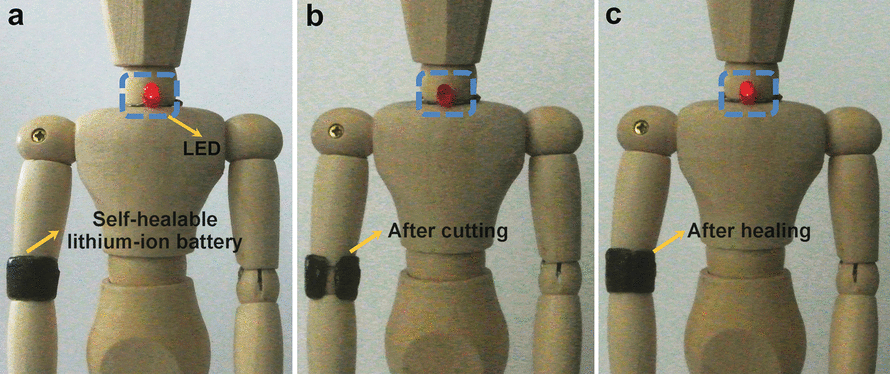
Electronics that can be embedded in clothing are a growing trend. However, power sources remain a problem. In the journal Angewandte Chemie, scientists have now introduced thin, flexible, lithium ion batteries with self-healing properties that can be safely worn on the body. Even after completely breaking apart, the battery can grow back together without significant impact on its electrochemical properties.
wiley_selfhealinglithiumionbattery

© Wiley-VCH

An Oct. 20, 2016 Wiley Angewandte Chemie International Edition press release (also on EurekAlert), which originated the news item, describes some of the problems associated with lithium-ion batteries and this new technology designed to address them,

Existing lithium ion batteries for wearable electronics can be bent and rolled up without any problems, but can break when they are twisted too far or accidentally stepped on—which can happen often when being worn. This damage not only causes the battery to fail, it can also cause a safety problem: Flammable, toxic, or corrosive gases or liquids may leak out.

A team led by Yonggang Wang and Huisheng Peng has now developed a new family of lithium ion batteries that can overcome such accidents thanks to their amazing self-healing powers. In order for a complicated object like a battery to be made self-healing, all of its individual components must also be self-healing. The scientists from Fudan University (Shanghai, China), the Samsung Advanced Institute of Technology (South Korea), and the Samsung R&D Institute China, have now been able to accomplish this.

The electrodes in these batteries consist of layers of parallel carbon nanotubes. Between the layers, the scientists embedded the necessary lithium compounds in nanoparticle form (LiMn2O4 for one electrode, LiTi2(PO4)3 for the other). In contrast to conventional lithium ion batteries, the lithium compounds cannot leak out of the electrodes, either while in use or after a break. The thin layer electrodes are each fixed on a substrate of self-healing polymer. Between the electrodes is a novel, solvent-free electrolyte made from a cellulose-based gel with an aqueous lithium sulfate solution embedded in it. This gel electrolyte also serves as a separation layer between the electrodes.

After a break, it is only necessary to press the broken ends together for a few seconds for them to grow back together. Both the self-healing polymer and the carbon nanotubes “stick” back together perfectly. The parallel arrangement of the nanotubes allows them to come together much better than layers of disordered carbon nanotubes. The electrolyte also poses no problems. Whereas conventional electrolytes decompose immediately upon exposure to air, the new gel is stable. Free of organic solvents, it is neither flammable nor toxic, making it safe for this application.

The capacity and charging/discharging properties of a battery “armband” placed around a doll’s elbow were maintained, even after repeated break/self-healing cycles.

Here’s a link to and a citation for the paper,

A Self-Healing Aqueous Lithium-Ion Battery by Yang Zhao, Ye Zhang, Hao Sun, Xiaoli Dong, Jingyu Cao, Lie Wang, Yifan Xu, Jing Ren, Yunil Hwang, Dr. In Hyuk Son, Dr. Xianliang Huang, Prof. Yonggang Wang, and Prof. Huisheng Peng. Angewandte Chemie International Edition DOI: 10.1002/anie.201607951 Version of Record online: 12 OCT 2016

© 2016 Wiley-VCH Verlag GmbH & Co. KGaA, Weinheim

This paper is behind a paywall.