Tag Archives: Ptolemy

Copernicus’ cosmological model strongly influenced by ancient Muslim astronomer Ibn al-Shatir?

Caption: Ibn-al-shatir’s lunar model from which Copernicus is reported to have borrowed in composing his cosmological model. Credit: This work is in the public domain in the United States. Credit: https://en.wikipedia.org/wiki/Ibn_al-Shatir#/media/File:Ibn-al-shatir2.gif

An April 14, 2025 University of Sharjah press release on EurekAlert puts forth a fascinating conjecture backed up by research, Note 1: Links have been removed; Note 2: “Did Copernicus Draw on a Medieval Arab Astronomer? New Study Highlights Striking Parallels” on medievalists.net sums up the researcher’s findings,,

New research has revealed that the cosmological model developed by Nicolaus Copernicus, the renowned European Renaissance polymath, bears striking resemblance to the one designed by an Arab astronomer nearly two centuries earlier.

Copernicus, a Polish astronomer who lived in the 16th century, is believed to be one of [sic] early European scientists to have put forward the theoretical model that the Sun was the center of the solar system, defying the church and the accepted wisdom that the Earth was the center of the universe.

Copernicus’s model is called sun-centered or heliocentric. In it, he challenges centuries-old science based on the teachings of Aristotle and Ptolemy, who thought the Earth was at rest at the center of the universe with other planets, including the sun, in its orbit.

The research conducted at the University of Sharjah is a comparative and analytical study which examines in parallel the writings of Copernicus in correlation with the works of the 14th century Muslim astronomer Ibn al-Shatir.

A recently completed Ph.D. thesis posted to the Sharjah University Library website, the research textually and critically analyzes the contributions of the two scientists to see where they concur or diverge in presenting their theories despite a historical gap of more than 200 years between them.

Dr. Salama Al-Mansouri, the research’s author, places Ibn al-Shatir’s cosmological model at the forefront of astronomical achievements in the Islamic scientific tradition. “Ibn al-Shatir was the first astronomer to have successfully challenged the Ptolemaic cosmological system of planets revolving around Earth and corrected the theory’s inaccuracies about two centuries before Copernicus,” says Dr. Al-Mansouri.

The fact that Copernicus borrows from works of scientists and astronomers who preceded him is not new. However, the study highlights the significant similarities between Copernicus and Ibn al-Shatir, an engineer, mathematician and astronomer who was the timekeeper for the Umayyad Mosque in Damascus, Syria.

Correlating the two cosmological models, the study suggests Copernicus was heavily influenced by Ibn al-Shatir’s astronomy and his ideas that the Earth and other solar planets orbit the Sun.

“Ibn al-Shatir’s astronomical manuscripts, particularly his work in Nihāyat al-Sul, demonstrate planetary models that predate and closely mirror those later proposed by Copernicus, indicating a shared mathematical lineage,” says Mesut Idriz, University of Sharjah’s professor of history and Islamic civilization and one of the study’s supervisors.

Nihayat al-sul fi tashih al-usul or “The Final Quest Concerning the Rectification of Principles” is Ibn al-Shatir’s most influential and important astronomical treatise in which, according to the study, the Muslim scientist corrects and refines many of the Ptolemaic models of the Sun, Moon, and planets.

Prof. Idriz acknowledges the complexity of studies based on “historical astronomical manuscripts” as they need to combine a “unique intersection of expertise—astronomy, manuscript studies, and historiography. Muslim manuscript-based research is an intricate process that requires fluency in Arabic and Persian, the medium of writing for Muslim scientists.”

Interpreting medieval astronomical manuscripts is not an easy job as it demands methodological precision, tracing textual transmission, comparing mathematical formulations, and evaluating observational data. To surmount such a sophisticated multidisciplinary approach, Dr. Salama sought advice and assistance from the community of academics at the Sharjah Academy for Astronomy, Space Sciences and Technology (SAASST), which has become a hub for renowned Arab and Muslim astronomers and scientists.

Dr. Salama conducts a critical textual analysis between Copernicus’s most famous work De revolutionibus orbium coelestium or On the Revolutions of the Celestial Spheres – a landmark in the history of science, which triggered the so-called Copernican Revolution – and the astronomical manuscripts of Ibn al-Shatir, particularly his Nihayat al-sul fi tashih al-usul.

The study reveals compelling correlations, underscoring the pivotal role of manuscript translation and transmission in the evolution of heliocentric theory and the assessment of the role the unraveling of Muslim manuscripts can play in rectifying historical inaccuracies about the history of science.

On the importance of the correlations between the work of Copernicus and that of Ibn al-Shatir, Mashhoor Al-Wardat, professor of astrophysics at SAASST, says, “The striking similarity between the planetary models developed by Ibn al-Shatir and Copernicus, particularly those concerning the orbits of Mercury and the Moon, provides clear evidence of Copernicus’s reliance on Ibn al-Shatir’s work …This raises profound questions about the transmission of knowledge from Islamic civilization to Europe and about the roots of modern astronomy.”

Dr. Salama provides an overview of Arabic manuscripts and their Latin translations in European archives in Kraków in Poland, and the Vatican, where Copernicus made his most outstanding contribution to astronomy. She finds that Ibn al-Shatir’s treatise Nihayat al-sul fi tashih al-usul was among the archives. She goes on, “Though in its original Arabic version, the manuscript could not have escaped the attention of a scholar like Copernicus.”

The study provides no definitive proof that Copernicus had read Iban al-Shatir’s works as there were no Latin translations of Ibn al-Shatir’s writings accessible to the researcher. However, the research posits that the Polish astronomer most probably had access to Ibn al-Shatir’s ideas through “intermediary channels” given the strong resemblance between their interpretations and mathematical calculations of planets orbiting the Sun.

The textual parallels between the two astronomers, according to the study, are most noticeable in “the identical calculations and results … imply(ing) that Copernicus may have adapted Ibn al-Shatir’s techniques” in developing “his philosophical shift to heliocentrism” a model which the study admits was Copernicus’s own invention.

However, the study sheds light on areas where Copernicus’s theory draws directly on Ibn al-Shatir. It mentions the lunar model in which the Muslim astronomer uses epicycles to correct Ptolemy’s exaggerated lunar distance variations.

“This is nearly identical to Copernicus’s lunar model in De Revolutionibus,” the study notes. “Both reduced the lunar distance fluctuation from Ptolemy’s factor of two to a more accurate range, relying on similar geometric constructions.

“For Mercury and the inner planets, Copernicus’s use of secondary epicycles and the Tusi-couple-like mechanism echoes Ibn al-Shatir’s approach. Ibn al-Shatir’s Mercury model, with its multiplication of epicycles to eliminate eccentrics, reappears in Copernicus’s work.”

Ibn al-Shatir is also celebrated for his Tusi-couple, a mathematical technique and an innovative mathematical device in which he employs additional epicycles to eliminate the equant—a problematic feature of Ptolemy’s system.

The Tusi-couple derives its name from Nasir al-Din al-Tusi, a 13th century Muslim polymath whose writings show the most accurate tables in antiquity of planetary motions, an updated planetary model, as well as penetrating critiques of Ptolemaic astronomy.

Ibn al-Shatir’s use of the Tusi-couple to simulate linear motion influenced Copernicus who produced similar adjustments, though Copernicus applied them within a heliocentric framework, the study notes.

Writes the study’s author, “Both astronomers (Copernicus and Ibn al-Shatir) replaced Ptolemy’s equant with additional circular motions, achieving uniform motion without an artificial reference point.

“Ibn al-Shatir’s solar model, with a new eccentricity and epicycles yielding a maximum solar equation of 2;2,6°, parallels Copernicus’s solar calculations. This suggests Copernicus may have adopted Ibn al-Shatir’s numerical tables or methods, adapting them to his Sun-centered system.”

Asked whether she thinks Copernicus loaned [sic] at least parts of his theory from Ibn al-Shatir, Dr. Salama adds, “Our analysis reveals that Ibn al-Shatir’s treatise, though geocentric in intent, produced results so aligned with heliocentrism that Copernicus’s debt to him is undeniable—two centuries of separation could not erase this intellectual kinship.”

The research findings apparently seek to rectify what the author perceives as a historical oversight by Western scholars, who are frequently alleged in current Arab and Muslim science literature to have mostly Eurocentric tendencies, marginalizing contributions of Muslim astronomers like Ibn al-Shatir in favor of European figures like Copernicus.

The study is of significant implications to the history of science in the Middle Ages and the European Renaissance. By demonstrating parallels between Ibn al-Shatir’s and Copernicus’s work, the study challenges this Eurocentric narrative that the heliocentric revolution was a solely European achievement.

In the meantime, it underscores the Islamic Golden Age’s role in laying mathematical and observational foundations, prompting historians to reconsider the global flow of scientific knowledge.

The research goes as far as highlighting the need to update science curricula to reflect a more inclusive history, acknowledging contributions from non-Western scholars.

Of the significance of the study, Prof. Hamid al-Naimiy, a renowned astronomer and the research’s main supervisor, said, “This study is a clarion call to rewrite the history of astronomy, ensuring that the brilliance of Muslim scholars like Ibn al-Shatir stands alongside Copernicus in our collective narrative of scientific progress.”

Asked about his opinion of Ibn al-Shatir’s cosmological model, Prof al-Naimiy, who is also Sharjah University’s Chancellor and SAASST’s director, said the Muslim astronomer was a pioneer in Islamic scientific tradition and his treatise “shows that he dismantled the Ptolemaic model and corrected its flaws two centuries before Copernicus. This work emphasizes the significant contributions of our heritage to global astronomy.”

Says Dr. Salama, “Ibn al-Shatir’s empirical refinements within a geocentric framework, paralleled by Copernicus’s adaptation, illustrate how incremental improvements can precede paradigm shifts,” adding that her research “offers a model for modern science, where foundational work in one context can catalyze breakthroughs in another.”

Dr. Salama makes a compelling case for reassessing Copernicus’ work. She also raised a few more questions. Perhaps it’s due to my ignorance but I wonder about using the descriptors ‘Arab’ and ‘Muslim’ synonymously’. At a guess, during Ibn al-Shatir’s lifetime the two may well have been synonymous although you don’t see religion and national group (for want of a better term) used synonymously with European scientists of any period. It suggests additional interesting questions (to me anyway) about religion and about other identifications and the relationship between them with science.

The study “The Latest on the heliocentric theory as explained by Ibn al-Shater and Copernicus: a comparative analytical study” is available here but you do need Arabic language skills to access it.

Science tattoos and a brief chat with Carl Zimmer about his book, Science Ink

I’m back with another New York Academy of Sciences public event (my Jan. 3, 2012 posting listed a number of events), this time it’s  Science Ink: Tattoos of the Science Obsessed with Carl Zimmer. Here’s a description of the event (which will take place on Tuesday, Jan. 24, 2012 from 7 – 8:30 pm),

How much do you love science? Enough to get it permanently inked on your skin?

Join award-winning science journalist and New York Academy of Sciences regular Carl Zimmer for a talk on his latest book, Science Ink, which showcases over 300 tattoos dedicated to the pursuit of science.

Tattoos have been a part of human culture as far back as Neolithic times. Scientists have uncovered tattoos on mummified ancients from Western China to Egypt to Scandanavia. And the subjects of those tattoos vary as much as the cultures—from elaborate animal and organic designs to simple graphic designs thought to have therapeutic qualities. In more modern times in the Western world, tattoos came into vogue in the late 1800s when British elites began to tattoo themselves—both Winston Churchill and his mother, Lady Randolph Churchill, had tattoos. And today, it’s clear that in American culture, tattoos have had a resurgence in popularity.

Choosing what to mark your body with permanently is a source of much conversation and consternation. And as Carl Zimmer discovered after a blog post asking about science tattoos, there is a passionate group of people who made the choice to ink themselves with science.

In this special event, Zimmer will speak about the science and history of tattooing, and offer highlights from his book Science Ink, which features a gallery of scientific tattoos, spanning fields from evolutionary biology and neuroscience to mathematics and astrophysics. In addition, Zimmer is inviting a handful of those featured in the book to come and share the compelling personal stories behind their ink.

Here are more details about the event, pricing is as follows,

Member:                                                                   $15

Student / Postdoc / Fellow Member:           $10

Nonmember:                                                           $25

Student / Postdoc / Fellow Nonmember:   $20

In a Jan. 9, 2012 posting on his blog, The Loom, Carl Zimmer offers more information about his book and upcoming talk plus a discount,

Get $10 dollars off admission by using the promo code ZIMMER. Register [here or http://www.nyas.org/scienceink]

The address and contact details:

The New York Academy of Sciences

7 World Trade Center
250 Greenwich Street, 40th floor
New York, NY 10007-2157
212.298.8600
nyas@nyas.org

As for Carl Zimmer and science tattoos, I decided to investigate a bit further. Here’s an excerpt from Carl Zimmer’s website bio webpage,

The New York Times Book Review calls Carl Zimmer “as fine a science essayist as we have.” In his books, essays, articles, and blog posts, Zimmer reports from the frontiers of biology, where scientists are expanding our understanding of life. He is a popular speaker at universities, medical schools, museums, and festivals, and he is also a frequent guest on radio programs such as Radio Lab and This American Life.

In addition to writing books, Zimmer has written hundreds of articles for the New York Times and magazines including National Geographic, Time, Scientific American, Science, and Popular Science. From 1994 to 1998 Zimmer was a senior editor at Discover, where he remains a contributing editor and writes a monthly column about the brain.

Since 2003, Zimmer has written the award-winning blog, The Loom. Along with essays about science, The Loom is also home to a popular gallery of science tattoos. In November 2011, Zimmer will publish a book of his favorite selections, called Science Ink: Tales of the Science Obsessed.

Zimmer is a lecturer at Yale University, where he teaches writing about science and the environment. He was also the first Visiting Scholar at the Science, Health, and Environment Reporting Program at New York University’s Arthur L. Carter Journalism Institute.

He is, to his knowledge, the only writer after whom a species of tapeworm has been named. [emphasis mine]

I do love a sense of humour. As for Zimmer’s latest book, Science Ink, his website offers some excerpts from it (here are a few samples),

Astrarium, p.71
“Although I’m not a scientist by trade,” writes Lauren Caldwell, “my work on seventeenth- and eighteenth-century British literature has provided ample opportunity for me to become acquainted with the work of some brilliant scientific innovators. Though we have discarded some of their ideas, their work retains all of its vital visual force. ¶ “Years ago I discovered and fell in love with the comprehensive diagrams in Giovanni de’Dondi’s 1364 Il Tractatus Astarii, which contained the plans for the first famous astrarium. Each piece has its own delicate mechanical beauty, but I chose for my backpiece the Mercury wheelwork. Of course, you couldn’t track Mercury with it—de’Dondi followed Ptolemy—but his astrarium remains a lovely and impressive testament to human ingenuity and curiosity. ¶ “The more spare geometrical diagrams that surround the de’Dondi piece are taken from Sir Isaac Newton’s Principia Mathematica—of which little enough, I imagine, need be said. Though in many respects these two men couldn’t have been more different, they shared a vision of a universe as elegant and aesthetically compelling today as it was when they lived and worked.”

Astrarium tattoo (from Science Ink by Carl Zimmer)

DNA monster, bottom p.102
Jay Phelan, a biologist at UCLA, got his DNA tattoo in 1990 while he was in graduate school. “As I got deeper into the study of evolution, genetics, and human behavior,” he writes, “I realized that there was a tension between what my genes ‘wanted’ me to do and what I wanted to do, from the fattiness of the foods I ate, to the selfishness/selflessness I showed to others, to issues with managing my money, my risk-taking, and my relationships, and more. It dawned on me that I was fighting a never-ending battle. Anyway, I tried to come up with a design that captured that tension and, once I did, decided to get it tattooed on my back.”
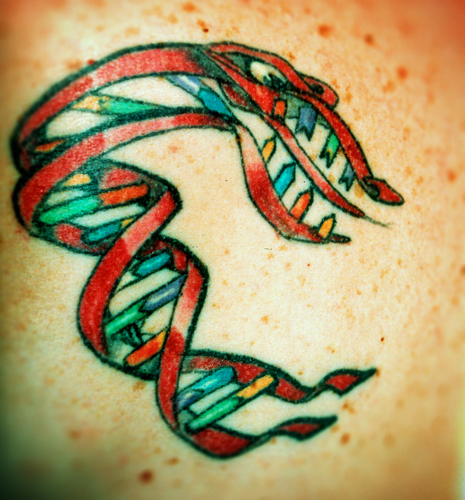
DNA monster tattoo (from Science Ink by Carl Zimmer)

I was sufficiently fascinated to send off a few questions to Carl Zimmer about science tattoos and his upcoming talk at the NYAS and he very kindly replied,

  • Given the title of your latest book (Science Ink: Tattoos of the Science Obsessed), I’m wondering if you have any tattoos.
    If so, what is it?

I don’t have any tattoos actually. I’ve never been particularly interested in getting one, and am no big fan of needles. But I find the lack of a tattoo is no impediment to appreciating the tattoos of scientists.  If I sell of whole bunch of copies of the book, maybe I’ll have to celebrate by getting one. I was thinking about getting  my wife’s name, Grace, spelled out as amino acids.

  • What most surprised you about this book?

At first the surprise was simply that any scientist at all had tattoos.  The initial flood of pictures that filled up my e-mail inbox was amazing. After I got accustomed to the idea that there is lots and lots of scientists with tattoos out there, the next big surprise was how many interesting stories there were, illustrated by these tattoos. Stories from the history of science, stories from the personal lives of the scientists. And since telling stories is my job, I decided to turn Science Ink into a book of miniature essays.

  • Is there any branch of science that attracts more people who are willing to ink their bodies?

I don’t see any field being way in the lead compared other ones. In fact, what really impressed me was that just about every branch of science I can imagine ended up being represented in the book. I have groups of linguistics tattoos in the book, astronomy tattoo,s medical tattoos ,tattoos about quantum physics, and so on. Basically, by looking at these tattoos you end up taking a tour of all science.

  • Could you briefly preview a little bit of your Ja.24.12 talk?

I’m going to be talking at the New York Academy of Sciences about what got me into this peculiar project, and some of the things I learned about scientists and science in the process. But I’m also going to be talking about tattooing itself. It’s actually a pretty fascinating scientific subject in its own right. Anthropologists have found evidence of tattooing in many cultures around the world, and it goes back thousands of years. So I think that tattoos speak to something really important about what it means to be human–and, in this particular case, what it means to be a scientist.

Dear Carl, Thank you for taking time out of a very busy schedule (he has a talk scheduled Jan. 20, 2012 too; scroll down to the next paragraph for information about that event plus all of his usual work) to respond. I hope the book is a huge success.

There is one other related Science Ink event that might be of interest. The ScienceOnline2012 conference, January 19 – 21, 2012 (no spaces left for attendees), held annually in Durham, North Carolina and (mentioned in my Nov. 2, 2011 posting) is hosting a Science of Ink tour for 30 people to the Dogstar Tattoo Company on Friday, Jan. 20, 2012. The webpage for the tour notes that it is completely booked but if you follow the Twitter hash tag (#SciInk) you may be able to get on the tour (as people do drop out of these things for one reason or another). From the tour webpage,

Join us on Friday afternoon, January 20th, at the Dogstar Tattoo Company in Durham, NC’s Golden Belt district for a lecture by Carl Zimmer on the science of tattoos, a reception & tour of the studio, and the opportunity to get inked (or just watch the process!). Carl will have his book, Science Ink: The Tattoos of the Science Obsessed available–and we can probably convince him to sign a few ☺

This isn’t your typical tattoo shop. When Carl Zimmer first saw the photos, he declared, “It’s like a cathedral of tattoo parlors.”

When you register, please indicate if you definitely plan to get a tattoo, might want to get a tattoo, or definitely don’t plan to get inked (but want to observe). [emphasis mine]

Good luck with getting on the tour or getting to the talk in New York. As for anyone from Vancouver who might be hoping that Carl Zimmer will be here for the American Association for the Advancement of Science (AAAS) 2012 annual meeting, sadly, the answer is no.