Tag Archives: Claudia Fugazza

Merry 2025 Christmas: sea slugs, the Nicholas Brothers, ethnomathematics, three new frogs (hidden gems), gifted dogs, and more

What you’re looking at is a sea slug:

Anatomy of the sacoglossan mollusc Elysia chlorotica. Sea slug consuming its obligate algal food Vaucheria litorea. Small, punctate green circles are the plastids located within the extensive digestive diverticula of the animal. By Karen N. Pelletreau et al. – http://journals.plos.org/plosone/article?id=10.1371/journal.pone.0097477, CC BY 4.0, https://commons.wikimedia.org/w/index.php?curid=38619279 [[image downloaded from the Elysia chlorotica Wikipedia entry]

This is one of my favourite stories. From a November 27, 2025 article “A rare photosynthesizing sea slug has been found off N.S. Here’s why scientists are excited” by Frances Willick for the Canadian Broadcasting Corporation (CBC) news online website,

When she made the discovery that would thrill her fellow snorkellers and excite researchers across North America, she didn’t think much of it at first.

“I just thought, oh, that’s a rotten leaf, keep going,” says Elli Ofthenorth.

The avid snorkeller passed by this “black gunk” once, twice, but it wasn’t until her third pass that something caught her eye enough to take a closer look, and she realized it was a living creature.

“I just started yelling, there’s a sea slug here!”

Ofthenorth’s mother, who was on the shore at Rainbow Haven Provincial Park near Dartmouth, N.S., lit up the snorkel group chat, and within minutes, members identified it as Elysia chlorotica, or Eastern emerald elysia.

This unassuming creature could almost pass for your garden-variety slug — the kind that decimates your lettuce every summer. That is, until its crinkly-looking back unfurls a stunning, emerald green “leaf,” complete with pale “veins” branching outward from the centre.

It’s this “leaf,” and what it does for the sea slug, that holds so much promise for research in medicine, clean energy and other fields. 

But it’s so elusive that researchers are having a hard time studying it.

E. chlorotica can photosynthesize, stealing the chloroplasts — the photosynthesizing organs — of the algae it eats, keeping them alive in its body, and using them to get energy from the sun. The sea slugs can then subsist for months at a time without consuming food.

“It’s like if I ate a whole bunch of spinach and then I just woke up this morning and I just sunbathed for an hour and then I wouldn’t need to eat for the rest of the week,” says Hunter Stevens, a biologist with the Canadian Parks and Wilderness Society’s Nova Scotia chapter. “These slugs are essentially doing the same thing.”

Elusive and ephemeral

However, this coveted slug excels at eluding researchers.

Historically, known populations have existed in the Minas Basin area of Nova Scotia and in Martha’s Vineyard in Massachusetts — and theoretically their habitat exists all along the Eastern Seaboard of the U.S. — but recent efforts to find them have been unsuccessful.

“For so long it just seemed like nobody had seen them,” says Krug [Patrick Krug, a professor of biological sciences at California State University, Los Angeles]. “It was such a shot in the dark, it wasn’t even worth going to look.”

Dylan Gagler, a PhD student at the American Museum of Natural History in New York, has searched the slug’s favoured habitat off Martha’s Vineyard repeatedly this year, but without luck so far.

When Stevens’s Instagram post about the Rainbow Haven discovery popped up in Gagler’s feed, he says he was “having like a freak-out, FOMO [fear of missing out] moment of, like, I got to get up to Nova Scotia. Like, this is clearly where all the action is.”

Gagler contacted Stevens to get information about the conditions at the Rainbow Haven location, such as the air and water temperature and the depth they were found at, in order to fine-tune his own searches. He’s also exploring the permitting process to collect specimens from Nova Scotia to raise in a lab.

Though E. chlorotica has been hard to find, Krug says there have been a few sightings in recent months, including the one in Nova Scotia, as well as in the Carolinas and in Tampa Bay, Fla.

He says the populations are “ephemeral,” seeming to go through cycles of boom and bust — sometimes abundant, but then vanishing suddenly.

The fact that the recent discovery of this thriving population was made within the bounds of a provincial park in Nova Scotia underscores how important protected areas are to biodiversity, Stevens says.

“As coastal development proliferates and continues to advance, some of these populations, we may not even know about them, and they’ll disappear,” he says. “And so these slugs will probably get rarer as time goes on.”

Stevens says Ofthenorth’s discovery highlights the importance of citizen science.

“It just shows the power of curiosity and how anybody here can go into the water and there’s still that potential to find this really scientifically significant observation.”

If you have the time, Willick’s November 27, 2025 article “A rare photosynthesizing sea slug has been found off N.S. Here’s why scientists are excited” includes pictures and a video.

Introduction

I always look forward to this Christmas posting as it’s an opportunity to publish some stories that wouldn’t ordinarily be featured here like the sea slug/leaf that opened this post.The focus will be (mostly) on animals. Note: I will not be removing links from the news/press releases nor will I be providing separate citations and links.

On to the rest of the programme, there should always be a little dance in one’s life.

Nicholas Brothers

[downloaded from https://mymodernmet.com/cab-calloway-jumpin-jive-nicholas-brothers/]

Watch their feet. There’s a reason dancers still talk about those two; the synchronization is something. There was link to the Nicholas Brothers’ routine in Stormy Weather (1943 film) was in my December 24, 2025 posting but …

Given the past year, I think it’s time to revisit the brothers and Emma Taggart’s October 4, 2019 article on My Modern Met (scroll down to see Cab Calloway and his band performing ‘Jumpin Jive’ as an introduction to what is one of the most lauded tap routines ever recorded on film).

What makes it jaw-dropping is that it was done in one take and with no rehearsal .Do read Taggart’s October 4, 2019 article for a detail I found a little mystifying (what was the director thinking?).

I have a little more about ‘Stormy Weather’ and the dance. Nick Castle was the dance director (uncredited) for the movie and the Nicholas Brothers’ routine was something he worked out with the brothers..I found that bit of information in “C’mon, Get Happy; the Making of Summer Stock,” a 2023 book by David Frantle and Tom Johnson. The book has a number of dancers and choreographers commenting on the movie’s (Summer Stock) dance routines (Gene Kelly was in the movie) in detail. Castle was the ‘dance stager’ for “Summer Stock,” which is why the routine and the Nicholas Brothers are mentioned.

8,000 years ago, before numbers existed, art demonstrated early mathematical thinking (ethnomathematics)

A December 16, 2025 news item on ScienceDaily makes an extraordinary statement about art, mathematics, and prehistoric civilization,

A study published in the Journal of World Prehistory suggests that some of the earliest known images of plants created by humans served a deeper purpose than decoration. According to the researchers, these ancient designs also reveal early mathematical thinking.

By closely examining prehistoric pottery, Prof. Yosef Garfinkel and Sarah Krulwich of the Hebrew University traced the oldest consistent use of plant imagery in human art to more than 8,000 years ago. The pottery comes from the Halafian culture of northern Mesopotamia (c. 6200-5500 BCE). Their findings show that early farming communities carefully painted flowers, shrubs, branches, and trees, arranging them in ways that reflect deliberate geometric structure and numerical order.

A meticulously executed drawing of a single large flower, depicted in a symmetrical arrangement with 16 or 32 petals, and a bowl with 64 (+ 12) flowers Courtesy Canadian Friends of the Hebrew University of Jerusalem

This undated news release on the Canadian Friends of the Hebrew University of Jerusalem website provides more detail about the work, Note: There are lots of images accompanying this story that are not included here,

A new study reveals that the Halafian culture of northern Mesopotamia (c. 6200–5500 BCE) produced the earliest systematic plant imagery in prehistoric art, flowers, shrubs, branches, and trees painted on fine pottery, arranged with precise symmetry and numerical sequences, especially petal and flower counts of 4, 8, 16, 32, and 64. This suggests that early farming villages in the Near East already possessed sophisticated, practical mathematical thinking about dividing space and quantities, likely tied to everyday needs such as fairly sharing crops from collectively worked fields, long before writing or formal number systems existed.

A new study published in the Journal of World Prehistory reveals that some of humanity’s earliest artistic representations of botanical figures were far more than decorative, they were mathematical.

In an extensive analysis of ancient pottery, Prof. Yosef Garfinkel and Sarah Krulwich of the Hebrew University have identified the earliest systematic depictions of vegetal motifs in human history, dating back over 8,000 years to the Halafian culture of northern Mesopotamia (c. 6200–5500 BCE). Their research shows that these early agricultural communities painted flowers, shrubs, branches, and trees with remarkable care, and embedded within them evidence of complex geometric and arithmetic thinking. 

A New Understanding of Prehistoric Art

Earlier prehistoric art focused primarily on humans and animals. Halafian pottery, however, marks the moment when the plant world entered human artistic expression in a systematic and visually sophisticated way.

Across 29 archaeological sites, Garfinkel and Krulwich documented hundreds of carefully rendered vegetal motifs, some naturalistic, others abstract, all reflecting conscious artistic choice.

“These vessels represent the first moment in history when people chose to portray the botanical world as a subject worthy of artistic attention,” the authors note. “It reflects a cognitive shift tied to village life and a growing awareness of symmetry and aesthetics.” 

Among the study’s most striking insights is the precise numerical patterning in Halafian floral designs. Many bowls feature flowers with petal counts that follow geometric progression: 4, 8, 16, 32, and even arrangements of 64 flowers.

These sequences, the researchers argue, are intentional and demonstrate a sophisticated grasp of spatial division long before the appearance of written numbers.

“The ability to divide space evenly, reflected in these floral motifs, likely had practical roots in daily life, such as sharing harvests or allocating communal fields,” Garfinkel explains. 

This work contributes to the field of ethnomathematics, which identifies mathematical knowledge embedded in cultural expression.

The motifs documented span the full botanical spectrum:

  • Flowers with meticulously balanced petals
  • Seedlings and shrubs, rendered with botanical clarity
  • Branches, arranged in rhythmic, repeating bands
  • Tall, imposing trees, sometimes shown alongside animals or architecture

Notably, none of the images depict edible crops, suggesting that the purpose was aesthetic rather than agricultural or ritualistic. Flowers, the authors note, are associated with positive emotional responses, which may explain their prominence. 

Revising the History of Mathematics

While written mathematical texts appear millennia later in Sumer, Halafian pottery reveals an earlier, intuitive form of mathematical reasoning, rooted in symmetry, repetition, and geometric organization.

“These patterns show that mathematical thinking began long before writing,” Krulwich says. “People visualized divisions, sequences, and balance through their art.”

By cataloguing these vegetal motifs and revealing their mathematical foundations, the study offers a new perspective on how early communities understood the natural world, organized their environments, and expressed cognitive complexity.

The research paper titled “The Earliest Vegetal Motifs in Prehistoric Art: Painted Halafian Pottery of Mesopotamia and Prehistoric Mathematical Thinking” is now available in Journal of World Prehistory and can be accessed at https://doi.org/10.1007/s10963-025-09200-9

And now, back to the animal stories

Frogs! There must always be at least one story here at Christmas about these critters.

Caption: Pristimantis chinguelas. Credit: Germán Chávez

According to a June 25, 2025 Pensoft (publisher) news release on EurekAlert, three new species have been round in Northern Peru, Note: The link to the study has been retained while one other link has been removed,

High in the cloud-wrapped peaks of the Cordillera de Huancabamba, where the Andes dip and twist into isolated ridges, a team of Peruvian scientists has brought three secretive frogs out of obscurity and into the scientific record. The study [appears to be open access], led by herpetologist Germán Chávez and published in Evolutionary Systematics, describes Pristimantis chinguelas, P. nunezcortezi, and P. yonke—three new species discovered in the rugged, misty highlands of northwestern Peru.

“They’re small and unassuming,” Chávez says, “but these frogs are powerful reminders of how much we still don’t know about the Andes.”

Between 2021 and 2024, the team carried out a series of tough expeditions, hiking steep trails and combing mossy forests and wet páramo for signs of amphibian life. It was in this setting—both harsh and enchanting—that they encountered the new species.

Each frog tells a different story:

P. chinguelas, discovered on a cliffside of Cerro Chinguelas, has a body dotted with prominent large tubercles on both sides. Its high-pitched “peep” can be heard on humid nights.

P. nunezcortezi lives near a cool mountain stream in a regenerating forest. With large black blotches on axillae and groins, it was named in honour of ornithologist Elio Nuñez-Cortez, a conservation trailblazer in the region.

P. yonke, the smallest of the three, was found nestled in bromeliads at nearly 3,000 meters. Its name nods to “yonque,” a sugarcane spirit consumed by locals to brave the highland chill.

“Exploring this area is more than fieldwork—it’s an immersion into wilderness, culture, and resilience,” says co-author Karen Victoriano-Cigüeñas.

“Many of these mountain ridges are isolated, with no roads and extreme terrain,” adds Ivan Wong. “The weather shifts within minutes, and the steep cliffs make every step a challenge. It’s no wonder so few scientists have worked here before. But that’s exactly why there’s still so much to find.”

Despite the thrill of discovery, the frogs’ future is uncertain. The team observed signs of habitat degradation, fire damage, and expanding farmland. For now, the species are listed as Data Deficient under IUCN criteria, but the call to action is clear.

“The Cordillera de Huancabamba is not just a remote range—it’s a living archive of biodiversity and cultural legacy,” says co-author Wilmar Aznaran. “And we’ve barely scratched the surface.”

Caption: A new study publishing in Current Biology on September 18 reveals that dogs with a vocabulary of toy names—known as Gifted Word Learners—can extend learned labels to entirely new objects, not because the objects look similar, but because they are used in the same way. Credit: Department of Ethology / Eötvös Loránd University

Hungarian scientists have furthered the research into dogs and learning. From a September 18, 2025 Eötvös Loránd University press release (also on EurekAlert),

BUDAPEST, Hungary — A new study publishing in Current Biology on September 18 by the Department of Ethology at Eötvös Loránd University reveals that dogs with a vocabulary of toy names—known as Gifted Word Learners—can extend learned labels to entirely new objects, not because the objects look similar, but because they are used in the same way.

In humans, “label extension” is a cornerstone of early language development. In non-humans, until now, it had only been documented in few so-called language-trained individual animals, after years of intensive training in captivity.

But learning to extend labels to objects that share the same function, rather than visual similarities, is considered an even more complex skill. A toddler learns that the word “cup” can apply to mugs, tumblers, and sippy cups, or that both a spoon and a ladle are “for scooping.” While individuals of many animal species can group items by appearance, extending a learned label to a functionally similar but visually different object has long been considered an advanced skill.

Video abstract at this link: https://youtu.be/8_NbCYAWSfU

The time and efforts needed to train animals in captivity to learn verbal labels, as well as the very limited number of subjects that successfully acquired such vocabulary, have until now limited the feasibility of this type of research.

But here comes the twist! “Gifted Word Learner dogs offer a unique possibility to study this phenomenon because they rapidly learn verbal labels – the names of toys – during natural interactions in their human families” said Dr. Claudia Fugazza, lead author of the study.

“Our results show that these dogs do not just memorize object names,” continues Dr. Fugazza. “They understand the meaning behind those labels well enough to apply them to new, very different-looking toys— by recognizing what the toys were for.”

Link to the social media of the Gifted Word Learner dogs project: https://linktr.ee/geniusdogchallenge

A Play-Based Experiment

Researchers of the Department of Ethology, at Eötvös Lorand University tested 7 Gifted Word Learner dogs—(six Border collies and a Blue heeler)—known for their unusual ability to learn the names of dozens of toys naturally, through everyday play.

The experiment had four stages, all of them conducted in a natural setup, at the house of each dog owner, during playful interactions:

  1. Fist, in the Learning Phase, Dogs learned two new labels, such as “Pull” and “Fetch,” each referring not to a single item, but to a group of toys that looked completely different but were used in the same way during play (tug or retrieve).
  2. Second, during a formal Assessment, the dogs showed that they had successfully learned those labels and could appropriately choose the “Pulls” and “Fetches” when asked.
  3. The crucial part of the experiment was carried out after this Assessment: in the Generalization Phase, the dogs were introduced to new toys, also with diverse physical features, and the owner played in the same two ways as before, but this time saying no labels.
  4. Test – When asked for a “Pull” or “Fetch,” the dogs selected the correct unlabelled toy significantly above chance, indicating they had generalized the labels to a functional category.

Why This Matters

The study provides the first evidence that dogs can generalize verbal labels to functional categories during natural-like playful interactions in their human families—mirroring, in functional terms, the natural context of human language development.

“This ability shows that classification linked to verbal labels can emerge in non-human, non-linguistic species living in natural settings,” said Dr. Adam Miklosi, coauthor of the study. “It opens exciting new avenues for studying how language-related skills may evolve and function beyond our own species.”

Key Points

  • Dogs extended verbal labels to objects that shared only functional properties, not appearance.
  • The skill emerged naturally through play with owners—no formal training required.
  • While the mechanisms of such learning are not known, the context in which it happens present a striking parallel with that of human infants: daily life in a human family.
  • The study of these skills in a non-human species in its natural environment paves the way for understanding the how language-related skills evolved and function.

Journal

Current Biology

DOI

10.1016/j.cub.2025.08.013

Article Title

Dogs extend verbal labels for functional classification of objects

Caption: Red-cheeked Cordonbleu. Credit: Çağan Şekercioğlu, University of Utah

A September 30, 2025 University of Utah news release (also on EurekAlert) announced the BIRDBASE dataset has tracked (and continues to track) ecological traits for over 11,000 birds,

Çağan Şekercioğlu was an ambitious, but perhaps naive graduate student when, 26 years ago, he embarked on a simple data-compilation project that would soon evolve into a massive career-defining achievement.

With the help of countless students and volunteers, the University of Utah conservation biologist has finally released BIRDBASE, an encyclopedic dataset of traits covering all the bird species recognized by the world’s four major avian taxonomies.

Described this week in a study published in the journal Scientific Data, the dataset covers 78 ecological traits, including conservation status, for 11,589 species of birds in 254 families. The main trait categories tracked are body mass; habitat; diet; nest type; clutch size; life history; elevational range; and movement strategy, that is whether and how they migrate.

While some little-known species still have incomplete data, the dataset provides a foundation for ornithologists around the world to conduct new global analyses in ornithology, conservation biology and macroecology, including the links between bird species’ ecological traits and their risk of extinction, according to Şekercioğlu, a professor in the university’s School of Biological Sciences. He also hopes BIRDBASE will help other biologists win support for studying avian conservation.

“To get funding you have to have a big question, but without data, how are you going to answer those big questions?” Şekercioğlu posed. “It also shows we still have ways to go. Birds are the best-known class of organism, but even though they are the best known, we still have big data gaps.”

BIRDBASE’s public launch coincides with the release of the first unified global checklist for birds, known as AviList, a grand taxonomy under one cover.

The BIRDBASE project started in 1999 when Şekercioğlu was a graduate student at Stanford University, spending field seasons in Costa Rica. While writing the first chapter of his Ph.D. thesis, he needed to know the percentage of tropical forest understory bug-eating birds, technically known as insectivores, that are threatened with extinction. He was perplexed to discover that information had yet to be determined.

“I realized that statistic doesn’t exist because nobody had analyzed all the birds of the world and their threat status based on diet,” he said. “I’m like, this is unbelievable. There’s no global database on birds. I’m lucky that I was in grad school because I was naive and I love birds.”

In other words, he set out to figure it out himself. That meant gathering and organizing life history traits for all such bird species, including their diets, habitats and conservation status. For a keen birder like Şekercioğlu, it seemed like a simple task that would be fun, compiling data found on thousands of bird species published in huge beautifully illustrated volumes. It turned out to be tedious and seriously time consuming, but worthwhile.

Thanks to a cadre of volunteers in the Stanford Volunteer Program and undergraduates, whose labors were compensated by the Stanford Center for Conservation Biology, Şekercioğlu answered his question within a couple years. Twenty-seven percent of tropical understory insectivores were threatened or near threatened with extinction. This finding wound up not supporting the hypothesis of his research, but that’s science.

Yet the dataset was so helpful that he labored on with the data-compiling project to eventually cover all bird species and expanded the number of traits included. “What started as this little specialized question turned into this global database, the first of its kind” he said.

BIRDBASE has proven a boon to many other avian researchers who have tapped it to support dozens of papers, most of them listing Şekercioğlu as co-author. The tally of Şekercioğlu’s papers that have used BIRDBASE currently stands at 98, accounting for 14,000 of Şekercioğlu’s 24,000-plus citations.

Among the conclusions the dataset has enabled is that a majority of the world’s bird species, or 54%, are insectivores, and many species in this group are under pressure.

“Most of them are tropical forest species. It is a very important group and they’re declining,” he said. “They’re sensitive even though they’re not hunted. They are small, so they don’t need a big area. You wouldn’t expect them to be the most sensitive group to habitat fragmentation but they are highly specialized.”

The dataset also showed that fish-eating seabirds are at elevated risk of extinction as well, and fruit-eating birds are vital to the survival of tropical rain forests.

“The most important seed dispersers in the tropics are frugivorous birds,” Şekercioğlu said. “In some tropical forests, over 90% of all woody plants’ seeds are dispersed by fruit-eating birds who eat them and then defecate the seeds somewhere else and they germinate.”

Now for the first time BIRDBASE is publicly available to all researchers online, “no strings attached.” It can be found as an Excel spreadsheet on a site hosted by Figshare, with separate worksheet tabs for trait values, trait definitions, nest details and data sources, packaged on one row per species.

Şekercioğlu emphasized that BIRDBASE remains a work in progress that will be continuously updated. Kind of like a medieval cathedral that is open for worship, but never really finished. He estimated that nearly 30 person-years of labor have gone into the project, work that entails entering data collected from various authoritative sources, such as BirdLife International, Birds of the World, hundreds of bird books and ornithological papers, and Şekercioğlu’s field observations of more than 9,400 bird species.

“Thanks to my being naïve, something that started with just a little question in grad school led to the foundation of my career. Right now, if one of my students came to me and said, ‘Hey, as part of my PhD I want to enter the world’s birds into a dataset,’ I’m like, ‘No, you’re not doing that. You’ll never finish your Ph.D.’ Fortunately I finished my Ph.D., but think about it, 1999 is when I had the idea and we are still putting finishing touches in 2025.”

downloaded from bumblebeeconservation.org

Bumlebees can read Morse code? Apparently, the answer is yes. From a November 13, 2025 Queen Mary University of London (QMUL) press release (also on EurekAlert but published on November 12, 2025),

Researchers at Queen Mary University of London have shown for the first time that an insect – the bumblebee Bombus terrestris – can decide where to forage for food based on different durations of visual cues.  

In Morse code, a short duration flash or ‘dot’ denotes a letter ‘E’ and a long duration flash, or ‘dash’, means letter ‘T’. Until now, the ability to discriminate between ‘dot’ and ‘dash’ has been seen only in humans and other vertebrates such as macaques or pigeons.  

PhD student Alex Davidson and his supervisor Dr Elisabetta Versace, Senior Lecturer in Psychology at Queen Mary, led a team that studied this ability in bees. They built a special maze to train individual bees to find a sugar reward at one of two flashing circles, shown with either a long or short flash duration. For instance, when the short flash, or ‘dot’, was associated with sugar, then the long flash, or ‘dash’, was instead associated with a bitter substance that bees dislike.  

At each room in the maze, the position of the ‘dot’ and ‘dash’ stimulus was changed, so that bees could not rely on spatial cues to orient their choices. After bees learned to go straight to the flashing circle paired with the sugar, they were tested with flashing lights but no sugar present, to check whether bees’ choices were driven by the flashing light, rather than by olfactory or visual cues present in the sugar.   

It was clear the bees had learnt to tell the light apart based on their duration, as most of them went straight to the ‘correct’ flashing light duration previously associated with sugar, irrespective of spatial location of the stimulus. 

Alex Davidson said: “We wanted to find out if bumblebees could learn to the difference between these different durations, and it was so exciting to see them do it”. 

“Since bees don’t encounter flashing stimuli in their natural environment, it’s remarkable that they could succeed at this task. The fact that they could track the duration of visual stimuli might suggest an extension of a time processing capacity that has evolved for different purposes, such as keeping track of movement in space or communication”. 

“Alternatively, this surprising ability to encode and process time duration might be a fundamental component of the nervous system that is intrinsic in the properties of neurons. Only further research will be able to address this issue.” 

The neural mechanisms involved in the ability to keep track of time for these durations remain mostly unknown, as the mechanisms discovered for entraining with the daylight cycle (circadian rhythms) and seasonal changes are too slow to explain the ability to differentiate between a ‘dash’ and a ‘dot’ with different duration.  

Various theories have been put forward, suggesting the presence of a single or multiple internal clocks. Now that the ability to differentiate between durations of flashing lights has been discovered in insects, researchers will be able to test different models in these ‘miniature brains’ smaller than one cubic millimetre. 

Elisabetta Versace continued: “Many complex animal behaviours, such as navigation and communication, depend on time processing abilities. It will be important to use a broad comparative approach across different species, including insects, to shed light on the evolution of those abilities. Processing durations in insects is evidence of a complex task solution using minimal neural substrate. This has implications for complex cognitive-like traits in artificial neural networks, which should seek to be as efficient as possible to be scalable, taking inspiration from biological intelligence.” 


Journal

Biology Letters

DOI

10.1098/rsbl.2025.0440

Article Title

Duration discrimination in the bumblebee Bombus terrestris

The bumblebee image at the start of this news bit is from Bumblebee Conservation Trust in the UK; their website can be found here.

Joyeux Noël!

We live in such an extraordinary world: able to watch the Nicholas Brothers give a performance that is decades old, observe a leaf that’s really a sea slug, discover that bumblebees can learn Morse code, etc.

I’m ‘wrapping’ this up with two more items.

The mathematics of gift wrapping

Credit: Krysten Casumpang. Courtesy: University of British Columbia (UBC)

A December 18, 2025 University of British Columbia (UBC) Question & Answer (Q&A) interview (also received via email) features mathematician Adam Martens,

UBC Mathematics postdoctoral fellow Adam Martens talks about the geometry of gift wrapping—and why you can’t wrap a ball perfectly (so don’t even bother!). 

From Christmas to Hanukkah to Kwanzaa, the gift-giving season is upon us. After we track down the perfect items for our favourite people, another task awaits us: gift wrapping. It’s not just an art—it’s math in disguise. 

We spoke to Dr. Adam Martens, UBC mathematics postdoctoral fellow and differential geometer about the best shapes to reduce waste—and why a donut-shaped object can be wrapped perfectly, but only if you work in four dimensions. 

What is a differential geometer? 

 A geometer is a specialist in geometry, or the study of points, lines, angles, surfaces, and solids. A differential mathematician studies smooth objects called ‘manifolds’, for example, a flat piece of paper or the surface of a ball. We also think about higher-dimensional objects, like the space-time of the universe. 

What is the easiest shape to wrap? 

No surprises here, but a box. The nice thing about wrapping a box is that each side is flat, and the flat edges meet at simple creases. Wrapping paper can be easily folded over the edges—mathematicians call this a manifold with corners. 

Wrapping paper is inherently flat and rigid. It can be folded, but from a mathematical point of view, it cannot be warped so that it lies flat on a curved surface. 

This means it’s mathematically impossible to wrap a sphere perfectly i.e. without any creases or folds. The only way to effectively wrap a ball is to put the ball in a box. 
A closely related theorem in calculus is the “hairy ball theorem,” which says you can’t comb a hairy ball flat without creating a cowlick or hair swirl. 

What is the most difficult shape to wrap? 

Technically, any shape that is not flat is equally difficult because they are all impossible. You cannot bend the wrapping paper to fit non-flat shapes. You could work around this by cutting and taping, but if any point is not flat, it’s impossible – at least not without creasing the wrapping paper. 

That being said, there are shapes that seem impossible to wrap but are actually technically doable. Take a donut shape, what we call a “torus” in math. This object sits inside four-dimensional space where, if you were a 4D creature, you could make a torus flat and wrap it— so potentially not very helpful for your holiday shopping since we’re 3D beings and can’t visualize what is going on.  

We can see this by taking a flat piece of paper. If you glued the long sides together, you would get a cylinder. You can’t do this in 3D because the paper would crinkle, but if you bend the paper and glue the short ends together, you’re able to take a flat piece of paper and bend it into a torus. 

What gift-container shape minimizes the amount of wrapping needed? 

In geometry, the isoperimetric inequality is a principle that tells us that a sphere is the most efficient shape for enclosing an item. An example of this is when we blow bubbles in a glass of water—the bubbles form as spheres because the air inside of them wants to take up as little space as possible due to the air pressure they face on the outside. In this sense, a sphere would be your most optimal shape for minimizing wrapping, except it wouldn’t really because, as we know, you can’t really wrap a sphere very well. 

The next best option would be a cube—not an arbitrary rectangular box—where all sides are equal in length. For a fixed volume, a cube minimizes the surface area that needs to be covered in wrapping paper. 

How about gift bags? 

It’s not always about optimization. As human beings, we tend to find things aesthetically pleasing when they’re not square. Gift bags, for example, are elongated in one direction. We like the look of this. A lot of it has to do with the golden ratio—1.618, also known as Phi—which we can find in nature, including in the radial spiral of pinecones or sunflower seeds, in art in the proportions of the Mona Lisa’s face and torso, and architecture, in the proportions of the Parthenon. I even have it tattooed on my arm. Many people think that some of these appearances in nature are just a coincidence or selection bias, but something about this ratio is very pleasing to the eye. 

3D Printed Ice Christmas Tree Image: University of Amsterdam [downloaded from https://www.homecrux.com/3d-printed-ice-christmas-tree/353009/]

A tree made entirely of ice with not a freezer nor piece of refrigeration equipment nor chainsaw and ice block in sight. You might call if a physics miracle.

A thank you to Nanowerk where I found the December 17, 2025 news item.

You can also read more about the icy Christmas tree in a December 17, 2025 University of Amsterdam (Netherlands) press release or in a December 19, 2025 article by Happy Jasta for homecrux.com

I wish you all the best of celebrations.

Poinsettia frogs and a Merry 2023 Christmas

I stumbled across this image in a December 20, 2023 article by Dorothy Woodend for The Tyee where she is the culture editor,
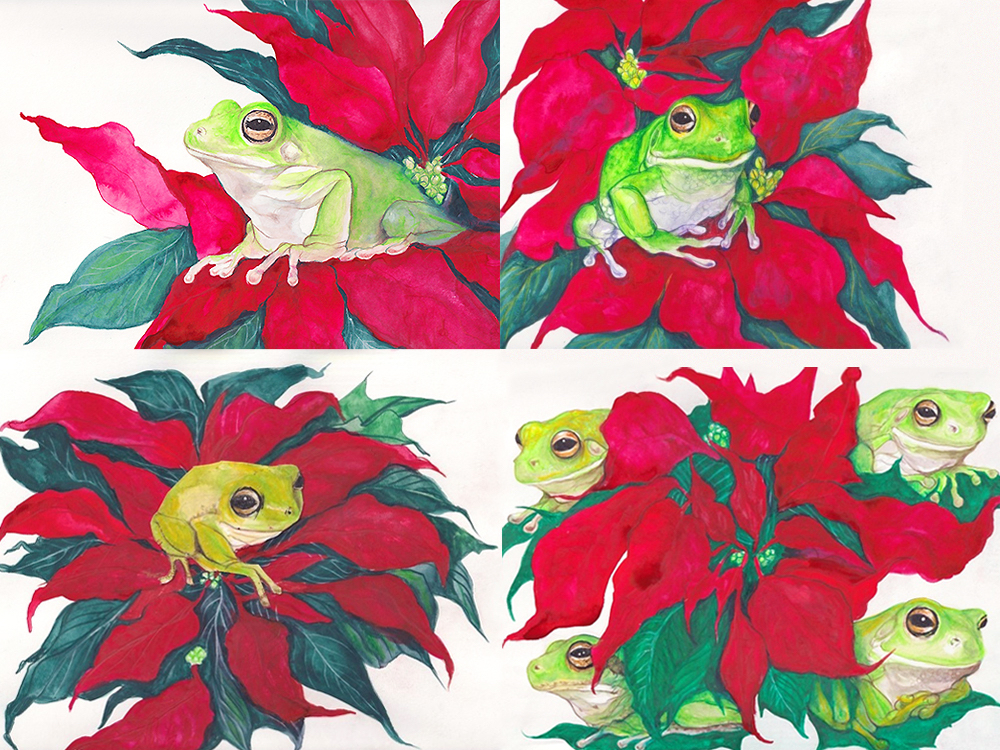
Instead of new material goods this holiday season, I’m searching for something more elusive and ultimately sustaining. And it may help us grow our appreciation for the natural world and its mysteries. Illustrations for The Tyee by Dorothy Woodend.

À propos given the name for this blog and the time of year. Thank you, Ms. Woodend!

I try not to do too many of these stories since the focus for this blog is new and emerging science and technology but I can’t resist including these frog stories (and one dog story). Plus, there may be some tap dancing.

A new (!) fanged frog in Indonesia

This is not the tiny Indonesian fanged frog but it does show you what a fanged frog looks like, from the December 21, 2023 “What Are Fanged Frogs?” posting on the Vajiram and Ravi IAS Study Center website,
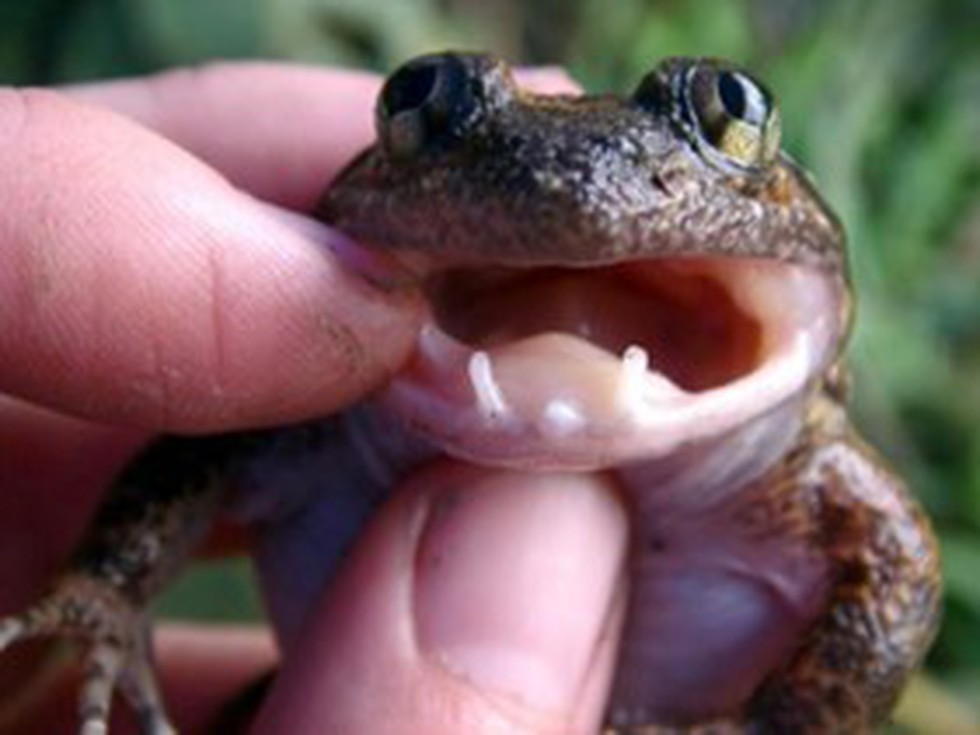
Not an Indonesian fanged frog. h/t Vajiram and Ravi IAS Study Center [downloaded from https://vajiramias.com/current-affairs/what-are-fanged-frogs/658416a9f0e178517404afda/]

If you don’t have much time and are interested in the latest fanged frog, check out the December 21, 2023 “What Are Fanged Frogs?” posting as they have relevant information in bullet point form.

On to the specifics about the ‘new’ fanged frog from a December 21, 2023 news item on ScienceDaily,

In general, frogs’ teeth aren’t anything to write home about — they look like pointy little pinpricks lining the upper jaw. But one group of stream-dwelling frogs in Southeast Asia has a strange adaptation: two bony “fangs” jutting out of their lower jawbone. They use these fangs to battle with each other over territory and mates, and sometimes even to hunt tough-shelled prey like giant centipedes and crabs. In a new study, published in the journal PLOS [Public Library of Science] ONE, researchers have described a new species of fanged frog: the smallest one ever discovered.

“This new species is tiny compared to other fanged frogs on the island where it was found, about the size of a quarter,” says Jeff Frederick, a postdoctoral researcher at the Field Museum in Chicago and the study’s lead author, who conducted the research as a doctoral candidate at the University of California, Berkeley.

A December 20, 2023 Field Museum news release (also on EurrekAlert), which originated the news item, adds more detail,

“Many frogs in this genus are giant, weighing up to two pounds. At the large end, this new species weighs about the same as a dime.”

In collaboration with the Bogor Zoology Museum, a team from the McGuire Lab at Berkeley   found the frogs on Sulawesi, a rugged, mountainous island that makes up part of Indonesia. “It’s a giant island with a vast network of mountains, volcanoes, lowland rainforest, and cloud forests up in the mountains. The presence of all these different habitats mean that the magnitude of biodiversity across many plants and animals we find there is unreal – rivaling places like the Amazon,” says Frederick.

While trekking through the jungle, members of the joint US-Indonesia amphibian and reptile research team noticed something unexpected on the leaves of tree saplings and moss-covered boulders: nests of frog eggs.

Frogs are amphibians, and they lay eggs that are encapsulated by jelly, rather than a hard, protective shell. To keep their eggs from drying out, most amphibians lay their eggs in water. To the research team’s surprise, they kept spotting the terrestrial egg masses on leaves and mossy boulders several feet above the ground. Shortly after, they began to see the small, brown frogs themselves.

“Normally when we’re looking for frogs, we’re scanning the margins of stream banks or wading through streams to spot them directly in the water,” Frederick says. “After repeatedly monitoring the nests though, the team started to find attending frogs sitting on leaves hugging their little nests.” This close contact with their eggs allows the frog parents to coat the eggs with compounds that keep them moist and free from bacterial and fungal contamination.

Closer examination of the amphibian parents revealed not only that they were tiny members of the fanged frog family, complete with barely-visible fangs, but that the frogs caring for the clutches of eggs were all male. “Male egg guarding behavior isn’t totally unknown across all frogs, but it’s rather uncommon,” says Frederick.

Frederick and his colleagues hypothesize that the frogs’ unusual reproductive behaviors might also relate to their smaller-than-usual fangs. Some of the frogs’ relatives have bigger fangs, which help them ward off competition for spots along the river to lay their eggs in the water. Since these frogs evolved a way to lay their eggs away from the water, they may have lost the need for such big imposing fangs. (The scientific name for the new species is Limnonectes phyllofolia; phyllofolia means “leaf-nester.”)

“It’s fascinating that on every subsequent expedition to Sulawesi, we’re still discovering new and diverse reproductive modes,” says Frederick. “Our findings also underscore the importance of conserving these very special tropical habitats. Most of the animals that live in places like Sulawesi are quite unique, and habitat destruction is an ever-looming conservation issue for preserving the hyper-diversity of species we find there. Learning about animals like these frogs that are found nowhere else on Earth helps make the case for protecting these valuable ecosystems.”

Here’s a link to and a citation for the paper,

A new species of terrestrially-nesting fanged frog (Anura: Dicroglossidae) from Sulawesi Island, Indonesia by Jeffrey H. Frederick, Djoko T. Iskanda, Awal Riyanto, Amir Hamidy, Sean B. Reilly, Alexander L. Stubbs, Luke M. Bloch, Bryan Bach, Jimmy A. McGuire. PLOS ONE 18(12): e0292598 DOI: https://doi.org/10.1371/journal.pone.0292598 Published: December 20, 2023

This paper is open access and online only.

Fatal attraction to … frog noses?

Bob Yirka in a November 28, 2023 article published on phys.org describes research into some unusual mosquito behaviour, Note: Links have been removed,

A pair of environmental and life scientists, one with the University of Newcastle, in Australia, the other the German Center for Integrative Biodiversity Research, has found that one species of mosquito native to Australia targets only the noses of frogs for feeding. In their paper published in the journal Ethology, John Gould and Jose Valdez describe their three-year study of frogs and Mimomyia elegans, a species of mosquito native to Australia

As part of their study of frogs living in a pond on Kooragang Island, the pair took a lot of photographs of the amphibians in their native environment. It was upon returning to their lab and laying out the photographs that they noticed something unique—any mosquito feeding on a frog’s blood was always atop its nose. This spot, they noted, seemed precarious, as mosquitos are part of the frog diet.

A mosquito perches on the nose of a green and yellow frog perched on a branch.
A species of Australian mosquito, Mimomyia elegans, appears to have a predilection for the nostrils of tree frogs, according to new observations published in the journal Ethology. (John Gould) [downloaded from https://www.cbc.ca/radio/asithappens/mosquitoes-on-frog-noses-1.7058168]

Sheena Goodyear posted a December 13, 2023 article containing an embedded Canadian Broadcasting Corporation (CBC) As It Happens radio programme audio file of an interview with researcher John Gould, Note: A link has been removed,

So why risk landing on the nose of something that wants to eat you, when there are so many other targets walking around full of delicious blood?

“In all of the occasions that we observed, it seems as if the frog didn’t realize that it had a mosquito on top of it…. They were actually quite happy, just sitting idly, while these mosquitoes were feeding on them,” Gould said.

“So it might be that the area between the eyes is a bit of a blind spot for the frogs.”

It’s also something of a sneak attack by the mosquitoes.

“Some of the mosquitoes first initially landed on the backs of the frogs,” Gould said. “They might avoid being eaten by the frogs by landing away from the head and then walking up to the nostrils to feed.

It’s a plausible theory, says amphibian expert Lea Randall, a Calgary Zoo and Wilder Institute ecologist who wasn’t involved in the research. 

“Frogs have amazing vision, and any mosquito that approached from the front would likely end up as a tasty snack for a frog,” she said.

“Landing on the back and making your way undetected to the nostrils is a good strategy.”

And the reward may just be worth the risk. 

“I could also see the nostrils as being a good place to feed as the skin is very thin and highly vascularized, and thus provides a ready source of blood for a hungry mosquito,” Randall said.

Gould admits his friends and loved ones have likely grown weary of hearing him “talking about frogs and nostrils.” But for him, it’s more than a highly specific scientific obsession; it’s about protecting frogs.

His earlier research has suggested that mosquitoes may be a vector for transmitting amphibian chytrid fungus, which is responsible for declines in frog populations worldwide. 

That’s why he had been amassing photos of frogs and mosquitoes in the first place.

“Now that we know where the mosquito is more likely to land, it might give us a better impression about how the infection spreads along the skin of the frog,” he said.

But more work needs to be done. His frog nostril research, while it encompasses three years’ of fieldwork, is a natural history observation, not a laboratory study with controlled variables.

“It would be quite interesting to know whether this particular type of mosquito is transferring the chytrid fungus, and also how the fungus spreads once the mosquito has landed,” Gould said.

A man in a bright yellow jacket and a light strapped to his forehead poses outside at night with a tiny frog perched on his hand.
Gould describes himself as a ‘vampire scientist’ who stays up all night studying nocturnal tree frogs in Australia. ‘They’re so soft and timid a lot of the times,’ he said. ‘They’re quite a special little, little animal.’ (Submitted by John Gould)

Vampire scientist, eh? You can find the embedded 6 mins. 28 secs. audio file in the December 13, 2023 article on the CBC website.

Here’s a link to and a citation for the research paper,

A little on the nose: A mosquito targets the nostrils of tree frogs for a blood meal by John Gould, Jose W. Valdez. Ethology DOI: https://doi.org/10.1111/eth.13424 First published: 21 November 2023

This paper is open access.

Gifted dogs

Caption: Shira, 6 -year-old, female, Border Collie mix, that was rescued at a young age. She lives in New Jersey, and knows the names of 125 toys. Credit Photo: Tres Hanley-Millman

A December 14, 2023 news item on phys.org describes some intriguing research from Hungary,

All dog owners think that their pups are special. Science now has documented that some rare dogs are even more special. They have a talent for learning hundreds of names of dog toys. Due to the extreme rarity of this phenomenon, until recently, very little was known about these dogs, as most of the studies that documented this ability included only a small sample of one or two dogs.

A December 18,2023 Eötvös Loránd University (ELTE) press release (also on EurekAlert but published December 14, 2023), which originated the news item, delves further into the research,

In a previous study, the scientists found that only very few dogs could learn the names of object, mostly dog toys. The researchers wanted to understand this phenomenon better and, so they needed to find more dogs with this ability. But finding dogs with this rare talent was a challenge! For five years, the researchers tirelessly searched across the world for these unique Gifted Word Learner (GWL) dogs. As part of this search, in 2020, they launched a social media campaign and broadcasted their experiments with GWL dogs, in the hope of finding more GWL dogs.

“This was a citizen science project” explains Dr. Claudia Fugazza, team leader. “When a dog owner told us they thought their dog knew toy names, we gave them instructions on how to self-test their dog and asked them to send us the video of the test”. The researchers then held an online meeting with the owners to test the dog’s vocabulary under controlled conditions and, if the dog showed he knew the names of his toys, the researchers asked the owners to fill out a questionnaire. “In the questionnaire, we asked the owners about their dog’s life experience, their own experience in raising and training dogs, and about the process by which the dog came to learn the names of his/her toys” explains Dr. Andrea Sommese, co-author.

VIDEO ABSTRACT ABOUT THE RESEARCH

The researchers found 41 dogs from 9 different countries: the US, the UK, Brazil, Canada, Norway, Netherlands, Spain, Portugal and Hungary. Most of the previous studies on this topic included Border collies. So, while object label learning is very rare even in Border collies, it was not surprising that many of the dogs participating in the current study (56%) belonged to this breed. However, the study documented the ability to learn toy names in a few dogs from non-working breeds, such as two Pomeranians, one Pekingese, one Shih Tzu, a Corgi, a Poodle, and a few mixed breeds.

“Surprisingly, most owners reported that they did not intentionally teach their dogs toy names, but rather that the dogs just seemed to spontaneously pick up the toy names during unstructured play sessions,” says Shany Dror, lead researcher. In addition, the vast majority of owners participating in the study had no professional background in dog training and the researchers found no correlations between the owners’ level of experience in handling and training dogs, and the dogs’ ability to select the correct toys when hearing its names.

“In our previous studies we have shown that GWL dogs learn new object names very fast” explains Dror. “So, it is not surprising that when we conducted the test with the dogs, the average number of toys known by the dogs was 29, but when we published the results, more than 50% of the owners reported that their dogs had already acquired a vocabulary of over 100 toy names”.

“Because GWL dogs are so rare, until now there were only anecdotes about their background” explains Prof. Adam Miklósi, Head of the Ethology Department at ELTE and co-author. “The rare ability to learn object names is the first documented case of talent in a non-human species. The relatively large sample of dogs documented in this study, helps us to identify the common characteristics that are shared among these dogs, and brings us one step closer in the quest of understanding their unique ability”.

This research is part of the Genius Dog Challenge research project which aims to understand the unique talent that Gifted Word Learner dogs have. The researchers encourage dog owners who believe their dogs know multiple toy names, to contact them via the Genius Dog Challenge website.

Here’s a link to and a citation for the research paper,

A citizen science model turns anecdotes into evidence by revealing similar characteristics among Gifted Word Learner dogs by Shany Dror, Ádám Miklósi, Andrea Sommese & Claudia Fugazza. Scientific Reports volume 13, Article number: 21747 (2023) DOI: https://doi.org/10.1038/s41598-023-47864-5 Published: 14 December 2023

This paper is open access.

The End with an origin story NORAD’s Santa Tracker and some tap dancing

At the height of Cold War tensions between the US and Russia, the red phone (to be used only by the US president or a four star genera) rang at the North American Aerospace Defense Command (NORAD). Before the conversation ended, the colonel in charge had driven a child to tears and put in motion the start of a beloved Christmas tradition.

There’s a short version and a long version and if you want all the details read both,

As for the tap dancing, I have three links:

  1. Irish Dancers Face Off Against American Tap Dancers To Deliver EPIC Performance!” is an embedded 8 mins. dance off video (scroll down past a few paragraphs) in Erin Perri’s September 1, 2017 posting for themix.net. And, if you scroll further down to the bottom of Perri’s post, you’ll see an embedded video of Sammy Davis Jr.

In the video …, along with his dad and uncle, Sammy performs at an unbelievable pace. In the last 30 seconds of this routine, Sammy demonstrates more talent than other dancers are able to cram into a lifelong career! You can see these three were breakdancing long before it became a thing in the 1980s and they did it wearing tap shoes!

..

2. “Legendary Nicholas Brothers Dance Routine Was Unrehearsed and Filmed in One Take” embedded at the end of Emma Taggart’s October 4, 2019 posting on mymodernmet.com

3. Finally, there’s “Jill Biden releases extravagant dance video to celebrate Christmas at the White House” with a video file embedded (wait for it to finish loading and scroll down a few paragraphs) in Kate Fowler’s December 15, (?) 2023 article for MSN. It’s a little jazz, a little tap, and a little Christmas joy.

Joyeux Noël!