Tag Archives: Jan Steyaert

Limiting the side effects of opioids with a new nanobody?

As someone who lives in a Canadian province (British Columbia) where a public health emergency was declared in 2016 due to drug overdose deaths, this research from Switzerland interests me greatly.

Here’s the situation, eight years after the declaration, the numbers are still rising, from an April 14, 2024 article by Darryl Greer for Canadian Press on the Canadian Broadcasting Corporation (CBC) news online website,

8 years and 14,000 deaths later, B.C.’s drug emergency rages on

More than 14,000 people have died since emergency declared in 2016, largely due to the potent opioid fentanyl

There’s some promising work from the University of Geneva, which could lessen opioid side effects, from an October 9, 2024 news item on phys.org, Note: A link has been removed,

Opioid drugs are highly effective at relieving pain but come with severe drawbacks. Their side effects range from dizziness to potentially fatal respiratory depression. Their illegal use contributes to nearly half a million deaths worldwide each year.

Researchers from the University of Geneva (UNIGE) have discovered a molecule, called nanobody NbE, which binds tightly and durably to the cell receptors that usually bind to opioids, thereby blocking the drugs’ activity. Moreover, the scientists were able to create even smaller molecules that retain the same properties, which could prove far more effective than current treatments in mitigating the harmful effects of opioids.

An October 9, 2024 Université de Genève press release (also on EurekAlert), which originated the news item, provides more information about how a nanobody could help blunt opioid side effects,

Opioids are a large family of pharmaceuticals that include morphine, fentanyl and tramadol. These powerful drugs are mainly used as painkillers, but also trigger a euphoric effect by interacting with nerve cells in the brain. However, they are very addictive and produce dangerous side effects. Diverted from their original use, natural and synthetic opioids have become the deadliest drugs in the United States, and this global health crisis is now threatening Europe.


“We need to urgently develop new molecules to better mitigate the side effects for patients and manage the risks of opioid-related overdoses”, explains Miriam Stoeber, associate professor in the Department of Cell Physiology and Metabolism at UNIGE Faculty of Medicine, who initiated and coordinated the project. “To understand how a molecule works, we need to know how it affects the brain cells. In our study, we used tiny natural proteins derived from llama antibodies, called nanobodies, designed to bind specifically to the target receptor on the cell’s surface.”


The strong binding power of nanobody NbE 

UNIGE researchers have found that NbE, one of the nanobodies under study, has the unique ability to bind so tightly and durably to specific opioid receptors that it prevents opioids from binding to these same receptors, therefore blocking the drug’s activity. “To determine how NbE binds to its target, we used high resolution structural biology methods, thanks to the new Dubochet Centre for Imaging”, describes Andreas Boland, assistant professor in the Department of Molecular and Cellular Biology at UNIGE Faculty of Science, and co-last author of the study. “We identified a unique binding mode where only a small portion of the nanobody is responsible for its correct receptor selectivity. Knowing precisely which part of the nanobody is at stake allows us to imagine new ways to induce the same effects with pharmaceuticals.”

Small molecules, large effects 

While significantly smaller than antibodies, nanobodies remain quite large. They can be costly to produce and may not fully reach the target tissue in the body. In collaboration with the Prof. Steven Ballet team from the University of Brussels, the UNIGE research team synthesised in vitro a set of even smaller molecules mimicking the key part of NbE responsible for the selected binding to opioid receptors. “By durably blocking opioid receptors, our new molecules have the potential to reverse or reduce the deleterious side effects of opioids. In case of overdose, they could provide a better, longer lasting option than naloxone, the treatment currently in use. We will now refine their structure to improve even further their efficiency and facilitate their delivery to the targeted nerve cells in the brain”, concludes Miriam Stoeber.

Here’s an illustration of the nanobody at work,

Caption: NbE (red) binds the specific receptor responsible for opioid action (blue) and blocks off other small molecules (white/yellow/red). Credit: © UNIGE

Here’s a link to and a citation for the paper,

Structural basis of μ-opioid receptor targeting by a nanobody antagonist by Jun Yu, Amit Kumar, Xuefeng Zhang, Charlotte Martin, Kevin Van holsbeeck, Pierre Raia, Antoine Koehl, Toon Laeremans, Jan Steyaert, Aashish Manglik, Steven Ballet, Andreas Boland & Miriam Stoeber. Nature Communications volume 15, Article number: 8687 (2024) DOI: https://doi.org/10.1038/s41467-024-52947-6 Published: 09 October 2024

This paper is open access.

Nanobody could lead to treatment for retinitis pigmentosa (a condition that leads to blindness)

This is an image illustrating the work but you’ll probably need to read the news release to understand the explanation offered,
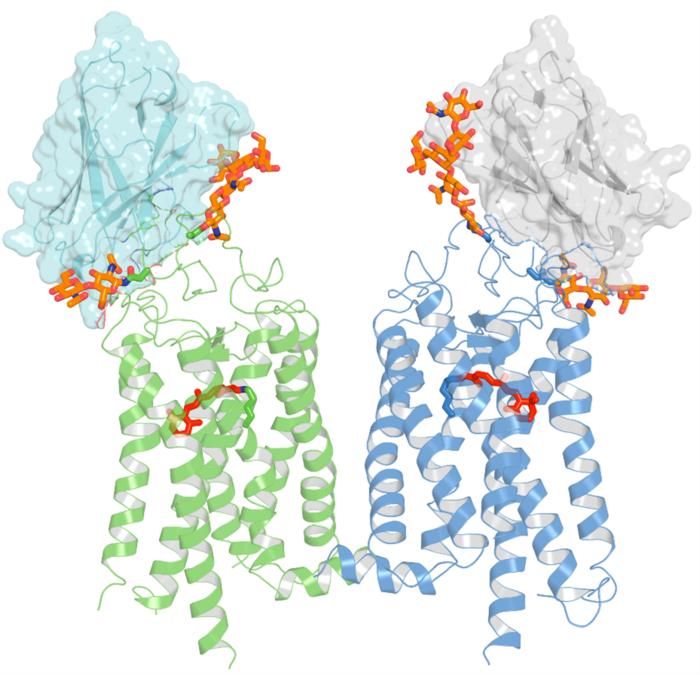
Caption: This image depicts the crystal structure of two nanobodies binding to a rhodopsin dimer. The rhodopsin molecules are shown in green and blue, with 11-cis-retinal displayed in red. The figure emphasizes the significant interactions between the nanobodies (represented in a semi-transparent surface cartoon) and the extracellular surface of rhodopsin, including its N-terminal glycans highlighted in orange.. Credit: UCI [University of California at Irvine] School of Medicine

The research from the University of California at Irvine (UCI) has been featured twice, in an August 31, 2023 news item on phys.org and again in a September 7, 2023 news item on ScienceDaily.

An August 29, 2023 UCI news release (also on EurekAlert but published Sept. 6, 2023), which originated the news items, provides information about RP and the nanobodies,

A team of scientists from the University of California, Irvine, believe they have discovered a special antibody which may lead to a treatment for Retinitis Pigmentosa, a condition that causes loss of central vision, as well as night and color vision. 

The study, Structural basis for the allosteric modulation of rhodopsin by nanobody binding to its extracellular domain, was published in Nature Communications. Authors of the study were Arum Wu, PhD, David Salom, PhD, John D. Hong, Aleksander Tworak, PhD, Philip D. Kiser, PharmD, PhD, and Krzysztof Palczewski, PhD, in the Department of Ophthalmology, Gavin Herbert Eye Institute, at the University of California, Irvine. Research was conducted  in collaboration with Jan Steyaert, PhD, at the Vrije Universiteit Brussel (VUB).

Retinitis Pigmentosa (RP) is a group of inherited eye diseases that affect the retina in the back of the eye. It is caused by the death of cells that detect light signals, known as photoreceptor cells. There is no known cure for RP, and the development of new treatments for this condition relies on cell and gene therapies. 

UCI researchers have targeted their study on a specific molecule which they believe will provide a treatment for Rhodopsin-associated autosomal dominant RP (adRP). The molecule, Rhodopsin, is a key light-sensing molecule in the human retina. It is found in rod photoreceptor cells, and mutations in the Rhodopsin gene are a primary cause of adRP. 

“More than 150 mutations in rhodopsin can cause Retinitis Pigmentosa, making it challenging to develop targeted gene therapies,” said Krzysztof Palczewski, PhD, Donald Bren Professor, UCI School of Medicine. “However due to the high prevalence of RP, there has been significant investment in research and development efforts to find novel treatments.”

Although Rhodopsin has been studied for over a century, key details of its mechanism for converting light into a cellular signal have been difficult to experimentally address.

For this study, researchers used a special type of llama-derived antibody, known as a nanobody, that can halt the process of Rhodopsin photoactivation, allowing it to be investigated at high resolution. 

“Our team has developed nanobodies that work through a novel mechanism of action. These nanobodies have high specificity and can recognize the target rhodopsin extracellularly,” said David Salom , PhD, researcher and project scientist, UCI School of Medicine. “This enables us to lock this GPCR in a non-signaling state.” 

Scientists discovered that these nanobodies target an unexpected site on the Rhodopsin molecule, near the location where retinaldehyde binds. They also found that the stabilizing effect of these nanobodies can also be applied to Rhodopsin mutants that are associated with retinal disease, suggesting their use as therapeutics. 

“In the future, we hope to involve the in vitro evolution of these initial set of nanobodies,” said Arum Wu, PhD, researcher and project scientist, UCI School of Medicine. “We will also evaluate the safety and effectiveness of a future nanobody gene therapy for RP.”

Researchers hope to improve nanobodies’ ability to recognize Rhodopsin from other species including mice, for which several pre-clinical models of adRP are available. They also have plans to use these nanobodies to address a long-term goal in the field of structurally resolving the key intermediate states of Rhodopsin from the inactive state to the fully ligand-activated state.

Here’s a link to and a citation for the paper,

Structural basis for the allosteric modulation of rhodopsin by nanobody binding to its extracellular domain by Arum Wu, David Salom, John D. Hong, Aleksander Tworak, Kohei Watanabe, Els Pardon, Jan Steyaert, Hideki Kandori, Kota Katayama, Philip D. Kiser & Krzysztof Palczewski. Nature Communications volume 14, Article number: 5209 (2023) DOI: https://doi.org/10.1038/s41467-023-40911-9 Published: 25 August 2023

This paper is open access.