Tag Archives: Delft University of Technology (TU Delft)

The beginnings of a quantum network link between Dutch cities

Dutch researchers, having previously announced a multi-node quantum network of three quantum processors (see my July 8, 2021 posting), are now part of an international team which has announced in an October 30, 2024 news item on ScienceDaily, a further advancement toward a future quantum internet,

An international research team led by QuTech has demonstrated a network connection between quantum processors over metropolitan distances. Their result marks a key advance from early research networks in the lab towards a future quantum internet. The team developed fully independently operating nodes and integrated these with deployed optical internet fibre, enabling a 25 km quantum link. The researchers published their findings in Science Advances.

For anyone unfamiliar with QuTech, here’s the explanation I had in my July 8, 2021 posting,

… Note: QuTech is the research center for Quantum Computing and Quantum Internet, a collaboration between TU Delft [added December 16, 2024: Delft University of Technology] and TNO is Nederlandse Organisatie voor Toegepast Natuurwetenschappelijk Onderzoek (English: Netherlands Organisation for Applied Scientific Research), an independent research organization) …

An October 31, 2024 Delft University of Technology press release (also on EurekAlert but published on October 30, 2024 and also published as a Fraunhofer ILT [Fraunhofer Institute for Laser Technology] October 30, 2024 press release), which originated the news item, provides more information about the research, Note: A link has been removed,

The internet allows people to share information (bits) globally. A future quantum internet will enable sharing quantum information (qubits) over a new type of network. Such qubits can not only take the values 0 or 1, but also superpositions of those (0 and 1 at the same time). In addition, qubits can be entangled, which means they share a quantum connection enabling instant correlations, no matter the distance.

Researchers around the globe are working to build quantum networks that make use of these features to offer fundamentally new communication and computing capabilities, in coexistence with the current internet. For example, qubits can generate secure encryption keys for safely sharing financial or medical data. Quantum links can also connect distant quantum computers, enhancing their power and allowing access with full privacy for users.

Moving out of the lab

An international team led by Ronald Hanson at QuTech—a collaboration between the TU Delft and TNO—was able to connect two small quantum computers between the Dutch cities of Delft and The Hague. “The distance over which we create quantum entanglement in this project, via 25 km of deployed underground fiber, is a record for quantum processors,” says Hanson. “This is the first time such quantum processors in different cities are connected.”

A few years ago the team reported the first multi-node quantum network inside the lab. “We were faced with new major challenges in going from these lab experiments to realizing a quantum link between cities. We had to design a flexible system that lets the nodes work independently over long distances, we needed to mitigate the impact of photon loss on the connection speed, and we had to ensure reliable confirmation each time the entanglement link was successfully created. Without these innovations, such a large distance would not have been possible.”

‘Like keeping the moon at a constant distance’

To tackle the challenge of photon loss, the team established the quantum connection using a photon-efficient protocol that required very precise stabilization of the connecting fiber link. Co-author Arian Stolk explains using an analogue: “The link needed to be stable well within the wavelength of the photons (smaller than a micrometer) over 25 kilometer of optical fiber. That challenge compares to keeping the distance between the earth and the moon constant with the accuracy of only a few millimeter. Through a combination of research insights and applied engineering, we were able to solve this puzzle.”

“In this work, we demonstrate successful entanglement between two quantum network nodes containing diamond spin qubits. The independently operated nodes are connected through a midpoint station via optical fiber. We were able to reliably deliver a pre-specified entangled state between the nodes.”

Collaboration between academia and industry

Co-author Kian van der Enden explains how indispensable the broad expertise of the team was for the success of the project: “Fraunhofer ILT developed a critical component for this demonstration, a new type of quantum frequency converter. OPNT delivered state-of-the-art timing hardware, Element Six provided its engineered synthetic diamond materials and Toptica developed high-stability lasers. Finally, Dutch telecom provider KPN provided the fiber infrastructure as well as the locations of the nodes, the midpoint, and the node in The Hague.”

Solid foundation for European quantum internet

This result is an important milestone that addresses key scaling challenges for future quantum networks. Jesse Robbers, Director Industry & Digital Infrastructure of Quantum Delta NL that co-funded the research, adds: “We continue to show leadership in the development of the future fundament of our Digital Infrastructure and how to make it applicable, which is the core of the national and European strategy.”

The architecture and methods are directly applicable to other qubit platforms, including the next-generation scalable qubits that the team is currently developing. The successful use of deployed, conventional internet infrastructure sets the stage for a new phase on the road towards a quantum internet. Hanson: “This work marks the crucial step out of the research lab into the field, enabling exploration of first quantum processor networks at metropolitan scale.”

Here’s a link to and a citation for the paper,

Metropolitan-scale heralded entanglement of solid-state qubits by Arian J. Stolk, Kian L. van der Enden, Marie-Christine Slater, Ingmar te Raa-Derckx, Pieter Botma, Joris van Rantwijk, J. J. Benjamin Biemond, Ronald A. J. Hagen, Rodolf W. Herfst, Wouter D. Koek, Adrianus J. H. Meskers, René Vollmer, Erwin J. van Zwet, Matthew Markham, Andrew M. Edmonds, J. Fabian Geus, Florian Elsen, Bernd Jungbluth, Constantin Haefner, Christoph Tresp, Jürgen Stuhler, Stephan Ritter, and Ronald Hanson. Science Advances 30 Oct 2024 Vol 10, Issue 44 DOI: 10.1126/sciadv.adp6442

This paper is open access.

Nanostrings that vibrate for a long, long, long time at ambient termperatures

It was the ‘ambient temperature’ that caught my attention, from a May 22, 204 news item on Nanowerk, Note: Links have been removed, Note: Much exciting work has to be conducted at very, very cold or very, very hot temperatures, so, ambient or room temperature is a big deal,

Researchers from TU Delft [Delft University of Technology] and Brown University have engineered string-like resonators capable of vibrating longer at ambient temperature than any previously known solid-state object — approaching what is currently only achievable near absolute zero temperatures. Their study, published in Nature Communications (“Centimeter-scale nanomechanical resonators with low dissipation”), pushes the edge of nanotechnology and machine learning to make some of the world’s most sensitive mechanical sensors.

Caption: Artist impression of new nanostrings that can vibrate for a very long time. These nanostrings vibrate more than 100.000 times per second. Because it’s difficult for energy to leak out, it also means environmental noise is hard to get in, making these some of the best sensors for room temperature environments. Credit: Richard Norte

A May 21, 2024 Delft University of Technology news release (also on EurekAlert but published May 22, 2024), which originated the news item, explains why the research is considered exciting,

A 100 year swing on a microchip

“Imagine a swing that, once pushed, keeps swinging for almost 100 years because it loses almost no energy through the ropes,” says associate professor Richard Norte. “Our nanostrings do something similar but rather than vibrating once per second like a swing, our strings vibrate 100,000 times per second. Because it’s difficult for energy to leak out, it also means environmental noise is hard to get in, making these some of the best sensors for room temperature environments.

This innovation is pivotal for studying macroscopic quantum phenomena at room temperature—environments where such phenomena were previously masked by noise. While the weird laws of quantum mechanics are usually only seen in single atoms, the nanostrings’ ability to isolate themselves from our everyday heat-based vibrational noise allows them to open a window into their own quantum signatures; strings made from billions of atoms. In everyday environments, this kind of capability would have interesting uses for quantum-based sensing.

Extraordinary match between simulation and experiment

“Our manufacturing process goes in a different direction with respect to what is possible in nanotechnology today,” said Dr. Andrea Cupertino, who spearheaded the experimental efforts. The strings are 3 centimetres long and 70 nanometres thick, but scaled up, this would be the equivalent of manufacturing guitar strings of glass that are suspended half a kilometre with almost no sag. “This kind of extreme structures are only feasible at nanoscales where the effects of gravity and weight enter differently. This allows for structures that would be unfeasible at our everyday scales but are particularly useful in miniature devices used to measure physical quantities such as pressure, temperature, acceleration and magnetic fields, which we call MEMS sensing,” explains Cupertino.

The nanostrings are crafted using advanced nanotechnology techniques developed at the TU Delft, pushing the boundaries of how thin and long suspended nanostructures can be made. A key of the collaboration is that these nanostructures can be made so perfectly on a microchip, that there is an extraordinary match between simulations and experiments – meaning that simulations can act as the data for machine learning algorithms, rather than costly experiments. “Our approach involved using machine learning algorithms to optimize the design without continuously fabricating prototypes,” noted lead author Dr. Dongil Shin, who developed these algorithms with Miguel Bessa. To further enhance efficiency of designing these large detailed structures, the machine learning algorithms smartly utilised insights from simpler, shorter string experiments to refine the designs of longer strings, making the development process both economical and effective.

According to Norte, the success of this project is a testament to the fruitful collaboration between experts in nanotechnology and machine learning, underscoring the interdisciplinary nature of cutting-edge scientific research.

Inertial navigation and next-generation microphones

The implications of these nanostrings extend beyond basic science. They offer promising new pathways for integrating highly sensitive sensors with standard microchip technology, leading to new approaches in vibration-based sensing. While these initial studies focus on strings, the concepts can be expanded to more complex designs to measure other important parameters like acceleration for inertial navigation or something looking more like a vibrating drumhead for next-generation microphones. This research demonstrates the vast array of possibilities when combining nanotechnology advances with machine learning to open new frontiers in technology.

Here’s a link to and a citation for the paper,

Centimeter-scale nanomechanical resonators with low dissipation by Andrea Cupertino, Dongil Shin, Leo Guo, Peter G. Steeneken, Miguel A. Bessa & Richard A. Norte. Nature Communications volume 15, Article number: 4255 (2024) DOI: https://doi.org/10.1038/s41467-024-48183-7 Published: 18 May 2024

This paper is open access.

I have highlighted work from this team previously in a September 15, 2022 posting, “One of world’s most precise microchip sensors thanks to nanotechnology, machine learning, extended cognition, and spiderwebs.”

One of world’s most precise microchip sensors thanks to nanotechnology, machine learning, extended cognition, and spiderwebs

I love science stories about the inspirational qualities of spiderwebs. A November 26, 2021 news item on phys.org describes how spiderwebs have inspired advances in sensors and, potentially, quantum computing,,

A team of researchers from TU Delft [Delft University of Technology; Netherlands] managed to design one of the world’s most precise microchip sensors. The device can function at room temperature—a ‘holy grail’ for quantum technologies and sensing. Combining nanotechnology and machine learning inspired by nature’s spiderwebs, they were able to make a nanomechanical sensor vibrate in extreme isolation from everyday noise. This breakthrough, published in the Advanced Materials Rising Stars Issue, has implications for the study of gravity and dark matter as well as the fields of quantum internet, navigation and sensing.
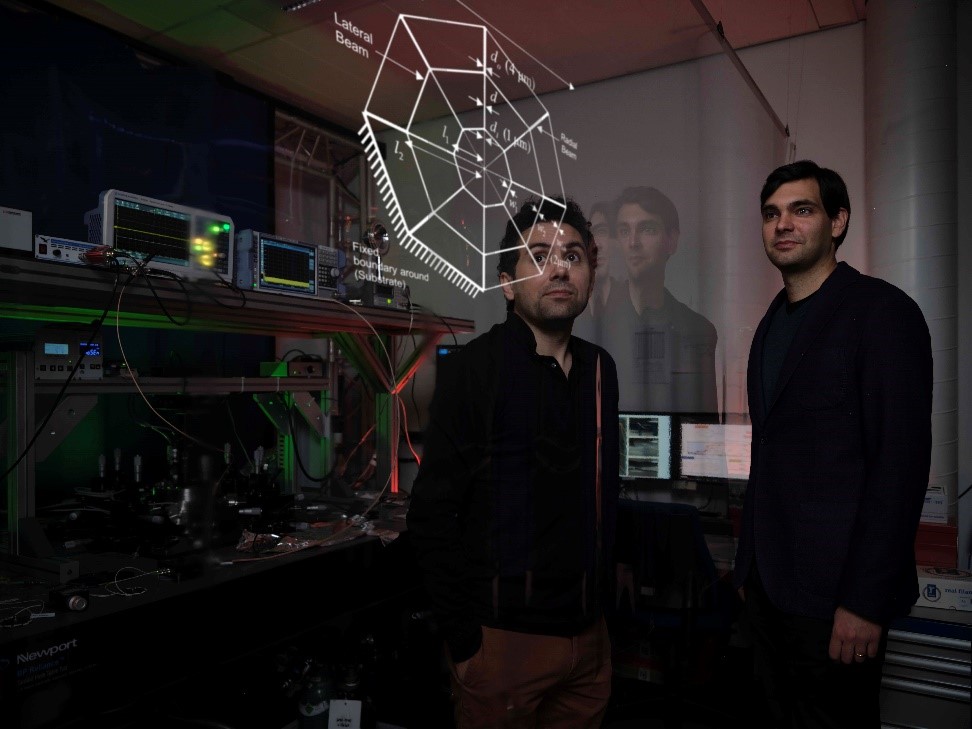
Inspired by nature’s spider webs and guided by machine learning, Richard Norte (left) and Miguel Bessa (right) demonstrate a new type of sensor in the lab. [Photography: Frank Auperlé]

A November 24, 2021 TU Delft press release (also on EurekAlert but published on November 23, 2021), which originated the news item, describes the research in more detail,

One of the biggest challenges for studying vibrating objects at the smallest scale, like those used in sensors or quantum hardware, is how to keep ambient thermal noise from interacting with their fragile states. Quantum hardware for example is usually kept at near absolute zero (−273.15°C) temperatures, with refrigerators costing half a million euros apiece. Researchers from TU Delft created a web-shaped microchip sensor which resonates extremely well in isolation from room temperature noise. Among other applications, their discovery will make building quantum devices much more affordable.

Hitchhiking on evolution
Richard Norte and Miguel Bessa, who led the research, were looking for new ways to combine nanotechnology and machine learning. How did they come up with the idea to use spiderwebs as a model? Richard Norte: “I’ve been doing this work already for a decade when during lockdown, I noticed a lot of spiderwebs on my terrace. I realised spiderwebs are really good vibration detectors, in that they want to measure vibrations inside the web to find their prey, but not outside of it, like wind through a tree. So why not hitchhike on millions of years of evolution and use a spiderweb as an initial model for an ultra-sensitive device?” 

Since the team did not know anything about spiderwebs’ complexities, they let machine learning guide the discovery process. Miguel Bessa: “We knew that the experiments and simulations were costly and time-consuming, so with my group we decided to use an algorithm called Bayesian optimization, to find a good design using few attempts.” Dongil Shin, co-first author in this work, then implemented the computer model and applied the machine learning algorithm to find the new device design. 

Microchip sensor based on spiderwebs
To the researcher’s surprise, the algorithm proposed a relatively simple spiderweb out of 150 different spiderweb designs, which consists of only six strings put together in a deceivingly simple way. Bessa: “Dongil’s computer simulations showed that this device could work at room temperature, in which atoms vibrate a lot, but still have an incredibly low amount of energy leaking in from the environment – a higher Quality factor in other words. With machine learning and optimization we managed to adapt Richard’s spider web concept towards this much better quality factor.”

Based on this new design, co-first author Andrea Cupertino built a microchip sensor with an ultra-thin, nanometre-thick film of ceramic material called Silicon Nitride. They tested the model by forcefully vibrating the microchip ‘web’ and measuring the time it takes for the vibrations to stop. The result was spectacular: a record-breaking isolated vibration at room temperature. Norte: “We found almost no energy loss outside of our microchip web: the vibrations move in a circle on the inside and don’t touch the outside. This is somewhat like giving someone a single push on a swing, and having them swing on for nearly a century without stopping.”

Implications for fundamental and applied sciences
With their spiderweb-based sensor, the researchers’ show how this interdisciplinary strategy opens a path to new breakthroughs in science, by combining bio-inspired designs, machine learning and nanotechnology. This novel paradigm has interesting implications for quantum internet, sensing, microchip technologies and fundamental physics: exploring ultra-small forces for example, like gravity or dark matter which are notoriously difficult to measure. According to the researchers, the discovery would not have been possible without the university’s Cohesion grant, which led to this collaboration between nanotechnology and machine learning.

Here’s a link to and a citation for the paper,

Spiderweb Nanomechanical Resonators via Bayesian Optimization: Inspired by Nature and Guided by Machine Learning by Dongil Shin, Andrea Cupertino, Matthijs H. J. de Jong, Peter G. Steeneken, Miguel A. Bessa, Richard A. Norte. Advanced Materials Volume34, Issue3 January 20, 2022 2106248 DOI: https://doi.org/10.1002/adma.202106248 First published (online): 25 October 2021

This paper is open access.

If spiderwebs can be sensors, can they also think?

it’s called ‘extended cognition’ or ‘extended mind thesis’ (Wikipedia entry) and the theory holds that the mind is not solely in the brain or even in the body. Predictably, the theory has both its supporters and critics as noted in Joshua Sokol’s article “The Thoughts of a Spiderweb” originally published on May 22, 2017 in Quanta Magazine (Note: Links have been removed),

Millions of years ago, a few spiders abandoned the kind of round webs that the word “spiderweb” calls to mind and started to focus on a new strategy. Before, they would wait for prey to become ensnared in their webs and then walk out to retrieve it. Then they began building horizontal nets to use as a fishing platform. Now their modern descendants, the cobweb spiders, dangle sticky threads below, wait until insects walk by and get snagged, and reel their unlucky victims in.

In 2008, the researcher Hilton Japyassú prompted 12 species of orb spiders collected from all over Brazil to go through this transition again. He waited until the spiders wove an ordinary web. Then he snipped its threads so that the silk drooped to where crickets wandered below. When a cricket got hooked, not all the orb spiders could fully pull it up, as a cobweb spider does. But some could, and all at least began to reel it in with their two front legs.

Their ability to recapitulate the ancient spiders’ innovation got Japyassú, a biologist at the Federal University of Bahia in Brazil, thinking. When the spider was confronted with a problem to solve that it might not have seen before, how did it figure out what to do? “Where is this information?” he said. “Where is it? Is it in her head, or does this information emerge during the interaction with the altered web?”

In February [2017], Japyassú and Kevin Laland, an evolutionary biologist at the University of Saint Andrews, proposed a bold answer to the question. They argued in a review paper, published in the journal Animal Cognition, that a spider’s web is at least an adjustable part of its sensory apparatus, and at most an extension of the spider’s cognitive system.

This would make the web a model example of extended cognition, an idea first proposed by the philosophers Andy Clark and David Chalmers in 1998 to apply to human thought. In accounts of extended cognition, processes like checking a grocery list or rearranging Scrabble tiles in a tray are close enough to memory-retrieval or problem-solving tasks that happen entirely inside the brain that proponents argue they are actually part of a single, larger, “extended” mind.

Among philosophers of mind, that idea has racked up citations, including supporters and critics. And by its very design, Japyassú’s paper, which aims to export extended cognition as a testable idea to the field of animal behavior, is already stirring up antibodies among scientists. …

It seems there is no definitive answer to the question of whether there is an ‘extended mind’ but it’s an intriguing question made (in my opinion) even more so with the spiderweb-inspired sensors from TU Delft.

Entanglement-based quantum network courtesy of Dutch researchers

Belated congratulations to the researchers at the Delft University of Technology! Very exciting news as an April 15, 2021 news item on ScienceDaily makes clear,

A team of researchers from QuTech in the Netherlands reports realization of the first multi-node quantum network, connecting three quantum processors. In addition, they achieved a proof-of-principle demonstration of key quantum network protocols. Their findings mark an important milestone towards the future quantum internet and have now been published in Science.

An April 15, 2021 Delft University of Technology (TU Delft) press release (also on EurekAlert), which originated the news item, describes the breakthrough in more detail, Note: QuTech is the research center for Quantum Computing and Quantum Internet, a collaboration between TU Delft and TNO is Nederlandse Organisatie voor Toegepast Natuurwetenschappelijk Onderzoek (English: Netherlands Organisation for Applied Scientific Research), an independent research organization),

The quantum internet

The power of the Internet is that it allows any two computers on Earth to be connected with each other, enabling applications undreamt of at the time of its creation decades ago. Today, researchers in many labs around the world are working towards first versions of a quantum internet – a network that can connect any two quantum devices, such as quantum computers or sensors, over large distances. Whereas today’s Internet distributes information in bits (that can be either 0 or 1), a future quantum internet will make use of quantum bits that can be 0 and 1 at the same time. ‘A quantum internet will open up a range of novel applications, from unhackable communication and cloud computing with complete user privacy to high-precision time-keeping,’ says Matteo Pompili, PhD student and a member of the research team. ‘And like with the Internet 40 years ago, there are probably many applications we cannot foresee right now.’

Towards ubiquitous connectivity

The first steps towards a quantum internet were taken in the past decade by linking two quantum devices that shared a direct physical link. However, being able to pass on quantum information through intermediate nodes (analogous to routers in the classical internet) is essential for creating a scalable quantum network. In addition, many promising quantum internet applications rely on entangled quantum bits, to be distributed between multiple nodes. Entanglement is a phenomenon observed at the quantum scale, fundamentally connecting particles at small and even at large distances. It provides quantum computers their enormous computational power and it is the fundamental resource for sharing quantum information over the future quantum internet. By realizing their quantum network in the lab, a team of researchers at QuTech – a collaboration between Delft University of Technology and TNO – is the first to have connected two quantum processors through an intermediate node and to have established shared entanglement between multiple stand-alone quantum processors.

Operating the quantum network

The rudimentary quantum network consists of three quantum nodes, at some distance within the same building. To make these nodes operate as a true network, the researchers had to invent a novel architecture that enables scaling beyond a single link. The middle node (called Bob) has a physical connection to both outer nodes (called Alice and Charlie), allowing entanglement links with each of these nodes to be established. Bob is equipped with an additional quantum bit that can be used as memory, allowing a previously generated quantum link to be stored while a new link is being established. After establishing the quantum links Alice-Bob and Bob-Charlie, a set of quantum operations at Bob converts these links into a quantum link Alice-Charlie. Alternatively, by performing a different set of quantum operations at Bob, entanglement between all three nodes is established.

Ready for subsequent use

An important feature of the network is that it announces the successful completion of these (intrinsically probabilistic) protocols with a “flag” signal. Such heralding is crucial for scalability, as in a future quantum internet many of such protocols will need to be concatenated. ‘Once established, we were able to preserve the resulting entangled states, protecting them from noise,’ says Sophie Hermans, another member of the team. ‘It means that, in principle, we can use these states for quantum key distribution, a quantum computation or any other subsequent quantum protocol.’

Quantum Internet Demonstrator

This first entanglement-based quantum network provides the researchers with a unique testbed for developing and testing quantum internet hardware, software and protocols. ‘The future quantum internet will consist of countless quantum devices and intermediate nodes,’ says Ronald Hanson, who led the research team. ‘Colleagues at QuTech are already looking into future compatibility with existing data infrastructures.’ In due time, the current proof-of-principle approach will be tested outside the lab on existing telecom fibre – on QuTech’s Quantum Internet Demonstrator, of which the first metropolitan link is scheduled to be completed in 2022.

Higher-level layers

In the lab, the researchers will focus on adding more quantum bits to their three-node network and on adding higher level software and hardware layers. Pompili: ‘Once all the high-level control and interface layers for running the network have been developed, anybody will be able to write and run a network application without needing to understand how lasers and cryostats work. That is the end goal.’

This news has likely lit some competitive fires in the research community. I think this is the first time I’ve featured news about the quantum internet since 2016 when, as it turns out, it was research from the University of Calgary that piqued my interest. See Teleporting photons in Calgary (Canada) is a step towards a quantum internet (a September 21, 2016 posting).

Here’s a link to and a citation for this latest work

Realization of a multinode quantum network of remote solid-state qubits by M. Pompili, S. L. N. Hermans, S. Baier, H. K. C. Beukers, P. C. Humphreys, R. N. Schouten, R. F. L. Vermeulen, M. J. Tiggelman, L. dos Santos Martins, B. Dirkse, S. Wehner, R. Hanson. Science 16 Apr 2021: Vol. 372, Issue 6539, pp. 259-264 DOI: 10.1126/science.abg1919

This paper is behind a paywall.

There is a video which introduces the concept of a quantum internet,