Tag Archives: Huilin Li

New treatments for drug-resistant fungal infections from McMaster University (Ontario, Canada)

A January 7, 2026 McMaster University news release also on EurekAlert announced a promising approach to fungal infections, Note: Links have been removed,

Fungal infections kill millions of people each year, and modern medicine is struggling to keep up. But researchers at McMaster University have identified a molecule that may help turn the tide — butyrolactol A, a chemical compound that targets a deadly, disease-causing fungi called Cryptococcus neoformans. 

Infections caused by Cryptococcus are extremely dangerous. The pathogen, which can cause pneuomia-like symptoms, is notoriously drug-resistant, and it often preys on people with weakened immune systems, like cancer patients or those living with HIV. And the same can be said about other fungal pathogens, like Candida auris or Aspergillus fumigatus — both of which, like Cryptococcus, have been declared priority pathogens by the World Health Organization.  

Despite the threat, though, doctors have only three treatment options for fungal infections.  

The gold standard is a drug class called amphotericin — though Gerry Wright, a professor in McMaster’s Department of Biochemistry and Biomedical Sciences, jokes that it’s often called “amphoterrible,” because of the major toxic side-effects that it has on humans.  

“Fungal cells are a lot like human cells, so the drugs that hurt them tend to hurt us too,” he says. “That’s why there are so few options available to patients.”  

The other two antifungal drug classes that are available — azoles and echinocandins — are much less effective treatment options, especially against Cryptococcus. Wright says azoles merely stop fungi from growing rather than outright killing them, while Cryptococcus and other fungi have become totally resistant to echinocandins, rendering them completely ineffective.  

So, with a stagnant antifungal drug pipeline, a limited arsenal of approved medicines, and rising rates of drug resistance, scientists are now betting on something called “adjuvants” as a solution to the growing health threat.  

“Adjuvants are helper molecules that don’t actually kill pathogens like drugs do, but instead make them extremely susceptible to existing medicine,” explains Wright, a member of the Michael G. DeGroote Institute for Infectious Disease Research (IIDR). 

Looking for adjuvants that might better sensitize Cryptococcus to existing antifungal drugs, Wright’s lab screened McMaster’s vast chemical collection for candidate molecules.  

Quickly, his team found a hit: butyrolactol A, a known-but-previously understudied molecule produced by certain Streptomyces bacteria. The researchers found that the molecule could synergize with echinocandin drugs to kill fungi that the drugs alone could not.

But they had no idea how it worked — and almost didn’t bother to find out.

“This molecule was first discovered in the early 1990s, and nobody has ever really looked at it since,” Wright says. “So, when it showed up in our screens, my first instinct was to walk away from it. I thought, ‘it’s a known compound, it kind of looks like amphotericin, it’s just another toxic molecule — not worth our time.’”

But he credits the determination of postdoctoral fellow Xuefei Chen for changing his mind.

“Early on, this molecule’s activity appeared to be quite good,” says Chen, who works in Wright’s lab. “I felt that if there was even a small chance that it could revive an entire class of antifungal medicine, we had to explore it.”

After years of what Wright calls “painstaking sleuthing and detective work” led by Chen, the research team revealed exactly how the adjuvant worked.

Chen discovered that butyrolactol A acts as a plug that clogs up an important protein complex that’s “mission critical” for Cryptococcus — “when it’s jammed, all hell breaks loose,” Wright says. This disturbance renders the fungus completely vulnerable to the drugs that it once resisted.

Working with researchers in the laboratory of McMaster Professor Brian Coombes, also a member of the IIDR, the research team has since shown that butyrolactol A also functions similarly in Candida auris, which gives it broad clinical potential.  

Wright says the findings, published recently in the prestigious journal Cell, are more than a decade in the making.  

“That first screen that put butyrolactol A on our radar took place in 2014,” he notes. “More than eleven years later, thanks almost entirely to Chen, we have identified a legitimate drug candidate and an entirely new target to attack with other new drugs.”  

The discovery marks the second antifungal compound and the third new antimicrobial found by Wright’s lab in the past year.  

Here’s a citation for and a link to the paper,

Butyrolactol A enhances caspofungin efficacy via flippase inhibition in drug-resistant fungi by
Xuefei Chen, H. Diessel Duan, Michael J. Hoy, Kalinka Koteva, Michaela Spitzer, Allison K. Guitor, Emily Puumala, Aline A. Fiebig, Guanggan Hu, Bonnie Yiu, Sommer Chou, Zhuyun Bian, Yeseul Choi, Amelia Bing Ya Guo, Wenliang Wang, Sheng Sun, Nicole Robbins, Anna Floyd Averette, Michael A. Cook, Ray Truant, Lesley T. MacNeil, Eric D. Brown, James W. Kronstad, Brian K. Coombes, Leah E. Cowen, Joseph Heitman, Huilin Li, Gerard D. Wright. Cell Volume 189, Issue 2 p620-639.e28 January 22, 2026 DOI: 10.1016/j.cell.2025.11.036 Published online: December 31, 2025

This paper is behind a paywall.

DNA (deoxyribonucleic acid) scaffolding for nonbiological construction

DNA (deoxyribonucleic acid) is being exploited in ways that would have seemed unimaginable to me when I was in high school. Earlier today (June 3, 2015), I ran a piece about DNA and data storage as imagined in an art/science project (DNA (deoxyribonucleic acid), music, and data storage) and now I have this work from the US Department of Energy’s (DOE) Brookhaven National Laboratory, from a June 1, 2015 news item on Nanowerk,

You’re probably familiar with the role of DNA as the blueprint for making every protein on the planet and passing genetic information from one generation to the next. But researchers at Brookhaven Lab’s Center for Functional Nanomaterials have shown that the twisted ladder molecule made of complementary matching strands can also perform a number of decidedly non-biological construction jobs: serving as a scaffold and programmable “glue” for linking up nanoparticles. This work has resulted in a variety of nanoparticle assemblies, including composite structures with switchable phases whose optical, magnetic, or other properties might be put to use in dynamic energy-harvesting or responsive optical materials. Three recent studies showcase different strategies for using synthetic strands of this versatile building material to link and arrange different types of nanoparticles in predictable ways.

The researchers have provided an image of the DNA building blocks,
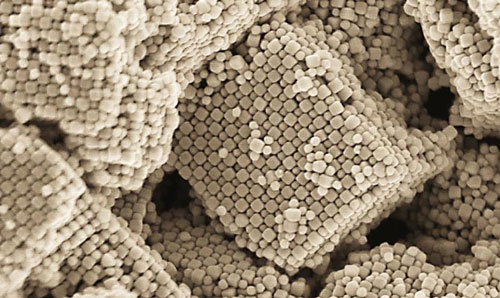
Controlling the self-assembly of nanoparticles into superlattices is an important approach to build functional materials. The Brookhaven team used nanosized building blocks—cubes or octahedrons—decorated with DNA tethers to coordinate the assembly of spherical nanoparticles coated with complementary DNA strands.

Controlling the self-assembly of nanoparticles into superlattices is an important approach to build functional materials. The Brookhaven team used nanosized building blocks—cubes or octahedrons—decorated with DNA tethers to coordinate the assembly of spherical nanoparticles coated with complementary DNA strands.

A June 1, 2015 article (which originated the news item) in DOE Pulse Number 440 goes on to highlight three recent DNA papers published by researchers at Brookhaven National Laboratory,

The first [leads to a news release], published in Nature Communications, describes how scientists used the shape of nanoscale building blocks decorated with single strands of DNA to orchestrate the arrangement of spheres decorated with complementary strands (where bases on the two strands pair up according to the rules of DNA binding, A to T, G to C). For example, nano-cubes coated with DNA tethers on all six sides formed regular arrays of cubes surrounded by six nano-spheres. The attractive force of the DNA “glue” keeps these two dissimilar objects from self-separating to give scientists a reliable way to assemble composite materials in which the synergistic properties of different types of nanoparticles might be put to use.

In another study [leads to a news release], published in Nature Nanotechnology, the team used ropelike configurations of the DNA double helix to form a rigid geometrical framework, and added dangling pieces of single-stranded DNA to glue nanoparticles in place on the vertices of the scaffold. Controlling the code of the dangling strands and adding complementary strands to the nanoparticles gives scientists precision control over particle placement. These arrays of nanoparticles with predictable geometric configurations are somewhat analogous to molecules made of atoms, and can even be linked end-to-end to form polymer-like chains, or arrayed as flat sheets. Using this approach, the scientists can potentially orchestrate the arrangements of different types of nanoparticles to design materials that regulate energy flow, rotate light, or deliver biomolecules.

“We may be able to design materials that mimic nature’s machinery to harvest solar energy, or manipulate light for telecommunications applications, or design novel catalysts for speeding up a variety of chemical reactions,” said Oleg Gang, the Brookhaven physicist who leads this work on DNA-mediated nano-assembly.

Perhaps most exciting is a study [leads to a news release] published in Nature Materials in which the scientists added “reprogramming” strands of DNA after assembly to rearrange and change the phase of nanoparticle arrays. This is a change at the nanoscale that in some ways resembles an atomic phase change—like the shift in the atomic crystal lattice of carbon that transforms graphite into diamond—potentially producing a material with completely new properties from the same already assembled nanoparticle array. Inputting different types of attractive and repulsive reprogramming DNA strands, scientists could selectively trigger the transformation to the different resulting structures.

“The ability to dynamically switch the phase of an entire superlattice array will allow the creation of reprogrammable and switchable materials wherein multiple, different functions can be activated on demand,” Gang said.

Here are links to and citation for all three papers,

Superlattices assembled through shape-induced directional binding by Fang Lu, Kevin G. Yager, Yugang Zhang, Huolin Xin, & Oleg Gang. Nature Communications 6, Article number: 6912 doi:10.1038/ncomms7912 Published 23 April 2015

Prescribed nanoparticle cluster architectures and low-dimensional arrays built using octahedral DNA origami frames by Ye Tian, Tong Wang, Wenyan Liu, Huolin L. Xin, Huilin Li, Yonggang Ke, William M. Shih, & Oleg Gang. Nature Nanotechnology (2015) doi:10.1038/nnano.2015.105 Published online 25 May 2015

Selective transformations between nanoparticle superlattices via the reprogramming of DNA-mediated interactions by Yugang Zhang, Suchetan Pal, Babji Srinivasan, Thi Vo, Sanat Kumar & Oleg Gang. Nature Materials (2015) doi:10.1038/nmat4296 Published online 25 May 2015

The first study is open access, the second is behind a paywall but there is a free preview via ReadCube Acces, and the third is behind a paywall.