Tag Archives: Nottingham Trent University

Space junk: do scientists have a fix?

Given the recent launch of Artemis II on April 1, 2026 on the first crewed US mission to the moon in decades (more about the mission here) and its return to earth today, April 10, 2026, this posting about space junk seems à propos.

December 3 and 4, 2025 were banner days for space debris (or space junk) stories. I have three.

What is the space debris problem and just how bad is it?

Ian Whittaker (Senior Lecturer in Physics, Nottingham Trent University) and Lesley Masters (Senior Lecturer in International Relations, Nottingham Trent University) wrote a December 4, 2025 essay for The Conversation that introduces the problem and provides updates on what is happening internationally, Note: Links have been removed,

China routinely sends astronauts to and from its space station Tiangong. A crew capsule is about to undock from the station and return to Earth, but there’s nothing routine about its journey home.

The Shenzhou-20 capsule will carry no crew, because one of its windows has been struck by space debris. Astronauts noticed an apparent crack on November 5 [2025], during pre-return checks.

Space journalist Andrew Jones explained how experts on the ground had studied images of the damage and concluded that a piece of debris smaller than 1mm (roughly 1/25th of an inch) had penetrated from the outer to inner layers of the glass.

Simulations and tests confirmed a low probability that the window could fail during the high-temperature re-entry through Earth’s atmosphere. Although a worst-case scenario, it was one that officials deemed unacceptable. A rescue mission – Shenzhou-22 – was launched to bring the astronauts back from the station.

Experts have been warning about the threat posed by space debris for years. The ever-growing number of space programmes by states and private entities is now contributing to an increasingly congested environment in orbit.

The European Space Agency estimates that there are more than 15,100 tonnes of material in space that has been launched from Earth. There are 1.2 million debris objects between 1cm and 10cm, and 140 million debris objects between 1mm and 1cm.

In low orbit they will be travelling around 7.6 km/s (roughly 17,000 miles per hour), damaging anything they hit. This is how a piece less than 1mm in size was able to penetrate the thick glass of Shenzhou-20’s capsule.

A number of countries are able to track what’s in space, but given that these may include classified satellites, there is a reluctance by states to share details. China’s space programme is overseen by its military, in line with a view that space is inherently linked to national security. This only adds to the geopolitical tensions between states around the use of space.

Treaties and responsibilities

The outer space treaty from 1967 sought to outline how space should be governed. But it is outdated and does not account for the increased presence of debris or the proliferation of private space launches. Nor does it address responsibilities when it comes to the sustainable use of space.

A total of 117 states are parties to the treaty, yet while efforts are ongoing to develop new norms around space governance, including the creation of the Inter-Agency Space Debris Coordination Committee, the organisation may offer a platform for cooperation and research but does not result in binding decisions for state action. The lack of any global agreement on space debris, and more importantly repercussions, makes tackling the problem of space debris even harder.

Technology is being developed to address space debris – but this generally appears as concept mission plans with only a few trial tests being launched anywhere globally. Examples include the idea of a harpoon to collect large pieces – although the recoil of such an instrument means the spacecraft that deploys it could become a new piece of debris.

A solution for cleaning up the space debris

This December 3, 2025 news item on ScienceDaily (also available with some embedded images in a December 1, 2025 news item on SciTechDaily) offers a technology fix based on the notion of a circular economy,

Earth’s orbit is getting crowded with broken satellites and leftover rocket parts. Researchers say the solution is to build spacecraft that can be repaired, reused, or recycled instead of abandoned. They also want new tools to collect old debris and new data systems that help prevent collisions. The goal is to make space exploration cleaner and more sustainable.

Each rocket launch sends valuable materials into the sky that cannot be recovered, while also releasing large amounts of greenhouse gases and chemicals that damage the ozone layer. A new paper published December 1 [2025] in the Cell Press journal Chem Circularity examines how familiar ideas like reducing, reusing, and recycling could be built into the way satellites and spacecraft are designed, repaired in orbit, and handled at the end of their service lives.

“As space activity accelerates, from mega-constellations of satellites to future lunar and Mars missions, we must make sure exploration doesn’t repeat the mistakes made on Earth,” says senior author and chemical engineer Jin Xuan of the University of Surrey. “A truly sustainable space future starts with technologies, materials and systems working together.”

Applying the 3 Rs to spacecraft, satellites, and space stations

According to the team, the foundation of a circular space economy lies in the 3 Rs: reduce, reuse, and recycle. Reducing waste would begin with building satellites and spacecraft that last longer and can be fixed more easily in space. They also suggest turning space stations into multifunctional centers where spacecraft can refuel, undergo repairs, or even have new components manufactured, which could cut down on the number of launches required.

The authors add that bringing spacecraft and space stations safely back to Earth for reuse would require better recovery systems, including technologies such as parachutes and airbags. They point out that equipment in space experiences significant wear because of extreme temperatures and radiation, so any part intended for reuse would need to pass strict safety checks.

Recovering orbital debris and using advanced technology for safer space operations

The researchers also recommend new efforts to gather orbital debris, such as using robotic arms or nets to collect fragments so the materials can be recycled. This would also help prevent collisions that create even more debris.

Data-driven tools will play an important role in this transition, the authors say. Information gathered from spacecraft could guide improvements in design and help limit waste, while simulation tools may reduce the need for expensive physical testing. They add that AI systems could help spacecraft and satellites avoid dangerous debris in real time.

Transforming the entire space system through innovation and global cooperation

The authors emphasize that a circular space economy represents a major shift in how the space sector works. Instead of focusing on single pieces of hardware, the entire system needs to be considered at once, from the materials used to how spacecraft are operated and retired.

“We need innovation at every level, from materials that can be reused or recycled in orbit and modular spacecraft that can be upgraded instead of discarded, to data systems that track how hardware ages in space,” says Xuan.

“But just as importantly, we need international collaboration and policy frameworks to encourage reuse and recovery beyond Earth. The next phase is about connecting chemistry, design, and governance to turn sustainability into the default model for space.”

This research received support from the UK Engineering and Physical Sciences Research Council, the Leverhulme Trust, and the Surrey-Adelaide Partnership Fund.

Here’s a link to and a citation for the paper,

Resource and material efficiency in the circular space economy by Zhilin Yang, Lirong Liu, Lei Xing, Adam Amara, Jin Xuan. Chem Circularity, 2025; 100001 DOI: 10.1016/j.checir.2025.100001

This paper is open access.

Commercializing space debris cleanup

This December 4, 2025 Stevens Institute of Technology news release (also on EurekAlert) theorizes that commercializing the cleanup will lead to clearer skies, Note: Links have been removed,

High up in the earth’s orbit, millions of human-made objects large and small are flying at speeds of over 15,000 miles per hour. The objects, which range from inactive satellites to fragments of equipment resulting from explosions or collisions of previously launched rockets, are space debris, colloquially referred to as space junk. Sometimes the objects collide with each other, breaking into even smaller pieces. 

No matter the size, all of this debris poses a problem. Flying at high speeds caused by prior launches or explosions, they create danger for operational satellites and spacecraft, which are vital for the efficacy of modern technologies like GPS, digital communication and weather forecasting. At orbital speeds, even tiny fragments can cause significant damage to operational equipment, endangering future space missions and the people who would participate in them. 

“Even if a tiny, five-millimeter object hits a solar panel or a solar array of a satellite, it could break it,” says Assistant Professor Hao Chen, whose research involves space systems design. “And we have over 100 million objects smaller than one centimeter in orbit. So if you want to avoid a collision, you have to maneuver your spacecraft, which takes up fuel and is costly. Additionally, we have humans on the International Space Station who sometimes must go outside the spacecraft where the space debris can hit them too. It’s really dangerous.”

Cleaning up space junk is technologically challenging and expensive. Furthermore, there are currently no incentives for countries or private companies to do so. Without binding international regulations or an enforceable “polluter pays” principle with consequences for non-compliance, the circumstances have led to a “cosmic free-for-all.” So in his latest study, Space Logistics Analysis and Incentive Design for Commercialization of Orbital Debris Remediation published in Journal of Spacecraft and Rockets on October 5, 2025, Chen and his collaborators investigated ways to create commercial opportunities for space operators and debris remediators to clean up the dangerous junk. “We wanted to see whether there’s any potential to have commercial players interested in removing the debris,” Chen says. 

The study analyzed three possible scenarios of debris cleanup — controlled reentry back to earth, uncontrolled reentry back to earth, and recycling in space. All three methods would require a space debris remediation satellite — a vehicle designed to capture and remove space junk from orbit.

In the uncontrolled reentry scenario, the remediation service vehicle would grab the debris from the orbit path it flies in and bring it down to about 350 kilometers away from earth. The piece of debris would continue orbiting around our planet until it enters the atmosphere and either burns or lands someplace. “It will either burn or drop somewhere on earth, but we don’t know where because it depends on the atmospheric drag it receives,” Chen explains. This uncontrolled reentry method is the cheapest as the remediation vehicle doesn’t have to fly long distances. 

In the controlled reentry scenario, the remediation service vehicle would bring the debris much closer to earth, down to about 50 kilometers. “Controlled reentry is more expensive because the servicer needs to bring the debris down closer to earth and then fly up again to get the next piece of debris,” Chen says. “That consumes more energy and more fuel than an uncontrolled reentry.”

In the recycling scenario, the debris would be transported from its original orbit to a recycling center up in space. The transportation would require fuel adding to the cost, but a lot of energy will also be saved by reusing aluminum, the metal commonly used in spacecraft, up in orbit rather than having to bring it up from earth. “It takes about $1500 per kilogram to launch anything from earth to space,” explains Chen. “So if you don’t have to launch from earth, it’s a benefit.”

Next Chen and collaborators analyzed ways to incentivize companies into space debris removal. They used Game Theory and Nash Bargaining Theory, developed by mathematician John Nash, to figure out the fairest deal for the two entities involved — in this case space operators, companies that own and run satellites, and debris remediators, entities that remove the space junk. 

“The debris remediators pay for the missions, the technology, and the actual work. Without some kind of financial incentive, they don’t really gain anything from it — they bear all the costs while others reap the benefits,” says Chen. Meanwhile space operators stand a lot to gain from debris removal. Their satellites can operate more safely and efficiently, so they save money on fuel and operations, since they don’t have to make extra maneuvers to avoid collisions. “However, they don’t actually do anything to remove the debris themselves — they just enjoy the cleaner, safer environment,” Chen points out. 

To solve this problem, Chen’s team proposes creating fees that space operators would have to pay. “We will need some agency to create an incentive for the debris remediators,” says Chen. “The money should come from the people who enjoy all those benefits. Our analysis shows that there is a surplus to be generated from the remediation of orbital debris, and that surplus can be optimally shared by space operators and debris remediators.”

Without such a solution, the space debris dangers will only continue growing, generated by the current and future objects left in orbit, Chen notes. “That is what’s needed to move us closer to a space industry that is safer, more sustainable, and still profitable.”

Chen’s research was funded by the NASA Office of Technology, Policy, and Strategy. The team will present their research at NASA headquarters on December 10, 2025.

About Stevens Institute of Technology

Stevens is a premier, private research university situated in Hoboken, New Jersey. Since our founding in 1870, technological innovation has been the hallmark of Stevens’ education and research. Within the university’s three schools and one college, more than 8,000 undergraduate and graduate students collaborate closely with faculty in an interdisciplinary, student-centric, entrepreneurial environment. Academic and research programs spanning business, computing, engineering, the arts and other disciplines actively advance the frontiers of science and leverage technology to confront our most pressing global challenges. The university continues to be consistently ranked among the nation’s leaders in career services, post-graduation salaries of alumni and return on tuition investment.

Here’s a link to and a citation for the paper,

Space Logistics Analysis and Incentive Design for Commercialization of Orbital Debris Remediation by Asaad Abdul-Hamid, Brycen D. Pearl, Hang Woon Lee and Hao Chen. Journal of Spacecraft and Rockets Volume 63, Number 1Bimonthly January 2026 DOI: https://doi.org/10.2514/1.A36465 Published Online:5 Oct 2025

This paper is behind a paywall.

Good luck to the Artemis II astronauts.

For anyone interested in more space debris stories, here are four from this blog,

With a wave of your finger you can control your electronic fabric

A March 6, 2025 news item on ScienceDaily announces a durable electronic textile that can be washed,

A team of researchers from Nottingham Trent University (UK), Helmholtz-Zentrum Dresden-Rossendorf (HZDR) and Free University of Bozen-Bolzano (Italy) has created washable and durable magnetic field sensing electronic textiles — thought to be the first of their kind — which they say paves the way to transform use in clothing, as they report in the journal Communications Engineering. This technology will allow users to interact with everyday textiles or specialized clothing by simply pointing their finger above a sensor.

A March 5, 2025 Helmholtz-Zentrum Dresden-Rossendorf press release (also on EurekAlert but published March 6, 2025), which originated the news item, describes some possibilities that, until now, have been the province of science fiction,

The researchers show how they placed tiny flexible and highly responsive magnetoresistive sensors within braided textile yarns compatible with conventional textile manufacturing. The garment can be operated by the user across a variety of functions through the use of a ring or glove which would require a miniature magnet. The sensors are seamlessly integrated within the textile, allowing the position of the sensors to be indicated using dyeing or embroidering, acting as touchless controls or ‘buttons’.

The technology, which could even be in the form of a textile-based keyboard, can be integrated into clothing and other textiles and can work underwater and across different weather conditions. Importantly, the researchers argue, it is not prone to accidental activation unlike some capacitive sensors in textiles and textile-based switches. “By integrating the technology into everyday clothing people would be able to interact with computers, smart phones, watches and other smart devices, transforming their clothes into a wearable human-computer interface”, summarizes Dr. Denys Makarov from the Institute of Ion Beam Physics and Materials Research at HZDR.

Washable fashion for human-computer interaction

The technology could be applied to areas such as temperature or safety controls for specialized clothing, gaming, or interactive fashion – such as allowing its users to employ simple gestures to control LEDs or other illuminating devices embedded in the textiles. Furthermore, the research team demonstrates the technology on a variety of uses, including a functional armband allowing navigational control in a virtual reality environment, and a self-monitoring safety strap for a motorcycle helmet. “It is the first time that washable magnetic sensors have been unobtrusively integrated within textiles to be used for human-computer interactions”, emphasizes Prof. Niko Münzenrieder from Free University of Bozen-Bolzano.

“Our design could revolutionize electronic textiles for both specialized and everyday clothing,” said lead researcher Dr. Pasindu Lugoda, who is based in Nottingham Trent University’s Department of Engineering. He further remarks: “Tactile sensors on textiles vary in usefulness as accidental activation occurs when they rub or brush against surfaces. Touchless interaction reduces wear and tear. Importantly, our technology is designed for everyday use. It is machine washable and durable and does not impact the drape, or overall aesthetic appeal of the textile.”

Electronic textiles are becoming increasingly popular with wide-ranging uses, but the fusion of electronic functionality and textile fabrics can be very challenging. Such textiles have evolved and now rely on soft and flexible materials which are robust enough to endure washing and bending, but which are intuitive and reliable.

Here’s a link to and and a citation for the paper,

Submersible touchless interactivity in conformable textiles enabled by highly selective overbraided magnetoresistive sensors by Pasindu Lugoda, Eduardo Sergio Oliveros-Mata, Kalana Marasinghe, Rahul Bhaumik, Niccolò Pretto, Carlos Oliveira, Tilak Dias, Theodore Hughes-Riley, Michael Haller, Niko Münzenrieder & Denys Makarov. Communications Engineering volume 4, Article number: 33 (2025) DOI: https://doi.org/10.1038/s44172-025-00373-x Published: 25 February 2025

This paper is open access.

The sound of dirt

So you don’t get your hopes up, this acoustic story doesn’t offer any accompanying audio/acoustic files, i.e., I couldn’t find the sound of dirt.

In any event, there’s still an interesting story in an April 10, 2023 news item on phys.org,

U.K. and Australian ecologists have used audio technology to record different types of sounds in the soils of a degraded and restored forest to indicate the health of ecosystems.

Non-invasive acoustic monitoring has great potential for scientists to gather long-term information on species and their abundance, says Flinders University [Australia] researcher Dr. Jake Robinson, who conducted the study while at the University of Sheffield in England.

Photo: Pixabay

An April 8, 2023 Flinders University press release, which originated the news item, delves into the researcher’s work, Note: Links have been removed,

“Eco-acoustics can measure the health lf landscapes affected by farming, mining and deforestation but can also monitor their recovery following revegetation,” he says.  

“From earthworms and plant roots to shifting soils and other underground activity, these subtle sounds were stronger and more diverse in healthy soils – once background noise was blocked out.”   

The subterranean study used special microphones to collect almost 200 sound samples, each about three minutes long, from soil samples collected in restored and cleared forests in South Yorkshire, England. 

“Like underwater and above-ground acoustic monitoring, below-ground biodiversity monitoring using eco-acoustics has great potential,” says Flinders University co-author, Associate Professor Martin Breed. 

Since joining Flinders University, Dr Robinson has released his first book, entitled Invisible Friends (DOI: 10.53061/NZYJ2969) [emphasis mine], which covers his core research into ‘how microbes in the environment shape our lives and the world around us’. 

Now a researcher in restoration genomics at the College of Science and Engineering at Flinders University, the new book examines the powerful role invisible microbes play in ecology, immunology, psychology, forensics and even architecture.  

“Instead of considering microbes the bane of our life, as we have done during the global pandemic, we should appreciate the many benefits they bring in keeping plants animals, and ourselves, alive.”  

In another new article, Dr Robinson and colleagues call for a return to ‘nature play’ for children [emphasis mine] to expose their developing immune systems to a diverse array of microbes at a young age for better long-term health outcomes. 

“Early childhood settings should optimise both outdoor and indoor environments for enhanced exposure to diverse microbiomes for social, cognitive and physiological health,” the researchers say.  

“It’s important to remember that healthy soils feed the air with these diverse microbes,” Dr Robinson adds.  

It seems Robinson has gone on a publicity blitz, academic style, for his book. There’s a May 22, 2023 essay by Robinson, Carlos Abrahams (Senior Lecturer in Environmental Biology – Director of Bioacoustics, Nottingham Trent University); and Martin Breed (Associate Professor in Biology, Flinders University) on the Conversation, Note: A link has been removed,

Nurturing a forest ecosystem back to life after it’s been logged is not always easy.

It can take a lot of hard work and careful monitoring to ensure biodiversity thrives again. But monitoring biodiversity can be costly, intrusive and resource-intensive. That’s where ecological acoustic survey methods, or “ecoacoustics”, come into play.

Indeed, the planet sings. Think of birds calling, bats echolocating, tree leaves fluttering in the breeze, frogs croaking and bush crickets stridulating. We live in a euphonious theatre of life.

Even the creatures in the soil beneath our feet emit unique vibrations as they navigate through the earth to commute, hunt, feed and mate.

Robinson has published three papers within five months of each other, in addition to the book, which seems like heavy output to me.

First, here’s a link to and a citation for the education paper,

Optimising Early Childhood Educational Settings for Health Using Nature-Based Solutions: The Microbiome Aspect by Jake M. Robinson and Alexia Barrable. Educ. Sci. 2023, 13 (2), 211 DOI: https://doi.org/10.3390/educsci13020211
Published: 16 February 2023

This is an open access paper.

For these two links and citations, the articles seem to be very closely linked.,

The sound of restored soil: Measuring soil biodiversity in a forest restoration chronosequence with ecoacoustics by Jake M. Robinson, Martin F. Breed, Carlos Abrahams. doi: https://doi.org/10.1101/2023.01.23.525240 Posted January 23, 2023

The sound of restored soil: using ecoacoustics to measure soil biodiversity in a temperate forest restoration context by Jake M. Robinson, Martin F. Breed, Carlos Abrahams. Restoration Ecology, Online Version of Record before inclusion in an issue e13934 DOI: https://doi.org/10.1111/rec.13934 First published: 22 May 2023

Both links lead to open access papers.

Finally, there’s the book,

Invisible Friends; How Microbes Shape Our Lives and the World Around Us by Jake Robinson. Pelagic Publishing, 2022. ISBN 9781784274337 DOI: 10.53061/NZYJ2969

This you have to pay for.

For those would would like to hear something from nature, I have a May 27, 2022 posting, The sound of the mushroom. Enjoy!

Space cloth (Zephlinear): a new technique for producing textiles

A lightweight zephlinear scarf with LEDs Courtesy: Nottingham Trent University

A lightweight zephlinear [space cloth]  scarf with LEDs Courtesy: Nottingham Trent University

What makes the scarf in the preceding image unusual is that the yarn hasn’t been knitted or woven. A Sept. 21, 2016 news item on phys.org describes the work,

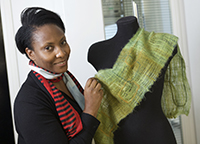
Sonia Reynolds invented ‘space cloth’ – the first non-woven material made from yarn. It has a strong potential for use as a smart textile due to its unique structure with space to encase copper wiring, light emitting diodes (LEDs) and more.

Ms Reynolds brought the idea to Nottingham Trent University’s Advanced Textile Research Group and is now undertaking a PhD in the subject to further develop the fabric’s novel manufacturing process under the direction of Professor Tilak Dias and Dr Amanda Briggs-Goode, of the School of Art and Design.

Scientifically named Zephlinear, unlike traditional woven or knitted materials which are made by the interloping or interlacing of yarns, it is made by a newly established technique known as yarn surface entanglement.

A Sept. 21, 2016 Nottingham Trent University press release, which originated the news item, provides more information,

Ms Reynolds said: “This is a real breakthrough for the textiles industry. It’s the first non-woven material made from yarn and promises major benefits for the future of clothing, and more.

“Because of the material’s linear channels of yarn, it has great potential to be used as a smart textile. In particular, we believe it lends itself well to being embedded with microcapsules containing medication or scent, to either help deliver drugs to specific parts of the body or to create antibacterial and aromatic clothing.

“As the material is visually different, it has potential to be used for other applications as well, such as wall coverings, in addition to clothing.

“And because it’s much less labour intensive to make than knit or weave fabrics, it’s a more environmentally friendly material to produce as well.”

The name, Zephlinear, derives from the merger of two words, zephyr and linear. It was given the nickname ‘space cloth’ due to its appearance and its e-textile capabilities.

The material – which is patent pending – was recently presented at the Wearable Technology Show, USA, by Ms Reynolds.

Research shows that it is strongest and most efficient when created from natural yarns such as one hundred per cent wool, hair and wool/silk mixtures, though it can also be made from synthetic yarns.

Professor Dias, who leads the university’s Advanced Textiles Research Group, said: “Zephlinear is a remarkable development in an industry which is advancing at an incredible pace.

“We believe it has huge potential for textiles, and we have already found that it combines well with e-textile technologies such as heated textiles or textiles with embedded LEDs.

“As a fabric it is very lightweight and flexible, and it retracts back to its original shape well after it has been stretched.

“We’re very much looking forward to developing the material further and feel certain that it will help provide people with smarter and more environmentally friendly clothing in the future”.

Here’s an image of Sonia Reynolds with another Zephlinear scarf,

Sonia Reynolds with a zephlinear scarf Courtesy Nottingham Trent University

Sonia Reynolds with a zephlinear scarf Courtesy Nottingham Trent University

This is the first time I’ve heard of a ‘smart’ or ‘e’ textile that works better when a natural fiber is used.