Tag Archives: Singapore-MIT Alliance for Research and Technology (SMART)

Nanofabrication, silk microneedles, and agriculture

In demonstrations, the team showed their new technique could be used to give plants iron to treat a disease known as chlorosis, and to add B12 to tomato plants to make them more nutritious for humans. Credit: Courtesy of Benedetto Marelli

What a gorgeous tomato plant! Here’s more about the work that went into this plant and others in an April 29, 2025 news item on ScienceDaily,

When farmers apply pesticides to their crops, 30 to 50 percent of the chemicals end up in the air or soil instead of on the plants. Now, a team of researchers from MIT [Massachusetts Institute of Technology] and Singapore has developed a much more precise way to deliver substances to plants: tiny needles made of silk.

In a study published today in Nature Nanotechnology, the researchers developed a way to produce large amounts of these hollow silk microneedles. They used them to inject agrochemicals and nutrients into plants, and to monitor their health.

An April 29, 2025 Massachusetts Institute of Technology (MIT) news release (also on EurekAlert) by Zach Winn, which originated the news item, delves further into the research, Note: Links have been removed,

“There’s a big need to make agriculture more efficient,” says Benedetto Marelli, the study’s senior author and an associate professor of civil and environmental engineering at MIT. “Agrochemicals are important for supporting our food system, but they’re also expensive and bring environmental side effects, so there’s a big need to deliver them precisely.”

Yunteng Cao PhD ’22, currently a postdoc [at?] Yale University, and Doyoon Kim, a former postdoc in the Marelli lab, led the study, which included a collaboration with the Disruptive and Sustainable Technologies for Agricultural Precision (DiSTAP) interdisciplinary research group at the Singapore-MIT Alliance for Research and Technology (SMART). 

In demonstrations, the team used the technique to give plants iron to treat a disease known as chlorosis, and to add vitamin B12 to tomato plants to make them more nutritious. The researchers also showed the microneedles could be used to monitor the quality of fluids flowing into plants and to detect when the surrounding soil contained heavy metals.

Overall, the researchers believe the microneedles could serve as a new kind of plant interface for real-time health monitoring and biofortification.

“These microneedles could be a tool for plant scientists so they can understand more about plant health and how they grow,” Marelli says. “But they can also be used to add value to crops, making them more resilient and possibly even increasing yields.”

The inner workings of plants

Accessing the inner tissues of living plants requires scientists to get through the plants’ waxy skin without causing too much stress. In previous work, the researchers used silk-based microneedles to deliver agrochemicals to plants in lab environments and to detect pH changes in living plants. But these initial efforts involved small payloads, limiting their applications in commercial agriculture.

“Microneedles were originally developed for the delivery of vaccines or other drugs in humans,” Marelli explains. “Now we’ve adapted it so that the technology can work with plants, but initially we could not deliver sufficient doses of agrochemicals and nutrients to mitigate stressors or enhance crop nutritional values.”

Hollow structures could increase the amount of chemicals microneedles can deliver, but Marelli says creating those structures at scale has historically required clean rooms and expensive facilities like the ones found inside the MIT.nano building.

For this study, Cao and Kim created a new way to manufacture hollow silk microneedles by combining silk fibroin protein with a salty solution inside tiny, cone-shaped molds. As water evaporated from the solution, the silk solidified into the mold while the salt forms crystalline structures inside the molds. When the salt was removed, it left behind in each needle a hollow structure or tiny pores, depending on the salt concentration and the separation of the organic and inorganic phases.

“It’s a pretty simple fabrication process. It can be done outside of a clean room — you could do it in your kitchen if you wanted,” Kim says. “It doesn’t require any expensive machinery.”

The researchers then tested their microneedles’ ability to deliver iron to iron-deficient tomato plants, which can cause a disease known as chlorosis. Chlorosis can decrease yields, but treating it by spraying crops is inefficient and can have environmental side effects. The researchers showed that their hollow microneedles could be used for the sustained delivery of iron without harming the plants.

The researchers also showed their microneedles could be used to fortify crops while they grow. Historically, crop fortification efforts have focused on minerals like zinc or iron, with vitamins only added after the food is harvested.

In each case, the researchers applied the microneedles to the stalks of plants by hand, but Marelli envisions equipping autonomous vehicles and other equipment already used in farms to automate and scale the process.

As part of the study, the researchers used microneedles to deliver vitamin B12, which is primarily found naturally in animal products, into the stalks of growing tomatoes, showing that vitamin B12 moved into the tomato fruits before harvest. The researchers propose their method could be used to fortify more plants with the vitamin.

Co-author Daisuke Urano, a plant scientist with DiSTAP, explains that “through a comprehensive assessment, we showed minimal adverse effects from microneedle injections in plants, with no observed short- or long-term negative impacts.”

“This new delivery mechanism opens up a lot of potential applications, so we wanted to do something nobody had done before,” Marelli explains.

Finally, the researchers explored the use of their microneedles to monitor the health of plants by studying tomatoes growing in hydroponic solutions contaminated with cadmium, a toxic metal commonly found in farms close to industrial and mining sites. They showed their microneedles absorbed the toxin within 15 minutes of being injected into the tomato stalks, offering a path to rapid detection.

Current advanced techniques for monitoring plant health, such as colorimetric and hyperspectral lead analyses, can only detect problems after plants growth is already being stunted. Other methods, such as sap sampling, can be too time-consuming.

Microneedles, in contrast, could be used to more easily collect sap for ongoing chemical analysis. For instance, the researchers showed they could monitor cadmium levels in tomatoes over the course of 18 hours.

A new platform for farming

The researchers believe the microneedles could be used to complement existing agricultural practices like spraying. The researchers also note the technology has applications beyond agriculture, such as in biomedical engineering.

“This new polymeric microneedle fabrication technique may also benefit research in microneedle-mediated transdermal and intradermal drug delivery and health monitoring,” Cao says.

For now, though, Marelli believes the microneedles offer a path to more precise, sustainable agriculture practices.

“We want to maximize the growth of plants without negatively affecting the health of the farm or the biodiversity of surrounding ecosystems,” Marelli says. “There shouldn’t be a trade-off between the agriculture industry and the environment. They should work together.”

This work was supported, in part, by the U.S. Office of Naval Research, the U.S. National Science Foundation, SMART, the National Research Foundation of Singapore, and the Singapore Prime Minister’s Office.

Here’s a link to and a citation for the paper,

Nanofabrication of silk microneedles for high-throughput micronutrient delivery and continuous sap monitoring in plants by Yunteng Cao, Doyoon Kim, Sally Shuxian Koh, Zheng Li, Federica Rigoldi, Julia Eva Fortmueller, Kasey Goh, Yilin Zhang, Eugene J. Lim, Hui Sun, Elise Uyehara, Raju Cheerlavancha, Yangyang Han, Rajeev J. Ram, Daisuke Urano & Benedetto Marelli. Nature Nanotechnology (2025) DOI: https://doi.org/10.1038/s41565-025-01923-2 Published: 29 April 2025

This paper is behind a paywall.

Living plants detect arsenic by way of embedded nanosensors

There’s a lot of arsenic in the world and it’s often a factor in making water undrinkable. When that water is used in farming It also pollutes soil and enters food-producing plants. A December 11, 2020 news item on Nanowerk announces research into arsenic detectors in plants,

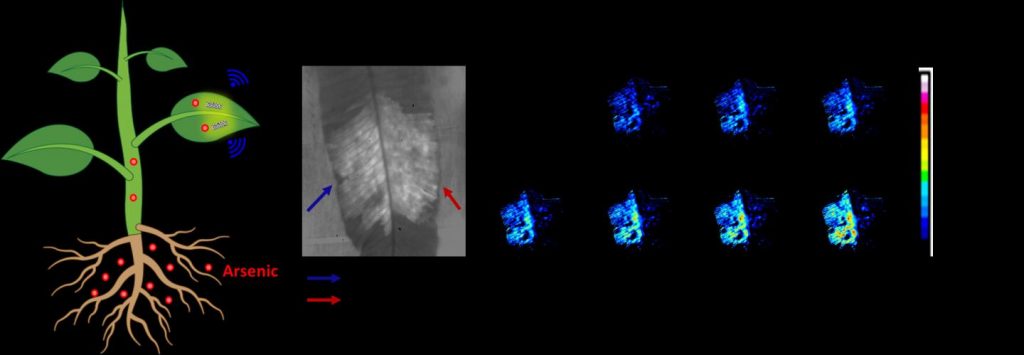
Researchers have developed a living plant-based sensor that can in real-time detect and monitor levels of arsenic, a highly toxic heavy metal, in the soil. Arsenic pollution is a major threat to humans and ecosystems in many Asia Pacific countries.

Caption: Non-destructive plant nanobionic sensor embedded within leaves to report arsenic levels within plants to portable electronics, enabling real-time monitoring of arsenic uptake in living plants. Credit: Dr. Tedrick Thomas Salim Lew

I was not able to find the source for the news item but I did locate something close. From a December 13, 2020 Singapore-Massachusetts Institute of Technology (MIT) Alliance for Research and Technology (SMART), also on EurekAlert,

Scientists from the Disruptive and Sustainable Technologies for Agricultural Precision (DiSTAP) research group at the Singapore-MIT Alliance for Research and Technology (SMART), MIT’s research enterprise in Singapore, have engineered a novel type of plant nanobionic optical sensor that can detect and monitor, in real time, levels of the highly toxic heavy metal arsenic in the underground environment. This development provides significant advantages over conventional methods used to measure arsenic in the environment and will be important for both environmental monitoring and agricultural applications to safeguard food safety, as arsenic is a contaminant in many common agricultural products such as rice, vegetables, and tea leaves.

Arsenic and its compounds are a serious threat to humans and ecosystems. Long-term exposure to arsenic in humans can cause a wide range of detrimental health effects, including cardiovascular disease such as heart attack, diabetes, birth defects, severe skin lesions, and numerous cancers including those of the skin, bladder, and lung. Elevated levels of soil arsenic as a result of anthropogenic activities such as mining and smelting are also harmful to plants, inhibiting growth and resulting in substantial crop losses.

Food crops can absorb arsenic from the soil, leading to contamination of food and produce consumed by humans. Arsenic in underground environments can also contaminate groundwater and other underground water sources, the long-term consumption of which can cause severe health issues. As such, developing accurate, effective, and easy-to-deploy arsenic sensors is important to protect both the agriculture industry and wider environmental safety.

The novel optical nanosensors exhibit changes in their fluorescence intensity upon detecting arsenic. Embedded in plant tissues, with no detrimental effects on the plant, these sensors provide a nondestructive way to monitor the internal dynamics of arsenic taken up by plants from the soil. This integration of optical nanosensors within living plants enables the conversion of plants into self-powered detectors of arsenic from their natural environment, marking a significant upgrade from the time- and equipment-intensive arsenic sampling methods of current conventional methods.

“Our plant-based nanosensor is notable not only for being the first of its kind, but also for the significant advantages it confers over conventional methods of measuring arsenic levels in the below-ground environment, requiring less time, equipment, and manpower,” says Lew. “We envision that this innovation will eventually see wide use in the agriculture industry and beyond. I am grateful to SMART DiSTAP and the Temasek Life Sciences Laboratory (TLL), both of which were instrumental in idea generation and scientific discussion as well as research funding for this work.”

Besides detecting arsenic in rice and spinach, the team also used a species of fern, Pteris cretica, which can hyperaccumulate arsenic. This fern species can absorb and tolerate high levels of arsenic with no detrimental effect — engineering an ultrasensitive plant-based arsenic detector, capable of detecting very low concentrations of arsenic, as low as 0.2 parts per billion. In contrast, the regulatory limit for arsenic detectors is 10 parts per billion. Notably, the novel nanosensors can also be integrated into other species of plants. The researchers say this is the first successful demonstration of living plant-based sensors for arsenic and represents a groundbreaking advancement that could prove highly useful in both agricultural research (e.g., to monitor arsenic taken up by edible crops for food safety) and general environmental monitoring.

Previously, conventional methods of measuring arsenic levels included regular field sampling, plant tissue digestion, extraction, and analysis using mass spectrometry. These methods are time-consuming, require extensive sample treatment, and often involve the use of bulky and expensive instrumentation. The new approach couples nanoparticle sensors with plants’ natural ability to efficiently extract analytes via the roots and transport them. This allows for the detection of arsenic uptake in living plants in real time, with portable, inexpensive electronics such as a portable Raspberry Pi platform equipped with a charge-coupled device camera akin to a smartphone camera.

Co-author, DiSTAP co-lead principal investigator, and MIT Professor Michael Strano adds, “This is a hugely exciting development, as, for the first time, we have developed a nanobionic sensor that can detect arsenic — a serious environmental contaminant and potential public health threat. With its myriad advantages over older methods of arsenic detection, this novel sensor could be a game-changer, as it is not only more time-efficient, but also more accurate and easier to deploy than older methods. It will also help plant scientists in organizations such as TLL to further produce crops that resist uptake of toxic elements. Inspired by TLL’s recent efforts to create rice crops which take up less arsenic, this work is a parallel effort to further support SMART DiSTAP’s efforts in food security research, constantly innovating and developing new technological capabilities to improve Singapore’s food quality and safety.”

The research is carried out by SMART and supported by the National Research Foundation (NRF) Singapore under its Campus for Research Excellence And Technological Enterprise (CREATE) program.

Led by MIT’s Strano and Singapore co-lead principal investigator Professor Chua Nam Hai, DiSTAP is one of the five Interdisciplinary Research Groups (IRGs) in SMART. The DiSTAP program addresses deep problems in food production in Singapore and the world by developing a suite of impactful and novel analytical genetic and biosynthetic technologies. The goal is to fundamentally change how plant biosynthetic pathways are discovered, monitored, engineered, and ultimately translated to meet the global demand for food and nutrients. Scientists from MIT, TTL, Nanyang Technological University, and National University of Singapore are collaboratively developing new tools for the continuous measurement of important plant metabolites and hormones for novel discovery, deeper understanding and control of plant biosynthetic pathways in ways not yet possible, especially in the context of green leafy vegetables; leveraging these new techniques to engineer plants with highly desirable properties for global food security, including high yield density production, drought and pathogen resistance and biosynthesis of high-value commercial products; developing tools for producing hydrophobic food components in industry-relevant microbes; developing novel microbial and enzymatic technologies to produce volatile organic compounds that can protect and/or promote growth of leafy vegetables; and applying these technologies to improve urban farming.

Here’s a link to and a citation for the paper,

Plant Nanobionic Sensors for Arsenic Detection by Tedrick Thomas Salim Lew, Minkyung Park, Jianqiao Cui, Michael S. Strano. Advanced Materials DOI: https://doi.org/10.1002/adma.202005683 First published: 26 November 2020

This paper is behind a paywall.