Tag Archives: Solomon Islands

Fish biofluorescence evolved more than 100 times in 112 million years

Before launching into the news announcements, a word about biofluorescence and bioluminesccnce. Biofluorescence is due to optical properties in fish scales, fur, butterfly wings, etc., with these properties usually being due to nanoscale structures on the wings, in the fur, etc. Bioluminescence is due to a chemical reaction, e.g., a reaction in fireflies’ stomachs.

A June 17, 2025 news item on ScienceDaily announced new information about the evolution of biofluorescence in fish,

New research led by scientists at the American Museum of Natural History sheds light on the ancient origins of biofluorescence in fishes and the range of brilliant colors involved in this biological phenomenon. Detailed in two complementary studies recently published in Nature Communications and PLOS One, the findings suggest that biofluorescence dates back at least 112 million years and, since then, has evolved independently more than 100 times, with the majority of that activity happening among fish that live on coral reefs.

A tropical striped triplefin (Helcogramma striata). © John Sparks and David Gruber Courtesy: American Museum of Natural History

A June 17, 2025 American Museum of Natural History news release (also on EurekAlert but published June 16, 2025), which originated the news item, delves further into biofluorescent fish and evolution,

The new work also reveals that in marine fishes, biofluorescence—which occurs when an organism absorbs light, transforms it, and emits it as a different color—involves a greater variety of colors than previously reported, spanning multiple wavelengths of green, yellow, orange, and red.

“Researchers have known for a while that biofluorescence is quite widespread in marine animals, from sea turtles to corals, and especially among fishes,” said Emily Carr, a Ph.D. student in the Museum’s Richard Gilder Graduate School and the lead author on the two new studies. “But to really get to the root of why and how these species use this unique adaptation—whether for camouflage, predation, or reproduction—we need to understand the underlying evolutionary story as well as the scope of biofluorescence as it currently exists.”

For the Nature Communications study, Carr led a comprehensive survey of all known biofluorescent teleosts—a type of bony fish that make up by far the largest group of vertebrates alive today. This resulted in a list of 459 biofluorescent species, including 48 species that were previously unknown to be biofluorescent. The researchers found that biofluorescence evolved more than 100 times in marine teleosts and is estimated to date back about 112 million years, with the first instance occurring in eels.

The team also found that fish species that live in or around coral reefs evolve biofluorescence at about 10 times the rate of non-reef species, with an increase in the number of fluorescent species following the Cretaceous-Paleogene (K-Pg) extinction about 66 million years ago, when all of the non-avian dinosaurs died off.

“This trend coincides with the rise of modern coral-dominated reefs and the rapid colonization of reefs by fishes, which occurred following a significant loss of coral diversity in the K-Pg extinction,” Carr said. “These correlations suggest that the emergence of modern coral reefs could have facilitated the diversification of fluorescence in reef-associated teleost fishes.”

Of the 459 known biofluorescent teleosts reported in this study, the majority are associated with coral reefs.

For the PLOS One study, Carr and colleagues used a specialized photography setup with ultraviolet and blue excitation lights and emission filters to look at the wavelengths of light emitted by fishes in the Museum’s Ichthyology collection. Collected over the last decade and a half on Museum expeditions to the Solomon Islands, Greenland, and Thailand, the specimens in the study were previously observed fluorescing, but the full range of their biofluorescent emissions was unknown.

The new work reveals far more diversity in colors emitted by teleosts—some families of which exhibit at least six distinct fluorescent emission peaks, which correspond with wavelengths across multiple colors—than had previously been reported.

“The remarkable variation we observed across a wide array of these fluorescent fishes could mean that these animals use incredibly diverse and elaborate signaling systems based on species-specific fluorescent emission patterns,” said Museum Curator John Sparks, an author on the new studies and Carr’s advisor. “As these studies show, biofluorescence is both pervasive and incredibly phenotypically variable among marine fishes. What we would really like to understand better is how fluorescence functions in these highly variable marine lineages, as well as its role in diversification.”

The researchers also note that the numerous wavelengths of fluorescent emissions found in this study could have implications for identifying novel fluorescent molecules, which are routinely used in biomedical applications, including fluorescence-guided disease diagnosis and therapy.

Other authors involved in this work include Rene Martin, from the Museum and the University of Nebraska-Lincoln; Mason Thurman, from Clemson University; Karly Cohen, from California State University; Jonathan Huie, from George Washington University; David Gruber, from Baruch College and The Graduate Center, City University of New York; and Tate Sparks, Rutgers University.

Research in the Solomon Islands was supported by the National Science Foundation under Grant Number DEB-1257555.

The Museum greatly acknowledges the Dalio Foundation for its generous support of the inaugural Explore21 Expedition.

The Museum’s Exlopre21 initiative is generously supported by the leadership contributions of Katheryn P. and Thomas L. Kempner, Jr. 

The 2019 Constantine S. Niarchos Expedition to Greenland was generously supported by the Stavros Niarchos Foundation. 

Research in Thailand was funded by the Museum and the National Science Foundation Graduate Research Fellowship Program under Grant Number DEB-1938103.

Additional funding for this work was provided by the National Science Foundation under Grant Number DGE-1746914.

I have links and citations for both papers mentioned in the news release. They will be listed in the order in which they were published earliest to latest: first (Nature Communications) and last (PLOS One).

Repeated and widespread evolution of biofluorescence in marine fishes by Emily M. Carr, Rene P. Martin, Mason A. Thurman, Karly E. Cohen, Jonathan M. Huie, David F. Gruber & John S. Sparks. Nature Communications volume 16, Article number: 4826 (2025) DOI: https://doi.org/10.1038/s41467-025-59843-7 Published: 24 May 2025

This paper is open access.

Marine fishes exhibit exceptional variation in biofluorescent emission spectra by Emily M. Carr, Mason A. Thurman, Rene P. Martin, Tate S. Sparks, John S. Sparks. PLOS One DOI: https://doi.org/10.1371/journal.pone.0316789 Published: June 16, 2025

This paper is open access.

An art initiative that enlists artists, curators, and scientists to work on environmental issues and discovered bioluminescent turtles*

Thanks to Mark Dwor of the Canadian Academy for Independent Scholars for sending me a link to this piece about bioluminescent sea turtles by Hili Perlson in a Sept. 29, 2015 posting on artnet news,

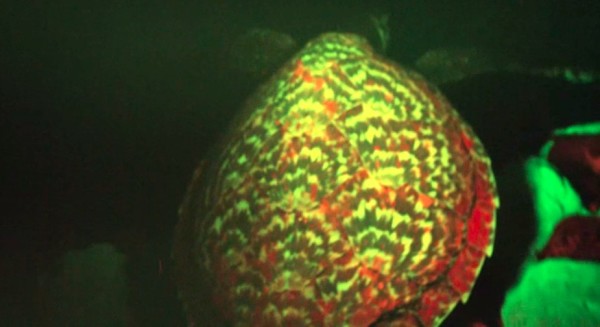
A marine biologist studying coral reefs off the Solomon Islands in the South Pacific made an amazing discovery this week when he noticed a “bright red-and-green spaceship” approaching his way in the pitch dark waters. The glowing underwater body turned out to be a hawksbill sea turtle, a critically endangered species.

The scientist, David Gruber, a National Geographic Emerging Explorer, was on site as part of a TBA21 Academy expedition, an art initiative that enlists artists, curators, and scientists to work on projects related to environmental issues. In 2002, art collector Francesca von Habsburg founded Thyssen-Bornemisza Art Contemporary (TBA21), which has long been dedicated to ambitious projects that defy categorizations.

Here’s what the ‘spaceship turtle’ looked like,

SpaceshipTurtleI encourage you to read Perlson’s piece in its entirety or to check out her blog posting for the embedded National Geographic video profiling the discovery.

For anyone interested in TBA 21, there’s this site homepage which seems focussed on the art/science projects and this site webpage which seems to be focussed on the organization’s art museum in Vienna, Austria.

*”and discovered bioluminescent turtles” added to headline Oct. 9, 2015 at 0950 hours PST.

Dyeing textiles naturally when enabled by nanotechnology

The May 15, 2012 news item on Nanowerk is intriguing,

Nanoparticles from a fungus could lead to new eco friendly dyes claim scientists from the Catholic University of Louvain.

Researchers working for the EU-funded research project SOPHIED have discovered that a fungus from the Solomon Islands produces special enzymes that act as nano-bio-catalysts.  These components help to trigger a chemical reaction between two different basic ingredients and turn it into a dye.

On digging into the matter a little further I found a Sept. 2, 2011 article by Elena Ledda for YOURIS; European Research Media Center about the reasons for the work and about the researcher who’s  focusing on the fungus, Estelle Enaud at Catholic University  of Louvain in Belgium,

The problems encountered by the traditional European colour industry go from lack of innovation and weak market competitiveness to toxicity, environmental hazards and health risks for those working in it. Dye-making industry is based on chemistry and processes designed more than a century ago, some of which are very energy consuming and potentially dangerous for the workers. In order to prevent explosive reactions when mixing the chemicals, the process has to be cooled down to ice cold temperatures, which consumes a lot of energy. Besides, some dyes can be toxic and there is a risk that they may pass the skin through perspiration. …

To overcome this bias scientists of the EU-funded research project SOPHIED led by the Catholic University of Louvain, in Belgium, have extracted special proteins, called enzymes, from fungi. …

“We already knew there is a whole spectrum of colours in the fungis and that the enzymes can form new color compounds during the bioremediation part, that is the process through which the metabolisms of microorganism removes pollutants. What we didn’t know was if it was possible to make textile dyes because these have special properties and chemical functions that you cannot find in nature”, says Estelle Enaud of the Earth and Life Institute – Applied Microbiology at the Université Catholique de Louvain. Enaud was a post-doc researcher in Sophie Vanhulle’s team. Sophie Vanhulle, the project co-ordinator, died two years ago. “The challenge was if it was possible to use the enzyme on a substance that is not natural, and it turned out it was!”

Here’s an interview with Enaud discussing her project (from the YOURIS website),

My curiosity still not satisfied, I researched SOPHIED to find out it is a European Union-funded project (Framework Project 6) with the tagline, novel sustainable bioprocess for European colour industries.  Here’s a 2008 interview with Magalie Foret, another researcher on the project discussing he SOPHIED project and her specialty wetlands engineering  (in French), from the SOPHIED website,

Getting back to Enaud and her latest work (from the Ledda article),

To extract the enzymes the fungi are put into a liquid that contains nutrients, which allows them to grow and release the desired proteins. After taking out the fungi, silica particles are added to the fluid. “The combination of enzymes and silica particles brings to a stabilization of the enzyme and eliminates proteins at the end in our dye product, since they might provoke allergies”, Estelle Enaud points out. “The particle we used the most had a mean size of 100 µm, much bigger than nano. The nano size and the nano part of the project concern the enzymes that are nanocatalysts and can also be called biological nano tools”, she explains. “I must admit I do not really like to use the word nano because although everything I work with as a biochemist is nano, biochemistry is not a new science area”.

The new colorants possess chemical features that allow them to adhere directly to the fibers of polyamide, wool or silk, making it unnecessary to add extra chemicals that can pollute water and provoke allergies. “Before putting this product on the market, it would be important to check its toxicity”, Victor Puntes, responsible of the ‘Inorganic nanoparticles group’ at the ICN (Institut Català de Nanotecnologia) points out. “In principle, large silica particles are more toxic than their nano counterpart: on the one hand, being larger they have a hard time to enter into the cell, on the other, once a few of them have entered, they can produce chronic inflammation that can result, maybe 20 years later, in some kind of cancer”, Puntes explains. Enaud ensures that the silica particles that they use are not toxic. She adds that the particles are customarily used in tooth paste, as ingredient in horticulture, and in concrete are not classified as dangerous substances.

Some interesting possibilities here assuming toxicity and scaling issues are dealt with. One final thought, I wonder if there might be some sort of ‘property’ issues. Given that the fungus under discussion comes from the Solomon Islands, it seems possible that indigenous peoples might feel proprietary, especially if they’ve been making using of it themselves thereby piquing the scientists’ interest in the first place.