So James Joyce included some physics in his novel, Ulysses (serialized in The Little Review from March 1918 to December1920 and published as a novel in February 1922)?
That’s not the only surprise. Apparently, penguins perform some interesting feats from a physics perspective. I have two stories about penguin physics with the latest research being published in June 2023.
Let’s start with literature.
James Joyce, Ulysses, and 19th century physics
This article came to my attention in April 2023 but the material is from 2021/22. Thankfully, since it’s a literature topic, timing doesn’t matter quite as much as it does for other topics. From a December 22, 2021 American Institute of Physics news release highlights an intriguing article in The Physics Teacher,
James Joyce’s book “Ulysses” is widely considered a 20th-century literary masterpiece. It also contains a surprising amount of 19th-century classical physics, according to Harry Manos, faculty member at Los Angeles City College.
“Ulysses” chronicles the ordinary life of the protagonist Leopold Bloom over a single day in 1904. In The Physics Teacher, by AIP Publishing, Manos reveals several connections that have not been analyzed before in the Joycean literature between classic physics prevalent during that time and various passages of the book.
“‘Ulysses’ exemplifies what physics students and teachers should realize — namely, physics and literature are not mutually exclusive,” Manos said.
Manos shows how Joyce uses the optics of concave and convex mirrors to metaphorically parallel “Ulysses” with Homer’s “Odyssey,” and how Joyce uses physics to show Bloom’s strengths and weaknesses in science.
…
Here’s a link to and a citation for the paper,
Physics in James Joyce’s Ulysses by Harry Manos. The Physics Teacher 60, 6–10 (2022) DOI: https://doi.org/10.1119/5.0028832 Published online: January 1, 2022
This paper is behind a paywall but there is a freely available abstract
Ulysses by James Joyce (1882–1941) has a surprising amount of 19th-century, classical physics. The physics community is familiar with the name James Joyce mainly through the word “quark” (onomatopoeic for the sound of a duck or seagull), which Murray Gell-Mann (1929-2019 – Physics Nobel Prize 1969) sourced from Joyce’s Finnegan’s Wake. Ulysses, however, was ranked number one in 1998 on the Modern Library “100 Best Novels” list and is, in whole or in part, in the literature curriculum in university English departments worldwide. The fact that Ulysses contains so much classical physics should not be surprising. Joyce’s friend Eugene Jolas observed: “the range of subjects he [Joyce] enjoyed discussing was a wide one … [including] certain sciences, particularly physics, geometry, and mathematics.” Knowing physics can enhance everyone’s understanding of this novel and enrich its entertainment value. Ulysses exemplifies what physics students (science and non-science majors) and physics teachers should realize, namely, physics and literature are not mutually exclusive.
In addition to the December 22, 2021 American Institute of Physics news release which provides some detail about the physics in Ulysses, there’s Jennifer Ouellette’s April 2, 2023 article for Ars Technica where in addition to the material in the news release, she adds some intriguing information, Note: Links have been removed,
…
In Chapter 15 (“Circe”), one of the characters says, “You can call me up by sunphone any old time”—a phrase that also appears in Joyce’s handwritten notes for the chapter. While Manos was unable to trace a specific source for this term, there was a similar device that had been invented some 20 years earlier: Alexander Graham Bell’s photophone, co-invented with his assistant Charles Sumner Tainter.
Unlike the telephone, which relies on electricity, the photophone transmitted sound on a beam of light. Bell’s voice was projected through the instrument to a mirror, causing similar vibrations in the mirror. When he directed sunlight into the mirror, it captured and projected the mirror’s vibrations via reflection, which were then transformed back into sound at the receiving end of the projection. Bell’s device never found immediate application, but it’s arguably the progenitor to modern fiber-optic telecommunications.
There are several other instances of physics (both correct and incorrect/outdated) mentioned in Ulysses, per Manos, including Bloom misunderstanding the science of X-rays; his confusion over parallax; trying to figure out the source of buoyancy in the Dead Sea; ruminating on Archimedes’ “burning glass”; seeing rainbow colors in a water spray; and pondering why he hears the ocean when he places a seashell to his ear. Manos believes introducing literature like Ulysses into physics courses could be a boon for non-majors, as well as encouraging physics and engineering students to learn more about literature.
In fact, Manos notes that an earlier 1995 paper introduced a handy introductory physics problem involving distance, velocity, and time. Ulysses opens with Stephen Dedalus and his roommate, Buck Mulligan, standing at the Martello tower overlooking a bay at Sandy Cove. …
Now onto …
Penguin physics
Two stories, two research teams, and six months separate their papers.
A February 7, 2023 news item on phys.org features work from a team of Japanese scientists studying how penguins turn in the water, Note: A link has been removed,
Penguins constitute a fascinating family of flightless birds, that although somewhat clumsy on land, are extremely talented swimmers. Their incredible maneuverability in water has captivated biologists for decades, with the first hydrodynamic studies on their swimming dating back to the 1970s.
Although a rare few studies have clarified some of the physics behind penguins’ dexterity, most of them have focused on forward swimming rather than turning. While one may argue that existing studies on the turning mechanisms of flying birds could shed some light on this topic, water is 800 hundred times denser than air, and thus the turning mechanisms employed are presumably very different between these media.
In an effort to bridge this knowledge gap, a pair of Japanese scientists from Tokyo Institute of Technology (Tokyo Tech), including Associate Professor Hiroto Tanaka, recently conducted a study. The main goal of this work, which was published in Journal of Experimental Biology, was to gain a better understanding of the three dimensional (3D) kinematics and hydrodynamic forces that enable penguins to turn underwater.
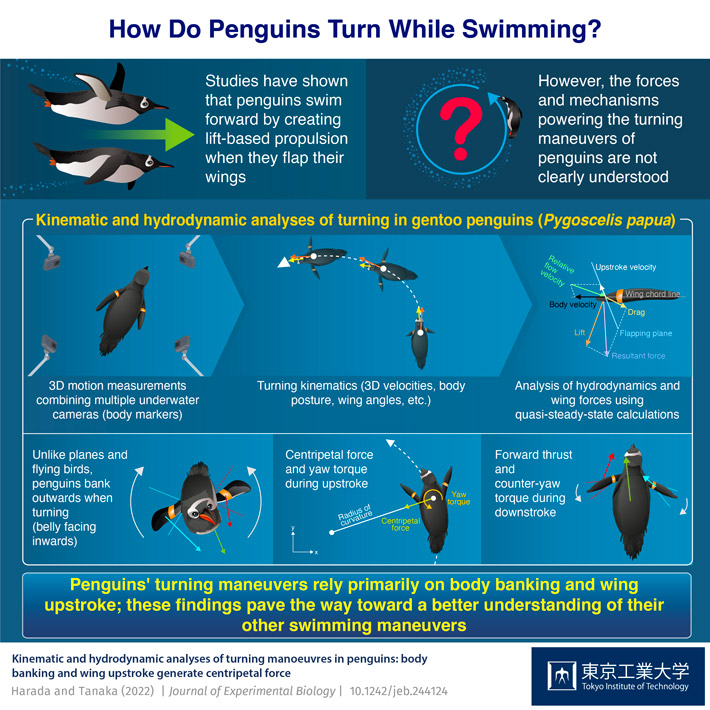
A February 8, 2023 Tokyo Institute of Technology (Tokyo Tech) press release, which originated the news item, describes the research in more technical detail,
The researchers recorded two sessions of gentoo penguins (Pygoscelis papua) free swimming in a large water tank at Nagasaki Penguin Aquarium, Japan, using a dozen or more underwater cameras. Then, thanks to a technique called 3D direct linear transformation, they were able to integrate data from all the footage and conduct detailed 3D motion analyses by tracking various points on the penguins’ bodies and wings.
Armed with these data, the researchers then established a mathematical 3D body model of the penguins. This model covered the orientation and angles of the body, the different positions and motions of the wings during each stroke, the associated kinematic parameters and hydrodynamic forces, and various turning metrics. Through statistical analyses and comparisons with the experimental data, the researchers validated the model and gained insight into the role of the wings and other body movements during turning.
The main findings of the study were related to how penguins generate centripetal force to assist their turns. They achieve this, in part, is by maintaining outward banking, which means that they tilt their bodies such that their belly faces inward. In powered turns—those in which the penguin flaps its wings—the majority of changes in direction occur during the upstroke, whereas the forward thrust occurs during the downstroke. In addition, it turns out that penguins flap their wings with a certain asymmetry during powered turns. “We found contralateral differences in wing motion; the wing on the inside of the turn becomes more elevated during the upstroke than the other,” explains Assoc. Prof. Tanaka, “Quasi-steady calculations of wing forces confirmed that this asymmetry in wing motion with the outward banking contributes to the generation of centripetal force during the upstroke. In the following downstroke, the inside wing generates thrust and counter yaw torque to brake the turning.”
Overall, these findings contribute to a greater understanding of how penguins turn when swimming, which is relevant from both biological and engineering standpoints. However, Assoc. Prof. Tanaka remarks that these findings bring but one piece to the puzzle: “The mechanisms of various other maneuvers in penguins, such as rapid acceleration, pitch up and down, and jumping out of the water, are still unknown. Our study serves as the basis for further understanding of more complex maneuvers.”
Let us hope future research helps fully clarify how penguins achieve their mesmerizing aquatic prowess!
Here’s a link to and a citation for the paper,
Kinematic and hydrodynamic analyses of turning manoeuvres in penguins: body banking and wing upstroke generate centripetal force by Natsuki Harada and Hiroto Tanaka. J Exp Biol (2022) 225 (24): jeb244124. DOI: https://doi.org/10.1242/jeb.244124 Published online December 22, 2022
This paper is open access.
Penguins are the fastest swimming birds and this team published a paper about their propulsion six months after the ‘turning’ team according to a June 20, 2023 news item on phys.org,
Penguins aren’t just cute: they’re also speedy. Gentoo penguins are the fastest swimming birds in the world, and that ability comes from their unique and sophisticated wings.
Researchers from the University of Chinese Academy of Sciences, Chinese Academy of Sciences, and King Mongkut’s Institute of Technology Ladkrabang [KMITL or KMIT Ladkrabang; Thailand] developed a model to explore the forces and flow structures created by penguin wings underwater. They determined that wing feathering is the main factor for generating thrust. Their findings have been published in the journal Physics of Fluids.
…
An American Institute of Physics June 20, 2022 news release (also on EurekAlert), which originated the news item, provides further explanation of how penguins are able to achieve their swimming speed,
Penguin wings, aka flippers, bear some resemblance to airplane wings covered with scaly feathers. To maximize efficiency underwater instead of in the air, penguin wings are shorter and flatter than those of flying birds.
The animals can adjust swimming posture by active wing feathering (changing the angle of their wings to reduce resistance), pitching, and flapping. Their dense, short feathers can also lock air between the skin and water to reduce friction and turbulence.
“Penguins’ superior swimming ability to start/brake, accelerate/decelerate, and turn swiftly is due to their freely waving wings. They allow penguins to propel and maneuver in the water and maintain balance on land,” said author Prasert Prapamonthon. “Our research team is always curious about sophisticated creatures in nature that would be beneficial to mankind.”
The hydrodynamic model takes in information about the flapping and feathering of the wings, including amplitude, frequency, and direction, and the fluid parameters, such as velocity and viscosity. Using the immersed boundary method, it solves for the motion of the wing and the thrust, lift, and lateral forces.
To establish the movement of wings across species, researchers use the ratio of wing flapping speed to forward speed. This value avoids any differences between air and water. Additionally, the authors define an angle of thrust, determined by the angle of the wings. Both of these parameters have a significant impact on the penguin’s thrust.
“We proposed the concept of angle of thrust, which explains why finned wings generate thrust: Thrust is primarily determined by the angle of attack and the relative angle of the wings to the forward direction,” said Prapamonthon. “The angle of thrust is an important concept in studying the mechanism of thrust generated by flapping motion and will be useful for designing mechanical wing motion.”
These findings can guide the design of aquatic vehicles by quickly estimating propulsion performance without high experimental or computational costs.
In the future, the team plans to examine a more realistic 3D penguin model. They will incorporate different wing properties and motion, such as starting, braking, turning, and jumping in and out of water.
Here’s a link to and a citation for the paper,
Hydrodynamic performance of a penguin wing: Effect of feathering and flapping by Hao Zhanzhou (郝占宙), Yin Bo (银波), Prasert Prapamonthon, Yang Guowei (杨国). Physics of Fluids 35 (6), 061907 (2023) DOI: https://doi.org/10.1063/5.0147776 Published online: June 20, 2023
This paper is open access.