Tag Archives: David Rokeby

Toronto’s ArtSci Salon is hosting a couple more October 2025 events

I have two art/science events and one art/science conference/festival (IRL [in real life or in person] and Zoom) taking place in Toronto, Ontario.

October 16, 2025

There is a closing event for the “I don’t do Math” series mentioned in my September 8, 2025 posting,

ABOUT
“I don’t do math” is a photographic series referencing dyscalculia, a learning difference affecting a person’s ability to understand and manipulate number-based information.

This initiative seeks to raise awareness about the challenges posed by dyscalculia with educators, fellow mathematicians, and parents, and to normalize its existence, leading to early detection and augmented support. In addition, it seeks to reflect on and question broader issues and assumptions about the role and significance of Mathematics and Math education in today’s changing socio-cultural and economic contexts. 

The exhibition will contain pedagogical information and activities for visitors and students. The artist will also address the extensive research that led to the exhibition. The exhibition will feature two panel discussions following the opening and to conclude the exhibition.

I have some information from an October 12, 2025 ArtSci Salon announcement (received via email) about the “I don’t do math” closing event,

in us for 

Closing Exhibition Panel Discussion
Thursday, October 16 2025
10:00 am -12:00 pm room 309
The Fields Institute for Research in Mathematical Sciences (or online)

Artist Ann Piché will be in conversation with
Andrew Fiss, Jacqueline Wernimont, Amenda Chow, Ellen Abrams, Michael Barany and JP Ascher

RSVP here

October 21, 2025

The second event mentioned in the October 12, 2025 ArtSci Salon announcement, Note 1: A link has been removed, Note 2: This event is part of a larger series,

Marco Donnarumma 
Monsters of Grace: bodies, sounds, and machines

Tuesday, October 21, 2025
3:30-4:30 PM
Sensorium Research Loft 
4th floor
Goldfarb Centre for Fine Arts
York University

About the talk
What is sound to those who do not hear it? How does one listen to something that cannot be heard? What kind of sensory gaps are created by aiding technologies such as prostheses and artificial intelligence (AI)? As a matter of fact, the majority of non-deaf people hear only partially due to age and personal experience. Still, sound is most often considered through the normalizing viewpoint of the non-deaf. If I become your body, what does sound become for me? Join us to welcome Marco Donnarumma  ahead of his new installation/performance at Paul Cadario Conference Room (Oct 22, 8-10 PM University College [University of Toronto] – 15 King’s College Circle). His talk will focus on this latest work in the context of a largest body of work titled “I Am Your Body,” an ongoing project investigating how normative power is enforced through the technological mediation of the senses.

About the artist:
Marco Donnarumma is an artist, inventor and theorist. His oeuvre confronts normative body politics with uncompromising counter-narratives, where bodies are in tension between control and agency, presence and absence, grace and monstrosity. He is best known for using sound, AI, biosensors, and robotics to turn the body into a site of resistance and transformation. He has presented his work in thirty-seven countries across Asia, Europe, North and South America and is the recipient of numerous accolades, most notably the German Federal Ministry of Research and Education’s Artist of the Science Year 2018, and the Prix Ars Electronica’s Award of Distinction in Sound Art 2017. Donnarumma received a ZER01NE Creator grant in 2024 and was named a pioneer of performing arts with advanced technologies by the major national newspaper Der Standard, Austria. His writings are published in Frontiers in Computer Science, Computer Music Journal and Performance Research, among others, and his newest book chapter, co-authored with Elizabeth Jochum, will appear in Robot Theaters by Routledge. Together with Margherita Pevere he runs the performance group Fronte Vacuo.


I wonder if Donnarumma’s “Monsters of Grace: bodies, sounds, and machines’ received any inspiration from “Monsters of Grace” (Wikipedia entry) or if it’s just happenstance, Note: Links have been removed,

Monsters of Grace is a multimedia chamber opera in 13 short acts directed by Robert Wilson, with music by Philip Glass and libretto from the works of 13th-century Sufi mystic Jalaluddin Rumi. The title is said to be a reference to Wilson’s corruption of a line from Hamlet: “Angels and ministers of grace defend us!” (1.4.39).

So, the October 21, 2025 event is a talk at York University taking place before the “Who’s afraid of AI? Arts, Sciences, and the Futures of Intelligence” (more below).

“Who’s afraid of AI? Arts, Sciences, and the Futures of Intelligence,” a conference and arts festival at the University of Toronto

The conference (October 23 – 24, 2025) is concurrent with the arts festival (October 19 – 25, 2025) at the University of Toronto. Here’s more from the event homepage on the https://bmolab.artsci.utoronto.ca/ website, Note: BMO stands for Bank of Montreal, Note: No mention of Edward Albee and “Who’s afraid of Virginia Woolf?,”

2025 marks an inflection point in our technological landscape, driven by seismic shifts in AI innovation.

Who’s Afraid of AI? Arts, Science, and the Futures of Intelligence is a week-long inquiry into the implications and future directions of AI for our creative and collective imaginings, and the many possible futures of intelligence. The complexity of these immediate future calls for interdisciplinary dialogue, bringing together artists, AI researchers, and humanities scholars.

In this volatile domain, the question of who envisions our futures is vital. Artists explore with complexity and humanity, while the humanities reveal the histories of intelligence and the often-overlooked ways knowledge and decision-making have been shaped. By placing these voices in dialogue with AI researchers and technologists, Who’s Afraid of AI? examines the social dimensions of technology, questions tech solutionism from a social-impact perspective, and challenges profit-driven AI with innovation guided by public values.

The two-day conference at the University of Toronto’s University College anchors the week and features panels and debates with leading figures in these disciplines, including a keynote by 2025 Nobel Laureate in Physics Geoffrey Hinton, the “Godfather of AI” and 2025 Neil Graham Lecturer in Science, Fei-Fei Li, an AI pioneer.

Throughout the week, the conversation continues across the city with:

  • AI-themed and AI powered art shows and exhibitions
  • Film screenings
  • Innovative theatre
  • Experimental music

Who’s Afraid of AI? demonstrates that Toronto has not only shaped the history of AI but continues to prepare its future.Step into this changing landscape and be part of this transformative dialogue — register today!

Organizing Committee:

Pia Kleber, Professor-Emerita, Comparative Literature, and Drama, U of T
Dirk Bernhardt-Walther, Department of Psychology, Program Director, Cognitive Science, U of T
David Rokeby, Director, BMO Lab, Centre for Drama, Theatre and Performance Studies, U of T
Rayyan Dabbous, PhD candidate, Centre for Comparative Literature, U of T

This looks like a pretty interesting programme (if you’re mainly focused on AI and the creative arts), from the event homepage on the https://bmolab.artsci.utoronto.ca/ website, Note 1: All times are ET, Note 2: I have not included speakers’ photos,

The conference will explore core questions about AI such as its capabilities, possibilities and challenges, bringing their unique research, creative practice, scholarship and experience to the discussion. Speakers will also engage in an interdisciplinary conversation on topics including AI’s implications for theories of mind and embodiment, its influence on creation, innovation, and discovery, its recognition of diverse perspectives, and its transformation of artistic, cultural, political and everyday practices.

Thursday, October 23, 2025

Mind the World

9 AM | Clark Reading Room, University College – 15 King’s College Circle

What are the merits and limits of artificial intelligence within the larger debate on embodiment? This session brings together an artist who has given AI a physical dimension, a neuroscientist who reckons with the biological neural networks inspiring AI, and a humanist knowledgeable of the longer history in which the human has tried to decouple itself from its bodily needs and wants.

Suzanne Kite
Director, The Wihanble S’a Center for Indigenous AI

James DiCarlo
Director, MIT Quest for Intelligence

N. Katherine Hayles
James B. Duke Distinguished Professor Emerita of Literature

Staging AI

11 AM | Clark Reading Room, University College – 15 King’s College Circle

How is AI changing the arts? To answer this question, we bring together theatre directors and artists who have made AI the main driving plot of their stories and those who opted to keep technology secondary in their productions.

Kay Voges
Artistic Director, Schauspiel Köln

Roland Schimmelpfennig
Playwright and Director, Berlin

Hito Steyerl
Artist, Filmmaker and Writer, Berlin

Recognizing ‘Noise’

2 PM | Clark Reading Room, University College – 15 King’s College Circle

How can we design a more inclusive AI? This session brings together an artist who has worked with AI and has been sensitive to groups who may be excluded by its practice, an inclusive design scholar who has grappled with AI’s potential for personalized accessibility, and a humanist who understands the longer history on pattern and recognition from which emerged AI.

Marco Donnarumma
Artist, Inventor, Theorist, Berlin

Jutta Treviranus
Director, OCADU [Ontario College of Art & Design University],
Inclusive Design Research Centre

Eryk Salvaggio
Media Artist and Tech Policy Press Fellow, Rochester

Art, Design, and Application are the Solution to AI’s Charlie Chaplain Problem

4 PM | Hart House Theatre – 7 Hart House Circle

Daniel Wigdor
CoFounder and Chief Executive Officer, AXL

Keynote and Neil Graham Lecture in Science

4:15 PM | Hart House Theatre – 7 Hart House Circle

Fei-Fei Li
Sequoia Professor in Computer Science, Stanford Institute for Human-Centered AI

Geoffrey Hinton
2024 Nobel Laureate in Physics, Professor Emeritus in Computer Science

Friday, October 24, 2025

Life with AI

9 AM | Clark Reading Room, University College – 15 King’s College Circle

How do machine minds relate to human minds? What can we learn from one about the other? In this session we interrogate the impact of AI on our understanding of human knowledge and tool-making, from the perspective of philosophy, computer science, as well as the arts.

Jeanette Winterson
Author, Fellow of the Royal Society of Literature, Great Britain

Leif Weatherby
Professor of German and Director of Digital Theory Lab at
New York University

Jennifer Nagel
Professor, Philosophy, University of Toronto Mississauga

Discovery & In/Sight

11 AM | Clark Reading Room, University College – 15 King’s College Circle

This session explores creative practice through the lens of innovation and cultural/scientific advancement. An artist who creates with critical inspiration from AI joins forces with an innovation scholar who investigates the effects of AI on our decision making, as well as a philosopher of science who understands scientific discovery and inference as well as their limits.

Vladan Joler
Visual Artist and Professor of
New Media, University of Novi Sad [Serbia]

Alán Aspuru-Guzik
Professor of Chemistry and Computer Science, University of Toronto

Brian Baigrie
Professor, Institute for the History and Philosophy of Science & Technology, University of Toronto

Social history & Possible Futures

2 PM | Clark Reading Room, University College – 15 King’s College Circle

How does AI ownership and its private uses coexist within a framework of public good? It brings together an artist who has created AI tools to be used by others, an AI ethics researcher who has turned algorithmic bias into collective insight, and a philosopher who understands the connection between AI and the longer history of automation and work from which AI emerged.

Memo Akten
Artist working with Code, Data and AI, UC San Diego

Beth Coleman
Professor, Institute of Communication, Culture, Information and Technology, University of Toronto

Matteo Pasquinelli
Professor, Philosophy and Cultural Heritage Università Ca’ Foscari Venezia [Italy]

A Theory of Latent Spaces | Conclusion: Where do we go from here?

4 PM | Clark Reading Room, University College – 15 King’s College Circle

Antonio Somaini, curator of the remarkable ‘World through AI’ exhibition at the Museé du Jeu de Paume in Paris, will discuss the way in which ‘latent spaces’, a core characteristic of current AI models as “meta-archives” that shape profoundly our relation with the past.

Following this, we will engage in a larger discussion amongst the various conference speakers and attendees on how we can, as artists, humanities scholars, scientists and the general public, collectively imagine and cultivate a future where AI serves the public good and enhances our individual and collective lives.”

Antonio Somaini
Curator and Professor, Sorbonne Nouvelle [Université Sorbonne Nouvelle]

You can register here for this free conference, although, there’s now a waitlist for in person attendance. Do not despair, there’s access by Zoom,

In case you can’t make it in person, join us by Zoom:

Link: https://utoronto.zoom.us/j/82603012955

Webinar ID: 826 0301 2955

Passcode: 512183

I have not forgotten the festival, from the event homepage on the https://bmolab.artsci.utoronto.ca/ website,

Events Also Happening

October 22 | 2 PM | Student Forum and AI Commentary Contest Award | Paul Cadario Conference Room, University College – 15 King’s College Circle

October 22 | 8 – 10 PM | Marco Donnarumma, world première of a new performance installation | Paul Cadario Conference Room, University College – 15 King’s College Circle

October 23 | 2 PM | Jeanette Winterson: Arts & AI Talk | Paul Cadario Conference Room, University College – 15 King’s College Circle

October 24 | 7 PM | The Kiss by Roland Schimmelpfennig | The BMO Lab, University College – 15 King’s College Circle (Note: we are scheduling more performances. Check back for more info soon!)

October 25 | 8 PM | AI Cabaret featuring Jason Sherman, Rick Miller, Cole Lewis, BMO Lab projects and more| Crow’s Theatre, Nada Ristich Studio-Gallery – 345 Carlaw Avenue..

Get tickets for the AI Cabaret

(Use promo code AICAB for 100% discount)

Enjoy!

Toronto’s ArtSci Salon hosts October 16, 2023 and October 27, 2023 events and the Fourth Annual Small File Media Festival in Vancouver (Canada) Oct. 20 – 21, 2023

An October 5, 2023 announcement (received via email) from Toronto’s ArtSci Salon lists two events coming up in October 2023,

These two Events are part of the international Leonardo LASER series
LASER Toronto is hosted by Nina Czegledy and Roberta Buiani

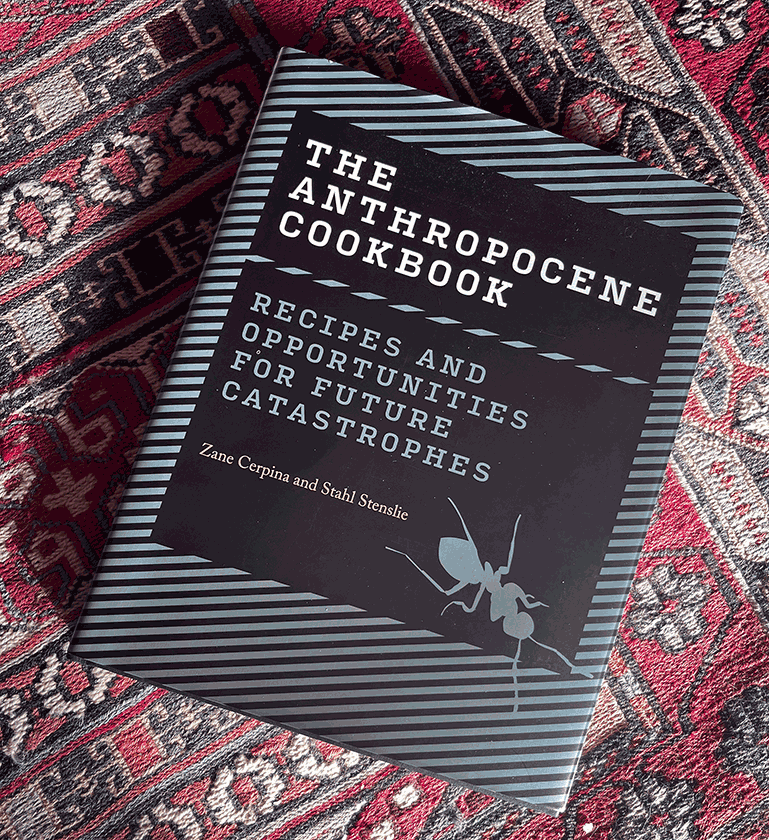
The Anthropocene Cookbook on October 16, 2023
[downloaded from: https://artscisalon.com/coms4208/]

From the Toronto ArtSci Salon October 5, 2023 announcement,

Oct 16 [2023], 3:30 PM [ET] 
The Anthropocene cookbook

with authors 
Zane Cerpina & Stahl Stenslie
Cerpina and Stenslie are the authors of
The Anthropocene Cookbook. How to survive in the age of catastrophes 

Join us to welcome Cerpina and Stenslie as they introduce us to their
book and discuss the future cuisine of humanity. To sustain the
soon-to-be 9 billion global population we cannot count on Mother
Earth’s resources anymore. The project explores innovative and
speculative ideas about new foods in the field of arts, design, science
& technology, rethinking eating traditions and food taboos, and
proposing new recipes for survival in times of ecological catastrophes.

To match the topic of their talk, attendees will be presented with
“anthropocene snacks” and will be encouraged to discuss food
alternatives and new networks of solidarity to fight food deserts,
waste, and unsustainable consumption.

This is a Hybrid event: our guests will join us virtually on zoom.
Join us in person at Glendon Campus, rm YH190 (the studio next to the
Glendon Theatre) for a more intimate community experience and some
anthropocene snacks. If you wish to join us on Zoom, please

register here

This event is part of a series on Emergent Practices in Communication,
featuring explorations on interspecies communication and digital
networks; land-based justice and collective care. The full program can be found here

This initiative is supported by York University’s Teaching Commons Academic Innovation Fund

Zane Cerpina is a multicultural and interdisciplinary female author,
curator, artist, and designer working with the complexity of
socio-political and environmental issues in contemporary society and in
the age of the Anthropocene. Cerpina earned her master’s degree in
design from AHO – The Oslo School of Architecture and Design and a
bachelor’s degree in Art and Technology from Aalborg University. She
resides in Oslo and is a project manager/curator at TEKS (Trondheim
Electronic Arts Centre). She is also a co-founder and editor of EE:
Experimental Emerging Art Journal. From 2015 to 2019, Cerpina was a
creative manager and editor at PNEK (Production Network for Electronic
Art, Norway).

Stahl Stenslie works as an artist, curator and researcher specializing
in experimental media art and interaction experiences. His aesthetic
focus is on art and artistic expressions that challenge ordinary ways of
perceiving the world. Through his practice he asks the questions we tend
to avoid – or where the answers lie in the shadows of existence.
Keywords of his practice are somaesthetics, unstable media,
transgression and numinousness. The technological focus in his works is
on the art of the recently possible – such as i) panhaptic
communication on Smartphones, ii) somatic and immersive soundspaces, and
iii) design of functional and lethal artguns, 3D printed in low-cost
plastic material.He has a PhD on Touch and Technologies from The School
of Architecture and Design, Oslo, Norway. Currently he heads the R&D
department at Arts for Young Audiences Norway.

If you’re interested in the book, there’s the anthropocenecookbook.com, which has more about the book and purchase information,

The Anthropocene Cookbook is by far the most comprehensive collection of ideas about future food from the perspective of art, design, and science. It is a thought-provoking book about art, food, and eating in the Anthropocene –The Age of Man– and the age of catastrophes.

Published by The MIT Press [MIT = Massachusetts Institute of Technology]
| mitpress.mit.edu

Supported by TEKS
Trondheim Electronic Arts Centre
| www.teks.no

*Date changed* Streaming Carbon Footprint on October 27, 2023

Keep scrolling down to Date & location changed for Streaming Carbon Footprint subhead.

From the Toronto ArtSci Salon October 5, 2023 announcement,

Oct 27, [2023] 5:00-7:00 PM  [ET]
Streaming Carbon Footprint

with 
Laura U. Marks
and
David Rokeby

Room 230
The Fields Institute for Research in Mathematical Sciences
222 College Street, Toronto

We are thrilled to announce this dialogue between media Theorist Laura U. Marks and Media Artist David Rokeby. Together, they will discuss a well known elephant in the room of media and digital technologies: their carbon footprint. As social media and streaming media usage increases exponentially, what can be done to mitigate their impact? are there alternatives?

This is a live event: our guests will join us in person.

if you wish to join us on Zoom instead, a link will be circulated on our website and on social media a few days before the event. The event will be recorded

Laura U. Marks works on media art and philosophy with an intercultural focus, and on small-footprint media. She programs experimental media for venues around the world. As Grant Strate University Professor, she teaches in the School for the Contemporary Arts at Simon Fraser University in Vancouver, Canada. Her upcoming book The Fold: From Your Body to the Cosmos will be published I March 2024 by Duke University Press. 

David Rokeby is an installation artist based in Toronto, Canada. He has been creating and exhibiting since 1982. For the first part of his career he focussed on interactive pieces that directly engage the human body, or that involve artificial perception systems. In the last decade, his practice has expanded to included video, kinetic and static sculpture. His work has been performed / exhibited in shows across Canada, the United States, Europe and Asia.

Awards include the first BAFTA (British Academy of Film and Television Arts) award for Interactive Art in 2000, a 2002 Governor General’s award in Visual and Media Arts and the Prix Ars Electronica Golden Nica for Interactive Art 2002. He was awarded the first Petro-Canada Award for Media Arts in 1988, the Prix Ars Electronica Award of Distinction for Interactive Art (Austria) in 1991 and 1997.

I haven’t been able to dig up any information about registration but it will be added here should I stumble across any in the next few weeks. I did, however, find more information about Marks’s work and a festival in Vancouver (Canada).

Fourth Annual Small File Media Festival (October 20 -21, 2023) and the Streaming Carbon Footprint

First, let’s flip back in time to a July 27, 2021 Simon Fraser University (SFU) news release (also published as a July 27, 2021 news item on phys.org) by Tessa Perkins Deneault,

When was the last time you watched a DVD? If you’re like most people, your DVD collection has been gathering dust as you stream movies and TV from a variety of on-demand services. But have you ever considered the impact of streaming video on the environment?

School for the Contemporary Arts professor Laura Marks and engineering professor Stephen Makonin, with engineering student Alejandro Rodriguez-Silva and media scholar Radek Przedpełski, worked together for over a year to investigate the carbon footprint of streaming media supported by a grant from the Social Sciences and Humanities Research Council of Canada.

“Stephen and Alejandro were there to give us a reality check and to increase our engineering literacy, and Radek and I brought the critical reading to it,” says Marks. “It was really a beautiful meeting of critical media studies and engineering.”

After combing through studies on Information and Communication Technologies (ICT) and making their own calculations, they confirmed that streaming media (including video on demand, YouTube, video embedded in social media and websites, video conferences, video calls and games) is responsible for more than one per cent of greenhouse gas emissions worldwide. And this number is only projected to rise as video conferencing and streaming proliferate.

“One per cent doesn’t sound like a lot, but it’s significant if you think that the airline industry is estimated to be 1.9 per cent,” says Marks. “ICT’s carbon footprint is growing fast, and I’m concerned that because we’re all turning our energy to other obvious carbon polluters, like fossil fuels, cars, the airline industry, people are not going to pay attention to this silent, invisible carbon polluter.”

One thing that Marks found surprising during their research is how politicized this topic is.

Their full report includes a section detailing the International Energy Association’s attack on French think tank The Shift Project after they published a report on streaming media’s carbon footprint in 2019. They found that some ICT engineers state that the carbon footprint of streaming is not a concern because data centres and networks are very efficient, while others say the fast-rising footprint is a serious problem that needs to be addressed. Their report includes comparisons of the divergent figures in engineering studies in order to get a better understanding of the scope of this problem.

The No. 1 thing Marks and Makonin recommend to reduce streaming’s carbon footprint is to ensure that our electricity comes from renewable sources. At an individual level, they offer a list of recommendations to reduce energy consumption and demand for new ICT infrastructure including: stream less, watch physical media including DVDs, decrease video resolution, use audio-only mode when possible, and keep your devices longer—since production of devices is very carbon-intensive.    

Promoting small files and low resolution, Marks founded the Small File Media Festival [link leads to 2023 programme], which will present its second annual program [2021] of 5-megabyte films Aug. 10 – 20. As the organizers say, movies don’t have to be big to be binge-worthy.

Learn more about Marks’ research and the Small File Media Festival: https://www.sfu.ca/sca/projects—activities/streaming-carbon-footprint.html

And now for 2023, here’s a video promoting the upcoming fourth annual festival,

The Streaming Carbon Footprint webpage on the SFU website includes information about the final report and the latest Small File Media Festival. Although I found the Small File Media Festival website also included a link for purchasing tickets,

The Small File Media Festival returns for its fourth iteration! We are delighted to partner with The Cinematheque to present over sixty jewel-like works from across the globe. These movies are small in file size, but huge in impact: by embracing the aesthetics of compression and low resolution (glitchiness, noise, pixelation), they lay the groundwork for a new experimental film movement in the digital age. This year, six lovingly curated programs traverse brooding pixelated landscapes, textural paradises, and crystalline infinities.

TICKETS AND FESTIVAL INFO

Join us Friday, October 20 [2023] for the opening-night program followed by a drinks reception in the lobby and a dance party in the cinema, featuring music by Vancouver electronic artist SAN. We’ll announce the winner of the coveted Small-File Golden Mini Bear during Saturday’s [October 21, 2023] award ceremony! As always, the festival will stream online at small​file​.ca after the live events.

We’re most grateful to our future-forward friends at the Social Sciences and Humanities Research Council of Canada, Canada Council for the Arts, and SFU Contemporary Arts. Thanks to VIVO Media Arts, Cairo Video Festival, and The Hmm for generous distribution and exhibition awards, and to UKRAïNATV, a partner in small-file activism.

Cosmically healthy, community-building, and punk AF, small-file ecomedia will heal the world, one pixel at a time.

TICKETS

There we have it. And then, we didn’t

*Date & location change* for Streaming Carbon Footprint event

From an October 27, 2023 ArtSci Salon notice,

Nov 7, [2023] 5:00-7:00 PM 
Streaming Carbon Footprint

with 
Laura U. Marks
and
David Rokeby
 

Tuesday, November 7 [2023]
5:00-7:00 pm
The BMO Lab
15 King’s College Circle, room H-12
Toronto, Ontario M5S 3H7

Good luck to the organizers. It must have been nervewracking to change the date so late in the game.