Tag Archives: Institute of Science and Technology Austria (IST Austria)

Call for Applications: ISTA (Institute of Science and Technology Austria) Journalist in Residence 2026

The deadline for Journalist in Residence applications to the Institute of Science and Technology Austria (ISTA) is October 31, 2025. Here’s more from a September 10, 2025 Institute of Science and Technology Austria press release on EurekAlert,

The Institute of Science and Technology Austria (ISTA) invites journalists to apply for its annual, generously funded residency program starting spring 2026. Come spend 3 to 6 months on ISTA’s vibrant, interdisciplinary campus near Vienna, gaining exclusive access to world-class researchers from a wide range of fields. Engage with innovative minds, deepen your reporting and perspectives, and connect society with scientific discovery.

About ISTA

The Institute of Science and Technology Austria (ISTA) is a rapidly growing, PhD-granting academic institution with a bold mission – to ask curiosity-driven questions and push the boundaries of basic research through collaboration across disciplines. With an expanding, state-of-the-art campus that first opened in 2009, ISTA currently hosts around 90 research groups and 78 nationalities. From AI to astrophysics and the climate to quantum mechanics, research areas span the mathematical and physical sciences, life sciences, and information and system sciences. Building on the momentum of recent years, ISTA is charting an ambitious course and on track to reach 150 research groups and more than 2,000 employees by 2036.

ISTA is a hub where science sparks innovation, engagement, and real-world impact. The Institute not only trains the next generation of scientific leaders but also strives to bring science closer to society through a variety of outreach programs ­– from the new VISTA Science Experience Center to start-ups and spin-offs supported by the XISTA ecosystem.

The Residency at a Glance:

  • Duration: 3 to 6 months (starting in spring 2026)
  • Compensation: €15,000 plus travel expenses
  • Location: ISTA’s campus, Klosterneuburg (near Vienna, Austria)
  • Eligibility: Experienced science or technology journalists (all formats welcome)
  • Language: While English is ISTA’s working language, journalists publishing/producing in other languages are also encouraged to apply.
  • Commitments: Journalists are expected to host interactive media training sessions and workshops, and participate in lectures and/or panel discussions to share their science communications expertise with the ISTA community.
  • Housing: Participants cover their own room and board costs. Depending on availability, journalists can either live on campus within walking distance of the Vienna Woods or look for more urban accommodation in downtown Klosterneuburg or nearby Vienna.

Why Apply?

  • Access – Interview leading scientists from around the world at one of Europe’s fastest-growing research institutes to enrich your reporting.
  • Inspiration – Attend campus seminars, lectures, and events to spark fresh story ideas and gain rare insights into ongoing frontier research.
  • Network – Connect with ISTA researchers and the wider ISTA community to build sources and relationships that will last beyond your stay.
  • Focus – Dedicate time to your writing and/or multimedia projects in a stimulating yet tranquil setting, with all that Vienna has to offer right at your doorstep.

Application Requirements:

To apply, please submit the following materials to journalistresidency@ista.ac.at by October 31, 2025:

  • CV
  • Cover letter
  • Samples of your best work (any format)
  • Proposal of planned activities while at ISTA
  • Names of 2 to 3 research groups you wish to engage with during the residency

For more details, please visit: ista.ac.at/residencies/

The press release offers one of the most complete descriptions of the requirements for the application that I can recall seeing. But, there is a little more information at ista.ac.at/residencies/,

When needed, ISTA supports residents with formalities to ensure a smooth arrival on campus.

While on site, journalists are hosted by the Communications team and artists by the Science Education unit.

Past Residents

There is also an Artist in Residence call coming up in a few weeks,. from ista.ac.at/residencies/,,

Artist in Residence

The open call for the ISTA Artist Residency 2026 will be published in fall 2025. ISTA will invite established as well as emerging Austrian and international artists to apply. For more information, please reach out to artistresidency@ista.ac.at.

Information on past Artist Residencies

VISTA Science Experience Center (mentioned in the press release) is celebrating its opening in early October 2025, Note: This looks like it’s either an illustration or it’s a highly pixelated image,

[downloaded from https://www.ethos.at/ideenreich/bildung/1205-vista-science-experience-center]

From the VISTA Science Experience Center website (English language version), the festival program webpage,

Hello Science! Hello Vista!

3. – 5. Oktober 2025

Welcome to the opening of the VISTA Science Experience Center!

We are celebrating the opening of the VISTA Science Experience Center with a grand opening festival at the ISTA campus in Klosterneuburg. You can look forward to three days full of exciting highlights: from keynotes and panels to interactive workshops and concerts.

Be there when the first exhibition “Science in the Making” opens and immerse yourself in ISTA’s fascinating research. From neuroscience and climate research to quantum physics and AI – here you can experience the diversity and dynamism of 21st-century science. We look forward to seeing you there!

The VISTA Science Experience Center website (English language version) can be found here and XISTA ecosystem here.

Good luck with your application!

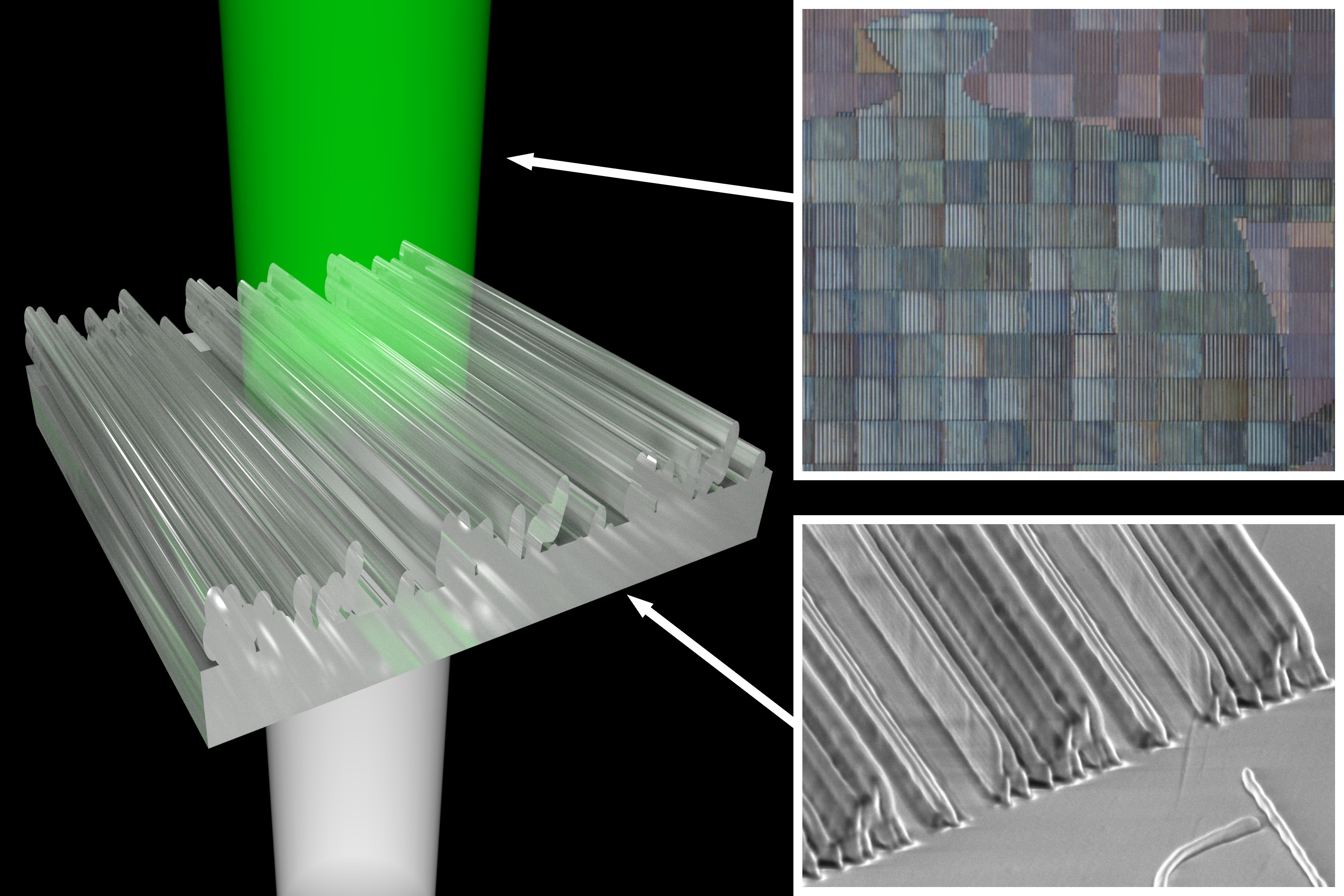
Structural colo(u)r from transparent 3D printed nanostructures

Caption: Light hits the 3-D printed nanostructures from below. After it is transmitted through, the viewer sees only green light — the remaining colors are redirected. Credit: Thomas Auzinger [downloaded from http://visualcomputing.ist.ac.at/publications/2018/StructCol/]

An August 17, 2018 news item on ScienceDaily announces the work illustrated by the image above,

Most of the objects we see are colored by pigments, but using pigments has disadvantages: such colors can fade, industrial pigments are often toxic, and certain color effects are impossible to achieve. The natural world, however, also exhibits structural coloration, where the microstructure of an object causes various colors to appear. Peacock feathers, for instance, are pigmented brown, but — because of long hollows within the feathers — reflect the gorgeous, iridescent blues and greens we see and admire. Recent advances in technology have made it practical to fabricate the kind of nanostructures that result in structural coloration, and computer scientists from the Institute of Science and Technology Austria (IST Austria) and the King Abdullah University of Science and Technology (KAUST) have now created a computational tool that automatically creates 3D-print templates for nanostructures that correspond to user-defined colors. Their work demonstrates the great potential for structural coloring in industry, and opens up possibilities for non-experts to create their own designs. This project will be presented at this year’s top computer graphics conference, SIGGRAPH 2018, by first author and IST Austria postdoc Thomas Auzinger. This is one of five IST Austria presentations at the conference this year.

SIGGRAPH 2018, now ended, was mentioned in my Aug. 9, 2018 posting.but since this presentation is accompanied by a paper, it rates its own posting. For one more excuse, there’s my fascination with structural colour.

An August 17, 2018 Institute of Science and Technology Austria press release (also on EurekAlert), which originated the news item, delves into the work,

The changing colors of a chameleon and the iridescent blues and greens of the morpho butterfly, among many others in nature, are the result of structural coloration, where nanostructures cause interference effects in light, resulting in a variety of colors when viewed macroscopically. Structural coloration has certain advantages over coloring with pigments (where particular wavelengths are absorbed), but until recently, the limits of technology meant fabricating such nanostructures required highly specialized methods. New “direct laser writing” set-ups, however, cost about as much as a high-quality industrial 3D printer, and allow for printing at the scale of hundreds of nanometers (hundred to thousand time thinner than a human hair), opening up possibilities for scientists to experiment with structural coloration.

So far, scientists have primarily experimented with nanostructures that they had observed in nature, or with simple, regular nanostructural designs (e.g. row after row of pillars). Thomas Auzinger and Bernd Bickel of IST Austria, together with Wolfgang Heidrich of KAUST, however, took an innovative new approach that differs in several key ways. First, they solve the inverse design task: the user enters the color they want to replicate, and then the computer creates a nanostructure pattern that gives that color, rather than attempting to reproduce structures found in nature. Moreover, “our design tool is completely automatic,” says Thomas Auzinger. “No extra effort is required on the part of the user.”

Second, the nanostructures in the template do not follow a particular pattern or have a regular structure; they appear to be randomly composed—a radical break from previous methods, but one with many advantages. “When looking at the template produced by the computer I cannot tell by the structure alone, if I see a pattern for blue or red or green,” explains Auzinger. “But that means the computer is finding solutions that we, as humans, could not. This free-form structure is extremely powerful: it allows for greater flexibility and opens up possibilities for additional coloring effects.” For instance, their design tool can be used to print a square that appears red from one angle, and blue from another (known as directional coloring).

Finally, previous efforts have also stumbled when it came to actual fabrication: the designs were often impossible to print. The new design tool, however, guarantees that the user will end up with a printable template, which makes it extremely useful for the future development of structural coloration in industry. “The design tool can be used to prototype new colors and other tools, as well as to find interesting structures that could be produced industrially,” adds Auzinger. Initial tests of the design tool have already yielded successful results. “It’s amazing to see something composed entirely of clear materials appear colored, simply because of structures invisible to the human eye,” says Bernd Bickel, professor at IST Austria, “we’re eager to experiment with additional materials, to expand the range of effects we can achieve.”

“It’s particularly exciting to witness the growing role of computational tools in fabrication,” concludes Auzinger, “and even more exciting to see the expansion of ‘computer graphics’ to encompass physical as well as virtual images.”

Here’s a link to and a citation for the paper,

Computational Design of Nanostructural Color for Additive Manufacturing by Thomas Auzinger, Wolfgang Heidrich, and Bernd Bickel. ACM Trans. Graph. 37, 4, Article 159 (August 2018). 16 pages. doi.org/10.1145/3197517.3201376

This appears to be open access.

There is also a project page bearing the same title as the paper, Computational Design of Nanostructural Color for Additive Manufacturing.