Tag Archives: Ian Gillespie

Vancouver (Canada), AI data centres, and the Mayor’s 11 AI agents (3 of 3)

The first two parts of this three-part series on AI data centres focused on environmental issues (Environmental impact of AI data center(re) boom: a roadmap [1 of 3]} a May 20, 2026 posting and (AI climate impact much smaller than many feared? So says a study from University of Waterloo, Canada [2 of 3]) a May 21, 2026 posting. This last part brings it home.

Featured in my May 8, 2026 posting, the 2026 Web Summit has provided an unexpected bonanza of fodder for local gossip about technology (AI data centres), local real estate problems, a glimpse into federal/provincial/municipal politics, and the Mayor.

AI data centres in Vancouver

One more AI data centre is being planned for Vancouver but first a little history. There was an AI data centre announcement in January 2026, from my February 6, 2026 posting, Note: My February 6 posting was a deepish dive into energy and water vis-à-vis data centres, which included some local nnews,

… as data centres become more important in their real estate markets as this January 31, 2026 article by Kenneth Chan for the Daily Hive could be said to hint at, Note: Links have been removed,

One of downtown Vancouver’s largest office development projects, first planned during the pre-pandemic office market boom, will not proceed as originally approved [emphasis mine], given the prevailing weak office market conditions.

Westbank’s major downtown Vancouver office tower project at steam plant site pivots to hotel, residential, and data centre uses

Westbank, a real estate developer, also features in the latest announcement about two more AI data centres (a second one at another Westbank property in Vancouver and a third in Kamloops at an unnamed property), from a May 11, 2026 article by Kenneth Chan for the Daily Hive, Note 1: NVDIA “is an American multinational technology company headquartered in Santa Clara, California” according to its Wikipedia entry; Note 2: A link has been removed from the following excerpt,.

Telus to build massive AI data centres at two Westbank properties in Vancouver

Canadian telecommunications giant Telus is moving ahead with plans to build a major sovereign artificial intelligence (AI) infrastructure network in British Columbia, following overwhelming demand for its first AI supercomputing facility in Quebec.

The Vancouver-based company announced today that it is working with the Government of Canada and local developer Westbank on a proposed cluster of AI-focused data centres designed to keep Canadian AI computing power and sensitive data within the country. The project forms part of the federal government’s Enabling Large-Scale Sovereign AI Data Centres initiative, aimed at strengthening Canada’s domestic AI infrastructure.

Telus notes the three-site B.C. network will eventually scale to more than 60,000 graphics processing units (GPUs) and 150 megawatts of computing capacity by 2032. The facilities are planned for Kamloops, which is expected to launch later this year, and two locations in Vancouver, which will be fully operational before the end of this decade.

The infrastructure will be powered by advanced computing systems from NVIDIA [emphasis mine], including the company’s latest AI hardware and networking technologies. Telus emphasized that Canadian businesses, post-secondary institutions, governments, and other organizations will be able to train and deploy AI models domestically instead of relying on foreign cloud infrastructure.

The announcement comes less than a year after Telus opened its first Sovereign AI Factory in Rimouski, Quebec. According to the company, the facility is already fully booked by customers and has been recognized on the TOP500 list of the world’s fastest supercomputers.

The company’s Sovereign AI Factory platform is designed to support the full AI development process — from training large-scale models to deploying AI applications — entirely within Canadian-owned and operated infrastructure.

“We are incredibly proud to be working with the Government of Canada to help build Canada’s sovereign AI infrastructure [emphasis mine],” said Darren Entwistle, the outgoing president and CEO of Telus, in a statement. Entwistle will retire at the end of June 2026.

Both facilities in Vancouver are being pursued as a direct partnership with Westbank.

The first new Vancouver AI data centre facility will be achieved at the 1977-built, six-storey M3 office building at 111 East 5th Ave. — home to a portion of Hootsuite’s headquarters office for more than a decade. It will see an initial launch in late 2026, with a gradual expansion through 2028 to reach its ultimate on-site size of 77,000 sq. ft. data centre — achieved from the full conversion of the building’s office levels and two underground parking levels, plus the creation of a ground-level restaurant to better serve the area’s office workers.

As part of Westbank’s cluster of buildings in this Mount Pleasant area that form the developer’s Main Alley tech campus of mixed-use office and residential buildings, M3 was originally slated for an eventual renovation for its continued and expanded office uses, including the vertical construction of three additional office floors above the 1970s-built structure. But this pre-pandemic plan is no longer being pursued, with the building’s long-term use pivoting to the Telus AI utility strategy.

“People toss around the word innovation lightly, but this is a story of true Canadian innovation,” said Ian Gillespie, founder and CEO, Westbank.

Canada’s sovereign AI infrastructure, eh? Well, the first AI data centre in Vancouver (announced in January 2026) is expected to come online in 2029 at 150 West Georgia St., formerly 720 Beatty St.

Pushback (and some context)

A May 12, 2026 article by Amir Ali in the Daily Hive provides some context both pro and con (resistance to the Vancouver AI data centres is in the following excerpt), Note: Links have been removed,

….

Telus suggests the project could generate $9 billion in economic activity in the province [emphasis mine], and create over 1,000 construction jobs, with hundreds more in long-term tech and operation roles.

In 2024, the Harvard Business Review compiled some data on the environmental costs of AI [emphasis mine].

“The training process for a single AI model, such as a large language model, can consume thousands of megawatt hours of electricity and emit hundreds of tons of carbon [emphasis mine],” the report said.

“All these environmental impacts are expected to escalate considerably, with the global AI energy demand projected to exponentially increase to at least 10 times the current level and exceed the annual electricity consumption of a small country like Belgium by 2026.[emphasis mine]”

The review concluded that AI’s environmental impacts have to resonate with the priorities and interests of local regions.

EarthJustice, a reputable non-profit public interest environmental law organization, also shared some insights on data centres late last month.

“Unchecked electricity demand from data centers threatens to increase health and climate-harming pollution, deplete water supplies [emphasis mine], and undermine our transition to clean energy,” it said.

EarthJustice says that nearby communities suffer from an increase in local air and water pollution, electronic waste, and noise pollution. It also said that data centres require around one to five million gallons of water per day.

“Although less water-intensive technologies are available, most data centers still rely on inefficient evaporative cooling.”

“Data center companies often negotiate secretive, special contracts for discounted power rates with utilities that shift costs onto regular household utility bills,” EarthJustice suggests, and we’ve reached out to BC Hydro for more information relating to local rates.

According to Telus, the Vancouver AI data centres, which work differently from traditional data centres, would be powered by 98 per cent renewable energy. [emphasis mine]

“A closed-loop liquid cooling system will reduce cooling energy consumption by 80 per cent [emphasis mine] compared to traditional data centres.”

“Importantly, in the age of AI, these data centres address Canada’s growing need for security and a Sovereign AI Solution – by providing 100% Canadian controlled infrastructure, data protection, domestic oversight and zero foreign dependency,” Telus said in its media release.

Westbank told Daily Hive that the M3 data centre’s site in Mount Pleasant currently hosts an existing data centre.

“There is no change in use, this is a case of adaptive reuse to support upgraded infrastructure. The urban locations of both data centres allow for the connection to district energy, which is what allows the projects to achieve low carbon outcomes,” Westbank added.

Ali’s May 12, 2026 article does a good job of noting the advantages and disadvantages; he also presents some reaction/pushback from politicians and from the community, Note: Links have been removed,

Many have weighed in on the development, including new federal NDP Leader Avi Lewis, who said we should be building affordable homes, a network of public grocery stores, electric buses and an east-west clean energy grid.

“Not massive corporate AI data centres unleashed without any democratic debate,” Lewis said in a post on X.

Lewis wasn’t the only political leader weighing in.

At the provincial level, Emily Lowan, the leader of the B.C. Greens said while data sovereignty is important, handouts for big AI isn’t the way to get there.

Others responded with shock at the proposed Mount Pleasant location.

Some brought up water restrictions, making points about how much water will be needed for these centres. Vancouver City Councillor Peter Meiszner responded to that concern.

Peter Meiszner @PeterMeiszner

Water consumption will be 90% lower than traditional data centres, with plans to incorporate recycled water from BC Place. (source @TELUS)

3,308 Views

Lowan responded to the environmental claims in a statement to Daily Hive Urbanized.

“TELUS’s claim that their centres will be powered by 98% clean energy is dubious at best. We’re already importing American coal-powered electricity to deal with our energy crisis. This energy crisis is caused by drought conditions, which will only be made worse by the extensive water usage of data centres,” she said.

Lowan said, “We need a moratorium on AI data centres.”

“Our government should not be celebrating a handout to TELUS to build AI data centres in the heart of Vancouver. Billionaires are hoarding our wealth, and now, our government is letting them hoard even more of our resources.”

Daily Hive Urbanized heard from Councillor Sean Orr about the development, too.

He said, “If we were to ask the people of Vancouver how we should use our infrastructure, our energy, and our space, would they pick data centres or would they pick something else?”

Orr wondered what the impact would be on the Vancouver electrical grid, and whether the corporations and private companies would be paying for additional infrastructure or whether that cost would fall on residents. 

“Currently, my understanding is that data centers have a short shelf life before being out of date with newer chips, and the chips themselves don’t last five years. We are building something that will require billions in assets but may become outdated three years after its built,” Orr said.

“Say what you will about pipelines, but they don’t become irrelevant after three years. Is it sovereign infrastructure to keep building something that is extremely expensive, and becomes outdated a year or two after construction completes?”

“Is it sovereign infrastructure to build something that may become a stranded asset very soon? I believe a bunch of data center construction projects are being paused for these very concerns right now,” Orr said. 

On the Vancouver subreddit, most of the opposition seems to be in regard to the chosen locations.

“It seems absolutely nutso to use this sort of transit accessible downtown real estate for something that would mostly house computers and generate relatively few jobs,” a Redditor said, adding, “Next to BC Place, that should be a hotel or office tower. You could put a data centre anywhere else in Metro Vancouver. Baffling.”

Someone else asked, “Doesn’t Vancouver already have water problems?”

What BC Hydro is saying

According to BC Hydro, the utility and the Province are taking a “managed and phased approach to serving these large new loads to protect affordability and reliability for residential customers.”

When it comes to high-demand projects like data centres, BC Hydro says there’s a structured and “competitive” process with capped power allocations, rather than unlimited first-come access.

[Comments]

AliasCapricious 2 days ago

People complain we have an economy overly reliant on real estate, then turn around and complains about frontier economic infrastructure. The job part isn’t the main thing, but rather Canadian tech companies have the infrastructure needed to be not dependent on US data infra. It keeps our start ups here and thus grow our high-margin tech sector.

The location is somewhat dubious, but these are the sort of thing we need in the next decades. If we are short on water and power we should be doubling down on renewables (wind/solar/hydro) and water infrastructure, since both will be required anyways. Energy demand is what drive further investments in those sectors.

Tin Man 2 days ago

A few years back, the news outlets warned (prepared?) the citizens of the Divided States of America, that there would be “rolling blackouts” due to the high energy demands of local AI data centers.

Is this what B.C. has to look forward to?

Refrigerators, ovens, heating, air conditioners and all the other devices that families depend on will be powered down so that the wealthy owners of these data centers can continue reaping massive wealth?

Jim Bob 2 days ago

No.

We are already looking at water shortages this year. BC Hydro is also under strain. Allowing these data centers to be built here in Vancouver is only going to cause skyrocketing bills for everyone living here.

They should be building these in remote areas, where they don’t need additional cooling and they can build out their own power. Alberta should have plenty of suitable locations. Why not go there?

cccccc 2 days ago

Residents are split on this? I’ve yet to see someone supporting it. Bad idea, bad locations, bad use of tax payer money.

….

Steven Zur 2 days ago

In the news this month – Westbank lawsuits and court documents indicating close to insolvent, Westbank towner nearly complete on Joyce Street goes into receivership, and then out of the blue the Federal government is support Telus’s building datacenters on two Westbank properties. Nothing more than a government handout to a poorly managed property development company.

Owen 3 days ago

I’d rather see entertainment uses at both locations

Sovereign data centres in Canada and a real estate developer in trouble

How can a data centre be made sovereign? That is a tricky question; something I’ve already hinted at. Kyle Bakx’s May 14, 2026 article for the Canadian Broadcasting Corporation’s (CBC) news online website details more of the issues,

Canada wants to build data centres that are not just physically located here, but controlled here — a distinction experts say could determine whether the country can reduce its dependence on U.S. tech giants and keep Canadian data subject to Canadian rules.

But as Ottawa reviews more than 160 data-centre proposals to support the growing demands of artificial intelligence, the promise of “sovereign” infrastructure is already running into a harder question: how much control Canada can really have over data centres [emphasis mine] that may still rely on foreign hardware, foreign customers and digital networks that do not always respect national borders.

“This is probably going to be one of the single biggest tech issues that we are going to deal with as a country,” said Ritesh Kotak, a Toronto-based lawyer and technology advisor.

Many countries, including Canada, are heavily dependent on U.S. firms for digital and cloud services [emphasis mine] — the remote computing and data storage offered by technology giants such as Amazon and Microsoft.

There are other problems too. For example, data centres are considered energy and water hogs (see my February 6, 2026 posting “AI is an energy/water hog. Where is all the power coming from? plus UN defines new ‘era of global water bankruptcy’, ” which also mentions the January 2026 announcement of the first data centre in one of Vancouver’s downtown buildings being developed by Westbank.

Before moving onto the Westbank issues, you might be interested in this 8 mins. interview (aired May 19, 2026) with Chris Madan, Telus (former) Vice-President of Digital Sales & Service; (current) Vice–President Digital Product and Head of AI Factories..Here’s how the segment is described on the CBC Radio’s Early Edition with Stephen Quinn webspace.

Chris Madan, the Telus head of AI factories, responds to concerns over health and environmental impacts surrounding the three-site AI data centre cluster set for construction in B.C.

Madan is a salesman determined to minimize any concerns and promote the company’s interests. Consequently, the value is in hearing how he deflects all the criticisms. (I don’t have a lot of patience with puffery but it can be useful.)

For a contrasting view, there’s Simon Enoch, Andrew Longhurst, and Rachel Pettigrew’s May 18, 2026 article “Vancouver Is Getting AI Data Centres. That’s Not Good” for The Tyee. While I am more sympathetic to their approach, it is unrelentingly negative and fails to mention any possible benefits.

Noise as a problem with data centres was news to me and is mentioned both in the CBC interview and in The Tyee article.

Now, onto the real estate developer.

Westbank towers in receivership

Both Vancouver properties being rezoned to allow the data centres are being developed by Westbank, which is currently experiencing money difficulties, from a May 12, 2026 posting on cityhallwatch.wordpress.org, Note: Links have been removed,

Westbank tower in receivership (5055-5083 Joyce St)

Westbank’s rental tower at 5055-5083 Joyce Street is now under receivership. KSV Advisory Inc. is the receiver and a number of documents and court filings are available on their website. OPTrust was owed approximately $109,211,965. Secured and unsecured creditors have claims of $292,993,043. We’ll include additional links and details as this story unfolds. Included below are several photos of the rental tower at 5083 Joyce Street and the surrounding context.

This May 11, 2026 article by Liezel Once for CMP magazine dives deeper into the developer’s money woes, Note: A link has been removed,

Westbank’s Joyce tower placed in receivership

Court oversight, $274 million in debt, and a former executive’s sworn claims paint a troubling portrait of a once-iconic developer

A 35-storey rental tower in east Vancouver associated with one of Canada’s most prominent development firms has been placed under court-supervised receivership, adding fresh urgency to a deepening cycle of real estate insolvencies.

The B.C. Supreme Court granted a receivership order on April 27, 2026, over two corporate entities — 5055 Joyce Holdings Inc. and 5055 Joyce Property Inc. — tied to a near-complete mixed-use rental development at 5083 Joyce Street in Vancouver, known informally as “Joyce 2.”

The application was brought by OPTrust [Ontario Public Service Employees Union and Government of Ontario pension fund] Joyce Financing Corp., which is owed approximately $109.2 million on a loan that matured without repayment on December 31, 2025.

The project, developed by Vancouver-based Westbank Holdings Ltd. — a firm founded in 1992 by CEO Ian Gillespie that built some of the city’s most architecturally ambitious buildings over three decades, including the Shangri-La hotels in Vancouver and Toronto — consists of 360 residential rental units, roughly 4,500 square feet of retail space, and 87 underground parking stalls.

Leases have already been executed with commercial and residential tenants, and certain units are occupied.

Court filings show OPTrust’s loan originated in May 2021, initially advanced at $40 million and later increased to $85 million.

The financing carried an interest rate that escalated to 11% after September 2024 and was secured by mortgages, personal property security, share pledges, and guarantees from related parties, including Westbank Holdings Ltd. and founder Ian Gillespie personally.

OPTrust issued a demand for repayment on January 13, 2026.

OPTrust, officially the OPSEU Pension Trust, is one of Canada’s largest defined-benefit pension funds, managing over $27.2 billion in net assets as of year-end 2025 and administering retirement benefits for 118,000 members, primarily Ontario public service employees.

The receivership is not the only legal matter Westbank is managing.

In a sworn affidavit filed April 29 [2026] in B.C. Supreme Court as part of a continuing breach-of-contract action, former employee Rhiannon Mabberley alleged that Westbank is in a “financially precarious position” and has laid off nearly half of its workforce, and that multiple real estate holdings have been liquidated to cover accumulated debts.

None of these claims have been proven in court [emphasis mine]. Westbank declined to confirm the layoff allegation.

“We cannot comment on matters before the courts, but we would note that none of these claims have been proven,” Westbank spokesperson Ariele Peterson told media.

Mabberley is suing Westbank for $1.2 million she alleges is owed under an employment agreement. Westbank has countered in court that the payment was conditional on project profits that were not achieved.

Her lawyers sought pretrial garnishing orders against Westbank’s corporate bank accounts; an affidavit states that a $1.2 million order ultimately yielded just $32,025.37, which Mabberley says she believes suggests the company has moved funds to protect assets from creditors.

….

For anyone unfamiliar with Vancouver and its relationship to real estate developer’s, it’s an important, some might say vital, one, which may explain why Justin McElroy, the CBC’s local municipal affairs reporter wrote this February 24, 2026 article (CBC news online) about Westbank’s legal fracas with one of its former VPs, Note: Links have been removed,

A lawsuit by a former vice-president of a prominent Vancouver development company appears to be revealing more details of many of its biggest projects taking a turn for the worse.

In December [2025?], Rhiannon Mabberley filed a civil claim against Westbank Project Corp., suing for a breach of contract when she left her role as vice-president of development in the first half of 2025.

Mabberley argued Westbank owed her $1.2 million, based on a previous employment agreement, in her claim.

In its response, Westbank says those payments were “dependent on the profits received by Westbank” on projects she was a part of, and those profits were not met.

The response by Westbank does not go into details as to why those profits were not met.

But an affidavit filed by Mabberley, which was first reported by Bloomberg News, reveals what she says is a text message to her from Westbank founder Ian Gillespie — and provides an intimate and stark commentary on the state of his company.

The allegations laid out in the affidavit and wider statement of claim have not been proven in court.

The alleged text was sent by Gillespie to Mabberley in September, four months after Mabberley left Westbank and three months before she took legal action.

In it, Gillespie references several high-profile development projects in Vancouver that are or formerly were under Westbank’s responsibility, and says that they are not profitable, including:

  • The Sen̓áḵw complex [emphasis mine] at the foot of the Burrard Bridge, which was originally a 50/50 partnership with the Squamish Nation before Westbank sold its share to Ontario Pension Trust [emphasis mine]. Gillespie texts that “the last minute negotiations resulted in me having to accept a 30% haircut from the original price … which itself was 50% less than we had agreed to last year.”
  • The recently opened Alberni and Butterfly buildings in downtown Vancouver. Gillespie texts that “Alberni still has many unsold units and … Butterfly is well over budget and closings are slow and uncertain.”
  • The massive Oakridge Park complex, which began in 2019 and has yet to open. Gillespie texts that “Oakridge is way behind schedule.”

The text ends with Gillespie saying he would offer Mabberley $200,000 “and then we can both go our separate ways,” adding that “it’s unfortunate but it’s the reality of the industry these days.”

In a statement, Westbank would not comment on the veracity of the text messages, saying it has not been proven in court.

The politics: Westbank, the federal/provincial/municipal governments, and AI data centres

Purely speculation on my part but I wonder if there’s hope that the AI data centres will help Westbank with its current financial woes. Westbank isn’t the only real estate developer experiencing problems as this May 19, 2026 posting on City Hall Watch makes clear,

City Council Preview May 19-20, 2026: Electronic billboards, Developer bailouts (CAC deferrals), 3 Broadway Plan rezonings, Italian Day grant and more

Staff are asking Council to again extend CAC payment [Community Amenity Contributions (CACs) are in-kind or cash contributions provided by property developers when Vancouver City Council grants development rights through rezoning.] deadline for 4 downtown tower sites (1450 West Georgia St $8,900,000, 1157 Burrard St $10,600,000, 1640-1650 Alberni St $32,700,000 & 1668-1684 Alberni St $37,041,000). This is the third time the request to extend the timeline for CAC payments has gone to Council, with the last extension set to lapse on May 31, 2026. The new target is suggested as May 31, 2028, which is well into the next term of a future Council. Should Council be allowing agreed-upon CAC payments slide again? Is this another developer bailout? [emphasis mine]

Vancouver’s city hall is not the only government lending assistance to developers. Way back in time there was this September 7, 2022 posting on Bob Mackin’s The Breaker pointing to a cozy relationship between Westbank’s Ian Gillespie and the federal Liberal government then lead by Prime Minister Justin Trudeau, Note: Links have been removed,

Ian Gillespie, the Westbank Corporation CEO, accepted a token 50 cent payment from members of the Squamish Nation during a ceremony under the Burrard Bridge on Sept. 6 [2022], where Prime Minister Justin Trudeau broke ground to begin the four-phase, 11-tower Senakw condo project. [emphases mine]

Squamish Nation members agreed to a 50-50 partnership in 2019 with Westbank to build 6,000 units on 4.7 hectares of Kitsilano Indian Reserve 6 regained through court settlements. Since then, Westbank’s share was reduced to 30% and OP Trust [emphasis mine], the Ontario Public Service Employees Union and Government of Ontario pension fund, now holds 20%. 

By 2029, up to 10,000 people could be living in the rental towers on either side of the bridge. A consultant’s estimate from 2019 suggested the deal could generate as much as $12.7 billion in cashflow for the band and developer [emphasis mine]. 

Trudeau was accompanied by four cabinet ministers, Patty Hajdu (Indigenous services), Ahmed Hussen (housing), Marc Miller (Crown-Indigenous relations) and Jonathan Wilkinson (natural resources). Before the start of their three-day cabinet retreat in Vancouver, Trudeau announced a $1.4 billion loan through Canada Mortgage and Housing Corporation to finance half the units, touting it as the largest loan in the Crown corporation’s history [emphasis mine]. CMHC spokesman Leonard Catling said the Rental Construction Financing Initiative is providing $668 million for phase one and $745 million for phase two. The loan is on a 10-year term, fixed interest rate and 50-year amortization. 

“While we cannot comment on the interest rate for any specific RCF loan, our interest rate generally is lower than alternative financing available in the market,” Catling said.

Gillespie, a Liberal Party supporter and proprietor of Trudeau’s preferred luxury hotel [emphasis mine], the Fairmont Pacific Rim, sat beside NDP Vancouver-Point Grey MLA David Eby [emphasis mine]. Though the construction site is in the Vancouver-False Creek provincial riding, Eby is the frontrunner to replace John Horgan as Premier this fall [Eby is now Premier of BC]. The Squamish Nation is a partner in the MST Development company with the Musqueam and Tsleil-Waututh nations in the Jericho lands project in Eby’s riding. Some of that land is proposed for an Olympic Village, if the NDP government backs the Canadian Olympic Committee bid for the 2030 Games and the International Olympic Committee chooses Vancouver next May. 

Seated nearby were directors of the Squamish Nation’s economic development company, Nch’kay, including Mike Magee, former Mayor Gregor Robertson’s chief of staff [emphasis mine], and NDP insider Joy MacPhail.

To sum up, Gillespie/Westbank gets a huge loan at low cost from the federal liberal government and runs into financial trouble a few years later. A former partner agency, OP Trust, forces one of Westbank’s housing projects (not the 11-tower Senakw condo project) into receivership. Meanwhile, Vancouver city hall rezones a couple of Westbank projects so the projects can now house AI data centres. Rather timely, given that there’s a federal Liberal government push for ‘sovereign data centres’ in Canada.

It’s almost like a fairy tale where magical characters pop in and out of the story and wondrous coincidences occur. The Justin Trudeau character transforms into Mark Carney who now leads the federal Liberal government. Gregor Robertson (former Vancouver mayor) transforms into a federal Liberal Minister of Housing [emphasis mine] and Infrastructure and Minister responsible for Pacific Economic Development Canada [emphasis mine]. And of course, there’s the previously mentioned transformation of development projects into housing for data centres at a time when a shortage of housing for people has become a national issue.

The magic doesn’t stop. My May 8, 2026 posting about the 2026 summit notes the presence of Robertson, Eby (current BC Premier), and Ken Sim, current Vancouver mayor at the 2026 Web Summit along with Canada’s federal Liberal Minister of Artificial Intelligence and Digital Innovation, Evan Solomon in what has been touted a great opportunity for local business and startups. Not surprisingly, AI became a major topic of conversation (more about Sim and AI coming in the next subsection).

I have expressed some doubt about the claims made by boosters and politicians about business opportunities and innovation being good for the local economy. It seems I’m not the only one. Dan Burgar, CEO of Frontier Collective.wrote this “Opinion: Vancouver is hosting the future, but we’re not keeping any of it” in a May 19, 2026 posting on the Daily Hive, Note: A link has been removed,

Last week, the second annual Web Summit conference in Vancouver brought over 20,000 people from around the world to the city. They came for our talent, our companies, and our setting. They’ll leave with deals signed, partnerships formed, and ideas that will turn into businesses somewhere else.

That last part is the problem we keep refusing to talk about.

Vancouver is great at hosting innovation. We’re terrible at keeping it.

Slack was built here. It was scaled in San Francisco. Hootsuite, AbCellera, General Fusion, and Clio: every one of them globally significant, and every one of them has had to look outside this city, this province, and often this country for the capital, the customers, and the conditions to grow. The pattern is so consistent it’s stopped being a pattern and started being the model.

Burger’s point is well taken (although he doesn’t mention D-Wave Systems). He goes on to suggest this,

The Mayor of Vancouver’s office, the Government of British Columbia, and the Government of Canada all have a role to play, and none of them should wait for the others.

Vancouver should treat innovation infrastructure the same way it treats public transit infrastructure: as a non-negotiable public good that catalyzes everything around it.

Mayor Sim took another approach at the 2026 Web Summit.

Sim and his AI minions (all 11 of them)

Sim’s missteps at the 2026 Web Summit are in keeping with his current policy of achieving an unbreakable streak (I exaggerate … a little bit) of own goals (even I’m affected by the sports fever of living in a 2026 World Cup city).

For anyone who might like to see a listing for the five months of this year, there’s the Ken SIm webpage on Global News. which as of May 22, 2026 includes these gems, “Report finds Vancouver Mayor Ken Sim misused influence, harassed councillor Sean Orr,” “Vancouver recovery advocate returning honour to city over mayor, council’s actions,” “Vancouver Mayor Ken Sim says comments about councillor Sean Orr [accusing Orr of openly selling drugs on Christmas Day 2026] came from an unverified photo,” “Vancouver Mayor Ken Sim files defamation lawsuit against 2 men,” and more.

I have never really recovered from reading Matt O’Grady’s October 4, 2023 article for Vancouver Magazine “A Year In, How’s Mayor Ken Sim Actually Doing?” It provides an unexpected view of our current mayor,

I’m sitting on a couch in the mayor’s third-floor offices, and Ken Sim is walking over to his turntable to put on another record. “How about the Police? I love this album.”

With the opening strains of  “Every Breath You Take” crackling to life, Sim is explaining his approach to conflict resolution, and how he takes inspiration from the classic management tome Getting to Yes: Negotiating Agreement Without Giving In.

“The way they approach things is, instead of having an adversarial relationship in every decision we look at, imagine you’re two judges on the same side of the table, trying to opine on a very difficult case and get to the best answer,” he says. “We’re just looking for the best answer.”

Suddenly, the office door swings open and Sim’s chief of staff, Trevor Ford, pokes his head in (for the third time in the past 10 minutes). “We have to go. Now.”

“Okay, okay,” says Sim, turning back to address me. “Do you mind if I change while we’re talking?” And so the door closes again—and, without further ado, the Mayor of Vancouver drops trou and goes in search of a pair of shorts, continuing with a story about how some of his west-side friends are vocally against the massive Jericho Lands development promising to reshape their 4th and Alma neighbourhood.

“And I’m like, ‘Let me be very clear: I 100-percent support it, this is why—and we’ll have to agree to disagree,’” he says, trading his baby-blue polo for a fitted charcoal grey T-shirt. Meanwhile, as Sim does his wardrobe change, I’m doing everything I can to keep my eyes on my keyboard—and hoping the mayor finds his missing shorts.

It’s fair to assume that previous mayors weren’t in the habit of getting naked in front of journalists. At least, I can’t quite picture Kennedy Stewart doing so, or Larry or Gordon Campbell either. 

But it also fits a pattern that’s developing with Ken Sim as a leader entirely comfortable in his own skin. He’s in a hurry to accomplish big things—no matter who’s watching and what they might say (or write). And he eagerly embraces the idea of bringing Vancouver’s “swagger” back—outlined in his inaugural State of the City address, and underlined when he shotgunned a beer [later reporting indicated a vodka cream soda was shotguneed] at July’s [2023] Khatsahlano Street Party.

Flying free to the wind, eh?

Moving onto Sim’s latest gaffe in what appears to be an ill advised attempt at impressing an audience of tech innovators, this happened (you can find the story in the headlines),

For anyone who’d like to hear the story, there’s an 11 mins. interview (aired May 14, 2026) with Justin McElroy, CBC’s municipal affairs reporter for BC..Here’s how the segment is described on the CBC Radio’s Early Edition with Stephen Quinn webspace

Vancouver Mayor Ken Sim is clarifying his comments about having 11 different AI agents doing work for him — but it’s just one of many stories about artificial intelligence that have come this week in Vancouver.

Sim is up for re-election on October 17, 2026. There are seven candidates currently vying to be mayor (Wikipedia entry for 2026 Vancouver municipal election). It should be interesting.

Final thoughts

AI data centres are, generally speaking, not popular. The exception being the folks making money from them or, at least in Vancouver, hoping that their businesses (e.g., Westbank) can be saved by them. There’s been a lot of concern over electricity and water use.

The University of Waterloo’s claim that AI’s climate impact is much smaller than many feared is based on some data from 2016 and earlier. This April 16, 2026 International Energy Agency (IEA) press release about a new report notes this about AI energy use,

According to the report – Key Questions on Energy and AI – power consumption per AI task is declining rapidly, with efficiency improving at a rate unprecedented in energy history. However, more people are using AI, and energy-intensive uses – such as AI agents – are on the rise [emphasis mine]. As a result, electricity consumption from data centres is set to double by 2030, and power use from those focused on AI is poised to triple.

Sim and his 11 AI agents (personal use only) not withstanding, it would be interesting to know how much AI is being deployed in city departments, including the police, and plans for AI deployment. (Just an idle thought)

While I have been critical of Simon Enoch, Andrew Longhurst, and Rachel Pettigrew’s May 18, 2026 article “Vancouver Is Getting AI Data Centres. That’s Not Good” for The Tyee, they make some useful points about noise (an issue when these centres are in urban areas) and environmental standards.

I expect unfettered enthusiasm and boosterism from the technology community at something like the Web Summit; it’s disconcerting when found in the city’s mayor. But much more disquieting was this, “Far-Right Speakers Given a Perch at Vancouver’s Web Summit,” May 18, 2026 article by Jen St. Denis for The Tyee. (I’ve added a link and an excerpt from the article at the end of my May 8, 2026 posting about the summit.) There were a lot of politicians at the 2026 summit, maybe next time they’ll check with the organizers about who’s being invited to speak.

AI data centres aren’t just a technology story, they’re also an energy story, a water story, a political story, and, in some cases, a neighbourhood story.

ETA May 22, 2026 at 1530 hours: Massive protest march against Vancouver AI data centres tomorrow (May 23, 2026)

I don’t usually write about issues that are this dynamic but Daniel Chai’s May 22, 2026 article for the Daily Hive features news of a protest. Interestingly, there were no protests when the first AI data centre was announced in January 2026. It seems the Web Summit stimulated an opposition movement, Note: Links have been removed,

A huge demonstration against the proposed cluster of AI data centres in Vancouver will take place on Saturday, May 23, and traffic may be impacted throughout downtown.

A group behind the Instagram page @no.ai.vancouver was formed shortly after news broke that Telus was moving ahead with plans to build a major sovereign artificial intelligence (AI) infrastructure network in British Columbia.

This includes new AI data centres at two Westbank properties in Vancouver that could become fully operational before the end of this decade.

“No.ai.vancouver is trying to spread awareness about the impact of AI data centres on the environment, help in halting the construction of these AI data centres, and looking out for the people who call this place home,” said Torin LaRocque, an 18-year-old student living in Vancouver who founded the group.

“I was inspired to create this movement after seeing all the devastation these centres are causing to people living nearby.”

For LaRocque, one of the top negative issues surrounding the proposed facilities is their impact on the environment.

“Telus states that the new AI Data Centres use 90 per cent less energy than the average centre,” said the Vancouver resident. “However, they also state that they will have more than 60,000 GPUs on the conservative side.

“[If] each GPU will process an AI prompt a day, that is still over 1400 litres of water being used a day. Vancouver is already under stage two water restrictions. Why should we let these data centres use the water that Vancouver’s population needs?”

The demonstration on Saturday, May 23, begins with poster-making at Victory Square at 11 a.m., with some supplies provided.

Participants in the protest against the AI Data Centres will meet at Waterfront Station at 1 p.m., with plans to march down Granville Street starting at 1:30 p.m.

The march, which LaRocque said could draw a large procession, will continue over the bridge until it reaches Granville Island.

Officers from the Vancouver Police Department (VPD) will be on site during the demonstration.

LaRocque, who describes himself as an initiator of the group, shared that the positive response from the community has been honestly shocking.

“I am confident that if enough people show up and demand change, either by protesting or signing the petition, we can bring this to the city with more than just one person backing it up. The more signatures and protesters we have, the more the City will be unable to ignore.”

The group has also shared a link to a petition calling for a stop to the Vancouver AI Data Centre, which has garnered over 1,400 signatures as of press time.

Daily Hive reached out to the City for comment on the protest, with a representative responding, “The City of Vancouver recognizes and upholds the right to free speech and peaceful protest.” [almost like an AI agent wrote the reply]

Should you be interested in going to the protest, Victory Square’s address is: 200 W Hastings St.

A dance with love and fear: the Yoko Ono exhibit and the Takashi Murakami exhibit in Vancouver (Canada)

It seems Japanese artists are ‘having a moment’. There’s a documentary (Kusama—Infinity) about contemporary Japanese female artist, Yayoi Kusama, making the festival rounds this year (2018). Last year (2017), the British Museum mounted a major exhibition of Hokusai’s work (19th Century) and in 2017, the Metropolitan Museum of Art Costume Institute benefit was inspired by a Japanese fashion designer, “Rei Kawakubo/Comme des Garçons: Art of the In-Between.” (A curator at the Japanese Garden in Portland who had lived in Japan for a number of years mentioned to me during an interview that the Japanese have one word for art. There is no linguistic separation between art and craft.)

More recently, both Yoko Ono and Takashi Murakami have had shows in Vancouver, Canada. Starting with fear as I prefer to end with love, Murakami had a blockbuster show at the Vancouver Gallery.

Takashi Murakami: a dance with fear (and money too)

In the introductory notes at the beginning of the exhibit: “Takashi Murakami: The Octopus Eats Its own Leg,” it was noted that fear is one of Murakami’s themes. The first few pieces in the show had been made to look faded and brownish to the point where you had to work at seeing what was underneath the layers. The images were a little bit like horror films something’s a bit awry then scary and you don’t know what it is or how to deal with it.

After those images, the show opened up to bright, bouncy imagery commonly associated with Mrjakami’s work. However, if you look at them carefully, you’ll see many of these characters have big, pointed teeth. Also featured was a darkened room with two huge warriors.At a guess, I’d say they were 14 feet tall.

It  made for a disconcerting show with its darker themes usually concealed in bright, vibrant colour. Here’s an image promoting Murakami’s Vancouver birthday celebration and exhibit opening,
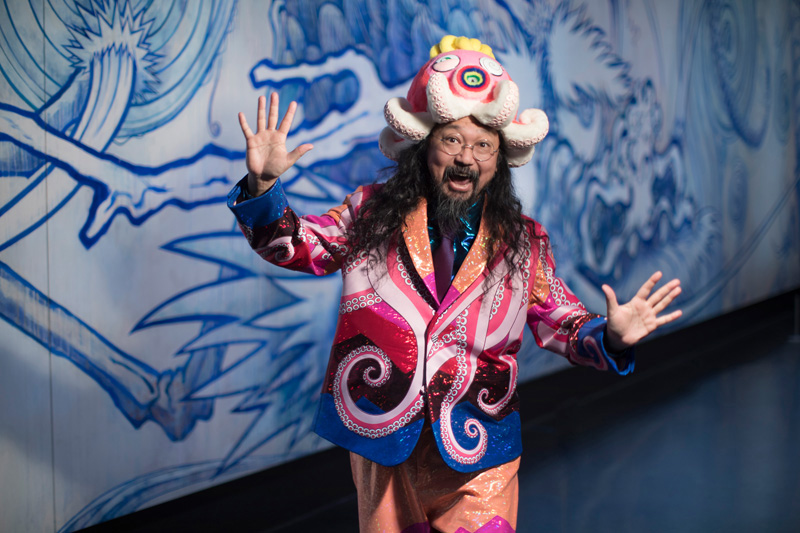
‘Give me the money, now!’ says a gleeful Takashi Murakami, whose expansive show is currently at the Vancouver Art Gallery. Photo by the VAG. [downloaded from https://thetyee.ca/Culture/2018/02/07/Takashi-Murakami-VAG/]

The colours and artwork shown in the marketing materials (I’m including the wrapping on the gallery itself) were  exuberant as was Murakami who acted as his own marketing material. I’m mentioning the money It’s very intimately and blatantly linked to Murakami’s art and work.  Dorothy Woodend in a Feb. 7, 2018 article for The Tyee puts it this way (Note: Link have been removed),

The close, almost incestuous relationship between art and money is a very old story. [emphasis mine] You might even say it is the only story at the moment.

You can know this, understand it to a certain extent, and still have it rear up and bite you on the bum. [emphasis mine] Such was my experience of attending the exhibition preview of Takashi Murakami’s The Octopus Eats Its Own Leg at the Vancouver Art Gallery.

The show is the first major retrospective of Murakami’s work in Canada, and the VAG has spared no expense in marketing the living hell out of the thing. From the massive cephalopod installed atop the dome of the gallery, to the ocean of smiling cartoon flowers, to the posters papering every inch of downtown Vancouver, it is in a word: huge.

If you don’t know much about Murakami the show is illuminating, in many different ways. Expansive in extremis, the exhibition includes more than 50 works that trace a path through the evolution of Murakami’s style and aesthetic, moving from his early dark textural paintings that blatantly ripped off Anselm Kiefer, to his later pop-art style (Superflat), familiar from Kanye West albums and Louis Vuitton handbags.

make no mistake, money runs underneath the VAG show like an engine [emphasis mine]. You can feel it in the air, thrumming with a strange radioactive current, like a heat mirage coming off the people madly snapping selfies next to the Kanye Bear sculpture.

The artist himself seems particularly aware of how much of a financial edifice surrounds the human impulse to make images. In an on-stage interview with senior VAG [Vancouver Art Gallery] curator Bruce Grenville during a media preview for the show, Murakami spoke plainly about the need for survival (a.k.a. money) [emphasis mine] that has propelled his career.

Even the title of the show speaks to the notion of survival (from Woodend’s article; Note: Links have been removed),

The title of the show takes inspiration from Japanese folklore about a creature that sacrifices part of its own body so that the greater whole might survive. In the natural world, an octopus will chew off its own leg if there is an infection, and then regrow the missing limb. In the art world, the idea pertains to the practice of regurgitating (recycling) old ideas to serve the endless voracious demand for new stuff. “I don’t have the talent to come up with new ideas, so in order to survive, you have to eat your own body,” Murakami explains, citing his need for deadlines, and very bad economic conditions, that lead to a state of almost Dostoyevskyian desperation. “Please give me the money now!” he yells, and the assembled press laughs on cue.

The artist’s responsibility to address larger issues like gender, politics and the environment was the final question posed during the Q&A, before the media were allowed into the gallery to see the work. Murakami took his time before answering, speaking through the nice female translator beside him. “Artists don’t have that much power in the world, but they can speak to the audience of the future, who look at the artwork from a certain era, like Goya paintings, and see not just social commentary, but an artistic point of view. The job of the artist is to dig deep into human beings.”

Which is a nice sentiment to be sure, but increasingly art is about celebrity and profit. Record-breaking shows like Alexander McQueen’s Savage Beauty and Rei Kawakubo/Comme des Garçons: Art of the In-Between demonstrated an easy appeal for both audiences and corporations. One of Murakami’s earlier exhibitions featured a Louis Vuitton pop-up shop as part of the show. Closer to home, the Fight for Beauty exhibit mixed fashion, art and development in a decidedly queasy-making mixture.

There is money to be made in culture of a certain scale, with scale being the operative word. Get big or get out.

Woodend also relates the show and some of the issues it raises to the local scene (Note: Links have been removed),

A recent article in the Vancouver Courier about the Oakridge redevelopment plans highlighted the relationship between development and culture in raw numbers: “1,000,000 square feet of retail, 2,600 homes for 6,000 people, office space for 3,000 workers, a 100,000-square-foot community centre and daycare, the city’s second-largest library, a performing arts academy, a live music venue for 3,000 people and the largest public art program in Vancouver’s history…”

Westbank’s Ian Gillespie [who hosted the Fight for Beauty exhibit] was quoted extensively, outlining the integration between the city and the developer. “The development team will also work with the city’s chief librarian to figure out the future of the library, while the 3,000-seat music venue will create an ‘incredible music scene.’” The term “cultural hub” also pops up so many times it’s almost funny, in a horrifying kind of way.

But bigness often squeezes out artists and musicians who simply can’t compete. Folk who can’t fill a 3,000-seat venue, or pack in thousands of visitors, like the Murakami show, are out of luck.

Vancouver artists, who struggle to survive in the city and have done so for quite some time, were singularly unimpressed with the Oakridge development proposal. Selina Crammond, a local musician and all-around firebrand, summed up the divide in a few eloquent sentences: “I mean really, who is going to make up this ‘incredible music scene’ and fill all of these shiny new venues? Many of my favourite local musicians have already moved away from Vancouver because they just can’t make it work. Who’s going to pay the musicians and workers? Who’s going to pay the large ticket prices to be able to maintain these spaces? I don’t think space is the problem. I think affordability and distribution of wealth and funding are the problems artists and arts workers are facing.”

The stories continue to pop up, the most recent being the possible sale and redevelopment of the Rio Theatre. The news sparked an outpouring of anger, but the story is repeated so often in Vancouver, it has become something of a cliché. You need only to look at the story of the Hollywood Theatre for a likely ending to the saga.

Which brings me back around to the Murakami exhibit. To be perfectly frank, the show is incredible and well-worth visiting. I enjoyed every minute of wandering through it taking in the sheer expanse of mind-boggling, googly-eyed detail. I would urge you to attend, if you can afford it. But there’s the rub. I was there for free, and general admission to the VAG is $22.86. This may not seem like a lot, but in a city where people can barely make rent, culture becomes the purview of them that can afford it.

The City of Vancouver recently launched its Creative Cities initiative to look at issues of affordability, diversity and gentrification.

We shall see if anything real emerges from the process. But in the meantime, Vancouver artists might have to eat their own legs simply to survive. [Tyee]

Survival issues and their intimate companions, fear, are clearly a major focus for Murakami’s art.

For the curious, the Vancouver version of the Murakami retrospective show was held from February 3 – May 6, 2018. There are still some materials about the show available online here.

Yoko Ono and the power of love (and maybe money, too)

More or less concurrently with the Murakami exhibition, the Rennie Museum (formerly Rennie Collection), came back from a several month hiatus to host a show featuring Yoko Ono’s “Mend Piece.”

From a Rennie Museum (undated) press release,

Rennie Museum is pleased to present Yoko Ono’s MEND PIECE, Andrea Rosen Gallery, New York City version (1966/2015). Illustrating Ono’s long standing artistic quest in social activism and world peace, this instructional work will transform the historic Wing Sang building into an intimate space for creative expression and bring people together in an act of collective healing and meditation. The installation will run from March 1 to April 15, 2018.

First conceptualized in 1966, the work immerses the visitor in a dream-like state. Viewers enter into an all-white space and are welcomed to take a seat at the table to reassemble fragments of ceramic coffee cups and saucers using the provided twine, tape, and glue. Akin to the Japanese philosophy of Wabi-sabi, an embracing of the flawed or imperfect, Mend Piece encourages the participant to transform broken fragments into an object that prevails its own violent rupture. The mended pieces are then displayed on shelves installed around the room. The contemplative act of mending is intended to promote reparation starting within one’s self and community, and bridge the gap created by violence, hatred, and war. In the words of Yoko Ono herself, “Mend with wisdom, mend with love. It will mend the earth at the same time.”

The installation of MEND PIECE, Andrea Rosen Gallery, New York City version at Rennie Museum will be accompanied by an espresso bar, furthering the notions of community and togetherness.

Yoko Ono (b. 1933) is a Japanese conceptual artist, musician, and peace activist pioneering feminism and Fluxus art. Her eclectic oeuvre of performance art, paintings, sculptures, films and sound works have been shown at renowned institutions worldwide, with recent exhibitions at The Museum of Modern Art, New York; Copenhagen Contemporary, Copenhagen; Museum of Contemporary Art, Tokyo; and Museo de Arte Latinoamericano de Buenos Aires. She is the recipient of the 2005 IMAJINE Lifetime Achievement Award and the 2009 Venice Biennale Golden Lion for Lifetime Achievement, among other distinctions. She lives and works in New York City.

While most of the shows have taken place over two, three, or four floors, “Mend Piece” was on the main floor only,
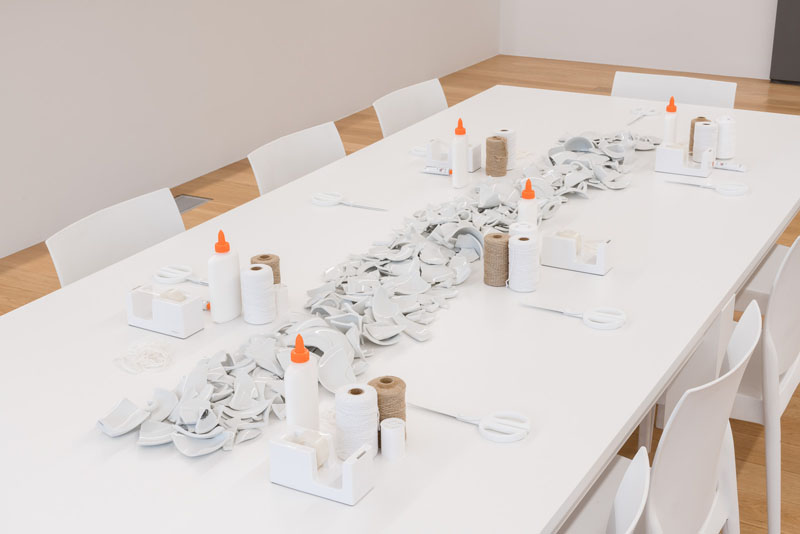
Courtesy: Rennie Museum

There was another “Mend Piece” in Canada, located at the Gardiner Museum and part of a larger show titled: “The Riverbed,” which ran from February 22 to June 3, 2018. Here’s an image of one of the Gardiner Museum “Mend” pieces that was featured in a March 7, 2018 article by Sonya Davidson for the Toronto Guardian,

Yoko Ono, Mend Piece, 1966 / 2018, © Yoko Ono. Photo: Tara Fillion Courtesy: Toronto Guardian

Here’s what Davidson had to say about the three-part installation, “The Riverbed,”

I’m sitting  on one of the cushions placed on the floor watching the steady stream of visitors at Yoko Ono’s exhibition The Riverbed at the Gardiner Museum. The room is airy and bright but void of  colours yet it’s vibrant and alive in a calming way. There are three distinct areas in this exhibition: Stone Piece, Line Piece and Mend Piece. From what I’ve experienced in Ono’s previous exhibitions, her work encourages participation and is inclusive of everyone. She has the idea. She encourages us to  go collaborate with her. Her work is describe often as  redirecting our attention to ideas, instead of appearances.

Mend Piece is the one I’m most familiar with. It was part of her exhibition I visited in Reykjavik [Iceland]. Two large communal tables are filled with broken ceramic pieces and mending elements. Think glue, string, and tape.  Instructions from Ono once again are simple but with meaning. Take the pieces that resonate with you and mend them as you desire. You’re encourage [sic] to leave it in the communal space for everyone to experience what you’ve experienced. It reminded me of her work decades ago where she shattered porcelain vases, and people invited people to take a piece with them. But then years later she collected as many back and mended them herself. Part contemporary with a nod to the traditional Japanese art form of Kintsugi – fixing broken pottery with gold and the philosophy of nothing is ever truly broken. The repairs made are part of the history and should be embraced with honour and pride.

The experience at the Rennie was markedly different . I recommend reading both Davidson’s piece (includes many embedded images) in its entirety to get a sense for how different and this April 7, 2018 article by Jenna Moon for The Star regarding the theft of a stone from The Riverbed show at the Gardiner,

A rock bearing Yoko Ono’s handwriting has been stolen from the Gardiner Museum, Toronto police say. The theft reportedly occurred around 5:30 p.m. on March 12.

The rock is part of an art exhibit featuring Ono, where patrons can meditate using several river rocks. The stone is inscribed with black ink, and reads “love yourself” in block letters. It is valued at $17,500 (U.S.), [emphasis mine] Toronto police media officer Gary Long told the Star Friday evening.

As far as I can tell, they still haven’t found the suspect who was described as a woman between the ages of 55 and 60. However the question that most interests me is how did they arrive at a value for the stone? Was it a case of assigning a value to the part of the installation with the stones and dividing that value by the number of stones? Yoko Ono may focus her art on social activism and peace but she too needs money to survive. Moving on.

Musings on ‘mend’

Participating in “Mend Piece” at the Rennie Museum was revelatory. It was a direct experience of the “traditional Japanese art form of Kintsugi – fixing broken pottery with gold and the philosophy of nothing is ever truly broken.” So often art is at best a tertiary experience for the viewer. The artist has the primary experience producing the work and the curator has the secondary experience of putting the show together.

For all the talk about interactive installations and pieces, there are few that truly engage the viewer with the piece. I find this rule applies: the more technology, the less interactivity.

“Mend” insisted on interactivity. More or less. I went with a friend and sat beside the one person in the group who didn’t want to talk to anyone. And she wasn’t just quiet, you could feel the “don’t talk to me” vibrations pouring from every one of her body parts.

The mending sessions were about 30 minutes long and, as Davidson notes, you had string, two types of glue, and twine. For someone with any kind of perfectionist tendencies (me) and a lack of crafting skills (me), it proved to be a bit of a challenge, especially with a semi-hostile person beside me. Thank goodness my friend was on the other side.

Adding to my travails was the gallery assistant (a local art student) who got very anxious and hovered over me as I attempted and failed to set my piece on a ledge in the room (twice). She was very nice and happy to share, without being intrusive, information about Yoko Ono and her work while we were constructing our pieces. I’m not sure what she thought was going to happen when I started dropping things but her hovering brought back memories of my adolescence when shopkeepers would follow me around their store.

Most of my group had finished and even though there was still time in my session, the next group rushed in and took my seat while I failed for the second time to place my piece. I stood for my third (and thankfully successful) repair attempt.

At that point I went to the back where more of the “Mend” communal experience awaited. Unfortunately, the coffee bar’s (this put up especially for the show) espresso machine was not working. There was some poetry on the walls and a video highlighting Yoko Ono’s work over the years and the coffee bar attendant was eager to share (but not intrusively so) some information about Yoko and her work.

As I stated earlier, it was a revelatory experience. First, It turned out my friend had been following Yoko’s work since before the artist had hooked up with John Lennon and she was able to add details to the attendants’ comments.

Second, I didn’t expect was a confrontation with the shards of my past and personality. In essence, mending myself and, hopefully, more. There was my perfectionism, rejection by the unfriendly tablemate, my emotional response (unspoken) to the hypervigilant gallery assistant, having my seat taken from me before the time was up, and the disappointment of the coffee bar. There was also a rediscovery of my friend, a friendly tablemate who made a beautiful object (it looked like a bird), the helpfulness of both the gallery assistants, Yoko Ono’s poetry, and a documentary about the remarkable Yoko.

All in all, it was a perfect reflection of imperfection (wabi-sabi), brokenness, and wounding in the context of repair (Kintsugi)/healing.

Thank you, Yoko Ono.

For anyone in Vancouver who feels they missed out on the experience, there are some performances of “Perfect Imperfections: The Art of a Messy Life” (comedy, dance, and live music) at Vancity Culture Lab at The Cultch from June 14 – 16, 2018. You can find out more here.

The moment

It certainly seems as if there’s a great interest in Japanese art, if you live in Vancouver (Canada), anyway. The Murakami show was a huge success for the Vancouver Art Gallery. As for Yoko Ono, the Rennie Museum extended the exhibit dates due to demand. Plus, the 2018 – 2020 version of the Vancouver Biennale is featuring (from a May 29, 2018 Vancouver Biennale news release),

… Yoko Ono with its 2018 Distinguished Artist Award, a recognition that coincides with reissuing the acclaimed artist’s 2007 Biennale installation, “IMAGINE PEACE,” marshalled at this critical time to re-inspire a global consciousness towards unity, harmony, and accord. Yoko Ono’s project exemplifies the Vancouver Biennale’s mission for diverse communities to gain access, visibility and representation.

The British Museum’s show (May 25 – August 13, 2017), “Hokusai’s Great Wave,” was seen in Vancouver at a special preview event in May 2017 at a local movie house, which was packed.

The documentary film festival, DOXA (Vancouver) closed its 2018 iteration with the documentary about Yayoi Kusama. Here’s more about her from a May 9, 2018 article by Janet Smith for the Georgia Straight,

Amid all the dizzying, looped-and-dotted works that American director Heather Lenz has managed to capture in her new documentary Kusama—Infinity, perhaps nothing stands out so much as images of the artist today in her Shinjuku studio.

Interviewed in the film, the 89-year-old Yayoi Kusama sports a signature scarlet bobbed anime wig and hot-pink polka-dotted dress, sitting with her marker at a drawing table, and set against the recent creations on her wall—a sea of black-and-white spots and jaggedy lines.

“The boundary between Yayoi Kusama and her art is not very great,” Lenz tells the Straight from her home in Orange County. “They are one and the same.”

It was as a young student majoring in art history and fine art that Lenz was first drawn to Kusama—who stood out as one of few female artists in her textbooks. She saw an underappreciated talent whose avant-pop works anticipated Andy Warhol and others. And as Lenz dug deeper into the artist’s story, she found a woman whose struggles with a difficult childhood and mental illness made her achievements all the more remarkable.

Today, Kusama is one of the world’s most celebrated female artists, her kaleidoscopic, multiroom show Infinity Mirrors drawing throngs of visitors to galleries like the Art Gallery of Ontario and the Seattle Art Museum over the past year. But when Lenz set out to make her film 17 long years ago, few had ever heard of Kusama.

I am hopeful that this is a sign that the Vancouver art scene is focusing more attention to the west, to Asia. Quite frankly, it’s about time.

As a special treat, here’s a ‘Yoko Ono tribute’ from the Bare Naked Ladies,

Dance!