It seems Japanese artists are ‘having a moment’. There’s a documentary (Kusama—Infinity) about contemporary Japanese female artist, Yayoi Kusama, making the festival rounds this year (2018). Last year (2017), the British Museum mounted a major exhibition of Hokusai’s work (19th Century) and in 2017, the Metropolitan Museum of Art Costume Institute benefit was inspired by a Japanese fashion designer, “Rei Kawakubo/Comme des Garçons: Art of the In-Between.” (A curator at the Japanese Garden in Portland who had lived in Japan for a number of years mentioned to me during an interview that the Japanese have one word for art. There is no linguistic separation between art and craft.)
More recently, both Yoko Ono and Takashi Murakami have had shows in Vancouver, Canada. Starting with fear as I prefer to end with love, Murakami had a blockbuster show at the Vancouver Gallery.
Takashi Murakami: a dance with fear (and money too)
In the introductory notes at the beginning of the exhibit: “Takashi Murakami: The Octopus Eats Its own Leg,” it was noted that fear is one of Murakami’s themes. The first few pieces in the show had been made to look faded and brownish to the point where you had to work at seeing what was underneath the layers. The images were a little bit like horror films something’s a bit awry then scary and you don’t know what it is or how to deal with it.
After those images, the show opened up to bright, bouncy imagery commonly associated with Mrjakami’s work. However, if you look at them carefully, you’ll see many of these characters have big, pointed teeth. Also featured was a darkened room with two huge warriors.At a guess, I’d say they were 14 feet tall.
It made for a disconcerting show with its darker themes usually concealed in bright, vibrant colour. Here’s an image promoting Murakami’s Vancouver birthday celebration and exhibit opening,
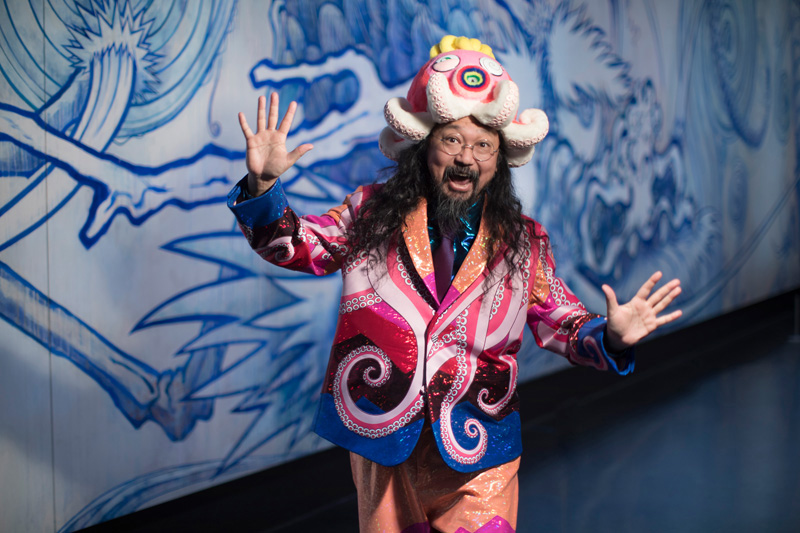
‘Give me the money, now!’ says a gleeful Takashi Murakami, whose expansive show is currently at the Vancouver Art Gallery. Photo by the VAG. [downloaded from https://thetyee.ca/Culture/2018/02/07/Takashi-Murakami-VAG/]
The close, almost incestuous relationship between art and money is a very old story. [emphasis mine] You might even say it is the only story at the moment.
You can know this, understand it to a certain extent, and still have it rear up and bite you on the bum. [emphasis mine] Such was my experience of attending the exhibition preview of Takashi Murakami’s The Octopus Eats Its Own Leg at the Vancouver Art Gallery.
The show is the first major retrospective of Murakami’s work in Canada, and the VAG has spared no expense in marketing the living hell out of the thing. From the massive cephalopod installed atop the dome of the gallery, to the ocean of smiling cartoon flowers, to the posters papering every inch of downtown Vancouver, it is in a word: huge.
If you don’t know much about Murakami the show is illuminating, in many different ways. Expansive in extremis, the exhibition includes more than 50 works that trace a path through the evolution of Murakami’s style and aesthetic, moving from his early dark textural paintings that blatantly ripped off Anselm Kiefer, to his later pop-art style (Superflat), familiar from Kanye West albums and Louis Vuitton handbags.
…
… make no mistake, money runs underneath the VAG show like an engine [emphasis mine]. You can feel it in the air, thrumming with a strange radioactive current, like a heat mirage coming off the people madly snapping selfies next to the Kanye Bear sculpture.
The artist himself seems particularly aware of how much of a financial edifice surrounds the human impulse to make images. In an on-stage interview with senior VAG [Vancouver Art Gallery] curator Bruce Grenville during a media preview for the show, Murakami spoke plainly about the need for survival (a.k.a. money) [emphasis mine] that has propelled his career.
…
Even the title of the show speaks to the notion of survival (from Woodend’s article; Note: Links have been removed),
The title of the show takes inspiration from Japanese folklore about a creature that sacrifices part of its own body so that the greater whole might survive. In the natural world, an octopus will chew off its own leg if there is an infection, and then regrow the missing limb. In the art world, the idea pertains to the practice of regurgitating (recycling) old ideas to serve the endless voracious demand for new stuff. “I don’t have the talent to come up with new ideas, so in order to survive, you have to eat your own body,” Murakami explains, citing his need for deadlines, and very bad economic conditions, that lead to a state of almost Dostoyevskyian desperation. “Please give me the money now!” he yells, and the assembled press laughs on cue.
…
The artist’s responsibility to address larger issues like gender, politics and the environment was the final question posed during the Q&A, before the media were allowed into the gallery to see the work. Murakami took his time before answering, speaking through the nice female translator beside him. “Artists don’t have that much power in the world, but they can speak to the audience of the future, who look at the artwork from a certain era, like Goya paintings, and see not just social commentary, but an artistic point of view. The job of the artist is to dig deep into human beings.”
Which is a nice sentiment to be sure, but increasingly art is about celebrity and profit. Record-breaking shows like Alexander McQueen’s Savage Beauty and Rei Kawakubo/Comme des Garçons: Art of the In-Between demonstrated an easy appeal for both audiences and corporations. One of Murakami’s earlier exhibitions featured a Louis Vuitton pop-up shop as part of the show. Closer to home, the Fight for Beauty exhibit mixed fashion, art and development in a decidedly queasy-making mixture.
There is money to be made in culture of a certain scale, with scale being the operative word. Get big or get out.
Woodend also relates the show and some of the issues it raises to the local scene (Note: Links have been removed),
A recent article in the Vancouver Courier about the Oakridge redevelopment plans highlighted the relationship between development and culture in raw numbers: “1,000,000 square feet of retail, 2,600 homes for 6,000 people, office space for 3,000 workers, a 100,000-square-foot community centre and daycare, the city’s second-largest library, a performing arts academy, a live music venue for 3,000 people and the largest public art program in Vancouver’s history…”
Westbank’s Ian Gillespie [who hosted the Fight for Beauty exhibit] was quoted extensively, outlining the integration between the city and the developer. “The development team will also work with the city’s chief librarian to figure out the future of the library, while the 3,000-seat music venue will create an ‘incredible music scene.’” The term “cultural hub” also pops up so many times it’s almost funny, in a horrifying kind of way.
But bigness often squeezes out artists and musicians who simply can’t compete. Folk who can’t fill a 3,000-seat venue, or pack in thousands of visitors, like the Murakami show, are out of luck.
Vancouver artists, who struggle to survive in the city and have done so for quite some time, were singularly unimpressed with the Oakridge development proposal. Selina Crammond, a local musician and all-around firebrand, summed up the divide in a few eloquent sentences: “I mean really, who is going to make up this ‘incredible music scene’ and fill all of these shiny new venues? Many of my favourite local musicians have already moved away from Vancouver because they just can’t make it work. Who’s going to pay the musicians and workers? Who’s going to pay the large ticket prices to be able to maintain these spaces? I don’t think space is the problem. I think affordability and distribution of wealth and funding are the problems artists and arts workers are facing.”
The stories continue to pop up, the most recent being the possible sale and redevelopment of the Rio Theatre. The news sparked an outpouring of anger, but the story is repeated so often in Vancouver, it has become something of a cliché. You need only to look at the story of the Hollywood Theatre for a likely ending to the saga.
Which brings me back around to the Murakami exhibit. To be perfectly frank, the show is incredible and well-worth visiting. I enjoyed every minute of wandering through it taking in the sheer expanse of mind-boggling, googly-eyed detail. I would urge you to attend, if you can afford it. But there’s the rub. I was there for free, and general admission to the VAG is $22.86. This may not seem like a lot, but in a city where people can barely make rent, culture becomes the purview of them that can afford it.
The City of Vancouver recently launched its Creative Cities initiative to look at issues of affordability, diversity and gentrification.
We shall see if anything real emerges from the process. But in the meantime, Vancouver artists might have to eat their own legs simply to survive. [Tyee]
Survival issues and their intimate companions, fear, are clearly a major focus for Murakami’s art.
For the curious, the Vancouver version of the Murakami retrospective show was held from February 3 – May 6, 2018. There are still some materials about the show available online here.
Yoko Ono and the power of love (and maybe money, too)
More or less concurrently with the Murakami exhibition, the Rennie Museum (formerly Rennie Collection), came back from a several month hiatus to host a show featuring Yoko Ono’s “Mend Piece.”
From a Rennie Museum (undated) press release,
Rennie Museum is pleased to present Yoko Ono’s MEND PIECE, Andrea Rosen Gallery, New York City version (1966/2015). Illustrating Ono’s long standing artistic quest in social activism and world peace, this instructional work will transform the historic Wing Sang building into an intimate space for creative expression and bring people together in an act of collective healing and meditation. The installation will run from March 1 to April 15, 2018.
First conceptualized in 1966, the work immerses the visitor in a dream-like state. Viewers enter into an all-white space and are welcomed to take a seat at the table to reassemble fragments of ceramic coffee cups and saucers using the provided twine, tape, and glue. Akin to the Japanese philosophy of Wabi-sabi, an embracing of the flawed or imperfect, Mend Piece encourages the participant to transform broken fragments into an object that prevails its own violent rupture. The mended pieces are then displayed on shelves installed around the room. The contemplative act of mending is intended to promote reparation starting within one’s self and community, and bridge the gap created by violence, hatred, and war. In the words of Yoko Ono herself, “Mend with wisdom, mend with love. It will mend the earth at the same time.”
The installation of MEND PIECE, Andrea Rosen Gallery, New York City version at Rennie Museum will be accompanied by an espresso bar, furthering the notions of community and togetherness.
Yoko Ono (b. 1933) is a Japanese conceptual artist, musician, and peace activist pioneering feminism and Fluxus art. Her eclectic oeuvre of performance art, paintings, sculptures, films and sound works have been shown at renowned institutions worldwide, with recent exhibitions at The Museum of Modern Art, New York; Copenhagen Contemporary, Copenhagen; Museum of Contemporary Art, Tokyo; and Museo de Arte Latinoamericano de Buenos Aires. She is the recipient of the 2005 IMAJINE Lifetime Achievement Award and the 2009 Venice Biennale Golden Lion for Lifetime Achievement, among other distinctions. She lives and works in New York City.
While most of the shows have taken place over two, three, or four floors, “Mend Piece” was on the main floor only,
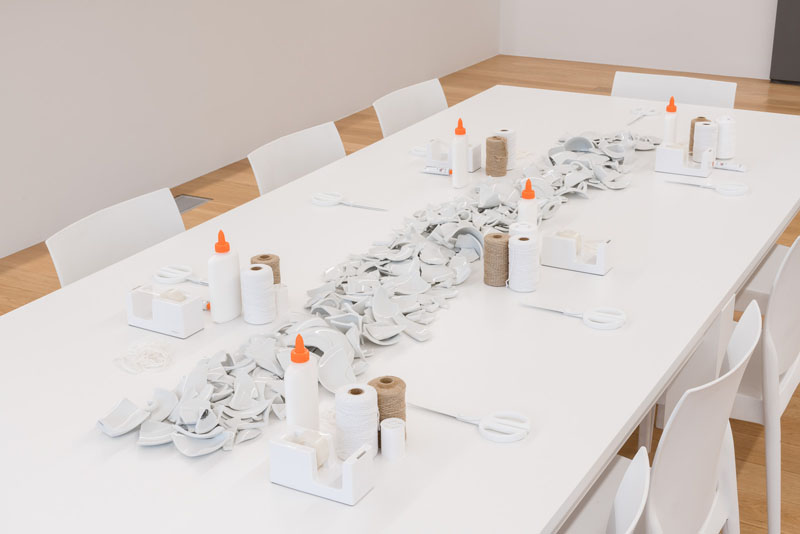
Courtesy: Rennie Museum
There was another “Mend Piece” in Canada, located at the Gardiner Museum and part of a larger show titled: “The Riverbed,” which ran from February 22 to June 3, 2018. Here’s an image of one of the Gardiner Museum “Mend” pieces that was featured in a March 7, 2018 article by Sonya Davidson for the Toronto Guardian,
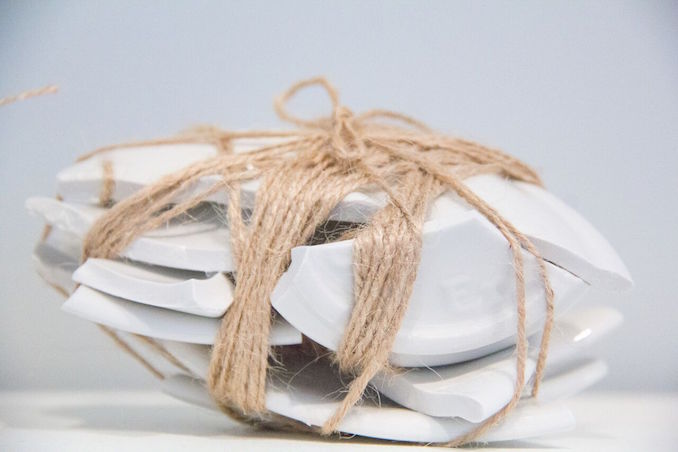
Yoko Ono, Mend Piece, 1966 / 2018, © Yoko Ono. Photo: Tara Fillion Courtesy: Toronto Guardian
Here’s what Davidson had to say about the three-part installation, “The Riverbed,”
I’m sitting on one of the cushions placed on the floor watching the steady stream of visitors at Yoko Ono’s exhibition The Riverbed at the Gardiner Museum. The room is airy and bright but void of colours yet it’s vibrant and alive in a calming way. There are three distinct areas in this exhibition: Stone Piece, Line Piece and Mend Piece. From what I’ve experienced in Ono’s previous exhibitions, her work encourages participation and is inclusive of everyone. She has the idea. She encourages us to go collaborate with her. Her work is describe often as redirecting our attention to ideas, instead of appearances.
…
Mend Piece is the one I’m most familiar with. It was part of her exhibition I visited in Reykjavik [Iceland]. Two large communal tables are filled with broken ceramic pieces and mending elements. Think glue, string, and tape. Instructions from Ono once again are simple but with meaning. Take the pieces that resonate with you and mend them as you desire. You’re encourage [sic] to leave it in the communal space for everyone to experience what you’ve experienced. It reminded me of her work decades ago where she shattered porcelain vases, and people invited people to take a piece with them. But then years later she collected as many back and mended them herself. Part contemporary with a nod to the traditional Japanese art form of Kintsugi – fixing broken pottery with gold and the philosophy of nothing is ever truly broken. The repairs made are part of the history and should be embraced with honour and pride.
The experience at the Rennie was markedly different . I recommend reading both Davidson’s piece (includes many embedded images) in its entirety to get a sense for how different and this April 7, 2018 article by Jenna Moon for The Star regarding the theft of a stone from The Riverbed show at the Gardiner,
A rock bearing Yoko Ono’s handwriting has been stolen from the Gardiner Museum, Toronto police say. The theft reportedly occurred around 5:30 p.m. on March 12.
The rock is part of an art exhibit featuring Ono, where patrons can meditate using several river rocks. The stone is inscribed with black ink, and reads “love yourself” in block letters. It is valued at $17,500 (U.S.), [emphasis mine] Toronto police media officer Gary Long told the Star Friday evening.
…
As far as I can tell, they still haven’t found the suspect who was described as a woman between the ages of 55 and 60. However the question that most interests me is how did they arrive at a value for the stone? Was it a case of assigning a value to the part of the installation with the stones and dividing that value by the number of stones? Yoko Ono may focus her art on social activism and peace but she too needs money to survive. Moving on.
Musings on ‘mend’
Participating in “Mend Piece” at the Rennie Museum was revelatory. It was a direct experience of the “traditional Japanese art form of Kintsugi – fixing broken pottery with gold and the philosophy of nothing is ever truly broken.” So often art is at best a tertiary experience for the viewer. The artist has the primary experience producing the work and the curator has the secondary experience of putting the show together.
For all the talk about interactive installations and pieces, there are few that truly engage the viewer with the piece. I find this rule applies: the more technology, the less interactivity.
“Mend” insisted on interactivity. More or less. I went with a friend and sat beside the one person in the group who didn’t want to talk to anyone. And she wasn’t just quiet, you could feel the “don’t talk to me” vibrations pouring from every one of her body parts.
The mending sessions were about 30 minutes long and, as Davidson notes, you had string, two types of glue, and twine. For someone with any kind of perfectionist tendencies (me) and a lack of crafting skills (me), it proved to be a bit of a challenge, especially with a semi-hostile person beside me. Thank goodness my friend was on the other side.
Adding to my travails was the gallery assistant (a local art student) who got very anxious and hovered over me as I attempted and failed to set my piece on a ledge in the room (twice). She was very nice and happy to share, without being intrusive, information about Yoko Ono and her work while we were constructing our pieces. I’m not sure what she thought was going to happen when I started dropping things but her hovering brought back memories of my adolescence when shopkeepers would follow me around their store.
Most of my group had finished and even though there was still time in my session, the next group rushed in and took my seat while I failed for the second time to place my piece. I stood for my third (and thankfully successful) repair attempt.
At that point I went to the back where more of the “Mend” communal experience awaited. Unfortunately, the coffee bar’s (this put up especially for the show) espresso machine was not working. There was some poetry on the walls and a video highlighting Yoko Ono’s work over the years and the coffee bar attendant was eager to share (but not intrusively so) some information about Yoko and her work.
As I stated earlier, it was a revelatory experience. First, It turned out my friend had been following Yoko’s work since before the artist had hooked up with John Lennon and she was able to add details to the attendants’ comments.
Second, I didn’t expect was a confrontation with the shards of my past and personality. In essence, mending myself and, hopefully, more. There was my perfectionism, rejection by the unfriendly tablemate, my emotional response (unspoken) to the hypervigilant gallery assistant, having my seat taken from me before the time was up, and the disappointment of the coffee bar. There was also a rediscovery of my friend, a friendly tablemate who made a beautiful object (it looked like a bird), the helpfulness of both the gallery assistants, Yoko Ono’s poetry, and a documentary about the remarkable Yoko.
All in all, it was a perfect reflection of imperfection (wabi-sabi), brokenness, and wounding in the context of repair (Kintsugi)/healing.
Thank you, Yoko Ono.
For anyone in Vancouver who feels they missed out on the experience, there are some performances of “Perfect Imperfections: The Art of a Messy Life” (comedy, dance, and live music) at Vancity Culture Lab at The Cultch from June 14 – 16, 2018. You can find out more here.
The moment
It certainly seems as if there’s a great interest in Japanese art, if you live in Vancouver (Canada), anyway. The Murakami show was a huge success for the Vancouver Art Gallery. As for Yoko Ono, the Rennie Museum extended the exhibit dates due to demand. Plus, the 2018 – 2020 version of the Vancouver Biennale is featuring (from a May 29, 2018 Vancouver Biennale news release),
… Yoko Ono with its 2018 Distinguished Artist Award, a recognition that coincides with reissuing the acclaimed artist’s 2007 Biennale installation, “IMAGINE PEACE,” marshalled at this critical time to re-inspire a global consciousness towards unity, harmony, and accord. Yoko Ono’s project exemplifies the Vancouver Biennale’s mission for diverse communities to gain access, visibility and representation.
The British Museum’s show (May 25 – August 13, 2017), “Hokusai’s Great Wave,” was seen in Vancouver at a special preview event in May 2017 at a local movie house, which was packed.
The documentary film festival, DOXA (Vancouver) closed its 2018 iteration with the documentary about Yayoi Kusama. Here’s more about her from a May 9, 2018 article by Janet Smith for the Georgia Straight,
Amid all the dizzying, looped-and-dotted works that American director Heather Lenz has managed to capture in her new documentary Kusama—Infinity, perhaps nothing stands out so much as images of the artist today in her Shinjuku studio.
Interviewed in the film, the 89-year-old Yayoi Kusama sports a signature scarlet bobbed anime wig and hot-pink polka-dotted dress, sitting with her marker at a drawing table, and set against the recent creations on her wall—a sea of black-and-white spots and jaggedy lines.
“The boundary between Yayoi Kusama and her art is not very great,” Lenz tells the Straight from her home in Orange County. “They are one and the same.”
It was as a young student majoring in art history and fine art that Lenz was first drawn to Kusama—who stood out as one of few female artists in her textbooks. She saw an underappreciated talent whose avant-pop works anticipated Andy Warhol and others. And as Lenz dug deeper into the artist’s story, she found a woman whose struggles with a difficult childhood and mental illness made her achievements all the more remarkable.
Today, Kusama is one of the world’s most celebrated female artists, her kaleidoscopic, multiroom show Infinity Mirrors drawing throngs of visitors to galleries like the Art Gallery of Ontario and the Seattle Art Museum over the past year. But when Lenz set out to make her film 17 long years ago, few had ever heard of Kusama.
…
I am hopeful that this is a sign that the Vancouver art scene is focusing more attention to the west, to Asia. Quite frankly, it’s about time.
As a special treat, here’s a ‘Yoko Ono tribute’ from the Bare Naked Ladies,
Dance!