I believe this is an April (?) 2024 newsletter and it’s definitely from Canada’s Perimeter Institute for Theoretical Physics (PI). Received via email, I was able to find this online copy (Note: I’m not sure how long this copy will remain online) and am excerpting a few items for inclusion here,
…
The current state of theoretical physics
Join the latest episode of Conversations at Perimeter as Neil Turok [director of the Perimeter Institute, 2008 – 2019] delves into the intriguing topic of the simplicity of nature.
Free tickets to attend the event in person will be available on Monday, April 22, at 9:00 AM EDT. Live-stream will also be available on the PI YouTube channel.
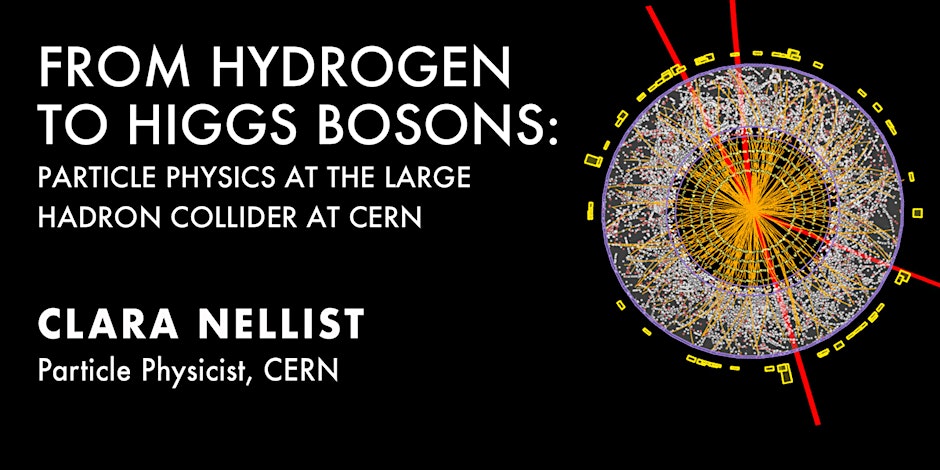
Hydrogen to Higgs Boson: Particle Physics at the Large Hadron Collider
Explore particle physics with Dr. Clara Nellist at the Perimeter Institute on May 8, as she discusses CERN’s groundbreaking research.
Date and time
Starts on Wednesday, May 8 [2024] · 6pm EDT
Location
Perimeter Institute for Theoretical Physics 31 Caroline Street North Waterloo, ON N2L 2Y5 …
Agenda
6:00 p.m.
Doors Open
Perimeter’s main floor will be open for ticket holders, with scientists available to answer science questions until the show begins.
7:00 p.m. – 8:00 p.m.
Public Lecture
The public lecture will begin at 7:00pm, including a live stream for virtual attendees. This will include a full presentation as well as a Q&A session.
8:00 p.m. – 8:30 p.m.
Post-Event Discussion
Following the lecture, discussion will continue in the atrium, where you can ask questions to the presenter as well as other researchers in the crowd.
About this event
About the Speaker:
Dr Clara Nellist – Particle Physicist and Science Communicator, is currently working at CERN [European Organization for Nuclear Research] on the ATLAS experiment, with research focusing on top quarks and searching for dark matter with machine learning. Learn more about her work on her Instagram here.
About the Event:
Registration to attend the event in person will be available on Monday, April 22 at 9:00 AM EDT.
Tickets for this event are 100% free. [emphasis mine] As always, our public lectures are live-streamed in real-time on our YouTube channel – available here: https://www.youtube.com/@PIOutreach
…
The existence of the Higgs boson was confirmed (or as close to confirmed as scientists will get) in 2012 (see my July 4, 2012 posting “Tears of joy as physicists announce they’re pretty sure they found the Higgs Boson” for an account of the event. Peter Higgs and and François Englert were awarded the 2013 Nobel Prize in Physics.
If you are planning to attend the lecture in person, free tickets will be made available on Monday, April 22, at 9:00 AM EDT. Go here and, remember, these tickets go quickly.
This June 11, 2019 announcement (received via email) features an upcoming talk hosted by the local Café Scientifque community,
Our next café will happen on TUESDAY, JUNE 25TH at 7:30PM in the back room at YAGGER’S DOWNTOWN (433 W Pender). Our speaker for the evening will be DR. LARS MARTIN.
FROM ALPHA TO OMEGA – PARTICLES AND HOW WE DETECT THEM
Ever since the discovery of the electron in the late 19th century, physicists have used detectors to measure and identify particles. While today’s detector systems – like ATLAS at the Large Hadron Collider – are complex (and expensive) systems that detect obscure particles, the underlying principles of these detectors are relatively straightforward. The goal of this talk is to give attendees a basic understanding of what these machines actually do.
Lars Martin works as a detector physicist at TRIUMF, most recently supporting the ALPHA-g antimatter gravity experiment at CERN.
Compared to five or more years ago, there’s a lollapalooza of art/sci (or sciart) events coming up in September 2018. Of course, it’s helpful if you live in or are visiting Toronto or Vancouver or Calgary at the right time. All of these events occur from mid September (roughly) to the end of September. In no particular date order:
“The Sense of Beauty: Art and Science at CERN” (2017) by Valerio Jalongo
TUESDAY, SEPTEMBER 25, 2018 at 6:30 pm
The CINEMATHEQUE – 1131 Howe Street, Vancouver
Duration of film: 75’. Director in attendance; Q&A with the film director to follow the screening
Free Admission
RSVP: info@dantesocietybc.ca
Director Jalongo will discuss the making of his documentary in a seminar open to the public on September 24 (1:00-2:30 pm) at UBC [University of British Columbia] (Buchanan Penthouse, *1866 Main Maill, Block C, 5th floor*, Vancouver).
The Sense of Beauty is the story of an unprecedented experiment that involves scientists from throughout the world collaborating around the largest machine ever constructed by human beings: the LHC (Large Hadron Collider). As the new experiment at CERN proceeds in its exploration of the mysterious energy that animates the universe, scientists and artists guide us towards the shadow line where science and art, in different ways, pursue truth and beauty.
Some of these men and women believe in God, while others believe only in experiment and doubt. But in their search for truth they are all alert to an elusive sixth – or seventh – sense: the sense of beauty. An unmissable opportunity for lovers of science, of beauty, or of both.
Rome-born Valerio Jalongo is a teacher, screenwriter and director who works in cinema and TV, for which he created works of fiction and award-winning documentaries. Among them: Sulla mia pelle (On My Skin, 2003) and La scuola è finita (2010), starring Valeria Golino, on the difficulties facing public schools in Italy.
This event is presented by the Dante Alighieri Society of BC in collaboration with the Consulate General of Italy in Vancouver and in association with ARPICO (www.arpico.ca), the Society of Italian Researchers and Professionals in Western Canada.
RSVP: info@dantesocietybc.ca
I searched for more information both about the film and about the seminar at UBC. I had no luck with the UBC seminar but I did find more about the film. There’s an April (?) 2017 synopsis by Luciano Barisone on the Vision du Réel website,
From one cave to another. In prehistoric times, human beings would leave paintings in caves to show their amazement and admiration for the complexity of the world. These reproductions of natural forms were the results of an act of creation and also of mystical gestures which appropriated the soul of things. In another gigantic and modern den, the immense CERN laboratory, the same thing is happening today, a combination of enthralled exploration of the cosmos and an attempt to control it. Valerio Jalongo’s film tackles the big questions that have fascinated poets, artists and philosophers since the dawn of time. Who are we? Where do we come from? Where are we going? The scientists at CERN attempt to answer them through machines that explore matter and search for the origins of life. In their conversations or their words to camera, the meaning of existence thus seems to become a pure question of the laws of physics and mathematical formulae. If only for solving the mystery of the universe a sixth sense is necessary. That of beauty…
There’s also a February 5, 2018 essay by Stefano Caggiano for Interni, which uses a description of the film to launch into a paean to Italian design,
The success of the documentary The Sense of Beauty by Valerio Jalongo, which narrates the ‘aesthetic’ side of the physicists at CERN when faced with the fundamental laws of nature, proves that the yearning for beauty is not just an aspect of art, but something shared by all human efforts to interpret reality.
It is no coincidence that the scientists themselves define the LHC particle accelerator (27 km) as a grand machine for beauty, conceived to investigate the meaning of things, not to perform some practical function. In fact, just as matter can be perceived only through form, and form only if supported by matter (Aristotle already understood this), so the laws of physics can be glimpsed only when they are applied to reality.
This is why in the Large Hadron Collider particles are accelerated to speeds close to that of light, reconstructing the matter-energy conditions just a few instants after the Big Bang. Only in this way is it possible to glimpse the hidden fundamental laws of the universe. It is precisely this evanescence that constitutes ‘beauty.’
The quivering of the form that reveals itself in the matter that conceals it, and which – given the fact that everything originates in the Big Bang – is found everywhere, in the most faraway stars and the closest objects: you just have to know how to prove it, grasp it, how to wait. Because this is the only way to establish relations with beauty: not perceiving it but awaiting it. Respecting its way of offering itself, which consists in denying itself.
Charging the form of an object with this sensation of awaiting, then, means catalyzing the ultimate and primary sense of beauty. And it is what is held in common by the work of the five Italian designers nominated for the Rising Talent Awards of Maison & Object 2018 (with Kensaku Oshiro as the only non-Italian designer, though he does live and work in Milan).
…
There’s a trailer (published by CERN on November 7, 2017,
It’s in both Italian and English with subtitles throughout, should you need them.
*The address for the Buchanan Penthouse was corrected from: 2329 West Mall to 1866 Main Maill, Block C, 5th floor on Sept. 17, 2018.
Toronto’s ArtSci Salon at Nuit Blanche, Mycology, Wild Bees and Art+Tech!
From a Tuesday, September 11, 2018 Art/Sci Salon announcement (received via email),
Baba Yaga Collective and ArtSci Salon Present: Chaos Fungorum
In 1747, Carl Linnaeus, known as the “father of taxonomy”, observed
that the seeds of fungus moved in water like fish until “..by a law of
nature thus far unheard of and surpassing all human understanding..,”
they changed back to plant in their adult life.
He proceeded to include fungi in the new genus of “Chaos”. But why
delimiting fungi within categories and boundaries when it is exactly
their fluidity that make them so interesting?
Chaos Fungorum draws on the particular position occupied by fungi and
other hybrid organisms: neither plant nor animal, fungi extend across,
and can entertain, communications and collaborations between animal,
human and industrial realms.
Mixing different artistic practices and media, the artists featured in
this exhibition seek to move beyond rigid comprehensions of the living
by working with, rather than merely shaping, sculpting and manipulating
plants, microorganisms and fungi. Letting the non-human speak is to move
away from an anthropocentric approach to the world: it not only opens to
new rewarding artistic practices, but it also fosters new ideas of
sustainable coexistence, new unusual life collaborations and
adaptations, and new forms of communications and languages.
THE EXHIBITION
September 26 – October 7, 2018
Baba Yaga Collective 906 Queen Street West @Crawford, Toronto
All the Buzz on Wild Bee Club!
Summer Speaker Series
Wed Sept 19 at 7pm
High Park Nature Centre,
All the Buzz on Wild Bee Club! – Summer Speaker Series
The speaker series will feature the club’s biologist/leader SUSAN FRYE.
A major component of this club will use the SONIC SOLITARIES AUDIO BEE
CABINET – an observable nest site for bees in OURSpace – to encompass a
sensory experience with stem nesting bees and wasps, and to record
weekly activity at the cabinet. Pairing magnified views in tandem with
amplified sound via headphones, the cabinet facilitates an enhanced
perception of its tiny inhabitants: solitary bees and wasps and other
nest biota in action, up close. As citizen scientists, we can gather and
record observations to compile them into a database that will contribute
to our growing understanding of native bees, the native (and non-native)
plants they use for food and nest material sources, their co-evolution,
and how pollination in a park and restored habitat setting is
facilitated by native bees.
Fri, Sept 21, 8pm
Music Gallery, 918 Bathurst (their new location) – Trio Wow & Flutter
with Bea Labikova, fujara, saxophones,
Kayla Milmine-Abbott, soprano saxophone,
Sarah Peebles, shō, cracklebox, amplifiers.
Call for Participants: Art+Tech Jam
ChangeUp’s Art+Tech Jam
September 21-23
This three days event will unite a diverse group of artists and
technologists in an intensive, collaborative three-day creation period
and culminating showcase (public exhibition and interdisciplinary rave).
ChangeUo is currently accepting applicants from tech and arts/culture
spaces of all ages, backgrounds, and experience levels.
Limited spots available.
For more information and to apply https://tinyurl.com/changeup-artsorg
I looked up Nanotopia and found it on SoundCloud. Happy listening!
Et Al III (the ultimate science bar night in Vancouver) and more
A September 12, 2018 Curiosity Collider announcement (received via email) reveals details about the latest cooperative event/bar night put on by three sciencish groups,
Curiosity Collider is bringing art + science to Vancouver’s Ultimate Bar Science Night with Nerd Nite & Science Slam
Do you enjoy learning about science in a casual environment? This is the third year that Curiosity Collider is part of Et al, the Ultimate Bar Science Night where we bring together awesome speakers and activities. Come and enjoy Curiosity Collider’s segment on quantum physics with Spoken Word Poet Angelica Poversky, Physicist James Day, and CC’s own Creative Director Char Hoyt.
When: Drinks and mingling start at 6:30pm. Presentations start at 7:30pm. Where:Rio Theatre, 1660 E Broadway, Vancouver, BC V5N 1W1 Cost:$15-20 via Eventbrite and at the door. Proceeds will be used to cover the cost of running this event, and to fund future science bar events.
Special Guest talk by Dr. Carin Bondar – Biologist with a Twist!
Dr. Carin Bondar is a biologist, author and philosopher. Bondar is author of the books Wild Sex and Wild Moms (Pegasus). She is the writer and host of an online series based on her books which have garnered over 100,000,000 views. Her TED talk on the subject has nearly 3 million views. She is host of several TV series including Worlds Oddest Animal Couples (Animal Planet, Netflix), Stephen Hawking’s Brave New World (Discovery World HD, National Geographic) and Outrageous Acts of Science (The Science Channel). Bondar is an adventurer and explorer, having discovered 11 new species of beetles and snails in the remote jungles of Borneo. Bondar is also a mom of 4 kids, two boys and two girls.
Follow updates on twitter via @ccollider or #ColliderCafe. This event is part of the Science Literacy Week celebration across Canada.
Save-the-date: Our next #ColliderCafe will be on Wednesday, September 26! More to come…
Our friends at STEAM Communications and Events are hosting Brews, Builds ‘N’ Bytes Nights at the Storm Crow Alehouse (Broadway) on September 20. Tickets are almost sold out!
Colleen McLaughlin Barlow, who presented at a previous Collider Cafe on her art+science work, will show her glass work Whale Dreams at the Lookout Gallery, September12 to November 16.
Vancouver Biennale is hosting Patricia Piccinini’s CURIOUS IMAGININGS at the Patricia Hotel. The exhibition will “challenge us to explore the social impacts of emerging biotechnology and our ethical limits in an age where genetic engineering and digital technologies are already pushing the boundaries of humanity.” Purchase tickets online.
Devoted readers 🙂 will note that the Vancouver Biennale’s Curious Imaginings show was featured here in a June 18, 2018 post and mentioned more recently in the context of a September 11, 2018 post on xenotransplantation.
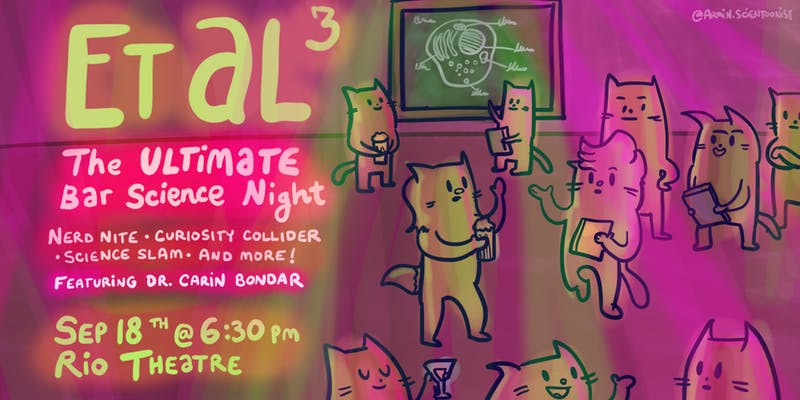
Et Al III: The Ultimate Bar Science Night Curiosity Collider + Nerd Nite Vancouver + Science Slam Canada
POSTER BY: Armin Mortazavi IG:@Armin.Scientoonist
Et Al III: The Ultimate Bar Science Night
Curiosity Collider + Nerd Nite Vancouver + Science Slam Canada
Special Guest talk by Dr. Carin Bondar – Biologist with a Twist!
6:30pm – Doors open
6:30-7:30 Drinks, Socializing, Nerding
7:30pm-945pm Stage Show with two intermissions
You like science? You like drinking while sciencing? In Vancouver there are many options to get educated and inspired through science, art, and culture in a casual bar setting outside of universities. There’s Nerd Nite which focuses on nerdy lectures in the Fox Cabaret, Curiosity Collider which creates events that bring together artists and scientists, and Science Slam, a poetry-slam inspired science communication competition!
In this third installment of Et Al, we’re making the show bigger than ever. We want people to know all about the bar science nights in Vancouver, but we also want to connect all you nerds together as we build this community. We encourage you to COME DRESSED AS YOUR FAVOURITE SCIENTIST. We will give away prizes to the best costumes, plus it’s a great ice breaker. We’re also encouraging science based organizations to get involved in the show by promoting your institution. Contact Kaylee or Michael at vancouver@nerdnite.com if your science organization would like to contribute to the show with some giveaways, you will get a free ticket, if you don’t have anything to give away, contact us anyway, we want this to be a celebration of science nights in Vancouver!
BIOS
CARIN BONDAR
Dr. Carin Bondar is a biologist, author and philosopher. Bondar is author of the books Wild Sex and Wild Moms (Pegasus). She is writer and host of online series based on her books (Wild Sex and Wild Moms) which have garnered over 100,000,000 views. Her TED talk on the subject has nearly 3 million views. She is host of several TV series including Worlds Oddest Animal Couples (Animal Planet, Netflix), Stephen Hawking’s Brave New World (Discovery World HD, National Geographic) and Outrageous Acts of Science (The Science Channel). Bondar is an adventurer and explorer, having discovered 11 new species of beetles and snails in the remote jungles of Borneo. Bondar is also a mom of 4 kids, two boys and two girls.
Curiosity Collider Art Science Foundation promotes interdisciplinary collaborations that capture natural human curiosity. At the intersection of art, culture, technology, and humanity are innovative ways to communicate the daily relevance of science. Though exhibitions, performance events and our quarterly speaker event, the Collider Cafe we help create new ways to experience science.
NERD NITE
In our opinion, there has never been a better time to be a Nerd! Nerd Nite is an event which is currently held in over 60 cities worldwide! The formula for each Nerd Nite is pretty standard – 20 minute presentations from three presenters each night, in a laid-back environment with lots to learn, and lots to drink!
SCIENCE SLAM
Science Slam YVR is a community outreach organization committed to supporting and promoting science communication in Vancouver. Our Science Slams are informal competitions that bring together researchers, students, educators, and communicators to share interesting science in creative ways. Every event is different, with talks, poems, songs, dances, and unexpected surprises. Our only two rules? Each slammer has 5 minutes, and no slideshows are allowed! Slammers come to share their science, and the judges and audience decide their fate. Who will take away the title of Science Slam champion?
An art, science, and engineering festival in Calgary, Alberta, Beakerhead opens on September 19, 2018 and runs until September 23, 2018. Here’s more from the 2018 online programme announcement made in late July (?) 2018,
Giant Dung Beetle, Zorb Ball Racers, Heart Powered Art and More Set to Explode on Calgary Streets!
Quirky, fun adventures result when art, science and engineering collide at Beakerhead September 19 – 23, 2018.
In just seven weeks, enormous electric bolts will light up the sky in downtown Calgary when a crazy cacophony of exhibits and events takes over the city. The Beakerhead crew is announcing the official program lineup with tickets now available online for all ticketed events. This year’s extravaganza will include remarkable spectacles of art and science, unique activities, and more than 50 distinct events – many of which are free, but still require registration to get tickets.
The Calgary-born smash up of art, science and engineering is in its sixth year. Last year, more than 145,000 people participated in Beakerhead and organizers are planning to top that number in 2018.
“Expect conversations that start with “wow!” says Mary Anne Moser, President and Co-founder of Beakerhead. “This year’s lineup includes a lot of original concepts, special culinary events, dozens of workshops, shows and and tours.”
Beakerhead events take place indoors and out. Beakernight is science’s biggest ticketed street party and tickets are now on sale.
Highlights of Beakerhead 2018:
Light up the Night: Giant electric bolts will light up the night sky thanks to two 10-metre Tesla Coils built by a team of artists and engineers.
Dinner with Drones: This exclusive dinner event will be an international first!
Lunch Without Light: This special Dark Table dining experience is led by a famous broadcaster and an esteemed neuroscientist.
Beakereats and Beakerbar: Dining is a whole new experience when chef and bartender become scientist! Creative Calgary chefs and mixologists experiment with a new theme in 2018: canola.
Four to Six on Fourth: Blocks of open-air experimentation including a human-sized hamster wheel, artists, performers, and hands-on or feet-on experiences like walking on liquid.
Beacons: This series of free neighbourhood installations is completely wild! There’s everything from a giant dung beetle to a 3.5 metre lotus that lights up with your heart beat.
Workshops: Learn the art of animation, understand cryptocurrency, meet famous scientists and broadcasters, make organic facial oil or a vegan carrot cake and much more.
Zorbathon: Get inside a zorb and cavort with family and friends in an oversized playground. Participate in rolling races, bump-a-thons, obstacle courses. Make a day of it.
Beakerhead takes place September 19 – 23, 2018 with the ticketed Beakernight on Saturday, September 22 at Fort Calgary.
Here’s a special shout out to Shaskatchewan`s Jean-Sébastien Gauthier and Brian F. Eames (featured here in a February 16, 2018 posting) and their free ‘Within Measure’ Sept. 19 – 23, 2018 event at Beakerhead.
This is the Higgs Hunters’ (or HiggsHunters) second call for volunteers; the first was described in my Dec. 2, 2014 posting. Some 18 months after the first call, over 20,000 volunteers have been viewing images from the Large Hadron Collider in a bid to assist physicists at CERN (European Organization for Nuclear Research).
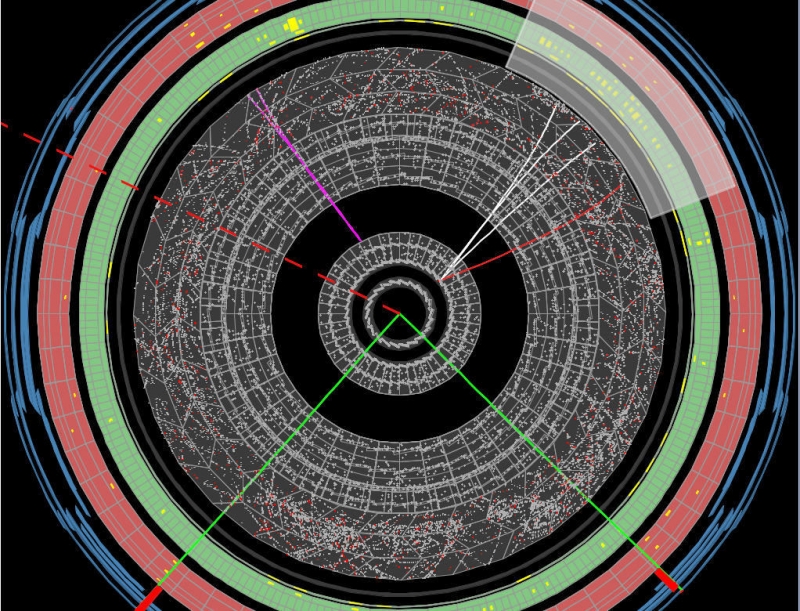
These images show how particles appear in the ATLAS detector. The lines show the paths of charged particles travelling away from a collision at the centre. Volunteers are looking for tracks appearing ‘out of thin air’ away from the centre. (Image: CERN)
A July 6, 2016 news item on phys.org announces the call for more volunteers (Note: Links have been removed),
A citizen science project, called HiggsHunters gives everyone the chance to help search for the Higgs boson’s relatives.
Volunteers are searching through thousands of images from the ATLAS experiment on the HiggsHunters.org website, which makes use of the Zooniverse citizen science platform.
They are looking for ‘baby Higgs bosons’, which leave a characteristic trace in the ATLAS detector.
This is the first time that images from the Large Hadron Collider have been examined on such a scale – 60,000 of the most interesting events were selected from collisions recorded throughout 2012 – the year of the Higgs boson discovery. About 20,000 of those collisions have been scanned so far, revealing interesting features.
A July 4, 2016 posting by Harriet Kim Jarlett on Will Kalderon’s CERN blog, which originated the news item, provides more details,
“There are tasks – even in this high-tech world – where the human eye and the human brain simply win out,” says Professor Alan Barr of the University of Oxford, who is leading the project.
Over the past two years, more than twenty thousand amateur scientists, from 179 countries, have been scouring images of LHC collisions, looking for as-yet unobserved particles.
Dr Will Kalderon, who has been working on the project says “We’ve been astounded both by the number of responses and ability of people to do this so well, I’m really excited to see what we might find”.
July 4, 2016 was the fourth anniversary of the confirmation that the Higgs Boson almost certainly exists (from the CERN blog),
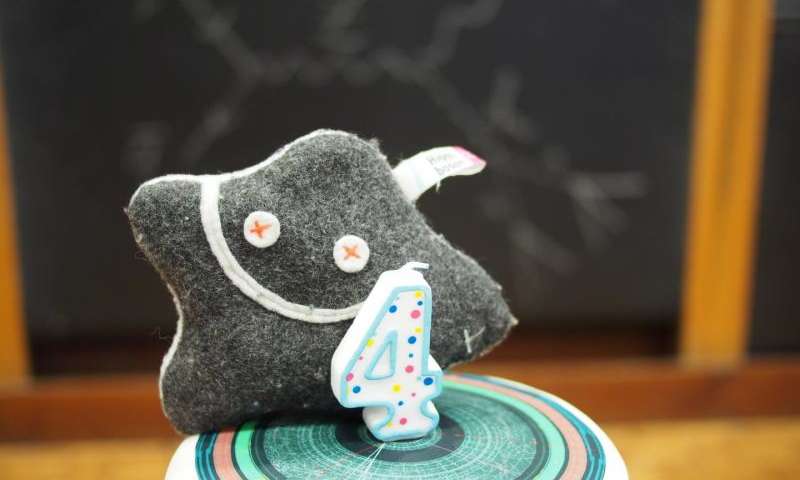
Today, July 4 2016, is the fourth birthday of the Higgs boson discovery. Here, a toy Higgs is sat on top of a birthday cake decorated with a HiggsHunter event display. On the blackboard behind is the process people are looking for – Higgs-strahlung. (Image: Will Kalderon/CERN)