This morning (March 26, 2024) a notice from the Science Media Centre of Canada (SMCC) arrived (via email) with two bits of news I’m including here.
A freshly launched online science magazine, Sequencer,
From the Science Media Centre of Canada’s March 26, 2024 notice,
Science journalists launch new online science magazine
Sequencer is a writer-owned, subscriber-based platform to explore the world’s weird, exciting, rage-inducing, or even hilarious phenomena.
There was more about this new science magazine in a March 21, 2024 posting by Neel Dhanesh for the Nieman Lab blog, (Note 1: The Nieman Lab appears to be an initiative of the Nieman Foundation for Journalism at Harvard University; Note 2: Links have been removed),
Last year, freelance journalist and National Geographic alum Michael Greshko predicted that a worker-owned science publication would be born in 2024. On Thursday, his prediction came true with the launch of Sequencer.
Sequencer is looking to fill a gap that’s been created by the withering of science desks at newsrooms across the country. The four founders — Max G. Levy, Dan Samorodnitsky, Shi En Kim, and Maddie Bender, all of whom are alums of Massive Science, which stopped publishing in 2021 — write that “traditional science media is broken” in a letter introducing the site:
…
Like its worker-owned brethren (see: Defector, 404 Media, Hell Gate, Aftermath, and more), Sequencer plans to be reader-supported, with subscriptions starting at $7 per month. I, like many others in the world of science journalism, am incredibly excited. …
There’s more about the cat called Masha, formerly known as Velveteen, and the author in a March 21, 2024 blog posting on Sequencer.
As for Sequencer and its founders, there’s the About Us webpage,
Sequencer is a place to decode our world with stories about science. It’s a venue for readers who care about pressing scientific questions and appreciate the weird, exciting, rage-inducing, spine-tingling, mind-bending, or even hilarious phenomena around us. It’s a platform for perennially curious journalists who don’t take themselves too seriously. It’s an invitation to discover alongside us.
We – Dan, Kim, Maddie, and Max [more about the founders later in this posting] – are not just the writers and editors, we’re also the founders and owners. We’re established science journalists and alumni of The Daily Beast, Scientific American, WIRED, Quanta, Smithsonian, C&EN, and more. We’re also all former scientists. Sequencer is our experiment.
Like any good experiment, Sequencer exists atop a heavily researched, rigorously tested, science-backed hypothesis: Traditional science media is broken, so it’s time for something new.
I found this bit particularly interesting,
This is typically how the sausage gets made in our industry: A scientist, usually someone who works at one of a handful of American or European universities, publishes their new work in a prestigious journal. Their well-funded institution’s PR team crafts a press release, puts the work under embargo, and emails it to journalists on their press list.
When it works, this model earns many important labs their 15 minutes of fame; millions of people learn about a breakthrough. But when it’s the governing model of science journalism, it constrains any content to bounds that are sterile and homogenous. There’s little room for analysis and perspective about the work that goes into doing science, let alone criticism or any reckoning with the future. At a time where climate change is laying waste to the planet and a historic pandemic trudges on and on, science journalism is too-often blank-faced and credulous.
That’s all assuming the model works. More and more, we’re realizing that it doesn’t. Bedrock science publications are dying. Or rather, they’re being actively killed by layoffs, predatory venture capital firms, and mega-conglomerates that keep inexplicably pivoting to video. It would be funny if it weren’t so bleak. [emphases mine]
…
My March 8, 2024 posting, “Science journalism … ch-ch-ch-ch-changes” provides more context for the phrases I’ve highlighted in the excerpt in the above,
Sequencer is subscriber-supported,
Sequencer is subscriber-supported. That means we are cutting out the middleman and going directly to the reader. We depend on your money to power us, and your feedback to shape our coverage. Do you like our stories? Are we missing something? What do normal people want to see in a science publication? Tell us! Email us at hello@sequencermag.com
We’re choosing $7/month because if you live in a major American city, $7 is the price of a latte. We deserve a latte, don’t you think?
Meet the founders,
Maddie Bender
Maddie is a science, health, and technology journalist. She has worked in print, digital, audio, and video media. Some reporting highlights include covering spotted lanternfly fetish content, brain-breaking pseudoscience, and metaverse fitness. She lives in Honolulu, HI, and deeply misses her cat (not dead, just in New York.)
…
Dan Samorodnitsky
Dan is a science journalist based in Minneapolis, MN. He’ll write about anything but specializes in biology, genetics, health, and the history of science. He has also written about Dairy Queens, church fish fries, and local politics. He has a cat, Masha, who will definitely appear in newsletters and posts.
…
Shi En Kim
Kim is a Malaysian-born, DC-based journalist whose writing spans the scientific gamut (please don’t make her pick a favorite beat). Outside of science writing, she dabbles in art, plans for backpacking trips faster she can go on them, and plots the next move against her imposter syndrome in a never-ending tussle.
…
Max G. Levy
Max is a science journalist whose favorite work tells the human stories behind discoveries in public health, climate change and tech. Max’s work appears in news outlets, magazines, and science videos on YouTube. He’s got sand in his hair as he writes this from his home in Los Angeles. If he goes a couple weeks without mentioning his late pet rats (R.I.P. Fiona, Syd, and Mouse) please call for help.
…
Storytelling grants and the National Geographic
This is the second item of interest from the SMCC March 26, 2024 notice,
National Geographic Storytelling Grants Submission deadline has been extended. New submission deadline: April 11, 2024 | 23:59 ET The grants fund individuals working on projects in science, conservation, storytelling, education, and technology that align with one or more of our focus areas …
I found the page where the grants are described to be confusing. First, storytelling grants are part of the National Geographic’s ‘Grants and Investments program known as ‘National Geographic Explorers’ and there are two levels of grant opportunities with ‘storytellers’ being at Level II.
If you scroll down the National Geographic Grants and Investments webpage about 80% of the way, you’ll find Additional Resources, which includes the Level II Grants Program Storytelling Application Template. Good luck!
Extra
In the next day or so (probably by March 28, 2024), you may be seeing some articles about moon-bound Canadian astronaut, Jeremy Hansen, He’s giving a virtual presentation at the University of British Columbia (UBC). From a March 26, 2024 UBC media advisory (received via email),
Hansen is one of four crew members for the Artemis II mission, which will send astronauts around the Moon on the first crewed flight of the SLS rocket and Orion spacecraft, no earlier than September 2025. He has lived in a cave underground and on the ocean floor in space mission simulations, and will be the first Canadian to participate in a lunar mission.
I don’t believe this event is open to the public, which is why I haven’t included details but you can be on the lookout for articles particularly in local (Vancouver, Canada) publications over the next few days.
Interweave is a free show at The Kent in the gallery in downtown Vancouver, Canada. Here’s more from a Simon Fraser University (SFU) announcement (received via email),
Embrace the fusion of creativity and expression alongside your fellow alumni in a setting that celebrates innovation and the uncharted synergy between fashion, music, and movement. This is a great opportunity to mingle and reconnect with your peers.
Event Details:
Date: March 21, 2024
Time: Doors 7:30pm, Show 8:00pm
Location: The Kent Vancouver, 534 Cambie Street
Free Entry, RSVP required
Interweave is the first event from Fashion x Electronics (FXE), a collective created by Kimia Koochakzadeh-Yazdi, SCA alumnus, composer, and performer, and designer Kayla Yazdi. FXE is an interdisciplinary collective that is building multi-sensory experiences for their community, bridging together a diverse range of disciplines.
This is a 19+ event. ID will be checked at the door.
Kayla Yazdi is an Iranian-Canadian designer based in Vancouver, Canada. Her upbringing in Iran immersed her in a world of culture, art, and color. Holding a diploma in painting and a bachelor’s degree in design with a specialization in fashion and technology, Kayla has cultivated the skill set that merges her artistic sensibilities with innovative design concepts.
Kayla is dedicated to the creation of “almost” zero-waste garments. With design, technology, and experimentation, Kayla seeks to minimize environmental impacts while delivering unique styles.
Kimia Koochakzadeh-Yazdi(b. 1997 Tehran, Iran) is a California/Vancouver-based composer and performer. She writes for hybrid instrumental/electronic ensembles, creates electroacoustic and audiovisual works, and performs electronic music. Kimia explores the unfamiliar familiar while constantly being driven by the concepts of motion, interaction, and growth in both human life and in the sonic world. Being a cross-disciplinary artist, she has actively collaborated on projects evolving around dance, film, and theatre. Kimia’s work has been showcased by organizations such as Iranian Female Composer Association, Music on Main, Western Front, Vancouver New Music, and Media Arts Committee. She has been featured in The New York Times, Georgia Straight, MusicWorks Magazine, Vancouver Sun, and Sequenza 21. Her work has been performed at festivals around the world including Ars Electronica Festival, Festival Ecos Urbanos, Tehran Contemporary Sounds, AudioVisual Frontiers Virtual Exhibition, The New York City Electroacoustic Music Festival, Yarn/Wire Institute, Ensemble Evolution, New Music on the Point, wasteLAnd Summer Academy, EQ: Evolution of the String Quartet, Modulus Festival, and SALT New Music Festival. She holds a BFA in Music Composition from Simon Fraser University’s Interdisciplinary School for the Contemporary Arts, having studied with Sabrina Schroeder and Mauricio Pauly. Kimia is currently pursuing her DMA in Music Composition at Stanford University.
For more details about the sisters and the performance, Marilyn R. Wilson has written up a February 21, 2024 interview with both sisters for her Olio blog,
Can you share a little bit about your background, the life, work, experiences that led you to who you are today? Kayla: I’m a visual artist with a focus on fashion design, and textile development. I like to explore ways to create wearable art with minimal waste produced in the process. I studied painting at Azadehgan School of Art in Iran and fashion design & technology at Wilson School of Design in Vancouver. My interest in fashion is rooted in creating functional art. I enjoy the business aspect of fashion however, I want to push boundaries of how fashion can be seen as art rather than solely as production.
Kimia: I’m a composer of acoustic and electronic music, I perform and build instruments, and a lot of times I combine these components together. Working with various disciplines is also an important part of my practice. I studied piano performance at Tehran Music School before moving to Vancouver to study composition at Simon Fraser University. I am currently a doctorate candidate in music composition at Stanford University. I love electronic music, food, and sports! My family, partner, and friends are a huge part of my life!
…
You have your premier event called “Interweave” coming up on March 21st at The Kent Gallery in Vancouver. What can guests attending expect this evening?
Kayla & Kimia: Interweave is a multidisciplinary performance that bridges fashion, music, technology, and dance. Our dancers will be performing in garments designed by Kayla, that are embedded with microcontrollers and sensors developed by Kimia. The dancers control various musical parameters through their movements and their interaction with the sensors that are incorporated within the garments. Along with works for movement and dance, there will be a live electronic music performance made for costume-made instruments. So far we have received an amazing amount of support and RSVP’s from the art industry in Vancouver and look forward to welcoming many local creative individuals.
We’d love to know about the team of professionals who are working hard to create this unique experience.
Kayla & Kimia: We are working with the amazing choreographers/dancers Anya Saugstad and Daria Mikhailiuk. We are thankful for Laleh Zandi’s help for creating a sculpture for one of our instruments which will be performed by Kimia. Celeste Betancur and Richard Lee have been our amazing audio tech assistants. We are very appreciative of everyone involved in FXE’s premiere and can’t wait to showcase our hard work.
…
I have a bit more about Kimia Koochakzadeh-Yazdi and her work in music from a February 27, 2024 profile on the SFU School for the Contemporary Arts website, Note: Links have been removed,
Please introduce yourself.
I’m a composer of acoustic and electronic music, I perform and build instruments, and a lot of times, I combine these components together. Working with various disciplines is also an important part of my practice. I studied piano performance at Tehran Music School before moving to Vancouver to study composition at Simon Fraser University, graduating from the SCA in 2020. I am currently a doctoral student in music composition at Stanford University, where I spend most of my time.
…
Tell us about your current studies.
I’m in the third year of the DMA (Doctor of Musical Arts) program at Stanford University. I do the majority of my work at the Center for Computer Research in Music and Acoustics (CCRMA). I’m currently trying to learn and to experiment as much as possible! The amount of resources and ideas that I have been exposed to during the last couple of years has been quite significant and wonderful. I have been taking courses in subjects that I never thought I would study, from classes in the computer science and the mechanical engineering departments, to ones in education and theatre. I’m grateful to have been given a supportive platform to truly experiment and to learn.
As for my compositions, they are more melodic than before, and that currently makes me happy. I have started to perform more again (piano and electronics), and it makes me question: why did I ever stop…?
…
Koochakzadeh-Yazdi’s mention of building instruments reminded me of Icelandic musician, Bjork and Biophilia, which was an album, various art projects, and a film (Biophilia Live), which featured a number of musical instruments she created.
Getting back to Interweave, it’ s on March 21, 2024 at The Kent, specifically the gallery, which has,
… 14 foot ceilings boasts 50 track lights with the ability to transform the vacuous hall from candlelight to daylight. The lights are fully dimmable in an array of playful hues, according to your whim. A full array of DMX Lighting and control systems live alongside the track light system and our recently installed (Vancouvers only) immersive projection system [emphasis mine] is ready for your vision. This is your show.
I wonder if ‘multi-sensory’ includes an immersive experience.
Don’t forget, you have to RSVP for Interweave, which is free.
*Unsurprisingly, this event has been cancelled. More details at the end of this posting.* This is not a free event; they’ve changed the information about fees/no fees and how the fees are being assessed enough times for me to lose track; check the eventbrite registration page for the latest. Also, there will not be a publicly available recording of the event. (For folks who can’t afford the fees, there’s a contact listed later in this posting.)
First, here’s the “The Planetary Politics of AI: Past, Present, and Future” event information (from a January 10, 2024 Simon Fraser University (SFU) Public Square notice received via email),
The Planetary Politics of AI: Past, Present, and Future
Wednesday, March 6 [2024] | 7:00pm | In-person | Free [Note: This was an error.]
Generative AI has dominated headlines in 2023, but these new technologies rely on a dramatic increase in the extraction of data, human labor, and natural resources. With increasing media manipulation, polarizing discourse, and deep fakes, regulators are struggling to manage new AI.
On March 6th [2024], join renowned author and digital scholar Kate Crawford, as she sits in conversation with SFU’s Wendy Hui Kyong Chun. Together, they will discuss the planetary politics of AI, how we got here, and where it might be going.
…
A January 11, 2024 SFU Public Square notice (received via email) updates the information about how this isn’t a free event and offers an option for folks who can’t afford the price of a ticket, Note Links have been removed,
The Planetary Politics of AI: Past, Present, and Future
Wednesday, March 6 | 7:00pm | In-person | Paid
Good morning,
We’ve been made aware that yesterday’s newsletter had a mistake, and we thank those who brought it to our attention. The March 6th [2024] event, The Planetary Politics of AI: Past, Present, and Future, is not a free event and has an admission fee for attendance. We apologize for the confusion.
Whenever possible, SFU Public Square’s events are free and open to all, to ensure that the event is as accessible as possible. For this event, there is a paid admission, with a General and Student/Senior Admission option. That being said, if the admission fees are a barrier to access, please email us at psqevent@sfu.ca. Exceptions can be made. [emphasis mine]
Djavad Mowafaghian Cinema (SFU Vancouver — Woodward’s Building) 149 W Hastings Street Vancouver, BC V6B 1H7
[See registration page for link to map]
Refund Policy
Refunds up to 7 days before event
About the speakers
Kate Crawfordis a leading international scholar of the social implications of artificial intelligence. She is a Research Professor at USC Annenberg in Los Angeles, a Senior Principal Researcher at MSR in New York, an Honorary Professor at the University of Sydney, and the inaugural Visiting Chair for AI and Justice at the École Normale Supérieure in Paris. Her latest book, Atlas of AI (Yale, 2021), won the Sally Hacker Prize from the Society for the History of Technology, the ASSI&T Best Information Science Book Award, and was named one of the best books in 2021 by New Scientist and the Financial Times.
Over her twenty-year research career, she has also produced groundbreaking creative collaborations and visual investigations. Her project Anatomy of an AI System with Vladan Joler is in the permanent collection of the Museum of Modern Art in New York and the V&A in London, and was awarded with the Design of the Year Award in 2019 and included in the Design of the Decades by the Design Museum of London. Her collaboration with the artist Trevor Paglen, Excavating AI, won the Ayrton Prize from the British Society for the History of Science. She has advised policy makers in the United Nations, the White House, and the European Parliament, and she currently leads the Knowing Machines Project, an international research collaboration that investigates the foundations of machine learning. And in 2023, Kate Crawford was named on of the TIME100 list as one of the most influential people in AI.
Wendy Hui Kyong Chun is Simon Fraser University’s Canada 150 Research Chair in New Media, Professor in the School of Communication, and Director of the Digital Democracies Institute. At the Institute, she leads the Mellon-funded Data Fluencies Project, which combines the interpretative traditions of the arts and humanities with critical work in the data sciences to express, imagine, and create innovative engagements with (and resistances to) our data-filled world.
She has studied both Systems Design Engineering and English Literature, which she combines and mutates in her research on digital media. She is author many books, including: Control and Freedom: Power and Paranoia in the Age of Fiber Optics (MIT, 2006), Programmed Visions: Software and Memory (MIT 2011), Updating to Remain the Same: Habitual New Media (MIT 2016), and Discriminating Data: Correlation, Neighborhoods, and the New Politics of Recognition (2021, MIT Press). She has been Professor and Chair of the Department of Modern Culture and Media at Brown University, where she worked for almost two decades and is currently a Visiting Professor. She is a Fellow of the Royal Society of Canada, and has also held fellowships from: the Guggenheim, ACLS, American Academy of Berlin, Radcliffe Institute for Advanced Study at Harvard.
I’m wondering if the speakers will be discussing how visual and other arts impact their views on AI and vice versa. Both academics have an interest in the arts as you can see in Crawford’s event bio. As for Wendy Hui Kyong Chun, in my April 23, 2021 posting where if you scroll down to her name, (about 30% of the way down), you’ll see she was involved with “Multimedia & Electronic Music Experiments (MEME),” History of Art and Architecture,” and “Theatre Arts and Performance Studies” at Brown University.
A February 12, 2024 SFU Public Square announcement (received via email), which includes a link to this Speaker’s Spotlight webpage (scroll down), suggests my speculation is incorrect,
For over two decades, Kate Crawford’s work has focused on understanding large scale data systems, machine learning and AI in the wider contexts of history, politics, labor, and the environment.
Her latest book, Atlas of AI (2021) explores artificial intelligence as the extractive industry of the 21st century, relying on vast amounts of data, human labour, and natural resources. …
One more biographical note about Crawford, she was mentioned here in an April 17, 2015 posting, scroll down to the National Film Board of Canada subhead, then down to Episode 5 ‘Big Data and its Algorithms’ of the Do Not Track documentary; she is one of the interviewees. I’m not sure if that documentary is still accessible online.
Or, SFU is hosting its free 2023 Nobel Prize-themed lecture at Science World on March 6, 2024 (see my January 16, 2024 posting and scroll down about 30% of the way for more details).
Unfortunately, this event has been cancelled due to extenuating circumstances. If you have questions or concerns, please email us at psqevent@sfu.ca. We apologize for any inconvenience this may cause and we thank you for your understanding.
My guess? They didn’t sell enough tickets. My assessment? Poor organization (e.g., the confusion over pricing), and poor marketing (e.g., no compelling reason to buy a ticket, (e.g.,, neither participant is currently a celebrity or a hot property, the presentation was nothing unique or special, it was just a talk; the title was mildly interesting but not exciting or provocative, etc.).
I wonder if Vancouver’s Mayor Ken Sim will be joining the folks at the giant culture/tech event known as South by Southwest® (SxSW) later in 2024. Our peripatetic mayor seems to enjoy traveling to sports events (FIFA 2023 in Qatar), to Los Angeles to convince producers of a hit television series, “The Last of Us,” that they film the second season in Vancouver, and, to Austin, Texas for SxSW 2023. Note: FIFA is Fédération internationale de football association or ‘International Association Football Federation’.
It’s not entirely clear why Mayor Sim’s presence was necessary at any of these events. In October 2023, he finished his first year in office; a business owner and accountant, Sim is best known for his home care business, “Nurse Next Door” and his bagel business, “Rosemary Rocksalt,” meaning he wouldn’t seem to have much relevant experience with sports and film events.
I gather Mayor Sim’s presence was part of the 2023 hype (for those who don’t know, it’s from ‘hyperbole’) where SxSW was concerned, from the Vancouver Day at SxSW 2023 event page,
Vancouver Day
Past(03/12/2023) 12:00PM – 6:00PM
FREE W/ RSVP | ALL AGES
Swan Dive
The momentum and vibrancy of Vancouver’s innovation industry can’t be stopped!
The full day event will see the Canadian city’s premier technology innovators, creative tech industries, and musical artists show why Vancouver is consistently voted one of the most desirable places to live in the world.
We will have talks/panels with the biggest names in VR/AR/Metaverse, AI, Web3, premier technology innovators, top startups, investors and global thought-leaders. We will keep Canada House buzzing throughout the day with activations/demos from top companies from Vancouver and based on our unique culture of wellness and adventure will keep guests entertained, and giveaways will take place across the afternoon.
The Canadian city is showing why Vancouver has become the second largest AR/VR/Metaverse ecosystem globally (with the highest concentration of 3D talent than anywhere in the world), a leader in Web3 with companies like Dapper Labs leading the way and becoming a hotbed in technology like artificial intelligence.
The Frontier Collective’s Vancouver’s Takeover of SXSW is a signature event that will enhance Vancouver as the Innovation and Creative Tech leader on the world stage.It is an opportunity for the global community to encounter cutting-edge ideas, network with other professionals who share a similar appetite for a forward focused experience and define their next steps.
Some of our special guests include City of Vancouver Mayor Ken Sim [emphasis mine], Innovation Commissioner of the Government of BC- Gerri Sinclair, Amy Peck of Endeavor XR, Tony Parisi of Lamina1 and many more.
In the evening, guests can expect a special VIP event with first-class musical acts, installations, wellness activations and drinks, and the chance to mingle with investors, top brands, and top business leaders from around the world.
To round out the event, a hand-picked roster of Vancouver musicians will keep guests dancing late into the night.
This is from Mayor Sim’s Twitter (now X) feed, Note: The photographs have not been included,
Mayor Ken Sim@KenSimCity Another successful day at #SXSW2023 showcasing Vancouver and British Columbia while connecting with creators, innovators, and entrepreneurs from around the world! #vanpoli#SXSW
2024 hype at SxSW and Vancouver’s Frontier Collective
New year and same hype but no Mayor Sim? From a January 22, 2024 article by Daniel Chai for the Daily Hive, Note: A link has been removed,
Frontier Collective, a coalition of Vancouver business leaders, culture entrepreneurs, and community builders, is returning to the South by Southwest (SXSW) Conference next month to showcase the city’s tech innovation on the global stage.
The first organization to formally represent and promote the region’s fastest-growing tech industries, Frontier Collective is hosting the Vancouver Takeover: Frontiers of Innovation from March 8 to 12 [2024].
According to Dan Burgar, CEO and co-founder of Frontier Collective, the showcase is not just about presenting new advancements but is also an invitation to the world to be part of a boundary-transcending journey.
…
“This year’s Vancouver Takeover is more than an event; it’s a beacon for the brightest minds and a celebration of the limitless possibilities that emerge when we dare to innovate together.”
…
Speakers lined up for the SXSW Vancouver Takeover in Austin, Texas, include executives from Google, Warner Bros, Amazon, JP Morgan, Amazon, LG, NTT, Newlab, and the Wall Street Journal.
…
“The Frontier Collective is excited to showcase a new era of technological innovation at SXSW 2024, building on the success of last year’s Takeover,” added Natasha Jaswal, VP of operations and events of Frontier Collective, in a statement. “Beyond creating a captivating event; its intentional and curated programming provides a great opportunity for local companies to gain exposure on an international stage, positioning Vancouver as a global powerhouse in frontier tech innovation.
Join us for a curated experience of music, art, frontier technologies and provocative panel discussions. We are organizing three major events, designed to ignite conversation and turn ideas into action.
We’re excited to bring together leaders from Vancouver and around the world to generate creative thinking at the biggest tech festival.
Let’s create the future together!
You have a choice of two parties and a day long event. Enjoy!
Who is the Frontier Collective?
The group announced itself in 2022, from a February 17, 2022 article in techcouver, Note: Links have been removed,
The Frontier Collective is the first organization to formally represent and advance the interests of the region’s fastest-growing industries, including Web3, the metaverse, VR/AR [virtual reality/augmented reality], AI [artificial intelligence], climate tech, and creative industries such as eSports [electronic sports], NFTs [non-fungible tokens], VFX [visual effects], and animation.
Did you know the Vancouver area currently boasts the world’s second largest virtual and augmented reality sector and hosts the globe’s biggest cluster of top VFX, video games and animation studios, as well as the highest concentration of 3D talent?
Did you know NFT technology was created in Vancouver and the city remains a top destination for blockchain and Web3 development?
Frontier Collective’s coalition of young entrepreneurs and business leaders wants to raise awareness of Vancouver’s greatness by promoting the region’s innovative tech industry on the world stage, growing investment and infrastructure for early-stage companies, and attracting diverse talent to Vancouver.
“These technologies move at an exponential pace. With the right investment and support, Vancouver has an immense opportunity to lead the world in frontier tech, ushering in a new wave of transformation, economic prosperity and high-paying jobs. Without backing from governments and leaders, these companies may look elsewhere for more welcoming environments.” said Dan Burgar, Co-founder and Head of the Frontier Collective. Burgar heads the local chapter of the VR/AR Association.
…
Their plan includes the creation of a 100,000-square-foot innovation hub in Vancouver to help incubate startups in Web3, VR/AR, and AI, and to establish the region as a centre for metaverse technology.
…
Frontier Collective’s team includes industry leaders at the Vancouver Economic Commission [emphasis mine; Under Mayor Sim and his majority City Council, the commission has been dissolved; see September 21, 2023 Vancouver Sun article “Vancouver scraps economic commission” by Tiffany Crawford], Collision Conference, Canadian incubator Launch, Invest Vancouver, and the BDC Deep Tech Fund. These leaders continue to develop and support frontier technology in their own organizations and as part of the Collective.
Interestingly, a February 7, 2023 article by the editors of BC Business magazine seems to presage the Vancouver Economic Commission’s demise. Note: Links have been removed,
Last year, tech coalition Frontier Collective announced plans to position Vancouver as Canada’s tech capital by 2030. Specializing in subjects like Web3, the metaverse, VR/AR, AI and animation, it seems to be following through on its ambition, as the group is about to place Vancouver in front of a global audience at SXSW 2023, a major conference and festival celebrating tech, innovation and entertainment.
Taking place in Austin, Texas from March 10-14 [2023], Vancouver Takeover is going to feature speakers, stories and activations, as well as opportunities for companies to connect with industry leaders and investors. Supported by local businesses like YVR Airport, Destination Vancouver, Low Tide Properties and others, Frontier is also working with partners from Trade and Invest BC, Telefilm and the Canadian Consulate. Attendees will spot familiar faces onstage, including the likes of Minister of Jobs, Economic Development and Innovation Brenda Bailey, Vancouver mayor Ken Sim [emphasis mine] and B.C. Innovation Commissioner Gerri Sinclair.
…
That’s right, no mention of the Vancouver Economic Commission.
As for the Frontier Collective Team (accessed January 29, 2024), the list of ‘industry leaders’ (18 people with a gender breakdown that appears to be 10 male and 8 female) and staff members (a Senior VP who appears to be male and the other seven staff members who appear to be female) can be found here. (Should there be a more correct way to do the gender breakdown, please let me know in the Comments.)
i find the group’s name a bit odd, ‘frontier’ is something I associate with the US. Americans talk about frontiers, Canadians not so much.
If you are interested in attending the daylong (11 am – 9 pm) Vancouver Takeover at SxSW 2024 event on March 10, 2024, just click here.
Aside: swagger at Vancouver City Hall, economic prosperity, & more?
What follows is not germane to the VR/AR community, SxSW of any year, or the Frontier Collective but it may help to understand why the City of Vancouver’s current mayor is going to events where he would seem to have no useful role to play.
Matt O’Grady’s October 4, 2023 article for Vancouver Magazine offers an eyeopening review of Mayor Ken Sim’s first year in office.
Ken Sim swept to power a year ago promising to reduce waste, make our streets safer and bring Vancouver’s “swagger” back. But can his open-book style win over the critics?
I’m sitting on a couch in the mayor’s third-floor offices, and Ken Sim is walking over to his turntable to put on another record. “How about the Police? I love this album.”
With the opening strains of “Every Breath You Take” crackling to life, Sim is explaining his approach to conflict resolution, and how he takes inspiration from the classic management tome Getting to Yes: Negotiating Agreement Without Giving In.
…
Odd choice for a song to set the tone for an interview. Here’s more about the song and its origins according to the song’s Wikipedia entry,
…
To escape the public eye, Sting retreated to the Caribbean. He started writing the song at Ian Fleming’s writing desk on the Goldeneye estate in Oracabessa, Jamaica.[14] The lyrics are the words of a possessive lover who is watching “every breath you take; every move you make”. Sting recalled:
“I woke up in the middle of the night with that line in my head, sat down at the piano and had written it in half an hour. The tune itself is generic, an aggregate of hundreds of others, but the words are interesting. It sounds like a comforting love song. I didn’t realise at the time how sinister it is. I think I was thinking of Big Brother, surveillance and control.”[15][emphasis mine]
Suddenly, the office door swings open and Sim’s chief of staff, Trevor Ford, pokes his head in (for the third time in the past 10 minutes). “We have to go. Now.”
“Okay, okay,” says Sim, turning back to address me. “Do you mind if I change while we’re talking?” And so the door closes again—and, without further ado, the Mayor of Vancouver drops trou [emphasis mine] and goes in search of a pair of shorts, continuing with a story about how some of his west-side friends are vocally against the massive Jericho Lands development promising to reshape their 4th and Alma neighbourhood.
“And I’m like, ‘Let me be very clear: I 100-percent support it, this is why—and we’ll have to agree to disagree,’” he says, trading his baby-blue polo for a fitted charcoal grey T-shirt. Meanwhile, as Sim does his wardrobe change, I’m doing everything I can to keep my eyes on my keyboard—and hoping the mayor finds his missing shorts.
It’s fair to assume that previous mayors weren’t in the habit of getting naked in front of journalists. At least, I can’t quite picture Kennedy Stewart doing so, or Larry or Gordon Campbell either.
But it also fits a pattern that’s developing with Ken Sim as a leader entirely comfortable in his own skin. He’s in a hurry to accomplish big things—no matter who’s watching and what they might say (or write). And he eagerly embraces the idea of bringing Vancouver’s “swagger” back—outlined in his inaugural State of the City address, and underlined when he shotgunned a beer at July’s [2023] Khatsahlano Street Party.
…
O’Grady’s October 4, 2023 article goes on to mention some of the more practical initiatives undertaken by Mayor Sim and his supermajority of ABC (Sim’s party, A Better City) city councillors in their efforts to deal with some of the city’s longstanding and intractable problems,
For a reminder of Sim’s key priorities, you need only look at the whiteboard in the mayor’s office. At the top, there’s a row labelled “Daily Focus (Top 4)”—which are, in order, 3-3-3-1 (ABC’s housing program); Chinatown; Business Advocacy; and Mental Health/Safety.
On some files, like Chinatown, there have been clear advances: council unanimously approved the Uplifting Chinatown Action Plan in January, which devotes more resources to cleaning and sanitation services, graffiti removal, beautification and other community supports. The plan also includes a new flat rate of $2 per hour for parking meters throughout Chinatown (to encourage more people to visit and shop in the area) and a new satellite City Hall office, to improve representation. And on mental health and public safety, the ABC council moved quickly in November to take action on its promise to fund 100 new police officers and 100 new mental health professionals [emphasis mine]—though the actual hiring will take time.
…
O’Grady likely wrote his article a few months before its October 2023 publication date (a standard practice for magazine articles), which may explain why he didn’t mention this, from an October 10, 2023 article by Michelle Gamage and Jen St. Denis for The Tyee,
100 Cops, Not Even 10 Nurses
…
One year after Mayor Ken Sim and the ABC party swept into power on a promise to hire 100 cops and 100 mental health nurses to address fears about crime and safety in Vancouver, only part of that campaign pledge has been fulfilled.
At a police board meeting in September, Chief Adam Palmer announced that 100 new police officers have now joined the Vancouver Police Department.
But just 9.5 full-time equivalent positions have been filled to support the mental health [emphasis mine] side of the promise.
In fact, Vancouver Coastal Health says it’s no longer aiming [emphasis mine] to hire 100 nurses. Instead, it’s aiming for 58 staff and specialists [emphasis mine], including social workers, community liaison workers and peers, as well as other disciplines alongside nurses to deliver care.
…
At the police board meeting on Sept. 21 [2023], Palmer said the VPD has had no trouble recruiting new police officers and has now hired 70 new recruits who are first-time officers, as well as at least 24 experienced officers from other police services.
…
In contrast, it’s been a struggle for VCH to recruit nurses specializing in mental health.
BC Nurses’ Union president Adriane Gear said she remembers wondering where Sim was planning on finding 100 nurses [emphasis mine] when he first made the campaign pledge. In B.C. there are around 5,000 full-time nursing vacancies, she said. Specialized nurses are an even more “finite resource,” she added.
…
I haven’t seen any information as to why the number was reduced from 100 mental health positions to 58. I’m also curious as to how Mayor Ken Sim whose business is called ‘Nurse Next Door’ doesn’t seem to know there’s a shortage of nurses in the province and elsewhere.
Last year, the World Economic Forum in collaboration with Quartz published a January 28, 2022 article by Aurora Almendral about the worldwide nursing shortage and the effects of COVID pandemic,
…
The report’s [from the International Council of Nurses (ICN)] survey of nurse associations around the world painted a grim picture of strained workforce. In Spain, nurses reported a chronic lack of PPE, and 30% caught covid. In Canada, 52% of nurses reported inadequate staffing, and 47% met the diagnostic cut-off for potential PTSD [emphasis mine].
Burnout plagued nurses around the world: 40% in Uganda, 60% in Belgium, and 63% in the US. In Oman, 38% nurses said they were depressed, and 73% had trouble sleeping. Fifty-seven percent of UK nurses planned to leave their jobs in 2021, up from 36% in 2020. Thirty-eight percent of nurses in Lebanon did not want to be nurses anymore, but stayed in their jobs because their families needed the money.
In Australia, 17% of nurses had sought mental health support. In China, 6.5% of nurses reported suicidal thoughts.
…
Moving on from Mayor Sim’s odd display of ignorance (or was it cynical calculation from a candidate determined to win over a more centrist voting population?), O’Grady’s October 4, 2023 article ends on this note,
…
When Sim runs for reelection in 2026, as he promises to do, he’ll have a great backdrop for his campaign—the city having just hosted several games for the FIFA World Cup, which is expected to bring in $1 billion and 900,000 visitors over five years.
The renewed swagger of Sim’s city will be on full display for the world to see. So too—if left unresolved—will some of Vancouver’s most glaring and intractable social problems.
I was born in Vancouver and don’t recall the city as having swagger, at any time. As for the economic prosperity that’s always promised with big events like the FIFA world cup, I’d like to see how much the 2010 Olympic Games held in Vancouver cost taxpayers and whether or not there were long lasting economic benefits. From a July 9, 2022 posting on Bob Mackin’s thebreaker.news,
…
The all-in cost to build and operate the Vancouver 2010 Games was as much as $8 billion, but the B.C. Auditor General never conducted a final report. The organizing committee, VANOC, was not covered by the freedom of information law and its records were transferred to the Vancouver Archives after the Games with restrictions not to open the board minutes and financial ledgers before fall 2025.
Mayor Sim will have two more big opportunities to show off his swagger in 2025 . (1) The Invictus Games come to Vancouver and Whistler in February 2025 and will likely bring Prince Harry and the Duchess of Sussex, Meghan Markle to the area (see the April 22, 2022 Associated Press article by Gemma Karstens-Smith on the Canadian Broadcasting Corporation website) and (2) The 2025 Junos (the Canadian equivalent to the Grammys) from March 26 – 30, 2025 with the awards show being held on March 30, 2025 (see the January 25, 2024 article by Daniel Chai for the Daily Hive website).
While he waits, Sim may have a ‘swagger’ opportunity later this month (February 2024) when Prince Harry and the Duchess of Sussex (Meghan Markle) visit the Vancouver and Whistler for a “a three-day Invictus Games’ One Year to Go event in Vancouver and Whistler,” see Daniel Chai’s February 2, 2024 article for more details.
Don’t forget, should you be in Austin, Texas for the 2024 SxSW, the daylong (11 am – 9 pm) Vancouver Takeover at SxSW 2024 event is on March 10, 2024, just click here to register. Who knows? You might get to meet Vancouver’s, Mayor Ken Sim. Or, if you can’t make it to Austin, Texas, O’Grady’s October 4, 2023 article offer an unusual political profile.
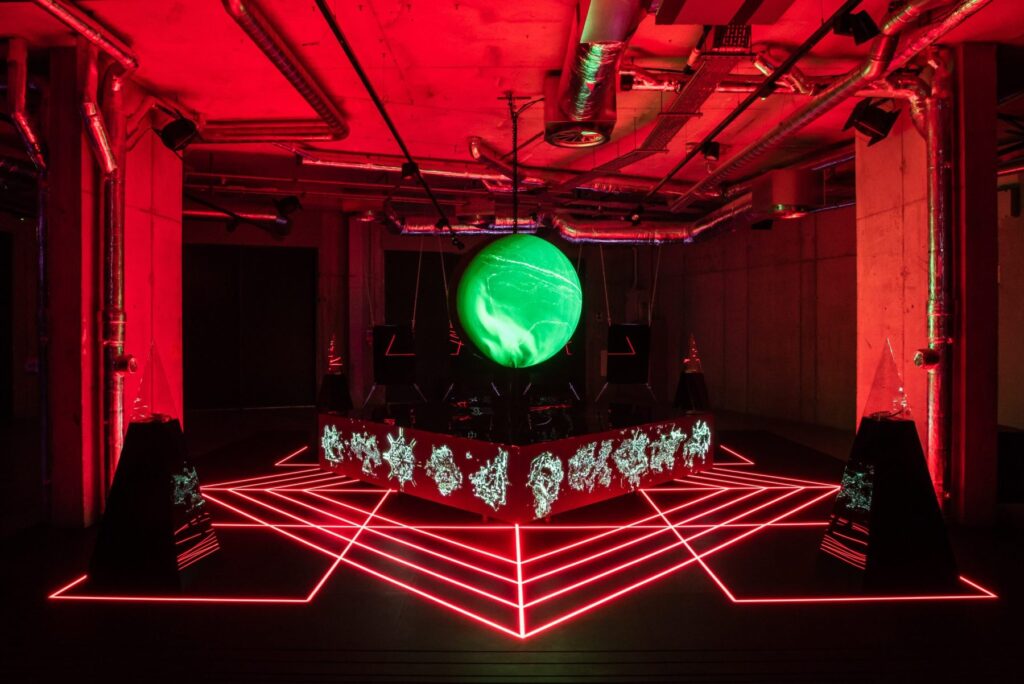
Spanning religiosity, science fiction, contemporary perspectives on artificial intelligence, and the techno-industrial complex, artist Zach Blas and writer/editor Jayne Wilkinson will be discussing CULTUS, an art installation currently being shown as part of the Belkin Gallery’s January 12 – April 14, 2024 exhibition, Aporia (Notes to a Medium),
Zach Blas, CULTUS , 2023, from the 2024 exhibition at Arebyte Gallery, London, UK. Courtesy of the artist. Photo: Max Colson
Here’s what the folks at the Belkin Art Gallery (Morris and Helen Belkin Art Gallery) had to say in their January 30, 2024 announcement (received via email),
Artist Talk with Zach Blas and Jayne Wilkinson
Thursday, February 1 at 5 pm
Please join us for a lecture by interdisciplinary artist Zach Blas, with a dialogue to follow with writer/editor Jayne Wilkinson. Blas will discuss his most recent work, CULTUS, the second in a trilogy of queer science-fiction installations addressing the beliefs, fantasies and histories that are influential to the contemporary tech industry. CULTUS (the Latin word for “worship”) considers the God-like status often afforded to artificial intelligence (AI) and examines how this religiosity is marshalled to serve beliefs about judgement and transcendence, extraction and immortality, pleasure and punishment, individual freedom and cult devotion. The conversation to follow will address some of the pressing intersecting political and ethical questions raised by both using and critiquing contemporary image technologies like AI.
This conversation will be audio-recorded; email us at belkin.gallery@ubc.ca if you are interested in listening to the recording following the event.
This talk is presented in conjunction with the Belkin’s exhibition Aporia (Notes to a Medium) and Critical Image Forum, a collaboration between the Belkin and the Department of Art History, Visual Art and Theory at UBC.
For anyone (like me) who’s never heard of either Blas or Wilkinson, there’s more on the Belkin’s event page,
Zach Blas is an artist, filmmaker and writer whose practice draws out the philosophies and imaginaries residing in computational technologies and their industries. Working across moving image, computation, installation, theory and performance, Blas has exhibited, lectured and held screenings at venues including the 12th Berlin Biennale for Contemporary Art, Whitney Museum of American Art, Tate Modern, 12th Gwangju Biennale and e-flux. His 2021 artist monograph Unknown Ideals is published by Sternberg Press. Blas is currently Assistant Professor of Visual Studies at the University of Toronto.
Jayne Wilkinson is a Toronto-based art writer and editor.
Should you be interested in attending the talk and/or the exhibition, here are some directions, from the Belkin Gallery’s Visit webpage,
Directions
The Morris and Helen Belkin Art Gallery is located at the University of British Columbia Vancouver campus, 1825 Main Mall, Vancouver BC, V6T 1Z2
TransLink offers many routes to UBC, including several express services (44, 84, R4, 99). The UBC Bus Loop is the last stop for each of these buses, and is located in the central area of campus near the AMS Nest. To get to the gallery, walk west on University Boulevard. (about 1 block) until you reach Main Mall. Turn right onto Main Mall and continue for about 3 blocks until you reach Crescent Road. We are located on your left at the corner of Main Mall and Crescent Road, near the Flagpole Plaza.
By Car
From downtown Vancouver, proceed west on West 4th Avenue, which becomes Chancellor Blvd and then merges with NW Marine Drive. Continue west on NW Marine Drive, to the Rose Garden Parkade (on your left).
From the airport, proceed to SW Marine Drive. Stay on SW Marine Drive, which eventually merges with NW Marine Drive. Continue just past the Museum of Anthropology (on your left) to the Rose Garden Parkade (on your right).
Accessibility
Entrance
The Belkin is wheelchair accessible. The main entrance is located on the east side of the building next to Main Mall. For people requiring wheelchair or easier accessibility, use the ramp from Crescent Road to access the main gallery doors. This entrance is level and accessible and has both a revolving door and a powered wheelchair-accessible door.
Washrooms
Washrooms are all-gender and include two multi-stall washrooms with wheelchair-accessible stalls and one stand-alone washroom that is wheelchair accessible.
Seating
Portable gallery stools are available for use.
Large Print Materials
Large print materials are available.
ASL Interpretation
ASL interpreters are available upon request for Belkin programs and events. To request interpretation for an event or tour, please contact us in advance.
Service Animals
Service dogs are welcome to accompany visitors.
Scent
The Belkin’s office is scent free. Occasionally, there are works or projects that are scent-focused.
Please ask our staff if you require any assistance or have any questions.
There are three upcoming Simon Fraser University (SFU) Café Scientifique events (Zoom) and one upcoming Nobel=themed lecture (in person) according to a January 15, 2024 notice (received via email), Note: All the events are free,
Hello SFU Cafe Scientifique friends!
We are back with a brand new line up for our Cafe Scientifique discussion series. Zoom invites will be sent closer to the event dates [emphasis mine]. We hope you can join us.
Café Scientifique: Why Do Babies Get Sick? A Systems Biology Approach to Developing Diagnostics and Therapeutics for Neonatal Sepsis.
Tuesday, January 30, 5:00-6:30pm over Zoom
Around the world five newborn babies die each second from life-threatening infections. Unfortunately there is no fast or easy way to tell which microbes are involved. Molecular Biology and Biochemistry assistant professor Amy Lee will share how we can use genomics and machine learning approaches to tackle this challenge. Register here. https://events.sfu.ca/event/38235-cafe-scientifique-january-why-do-babies-get-sick?
Cafe Scientifique: From data to dollars: A journey through financial modelling Tuesday, February 27, 5:00-6:30 pm over Zoom
Financial modelling involves using mathematical and statistical techniques to understand future financial scenarios, helping individuals and businesses make informed decisions about their investments. Join Dr. Jean-François Bégin as he explores how these models can empower us to navigate the complexities of financial markets.
Cafe Scientifique: Overtraining and the Everyday Athlete Tuesday, April 30, 5:00-6:30 pm over Zoom
What happens when we train too hard, don’t take enough time to recover, or underfuel while exercising, and how that applies to both elite athletes and just your “everyday athlete.” Join Dr. Alexandra Coates from our Biomedical Physiology and Kinesiology Department in this interesting discussion.
Missed our last Café Scientifique talk [Decoding how life senses and responds to carbon dioxide gas] with Dustin King? [SFU Molecular Biology and Biochemistry Assistant Professor Dustin King’s Indigenous background is central to his work and relationship with the biochemical research he conducts. He brings Indigenous ways of knowing and a two-eye seeing approach to critical questions about humanity’s impact upon the natural world …] Watch it on YouTube: https://www.youtube.com/watch?v=xCHTSbF3RVs&list=PLTMt9gbqLurAMfSHQqVAHu7YbyOFq81Ix&index=10
The ‘2023 Nobel Prize Lectures’ being presented by SFU do not feature the 2023 winners but rather, SFU experts in the relevant field, from the January 15, 2024 SFU Café Scientifique notice (received via email),
BACK IN-PERSON AT THE SCIENCE WORLD THEATRE!
Location: Science World Theatre 1455 Quebec Street Vancouver, BC V6A 3Z7
NOBEL PRIZE LECTURES
Wednesday, March 6, 2024
6:30-7:30 pm Refreshments, 7:30-9:30 pm Lectures
Celebrate the 2023 Nobel awardees in Chemistry, Physics, Physiology or Medicine!
SFU experts will explain Nobel laureates’ award-winning research and its significance to our everyday lives.
Featured presenters are
*Mark Brockman from Molecular Biology and Biochemistry for the Nobel Prize in Medicine and Physiology;
*Byron Gates from Chemistry for the Nobel Prize in Chemistry; and
*Shawn Sederberg from the School of Engineering Science for the Nobel Prize in Physics.
I first stumbled across these researchers in 2016 when their project was known as “Wearable Lower Limb Anthropomorphic Exoskeleton (WLLAE).” In my January 20, 2016 posting, “#BCTECH: being at the Summit (Jan. 18-19, 2016),” an event put on by the province of British Columbia (BC, Canada) and the BC Innovation Council (BCIC), I visited a number of booths and talks at the #BC TECH Summit and had this to say about WLLAE,
“The Wearable Lower Limb Anthropomorphic Exoskeleton (WLLAE) – a lightweight, battery-operated and ergonomic robotic system to help those with mobility issues improve their lives. The exoskeleton features joints and links that correspond to those of a human body and sync with motion. SFU has designed, manufactured and tested a proof-of-concept prototype and the current version can mimic all the motions of hip joints.” The researchers (Siamak Arzanpour and Edward Park) pointed out that the ability to mimic all the motions of the hip is a big difference between their system and others which only allow the leg to move forward or back. They rushed the last couple of months to get this system ready for the Summit. In fact, they received their patent for the system the night before (Jan. 17, 2016) the Summit opened.
…
Unfortunately, there aren’t any pictures of WLLAE yet and the proof-of-concept version may differ significantly from the final version. This system could be used to help people regain movement (paralysis/frail seniors) and I believe there’s a possibility it could be used to enhance human performance (soldiers/athletes). The researchers still have some significant hoops to jump before getting to the human clinical trial stage. They need to refine their apparatus, ensure that it can be safely operated, and further develop the interface between human and machine. I believe WLLAE is considered a neuroprosthetic device. While it’s not a fake leg or arm, it enables movement (prosthetic) and it operates on brain waves (neuro). It’s a very exciting area of research, consequently, there’s a lot of international competition. [ETA January 3, 2024: I’m pretty sure I got the neuroprosthetic part wrong]
Time moved on and there was a name change and then there was this November 10, 2023 article by Jeremy Hainsworth for the Vancouver is Awesome website,
Vancouver-based fashion designer Chloe Angus thought she’d be in a wheelchair for the rest of her life after being diagnosed with an inoperable benign tumour in her spinal cord in 2015, resulting in permanent loss of mobility in her legs.
Now, however, she’s been using a state-of-the-art robotic exoskeleton known as XoMotion that can help physically disabled people self-balance, walk, sidestep, climb stairs and crouch.
“The first time I walked with the exoskeleton was a jaw-dropping experience,” said Angus. “After all these years, the exoskeleton let me stand up and walk on my own without falling. I felt like myself again.”
She added the exoskeleton has the potential to completely change the world for people with motion disabilities.
XoMotion is the result of a decade of research and the product of a Simon Fraser University spinoff company, Human in Motion Robotics (HMR) Inc. It’s the brainchild of professors Siamak Arzanpour and Edward Park.
Arzanpour and Park, both researchers in the Burnaby-based university’s School of Mechatronic Systems Engineering, began work on the device in 2014. They had a vision to enhance exoskeleton technology and empower individuals with mobility challenges to have more options for movement.
“We felt that there was an immediate need to help people with motion disabilities to walk again, with a full range of motion. At the time, exoskeletons could only walk forward. That was the only motion possible,” Arzanpour said.
…
A November 15, 2023 article (with an embedded video) by Amy Judd & Alissa Thibault for Global News (television) highlights Alexander’s story,
…
SFU professors Siamak Arzanpour and Edward Park wanted to help people with motion disabilities to walk freely, naturally and independently.
The exoskeleton [XoMotion] is now the most advanced of its kind in the world.
Chloe Angus, who lost her mobility in her legs in 2015, now works for the team.
She said the exoskeleton makes her feel like herself again.
…
She was diagnosed with an inoperable benign tumor in her spinal cord in 2015 which resulted in a sudden and permanent loss of mobility in her legs. At the time, doctors told Angus that she would need a wheelchair to move for the rest of her life.
Now she is part of the project and defying all odds.
“After all these years, the exoskeleton let me stand up and walk on my own without falling. I felt like myself again.”
The state-of-the-art robotic exoskeleton known as XoMotion is the result of a decade of research and the product of an SFU spin off company, Human in Motion Robotics (HMR) Inc. The company has recently garnered millions in investment, an overseas partnership and a suite of new offices in Vancouver.
XoMotion allows individuals with mobility challenges to stand up and walk on their own, without additional support. When in use, XoMotion maintains its stability and simultaneously encompasses all the ranges of motion and degrees of freedom needed for users to self-balance, walk, sidestep, climb stairs, crouch, and more.
Sensors within the lower-limb exoskeleton mimic the human body’s sense of logic to identify structures along the path, and in-turn, generate a fully balanced motion.
SFU professors Siamak Arzanpour and Edward Park, both researchers in the School of Mechatronic Systems Engineering, began work on the device in 2014 with a vision to enhance exoskeleton technology and empower individuals with mobility challenges to have more options for movement.
“We felt that there was an immediate need to help people with motion disabilities to walk again, with a full range of motion. At the time, exoskeletons could only walk forward. That was the only motion possible,” says Arzanpour.
The SFU professors, who first met in 2001 as graduate students at the University of Toronto, co-founded HMR in 2016, bringing together a group of students, end-users, therapists, and organizations to build upon the exoskeleton. Currently, 70 per cent of HMR employees are SFU graduates.
…
In recent years, HMR has garnered multiple streams of investment, including a contract with Innovative Solutions Canada, and $10 million in funding during their Series A round in May, including an $8 million investment and strategic partnership from Beno TNR, a prominent Korean technology investment firm.
…
I decided to bring the embedded video here, it runs a little over 2 mins.,
Hopefully you won’t be subjected to a commercial prior to this 3 mins. 49 secs. video about the salmon and how artificial intelligence (AI) could make a difference in theirs and our continued survival,
Video caption: Wild Salmon Center is partnering with First Nations to pilot the Salmon Vision technology. (Credit: Olivia Leigh Nowak/Le Colibri Studio.)
Scientists and natural resource managers from Canadian First Nations, governments, academic institutions, and conservation organizations published the first results of a unique salmon population monitoring tool in Frontiers in Marine Science.
This groundbreaking new technology, dubbed “Salmon Vision,” combines artificial intelligence with age-old fishing weir technology. Early assessments show it to be remarkably adept at identifying and counting fish species, potentially enabling real-time salmon population monitoring for fisheries managers.
“In recent years, we’ve seen the promise of underwater video technology to help us literally see salmon return to rivers,” says lead author Dr. Will Atlas, Senior Watershed Scientist with the Portland-based Wild Salmon Center. “That dovetails with what many of our First Nations partners are telling us: that we need to automate fish counting to make informed decisions while salmon are still running.”
The Salmon Vision pilot study annotates more than 500,000 individual video frames captured at two Indigenous-run fish counting weirs on the Kitwanga and Bear Rivers of B.C.’s Central Coast.
The first-of-its-kind deep learning computer model, developed in data partnership with the Gitanyow Fisheries Authority and Skeena Fisheries Commission, shows promising accuracy in identifying salmon species. It yielded mean average precision rates of 67.6 percent in tracking 12 different fish species passing through custom fish-counting boxes at the two weirs, with scores surpassing 90 and 80 percent for coho and sockeye salmon: two of the principal fish species targeted by First Nations, commercial, and recreational fishers.
“When we envisioned providing fast grants for projects focused on Indigenous futurism and climate resilience, this is the type of project that we hoped would come our way,” says Dr. Keolu Fox, a professor at the University of California-San Diego, and one of several reviewers in an early crowdfunding round for the development of Salmon Vision.
Collaborators on the model, funded by the British Columbia Salmon Recovery and Innovation Fund, include researchers and fisheries managers with Simon Fraser University and Douglas College computing sciences, the Pacific Salmon Foundation, Gitanyow Fisheries Authority, and the Skeena Fisheries Commission. Following these exciting early results, the next step is to expand the model with partner First Nations into a half-dozen new watersheds on B.C.’s North and Central Coast.
Real-time data on salmon returns is critical on several fronts. According to Dr. Atlas, many fisheries in British Columbia have been data-poor for decades. That leaves fisheries managers to base harvest numbers on early-season catch data, rather than the true number of salmon returning. Meanwhile, changing weather patterns, stream flows, and ocean conditions are creating more variable salmon returns: uncertainty that compounds the ongoing risks of overfishing already-vulnerable populations.
“Without real-time data on salmon returns, it’s extremely difficult to build climate-smart, responsive fisheries,” says Dr. Atlas. “Salmon Vision data collection and analysis can fill that information gap.”
It’s a tool that he says will be invaluable to First Nation fisheries managers and other organizations both at the decision-making table—in providing better information to manage conservation risks and fishing opportunities—and in remote rivers across salmon country, where on-the-ground data collection is challenging and costly.
The Salmon Vision team is implementing automated counting on a trial basis in several rivers around the B.C. North and Central Coasts in 2023. The goal is to provide reliable real-time count data by 2024.
This October 18, 2023 article by Ramona DeNies for the Wild Salmon Center (WSC) is nicely written although it does cover some of the same material seen in the news release, Note: A link has been removed,
Right now, in rivers across British Columbia’s Central Coast, we don’t know how many salmon are actually returning. At least, not until fishing seasons are over.
And yet, fisheries managers still have to make decisions. They have to make forecasts, modeled on data from the past. They have to set harvest targets for commercial and recreational fisheries. And increasingly, they have to make the call on emergency closures, when things start looking grim.
“On the north and central coast of BC, we’ve seen really wildly variable returns of salmon over the last decade,” says Dr. Will Atlas, Wild Salmon Center Senior Watershed Scientist. “With accelerating climate change, every year is unprecedented now. Yet from a fisheries management perspective, we’re still going into most seasons assuming that this year will look like the past.”
One answer, Dr. Atlas says, is “Salmon Vision.” Results from this first-of-its-kind technology—developed by WSC in data partnership with the Gitanyow Fisheries Authority and Skeena Fisheries Commission—were recently published in Frontiers in Marine Science.
Wild salmon enumeration and monitoring using deep learning empowered detection and tracking by William I. Atlas, Sami Ma, Yi Ching Chou, Katrina Connors, Daniel Scurfield, Brandon Nam, Xiaoqiang Ma, Mark Cleveland, Janvier Doire, Jonathan W. Moore, Ryan Shea, Jiangchuan Liu. Front. Mar. Sci., 20 September 2023 Volume 10 – 2023 DOI: https://doi.org/10.3389/fmars.2023.1200408
Jeremy Hainsworth’s September 19, 2023 article on the Vancouver is Awesome website was like a dash of cold water. I had no idea that plans for using AI (artificial intelligence) in municipal administration were so far advanced (although I did cover this AI development, “Predictive policing in Vancouver—the first jurisdiction in Canada to employ a machine learning system for property theft reduction” in a November 23, 2017 posting). From Hainsworth’s September 19, 2023 article, Note: A link has been removed,
Human discretion and the ability to follow decision-making must remain top of mind employing artificial intelligence (AI) to providing public services, Union of BC Municipalities conference delegates heard Sept. 19 [2023].
And, delegates heard from Office of the Ombudsperson of B.C. representatives, decisions made by machines must be fair and transparent.
“This is the way of the future — using AI systems for delivering municipal services,” Zoë Macmillan, office manager of investigations, health and local services.
The risk in getting it wrong on fairness and privacy issues, said Wendy Byrne, office consultation and training officer, is a loss of trust in government.
It’s an issue the office has addressed itself, due to the impacts automated decision-making could have on British Columbians, in terms of the fairness they receive around public services. The issue has been covered in a June 2021 report, Getting Ahead of the Curve [emphasis mine]. The work was done jointly with B.C.’s Office of the Information and Privacy Commissioner.
And, said office representatives, there also needs to be AI decision-making trails that can be audited when it comes to transparency in decision-making and for people appealing decisions made by machines.
…
She [Zoë Macmillan] said many B.C. communities are on the verge of implementing AI for providing citizens with services. In Vancouver and Kelowna, AI is already being used [emphasis mine] in some permitting systems.
…
The public, meanwhile, needs to be aware when an automated decision-making system is assisting them with an issue, she [Wendy Byrne] noted.
…
It’s not clear from Hainsworth’s article excerpts seen here but the report, “Getting Ahead of the Curve” was a joint Yukon and British Columbia (BC) effort. Here’s a link to the report (PDF) and an excerpt, Note: I’d call this an executive summary,
Message from the Officers
With the proliferation of instantaneous and personalized services increasingly being delivered to people in many areas in the private sector, the public is increasingly expecting the same approach when receiving government services. Artificial intelligence (AI) is touted as an effective, efficient and cost-saving solution to these growing expectations. However, ethical and legal concerns are being raised as governments in Canada and abroad are experimenting with AI technologies in decision-making under inadequate regulation and, at times, in a less than transparent manner.
As public service oversight officials upholding the privacy and fairness rights of citizens, it is our responsibility to be closely acquainted with emerging issues that threaten those rights. There is no timelier an issue that intersects with our respective mandates as privacy commissioners and ombudsman, than the increasing use of artificial intelligence by the governments and public bodies we oversee.
The digital era has brought swift and significant change to the delivery of public services. The benefits of providing the public with increasingly convenient and timely service has spurred a range of computer-based platforms, from digital assistants to automated systems of approval for a range of services – building permits, inmate releases, social assistance applications, and car insurance premiums [emphasis mine] to name a few. While this kind of machine-based service delivery was once narrowly applied in the public sector, the use of artificial intelligence by the public sector is gaining a stronger foothold in countries around the world, including here in Canada. As public bodies become larger and more complex, the perceived benefits of efficiency, accessibility and accuracy of algorithms to make decisions once made by humans, can be initially challenging to refute.
Fairness and privacy issues resulting from the use of AI are well documented, with many commercial facial recognition systems and assessment tools demonstrating bias and augmenting the ability to use personal information in ways that infringe privacy interests. Similar privacy and fairness issues are raised by the use of AI in government. People often have no choice but to interact with government and the decisions of government can have serious, long-lasting impacts on our lives. A failure to consider how AI technologies create tension with the fairness and privacy obligations of democratic institutions poses risks for the public and undermines trust in government.
In examining examples of how these algorithms have been used in practice, this report demonstrates that there are serious legal and ethical concerns for public sector administrators. Key privacy concerns relate to the lack of transparency of closed proprietary systems that prove challenging to review, test and monitor. Current privacy laws do not contemplate the use of AI and as such lack obligations for key imperatives around the collection and use of personal information in machine-based systems. From a fairness perspective, the use of AI in the public sector challenges key pillars of administrative fairness. For example, how algorithmic decisions are made, explained, reviewed or appealed, and how bias is prevented all present challenging questions.
As the application of AI in public administration continues to gain momentum, the intent of this report is to provide both important context regarding the challenges AI presents in public sector decision-making, as well as practical recommendations that aim to set consistent parameters for transparency, accountability, legality and procedural fairness for AI’s use by public bodies. The critically important values of privacy protection and administrative fairness cannot be left behind as the field of AI continues to evolve and these principles must be more expressly articulated in legislation, policy and applicable procedural applications moving forward.
This joint report urges governments to respect and fulfill fairness and privacy principles in their adoption of AI technologies. It builds on extensive literature on public sector AI by providing concrete, technology-sensitive, implementable guidance on building fairness and privacy into public sector AI. The report also recommends capacity-building, co-operation and public engagement initiatives government should undertake to promote the public’s trust and buy-in of AI.
This report pinpoints the persistent challenges with AI that merit attention from a fairness and privacy perspective; identifies where existing regulatory measures and instruments for administrative fairness and privacy protection in the age of AI fall short and where they need to be enhanced; and sets out detailed, implementable guidance on incorporating administrative fairness and privacy principles across the various stages of the AI lifecycle, from inception and design, to testing, implementation and mainstreaming.
The final chapter contains our recommendations for the development of a framework to facilitate the responsible use of AI systems by governments. Our recommendations include:
– The need for public authorities to make a public commitment to guiding principles for the use of AI that incorporate transparency, accountability, legality, procedural fairness and the protection of privacy. These principles should apply to all existing and new programs or activities, be included in any tendering documents by public authorities for third-party contracts or AI systems delivered by service providers, and be used to assess legacy projects so they are brought into compliance within a reasonable timeframe.
– The need for public authorities to notify an individual when an AI system is used to make a decision about them and describe to the individual in a way that is understandable how that system operates.
– Government promote capacity building, co-operation, and public engagement on AI. This should be carried out through public education initiatives, building subject-matter knowledge and expertise on AI across government ministries, developing capacity to support knowledge sharing and expertise between government and AI developers and vendors, and establishing or growing the capacity to develop open-source, high-quality data sets for training and testing Automated Decision Systems (ADS).
– Requiring all public authorities to complete and submit an Artificial Intelligence Fairness and Privacy Impact Assessment (AIFPIA) for all existing and future AI programs for review by the relevant oversight body.
– Special rules or restrictions for the use of highly sensitive information by AI.
… [pp. 1-3]
These are the contributors to the report: Alexander Agnello: Policy Analyst, B.C. Office of the Ombudsperson; Ethan Plato: Policy Analyst, B.C. Office of the Information and Privacy Commissioner; and Sebastian Paauwe: Investigator and Compliance Review Officer, Office of the Yukon Ombudsman and Information and Privacy Commissioner.
A bit startling to see how pervasive ” … automated systems of approval for a range of services – building permits, inmate releases, social assistance applications, and car insurance premiums …” are already. Not sure I’d call this 60 pp. report “Getting Ahead of the Curve” (PDF). It seems more like it was catching up—even in 2021.
Finally, there’s my October 27, 2023 post about the 2023 Canadian Science Policy Conference highlighting a few of the sessions. Scroll down to the second session, “901 – The new challenges of information in parliaments“, where you’ll find this,
… This panel proposes an overview … including a discussion on emerging issues impacting them, such as the integration of artificial intelligence and the risks of digital interference in democratic processes.
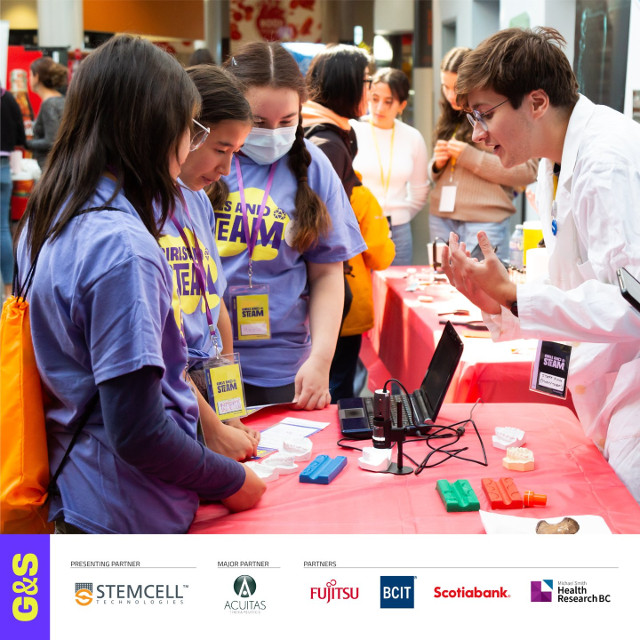
Thanks to Rebecca Bollwitt and the October 24, 2023 posting on her Miss 604 blog for the news about the 2023 (or 6th annual) Girls and STEAM (science, technology, engineering, arts, and math) Summit. From Alexis Miles’s October 24, 2023 post,
The 6th annual Girls and STEAM (science, technology, engineering, arts and design, and math), presented by STEMCELL Technologies, is taking place at Science World November 4th [2023].
Girls and STEAM at Science World Date: Saturday, November 4, 2023 Time: 7:45am to 4:00pm Location: Science World (1455 Quebec Street, Vancouver) Admission: Registration is open online for girls aged 12 to 14.
300 young girls, aged 12-14, will take over the Science World dome in a day of hands-on activities, enriching workshops, inspiring mentorship sessions and a keynote presentation.
…
This year’s keynote presentation features Andini Makosinski, Filipina-Polish Canadian inventor best known for her invention of the Hollow Flashlight that runs off the heat of the human hand, and theeDrink, a coffee mug that harvests the excess heat of a hot drink and converts it into electricity to charge a phone. The inspiration for Andini’s flashlight came from her friend in the Philippines, who had failed a grade in school because she had no light or electricity to study with at night.
STEMCELL Technologies, Canada’s largest biotechnology company, is pleased to announce it will be the presenting partner of the Girls and STEAM Summit at Science World in Vancouver.
The Summit, which takes place on November 4, 2023, is a full-day event with workshops, hands-on activities, a keynote presentation, and sessions with experienced mentors who work in STEAM (science, technology, engineering, art and design, and math).
“Science is about so much more than what happens in the laboratory. It provides a lens that can instill a deep-seated curiosity in young minds and enrich every aspect of our lives,” said Sharon Louis, Senior Vice President of Research and Development, STEMCELL. “Scientific education – in the classroom and out in the world – can lead to life-changing experiences and limitless opportunities for young women and girls. STEMCELL is proud to support the Girls and STEAM program to make science more accessible, and help ignite the passion of the next generation of scientists and leaders.”
…
About STEMCELL Technologies
STEMCELL Technologies supports life sciences research with more than 2,500 specialized reagents, tools, and services. STEMCELL offers high-quality cell culture media, cell separation technologies, instruments, accessory products, educational resources, and contract assay services that are used by scientists performing stem cell, immunology, cancer, regenerative medicine, and cellular therapy research globally.
[downloaded from https://miss604.com/2023/10/girls-and-steam-at-science-world.html]