Tag Archives: Asia Matatyaho Ya’akobi

Elegant art/science: boron nitride nanotubes (BNNTs) — touted for their strength, thermal stability and insulating properties — coaxed into visually striking images

This is the only ‘art’ boron nitride nanotube i could find,

Langmuir 2025, 41, 24, 15270–15282

A June 24, 2025 Rice University news release (also on EurekAlert) makes an art/science announcement, Note: Links have been removed,

In an elegant fusion of art and science, researchers at Rice University have achieved a major milestone in nanomaterials engineering by uncovering how boron nitride nanotubes (BNNTs) — touted for their strength, thermal stability and insulating properties — can be coaxed into forming ordered liquid crystalline phases in water. Their work, published in Langmuir, the premier American Chemical Society journal in colloid and surface chemistry, was so visually striking it graced the journal’s cover.

That vibrant image, however, represents more than just the beauty of science at the nanoscale. It captures the essence of a new, scalable method to align BNNTs in aqueous solutions using a common bile-salt surfactant — sodium deoxycholate (SDC) — opening the door to next-generation materials for aerospace, electronics and beyond.

“This work is very interesting from the fundamental point of view because it shows that BNNTs can be used as model systems to study novel nanorod liquid crystals,” said Matteo Pasquali, the A.J. Hartsook Professor of Chemical and Biomolecular Engineering, professor of chemistry, materials science and nanoengineering and corresponding author on the study. “The main advantage is that BNNTs are relatively transparent and easily studied via visible light unlike carbon nanotubes, which form dark liquid crystals that are hard to examine via light microscopy.”

For first author Joe Khoury, the study was more than routine science. Trained as an architect in Syria, he transitioned to chemical engineering after moving to the U.S., but his background in visual design may have helped him see something others might have missed. During a routine purification step, he noticed that as water was filtered from the dispersion, the leftover material became thick and glowed under polarized light — a hallmark of liquid crystal formation. Inspired by this observation, the team hypothesized that increasing the SDC concentration would drive BNNTs to self-assemble into ordered nematic phases.

To test their hypothesis, the researchers conducted a meticulous series of experiments, preparing BNNT-SDC dispersions at varying concentrations. They used polarized light microscopy to observe the transition from disordered states to partially ordered and then fully ordered liquid crystalline phases. Cryogenic electron microscopy provided high-resolution confirmation of BNNT alignment.

Crucially, they produced the first comprehensive phase diagram for BNNTs in surfactant solutions — a predictive map that allows scientists to anticipate how BNNTs will behave at different concentration ratios.

“No one had done this before,” Khoury said. “Previous studies either worked at low BNNT concentrations or used too little surfactant. We showed that if you increase both in the right proportion, you can trigger liquid crystalline ordering without using harsh chemicals or complicated procedures.”

In addition to mapping phase behavior, the team followed a simple, reproducible method to turn these dispersions into thin, well-aligned BNNT films. Using a specialized blade to shear the material onto a glass slide, they fabricated transparent, robust films ideal for thermal management and structural reinforcement applications (think lighter, stronger and more heat-tolerant components in tech devices or aircraft). Using X-ray diffraction and electron microscopy, the team confirmed the alignment at the nanoscale level.

“We demonstrated that nematic alignment in solution can be preserved and translated into solid films,” Khoury said. “That makes this a highly scalable platform for next-gen materials.”

The study lays the groundwork for new research into lyotropic liquid crystals formed from nanorods. Its simplicity — no strong acids, no harsh conditions — makes it accessible to labs worldwide. And its implications stretch from theoretical physics to commercial materials engineering.

“This is just the beginning,” Pasquali said. “With this road map, we can now explore how to fine-tune BNNT alignment for specific applications. It’s not just about making films; it’s about understanding a whole new class of functional nanomaterials.”

Pasquali added that the beauty of the images was mesmerizing.

“When Joe sent me candidate images for the cover, I felt like I was looking at paintings by Dali or Van Gogh,” Pasquali said. “The cover image could be the tower of Barad-dur from ‘The Lord of the Rings’ painted by a surrealist artist.”

Khoury added that this research would not have been possible without the guidance and mentorship from his team and co-authors, including Pasquali; Angel Martí, professor and chair of chemistry and professor of bioengineering and materials science and nanoengineering at Rice; Cheol Park of NASA Langley Research Center; Lyndsey Scammell from BNNT LLC; and Yeshayahu Talmon at the Technion-Israel Institute of Technology, among others.

This research was supported by the Welch Foundation, BNNT LLC, the Technion Russell Berrie Nanotechnology Institute and Rice’s Electron Microscopy Center and its Shared Equipment Authority.

Caption: Matteo Pasquali, the A.J. Hartsook Professor of Chemical and Biomolecular Engineering, professor of chemistry, materials science and nanoengineering, and first author Joe Khoury. Credit: Rice University.

Here’s a link to and a citation for the paper,

Lyotropic Liquid Crystalline Phase Behavior of Boron Nitride Nanotube Aqueous Dispersions by Joe F. Khoury, Asia Matatyaho Ya’akobi, Alina Chow, Eldar Khabushev, Irina Davidovich, Davide Cavuto, Mingrui Gong, Lyndsey R. Scammell, Cheol Park, Yeshayahu Talmon, Angel A. Martí, Matteo Pasquali. Langmuir 2025, 41, 24, 15270–15282 DOI: https://doi.org/10.1021/acs.langmuir.5c00563 Published May 5, 2025 Copyright © 2025 American Chemical Society

This paper is behind a paywall.

Detangling carbon nanotubes (CNTs)

An April 27, 2022 news item on ScienceDaily announces research into a solution to a vexing problem associated with the production of carbon nanotubes (CNTs),

Carbon nanotubes that are prone to tangle like spaghetti can use a little special sauce to realize their full potential.

Rice University scientists have come up with just the sauce, an acid-based solvent that simplifies carbon nanotube processing in a way that’s easier to scale up for industrial applications.

The Rice lab of Matteo Pasquali reported in Science Advances on its discovery of a unique combination of acids that helps separate nanotubes in a solution and turn them into films, fibers or other materials with excellent electrical and mechanical properties.

The study co-led by graduate alumnus Robert Headrick and graduate student Steven Williams reports the solvent is compatible with conventional manufacturing processes. That should help it find a place in the production of advanced materials for many applications.

An April 22, 2022 Rice University news release (received via email and also published on April 27, 2022 on EurekAlert), which originated the news item, delves further into how the research has environmental benefits and into its technical aspects (Note Links have been removed),

“There’s a growing realization that it’s probably not a good idea to increase the mining of copper and aluminum and nickel,” said Pasquali, Rice’s A.J. Hartsook Professor and a professor of chemical and biomolecular engineering, chemistry and materials science and nanoengineering. He is also director of the Rice-based Carbon Hub, which promotes the development of advanced carbon materials to benefit the environment.

“But there is this giant opportunity to use hydrocarbons as our ore,” he said. “In that light, we need to broaden as much as possible the range in which we can use carbon materials, especially where it can displace metals with a product that can be manufactured sustainably from a feedstock like hydrocarbons.” Pasquali noted these manufacturing processes produce clean hydrogen as well.

“Carbon is plentiful, we control the supply chains and we know how to get it out in an environmentally responsible way,” he said.

A better way to process carbon will help. The solvent is based on methanesulfonic (MSA), p-toluenesulfonic (pToS)and oleum acids that, when combined, are less corrosive than those currently used to process nanotubes in a solution. Separating nanotubes (which researchers refer to as dissolving) is a necessary step before they can be extruded through a needle or other device where shear forces help turn them into familiar fibers or sheets. 

Oleum and chlorosulfonic acids have long been used to dissolve nanotubes without modifying their structures, but both are highly corrosive. By combining oleum with two weaker acids, the team developed a broadly applicable process that enables new manufacturing for nanotubes products.

“The oleum surrounds each individual nanotube and gives it a very localized positive charge,” said Headrick, now a research scientist at Shell. “That charge makes them repel each other.”

After detangling, the milder acids further separate the nanotubes. They found MSA is best for fiber spinning and roll-to-roll film production, while pToS, a solid that melts at 40 degrees Celsius (104 degrees Fahrenheit), is particularly useful for 3D printing applications because it allows nanotube solutions to be processed at a moderate temperature and then solidified by cooling.

The researchers used these stable liquid crystalline solutions to make things in both modern and traditional ways, 3D printing carbon nanotube aerogels and silk screen printing patterns onto a variety of surfaces, including glass. 

The solutions also enabled roll-to-roll production of transparent films that can be used as electrodes. “Honestly, it was a little surprising how well that worked,” Headrick said. “It came out pretty flawless on the very first try.”

The researchers noted oleum still requires careful handling, but once diluted with the other acids, the solution is much less aggressive to other materials. 

“The acids we’re using are so much gentler that you can use them with common plastics,” Headrick said. “That opens the door to a lot of materials processing and printing techniques that are already in place in manufacturing facilities. 

“It’s also really important for integrating carbon nanotubes into other devices, depositing them as one step in a device-manufacturing process,” he said.

They reported the less-corrosive solutions did not give off harmful fumes and were easier to clean up after production. MSA and pToS can also be recycled after processing nanotubes, lowering their environmental impact and energy and processing costs.

Williams said the next step is to fine-tune the solvent for applications, and to determine how factors like chirality and size affect nanotube processing. “It’s really important that we have high-quality, clean, large diameter tubes,” he said.

Co-authors of the paper are alumna Lauren Taylor and graduate students Oliver Dewey and Cedric Ginestra of Rice; graduate student Crystal Owens and professors Gareth McKinley and A. John Hart at the Massachusetts Institute of Technology; alumna Lucy Liberman, graduate student Asia Matatyaho Ya’akobi and Yeshayahu Talmon, a professor emeritus of chemical engineering, at the Technion-Israel Institute of Technology, Haifa, Israel; and Benji Maruyama, autonomous materials lead in the Materials and Manufacturing Directorate, Air Force Research Laboratory.

Here’s a link to and a citation for the paper,

Versatile acid solvents for pristine carbon nanotube assembly by Robert J. Headrick, Steven M. Williams, Crystal E. Owens, Lauren W. Taylor, Oliver S. Dewey, Cedric J. Ginestra, Lucy Liberman, Asia Matatyaho Ya’akobi, Yeshayahu Talmon, Benji Maruyama, Gareth H. McKinley, A. John Hart, Matteo Pasquali. Science Advances • 27 Apr 2022 • Vol 8, Issue 17 • DOI: 10.1126/sciadv.abm3285

This paper is open access.
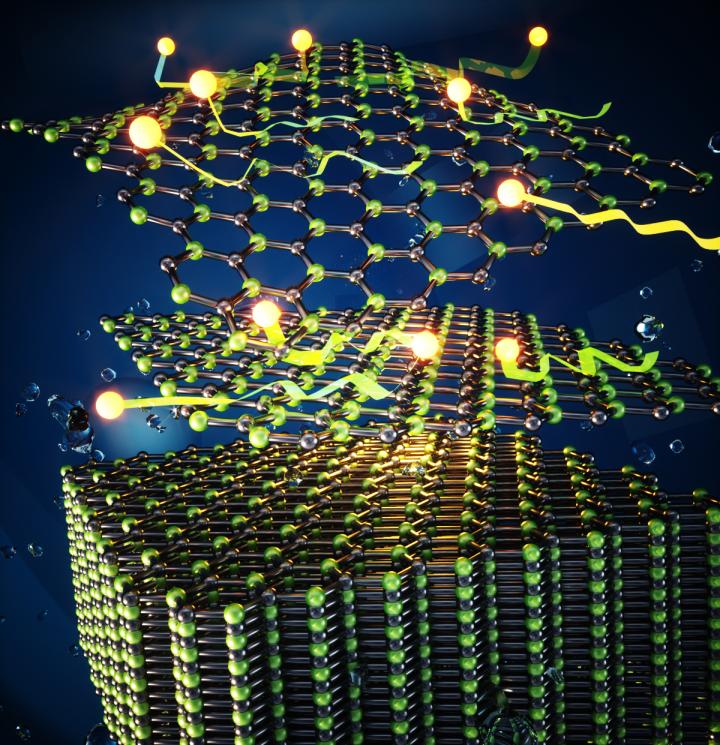
Soap and water for creating 2D nanoflakes (hexagonal boron nitride [hBN] sheets)

Rice University (Texas, US) has a pretty image illustrating the process of making 2D nanoflakes,

Caption: The image displays the exfoliation of hexagonal boron nitride into atomically thin nanosheets aided by surfactants, a process refined by chemists at Rice University. Credit: Ella Maru Studio

A January 27, 2021 news item on Nanowerk announces the Rice University news,

Just a little soap helps clean up the challenging process of preparing two-dimensional hexagonal boron nitride (hBN).

Rice University chemists have found a way to get the maximum amount [number] of quality 2D hBN nanosheets from its natural bulk form by processing it with surfactant (aka soap) and water. The surfactant surrounds and stabilizes the microscopic flakes, preserving their properties.

Experiments by the lab of Rice chemist Angel Martí identified the “sweet spot” for making stable dispersions of hBN, which can be processed into very thin antibacterial films that handle temperatures up to 900 degrees Celsius (1,652 degrees Fahrenheit).

A brief grammatical moment: I can see where someone might view it as arguable (see second paragraph of the above excerpt) but for me ‘amount’ is for something like ‘flour’ for an ‘amount of flour’. ‘Number’ is for something like a ‘number of sheets’. The difference lies in your ability to count the items. Generally speaking, you can’t count the number of flour, therefore, it’s the amount of flour, but you can count the number of sheets. Can count these hexagonal boron nitride (hBN) sheets? If not, is what makes this arguable.

A January 27, 2021 Rice University news release (also on EurekAlert), which originated the news item, delves into details,

The work led by Martí, alumna Ashleigh Smith McWilliams and graduate student Cecilia Martínez-Jiménez is detailed in the American Chemical Society journal ACS Applied Nano Materials.

“Boron nitride materials are interesting, particularly because they are extremely resistant to heat,” Martí said. “They are as light as graphene and carbon nanotubes, but you can put hBN in a flame and nothing happens to it.”

He said bulk hBN is cheap and easy to obtain, but processing it into microscopic building blocks has been a challenge. “The first step is to be able to exfoliate and disperse them, but research on how to do that has been scattered,” Martí said. “When we decided to set a benchmark, we found the processes that have been extremely useful for graphene and nanotubes don’t work as well for boron nitride.”

Sonicating bulk hBN in water successfully exfoliated the material and made it soluble. “That surprised us, because nanotubes or graphene just float on top,” Martí said. “The hBN dispersed throughout, though they weren’t particularly stable.

“It turned out the borders of boron nitride crystals are made of amine and nitric oxide groups and boric acid, and all of these groups are polar (with positive or negative charge),” he said. “So when you exfoliate them, the edges are full of these functional groups that really like water. That never happens with graphene.”

Experiments with nine surfactants helped them find just the right type and amount to keep 2D hBN from clumping without cutting individual flakes too much during sonication. The researchers used 1% by weight of each surfactant in water, added 20 milligrams of bulk hBN, then stirred and sonicated the mix.

Spinning the resulting solutions at low and high rates showed the greatest yield came with the surfactant known as PF88 under 100-gravity centrifugation, but the highest-quality nanosheets came from all the ionic surfactants under 8,000 g centrifugation, with the greatest stability from common ionic surfactants SDS and CTAC.

DTAB — short for dodecyltrimethylammonium bromide — under high centrifugation proved best at balancing the yield and quality of 2D hBN. The researchers also produced a transparent film from hBN nanosheets dispersed in SDS and water to demonstrate how they can be processed into useful products.

“We describe the steps you need to do to produce high-quality hBN flakes,” Martí said. “All of the steps are important, and we were able to bring to light the consequences of each one.”

Understanding the Exfoliation and Dispersion of Hexagonal Boron Nitride Nanosheets by Surfactants: Implications for Antibacterial and Thermally Resistant Coatings by Ashleigh D. Smith McWilliams, Cecilia Martínez-Jiménez, Asia Matatyaho Ya’akobi, Cedric J. Ginestra, Yeshayahu Talmon, Matteo Pasquali, and Angel A. Martí. ACS Appl. Nano Mater. 2021, 4, 1, 142–151 DOI: https://doi.org/10.1021/acsanm.0c02437 Publication Date: January 7, 2021 Copyright © 2021 American Chemical Society

This paper is behind a paywall.