This is going to be a jam-packed posting with the AI experts at the Canadian Science Policy Centre (CSPC) virtual panel, a look back at a ‘testy’ exchange between Yoshua Bengio (one of Canada’s godfathers of AI) and a former diplomat from China, an update on Canada’s Minister of Artificial Intelligence and Digital Innovation, Evan Solomon and his latest AI push, and a missive from the BC artificial intelligence community.
A Canadian Science Policy Centre AI panel on November 11, 2025
The Canadian Science Policy Centre (CSPC) provides an October 9, 2025 update on an upcoming virtual panel being held on Remembrance Day,
[AI-Driven Misinformation Across Sectors Addressing a Cross-Societal Challenge]
Upcoming Virtual Panel[s]: November 11 [2025]
Artificial Intelligence is transforming how information is created and trusted, offering immense benefits across sectors like healthcare, education, finance, and public discourse—yet also amplifying risks such as misinformation, deepfakes, and scams that threaten public trust. This panel brings together experts from diverse fields [emphasis mine] to examine the manifestations and impacts of AI-driven misinformation and to discuss policy, regulatory, and technical solutions [emphasis mine]. The conversation will highlight practical measures—from digital literacy and content verification to platform accountability—aimed at strengthening resilience in Canada and globally.
For more information on the panel and to register, click below.
Odd timing for this event. Moving on, I found more information on the CSPC’s webpage for this event, Note: Unfortunately, links to the moderator’s and speakers’ bios could not be copied here,
Canadian Science Policy Centre Email info@sciencepolicy.ca
…
This panel brings together cross-sectoral experts to examine how AI-driven misinformation manifests in their respective domains, its consequences, and how policy, regulation, and technical interventions can help mitigate harm. The discussion will explore practical pathways for action, such as digital literacy, risk audits, content verification technologies, platform responsibility, and regulatory frameworks. Attendees will leave with a nuanced understanding of both the risks and the resilience strategies being explored in Canada and globally.
Canada Research Chair in Internet & E-commerce Law, University of Ottawa See Bio
[Panelists]
Dr. Plinio Morita
Associate Professor / Director, Ubiquitous Health Technology Lab, University of Waterloo …
Dr. Nadia Naffi
Université Laval — Associate Professor of Educational Technology and expert on building human agency against AI-augmented disinformation and deepfakes. See Bio
Dr. Jutta Treviranus
Director, Inclusive Design Research Centre, OCAD U, Expert on AI misinformation in the Education sector and schools. See Bio
Dr. Fenwick McKelvey
Concordia University — Expert in political bots, information flows, and Canadian tech governance See Bio
Michael Geist has his own blog/website featuring posts on his ares of interest and featuring his podcast, Law Bytes. Jutta Treviranus is mentioned in my October 13, 2025 posting as a participant in “Who’s afraid of AI? Arts, Sciences, and the Futures of Intelligence,” a conference (October 23 – 24, 205) and arts festival at the University of Toronto (scroll down to find it) . She’s scheduled for a session on Thursday, October 23, 2025.
China, Canada, and the AI Action summit in February 2025
Zoe Kleinman’s February 10, 2025 article for the British Broadcasting Corporation (BBC) news online website also notes the encounter,
A former Chinese official poked fun at a major international AI safety report led by “AI Godfather” professor Yoshua Bengio and co-authored by 96 global experts – in front of him.
Fu Ying, former vice minister of foreign affairs and once China’s UK ambassador, is now an academic at Tsinghua University in Beijing.
The pair were speaking at a panel discussion ahead of a two-day global AI summit starting in Paris on Monday [February 10, 2025].
The aim of the summit is to unite world leaders, tech executives, and academics to examine AI’s impact on society, governance, and the environment.
Fu Ying began by thanking Canada’s Prof Bengio for the “very, very long” document, adding that the Chinese translation stretched to around 400 pages and she hadn’t finished reading it.
She also had a dig at the title of the AI Safety Institute – of which Prof Bengio is a member.
China now has its own equivalent; but they decided to call it The AI Development and Safety Network, she said, because there are lots of institutes already but this wording emphasised the importance of collaboration.
The AI Action Summit is welcoming guests from 80 countries, with OpenAI chief executive Sam Altman, Microsoft president Brad Smith and Google chief executive Sundar Pichai among the big names in US tech attending.
Elon Musk is not on the guest list but it is currently unknown whether he will decide to join them. [As of February 13, 2025, Mr. Musk did not attend the summit, which ended February 11, 2025.]
A key focus is regulating AI in an increasingly fractured world. The summit comes weeks after a seismic industry shift as China’s DeepSeek unveiled a powerful, low-cost AI model, challenging US dominance.
The pair’s heated exchanges were a symbol of global political jostling in the powerful AI arms race, but Fu Ying also expressed regret about the negative impact of current hostilities between the US and China on the progress of AI safety.
…
She gave a carefully-crafted glimpse behind the curtain of China’s AI scene, describing an “explosive period” of innovation since the country first published its AI development plan in 2017, five years before ChatGPT became a viral sensation in the west.
She added that “when the pace [of development] is rapid, risky stuff occurs” but did not elaborate on what might have taken place.
“The Chinese move faster [than the west] but it’s full of problems,” she said.
Fu Ying argued that building AI tools on foundations which are open source, meaning everyone can see how they work and therefore contribute to improving them, was the most effective way to make sure the tech did not cause harm.
Most of the US tech giants do not share the tech which drives their products.
Open source offers humans “better opportunities to detect and solve problems”, she said, adding that “the lack of transparency among the giants makes people nervous”.
But Prof Bengio disagreed.
His view was that open source also left the tech wide open for criminals to misuse.
He did however concede that “from a safety point of view”, it was easier to spot issues with the viral Chinese AI assistant DeepSeek, which was built using open source architecture, than ChatGPT, whose code has not been shared by its creator OpenAI.
…
Interesting, non? You can read more about Bengio’s views in an October 1, 2025 article by Rae Witte for Futurism.
In a Policy Forum, Yue Zhu and colleagues provide an overview of China’s emerging regulation for artificial intelligence (AI) technologies and its potential contributions to global AI governance. Open-source AI systems from China are rapidly expanding worldwide, even as the country’s regulatory framework remains in flux. In general, AI governance suffers from fragmented approaches, a lack of clarity, and difficulty reconciling innovation with risk management, making global coordination especially hard in the face of rising controversy. Although no official AI law has yet been enacted, experts in China have drafted two influential proposals – the Model AI Law and the AI Law (Scholar’s Proposal) – which serve as key references for ongoing policy discussions. As the nation’s lawmakers prepare to draft a consolidated AI law, Zhu et al. note that the decisions will shape not only China’s innovation, but also global collaboration on AI safety, openness, and risk mitigation. Here, the authors discuss China’s emerging AI regulation as structured around 6 pillars, which, combined, stress exemptive laws, efficient adjudication, and experimentalist requirements, while safeguarding against extreme risks. This framework seeks to balance responsible oversight with pragmatic openness, allowing developers to innovate for the long term and collaborate across the global research community. According to Zhu et al., despite the need for greater clarity, harmonization, and simplification, China’s evolving model is poised to shape future legislation and contribute meaningfully to global AI governance by promoting both safety and innovation at a time when international cooperation on extreme risks is urgently needed.
Here’s a link to and a citation for the paper,
China’s emerging regulation toward an open future for AI by Yue Zhu, Bo He, Hongyu Fu, Naying Hu, Shaoqing Wu, Taolue Zhang, Xinyi Liu, Gang Xu, Linghan Zhang, and Hui Zhou. Science 9 Oct 2025Vol 390, Issue 6769 pp. 132-135 DOI: 10.1126/science.ady7922
This paper is behind a paywall.
No mention of Fu Ying or China’s ‘The AI Development and Safety Network’ but perhaps that’s in the paper.
Canada and its Minister of AI and Digital Innovation
Evan Solomon (born April 20, 1968)[citation needed] is a Canadian politician and broadcaster who has been the minister of artificial intelligence and digital innovation since May 2025. A member of the Liberal Party, Solomon was elected as the member of Parliament (MP) for Toronto Centre in the April 2025 election.
He was the host of The Evan Solomon Show on Toronto-area talk radio station CFRB,[2] and a writer for Maclean’s magazine. He was the host of CTV’s national political news programs Power Play and Question Period.[3] In October 2022, he moved to New York City to accept a position with the Eurasia Group as publisher of GZERO Media.[4] Solomon continued with CTV News as a “special correspondent” reporting on Canadian politics and global affairs.”[4]
…
Had you asked me what background one needs to be a ‘Minister of Artificial Intelligence and Digital Innovation’, media would not have been my first thought. That said, sometimes people can surprise you.
Solomon appears to be an enthusiast if a June 10, 2025 article by Anja Karadeglija for The Canadian Press is to be believed,
Canada’s new minister of artificial intelligence said Tuesday [June 10, 2025] he’ll put less emphasis on AI regulation and more on finding ways to harness the technology’s economic benefits [emphases mine].
In his first speech since becoming Canada’s first-ever AI minister, Evan Solomon said Canada will move away from “over-indexing on warnings and regulation” to make sure the economy benefits from AI.
His regulatory focus will be on data protection and privacy, he told the audience at an event in Ottawa Tuesday morning organized by the think tank Canada 2020.
Solomon said regulation isn’t about finding “a saddle to throw on the bucking bronco called AI innovation. That’s hard. But it is to make sure that the horse doesn’t kick people in the face. And we need to protect people’s data and their privacy.”
The previous government introduced a privacy and AI regulation bill that targeted high-impact AI systems. It did not become law before the election was called.
That bill is “not gone, but we have to re-examine in this new environment where we’re going to be on that,” Solomon said.
He said constraints on AI have not worked at the international level.
“It’s really hard. There’s lots of leakages,” he said. “The United States and China have no desire to buy into any constraint or regulation.”
That doesn’t mean regulation won’t exist, he said, but it will have to be assembled in steps.
…
Solomon’s comments follow a global shift among governments to focus on AI adoption and away from AI safety and governance.
The first global summit focusing on AI safety was held in 2023 as experts warned of the technology’s dangers — including the risk that it could pose an existential threat to humanity. At a global meeting in Korea last year, countries agreed to launch a network of publicly backed safety institutes.
But the mood had shifted by the time this year’s AI Action Summit began in Paris. …
…
Solomon outlined several priorities for his ministry — scaling up Canada’s AI industry, driving adoption and ensuring Canadians have trust in and sovereignty over the technology.
He said that includes supporting Canadian AI companies like Cohere, which “means using government as essentially an industrial policy to champion our champions.”
The federal government is putting together a task force to guide its next steps on artificial intelligence, and Artificial Intelligence Minister Evan Solomon is promising an update to the government’s AI strategy.
Solomon told the All In artificial intelligence conference in Montreal on Wednesday [September 24, 2025] that the “refreshed” strategy will be tabled later this year, “almost two years ahead of schedule.”
…
“We need to update and move quickly,” he said in a keynote speech at the start of the conference.
The task force will include about 20 representatives from industry, academia and civil society. The government says it won’t reveal the membership until later this week.
Solomon said task force members are being asked to consult with their networks, suggest “bold, practical” ideas and report back to him in November [2025].
The group will look at various topics related to AI, including research, adoption, commercialization, investment, infrastructure, skills, and safety and security. The government is also planning to solicit input from the public. [emphasis mine]
Canada was the first country to launch a national AI strategy [the Pan-Canadian AI Strategy announced in 2016], which the government updated in 2022. The strategy focuses on commercialization, the development and adoption of AI standards, talent and research.
Solomon also teased a “major quantum initiative” coming in October [2025?] to ensure both quantum computing talent and intellectual property stay in the country.
Solomon called digital sovereignty “the most pressing policy and democratic issue of our time” and stressed the importance of Canada having its own “digital economy that someone else can’t decide to turn off.”
Solomon said the federal government’s recent focus on major projects extends to artificial intelligence. He compared current conversations on Canada’s AI framework to the way earlier generations spoke about a national railroad or highway.
…
He said his government will address concerns about AI by focusing on privacy reform and modernizing Canada’s 25-year-old privacy law.
“We’re going to include protections for consumers who are concerned about things like deep fakes and protection for children, because that’s a big, big issue. And we’re going to set clear standards for the use of data so innovators have clarity to unlock investment,” Solomon said.
…
The government is consulting with the public? Experience suggests that when all the major decisions will have been made; the public consultation comments will mined so officials can make some minor, unimportant tweaks.
Canada’s AI Task Force and parts of the Empire Club talk are revealed in a September 26, 2025 article by Alex Riehl for BetaKit,
Inovia Capital partner Patrick Pichette, Cohere chief artificial intelligence (AI) officer Joelle Pineau, and Build Canada founder Dan Debow are among 26 members of AI minister Evan Solomon’s AI Strategy Task Force trusted to help the federal government renew its AI strategy.
Solomon revealed the roster, filled with leading Canadian researchers and business figures, while speaking at the Empire Club in Toronto on Friday morning [September 26, 2025]. He teased its formation at the ALL IN conference earlier this week [September 24, 2025], saying the team would include “innovative thinkers from across the country.”
The group will have 30 days to add to a collective consultation process in areas including research, talent, commercialization, safety, education, infrastructure, and security.
…
The full AI Strategy Task Force is listed below; each member will consult their network on specific themes.
Research and Talent
Gail Murphy, professor of computer science and vice-president – research and innovation, University of British Columbia and vice-chair at the Digital Research Alliance of Canada
Diane Gutiw, VP – global AI research lead, CGI Canada and co-chair of the Advisory Council on AI
Michael Bowling, professor of computer science and principal investigator – Reinforcement Learning and Artificial Intelligence Lab, University of Alberta and research fellow, Alberta Machine Intelligence Institute and Canada CIFAR AI chair
Arvind Gupta, professor of computer science, University of Toronto
Adoption across industry and governments
Olivier Blais, co-founder and VP of AI, Moov and co-chair of the Advisory Council on AI
Cari Covent, technology executive
Dan Debow, chair of the board, Build Canada
Commercialization of AI
Louis Têtu, executive chairman, Coveo
Michael Serbinis, founder and CEO, League and board chair of the Perimeter Institute
Adam Keating, CEO and Founder, CoLab
Scaling our champions and attracting investment
Patrick Pichette, general partner, Inovia Capital
Ajay Agrawal, professor of strategic management, University of Toronto, founder, Next Canada and founder, Creative Destruction Lab
Sonia Sennik, CEO, Creative Destruction Lab
Ben Bergen, president, Council of Canadian Innovators
Building safe AI systems and public trust in AI
Mary Wells, dean of engineering, University of Waterloo
Joelle Pineau, chief AI officer, Cohere
Taylor Owen, founding director, Center [sic] for Media, Technology and Democracy [McGill University]
Education and Skills
Natiea Vinson, CEO, First Nations Technology Council
Alex Laplante, VP – cash management technology Canada, Royal Bank of Canada and board member at Mitacs
David Naylor, professor of medicine – University of Toronto
Infrastructure
Garth Gibson, chief technology and AI officer, VDURA
Ian Rae, president and CEO, Aptum
Marc Etienne Ouimette, chair of the board, Digital Moment and member, OECD One AI Group of Experts, affiliate researcher, sovereign AI, Cambridge University Bennett School of Public Policy
Security
Shelly Bruce, distinguished fellow, Centre for International Governance Innovation
James Neufeld, founder and CEO, Samdesk
Sam Ramadori, co-president and executive director, LawZero
With files from Josh Scott
If you have the time, Riehl ‘s September 26, 2025 article offers more depth than may be apparent in the excerpts I’ve chosen.
It’s been a while since I’ve seen Arvind Gupta’s name. I’m glad to see he’s part of this Task Force (Research and Talent). The man was treated quite shamefully at the University of British Columbia. (For the curious, this August 18, 2015 article by Ken MacQueen for Maclean’s Magazine presents a somewhat sanitized [in my opinion] review of the situation.)
One final comment, the experts on the virtual panel and members of Solomon’s Task Force are largely from Ontario and Québec. There is minor representation from others parts of the country but it is minor.
British Columbia wants entry into the national AI discussion
Just after I finished writing up this post, I received Kris Krug’s (techartist, quasi-sage, cyberpunk anti-hero from the future) October 14, 2025 communication (received via email) regarding an initiative from the BC + AI community,
Growth vs Guardrails: BC’s Framework for Steering AI
Our open letter to Minister Solomon shares what we’ve learned building community-led AI governance and how BC can help.
Ottawa created a Minister of Artificial Intelligence and just launched a national task force to shape the country’s next AI strategy. The conversation is happening right now about who gets compute, who sets the rules, and whose future this technology will serve.
Our new feature, Growth vs Guardrails [see link to letter below for ‘guardrails’], is already making the rounds in those rooms. The message is simple: if Ottawa’s foot is on the gas, BC is the steering wheel and the brakes. We can model a clean, ethical, community-led path that keeps power with people and place.
This is the time to show up together. Not as scattered voices, but as a connected movement with purpose, vision, and political gravity.
Over the past few months, almost 100 of us have joined as the new BC + AI Ecosystem Association non-profit as Founding Members. Builders. Artists. Researchers. Investors. Educators. Policymakers. People who believe that tech should serve communities, not the other way around.
Now we’re opening the door wider. Join and you’ll be part of the core group that built this from the ground up. Your membership is declaration that British Columbia deserves to shape its own AI future with ethics, creativity, and care.
If you’ve been watching from the sidelines, this is the time to lean in. We don’t do panels. We do portals. And this is the biggest one we’ve opened yet.
See you inside,
Kris Krüg Executive Director BC + AI Ecosystem Association kk@bc-ai.ca | bc-ai.ca
Canada just spun up a 30-day sprint to shape its next AI strategy. Minister Evan Solomon assembled 26 experts (mostly industry and academia) to advise on research, adoption, commercialization, safety, skills, and infrastructure.
On paper, it’s a pivot moment. In practice, it’s already drawing fire. Too much weight on scaling, not enough on governance. Too many boardrooms, not enough frontlines. Too much Ottawa, not enough ground truth.
…
This is Canada’s chance to reset the DNA of its AI ecosystem.
But only if we choose regeneration over extraction, sovereign data governance over corporate capture, and community benefit over narrow interests.
…
The Problem With The Task Force
Research says: The group’s stacked with expertise. But critics flag the imbalance. Where’s healthcare? Where’s civil society beyond token representation? Where are the people who’ll feel AI’s impact first: frontline workers, artists, community organizers?
…
The worry:Commercialization and scaling overshadow public trust, governance, and equitable outcomes. Again.
The numbers back this up: Only 24% of Canadians have AI training. Just 38% feel confident in their knowledge. Nearly two-thirds see potential harm. 71% would trust AI more under public regulation.
We’re building a national strategy on a foundation of low literacy and eroding trust. That’s not a recipe for sovereignty. That’s a recipe for capture.
Principles for a National AI Strategy: What BC + AI Stands For
I have two art/science events and one art/science conference/festival (IRL [in real life or in person] and Zoom) taking place in Toronto, Ontario.
October 16, 2025
There is a closing event for the “I don’t do Math” series mentioned in my September 8, 2025 posting,
…
ABOUT “I don’t do math” is a photographic series referencing dyscalculia, a learning difference affecting a person’s ability to understand and manipulate number-based information.
This initiative seeks to raise awareness about the challenges posed by dyscalculia with educators, fellow mathematicians, and parents, and to normalize its existence, leading to early detection and augmented support. In addition, it seeks to reflect on and question broader issues and assumptions about the role and significance of Mathematics and Math education in today’s changing socio-cultural and economic contexts.
The exhibition will contain pedagogical information and activities for visitors and students. The artist will also address the extensive research that led to the exhibition. The exhibition will feature two panel discussions following the opening and to conclude the exhibition.
…
I have some information from an October 12, 2025 ArtSci Salon announcement (received via email) about the “I don’t do math” closing event,
in us for
Closing Exhibition Panel Discussion Thursday, October 16 2025 10:00 am -12:00 pm room 309 The Fields Institute for Research in Mathematical Sciences (or online)
Artist Ann Piché will be in conversation with Andrew Fiss, Jacqueline Wernimont, Amenda Chow, Ellen Abrams, Michael Barany and JP Ascher
The second event mentioned in the October 12, 2025 ArtSci Salon announcement, Note 1: A link has been removed, Note 2: This event is part of a larger series,
…
Marco Donnarumma Monsters of Grace: bodies, sounds, and machines
Tuesday, October 21, 2025 3:30-4:30 PM Sensorium Research Loft 4th floor Goldfarb Centre for Fine Arts York University
About the talk What is sound to those who do not hear it? How does one listen to something that cannot be heard? What kind of sensory gaps are created by aiding technologies such as prostheses and artificial intelligence (AI)? As a matter of fact, the majority of non-deaf people hear only partially due to age and personal experience. Still, sound is most often considered through the normalizing viewpoint of the non-deaf. If I become your body, what does sound become for me? Join us to welcome Marco Donnarumma ahead of his new installation/performance at Paul Cadario Conference Room (Oct 22, 8-10 PM University College [University of Toronto] – 15 King’s College Circle). His talk will focus on this latest work in the context of a largest body of work titled “I Am Your Body,” an ongoing project investigating how normative power is enforced through the technological mediation of the senses.
About the artist: Marco Donnarumma is an artist, inventor and theorist. His oeuvre confronts normative body politics with uncompromising counter-narratives, where bodies are in tension between control and agency, presence and absence, grace and monstrosity. He is best known for using sound, AI, biosensors, and robotics to turn the body into a site of resistance and transformation. He has presented his work in thirty-seven countries across Asia, Europe, North and South America and is the recipient of numerous accolades, most notably the German Federal Ministry of Research and Education’s Artist of the Science Year 2018, and the Prix Ars Electronica’s Award of Distinction in Sound Art 2017. Donnarumma received a ZER01NE Creator grant in 2024 and was named a pioneer of performing arts with advanced technologies by the major national newspaper Der Standard, Austria. His writings are published in Frontiers in Computer Science, Computer Music Journal and Performance Research, among others, and his newest book chapter, co-authored with Elizabeth Jochum, will appear in Robot Theaters by Routledge. Together with Margherita Pevere he runs the performance group Fronte Vacuo.
…
I wonder if Donnarumma’s “Monsters of Grace: bodies, sounds, and machines’ received any inspiration from “Monsters of Grace” (Wikipedia entry) or if it’s just happenstance, Note: Links have been removed,
Monsters of Grace is a multimedia chamber opera in 13 short acts directed by Robert Wilson, with music by Philip Glass and libretto from the works of 13th-century Sufi mystic Jalaluddin Rumi. The title is said to be a reference to Wilson’s corruption of a line from Hamlet: “Angels and ministers of grace defend us!” (1.4.39).
So, the October 21, 2025 event is a talk at York University taking place before the “Who’s afraid of AI? Arts, Sciences, and the Futures of Intelligence” (more below).
“Who’s afraid of AI? Arts, Sciences, and the Futures of Intelligence,” a conference and arts festival at the University of Toronto
The conference (October 23 – 24, 2025) is concurrent with the arts festival (October 19 – 25, 2025) at the University of Toronto. Here’s more from the event homepage on the https://bmolab.artsci.utoronto.ca/ website, Note: BMO stands for Bank of Montreal, Note: No mention of Edward Albee and “Who’s afraid of Virginia Woolf?,”
2025 marks an inflection point in our technological landscape, driven by seismic shifts in AI innovation.
Who’s Afraid of AI? Arts, Science, and the Futures of Intelligence is a week-long inquiry into the implications and future directions of AI for our creative and collective imaginings, and the many possible futures of intelligence. The complexity of these immediate future calls for interdisciplinary dialogue, bringing together artists, AI researchers, and humanities scholars.
In this volatile domain, the question of who envisions our futures is vital. Artists explore with complexity and humanity, while the humanities reveal the histories of intelligence and the often-overlooked ways knowledge and decision-making have been shaped. By placing these voices in dialogue with AI researchers and technologists, Who’s Afraid of AI? examines the social dimensions of technology, questions tech solutionism from a social-impact perspective, and challenges profit-driven AI with innovation guided by public values.
The two-day conference at the University of Toronto’s University College anchors the week and features panels and debates with leading figures in these disciplines, including a keynoteby 2025 Nobel Laureate in Physics Geoffrey Hinton, the “Godfather of AI” and 2025 Neil Graham Lecturer in Science, Fei-Fei Li, an AI pioneer.
Throughout the week, the conversation continues across the city with:
AI-themed and AI powered art shows and exhibitions
Film screenings
Innovative theatre
Experimental music
Who’s Afraid of AI? demonstrates that Toronto has not only shaped the history of AI but continues to prepare its future.Step into this changing landscape and be part of this transformative dialogue — register today!
Organizing Committee:
Pia Kleber, Professor-Emerita, Comparative Literature, and Drama, U of T Dirk Bernhardt-Walther, Department of Psychology, Program Director, Cognitive Science, U of T David Rokeby, Director, BMO Lab, Centre for Drama, Theatre and Performance Studies, U of T Rayyan Dabbous, PhD candidate, Centre for Comparative Literature, U of T
…
This looks like a pretty interesting programme (if you’re mainly focused on AI and the creative arts), from the event homepage on the https://bmolab.artsci.utoronto.ca/ website, Note 1: All times are ET, Note 2: I have not included speakers’ photos,
The conference will explore core questions about AI such as its capabilities, possibilities and challenges, bringing their unique research, creative practice, scholarship and experience to the discussion. Speakers will also engage in an interdisciplinary conversation on topics including AI’s implications for theories of mind and embodiment, its influence on creation, innovation, and discovery, its recognition of diverse perspectives, and its transformation of artistic, cultural, political and everyday practices.
Thursday, October 23, 2025
Mind the World
9 AM | Clark Reading Room, University College – 15 King’s College Circle
What are the merits and limits of artificial intelligence within the larger debate on embodiment? This session brings together an artist who has given AI a physical dimension, a neuroscientist who reckons with the biological neural networks inspiring AI, and a humanist knowledgeable of the longer history in which the human has tried to decouple itself from its bodily needs and wants.
Suzanne Kite Director, The Wihanble S’a Center for Indigenous AI
James DiCarlo Director, MIT Quest for Intelligence
N. Katherine Hayles James B. Duke Distinguished Professor Emerita of Literature
Staging AI
11 AM | Clark Reading Room, University College – 15 King’s College Circle
How is AI changing the arts? To answer this question, we bring together theatre directors and artists who have made AI the main driving plot of their stories and those who opted to keep technology secondary in their productions.
Kay Voges Artistic Director, Schauspiel Köln
Roland Schimmelpfennig Playwright and Director, Berlin
Hito Steyerl Artist, Filmmaker and Writer, Berlin
Recognizing ‘Noise’
2 PM | Clark Reading Room, University College – 15 King’s College Circle
How can we design a more inclusive AI? This session brings together an artist who has worked with AI and has been sensitive to groups who may be excluded by its practice, an inclusive design scholar who has grappled with AI’s potential for personalized accessibility, and a humanist who understands the longer history on pattern and recognition from which emerged AI.
Marco Donnarumma Artist, Inventor, Theorist, Berlin
Jutta Treviranus Director, OCADU [Ontario College of Art & Design University], Inclusive Design Research Centre
Eryk Salvaggio Media Artist and Tech Policy Press Fellow, Rochester
Art, Design, and Application are the Solution to AI’s Charlie Chaplain Problem
4 PM | Hart House Theatre – 7 Hart House Circle
Daniel Wigdor CoFounder and Chief Executive Officer, AXL
Keynote and Neil Graham Lecture in Science
4:15 PM | Hart House Theatre – 7 Hart House Circle
Fei-Fei Li Sequoia Professor in Computer Science, Stanford Institute for Human-Centered AI
Geoffrey Hinton 2024 Nobel Laureate in Physics, Professor Emeritus in Computer Science
…
Friday, October 24, 2025
Life with AI
9 AM | Clark Reading Room, University College – 15 King’s College Circle
How do machine minds relate to human minds? What can we learn from one about the other? In this session we interrogate the impact of AI on our understanding of human knowledge and tool-making, from the perspective of philosophy, computer science, as well as the arts.
Jeanette Winterson Author, Fellow of the Royal Society of Literature, Great Britain
Leif Weatherby Professor of German and Director of Digital Theory Lab at New York University
Jennifer Nagel Professor, Philosophy, University of Toronto Mississauga
Discovery & In/Sight
11 AM | Clark Reading Room, University College – 15 King’s College Circle
This session explores creative practice through the lens of innovation and cultural/scientific advancement. An artist who creates with critical inspiration from AI joins forces with an innovation scholar who investigates the effects of AI on our decision making, as well as a philosopher of science who understands scientific discovery and inference as well as their limits.
Vladan Joler Visual Artist and Professor of New Media, University of Novi Sad [Serbia]
Alán Aspuru-Guzik Professor of Chemistry and Computer Science, University of Toronto
Brian Baigrie Professor, Institute for the History and Philosophy of Science & Technology, University of Toronto
Social history & Possible Futures
2 PM | Clark Reading Room, University College – 15 King’s College Circle
How does AI ownership and its private uses coexist within a framework of public good? It brings together an artist who has created AI tools to be used by others, an AI ethics researcher who has turned algorithmic bias into collective insight, and a philosopher who understands the connection between AI and the longer history of automation and work from which AI emerged.
Memo Akten Artist working with Code, Data and AI, UC San Diego
Beth Coleman Professor, Institute of Communication, Culture, Information and Technology, University of Toronto
Matteo Pasquinelli Professor, Philosophy and Cultural Heritage Università Ca’ Foscari Venezia [Italy]
A Theory of Latent Spaces | Conclusion: Where do we go from here?
4 PM | Clark Reading Room, University College – 15 King’s College Circle
Antonio Somaini, curator of the remarkable ‘World through AI’ exhibition at the Museé du Jeu de Paume in Paris, will discuss the way in which ‘latent spaces’, a core characteristic of current AI models as “meta-archives” that shape profoundly our relation with the past.
Following this, we will engage in a larger discussion amongst the various conference speakers and attendees on how we can, as artists, humanities scholars, scientists and the general public, collectively imagine and cultivate a future where AI serves the public good and enhances our individual and collective lives.”
Antonio Somaini Curator and Professor, Sorbonne Nouvelle [Université Sorbonne Nouvelle]
…
You can register here for this free conference, although, there’s now a waitlist for in person attendance. Do not despair, there’s access by Zoom,
In case you can’t make it in person, join us by Zoom:
October 22 | 2 PM | Student Forum and AI Commentary Contest Award | Paul Cadario Conference Room, University College – 15 King’s College Circle
October 22 | 8 – 10 PM |Marco Donnarumma, world première of a new performance installation | Paul Cadario Conference Room, University College – 15 King’s College Circle
October 23 | 2 PM | Jeanette Winterson: Arts & AI Talk | Paul Cadario Conference Room, University College – 15 King’s College Circle
October 24 | 7 PM | The Kiss by Roland Schimmelpfennig | The BMO Lab, University College – 15 King’s College Circle (Note: we are scheduling more performances. Check back for more info soon!)
October 25 | 8 PM | AI Cabaretfeaturing Jason Sherman, Rick Miller, Cole Lewis, BMO Lab projects and more| Crow’s Theatre, Nada Ristich Studio-Gallery – 345 Carlaw Avenue..
Uncredited image promoting Poetry Night [downloaded from: https://mailchi.mp/e40a5373a9cd/dont-miss-artscisalon-poetry-night?e=ee5b8cc3f5]
Is there some sort of misunderstanding between Toronto’s ArtSci Salon and the Onsite Gallery at OCAD (Ontario College of Art and Design) University)?
Previously, I featured a series organized around the ‘more-than’human’ exhibition at the Onsite Gallery which included events being held by the ArtSci Salon in my February 1, 2023 posting. This morning (April 3, 2023), I received, via email, an April 2, 2023 ArtSci Salon announcement about some upcoming events for the ‘Re-situating: more-than-human’ event series (sigh), Note 1: They’ve added a poet to the Poetry Night, added more detail to the May 2023 excursion, and added a call for projects; Note 2: The Onsite Gallery continues call to it the ‘more-than-human’ exhibition,
Poetry Night Wednesday, April 5 [2023] – 7:30-9:30
An immersive poetry performance that involves three poets reading poems and a site-specific live projection mapping response created by artist Ilze Briede (Kavi). Come to this in-depth and unique event of deep listening and embodied experience!
Dr. Madhur Anand, School of Environmental Sciences, University of Guelph Dr. Karen Houle, College of arts, University of Guelph
Liz Howard, Department of English, Concordia University
Projection mapping by Ilze Briede (Kavi) PhD student, York University
Don’t forget next event of the Re-Situating series:
The rare Charitable Research Reserve is an urban land trust and environmental institute in Waterloo Region/Wellington, protecting over 1,200 acres of highly sensitive lands.
This event follows and concludes several interdisciplinary dialogues on ethics of care, ecology, symbiosis, and human-plant relations. We weave together embodied discovery and sensory experience ; listening and thinking about the ethical and material implications of recognizing non-human individuals as valuable ; as well as different disciplines, epistemologies, positionalities. Our goal is to acquire better awareness of the ecological community to which we belong, with the intention of rethinking and resituating the human within a diverse, complex, and multifaceted ecosystem of other-than-human lifeforms.
The day will begin with a panel between artists and scientists investigating the social, economic, and natural complexities affecting both human and plant-life. The afternoon events will include a 30-minute walk through the wetlands at rare (wetland as carbon sinks), a Master Class led by Dr. Alice Jarry (the design of plant-based air filtration), and a rare led walk following the ecological lichen monitoring.
IMPORTANT! Bus will leave for rare at 9 am and will return to Toronto at 5:30 pm.
Please, note: Tickets are limited. Should you not be able to attend, please let us know so we can free up the space for someone else.
We require a nominal registration fee of $5 which will be refunded on the day of the event.
PROGRAM
Sunday, May 7 [2023] – 9:00 am – 5:30 pm
Meeting place: Onsite gallery, 199 Richmond Street West.
11:00 am-12:30 pm: Panel
Sumia Ali, McMaster University
Grace Grothaus, PhD candidate, York University
Dr. Alice Jarry, Speculative Life BioLab, Concordia University
Dr. Marissa Davis, University of Waterloo
12:30-1:30pm: lunch – catered
1:30-2:15 Wetlands walk
2:30-4:15 Workshop
Dr. Alice Jarry, Speculative Life BioLab, Concordia University – Plant based filtration systems
4:30-5:15 The lichen monitoring walk. This program at rare is one of several long-term ecological monitoring programs yielding valuable baseline data and can help to identify critical changes in ecosystem dynamics.
5:30 – return to Toronto
For more information and for media inquiries please contact Roberta Buiani – ArtSci Salon, The Fields Institute roberta.buiani@utoronto.ca Jane Tingley – Slolab, York University jtingley@yorku.ca
The call
From the April 2, 2023 ArtSci Salon announcement (received via email),
call for GLAM Incubator projects for 2023 – 2024
For more information about the Call for Projects please visit the GLAM Incubator’s website For specific questions about the Incubator or this year’s call, please email me directly at p.keilty@utoronto.ca. I am happy to answer any questions you or any potential partner organizations might have.
Great idea to have this acronym for a set of institutions that don’t usually inspire fun, slang adjectives. Here’s more about GLAM (Galleries, Libraries, Archives, and Museums) incubator from its homepage on the University of Toronto website,
The GLAM Incubator is a research and support hub that connects galleries, libraries, archives, and museums with industry partners, researchers, and students to advance the development of seedling projects that benefit cultural institutions, industry, and the research and teaching goals of universities worldwide. The overarching goal of the Incubator is to provide support to experimental projects that benefit the GLAM industries and engages students. It provides the broader context and overarching structure for an ongoing series of responsive, finite, cross-sector action research collaborations. A collaboration between the Faculty of Information and the Knowledge Media Design Institute at the University of Toronto, the GLAM Incubator provides space, administrative assistance, research expertise, equipment, event facilitation, limited funding, and knowledge mobilization.
Each year, the GLAM Incubator puts out a Call for Projects from GLAM institutions for small-scale projects that experiment or incubate new programming, service models, interactive experiences, technical services, knowledge media, and user interfaces that will have an impact on GLAM institutions or professions more broadly. Please consult our Call for Projects page for more information.
The GLAM Incubator is a theory and innovation lab dedicated to launching and supporting small-scale projects focused on the development of cutting-edge programming, service models, interactive experiences, knowledge media, and user interfaces that address a specific issue or opportunity associated with emerging technologies within the GLAM sector. The themes and contents of the projects supported by the Incubator evolve in keeping with shifting technological developments and in response to the fluctuating needs and concerns of the various stakeholders involved in the cultural industry sectors (professionals, patrons, funders).
The Incubator will use its resources and infrastructure to run multiple projects concurrently. In addition to meeting the above criteria, projects will demonstrate a capacity to engage a diversity of stakeholders, as well as new and existing community partners. Projects will be “small-scale,” with a well-bounded research design (e.g. a study addressing a specific issue or timed opportunity faced by a community or industry partner) and short-term (1-3 years) duration. Active projects will be set up in a “doored lab,” either dedicated or shared. The Incubator will purchase or assist with the purchase of technological equipment and software required for the research. It will assist with administrative tasks and knowledge mobilization activities, as described in more detail below. It will provide in-kind support to help project leads secure external grants to fund other costs associated with the research (including research assistant salaries, conference travel, etc.). In exchange, project leads and their teams will ensure that a significant proportion of the research activities occur within that space.
Project teams must participate in an annual Symposium and engage their research and results in Incubator-supported knowledge mobilization activities, public or community outreach activities, and student engagement opportunities, where applicable.
Incubator projects will be selected through an application process.
Two-page description of the project that includes an explanation of the project’s purpose and impact on a GLAM industry or profession;
Resume(s) of the lead applicant(s);
A list of collaborators including brief biographies or descriptive information
Sustainability for continuing the project after incubation
A list of potential equipment, space, administrative, and funding needs.
We also welcome inquiries from potential applicants.
Enjoy the events and good luck with your submission to GLAM.
Should you be interested in an ArtSci Salon event (and part of whatever this series and exhibition is being called), titled ‘On Ethics of Care’, held in late March 2023, there’s an embedded two hour video on their ‘Re-situating: more-than-human’ webpage,
Before getting to the announcement, this talk and Q&A (question and answer) session is being co-hosted by ArtSci Salon at the Fields Institute for Research in Mathematical Sciences and the OCAD University/DMG Bodies in Play (BiP) initiative.
For anyone curious about OCAD, it was the Ontario College of Art and Design and then in a very odd government/marketing (?) move, they added the word university. As for DMG, in their own words and from their About page, “DMG is a not-for-profit videogame arts organization that creates space for marginalized creators to make, play and critique videogames within a cultural context.” They are located in Toronto, Ontario. Finally, the Art/Sci Salon and the Fields Institute are located at the University of Toronto.
As for the talk, here’s more from the November 28, 2021 Art/Sci Salon announcement (received via email),
Inspired by her own experience with the health care system to treat a post-reproductive disease, interdisciplinary artist [Camille] Baker created the project INTER/her, an immersive installation and VR [virtual reality] experience exploring the inner world of women’s bodies and the reproductive diseases they suffer. The project was created to open up the conversation about phenomena experienced by women in their late 30’s (sometimes earlier) their 40’s, and sometimes after menopause. Working in consultation with a gynecologist, the project features interviews with several women telling their stories. The themes in the work include issues of female identity, sexuality, body image, loss of body parts, pain, disease, and cancer. INTER/her has a focus on female reproductive diseases explored through a feminist lens; as personal exploration, as a conversation starter, to raise greater public awareness and encourage community building. The work also represents the lived experience of women’s pain and anger, conflicting thoughts through self-care and the growth of disease. Feelings of mortality are explored through a medical process in male-dominated medical institutions and a dearth of reliable information. https://inter-her.art/ [1]
In 2021, the installation was shortlisted for the Lumen Prize.
Join us for a talk and Q&A with the artist to discuss her work and its future development.
After registering, you will receive a confirmation email containing information about joining the meeting.
This talk is Co-Hosted by the ArtSci Salon at the Fields Institute for Research in Mathematical Sciences and the OCAD University/DMG Bodies in Play (BiP) initiative.
This event will be recorded and archived on the ArtSci Salon Youtube channel
Bio
Camille Baker is a Professor in Interactive and Immersive Arts, University for the Creative Arts [UCA], Farnham Surrey (UK). She is an artist-performer/researcher/curator within various art forms: immersive experiences, participatory performance and interactive art, mobile media art, tech fashion/soft circuits/DIY electronics, responsive interfaces and environments, and emerging media curating. Maker of participatory performance and immersive artwork, Baker develops methods to explore expressive non-verbal modes of communication, extended embodiment and presence in real and mixed reality and interactive art contexts, using XR, haptics/ e-textiles, wearable devices and mobile media. She has an ongoing fascination with all things emotional, embodied, felt, sensed, the visceral, physical, and relational.
Her 2018 book _New Directions in Mobile Media and Performance_ showcases exciting approaches and artists in this space, as well as her own work. She has been running a regular meetup group with smart/e-textile artists and designers since 2014, called e-stitches, where participants share their practice and facilitate workshops of new techniques and innovations. Baker also has been Principal Investigator for UCA for the EU funded STARTS Ecosystem (starts.eu [2]) Apr 2019-Nov 2021 and founder initiator for the EU WEAR Sustain project Jan 2017-April 2019 (wearsustain.eu [3]).
I have two art/sci (or sciart) announcements, one concerns an event and the other is a news update.
Toronto’s ArtSci Salon and the Society of Literature, Science & the Arts (SLSA) 2018 Meeting
How could I not have stumbled across SLSA until now? Better late than never but the 2018 meeting/conference in Toronto, Canada is the 32nd of this annual event. (sigh)
Getting on to the important points, the ArtSci Salon is hosting a special roundtable as part of the conference (from a November 14, 2018 announcement received via email),
ArtSci Salon has organized a special roundtable at the annual SLSA
(Society for Science Literature and the Arts) which will take place in
Toronto this week.
The roundtable is public and will be held at OCADU [Ontario College of Art and Design University] in the gallery on 49 McCaul Street.
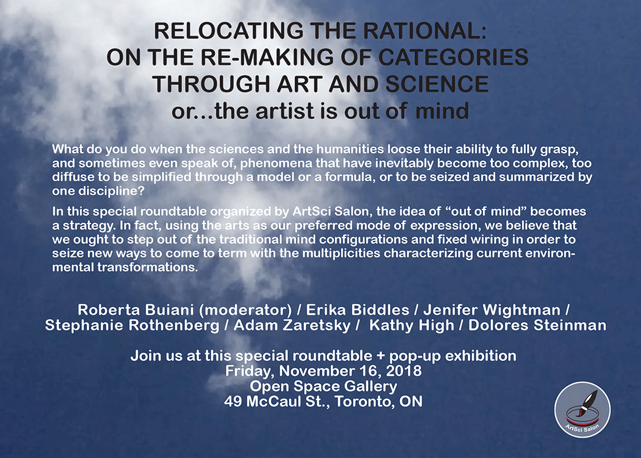
Re-locating the rational: on the re-making of categories through art and science (or: the artist is out of mind!)
A roundtable and a mobile/pop-up exhibition organized by ArtSci Salon
The world always exceeds our conception of it (Shotwell, 2016)
Coinciding with this year’s SLSA “Out of Mind” conference in Toronto, ArtSci Salon is proposing a panel/roundtable on “out-of-mindedness” as a way to re-think categories, and to disrupt the disciplinary and methodological status quo through which we normally see science and the humanities unfolding in academic contexts. We plan to do it through a pop-up exhibition featuring the works of local artists and members of SLSA.
What to do when the sciences and the humanities loose [sic] their ability to fully grasp, and sometimes even speak of, phenomena that have inevitably become too complex, too diffuse to be simplified through a model or a formula, or to be seized and summarized by one discipline?
This initiative is not designed to propose a set of new categories, but to pose a series of open questions, highlighting the necessity to conduct collaborative research between artistic practices and scientific research. We interpret the idea of “out of mind” as a strategy. In fact, using the arts as our preferred mode of expression, we believe that we ought to step out of the traditional mind configurations and fixed wiring in order to seize new ways to come to term with the multiplicities characterizing current environmental transformations. These occurrences have proved to be connected with nature, culture, and society in too many intricate ways, to the extent that neither science, nor technological methods are able to fully comprehend them.
Roundtable Participants:
Roberta Buiani (Chair)
Erika Biddles
Jenifer Wightman
Stephanie Rothenberg
Adam Zaretsky
Kathy High
Dolores Steinman
Here’s the poster:
One more logistical detail,
[T]he roundtable will be at 10:30-12:00 noon [Friday, November 16, 2018] followed by a small tour of the mobile pop-up exhibition[.]
For the curious, here’s the SLSA website and the SLSA 2018 [Meeting]—Out of Your Mind website. Unexpectedly, the University of Toronto is not one of the conference hosts, instead we have the University of Waterloo [Waterloo, Ontario] and York University [Toronto, Ontario] as joint hosts with OCAD University—Canada’s oldest art and design institution—partnering with the Rochester Institute of Technology (New York state, US).
Vancouver’s Curiosity Collider
Coincidentally on the same day I received the ArtSci Salon event information, I received a November 14, 2018 update for Vancouver’s art/sci (or sciart) organization, Curiosity Collider. From the update received via email,
Collider Update
Next events (save-the-date), call for submissions, and other art+science in town
Collisions Festival:
Meet Up & Hang Out
Are you an artist working in the sci/art genre? A scientist interested in collaborating with artists? Or one who wears both hats?
In the fall of 2019, the Curiosity Collider will be hosting our inaugural Sci-Art festival The Collisions Festival; the first theme will be Invasive Systems. The call for submission will be open in spring, 2019. The theme is meant to be broad in scope and not limited to any specific scientific subject/discipline; participants are encouraged to suggest various interpretation of the theme.
We would like to invite all artists and scientists who are interested in participating or potentially submitting a proposal to join us at this meet up event, chat about possible collaborations, and learn more about projects and details on “collaborative work” proposals we are looking for.
In the old days a ‘development director’ was a ‘fundraiser’. That RSVP? Likely, they’re trying to establish the size of their potential audience so they can get government grants. Audience size is important to corporate or ‘other’ funders but if you want a government grant you need numbers.
Getting back to the update, this is a grouping of Curiosity Collider’s latest hits,
#ColliderCafe: Art. Science. Cadence.
Did you miss our most recent Collider Cafe event? You can now chek out the talks by Singer-songwriter Devon More, Biologists Wayne Maddison and David Maddison, as well as Integrated Media Artist Victoria Gibson on our YouTube Channel.
Et al 3: Collaboration Process for Quantum Futures
Nerd Nite, Science Slam, and Curiosity Collider joined forces for the 3rd edition of Et al: the ultimate bar science night event. During the event, Quantum Physicist James Day and our Creative Managing Director Char Hoyt gave attendees an overview of the collaboration process that made Night shift: Quantum Futures, an event curated by CC and hosted at the Museum of Anthropology, possible.
While they don’t seem to have any details, there is a date for the next Collider Cafe,
Save the Date:
Next Collider Cafe
Our next Collider Cafe will be on Wednesday, January 23 at Cafe Deux Soleils. #ColliderCafe is a space for artists, scientists, makers, and anyone interested in art+science. Meet. Discover. Connect. Create.
Are you curious? Join us to explore how art and science intersect in the exploration of curiosity.
Finally, a miscellaneous listing of related events being held in Vancouver, mostly, this November,
Looking for more art+science in town?
November 17 (Victoria)Science Writers and Communicators of Canada is hosting a workshop on science writing in an age of reconciliation: What science writers can learn from indigenous community members about better representation and relationships. Only a few spots left! Register now.
November 15-18 CC friend Dzee Louise will open her studio during the East Side Cultural Crawl! Drop by at studio #5 just at the top of the stairs of the William Clark Building at 1310 William Street (on the corner of Clark).
Until December 15 Vancouver Biennale’s CURIOUS IMAGININGS continues…check out the exhibition that will “challenge us to explore the social impacts of emerging biotechnology and our ethical limits in an age where genetic engineering and digital technologies are already pushing the boundaries of humanity.”
I did write a preview (June 18, 2018) for the last event on the list, Curious Imaginings, which included some of the latest science on xenotransplantation and chimeras (i.e., examples of emerging biotechnology). That’s all folks!