Tag Archives: cyber security

New security protocol to protect miniaturized wireless medical implants from cyberthreats

A March 20, 2025 news item on ScienceDaily makes an announcement regarding cyberthreats and medical devices,

A brain implant designed to help control seizures is hijacked. A pacemaker receives fake signals, disrupting its rhythm. A hacker infiltrates an insulin pump, delivering a fatal overdose. While these scenarios sound like scenes from a sci-fi thriller, such cyberhealth threats are of real concern as medical technology moves toward smart, wirelessly connected implants.

A March 20, 2025 Rice University news release (also on EurekAlert), which originated the news release, describes the work in greater detail, Note: Links have been removed,

Smart bioelectronic implants promise to revolutionize healthcare, giving doctors remote access to monitor and adjust treatments. But as these devices become more advanced, they also become more vulnerable. Just like smartphones and bank accounts, medical implants could be targeted by cybercriminals. And when that happens, the consequences could be life-threatening.

At Rice University, electrical and computer engineer Kaiyuan Yang is working to stay ahead of these threats, developing hacker-resistant implants that protect patients from the dark side of medical innovation.

“As biomedical technology advances, the stakes of security are becoming ever more critical,” said Rice University engineer Kaiyuan Yang, who runs the Secure and Intelligent Micro-Systems (SIMS) Lab. “Imagine a tiny, battery-free medical implant ⎯ no bigger than a grain of rice ⎯ capable of treating diseases without major surgery or medication regimens.

“Such implants, powered wirelessly and connected to the internet through a wearable hub, could make a huge difference for the autonomy and life quality of people living with chronic conditions like epilepsy or treatment-resistant depression, for instance,” said Yang, an associate professor of electrical and computer engineering at Rice.

Advanced wireless implantable technology could enable doctors to monitor patients’ health and adjust treatment remotely, making the need for on-site testing and treatment obsolete. But Yang warns that with this potential comes a serious risk: Hackers could intercept communications, steal passwords or send fake commands, threatening patient safety.

In recent work presented at the International Solid-State Circuits Conference (ISSCC) ⎯ the flagship conference of the Institute of Electrical and Electronics Engineers (IEEE) ⎯ Yang and his team unveiled a first-of-its-kind authentication protocol for wireless, battery-free, ultraminiaturized implants that ensures these devices remain protected while still allowing emergency access. Known as magnetoelectric datagram transport layer security, or ME-DTLS, the protocol exploits a quirk of wireless power transfer, a technology that allows medical implants to be powered externally without a battery. Normally when the external power source ⎯ or in this case the external hub worn by the patient ⎯ moves slightly out of alignment, the amount of power the implant receives fluctuates.

“Lateral or side-to-side movement causes a signal misalignment that is usually considered a flaw in these systems, but we turned it into a security feature by transmitting binary values to specific movements with full awareness of the patient,” Yang said.

For example, by coding short movements as a “1” and longer movements as a “0,” the protocol enables users to input a secure access pattern just by moving the external hub in a specific way. This pattern-based input acts like a second authentication factor, much like entering a PIN after using a password or drawing a pattern to unlock a phone. The overall user experience with the ME-DTLS two-factor authentication closely resembles the process of logging into bank accounts today. Users enter their login credentials, wait for an SMS with a temporary passcode then input this passcode to log in.

This innovation solves two major problems in medical cybersecurity. First, it protects against stolen passwords by requiring a physical confirmation step that cannot be faked remotely. Second, it ensures emergency responders can access the device without needing preshared credentials. Thus, if a patient is unconscious or unable to provide a password, the implant transmits a temporary authentication signal that can only be detected at close range.

“This ensures that only a nearby authorized device can access the implant,” Yang said. “In emergencies, the implant verifies the responder or doctor by the pattern they draw and gives them access even if there is no internet connection.”

By leveraging an intrinsic feature of wireless power transfer systems, the solution developed by Yang and his team avoids the drawbacks of other security measures for implantable technologies, like the addition of bulky sensors.

The researchers tested the pattern input method with volunteers and found that it correctly recognized the patterns 98.72% of the time, proving their solution is both reliable and easy to use. The team also developed a rapid, low-power method for the implant to send data back out securely and effectively.

“To the best of our knowledge, we are the first to utilize the natural flaw of wireless power transfer to send secure information to the implant and enable secure two-factor authentication in miniaturized implants,” Yang said. “Compared to other medical devices, our design offers the best balance between security, efficiency and reliability.”

For patients, this could mean a future where their medical implants are both secure and accessible when it matters most, offering a simple, intuitive way to ensure that only the right people ⎯ whether a doctor, caregiver or emergency responder ⎯ can control the technology inside their bodies.

Yang and his team presented their work at the ISSCC held Feb.16-20 in San Francisco. At the conference, Yang was awarded the IEEE Solid-State Circuits Society New Frontier Award, which recognizes early career researchers “exploring innovative and visionary technical work,” according to the IEEE website. This year, Yang’s team was part of a larger contingent of Rice faculty and students who presented at the conference and were recognized for their achievements.

The work was supported by the National Science Foundation (2146476).

Here’s a link to and a citation for the paper,

35.4: A Miniature Biomedical Implant Secured by Two-Factor Authentication with Emergency Access by Wei Wang; Yumin Su; Huan-Cheng Liao; Yiwei Zou; Tian Qiu; Kaiyuan Yang. 2025 IEEE International Solid-State Circuits Conference (ISSCC), San Francisco, CA, USA, 2025, pp. 574-576 DOI: 10.1109/ISSCC49661.2025.10904583

This paper is behind a paywall.

MIT Media Lab releases new educational site for kids K-12: it’s all about artificial intelligence (AI)

Mark Wilson announces a timely new online programme from the Massachusetts Institute of Technology (MIT) in his April 9, 2020 article for Fast Company (Note: Links have been removed).

Not every child will grow up to attend MIT, but that doesn’t mean they can’t get a jump start on its curriculum. In response to the COVID-19 pandemic, which has forced millions of students to learn from home, MIT Media Lab associate professor Cynthia Breazeal has released [April 7, 2020] a website for K-12 students to learn about one of the most important topics in STEM [science, technology, engineering, and mathematics]: artificial intelligence.

The site provides 60 activities, lesson plans, and links to interactive AI experiments that MIT and companies like Google have developed in the past. Projects include coding robots to doodle, developing an image classifier (a tool that can identify images), writing speculative fiction to tackle the murky ethics of AI, and developing a chatbot (your grade schooler cannot possibly be worse at that task than I was). Everything is free, but schools are supposed to license lesson plans from MIT before adopting them.

Various associated MIT groups are covering a wide range of topics including the already mentioned AI ethics, as well as, cyber security and privacy issues, creativity, and more. Here’s a little something from a programme for the Girl Scouts of America, which focused on data privacy and tech policy,

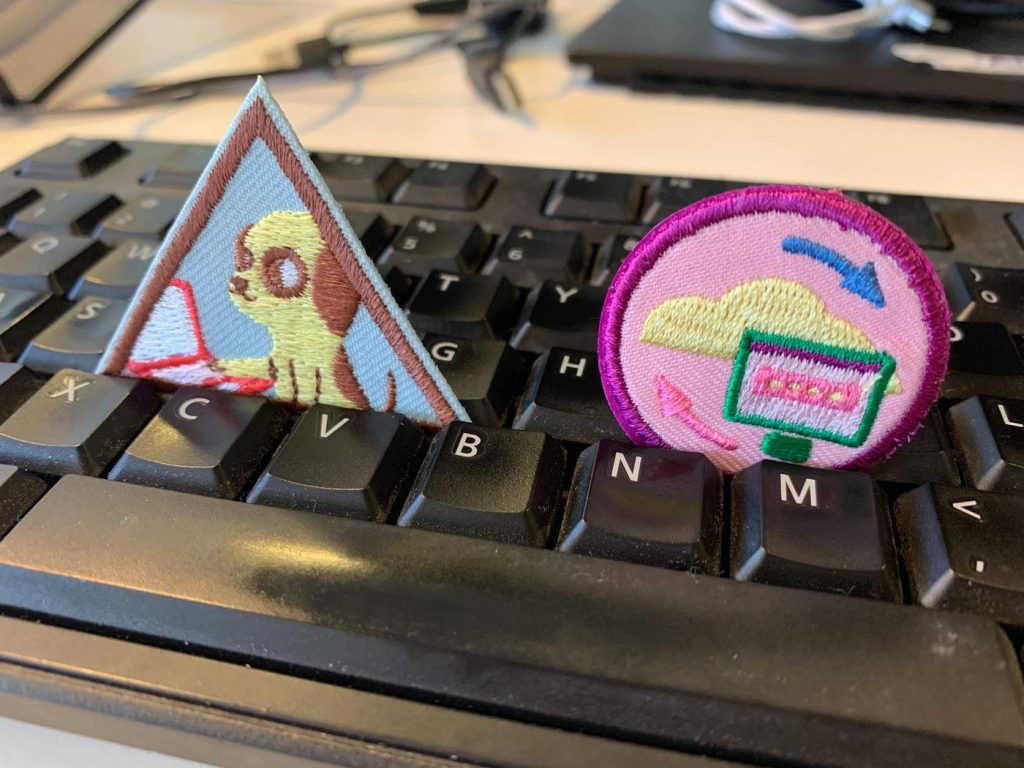
The Girl Scouts awarded the Brownie (7-9) and Junior (9-11) troops with Cybersecurity badges at the end of the full event. 
Credit: Daniella DiPaola [downloaded from https://www.media.mit.edu/posts/data-privacy-policy-to-practice-with-the-girl-scouts/]

You can find MIT’s AI education website here. While the focus is largely on children, it seems they are inviting adults to participate as well. At least that’s what I infer from what one of the groups associated with this AI education website, the LifeLong Kindergarten group states on their webpage,

The Lifelong Kindergarten group develops new technologies and activities that, in the spirit of the blocks and finger paint of kindergarten, engage people in creative learning experiences. Our ultimate goal is to foster a world full of playfully creative people, who are constantly inventing new possibilities for themselves and their communities.

The website is a little challenging with regard to navigation but perhaps these links to the Research Projects page will help you get started quickly or, for those who like to investigate a little further before jumping in, this News page (which is a blog) might prove helpful.

That’s it for today. I wish everyone a peaceful long weekend while we all observe as joyfully and carefully as possible our various religious and seasonal traditions. From my tradition to yours, Joyeuses Pâques!

The security of the Internet of Nano-Things with NanoMalaysia’s CEO Dr Rezal Khairi Ahmad

I’ve not come across the Internet of Nano-Things before and I’m always glad to be introduced to something new. In this case, I’m doubly happy as I get to catch up (a little) with the Malaysian nano scene. From an April 19, 2017 article by Avanti Kumar for mis.asia.com (Note: Links have been removed),

After being certified in 2011 as a nanocentre, national applied research agency MIMOS continued to make regular moves to boost Malaysia’s nanotechnology ambitions. This included helping to develop the national graphene action plan (NGAP 2020).

Much of the task of driving and commercialising the NGAP ecosystem is in the hands of NanoMalaysia, which was incorporated in 2011 as a company limited by guarantee (CLG) under Malaysia’s Ministry of Science, Technology and Innovation (MOSTI) to act as a business entity.

During another event in March 2016 where I saw that 360 new products were to be commercialised under NGAP, NanoMalaysia’s chief executive officer Dr. Rezal Khairi Ahmad said that benefits would include a US$5 billion impact on GNI (gross net income) and 9,000 related new jobs by the year 2020.

In his capacity as a keynote speaker at this year’s Computerworld Security Summit in Kuala Lumpur (20 April 2017), Dr Rezal agreed to a security-themed interview on this relatively new industry sector.  This is also part of a series of special security features.

To start, I asked Dr Rezal for a brief run-through of his role.

[RKA]  I’m the founding Chief Executive Officer and also Board Member of NanoMalaysia, Nano Commerce Sdn. Bhd, representing NanoMalaysia’s business interests, the Chairman of NanoVerify Sdn. Bhd, a nanotechnology certification entity and a Director of Nanovation Ventures Sdn. Bhd., an investment arm of NanoMalaysia.

Prior to this, I served as Acting Under-Secretary of National Nanotechnology Directorate, Ministry of Science, Technology and Innovation on the policy aspect of nanotechnology and vice president of [national investment body] Khazanah Nasional touching on human capital and investment research.

NanoMalaysia’s primary role in the development of Malaysia’s National Graphene Action Plan 2020 together with Agensi Inovasi Malaysia and PEMANDU [Performance Management & Delivery Unit attached to Prime Minister’s Office] is a major landmark in our journey to ensure Malaysia stays competitive in the global innovation landscape particularly in nanotechnology, which cuts across all industries including ICT [information and communications technologies].

Can you talk about graphene and its significance to local industry?

Graphene is touted as one of the game-changing advanced materials made of one atom-thick carbon and acknowledged by World Economic Forum [WEF] as no. 4 emerging technology in 2016.

Beyond being a fancy nano material, graphene plays a central role in the development of endogenous hardware aspects of Malaysia’s Internet of Things aspirations or the now evolved Internet of Nano-Things (IoNT). Some of these are:
-·Super small, lightweight and hyper-sensitive low-cost Graphene-based sensors and Radio Frequency ID (RFID)
– Higher speed, Low loss and power consumption graphene based optical transmitter and receiver for 5G systems
– Making IoNT a low-cost and practical industrial and domestic solutions in Malaysia.

Let’s move to the security aspects of nanotechnology: what’s your take on IoNT?

In the context of IoNT, which WEF acknowledged to be the top emerging technology in 2016, the current work-in-progress,  ‘ubiquitous’ deployment of sensors in Malaysia and worldwide, I certainly see increasing data security risks at the sensor, transmission, collection, processing and even analytics levels.

The initial industry approaches to IoNT data security will probably be polarised between cascaded and centralised system approaches.

I think some hacking attacks will obviously focus on data theft. I therefore foresee a trend favouring cascaded security – with both hardware, software and more advanced data encryption technologies in place.

What security steps do you currently advise?

The priority is to tackle potential data theft at every stage of IoNT systems.  The best-available preventive measures should include some versions of cascaded and embedded security in the form of hardware tags and advanced encryption.

To end, what’s your main message for business and IT leaders?

The digital era has removed the clear line that once separated State and Business as well as People. Everything and everyone is more interconnected. We are now an ecosystem both by chance and design. Cyber-attacks can be made to afflict either one and be used to hold any one at ransom thus creating a local or even global systemic chain reaction effect.

The connected world presents endless commercial, social and environmental development opportunities…and threats. The development and deployment of emerging cyber-related technologies, in particular IoNT – which promises a market size of US$9.69 billion by 2020 – should be done responsibly in the form of infused data security technologies to ensure prolific market acceptance and profitable returns.

For our part, NanoMalaysia is working with various parties locally and abroad push Malaysia’s strategic industry sectors to be relevant to the Fourth Industrial Revolution supported by cyber-physical systems manifesting into full automation, robots, artificial intelligence, de-centralised power generation, energy storage, water and food supplies, remote assets and logistics management and custom manufacturing requiring secured data sensing, traffic and analytics systems in place.

If you have the time, I advise reading the article in its entirety.
The perfect keyboard: it self-cleans and self-powers and it can identify its owner(s)

There’s a pretty nifty piece of technology being described in a Jan. 21, 2015 news item on Nanowerk, which focuses on the security aspects first (Note: A link has been removed),

In a novel twist in cybersecurity, scientists have developed a self-cleaning, self-powered smart keyboard that can identify computer users by the way they type. The device, reported in the journal ACS Nano (“Personalized Keystroke Dynamics for Self-Powered Human–Machine Interfacing”), could help prevent unauthorized users from gaining direct access to computers.

A Jan. 21, 2015 American Chemical Society (ACS) news release (also on EurekAlert), which originated the news item, continues with the keyboard’s security features before briefly mentioning the keyboard’s self-powering and self-cleaning capabilities,

Zhong Lin Wang and colleagues note that password protection is one of the most common ways we control who can log onto our computers — and see the private information we entrust to them. But as many recent high-profile stories about hacking and fraud have demonstrated, passwords are themselves vulnerable to theft. So Wang’s team set out to find a more secure but still cost-effective and user-friendly approach to safeguarding what’s on our computers.

The researchers developed a smart keyboard that can sense typing patterns — including the pressure applied to keys and speed — that can accurately distinguish one individual user from another. So even if someone knows your password, he or she cannot access your computer because that person types in a different way than you would. It also can harness the energy generated from typing to either power itself or another small device. And the special surface coating repels dirt and grime. The scientists conclude that the keyboard could provide an additional layer of protection to boost the security of our computer systems.

Here’s a link to and a citation for the paper,

Personalized Keystroke Dynamics for Self-Powered Human–Machine Interfacing by Jun Chen, Guang Zhu, Jin Yang, Qingshen Jing, Peng Bai, Weiqing Yang, Xuewei Qi, Yuanjie Su, and Zhong Lin Wang. ACS Nano, Article ASAP DOI: 10.1021/nn506832w Publication Date (Web): December 30, 2014

Copyright © 2014 American Chemical Society

This paper is behind a paywall. I did manage a peek at the paper and found that the keyboard is able to somehow harvest the mechanical energy of typing and turn it into electricity so it can self-power. Self-cleaning is made possible by a nanostructure surface modification. An idle thought and a final comment. First, I wonder what happens if you want to or have to share your keyboard? Second, a Jan. 21, 2015 article about the intelligent keyboard by Luke Dormehl for Fast Company notes that the researchers are from the US and China and names two of the institutions involved in this collaboration, Georgia Institute of Technology and the Beijing Institute of Nanoenergy and Nanosystems,.

ETA Jan. 23, 2015: There’s a Georgia Institute of Technology Jan. 21, 2015 news release on EurekAlert about the intelligent keyboard which offers more technical details such as these,

Conventional keyboards record when a keystroke makes a mechanical contact, indicating the press of a specific key. The intelligent keyboard records each letter touched, but also captures information about the amount of force applied to the key and the length of time between one keystroke and the next. Such typing style is unique to individuals, and so could provide a new biometric for securing computers from unauthorized use.

In addition to providing a small electrical current for registering the key presses, the new keyboard could also generate enough electricity to charge a small portable electronic device or power a transmitter to make the keyboard wireless.

An effect known as contact electrification generates current when the user’s fingertips touch a plastic material on which a layer of electrode material has been coated. Voltage is generated through the triboelectric and electrostatic induction effects. Using the triboelectric effect, a small charge can be produced whenever materials are brought into contact and then moved apart.

“Our skin is dielectric and we have electrostatic charges in our fingers,” Wang noted. “Anything we touch can become charged.”

Instead of individual mechanical keys as in traditional keyboards, Wang’s intelligent keyboard is made up of vertically-stacked transparent film materials. Researchers begin with a layer of polyethylene terephthalate between two layers of indium tin oxide (ITO) that form top and bottom electrodes.

Next, a layer of fluorinated ethylene propylene (FEP) is applied onto the ITO surface to serve as an electrification layer that generates triboelectric charges when touched by fingertips. FEP nanowire arrays are formed on the exposed FEP surface through reactive ion etching.

The keyboard’s operation is based on coupling between contact electrification and electrostatic induction, rather than the traditional mechanical switching. When a finger contacts the FEP, charge is transferred at the contact interface, injecting electrons from the skin into the material and creating a positive charge.

When the finger moves away, the negative charges on the FEP side induces positive charges on the top electrode, and equal amounts of negative charges on the bottom electrode. Consecutive keystrokes produce a periodic electrical field that drives reciprocating flows of electrons between the electrodes. Though eventually dissipating, the charges remain on the FEP surface for an extended period of time.

Wang believes the new smart keyboard will be competitive with existing keyboards, in both cost and durability. The new device is based on inexpensive materials that are widely used in the electronics industry.