Tag Archives: Simone Fabiano

Key obstacle to integrated bioelectronic implants removed with use of solid-state hydrogel

Cyborgs calling? It seems a logical extension from the work being described in Michael Berger’s August 28, 2025 Nanowerk Spotlight article, Note: A link has been removed,

Electronic devices that can sense, process, and respond to biological signals are reshaping how researchers approach medicine, neuroscience, and human–machine interaction [emphasis mine]. These systems, often soft, flexible, and powered by organic materials, promise to monitor brain activity, stimulate nerves, and control prosthetics with a level of precision and integration that rigid silicon electronics cannot match. The ambition is clear: build circuits that are not just compatible with the body, but functionally embedded within it.

Yet at the core of many of these bioelectronic systems lies a persistent technical obstacle. Organic electrochemical transistors—or OECTs—have emerged as one of the most promising components for such interfaces. They operate at low voltages, work well in wet environments, and can amplify faint biological signals. But their performance has depended almost entirely on liquid electrolytes—saline-based solutions that shuttle ions in and out of the transistor channel. While effective at driving fast switching and strong responses, these liquids are difficult to confine. They spread, leak, evaporate, and cause interference between closely packed devices. They make miniaturization harder, circuit integration more complex, and long-term implantation more fragile.

Solid-state electrolytes have been explored as a replacement. Some are made from ionic gels or charged polymers, others from hydrogels with modified compositions. But each compromise has created new limitations: reduced ion mobility, patterning challenges, long response times, or incompatibility with both p-type and n-type transistor operation. These tradeoffs have made it difficult to build dense, fast, reliable circuits for real use in living systems.

Now, researchers in Sweden report a material system that brings this goal closer. Writing in Advanced Materials (“A Photo‐Patternable Solid‐State Electrolyte for High‐Performance, Miniaturized, and Implantable Organic Electrochemical Transistor‐Based Circuits”), the team presents a hydrogel-based solid-state electrolyte that is both photopatternable and fast enough to match the performance of liquid systems.

This turns out to be a hydrogel and seaweed story, from Berger’s August 28, 2025 article,

Using a naturally derived polymer from seaweed and a light-activated crosslinker, they’ve built a platform that enables high-speed operation, micrometer-scale precision, and compatibility with flexible, implantable devices. The system supports both logic circuits and spiking neural mimics, all operating on a solid-state foundation—offering a solution to a long-standing bottleneck in bioelectronic circuit design.

This work introduces a solid-state hydrogel based on ι-carrageenan, a charged polysaccharide extracted from red seaweed, crosslinked with poly(ethylene glycol) diacrylate (PEGDA). When exposed to ultraviolet light, PEGDA forms a permanent network that locks the ι-carrageenan into a soft, water-stable gel. The result is a solid-state electrolyte that can be patterned with high precision, while maintaining ionic conductivity at levels comparable to liquid saline.

The hydrogel can be processed as a liquid and selectively hardened using light exposure. Before crosslinking, it spreads easily for coating or printing. After UV exposure, it forms a water-insoluble gel that can be patterned down to 15 micrometers. This resolution is sufficient for building densely packed circuits on flexible substrates. Crucially, the material retains ionic conductivity above 10 millisiemens per centimeter—on par with 0.1 molar sodium chloride. That conductivity enables fast ion movement through the gel, preserving the switching speed and signal fidelity expected of high-performance OECTs.

To move beyond digital logic, the researchers designed a circuit that mimics the behavior of a spiking neuron. This organic electrochemical neuron (OECN) was based on the leaky integrate-and-fire model used in artificial neural networks. It combines complementary OECTs with a reset transistor and integrates them into a spiking architecture that converts a continuous input into transient voltage pulses. The circuit was encapsulated using a biocompatible layer of parylene and fabricated on an ultrathin flexible substrate.

To demonstrate biological relevance, the team implanted this device in mice. They connected it to flexible stimulation electrodes coated with PEDOT:PSS, a conductive polymer that lowers electrode impedance. The system was wrapped around the cervical vagus nerve, a major nerve involved in autonomic regulation of the heart and digestive system. When inactive, the device produced no physiological effect. When activated to spike at frequencies between 1 and 20 hertz, it induced a measurable drop in heart rate of 2 to 4 percent—consistent with the known effects of vagus nerve stimulation.

Unlike previous systems based on liquid electrolytes, this device remained stable after implantation, with no fluid reservoirs or leakage pathways. Its function did not degrade after encapsulation, and spiking behavior remained consistent. The reduction in spiking frequency observed after implantation was attributed to the mouse acting as an external load, not to any failure of the circuit.

The platform introduced in this study enables a new level of complexity and stability in soft bioelectronics. It demonstrates that solid-state, hydrogel-based circuits can meet the electrical demands of real-world applications without sacrificing manufacturability or implant safety. By bridging the gap between ionic transport and scalable circuit design, this work sets the foundation for future generations of bioelectronic therapies and neural interfaces.

Berger’s August 28, 2025 article offers a lot more detail and his explanations tend to be accessible (relatively speaking).

Here’s a link to and a citation for the paper,

A Photo-Patternable Solid-State Electrolyte for High-Performance, Miniaturized, and Implantable Organic Electrochemical Transistor-Based Circuits by Miao Xiong, Chi-Yuan Yang, Junpeng Ji, April S. Caravaca, Qi Guo, Qifan Li, Mary J. Donahue, Dace Gao, Han-Yan Wu, Adam Marks, Yincai Xu, Deyu Tu, Iain McCulloch, Peder S. Olofsson, Simone Fabiano. Advanced Materials DOI: https://doi.org/10.1002/adma.20250931 First published: 22 August 2025

This paper is open access.

Artificial organic neuron mimics characteristics of biological nerve cells

There’s a possibility that in the future, artificial neurons could be used for medical treatment according to a January 12, 2023 news item on phys.org,

Researchers at Linköping University (LiU), Sweden, have created an artificial organic neuron that closely mimics the characteristics of biological nerve cells. This artificial neuron can stimulate natural nerves, making it a promising technology for various medical treatments in the future.

Work to develop increasingly functional artificial nerve cells continues at the Laboratory for Organic Electronics, LOE. In 2022, a team of scientists led by associate professor Simone Fabiano demonstrated how an artificial organic neuron could be integrated into a living carnivorous plant [emphasis mine] to control the opening and closing of its maw. This synthetic nerve cell met two of the 20 characteristics that differentiate it from a biological nerve cell.

I wasn’t expecting a carnivorous plant, living or otherwise. Sadly, they don’t seem to have been able to include it in this image although the ‘green mitts’ are evocative,
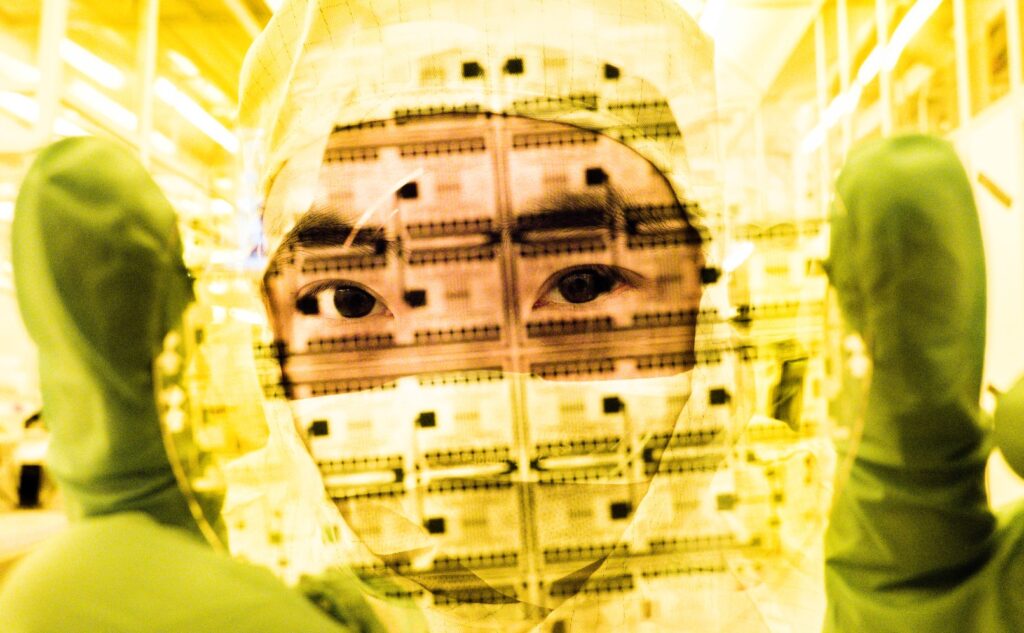
Caption: Artificial neurons created by the researchers at Linköping University. Credit: Thor Balkhed

A January 13, 2023 Linköping University (LiU) press release by Mikael Sönne (also on EurkeAlert but published January 12, 2023), which originated the news item, delves further into the work,

In their latest study, published in the journal Nature Materials, the same researchers at LiU have developed a new artificial nerve cell called “conductance-based organic electrochemical neuron” or c-OECN, which closely mimics 15 out of the 20 neural features that characterise biological nerve cells, making its functioning much more similar to natural nerve cells.

“One of the key challenges in creating artificial neurons that effectively mimic real biological neurons is the ability to incorporate ion modulation. Traditional artificial neurons made of silicon can emulate many neural features but cannot communicate through ions. In contrast, c-OECNs use ions to demonstrate several key features of real biological neurons”, says Simone Fabiano, principal investigator of the Organic Nanoelectronics group at LOE.

In 2018, this research group at Linköping University was one of the first to develop organic electrochemical transistors based on n-type conducting polymers, which are materials that can conduct negative charges. This made it possible to build printable complementary organic electrochemical circuits. Since then, the group has been working to optimise these transistors so that they can be printed in a printing press on a thin plastic foil. As a result, it is now possible to print thousands of transistors on a flexible substrate and use them to develop artificial nerve cells.

In the newly developed artificial neuron, ions are used to control the flow of electronic current through an n-type conducting polymer, leading to spikes in the device’s voltage. This process is similar to that which occurs in biological nerve cells. The unique material in the artificial nerve cell also allows the current to be increased and decreased in an almost perfect bell-shaped curve that resembles the activation and inactivation of sodium ion channels found in biology.

“Several other polymers show this behaviour, but only rigid polymers are resilient to disorder, enabling stable device operation”, says Simone Fabiano

In experiments carried out in collaboration with Karolinska Institute (KI), the new c-OECN neurons were connected to the vagus nerve of mice. The results show that the artificial neuron could stimulate the mice’s nerves, causing a 4.5% change in their heart rate.

The fact that the artificial neuron can stimulate the vagus nerve itself could, in the long run, pave the way for essential applications in various forms of medical treatment. In general, organic semiconductors have the advantage of being biocompatible, soft, and malleable, while the vagus nerve plays a key role, for example, in the body’s immune system and metabolism.

The next step for the researchers will be to reduce the energy consumption of the artificial neurons, which is still much higher than that of human nerve cells. Much work remains to be done to replicate nature artificially.

“There is much we still don’t fully understand about the human brain and nerve cells. In fact, we don’t know how the nerve cell makes use of many of these 15 demonstrated features. Mimicking the nerve cells can enable us to understand the brain better and build circuits capable of performing intelligent tasks. We’ve got a long road ahead, but this study is a good start,” says Padinhare Cholakkal Harikesh, postdoc and main author of the scientific paper.

Here’s a link to and a citation for the paper,

Ion-tunable antiambipolarity in mixed ion–electron conducting polymers enables biorealistic organic electrochemical neurons by Padinhare Cholakkal Harikesh, Chi-Yuan Yang, Han-Yan Wu, Silan Zhang, Mary J. Donahue, April S. Caravaca, Jun-Da Huang, Peder S. Olofsson, Magnus Berggren, Deyu Tu & Simone Fabiano. Nature Materials volume 22, pages 242–248 (2023) DOI: https://doi.org/10.1038/s41563-022-01450-8 Published online: 12 January 2023 Issue Date: February 2023

This paper is open access.

Mimicking the brain with an evolvable organic electrochemical transistor

Simone Fabiano and Jennifer Gerasimov have developed a learning transistor that mimics the way synapses function. Credit: Thor Balkhed

At a guess, this was originally a photograph which has been passed through some sort of programme to give it a paintinglike quality.

Moving onto the research, I don’t see any reference to memristors (another of the ‘devices’ that mimics the human brain) so perhaps this is an entirely different way to mimic human brains? A February 5, 2019 news item on ScienceDaily announces the work from Linkoping University (Sweden),

A new transistor based on organic materials has been developed by scientists at Linköping University. It has the ability to learn, and is equipped with both short-term and long-term memory. The work is a major step on the way to creating technology that mimics the human brain.

A February 5, 2019 Linkoping University press release (also on EurekAlert), which originated the news item, describes this ‘nonmemristor’ research into brainlike computing in more detail,

Until now, brains have been unique in being able to create connections where there were none before. In a scientific article in Advanced Science, researchers from Linköping University describe a transistor that can create a new connection between an input and an output. They have incorporated the transistor into an electronic circuit that learns how to link a certain stimulus with an output signal, in the same way that a dog learns that the sound of a food bowl being prepared means that dinner is on the way.

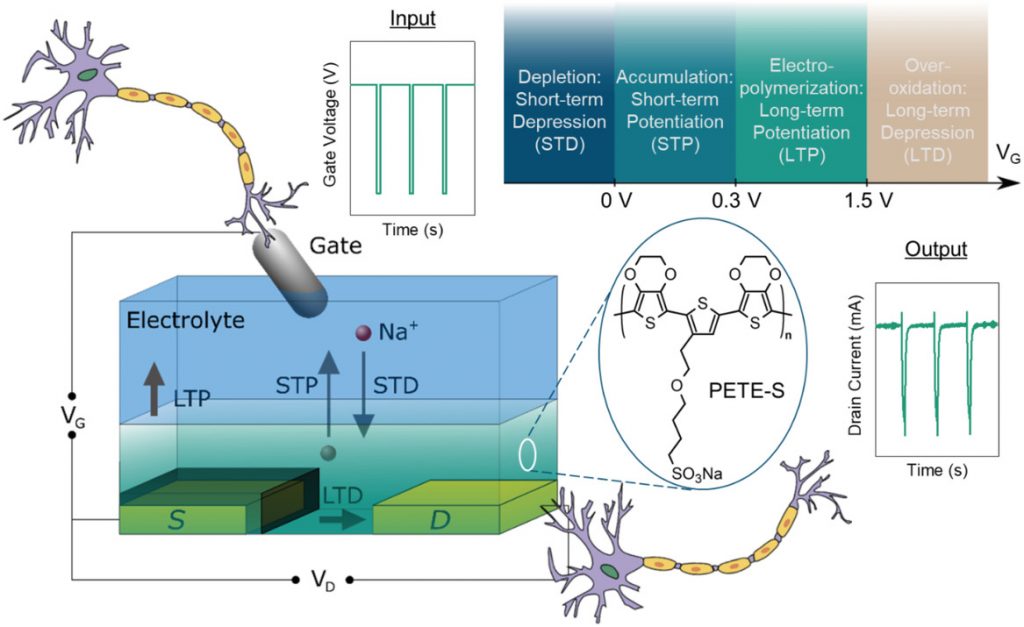
A normal transistor acts as a valve that amplifies or dampens the output signal, depending on the characteristics of the input signal. In the organic electrochemical transistor that the researchers have developed, the channel in the transistor consists of an electropolymerised conducting polymer. The channel can be formed, grown or shrunk, or completely eliminated during operation. It can also be trained to react to a certain stimulus, a certain input signal, such that the transistor channel becomes more conductive and the output signal larger.

“It is the first time that real time formation of new electronic components is shown in neuromorphic devices”, says Simone Fabiano, principal investigator in organic nanoelectronics at the Laboratory of Organic Electronics, Campus Norrköping.

The channel is grown by increasing the degree of polymerisation of the material in the transistor channel, thereby increasing the number of polymer chains that conduct the signal. Alternatively, the material may be overoxidised (by applying a high voltage) and the channel becomes inactive. Temporary changes of the conductivity can also be achieved by doping or dedoping the material.

“We have shown that we can induce both short-term and permanent changes to how the transistor processes information, which is vital if one wants to mimic the ways that brain cells communicate with each other”, says Jennifer Gerasimov, postdoc in organic nanoelectronics and one of the authors of the article.

By changing the input signal, the strength of the transistor response can be modulated across a wide range, and connections can be created where none previously existed. This gives the transistor a behaviour that is comparable with that of the synapse, or the communication interface between two brain cells.

It is also a major step towards machine learning using organic electronics. Software-based artificial neural networks are currently used in machine learning to achieve what is known as “deep learning”. Software requires that the signals are transmitted between a huge number of nodes to simulate a single synapse, which takes considerable computing power and thus consumes considerable energy.

“We have developed hardware that does the same thing, using a single electronic component”, says Jennifer Gerasimov.

“Our organic electrochemical transistor can therefore carry out the work of thousands of normal transistors with an energy consumption that approaches the energy consumed when a human brain transmits signals between two cells”, confirms Simone Fabiano.

The transistor channel has not been constructed using the most common polymer used in organic electronics, PEDOT, but instead using a polymer of a newly-developed monomer, ETE-S, produced by Roger Gabrielsson, who also works at the Laboratory of Organic Electronics and is one of the authors of the article. ETE-S has several unique properties that make it perfectly suited for this application – it forms sufficiently long polymer chains, is water-soluble while the polymer form is not, and it produces polymers with an intermediate level of doping. The polymer PETE-S is produced in its doped form with an intrinsic negative charge to balance the positive charge carriers (it is p-doped).

Here’s a link to and a citation for the paper,

An Evolvable Organic Electrochemical Transistor for Neuromorphic Applications by Jennifer Y. Gerasimov, Roger Gabrielsson, Robert Forchheimer, Eleni Stavrinidou, Daniel T. Simon, Magnus Berggren, Simone Fabiano. Advanced Science DOI: https://doi.org/10.1002/advs.201801339 First published: 04 February 2019

This paper is open access.

There’s one other image associated this work that I want to include here,

Synaptic transistor. Sketch of the organic electrochemical transistor, formed by electropolymerization of ETE‐S in the transistor channel. The electrolyte solution is confined by a PDMS well (not shown). In this work, we define the input at the gate as the presynaptic signal and the response at the drain as the postsynaptic terminal. During operation, the drain voltage is kept constant while the gate is pulsed. Synaptic weight is defined as the amplitude of the current response to a standard gate voltage characterization pulse of −0.1 V. Different memory functionalities are accessible by applying gate voltage Courtesy: Linkoping University Researchers

Organic nanoelectronics in water

Researchers in Sweden have developed organic electronics that are stable in water according to a January 11, 2018 news item on ScienceDaily,

Researchers at the Laboratory of Organic Electronics, Linköping University [Sweden], have developed the world’s first complementary electrochemical logic circuits that can function stably for long periods in water. This is a highly significant breakthrough in the development of bioelectronics.

A January 11, 2018 Linköping University press release, which originated the news item, notes this latest advance is based on work that started in 2002,

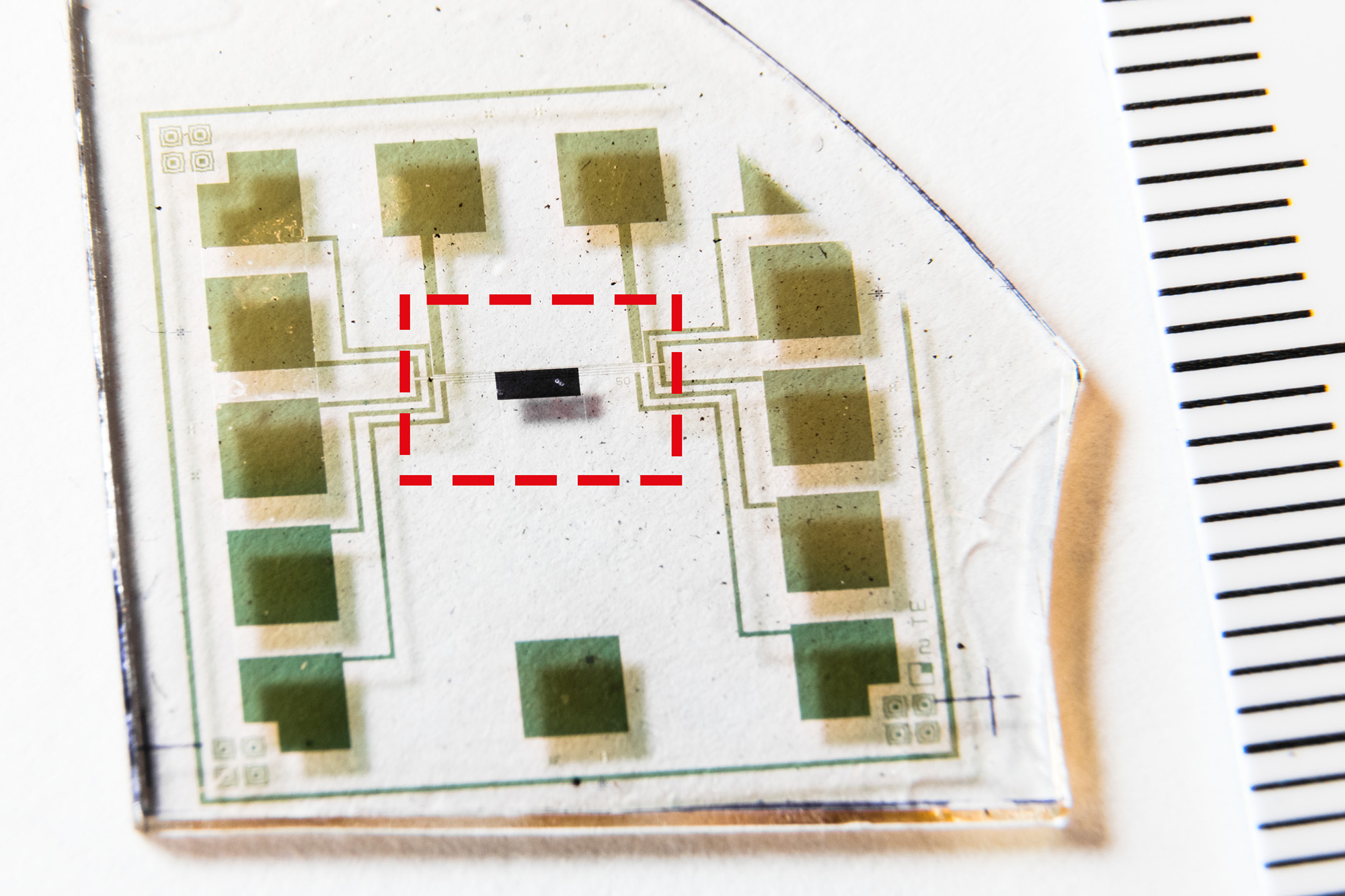
Complementary logic circuitComplementary logic circuit Photo credit: Thor Balkhed

The first printable organic electrochemical transistors were presented by researchers at LiU as early as 2002, and research since then has progressed rapidly. Several organic electronic components, such as light-emitting diodes and electrochromic displays, are already commercially available.

The dominating material used until now has been PEDOT:PSS, which is a p-type material, in which the charge carriers are holes. In order to construct effective electron components, a complementary material, n-type, is required, in which the charge carriers are electrons.
It has been difficult to find a sufficiently stable polymer material, one that can operate in water media and in which the long polymer chains can sustain high current when the material is doped.

N-type material

In an article in the prestigious scientific journal Advanced Materials, Simone Fabiano, head of research in the Organic Nanoelectronics group at the Laboratory of Organic Electronics, presents, together with his colleagues, results from an n-type conducting material in which the ladder-type structure of the polymer backbone favours ambient stability and high current when doped. One example is BBL, poly(benzimidazobenzophenanthroline), a material often used in solar cell research.

Postdoctoral researcher Hengda Sun has found a method to create thick films of the material. The thicker the film, the greater the conductivity.

“We have used spray-coating to produce films up to 200 nm thick. These can reach extremely high conductivities,” says Simone Fabiano.

The method can also be successfully used together with printed electronics across large surfaces.

Hengda Sun has also shown that the circuits function for long periods, both in the presence of oxygen and water.

Moist surroundings

“This may appear at first glance to be a small advance in a specialised field, but what is great about it is that it has major consequences for many applications. We can now construct complementary logic circuits – inverters, sensors and other components – that function in moist surroundings,” says Simone Fabiano.

“Resistors are needed in logical circuits that are based solely on p-type electrochemical transistors. These are rather bulky, and this limits the applications that can be achieved. With an n-type material in our toolbox, we can produce complementary circuits that occupy the available space much more efficiently, since resistors are no longer required in the logical circuits,” says Magnus Berggren, professor of organic electronics and head of the Laboratory for Organic Electronics.

Applications of the organic components include logic circuits that can be printed on textile or paper, various types of cheap sensor, non-rigid and flexible displays, and – not least – the huge field of bioelectronics. Polymers that conduct both ions and electrons are the bridge needed between the ion-conducting systems in the body and the electronic components of, for example, sensors.

Here’s a link to and a citation for the paper,

Complementary Logic Circuits Based on High-Performance n-Type Organic Electrochemical Transistors by Hengda Sun, Mikhail Vagin, Suhao Wang, Xavier Crispin, Robert Forchheimer, Magnus Berggren, and Simone Fabiano. Advanced Materials Vol. 30 Issue 3 Version of Record online: 10 JAN 2018 DOI: 10.1002/adma.201704916

© 2018 WILEY-VCH Verlag GmbH & Co. KGaA, Weinheim

This paper is behind a paywall.