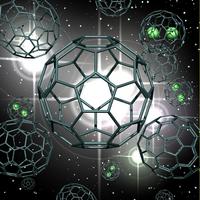
I wasn’t expecting to find this May 20, 2014 news item on Nanowerk to be* quite so fascinating, especially as It gets off to a slow start (a link has been removed),
In a new paper in The Journal of Chemical Physics (“Nuclear spin conversion of water inside fullerene cages detected by low-temperature nuclear magnetic resonance”), produced by AIP Publishing, a research team in the United Kingdom and the United States describes how water molecules “caged” in fullerene spheres (“buckyballs”) are providing a deeper insight into spin isomers — varieties of a molecule that differ in their nuclear spin. The results of this work may one day help enhance the analytical and diagnostic power of nuclear magnetic resonance (NMR) and magnetic resonance imaging (MRI).
Water molecules can exist as one of two isomers depending on how the spins of their two hydrogen atoms are oriented: ortho, where the spins are parallel and have a spin number of 1, and para, where the spins are antiparallel and have a spin number of 0. Scientists believe that any given molecule can transform from ortho- into para- spin states and vice versa, a process known as nuclear spin conversion.
“Currently, mechanisms for this conversion are not completely understood, nor how long it takes the molecules to transform from one spin isomer to the other,” said Salvatore Mamone, a post-doctoral physicist at the University of Southampton and lead author on the JCP paper. “To study this, we had to figure out how to reduce the strong intermolecular interactions that are responsible for aggregation and lower the rotational mobility of the water molecules.”
Next, there’s a brief summarized version of the research (from the news release),
The answer was to use chemical reactions to open a hole in fullerene (C60, also known as a buckyball) spheres, inject water molecules and then close the “cages” to form a complex referred to as H2O@C60. “At the end of this synthetic preparation nicknamed ‘molecular surgery,’ we find that 70 to 90 percent of the cages are filled, giving us a significant quantity of water molecules to examine,” Mamone said. “Because the [water] molecules are kept separated by the cages, there is a large rotational freedom that makes observation of the ortho and para isomers possible.”
This is followed by more technical details,
In their experiment, the researchers quickly cooled the individual H2O@C60 samples from 50 Kelvin (minus 223 degrees Celsius) to 5 K (minus 268 degrees Celsius) and then monitored their NMR signal every few minutes over several days.
“As the observed NMR signal is proportional to the amount of ortho-water in the sample [para-water with its spin number of 0 is “NMR silent”], we can track the percentages of ortho and para isomers at any time and any temperature,” Mamone explained. “At 50 K, we find that 75 percent of the water molecules are ortho, while at 5 K, they become almost 100 percent para. Therefore, we know that after the quick temperature jump, equilibrium is restored by conversion from ortho to para—and we see that conversion in real time.”
A surprising outcome of the experiment was that the researchers observed a second-order rate law in the kinetics of the spin conversion which proves that pairs of molecules have to interact for conversion to occur. “Previous studies have speculated that other nuclear spins can cause conversion but we found this not to be the case for H2O@C60,” Mamone said.
Next up, the research team plans to study the roles of isomer concentrations and temperature in the conversion process, the conversion of para-water to ortho (“back conversion”), how to detect single ortho- and para-water molecules on surfaces, and spin isomers in other fullerene-caged molecules.
Bravo to the news release writer for a very nice explanation of the science!
Solar cell efficiency is not good as researchers from l’Université de Montréal (UdeM, located in Quebec, Canada) and the University of Houston (UH, located Texas, US) note in a Jan. 29, 2014 joint UH/UdeM news release written by Lisa Merkl (UH) on EurekAlert,
“Scientists don’t fully understand what is going on inside the materials that make up solar cells. We were trying to get at the fundamental photochemistry or photophysics that describes how these cells work,” Bittner said [Eric Bittner, a John and Rebecca Moores Professor of Chemistry and Physics in UH’s College of Natural Sciences and Mathematics,].
Solar cells are made out of organic semiconductors – typically blends of materials. However, solar cells made of these materials have about 3 percent efficiency. Bittner added that the newer materials, the fullerene/polymer blends, only reach about 10 percent efficiency.
“There is a theoretical limit for the efficiency of the ideal solar cell – the Shockley-Queisser limit. The theory we published describes how we might be able to get above this theoretical limit by taking advantage of quantum mechanical effects,” Bittner said. “By understanding these effects and making use of them in the design of a solar cell, we believe you can improve efficiency.”
Silva [Carlos Silva, an associate professor at the Université de Montréal and Canada Research Chair in Organic Semiconductor Materials] added, “In polymeric semiconductors, where plastics form the active layer of solar cells, the electronic structure of the material is intimately correlated with the vibrational motion within the polymer chain. Quantum-mechanical effects due to such vibrational-electron coupling give rise to a plethora of interesting physical processes that can be controlled to optimize solar cell efficiencies by designing materials that best exploit them.”
Unfortunately, there’s no more information about this model other than this (from the news release),
“Our theoretical model accomplishes things that you can’t get from a molecular model,” he [Bittner] said. “It is mostly a mathematical model that allows us to look at a much larger system with thousands of molecules. You can’t do ordinary quantum chemistry calculations on a system of that size.”
The calculations have prompted a series of new experiments by Silva’s group to probe the outcomes predicted by their model.
Bittner and Silva’s next steps involve collaborations with researchers who are experts in making the polymers and fabricating solar cells.
A Jan. 16, 2014 Rice University news release landed in my mailbox this morning and revealed that researchers have ‘detuned’ or softened the atomic bonks in a molecule known as a buckminster fullenere (aka, buckyball),
Rice University scientists have found they can control the bonds between atoms in a molecule.
The molecule in question is carbon-60, also known as the buckminsterfullerene and the buckyball, discovered at Rice in 1985. The scientists led by Rice physicists Yajing Li and Douglas Natelson found that it’s possible to soften the bonds between atoms by applying a voltage and running an electric current through a single buckyball.
…
“This doesn’t mean we’re going to be able to arbitrarily dial around the strength of materials or anything like that,” Natelson said. “This is a very specific case, and even here it was something of a surprise to see this going on.
“But in general, if we can manipulate the charge distribution on molecules, we can affect their vibrations. We can start thinking, in the future, about controlling things in a better way.”
The effect appears when a buckyball attaches to a gold surface in the optical nano antenna used to measure the effects of an electric current on intermolecular bonds through a technique called Raman spectroscopy.
Natelson’s group built the nano antenna a few years ago to trap small numbers of molecules in a nanoscale gap between gold electrodes. Once the molecules are in place, the researchers can chill them, heat them, blast them with energy from a laser or electric current and measure the effect through spectroscopy, which gathers information from the frequencies of light emitted by the object of interest.
With continuing refinement, the researchers found they could analyze molecular vibrations and the bonds between the atoms in the molecule. That ability led to this experiment, Natelson said.
Natelson compared the characteristic vibrational frequencies exhibited by the bonds to the way a guitar string vibrates at a specific frequency based on how tightly it’s wound. Loosen the string and the vibration diminishes and the tone drops.
The nano antenna is able to detect the “tone” of detuned vibrations between atoms through surface-enhanced Raman spectroscopy (SERS), a technique that improves the readings from molecules when they’re attached to a metal surface. Isolating a buckyball in the gap between the gold electrodes lets the researchers track vibrations through the optical response seen via SERS.
When a buckyball attaches to a gold surface, its internal bonds undergo a subtle shift as electrons at the junction rearrange themselves to find their lowest energetic states. The Rice experiment found the vibrations in all the bonds dropped ever so slightly in frequency to compensate.
“Think of these molecules as balls and springs,” Natelson said. “The atoms are the balls and the bonds that hold them together are the springs. If I have a collection of balls and springs and I smack it, it would show certain vibrational modes.
“When we push current through the molecule, we see these vibrations turn on and start to shake,” Natelson said. “But we found, surprisingly, that the vibrations in buckyballs get softer, and by a significant amount. It’s as if the springs get floppier at high voltages in this particular system.” The effect is reversible; turn off the juice and the buckyball goes back to normal, he said.
The researchers used a combination of experimentation and sophisticated theoretical calculations to disprove an early suspicion that the well-known vibrational Stark effect was responsible for the shift. The Stark effect is seen when molecules’ spectral responses shift under the influence of an electric field. The Molecular Foundry, a Department of Energy User Facility at Lawrence Berkeley National Laboratory, collaborated on the calculations component.
Natelson’s group had spied similar effects on oligophenylene vinylene molecules used in previous experiments, also prompting the buckyball experiments. “A few years ago we saw hints of vibrational energies moving around, but nothing this clean or this systematic. It does seem like C-60 is kind of special in terms of where it sits energetically,” he said.
The discovery of buckyballs, which earned a Nobel Prize for two Rice professors, kick-started the nanotechnology revolution. “They’ve been studied very well and they’re very chemically stable,” Natelson said of the soccer-ball-shaped molecules. “We know how to put them on surfaces, what you can do to them and have them still be intact. This is all well understood.” He noted other researchers are looking at similar effects through the molecular manipulation of graphene, the single-atomic-layer form of carbon.
“I don’t want to make some grand claim that we’ve got a general method for tuning the molecular bonding in everything,” Natelson said. “But if you want chemistry to happen in one spot, maybe you want to make that bond really weak, or at least make it weaker than it was.
“There’s a long-sought goal by some in the chemistry community to gain precise control over where and when bonds break. They would like to specifically drive certain bonds, make sure certain bonds get excited, make sure certain ones break. We’re offering ways to think about doing that.”
Here’s a link to the abstract and a citation for the paper,
As business models go, I don’t believe that aspect of the PNAS model is going to prove successful. Why not make all the options available from the page containing the abstract as do other academic publishers?
Getting back to the buckyball, the researchers have provided an image to illustrate their work,
Rice University scientists discovered the bonds in a carbon-60 molecule – a buckyball – can be “detuned” when exposed to an electric current in an optical antenna. (Credit: Natelson Group/Rice University)
Canatu Ltd. is a Finnish company that’s trying to crowdfund its foldable, soft keyboard, Qii, on indiegogo. Here’s more about Canatu’s keyboard project from the Nov. 24, 2012 news item on Nanowerk,
Canatu Ltd., a developer of a new class of versatile carbon nanomaterial based custom films and sensors for flexible and formable touch devices, is launching Qii – the world’s first, truly mobile, rollable touch accessory.
The company appears to be creating a new class of product under the Qii brand name. From the indiegogo campaign description,
With Qii, your smartphone and your imagination, any surface can be effectively turned into a touch surface and any “dumb” object can be turned into a “smart” object. Nanotechnology and organic electronics make it possible. The idea is simple, but the applications are endless.
…
As our first Qii product, we’re offering a full QWERTY computer keyboard, including a number pad and function keys, wirelessly connected to your smartphone. Because its ultra thin and flexible, Qii is both full sized and pocket sized, so you’ll be able to effortlessly type and surf anywhere you go, be it in a café, the woods, or a car, train, bus or plane. It has an anti fingerprint coating to keep it clean and a textured surface for easy touch typing. It’s dirt and water resistant, so you don’t have to worry about spilling and it’s easily washable with soap and water. And, since Qii’s rollable electronics are printed, it’s tough.
Qii’s case is also a touchpad, allowing you to point, tap and scroll for easy surfing and graphical editing. You can use Qii on most any surface, so you can check your email on your friend’s belly, update your Facebook on your pet, or write your next novel on your pillow.
Some keyboards claim to be rollable, but you can’t roll them up and fit them in your pocket. We use a new kind of flexible transparent electronic film together with a new kind of touch sensing technology that can sense both position and force to create a compact and portable and programmable touch surface.
…
Qii will work with iPhone, iPod, iPad, Android, iPhone, Blackberry, Windows Phone, and Palm phones according to each platform’s available QWERTY keyboard and pointer standards.
Intriguing, non? You might want to watch this video for a demonstration,
There is a very brief description of the technology in the campaign material,
Our team has been working for years with our partners to bring Qii to life. Together we have developed new carbon based nanomaterials, new dry printing manufacturing techniques and now new, ultra-high transparency, flexible, bendable, stretchable, rollable and foldable touch technologies and unique touch algorithms to make Qii possible. It starts with our flexible, transparent, electrically conductive film made with a new carbon nanomaterial connected to state-of-the art sensing electronics to make a flexible, transparent touch sensing surface that determines both your finger’s position and force.
We’ll introduce the Qii in pliable hard coated plastic, but, in the future, the sensor can be printed on most anything, even paper, rubber or fabric.
I took a look at the Canatu website and found this information about a material they’ve developed and named, NanoBuds® and which I believe forms the basis for the company’s proposed Qii keyboard,
Canatu has developed a new material, the Carbon NanoBud®, which is a hybrid of Carbon Nanotubes and fullerenes. The hybridization is achieved directly in the material synthesis process and the resulting material combines the best features of both fullerenes and nanotubes.
…
Canatu’s first products focus on taking advantage of the high conductivity, high aspect ratio, low work function, chemical stability and mechanical flexibility of NanoBuds® to make the world’s highest performance carbon based transparent conductive film for transparent conductors in touch, haptics, displays and photovoltaics. These films, consisting of randomly oriented deposits of NanoBuds on polymer or glass substrates, are flexible, bendable, stretchable and have excellent transparency conductivity performance as shown below. [emphasis mine]
David Brown, the company’s Chief Technical Officer (CTO) originally announced the crowdfunding Qii campaign would take place on Kickstarter in Dan Rogers’s Oct. 10, 2012 article for Plastic Electronics,
An accessory using a novel nanomaterial touchscreen will be launched via the Kickstarter project in the coming weeks, according to nanotechnology developer Canatu.
Based in Finland, Canatu supplies carbon NanoBuds that can be used as a conductive layer alternative to indium tin oxide, which is considered too brittle for flexible electronics.
I’m not sure what happened with the ‘Kickstarter’ plans but the indiegogo campaign has 41 days left as Canatu tries to raise $1,850,000 by Jan. 6, 2013. The company must raise the entire amount requested or it receives nothing.
Good luck to the folks at Canatu. Qii looks like a product which would make moving around much easier. Imagine not having to lug your laptop or tablet around while enjoying the benefits of a full size keyboard.
I’ve always wondered where buckyballs come from (as have scientists for the last 25 years) and now there’s an answer of sorts (from the July 31, 2012 Florida State University news release Note: I have removed some links),
“We started with a paste of pre-existing fullerene molecules mixed with carbon and helium, shot it with a laser, and instead of destroying the fullerenes we were surprised to find they’d actually grown,” they wrote. The fullerenes were able to absorb and incorporate carbon from the surrounding gas.
By using fullenes that contained heavy metal atoms in their centers, the scientists showed that the carbon cages remained closed throughout the process.
“If the cages grew by splitting open, we would have lost the metal atoms, but they always stayed locked inside,” Dunk [Paul Dunk, a doctoral student in chemistry and biochemistry at Florida State and lead author of the study published in Nature Communications] noted.
The researchers worked with a team of MagLab chemists using the lab’s 9.4-tesla Fourier transform ion cyclotron resonance mass spectrometer to analyze the dozens of molecular species produced when they shot the fullerene paste with the laser. The instrument works by separating molecules according to their masses, allowing the researchers to identify the types and numbers of atoms in each molecule. The process is used for applications as diverse as identifying oil spills, biomarkers and protein structures.
Dexter Johnson in his Aug. 6, 2012 posting on the Nanoclast blog on the IEEE (Institute of Electrical and Electronics Engineers) provides some context and commentary (Note: I have removed a link),
When Richard Smalley, Robert Curl, James Heath, Sean O’Brien, and Harold Kroto prepared the first buckminsterfullerene (C60) (or buckyball), they kicked off the next 25 years of nanomaterial science.
Here’s an artist’s illustration of what these scientists have achieved, fullerene cage growth,
An artist’s representation of fullerene cage growth via carbon absorption from surrounding hot gases. Some of the cages contain lanthanum metal atoms. (Image courtesy National Science Foundation) [downloaded from Florida State University website]
As I noted earlier I’m not alone in my fascination (from the news release),
Many people know the buckyball, also known by scientists as buckminsterfullerene, carbon 60 or C60, from the covers of their school chemistry textbooks. Indeed, the molecule represents the iconic image of “chemistry.” But how these often highly symmetrical, beautiful molecules with fascinating properties form in the first place has been a mystery for a quarter-century. Despite worldwide investigation since the 1985 discovery of C60, buckminsterfullerene and other, non-spherical C60 molecules — known collectively as fullerenes — have kept their secrets. How? They’re born under highly energetic conditions and grow ultra-fast, making them difficult to analyze.
“The difficulty with fullerene formation is that the process is literally over in a flash — it’s next to impossible to see how the magic trick of their growth was performed,” said Paul Dunk, a doctoral student in chemistry and biochemistry at Florida State and lead author of the work.
There’s more than just idle curiosity at work (from the news release),
The buckyball research results will be important for understanding fullerene formation in extraterrestrial environments. Recent reports by NASA showed that crystals of C60 are in orbit around distant suns. This suggests that fullerenes may be more common in the universe than previously thought.
“The results of our study will surely be extremely valuable in deciphering fullerene formation in extraterrestrial environments,” said Florida State’s Harry Kroto, a Nobel Prize winner for the discovery of C60 and co-author of the current study.
The results also provide fundamental insight into self-assembly of other technologically important carbon nanomaterials such as nanotubes and the new wunderkind of the carbon family, graphene.
H/T to Nanowerk’s July 31, 2012 news item titled, Decades-old mystery how buckyballs form has been solved. In addition to Florida State University, National High Magnetic Field Laboratory (or MagLab), the CNRS (Centre National de la Recherche Scientifique)Institute of Materials in France and Nagoya University in Japan were also involved in the research.
Janelle Tam, a Grade 12 student at Waterloo Collegiate Institute, was awarded the $5,000 first prize by an impressed panel of eminent Canadian scientists assembled at the Ottawa headquarters of the National Research Council of Canada.
…
The theme of the competition, “How will you change the world?” inspired hundreds of students to participate in 2012 SBCC events Canada-wide.
…
Canada’s next big technological and health breakthrough might come from cellulose, the woody material found in trees that enables them to stand. Cellulose is made up of tiny nano-particles called nano-crystalline cellulose (NCC) that are measured in thousandths of the width of a human hair.
Only recently discovered, Waterloo’s Janelle Tam is the first to show that NCC is a powerful antioxidant, and may be superior to Vitamin C or E because it is more stable and its effectiveness won’t diminish as quickly.
“NCC is non-toxic, stable, soluble in water and renewable, since it comes from trees,” says Janelle, a Grade 12 student at Waterloo Collegiate Institute.
…
“NCC is really a hot field of research in Canada,” says Janelle, who notes that antioxidants have anti-aging and health promotion properties, including wound healing since they neutralize “free radicals” that damage or kill cells.
Janelle chemically ‘paired’ NCC with a well-known nano-particle called a buckminster fullerene. These ‘buckyballs’ (carbon molecules that look like a soccer ball) are already used in cosmetic and anti-aging products she says. The new NCC-buckyball combination acted like a ‘nano-vacuum,’ sucking up free radicals and neutralizing them.
“The results were really exciting,” she says and especially since cellulose is already used as filler and stabilizer in many vitamin products. One day those products may be super-charged free radical neutralizers thanks to NCC, she hopes.
Jeff Hicks’ May 8, 2012 story for TheRecord.com about Tam and her NCC work offers some insight into the young scientist and the scientific process,
Janelle, 16, is admittedly stubborn.
Gets it from her dad Michael, a University of Waterloo chemical engineering professor.
…
… you’ve got to have gumption to spend three to four hours a day in a University of Waterloo lab from September to March to invent a disease-fighting, anti-aging compound.
…
A frustrating nano-globe almost kicked her into submission last December.
Three months into her work she realized she had messed up. Her experimental technique was flawed. Her results were as worthless as Leafs playoff tickets.
Janelle wanted to give up. She told her mom Dorothy, a literacy social worker, she was never returning to the lab. Her older sister and former Team Canada science partner Vivienne, could not be leaned on for advice. Vivienne, 19, had left for Princeton.
…
But Janelle’s dad settled her down.
“He’s one of the most perseverant people I know,” she said. “He tells me that research is about failing and failing and failing. And failures are all steps on the way to success.”
Tam will be in Boston, Massachusetts for June 18, 2012 to compete in Sanofi’s International BioGENEius Challenge, which takes place at the same time as Sanofi’s BIO Annual International Convention. For anyone who’s curious about Sanofi, it’s a French multinational pharmaceutical company headquartered in Paris, France. I found the Wikipedia essay a little more informative than the Sanofi company website .
(For a mild change of pace) So, Sanofi is a large French company which sponsors this contest. Are Canadian companies sponsoring contests of this type? I ask the question because Canadian companies don’t invest in research and development at the same rate as companies in other countries and, it appears, do less to stimulate interest and participation in science pursuits amongst youth. Developing an innovative society means having a much more comprehensive approach than publicity campaigns and retooling government funding programmes.
Getting back to Tam’s work, congratulations! This is very exciting stuff especially in light of some of the concerns expressed in Bertrand Marotte’s recent article on NCC for the Globe and Mail newspaper, mentioned in my May 8, 2012 posting.
A flat layer of carbon atoms packed into a two-dimensional honeycomb arrangement, graphene is being touted as a miracle (it seems) material which will enable new kinds of electronic products. Recently, there have been a number of news items and articles featuring graphene research.
Here’s my roundup of the latest and greatest graphene news. I’m starting with an application that is the closest to commercialization: IBM recently announced the creation of the first graphene-based integrated circuit. From the Bob Yirka article dated June 10, 2011 on physorg.com,
Taking a giant step forward in the creation and production of graphene based integrated circuits, IBM has announced in Science, the fabrication of a graphene based integrated circuit [IC] on a single chip. The demonstration chip, known as a radio frequency “mixer” is capable of producing frequencies up to 10 GHz, and demonstrates that it is possible to overcome the adhesion problems that have stymied researchers efforts in creating graphene based IC’s that can be used in analog applications such as cell phones or more likely military communications.
The graphene circuits were started by growing a two or three layer graphene film on a silicon surface which was then heated to 1400°C. The graphene IC was then fabricated by employing top gated, dual fingered graphene FET’s (field-effect transistors) which were then integrated with inductors. The active channels were made by spin-coating the wafer with a thin polymer and then applying a layer of hydrogen silsequioxane. The channels were then carved by e-beam lithography. Next, the excess graphene was removed with an oxygen plasma laser, and then the whole works was cleaned with acetone. The result is an integrated circuit that is less than 1mm2 in total size.
Meanwhile, there’s a graphene research project in contention for a major research prize in Europe. Worth 1B Euros, the European Union’s 2011 pathfinder programme (Future and Emerging Technologies [Fet11]) in information technology) will select two from six pilot actions currently under way to be awarded a Flagship Initiative prize. From the Fet11 flagships project page,
FET Flagships are large-scale, science-driven and mission oriented initiatives that aim to achieve a visionary technological goal. The scale of ambition is over 10 years of coordinated effort, and a budget of up to one billion Euro for each Flagship. They initiatives are coordinated between national and EU programmes and present global dimensions to foster European leadership and excellence in frontier research.
To prepare the launch of the FET Flagships, 6 Pilot Actions are funded for a 12-month period starting in May 2011. In the second half of 2012 two of the Pilots will be selected and launched as full FET Flagship Initiatives in 2013.
Here’s the description of the Graphene Science and technology for ICT and beyond pilot action,
Graphene, a new substance from the world of atomic and molecular scale manipulation of matter, could be the wonder material of the 21st century. Discovering just how important this material will be for Information and Communication Technologies is the long term focus of the Flagship Initiative, simply called, GRAPHENE. This aims to explore revolutionary potentials, in terms of both conventional as well as radically new fields of Information and Communication Technologies applications.
Bringing together multiple disciplines and addressing research across a whole range of issues, from fundamental understandings of material properties to Graphene production, the Flagship will provide the platform for establishing European scientific and technological leadership in the application of Graphene to Information and Communication Technologies. The proposed research includes coverage of electronics, spintronics, photonics, plasmonics and mechanics, all based on Graphene.
[Project Team:]
Andrea Ferrari, Cambridge University, UK
Jari Kinaret, Chalmers University, Sweden
Vladimir Falko, Lancaster University, UK
Jani Kivioja, NOKIA, Finland [emphases mine]
Not so coincidentally (given one member of the team is associated with Nokia and another is associated with Cambridge University), the Nokia Research Centre jointly with Cambridge University issued a May 4, 2011 news release (I highlighted it in my May 6, 2011 posting [scroll down past the theatre project information]) about the Morph concept (a rigid, flexible, and stretchable phone/blood pressure cuff/calculator/and other electronic devices in one product) which they have been publicizing for years now. The news release concerned itself with how graphene would enable the researchers to take the Morph from idea to actuality. The webpage for the Graphene Pilot Action is here.
There’s something breathtaking when there is no guarantee of success about the willingness to invest up to 1B Euros in a project that spans 10 years. We’ll have to wait until 2013 before learning whether the graphene project will be one of the two selected as Flagship Initiatives.
I must say the timing for the 2010 Nobel Prize for Physics which went to two scientists (Andre Geim and Konstantin Novoselov) for their groundbreaking work with graphene sems interesting (featured in my Oct. 7, 2010 posting) in light of this graphene activity.
The rest of these graphene items are about research that could lay the groundwork for future commercialization.
Hui-Ming Cheng and co-workers from the Chinese Academy of Sciences’ Institute of Metal Research at Shenyang have now devised a chemical vapor deposition (CVD) method for turning graphene sheets into porous three-dimensional ‘foams’ with extremely high conductivity (“Three-dimensional flexible and conductive interconnected graphene networks grown by chemical vapour deposition” [published in Nature Materials 10, 424–428 (2011) doi:10.1038/nmat3001 Published online 10 April 2011]). By permeating this foam with a siloxane-based polymer, the researchers have produced a composite that can be twisted, stretched and bent without harming its electrical or mechanical properties.
Here’s an image from the Nature Publishing Group (NPG) of both the vapour and the bendable, twistable, stretchable composite (downloaded from the news item on Nanowerk where you can find a larger version of the image),
The ‘elastic’ conductor (image to the right) reminds me of the ‘paper’ phone which I wrote about May 8, 2011 and May 12, 2011. (It’s a project where teams from Queen’s University [in Ontario] and Arizona State University are working to create flexible screens that give you telephony, music playing and other capabilities much like the Morph concept.)
Researchers in Singapore have developed a graphene quantum dot using a C60 (a buckminster fullerene). From the June 13, 2011 news item (Graphene: from spheres to perfect dots) on Nanowerk,
An electron trapped in a space of just a few nanometers across behaves very differently to one that is free. Structures that confine electrons in all three dimensions can produce some useful optical and electronic effects. Known as quantum dots, such structures are being widely investigated for use in new types of optical and electronics technologies, but because they are so small it is difficult to fabricate quantum dots reproducibly in terms of shape and size. Researchers from the National University of Singapore (NUS) and A*STAR have now developed a technique that enables graphene quantum dots of a known size to be created repeatedly and quickly (“Transforming C60 molecules into graphene quantum dots” [published in Nature Nanotechnology 6, 247–252 (2011) doi:10.1038/nnano.2011.30 Published online 20 March 2011]).
This final bit is about a nano PacMan that allows for more precise patterning from a June 13, 2011 article written by Michael Berger,
A widely discussed method for the patterning of graphene is the channelling of graphite by metal nanoparticles in oxidizing or reducing environments (see for instance: “Nanotechnology PacMan cuts straight graphene edges”).
“All previous studies of channelling behavior have been limited by the need to perform the experiment ex situ, i.e. comparing single ‘before’ and ‘after’ images,” Peter Bøggild, an associate professor at DTU [Danish Technical University] Nanotech, explains to Nanowerk. “In these and other ex situ experiments the dynamic behavior must be inferred from the length of channels and heating time after completion of the experiment, with the rate of formation of the channel assumed to be consistent over the course of the experiment.”
In new work, reported in the June 9, 2011 advance online edition of Nano Letters (“Discrete dynamics of nanoparticle channelling in suspended graphene” [published in Nano Letters, Article ASAP, DOI: 10.1021/nl200928k, Publication Date (Web): June 9, 2011]), Bøggild and his team report the nanoscale observation of this channelling process by silver nanoparticles in an oxygen atmosphere in-situ on suspended mono- and bilayer graphene in an environmental transmission electron microscope, enabling direct concurrent observation of the process, impossible in ex-situ experiments.
Personally, I love the youtube video I’ve included here largely because it features blobs (as many of these videos do) where they’ve added music and titles (many of these videos do not) so you can better appreciate the excitement,
From the article by Michael Berger,
As a result of watching this process occur live in a transmission electron microscope, the researchers say they have seen many details that were hidden before, and video really brings the “nano pacman” behavior to life …
There’s a reason why they’re so interested in cutting graphene,
“With a deeper understanding of the fine details we hope to one day use this nanoscale channelling behavior to directly cut desired patterns out of suspended graphene sheets, with a resolution and accuracy that isn’t achievable with any other technique,” says Bøggild. “A critical advantage here is that the graphene crystal structure guides the patterning, and in our case all of the cut edges of the graphene are ‘zigzag’ edges.”
So there you have it. IBM creates the first integrated graphene-based circuit, there’s the prospect of a huge cash prize for a 10-year project on graphene so they could produce the long awaited Morph concept and other graphene-based electronics products while a number of research teams around the world continue teasing out its secrets with graphene ‘foam’ projects, graphene quantum dots, and nano PacMen who cut graphene’s zigzag edges with precision.
ETA June 16, 2011: For those interested in the business end of things, i.e. market value of graphene-based products, Cameron Chai features a report, Graphene: Technologies, Applications, and Markets, in his June 16, 2011 news item on Azonano.
Rice University’s 25th anniversary celebration of the discovery of buckminster fullerenes (noted previously in my May 13 2010 posting) is a conference while will be hosting a contingent of carbon nanotube specialists and a panel discussion featuring the team that discovered the buckminsterfullerene (buckyball). From the news item on physorg.com,
The Richard E. Smalley Institute for Nanoscale Science and Technology, the world’s first nanotechnology center when it opened in 1991, will bring top scientists to Rice for the Buckyball Discovery Conference, a three-day event that begins Oct. 11 and will take a comprehensive look at the past, present and future of nanotechnology.
…
An interactive discussion about the discovery of the buckyball moderated by Tom Tritton, president of the Chemical Heritage Foundation, will kick off the event. Nobel laureates Robert Curl, Rice’s University Professor Emeritus and Kenneth S. Pitzer-Schlumberger Professor Emeritus of Natural Sciences; Sir Harold Kroto, a professor at the University of Sussex at the time of the find and now at Florida State University; and former Rice graduate students James Heath and Sean O’Brien will reminisce about their groundbreaking discovery and the many years they spent defending it, what their work has meant for science and where they see nanotechnology headed. They will talk about working with their Rice colleague and fellow laureate, the late Rick Smalley, and answer audience questions.
…
Eight of the world’s renowned carbon nanotechnologists will discuss current research and development as well as the future of nanotechnology. They include Phaedon Avouris, Marvin Cohen, Hongjie Dai, Millie Dresselhaus, Morinobu Endo, Andre Geim, Andreas Hirsch and Donald Huffman. Breakout sessions will delve into applications of nanotechnology and the obstacles it faces in areas that include environmental health and safety, energy, health, aerospace and materials.
The conference doesn’t take place until Oct. 10-13, 2010. Registration is free (but you are responsible for your travel, accommodation, and food).
Astronomers are excited! They thought they’d found buckyballs (buckminster fullerenes) in some stars about 15 years ago but that finding still hasn’t been confirmed with laboratory data. Meanwhile, a new team including Jan Cami from the University of Western Ontario (Canada) and the SETI (Search for Extraterrestrial Intelligence) Institute in Mountainview, California recently made an unexpected discovery—buckyballs—while examining a planetary nebula (remains of a star shedding its outer layer of gas and dust as it ages). According to the news item on physorg.com,
“We found what are now the largest molecules known to exist in space,” said astronomer Jan Cami of the University of Western Ontario, Canada, and the SETI Institute in Mountain View, Calif. “We are particularly excited because they have unique properties that make them important players for all sorts of physical and chemical processes going on in space.” Cami has authored a paper about the discovery that will appear online Thursday [July 29, 2010?] in the journal Science.
Buckyballs are made of 60 carbon atoms arranged in three-dimensional, spherical structures. Their alternating patterns of hexagons and pentagons match a typical black-and-white soccer ball. The research team also found the more elongated relative of buckyballs, known as C70, for the first time in space. These molecules consist of 70 carbon atoms and are shaped more like an oval rugby ball. Both types of molecules belong to a class known officially as buckminsterfullerenes, or fullerenes.
You can also find the news item at Nanowerk where an alternative video clip (featuring an interview with Jan Cami discussing buckyballs) to the the silent animation featuring buckyballs and their movement available on the physorg.com site.
The folks at Rice University must be thrilled since proof of the existence of buckyballs on this planet is strongly associated with discoveries made by scientists at Rice (my May 13, 2010 posting provides a fuller picture of some of the twists and turns associated with that science story).
In mid-March 2010, Member of Parliament, Peter Julian, NDP (New Democrat Party) tabled the first Canadian bill (ETA June 22, 2010: Bill C-494) to regulate nanotechnology. Kudos to him for bringing nanotechnology into a national public forum and hopefully inspiring some discussion and debate.
Mr. Julian kindly agreed (thank you!) to answer some e-mail interview questions which I will be posting in a 3-part interview starting today where he answers questions about why he tabled the bill, the involvement of the NDP’s science shadow minister, and the state of the NDP’s science policy.
For anyone who’s not familiar with Mr. Julian, I got some biographical information from his constituency website,
Peter Julian
Member of Parliament, Burnaby–New Westminster
International Trade
Asia-Pacific Gateway
Deputy Critic Fisheries (West Coast Fisheries)
2010 Olympics
Has been the most active MP from Western Canada so far in the 40th Parliament.
First elected Member of Parliament for Burnaby-New Westminster in 2004 (by a narrow margin of 300 votes), and re-elected in 2006 (by 4,000 votes) and again in 2008 (by 7,000 votes).
Served as Critic on International Trade, Transportation, Persons with Disabilities, Gateways and the Vancouver 2010 Olympics in 39th Parliament; Critic on International Trade, the Treasury Board, Transportation and Persons with Disabilities in 38th Parliament.
Ranked fifth of 308 MPs in crafting of Private Member’s legislation in 39th Parliament including tougher drunk driving laws and eliminating toxic substances found in fire retardants.
Most active rookie in the House of Commons in the 38th Parliament.
Prominent critic of Harper Conservatives’ softwood lumber sellout. Called “the Iron Man” by CTV’s David Akin for determination to stop the sellout.
Previously a financial administrator, community activist and manual labourer. Served as National Executive Director of Council of Canadians – (founding member), former Executive Director of the Western Institute for the Deaf and Hard of Hearing (WIDHH).
Instrumental in building the British Columbia Disability Employment Network
Former National Policy Coordinator and Assistant and Acting Federal Secretary of the New Democratic Party of Canada.
Now on to the interview:
What was the impetus for including nanotechnology as part of this bill? i.e. was there some specific incident or has this been an ongoing concern?
The major forces for including my bill on nanotechnology were; the concerns raised by constituents, the progressive work done by the European Union (including the EU Council Directive on cosmetic products and the January 2010 report of the UK’s House of Lords Science and Technology Committee Report). In contrast Canada has made minimal progress towards ensuring that nanotechnology discoveries are safely introduced into the marketplace, environment, and to Canadians.
The exponential increase in applications and products using this type of technology makes updating the regulatory framework necessary. A regulatory vacuum cannot persist if the commercial and societal promises of nanotechnologies are to be fulfilled. There are trade and safety implications involved.
A modernized regulatory framework, based on precaution given the rapid evolution of nanotechnologies, would help ensure that Canadians will be protected from unintended effects. At the same time, it would enable Canadian businesses to enjoy a predictable regulatory environment for investment and innovation, for nanotechnology is a key driver in Canada’s continued growth via sustainable development.
The following are the key components of Bill C-494:
A) A definition of Nanotechnology definition based on “nanometre scale” (1-1000nm),
B) Prescribed Government of Canada research and studies, with the precautionary principle providing direction for a ‘life-cycle’ approach to nanotechnology, and,
C) A Nanotechnology Inventory established and published.
I believe that the definition contained in Bill C-494 constitutes the first legislative body effort since UK House of Lords Committee recommended a similar nanometre scale definition.
Was the NDP’s science shadow minister involved in this bill? What was Jim Malloway’s contribution?
As you may know, private members bills are at the initiative of individual MPs. I have consulted with the NDP Environment and Health critics, in addition to our own research, library of Parliament support, and input from civil society. Jim Malloway and the NDP caucus support the principle of Bill C-494 and share the view that Nanotechnologies present a tremendous opportunity for Canada and that is why safety must be ensured.
Is there going to be more interest in science policy from the NDP?
The NDP is focused on securing sound foundations for science policy by making sure the government has enough resources to support the development of science while monitoring the consequences. We are also focused on ensuring that funding for post secondary education is appropriate and the resources and knowhow of the public sector are not trivialized and outsourced. The civil service needs a critical mass of expertise to support a healthy science development policy. We must encourage and preserve independent research at the university level and make sure that it is not subservient to corporate funding. Science must be allowed to evolve regardless of the commercial aspect. Our small caucus is focused on helping create these conditions where Canadian science and its applications can flourish in both private and not-for-profit spheres, with appropriate regulatory safeguards.
Tomorrow: Mr. Julian answers questions about the ‘precautionary principle’ and the research that supports his bill.
I had a few idle thoughts on seeing a notice on Nanowerk in mid-March that Iran has published a national nanotechnology standard. From the notice on Nanowerk,
The committee of Iranian nanotechnology standardization chose 49 main words in nanotechnology by means of ISO, BSI, and ASTM published standards and translated their definitions into Persian in cooperation with a team from Persian Language and Literature Academy.
The words like nanotechnology, nanomaterials, nanoparticle, nanoscale, nanotube, nanosystem etc have been defined in this standard.
(I did click on the link for the publication but unfortunately there doesn’t seem to be an English language version available.)
I find it interesting that there is so much activity on the nanotechnology front in Iran and other other oil-producing regions including Alberta (Canada) which hosts the National Institute for Nanotechnology and gets a great deal of funding from the Alberta provincial government. Texas, also known for its oil, hosts a leader in nanotechnology research, Rice University which is celebrating its 25th anniversary as the site where ‘bucky balls’ or buckminster fullerenes were first discovered. In Saudi Arabia, they opened KAUST (King Abdullah University for Science and Technology) in September 2009. While the ambitions range far beyond (the Saudis hope to establish a modern ‘House of Wisdom’) nanotechnology, its research is an important element in the overall scheme of things. I guess the reason that all these areas which are known for their oil production are so invested in nanotechnology is that they know time is running out and they need new ways to keep their economies afloat.